BioNTech founder vaults into world’s richest on 250% surge
CorporateDec 05. 2020The BioNTech covid-19 production facility in Marburg, Germany, on Dec. 2, 2020. MUST CREDIT: Bloomberg photo by Alex Kraus.
By Syndication Washington Post, Bloomberg · Ben Stupples
Ugur Sahin just reached another milestone.
The co-founder of BioNTech on Thursday joined the world’s 500 richest people after the U.K. this week approved use of a covid-19 vaccine that the German firm created with Pfizer Inc.
BioNTech’s shares have jumped almost 8% this week and are up more than 250% for the year. Sahin is now the 493rd-richest person on the planet with a net worth of $5.1 billion, according to the Bloomberg Billionaires Index.
Sahin didn’t respond to a request for comment made through BioNTech’s press office.
The U.K. was the first western country to approve a covid-19 vaccine, clearing the way for the deployment of a shot that Pfizer and BioNTech have said is 95% effective in preventing illness. BioNTech is still waiting on a decision from the U.S. Food and Drug Administration and European Union regulators.
The German firm previously focused on fighting cancer, but Sahin and his wife Ozlem Tureci — BioNTech’s chief medical officer — sharpened their focus on covid-19 in January after reading a troubling study about the spread of the virus in a family that had visited Wuhan, China. Their results are a validation of the new type of drug that they’ve spent their careers chasing.
“It could open the pharmaceutical field for a new class of molecules,” Sahin said last month.
Turkish-born scientist Sahin is the sole shareholder of a German firm that controls an 18% stake in BioNTech, which raised $150 million from its U.S. initial public offering last year, filings show.
Sahin joins Germany’s Struengmann brothers among the world’s 500 richest. They own about half of BioNTech and backed the previous biotech venture that Sahin set up with his wife, Ganymed Pharmaceuticals. The siblings’ fortune is estimated at more than $24 billion combined.
The race to produce a covid-19 vaccine has also lifted a group of investors at BioNTech’s closest rival, Moderna.
Shares of the Cambridge, Massachusetts-based company have surged more than 700% this year, making billionaires of some early investors, including Massachusetts Institute of Technology professor Bob Langer and Harvard University professor Tim Springer, as well as Chief Executive Officer Stephane Bancel, who is now worth $4.9 billion.
Investors have been advised to follow key domestic and international developments as a mix of these would impact the Stock Exchange of Thailand (SET) Index, the baht and gold price next week.
The baht on Friday closed at 30.15 to the US dollar on Friday, strengthening from 30.29 last week due to mass sell-offs of the greenback amid hopes of a Covid-19 vaccine and the US Federal Reserve’s signs of quantitative easing.
A strategist at Kasikorn Research Centre expected the baht next week to move between 30.00 and 30.40 to the dollar, advising investors to follow the Bank of Thailand (BOT)’s measures to shepherd the baht, foreign funds flows, the domestic political situation and the Covid-19 outbreak.
Among international factors, he advised investors to follow the US inflation rate in November, the US weekly jobless claims, the US consumer confidence index in December, the European Central Bank meeting, the EU Summit and China’s economic data for November.
The SET Index on Friday closed at 1,449.83, up 0.84 per cent from the previous week, while transactions amounted to Bt88.5 billion, down 8.33 per cent from the previous week, on the back of positive news of a Covid-19 vaccine, rising oil price after Opec+ decided to extend the cap on oil production and the BOT’s move to amend regulations on eligibility criteria for regulatory capital.
The Market for Alternative Investment closed at 331.18, up 0.99 per cent from the previous week.
An analyst at Kasikorn Securities expected the SET next week to move between 1,430 and 1,485, advising investors to follow the Covid-19 outbreak, Thailand’s political situation, the Covid-19 crisis, Brexit and the Opec+ meeting, the ECB meeting, US-China relations and Brexit.
Among international factors, he advised following US consumers’ and producers’ price indices in November, the euro-zone and Japan’s third-quarter gross domestic product and China’s economic data in November.
Gold price on Friday closed at US$1,842.02 per ounce, while in Thailand it closed at Bt26,390 per baht weight.
An analyst at YLG Bullion International said there was limited upside for the metal amid the conflict between the US and China.
He advised investors to buy gold when its price rises over the support line between $1,815 and $1,829 per ounce as the price would rise to the resistance line between $1,847 and $1,864 per ounce.
“Meanwhile, investors should pay attention to their investment, as the Thailand Futures Exchange market is closed until Monday,” he said.
U.S. stocks climbed to all-time highs and Treasury yields jumped after a report showing U.S. employment gains slowed in November bolstered expectations for more federal stimulus.
All major indexes for U.S. equities – the S&P 500, the Dow Jones Industrial Average, the Russell 2000 and the Nasdaq Composite index – closed at records. Such synchronized highs were last seen in January 2018. The dollar posted its biggest weekly decline in five, while the yield on the 10-year Treasury note reached the highest in nine months.
“One of the recurring themes this year is the resiliency of the market, it’s been amazing and impressive,” said John Porter, head of equities at Mellon Investments.
Labor Department figures showed nonfarm payrolls increased by a less-than-forecast 245,000 from the prior month, as the unemployment rate dipped 0.2 percentage point to 6.7%. President-elect Joe Biden called the report “grim” and said it shows “there’s no time to lose” for Congress to pass a new Covid relief bill.
House Speaker Nancy Pelosi said there’s momentum building toward a compromise fiscal stimulus plan, though Republicans complained about the scale of aid to states included in the bipartisan proposal that’s become the best chance yet for a deal.
“The market is betting that we’ll get a relief package soon,” said Matt Maley, chief market strategist at Miller Tabak + Co. “If anything, this weaker report will get them to agree on a package sooner rather than later.”
Elsewhere, oil climbed as OPEC+ reached an agreement to ease its output cuts next year more gradually than previously planned. Bitcoin declined for the first time in three days after flirting this week with $20,000.
Energy companies led the Stoxx Europe 600 index higher. Asian equities closed mostly higher.
Here are the main moves in markets:
– – –
– The S&P 500 Index climbed 0.9% to 3,699.13 as of 4:01 p.m. New York time, the highest on record.
– The Dow Jones Industrial Average rose 0.8% to 30,217.77, the highest on record with the biggest advance in more than a week.
– The Nasdaq Composite index gained 0.7% to 12,464.23, the highest on record.
– The Stoxx Europe 600 index increased 0.6% to 394.04, the highest in more than nine months.
– The MSCI All-Country World Index rose 0.7% to 633, the highest on record.
– – –
– The Bloomberg Dollar Spot index dipped 0.1% to 1,129.43, the lowest in more than two years.
– The euro fell 0.1% to $1.2128.
– The British pound declined 0.1% to $1.3435.
– The Japanese yen weakened 0.3% to 104.17 per dollar, the largest drop in more than a week.
– – –
– The yield on 10-year Treasuries rose six basis points to 0.97%, the highest in more than three weeks.
– Germany’s 10-year yield increased one basis point to -0.55%.
– Britain’s 10-year yield gained three basis points to 0.351%.
– – –
– West Texas Intermediate crude rose 0.9% to $46.05 a barrel, the highest in nine months.
Wall Street keeps pushing into China as Washington balks
EconDec 05. 2020A monitor displays Alibaba Group Holding signage on the floor of the New York Stock Exchange in New York on Oct. 13, 2017. MUST CREDIT: Bloomberg photo by Michael Nagle.
By Syndication Washington Post, Bloomberg
A year into China’s big bang opening of its financial markets, Wall Street has ever more to lose from a growing consensus in Washington over reining in Beijing.
It’s a risk they’re willing to take.
A star-studded cast of global banks and fund houses have increased their presence in China this year and a record $212 billion of foreign funds have poured into Chinese bonds and stocks. Alongside have come a myriad of measures from Washington aimed at decoupling the U.S. from China, an issue that’s drawn bipartisan support given widespread alarm about the Asian nation’s rising influence in global affairs.
The latest U.S. salvo was fired on Wednesday with the passage of legislation that could lead to Chinese companies — including behemoths like Alibaba Group Holding Ltd. — getting kicked off American exchanges. The turbulence hasn’t swayed global finance from the opportunity to capture a share of profits that are estimated to swell to $47 billion in investment banking alone by 2026.
Goldman Sachs and JPMorgan Chase are now pushing to take full control of their China ventures, while fund giants such as BlackRock Inc have been given the greenlight to set up shop.
“There’s a lot of risk and uncertainty about future policy directions” said Chen Zhiwu, director of the Asia Global Institute at the University of Hong Kong. “But on the other hand, wow, the market is so big so some people are still willing to go in for the potential high gain at the cost of being exposed to a lot of high risk.”
All signs point to Congress continuing the confrontation under President-elect Joe Biden’s administration, with the risk of the finance industry becoming deeper enmeshed. Biden’s pick for national security adviser, Jake Sullivan, has questioned why the U.S. should prioritize opening China for the likes of Goldman Sachs, arguing that the competition between the two powers will turn on how “effectively each country stewards its national economy and shapes the global economy.”
At the same time, Beijing has vowed to continue easing barriers to its capital markets. Guo Shuqing, the chairman of the China Banking & Insurance Regulator Commission, wrote in a recent article that the fortunes of a nation are “often closely tied to its financial power” and that it will seek to actively participate in shaping international rules.
The opening isn’t some act to “reconcile” with the U.S. to defuse tensions but driven by self interest, said Jessie Guo, head of equity research at China Merchants Securities HK Co. The nation will keep the doors open as it pivots toward a “dual circulation” strategy in which the domestic market becomes the main growth driver, supplemented by foreign demand, she said.
The push has so far paid off for China in a tumultuous year, when its economy outperformed major rivals after the nation successfully contained the coronavirus.
A September survey by HSBC Qianhai Securities showed that almost two-thirds of more than 900 global institutional investors and major corporations are planning to increase their investment in China by an average of 25% over the next year. Investors in North America stood out as the only ones saying they will hold off on increasing their exposure to mainland Chinese corporate bonds and commercial paper.
Approvals to take major control in China have continued for foreign banks, asset managers and payment clearing networks. Firms including Goldman and Credit Suisse Group have ambitious hiring plans in China, and argue they can boost investments in the country since they are better able to control where the money is being put to use. Analysts at Goldman at the end of last year estimated profits in the Chinese brokerage sector could reach $47 billion by 2026, up from $10 billion in 2018.
Regulators have also given overseas traders access to futures and options, expanded a U.S.-style registration system for IPOs and scrapped quotas on foreign inflows.
That’s being noticed in the halls of Washington. A Congressional commission this week warned that China’s financial opening was part of a “calculated strategy” to secure foreign investments and use them to shore up the domestic economy.
U.S. lawmakers this week approved legislation that could lead to Chinese companies getting delisted unless they allow a review of their financial audits, albeit with a three-year phase-in period. Sanctions on Chinese firms connected to the military triggered JPMorgan to exclude new bonds from impacted companies from its widely followed debt indexes, underscoring how the U.S. can affect index-tracking investors around the world.
Banks also face a deadline this month for ensuring that they aren’t doing business with Hong Kong and Chinese officials sanctioned over their role in the political crackdown on the financial hub. Lenders, including major Chinese banks, have already taken steps to comply.
Banks and asset managers have to do more due diligence to avoid the risks of servicing sanctioned Chinese firms such as helping them to list or to raise capital, according to Benjamin Quinlan, chief executive officer at Quinlan & Associates, a strategy consultant in Hong Kong.
“That means having much stricter ‘know your customer’ and onboarding controls,” he said. “The reality is the biggest fines in the world are for sanction breaches with the U.S.”
China’s response so far has been to continue down the path of further opening, though the toughest reforms are yet to come. China’s strategy to make the yuan a global currency has so far come up short, with its share in payments falling to 1.66% as of October from 1.94% at the end of last year.
Capital controls and the uncertainty of repatriating funds remain a key hurdle for global investors as do a lack of transparency in rule-making. The abrupt cancellation of Ant Group’s record IPO in early November sent shudders through the markets.
That hasn’t swayed global firms such as Goldman Sachs. President John Waldron said in October that the U.S. bank is still waiting on further guidance on how to apply for a 100% stake. He also proposed further liberalization measures including reduced constraints on outbound capital flows, allowing foreign firms to act as market makers in China’s bond connect and further alignment with international regulatory standards.
Henry Fernandez, chairman of MSCI Inc., said in a recent Bloomberg TV interview that the opening shows China “is recognizing that in order to have that leadership in the world, economically, politically and financially, they need to embrace openness and become one of the largest countries in the world in all these markets.”
With the incoming Biden administration, “hopefully we can avoid a capital war, which can be devastating,” Fernandez said.
Thailand’s inflation to hit 1.2%, if economy expands as expected
EconDec 05. 2020Pimchanok Vonkorpon, director-general of the Trade Policy and Strategy Office
By The Nation
Thailand’s inflation rate is expected to hit 1.2 per cent next year, said Pimchanok Vonkorpon, director-general of the Trade Policy and Strategy Office.
The inflation will be within the range of 0.7 and 1.7 per cent next year assuming the economy expands between 3.5 per cent and 4.5 per cent, the Dubai crude oil price is between US$40 and $50 per barrel and the baht lies between Bt30 and Bt32 per US dollar.
The inflation rate this year has been forecast to contract by 0.87 per cent, she added.
Arlington Memorial Bridge reopens after two-year rehab
InternationalDec 05. 2020Vehicles cross the Arlington Memorial Bridge and, in the foreground, wait to enter Arlington National Cemetery in Virginia in May 2015. MUST CREDIT: Washington Post photo by Jabin Botsford
By The Washington Post · Michael E. Ruane
WASHINGTON – The Arlington Memorial Bridge over the Potomac River reopened Friday after a two-year, $227 million rehabilitation project that had disrupted traffic on one of D.C.’s most heavily used and historic spans.
Workers walk the Arlington Memorial Bridge just before it opened to traffic Friday. The bridge over the Potomac River between Washington, D.C., and Arlington, Va., reopened after a two-year, $227 million rehabilitation project that had disrupted traffic on one of Washington’s most heavily used and historic spans. MUST CREDIT: Washington Post photo by Michael S. Williamson
The bridge, which had seen many months of closed and shifted lanes, reopened fully, with all six lanes, at 11:30 a.m.
Jonathan Shafer, a spokesman for the National Park Service, called it the completion of a project “that’s been years in the making. It’s exciting that this bridge that’s been here for 88 years is ready for service in its second century.”
Some work will continue on the bridge, he said. And some landscaping won’t take place until next spring.
The crumbling landmark underwent a thorough facelift. Using construction cranes and barges, workers removed the old draw section and its rusted machinery, and replaced it with a new non-opening segment.
The roadway was resurfaced. And the decorative stone balustrades and flower-style fascia were refurbished or replaced.
The project, overseen by the Park Service and the Federal Highway Administration, began in 2018 after the highway administration found that – without the work – the bridge would have to close by 2021.
The structure had never undergone a complete rehabilitation, the Park Service said.
Designed in the neoclassical style in the 1920s by the architectural firm McKim, Mead & White, the 2,100-foot-long bridge has borne generations of motorists, Arlington National Cemetery mourners and the feet of myriad pilgrims and protesters since it opened in 1932.
With its elegance and multiple arches, it symbolically links North and South – the Lincoln Memorial and Arlington House, the Robert E. Lee Memorial – according to the Park Service.
But it was in poor condition, with much of its massive understructure corroded.
The bridge was originally built as a draw span and was said to be one of the longest and fastest openings in the world. But it was last raised in 1961 because other low bridges on the river prevented navigation by taller ships.
Over this span walked President Herbert Hoover and first lady Lou Hoover, inspecting the just-finished bridge on Jan. 16, 1932, as the country fell deeper into the Great Depression.
The bridge opened to traffic the next day, when more than 30,000 vehicles crossed, according to a news report. The speed limit was 22 mph.
The first funeral procession to the cemetery crossed the day after that.
The deceased was Alexander M. Harvey, a Canadian veteran of World War I who had worked on the bridge during its construction.
He had fallen from a building site in Washington five days before and was buried in the cemetery’s section for Canadian war veterans.
His was one of many such send-offs.
Famed World War I Gen. John Pershing’s funeral cortège crossed the bridge in July 1948.
President John Kennedy’s cortège, watched by millions on television, crossed after his assassination in 1963. The procession of his brother Robert crossed by moonlight after his assassination in 1968.
The bridge has witnessed protest marches during the Vietnam War, commemorative walks to mark the terrorist attacks of Sept. 11, 2001, and the armies of motorcycle riders who turned out for the annual Memorial Day rally.
“This is a hallowed gateway to Arlington National Cemetery and is the crossroads between Virginia and Washington D.C.,” Interior Secretary David Bernhardt said Friday.
“This is more than just a bridge,” he added. “It is a monument to our veterans … it’s a symbol of a country brought back together after the Civil War.”
By The Washington Post · William Booth, Karla Adam
LONDON – The first doses of the newly approved coronavirus vaccine made by Pfizer arrived in Britain on Thursday night, the shipment packed in dry ice and traveling by truck from the company’s manufacturing plant in Belgium through the Eurotunnel to England.
Yet excitement over next week’s planned launch of a mass immunization program was tempered Friday by frustration over a late decision to exclude front line health workers from the first round – though many had already booked appointments.
Priority will go to people over 80 years old and to nursing home caregivers, and public health officials conceded that demand could quickly outstrip supply in the early months, even for those groups. The 800,000 doses Britain expects to get this month “could be the only batch we receive for some time,” warned Chris Hopson, chief executive of NHS Providers.
Britain’s early launch makes it the first country to confront the challenges of rolling out a vaccine that uses revolutionary technology and requires extremely careful handling.
The United States isn’t far behind in its approval decision, and experience here could inform U.S. efforts – though the United Kingdom’s universal health-care system allows a more centralized approach.
The U.S. government plans to ship 6.4 million doses of Pfizer’s vaccine to states within 24 hours after an expected emergency-use authorization from the Food and Drug Administration, Army Gen. Gustave Perna, chief operations officer for Operation Warp Speed, said this week.
While the United States may also start slow in the early weeks, like Britain, Perna told reporters the numbers will quickly grow. The White House vaccine czar predicted the United States should be able to distribute enough vaccine to immunize 100 million people by the end of February.
A Centers for Disease Control and Prevention advisory panel on Tuesday voted to recommend prioritizing health-care workers and residents of long-term care facilities first. That’s in line with the priority lists in many countries around the world. But Britain shocked its National Health Service medical workers Thursday evening by revealing that, contrary to long-held assumptions, they would not be among the first to get an injection.
Frontline nurses and doctors have been regularly hailed as national heroes in Britain. In the early months of the cresting pandemic, citizens filled the streets banging pots and pans, blowing horns and clapping in weekly displays of appreciation for their courage.
But now, along with much of the country, they will be expected to wait.
Mike Adams, director for England at the Royal College of Nursing, said that in the past few weeks, “the messaging from politicians has been focused on ‘the NHS staff will get it,’ and so some of the narrative from politicians has been unhelpful in raising expectations.”
Adams told The Washington Post, “We want to see our members have access to it for their own safety and to prevent further outbreaks in the areas they are working, but we appreciate that with limited supply of vaccine, you understand why the most vulnerable are being prioritized. But the confusion is the most unhelpful part.”
Instead of ICU nurses, ventilator specialists and emergency room physicians, NHS officials and vaccine task force members said they wanted to prioritize the elderly and nursing home caregivers – because the highest mortality and the largest number of hospitalizations have come from that age group and sector.
Unfortunately, however, NHS officials conceded they do not yet have a protocol nor approval from drug regulators to offer Pfizer injections within nursing homes.
The vaccine, developed by the German company BioNTech and produced by Pfizer, is built on tiny bits of messenger RNA, which encourage the body to produce antibodies to repel the spike protein on the surface of the coronavirus. RNA vaccines need to be stored and shipped at seriously cold, sub-Antarctic temperatures of minus 75 Celsius, and so they require special handling.
British regulators, in granting emergency approval for the Pfizer vaccine, said it cannot be moved more than four times and that the trays of 975 doses cannot be split apart – meaning a tray cannot at this time be broken up to give injections in the typically smaller nursing homes caring for a fewer patients.
“It’s not like taking a six pack of yogurt out of your home fridge, breaking it up on the kitchen work top, putting one in your bag, taking it to work and then storing it in the work fridge,” Hopson said.
So while the NHS figures out how to get into nursing homes, the first jabs will be injected at one of the 50 hospitals serving an immunization hubs. Next year, the government plans to open mass immunization centers in conference centers, sport arenas, and schools.
Overall, Britain has ordered 40 million doses of the Pfizer vaccine, enough to vaccinate 20 million people, as each requires two shots, three weeks apart.
Business minister Alok Sharma told Sky News on Friday that he hoped the country would get “some millions” of doses from Pfizer this month, “but, of course, what we also always said is that the vast majority of this vaccination program will take place in the new year.”
The initial 800,000 doses promised from Pfizer won’t go far to cover the 3.2 million Brits aged 80 and above and the at least 300,000 caregivers working in nursing homes.
All of those people will be in line before the more than 1.4 million NHS workers.
Chaand Nagpaul, chair of the British Medical Association, the main doctors union, said that with limited supplies, it was important that those deemed most at risk were prioritized, but he criticized the government’s inconsistent messaging.
“During the first wave, we saw far too many health- and social-care workers become incredibly sick with covid – with many tragically dying – and therefore those working on the front line need to be given the opportunity to get protected early,” Nagpaul said.
“It’s crucial now that there’s absolute consistency and clarity, as more vaccines become available, for both the public and health care staff about when and where they can expect to be vaccinated,” he said.
Paul Hunter, a professor in medicine at the University of East Anglia, said the deployment will be a “big challenge,” but added that U.K. hospitals and labs were well equipped for handling samples that need low temperatures, including using liquid nitrogen and dry ice.
He said if the aim is to reduce the death toll, it made sense to prioritize nursing homes, which were hit “really badly” in the first wave.
After that, he said, the next on the list could be health care workers, “not only because they’re more at risk themselves, but they care for a lot of the people in the extremely vulnerable older age group.”
This is also important if there isn’t widespread uptake in those over 80 years old.
“If you target the upper 80s, and if they don’t take it up like you hoped, then the next best thing is to vaccinate people who come into close contact with them, which will be the health-care workers.”
ECB urged to extend bank dividend ban six months by watchdog
InternationalDec 05. 2020European Union flags fly outside the European Central Bank headquarters in Frankfurt, Germany, on July 16, 2020. MUST CREDIT: Bloomberg photo by Alex Kraus.
By Syndication Washington Post, Bloomberg · Nicholas Comfort
Europe should extend its de-facto ban on bank dividends by six months, a top official at the European Central Bank’s supervisory arm said, casting a shadow over investors’ hopes for a return to payouts early next year.
The comments come as big banks across Europe are facing fraught times, with regulators at the ECB and the Bank of England preparing to decide in coming weeks whether and how to lift their recommendations on payouts. Shareholder dividends were effectively frozen in March in a trade-off for unprecedented regulatory relief and government loan guarantees, yet bankers have subsequently slammed them as doing more harm than good.
Speaking in an interview ahead of the long-awaited decision this month, Ed Sibley, a member of the ECB’s supervisory board, said continued uncertainty, a need to preserve capital for lending and reputational issues for banks all speak in favor of extending the regulator’s existing recommendation. The question is how to implement it in practice, because the ECB doesn’t have the powers to enforce a blanket ban over mounting objection by lenders.
“Overall, we would be better if we were to hold off for another six months,” said Sibley, who is also a deputy governor at the Central Bank of Ireland. “Whether we can practically do that is a real challenge.”
European banking stocks pared gains on Friday, with the 22-member Euro Stoxx Banks Index up 0.9% as of 4:52 p.m. in Frankfurt after earlier rising 2%. The index has fallen 19% this year with Banco de Sabadell SA, ABN Amro Bank NV and Societe Generale SA among the biggest losers.
The BOE and ECB have said they will announce their decisions on dividends by the end of the year. The ECB will release its economic projections on Thursday, providing a key input for regulators, alongside its latest monetary policy decision. The BOE publishes its Financial Stability Report the next day.
“That will factor into our thinking, but there are lots of other things we need to think about as well,” said Sibley. “There are significant weaknesses in lots of banks’ ability to demonstrate to us that their planning is effective from a capital management perspective.”
The ECB recommended earlier this year that banks not pay dividends or buy back shares at least through the end of 2020. The central bank doesn’t have the legal basis to issue a blanket ban, yet big banks fell in line after chief watchdog Andrea Enria said he could impose legally-binding measures on an individual basis.
As the pandemic progressed and lenders largely managed to deal with the fallout, some of the banks hardest-hit by the dividend suspension have become more vocal in demanding a return to payouts. Many have seen their share prices erode this year, especially when compared with the U.S., where the Federal Reserve only demanded a cap on capital returns.
“We didn’t ban dividends, we expressed our view on them and I think that’s as far as we can go this time,” Sibley said. “You have to think about how would we implement something that is practical and will stand some degree of challenge. I think that’s where we’re having the debate.”
Other options floated by central bankers have been to allow only the strongest banks to return funds to shareholders.
That approach is also complicated, according to Sibley. It encourages banks to prioritize investors’ short-term interests over their longer-term financial health and risks disclosing non-public information about how the ECB views the governance failings of certain lenders, he said.
“That leads to another collective action problem or system-wide problem versus the individual incentive,” he said. “Overall, I think we’d be better off waiting. Practically, I don’t know how that’s going to be achievable so we’re going to have to come up with something that sits in the middle.”
Canada’s job market shows surprising strength amid new lockdowns
InternationalDec 05. 2020Bakers wearing protective masks shape and roll out loaves of bread dough at Portofino Bakery in Saanichton, British Columbia, on Nov. 19, 2020. MUST CREDIT: Bloomberg photo by James MacDonald.
By Syndication Washington Post, Bloomberg · Shelly Hagan
Canada’s job market remained surprisingly resilient in November despite a new surge in covid-19 cases.
The country added 62,100 jobs in the month, Statistics Canada said Friday in Ottawa, triple the median forecast in a Bloomberg survey and down only modestly from the 83,600 gain in October. The unemployment rate unexpectedly dropped to 8.5%, from 8.9% previously.
Employment was relatively robust even as a new wave of covid-19 cases forced local authorities to impose targeted restrictions on businesses to curb the spread.
“Canada’s labor market was able to outrun Covid again,” Royce Mendes, an economist at Canadian Imperial Bank of Commerce, said in a report to investors.
Construction, wholesale and retail trade and the public sector led the increase. Employment fell the most in two industries — accommodation and food services, and information, culture and recreation.
Hours worked rose 1.2% in November, and are down 5% since February. The labor market has recovered 81% of the 3 million positions lost during March and April.
Economists were expecting a gain of 20,000 jobs in November, the median forecast in a Bloomberg survey.
Still, November’s gain was the slowest since the recovery began in May, and sharply below the average increase of 395,000 over the previous six months. A slowdown has been widely expected with the economy entering a prolonged recuperation phase that could take years to play out.
Chinese coronavirus-vaccine maker Sinovac Biotech is good at getting its products to market. It was first to begin clinical trials of a SARS vaccine in 2003 and first to bring a swine flu vaccine to consumers in 2009.
Its CEO was also bribing China’s drug regulator for vaccine approvals during that time, court records show.
Sinovac is now seeking to supply its coronavirus vaccine to developing nations, from Brazil to Turkey to Indonesia. While graft and weak transparency have long plagued China’s pharmaceutical industry, seldom has the reliability of a single drug vendor from the country mattered this much to the rest of the world.
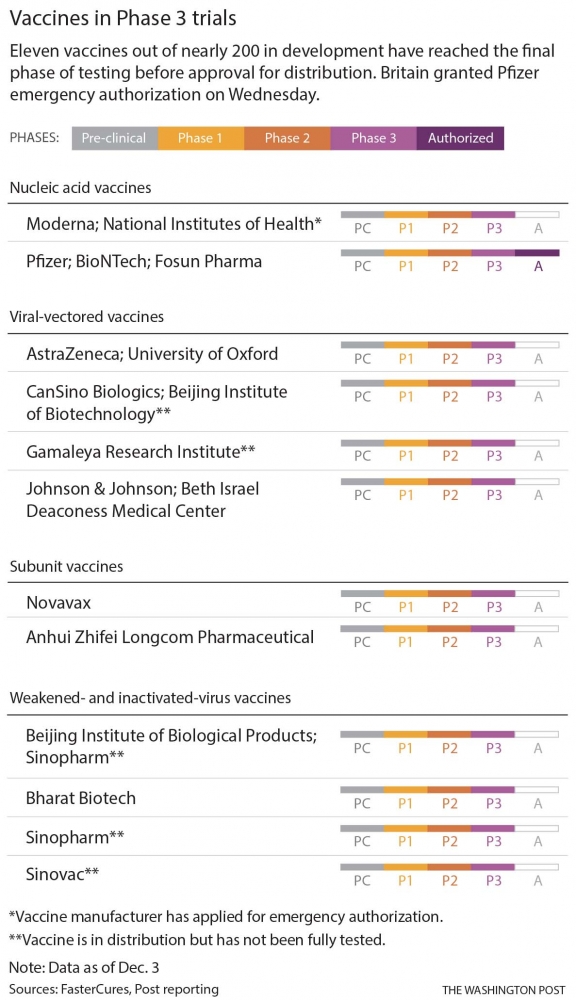
Sinovac is one of China’s two coronavirus-vaccine front-runners, with its clinical testing in the same final stage as Moderna’s and Pfizer-BioNTech’s. Domestically, Sinovac’s vaccine is in second place, with state-owned Sinopharm’s vaccines more widely administered under an emergency-use program. Another Chinese vaccine, developed by CanSino and a military research institute, is approved for emergency use by China’s military.
Sinovac’s vaccine, Coronavac, may end up adopted in a number of developing markets. Officials in Brazil and Indonesia – the most populous nations in Latin America and Southeast Asia – say Coronavac could be approved in coming weeks. In Brazil, São Paulo Gov. João Doria has called it the safest vaccine the country has tested.
Sinovac has not yet released efficacy data, making it unclear whether its vaccine can protect recipients as successfully as the vaccines from Moderna and Pfizer, which were more than 90% effective in preliminary analyses.
Sinovac has acknowledged the bribery case involving its CEO, saying in regulatory filings that he cooperated with prosecutors and was not charged. The CEO said in testimony he could not refuse demands for money from a regulatory official.
Sinovac has not been involved in safety scandals, and there is no evidence that any of the vaccines approved in cases involving bribery were faulty. But some medical experts say that extra scrutiny of Sinovac’s drug claims is justified, given its record of moral flexibility.
“The fact that the company has a history of bribery casts a long shadow of doubt over its unpublished, non-peer-reviewed data claims about its vaccine,” said Arthur Caplan, medical ethics division director at New York University Langone Medical Center. “Even in a plague, a company with a morally dubious track record has to be treated with great caution concerning its claims.”
While Sinovac’s history of bribery has raised concerns among investors of the Nasdaq-listed company, only in recent months has its record taken on such global implications. Governments are weighing the risks of new vaccines from companies like Sinovac against the certainty of more deaths if the pandemic continues.
A review of public records and trial testimonies by The Washington Post reflects that Sinovac’s rise to the front ranks of China’s vaccine industry took place with the help of priority projects from Beijing and kickbacks to officials who assisted in regulatory reviews and sales deals. A number of details from the court cases have not been reported previously, in part because of China’s censored media.
In 2016 court testimony, Sinovac’s founder and chief executive, Yin Weidong, admitted to giving more than $83,000 in bribes from 2002 to 2011 to a regulatory official overseeing vaccine reviews, Yin Hongzhang, and his wife. Yin Hongzhang confessed to expediting Sinovac’s vaccine certifications in return.
Those years corresponded to Sinovac’s breakout period, when the biotech start-up founded in 2001 was handpicked by Beijing officials to lead development of vaccines for SARS, avian flu and swine flu.
Yin Hongzhang, who shares a surname with Sinovac’s CEO but is no relation, was sentenced in 2017 to a decade in prison for taking bribes from Sinovac and seven other companies. Sinovac’s Yin Weidong, now 56, was not charged and continues to oversee the company’s coronavirus-vaccine drive this year.
For Sinovac, that case was not a one-off: At least 20 government officials and hospital administrators across five provinces admitted in court to taking bribes from Sinovac employees between 2008 and 2016.
– – –
Sinovac said in 2017 it had launched an internal investigation in response to the bribery cases. It has yet to announce the investigation’s result.
In its latest annual report, released in April, Sinovac said that Yin Weidong “was not charged with any offense or improper conduct and he cooperated as a witness with the procuratorate. To our knowledge, the Chinese authorities have not commenced any legal proceedings or government inquiries against Mr. Yin.”
The annual report said that Sinovac maintained strict anti-corruption policies but that “these policies may not be completely effective.”
In a statement to The Post, a Sinovac spokesman said the company had entrusted the legal system to handle the past bribery cases appropriately. He said the CEO’s ability to do his work was unaffected. Sinovac did not make Yin Weidong available for an interview.
Corruption in China’s pharmaceutical industry is a long-running scourge. Dali Yang, a University of Chicago political scientist, said China’s shift from decentralized drug approvals in the 1990s to centralized reviews in the 2000s created opportunities for graft.
But corruption is no longer as rampant as it once was, after several high-profile crackdowns sparked by drug-safety scandals, Yang said. In 2007, China executed Zheng Xiaoyu, the former head of the State Food and Drug Administration, in a grim warning to the industry. China’s President Xi Jinping launched another broad anti-corruption drive in 2012.
Vaccine mishaps continued to occur in recent years. In 2018, Sinovac’s larger rival Sinopharm recalled 400,000 shots of diphtheria, tetanus and pertussis vaccines for substandard quality.
In a Beijing court in 2016, Yin Hongzhang, the former deputy director of the China Food and Drug Administration’s drug-testing center, said Sinovac’s Yin Weidong gave him cash bribes over nine years as he sought regulatory approval for the company’s vaccines for hepatitis A, SARS, avian flu, foot-and-mouth disease and influenza A.
In exchange, Yin Hongzhang said he helped “accelerate the approval process” for Sinovac’s vaccines.
Sinovac’s CEO said in his testimony that he “could not refuse” requests from a regulator.
Peter Humphrey, a British corporate investigator who has probed pharmaceutical corruption cases in China, called it “a bit extraordinary” that Sinovac emerged unscathed in 2017, despite its CEO confessing to bribery.
China previously punished only the party that accepted the bribes, he said, but this changed in 2014 with a case involving GlaxoSmithKline. GSK was fined $490 million for bribing doctors and officials to bolster sales, and its top China executive given a suspended prison sentence.
For Sinovac, the bribery cases have had little visible impact except to exacerbate an acrimonious shareholder struggle that has frozen trade of its stock on Nasdaq since February 2019. This ownership battle has taken dramatic turns, including a physical fight for the company seal – a stamp used by Chinese firms for legalizing documents – that Sinovac said resulted in a factory power outage and ruined vaccines. Sinovac has otherwise continued business as usual.
– – –
In a 2012 interview with state-run China Youth Daily, Yin Weidong said that after a less-than-rigorous early education, he flunked his college entrance exam. He found his calling in a vocational epidemiology program: “I suddenly turned into the student asking the most questions in school.”
A few years later at age 21, he was hailed as the first person in China to isolate the hepatitis A virus. He would spend the next decade and a half developing and testing his hepatitis A vaccine – China’s first domestically developed one for the liver disease – before founding Sinovac in Beijing in 2001.
His big break came in April 2003: As SARS spread, Yin Weidong phoned municipal officials and volunteered to help develop a vaccine, according to the state-run Guangming Daily. Days later, China’s Ministry of Science and Technology named him the leader for a national project to fast-track a SARS vaccine, with government funding and researchers at his assistance.
While the project fizzled out along with SARS, it gave Sinovac’s team crucial practice in developing a vaccine for a coronavirus. As with this year’s plan, the SARS vaccine plan called for production to begin before testing finished.
Sinovac also received Beijing’s support for developing vaccines for avian flu and H1N1, with its team getting more experienced and faster.
When SARS hit, Sinovac’s Yin Weidong had already been bribing regulator Yin Hongzhang for a year.
In his court confession, Yin Hongzhang said he mentioned to Yin Weidong in 2002 that he wanted to buy a car, drawing a $15,200 cash gift from the executive. That same year, Sinovac’s first flagship product, the Healive hepatitis A vaccine, was approved for sale.
A few years later in 2006, Yin Weidong gave Yin Hongzhang and his wife $7,600 in cash, saying it was to help them furnish their new apartment, according to testimony by Yin Hongzhang’s wife. Yin Weidong said in testimony that when he was invited to their newly furnished home months later, he gave them another $15,200 in cash, which he expensed.
During that period, Sinovac gained approvals to sell influenza, avian flu and swine flu vaccines in China. Sinovac’s swine flu vaccine was approved for sale in China just half a year after the virus was detected in Mexico.
In 2011, Yin Hongzhang asked Yin Weidong to lend him around $45,600 to buy a villa on Beijing’s northern outskirts, according to his testimony.
Yin Weidong said in court that he arranged the cash drop-off through an intermediary, wary of repercussions if he handled it personally.
Yin Hongzhang’s wife, identified in court testimony only by her surname, Guo, told the court that she and her husband picked up the cash in a hotel lobby and never volunteered to repay the loan.
– – –
At lower levels, at least 20 officials and hospital employees confessed in Chinese courts between 2015 and 2018 to taking bribes from Sinovac employees, according to the court judgments.
“In the vaccine industry, we usually give a commission to the person in charge to encourage them to use our vaccines,” one Sinovac salesperson, identified only by the surname Yang, said in a 2017 case in the southern province of Guangdong.
Yang admitted to giving a hospital employee $2,441 in kickbacks – “always through envelopes of cash” – as a reward for the hospital purchasing 5,351 doses of Sinovac’s hepatitis A vaccine from 2011 to 2015.
Caplan, the medical ethics professor, said Sinovac’s history of bribery would alienate some potential customers. But some countries may still prefer Sinovac’s vaccine, as it can be stored closer to room temperature than the ones from Pfizer-BioNTech and Moderna. And some may lack other options.
“When there are no options and you’re in a plague, you tend to take what you can get,” Caplan said. “Sketchy history or not.”

 The BioNTech covid-19 production facility in Marburg, Germany, on Dec. 2, 2020. MUST CREDIT: Bloomberg photo by Alex Kraus.
 A monitor displays Alibaba Group Holding signage on the floor of the New York Stock Exchange in New York on Oct. 13, 2017. MUST CREDIT: Bloomberg photo by Michael Nagle.
  Pimchanok Vonkorpon, director-general of the Trade Policy and Strategy Office
  Vehicles cross the Arlington Memorial Bridge and, in the foreground, wait to enter Arlington National Cemetery in Virginia in May 2015. MUST CREDIT: Washington Post photo by Jabin Botsford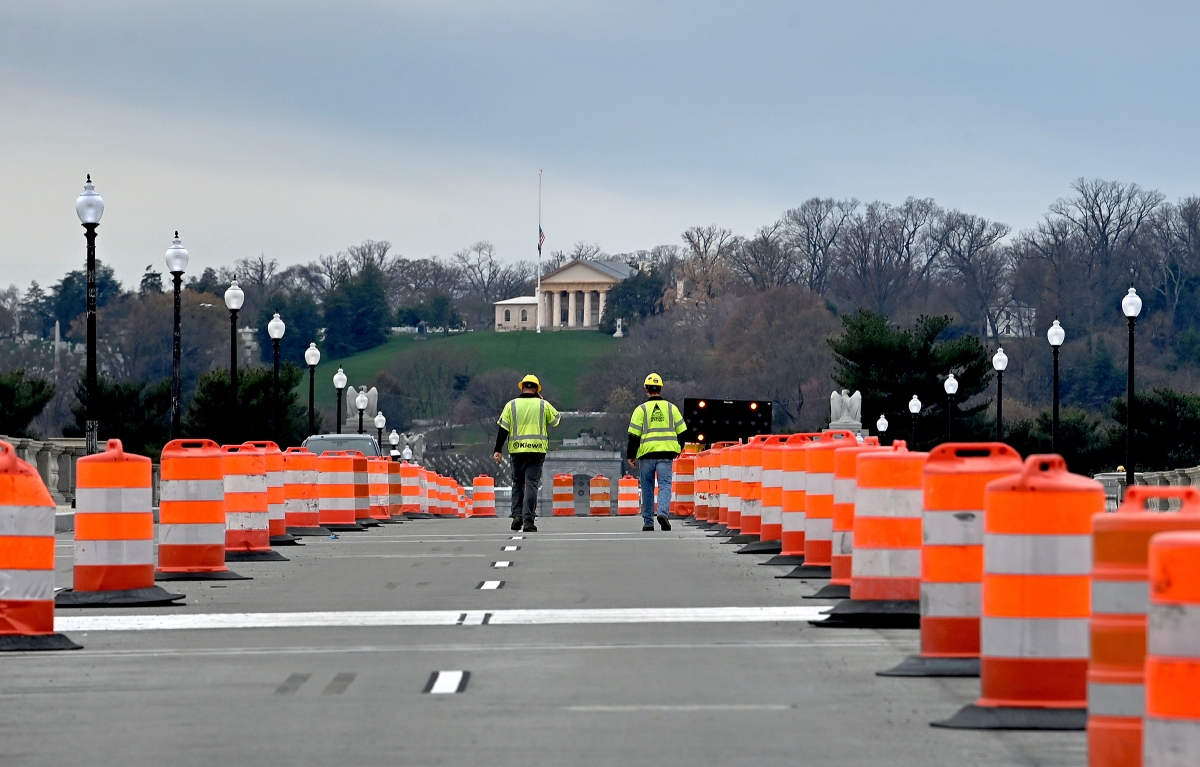
 European Union flags fly outside the European Central Bank headquarters in Frankfurt, Germany, on July 16, 2020. MUST CREDIT: Bloomberg photo by Alex Kraus.
  Bakers wearing protective masks shape and roll out loaves of bread dough at Portofino Bakery in Saanichton, British Columbia, on Nov. 19, 2020. MUST CREDIT: Bloomberg photo by James MacDonald.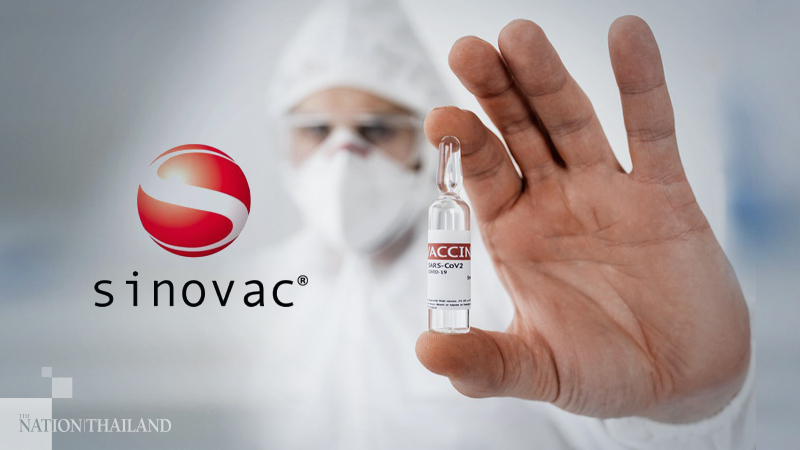
 SootinClaimon.Com