
ศาสตร์เกษตรดินปุ๋ย : ขอบคุณแหล่งข้อมูล : หนังสือพิมพ์ The Nation
http://www.nationmultimedia.com/news/national/30315196

By CHULARAT SAENGPASSA
THE NATION
New govt welfare programme begins; but only ‘reasonable cases’ will get aid.
AFTER working as an education official in the seaside province of Trang, Wichai (whose surname was withheld) had an ambition to set up his own business. But his venture collapsed and left him with debt of Bt12 million.
Wichai is on the verge of bankruptcy but has his fingers crossed that the Office of the Welfare Promotion Commission for Teachers and Educational Personnel (Otep) will agree to help.
If Wichai goes bankrupt, he will automatically lose his job because laws bar a bankrupt person from serving in the government sector. And with the loss of his job, he will be in even deeper trouble.
His colleague, Wipanan (surname withheld), is in equally bad financial shape, with outstanding debt of Bt17 million.
“I’ve sought loans from various sources to invest in a property business but my investments did not generate the returns I had expected,” she said. “When I failed to make repayment on time, even the banks imposed a very high interest rate on me, let alone loan sharks.”
She is trying to sell her house to clear part of her huge debt and, like Wichai, desperate for help from Otep. “If I am declared bankrupt and dismissed from civil service, how will I go on with my life?” Wipanan lamented.
She was willing to repay her debts via Otep, she said, which has been planning to offer a low interest rate of just 3.5 per cent to teachers and education officials in debt crises.
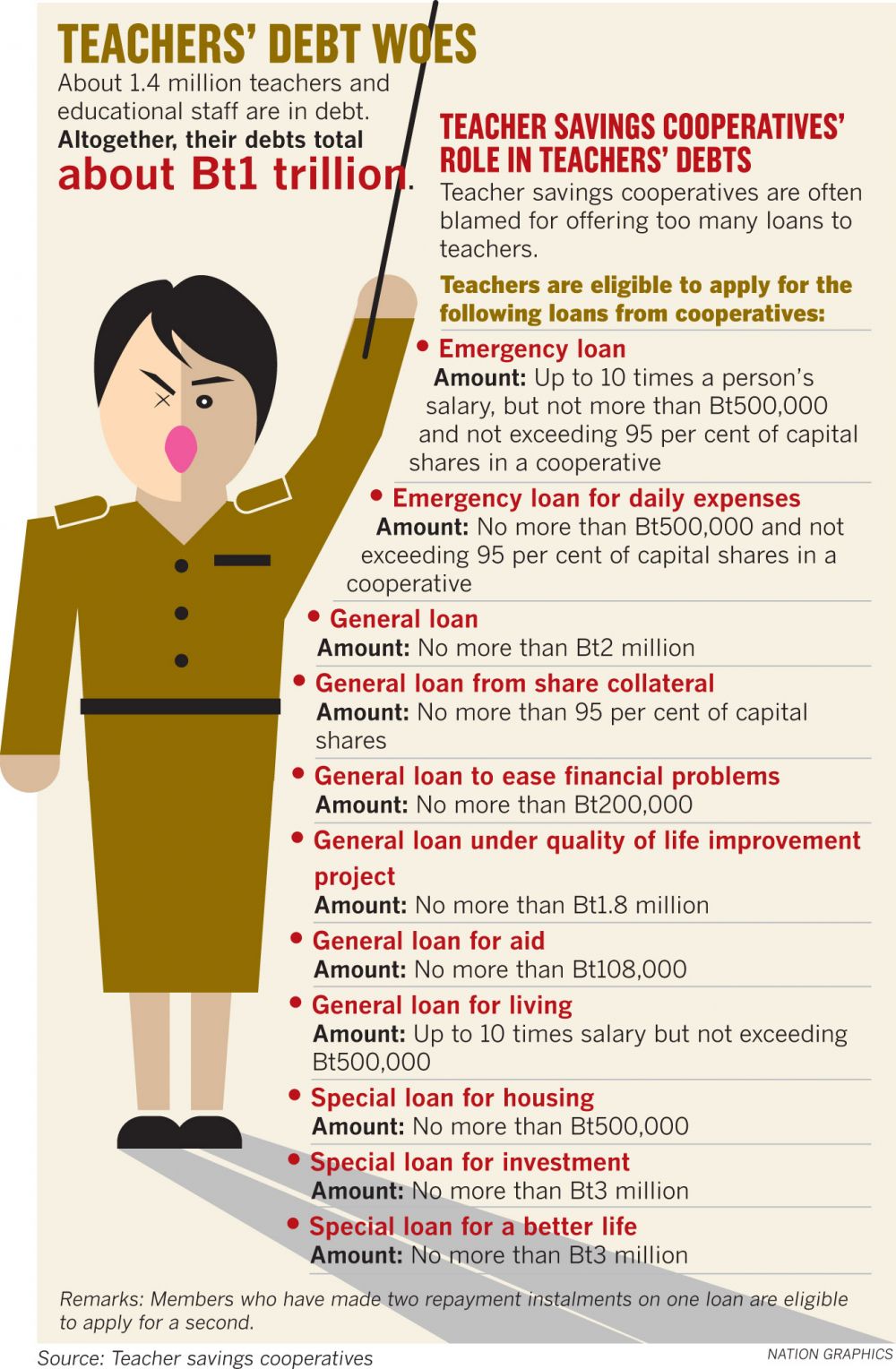
Pitsanu Tulasuk, the acting secretary-general of Otep, confirmed that a welfare programme has started to help teachers or education officials deep in debt crises. But he made it clear that not all in debt would be rescued.
“We will deliver help in reasonable cases. We will do background checks and so on,” he said.
Pitsanu said Otep has signed a Memorandum of Understanding (MoU) with 17 cooperatives in 17 provinces to implement the welfare programme.
In each province, the local cooperative and local branch of Otep will set up a screening committee to determine which teachers and education officials get help.
Between 700 and 1,000 teachers or education officials who face imminent bankruptcy lawsuits or property forfeiture will be given priority, if their loan records are justified.
Pitsanu, who is also deputy permanent secretary for Education, said the welfare programme had an initial budget of Bt1 billion, so it could never cover all 1.4 million teachers and education officials in debt.
“When the first batch of beneficiaries make repayments, we will have the budget to help others too,” he said. As of Thursday, the programme had attracted applications from 10,545 teachers and education officials. More than 1,000 were from Sakon Nakhon province.
When asked about Wichai’s and Wipanan’s cases, Pitsanu said the two definitely would not rank among the first batch because their cooperative had not yet signed an MoU with Otep. Pitsanu also emphasised that there would be strict screening criteria to ensure the money used for this welfare programme was well spent.
“The programme will also educate participants about HM King Bhumibol Adulyadej’s Sufficiency Economy Philosophy and expense-reduction tips,” he said.
The programme had been introduced partly because the Government Savings Bank (GSB) had reported that up to 70,000 teachers and education officials had not paid for loans they took out, even when their funeral-savings had been put forward as collateral.
The GSB and Otep will meet today to discuss measures to boost repayments by teachers and education officials working in the government sector. “We know the GSB offers up to Bt3 million in loan amount,” Pitsanu said.
The GSB is one of the many sources that teachers and education officials can get loans. Savings cooperatives for teachers and education officials are more often than not generous about their financial needs. At present, there are several types of loans that teachers and education officials can get from cooperatives. There are loans for not just emergencies but also investments and quality-of-life improvements.
Pitsanu said those who join the welfare programme will not be allowed to take out such loans again.
Sunan Lamsap, a 59-year-old retiree, said he joined an early-retirement scheme four or five years ago because he was overwhelmed with debt.
“My early-retirement benefits are more than Bt1 million. But even with that amount, I cannot clear all the debt. That’s why I started changing my lifestyle. I have now embraced a sufficiency economy [outlook]”.
 SootinClaimon.Com