ศาสตร์เกษตรดินปุ๋ย : ขอบคุณแหล่งข้อมูล : หนังสือพิมพ์ The Nation
http://www.nationmultimedia.com/news/national/30317481

By WASAMON AUDJARINT
THE NATION
IT IS COMMONLY known that a doctor’s sloppy handwriting can possibly result in a patient’s death, but what about the handwriting of someone as prominent as a prime minister?
The answer: It doesn’t hurt anyone physically, but certainly can be mortal for good reporting – and if it were not for help from the government communications team, reporters would not be able to understand the premier’s writing at all.
PM Prayut Chan-o-cha’s “vow of silence” in regard to dealing with the press has been going on since he was hit hard by political comments made by some reporters last week.
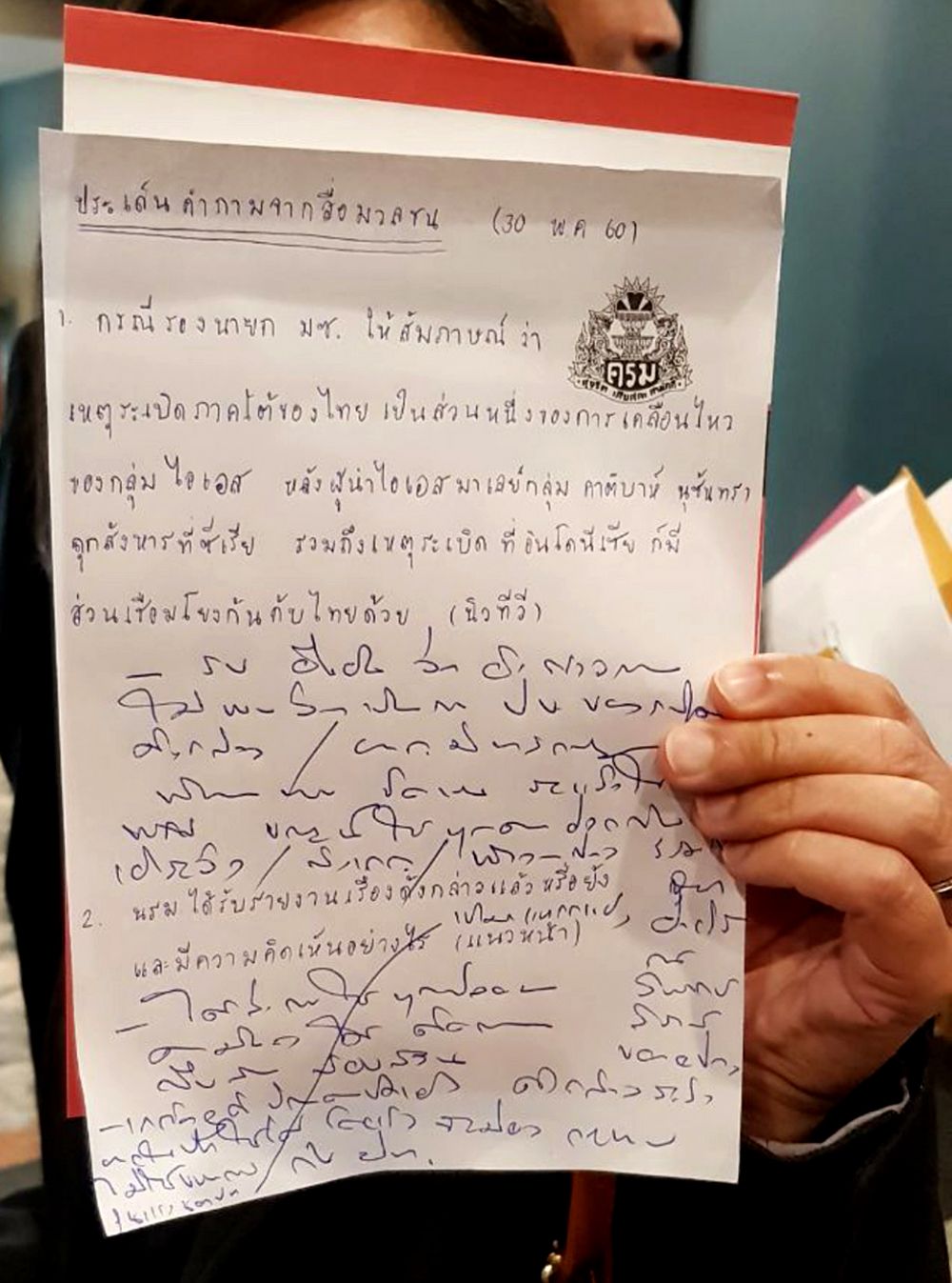
While continuing to deliver lengthy talks during events and ceremonies, the premier has refrained from providing oral interviews to the media over the past week.
However, considerate enough to maintain some interaction with journalists, Prayut chose to provide answers to questions after Cabinet meetings for the last two weeks in written form, in a move that has raised journalists’ eyebrows.
Prayut, who has been clocked speaking around 190 words per minute, is also particularly swift when penning his thoughts on paper.
But it is obviously difficult for reporters to produce serious reports on urgent matters such as the tragic hospital bombing, the peace dialogue in the deep South or flood management when all they have is an almost-illegible response to their questions.
All faith has therefore been put in the government spokespeople, who have taken responsibility for the job of “cracking the code”.
They took about an hour to decipher four pages of the PM’s handwriting before coming up with conclusions.
Neatly typed responses were distributed to reporters after last week’s Cabinet meeting, while after this week’s meeting, they read the PM’s words out loud.
Unsurprisingly for a military-installed government, many officers in the spokesperson team have military backgrounds, which means that some of them have worked with Prayut since he was head of the Army from 2010 to 2014.
“I’ve been used to his handwriting since then,” said one officer responsible for the transcription duty who asked not to be named.
“He often leaves comments, an order or notes at the end of documents. It’s my task to transcribe them, make legible versions of his notes, and attach them to the documents before forwarding them elsewhere,” the officer explained, adding that Prayut’s favourite means of communication are speaking and writing and that “he doesn’t like to type”.
He apparently maintains this approach even for his own script for his weekly television programme on Fridays, in which he usually delivers a monologue-style talk lasting from 30 minutes to an hour.
“In that case, the scripts can be 20 to 30 pages long,” the officer said.
Even for someone as close to the PM as members of the communications team, understanding every single word of Prayut’s handwriting is an impossibility.
“If I’m not sure about what he has written, I will make a note and take time with it. If it looks like a crucial point, I won’t skip it. We work in a team, also with his secretary, when transcribing his words and we are keen to ask each other,” the officer said.
“We don’t simply walk up to the PM and ask him to correct our transcription,” another officer said, adding, “and so far, he has never cautioned us for wrongly conveying his words, which means it works.”
One perk of being in the spokesperson team was getting to work close with the prime minister, the officers said.
That enables them to understand his way of thinking, work methods and style of command – and that’s the best way to synthesise his handwriting, they explained.
 SootinClaimon.Com