
#SootinClaimon.Com : ขอบคุณแหล่งข้อมูล : หนังสือพิมพ์ The Nation.
https://www.nationthailand.com/business/econ/40019786
Cooperation with stakeholders and the application of technology to business operations are key to survival in the digital era, logistics and e-commerce experts said at the “Trade Logistics Symposium 2022”.

The event, organised by the Department of International Trade Promotion, was held on September 2 and 3 at Lido Connect in downtown Bangkok and online via the Zoom application.
The event’s aim was to help personnel in logistics and related sectors exchange knowledge on the trends and directions of the industry so they can enhance their operations to meet international standards.
The event also aimed to boost the regional and international competitiveness of Thai logistics providers and international tour operators.
Up to 330 logistics providers, importers, exporters, students and other interested persons joined the event both online and in person.
The event comprised five discussions and one seminar, namely:
Cross border trade: Challenges of multi-transportation logistics
Kevin Zhang, founder and CEO of Philippines logistics provider Interluck, said Thailand plays a key role in cross-border trade in Southeast Asia as it is close to Myanmar, Laos, Cambodia, Vietnam, Malaysia and China.
However, he said, there are four challenges, namely change in customers’ expectations, customs delays, accurate and transparent landing cost calculation and global supply chain shortage.
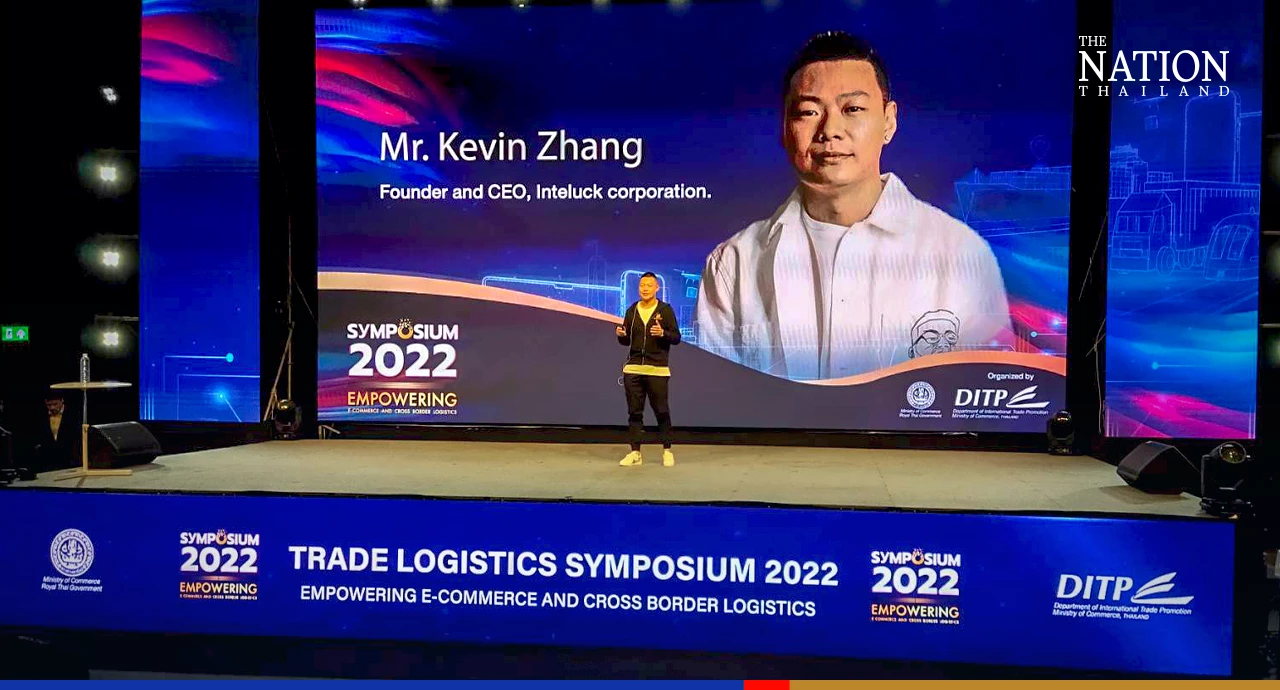
He advised businesses to be transparent and use technology in business operations to boost efficiency and gain customer confidence.
“The key is to connect all segments in logistics in response to challenges and difficulties in cross-border trade,” he said.
Fulfilment and warehousing in 21st century
Nattapume Pavaratn, executive committee member and senior vice president at JWD InfoLogistics, said there were many pain points in doing business, including finding the right sales channel and managing operational costs.
Nattapume, who is also president of Warehouse Silo and Cold Storage Business Association, said consumers’ feeling toward brands poses a challenge to businesses.

To tackle these challenges, he advised entrepreneurs to improve warehouse management and be flexible so they can fulfil consumers’ demands effectively. He also advised small business owners to adopt technology as it can solve their pain points effectively.
“Even though technology can help entrepreneurs with warehouse management, they should pay attention to many factors, such as business size and investments,” he said.
He also asked entrepreneurs to pay attention to the environment as green economy is part of the 21st century’s megatrends, along with robotic automation, fintech, data-driven business and e-commerce.
Tips to start door-to-door services
Jamie Ko, director of regional public affairs and policy at Grab, said the digital economy has brought benefits and opportunities to entrepreneurs, especially when it comes to seeking customers.

Since Southeast Asia’s digital economy has grown significantly during the Covid-19 crisis, she said, entrepreneurs should collaborate with partners to gain maximum benefits from the digital economy.
“The question is how do we work together across all stakeholder groups to gain benefits from the digital economy,” she said.
E-commerce, cross-border impact on Asean logistics industry
Cecile Barayre-El Shami, chief of United Nations Conference on Trade and Development (UNCTAD)’s Digital Economy Capacity-Building Section, said many e-commerce platforms had benefited during the pandemic.
She explained that e-commerce sales have increased exponentially from US$2.5 trillion in 2019 to $3.9 trillion in 2021, with the top three platforms being Alibaba, Amazon and jd.com.

She went on to say that Asean countries are working on e-commerce development, focusing on cross-border trade, business facilitation and consumer satisfaction by 2025.
However, she added, many countries in the region are less ready to engage in and benefit from e-commerce, such as internet access, logistics, skills availability and government strategies.
To make digital trade more sustainable and inclusive, she said, Asean countries should develop affordable and reliable ICT connectivity, build digital skills to ensure everybody can access digital trade, and improve regulatory framework and measurement.
“E-commerce ecosystem needs cooperation from every sector, such as government, digital commission and non-governmental organisations,” she said.
Collaboration at the heart of e-commerce logistics
Behzad Goudarzian, logistics manager of the United Arab Emirates supply chain solutions provider ISS Global Forwarding, said collaboration is the heart of e-commerce logistics.
He said all sectors, including consumer, marketplace, vendor, international freight, customs clearance, fulfilment and delivery, should work together, otherwise the operation would face difficulties.
“All gears should relatively move on the same page. If one gear stops, all gears will stop,” he said.
He also advised related agencies in e-commerce and logistics industries to focus more on data integration, ease customs procedures, streamline processes and use trusted digital payments.

Meanwhile, Pravin Shetty, ISS Global Forwarding’s regional IT manager, said technology also plays an important role in the e-commerce and logistics industries as they can facilitate many issues, such as system integration, secure transactions and risk mitigation.
He advised related agencies to apply four technologies to e-commerce and logistics operations, namely application programming interface, blockchain, internet of things and big data.
“Related agencies should optimise rules, improve delivery, ensure that the country’s infrastructure is in place and make use of equipment and resources,” he said.
Time for logistics marketplace platform in Mekong region
Piyanoot Sumrith, president of the Thai Transportation & Logistics Association, said the Mekong region is well prepared for adopting the logistics marketplace platform.
She added that people were now familiar with online shopping, thanks to the Covid-19 crisis over the past two years, as well as the government’s incentives, such as the Khon La Khrueng (Let’s Go Halves) co-paying scheme.
Piyanoot, who is also managing director of the delivery service WeMove Platform, expects the logistics marketplace platform to meet customers’ demand once factors like logistics and customs procedures are made smoother.
“It’s a good time to build the logistics marketplace platform as everything is ready, especially technology,” she said.

James Marchant, chief logistics officer for Lazada Express (Thailand), said even though the Covid-19 crisis changed customers’ behaviour, their expectation of the best service never changes.
He said it is only a matter of time before technology will play an important role in providing a different experience to customers, such as drones and robots.
“There are many trends that continue accelerating, such as how fast and how cheaply you can deliver and how strong is your return process,” he said.
Rachelle Alexis Lim, executive director of strategy and business development of payments platform 2C2P, said people preferred online shopping not just because of convenience but also because their demands have changed.
Echoing Marchant, she said online adoption will help boost the marketplace’s efficiency to provide experiences to customers, adding that many people preferred online payment instead of cash on delivery.
“Many businesses have shifted from traditional commerce to e-commerce even after the pandemic,” she said.
The panellists also urged the government to collaborate with related agencies to develop a logistics marketplace platform in the Mekong region and address it from various aspects, such as easing customs procedures and promoting technology adoption for sustainable growth.
Published : September 06, 2022
By : THE NATION
 SootinClaimon.Com