
#SootinClaimon.Com : ขอบคุณแหล่งข้อมูล : หนังสือพิมพ์ The Nation.
https://www.nationthailand.com/in-focus/40011231
The National Astronomical Research Institute of Thailand (NARIT) said on Monday that the Hunga-Tonga-Hunga-Ha’apai volcano eruption had an impact on nearly every coastline on Earth and that it would monitor the situation closely.
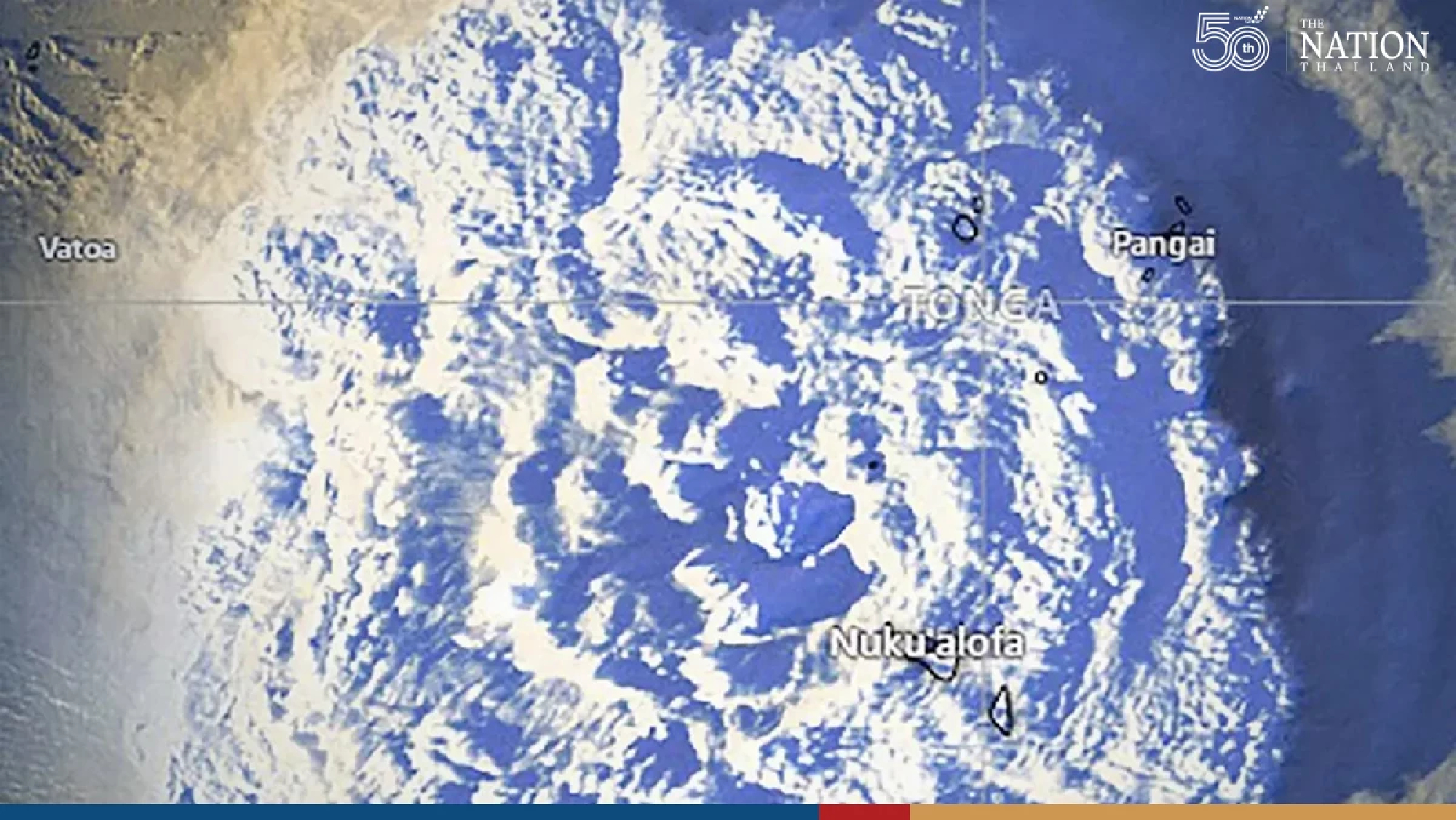
When a volcano erupts, the magma created by melting rocks rises and pushes through vents and fissures to the Earth’s surface. Sometimes the magma flows out in the form of lava, however, if the pressure of gas and steam under the Earth’s surface is high enough the magma shoots into the air, covering everything around it in fiery lava and ash. When a volcano underwater explodes, it can create a tsunami.
The volcano near Tonga in the Pacific Ocean exploded with huge amounts of gas and steam blasting into the air and having a widespread impact.
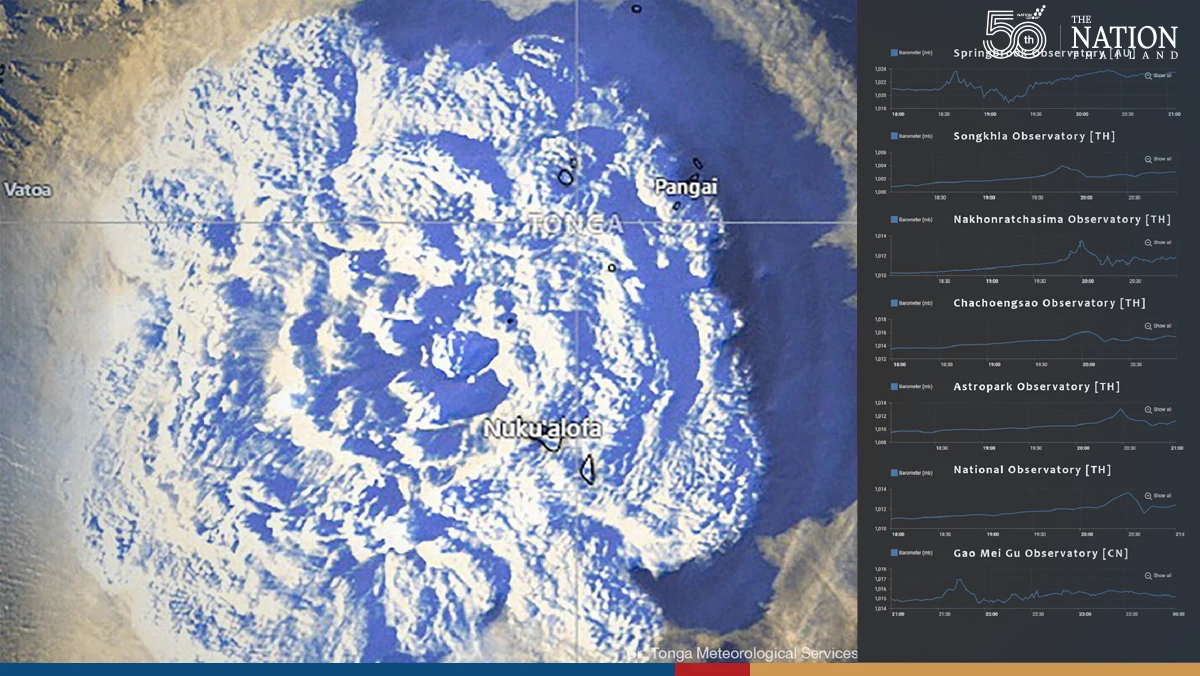
The impact of the eruption was measured in foreign and local weather stations at the following Thai time:
- 3.42pm: Australia, Springbrook Research Observatory
- 7.50pm: Songkhla, regional observatory
- 7.59pm: Nakhon Ratchasima, regional observatory
- 8.01pm: Chachoengsao, regional observatory
- 8.25pm: Chiang Mai, Princess Sirindhorn AstroPark
- 8.28pm: Chiang Mai, Thai National Observatory on Doi Inthanon
- 8.42pm: China, Gao Mei Gu Astronomical observatory
NARIT said this information can be used to determine the impact of the eruption and a similar system can be used for other natural phenomena, such as working out the impact of an asteroid.
More details can be found at http://weather.narit.or.th/

Related News
Better safe than sorry: PM tells agencies to be ready for possible tsunami
Hunga-Tonga-Hunga-Ha’apai volcano too far away to touch Thailand: govt
Tonga volcano eruption has massive waves crashing on shores far and wide
Published : January 18, 2022
By : THE NATION
 SootinClaimon.Com