
#SootinClaimon.Com : ขอบคุณแหล่งข้อมูล : หนังสือพิมพ์ The Nation.
https://www.nationthailand.com/life/40011271
In the final series of the ‘Power of Human Energy’ project, farmers learn how to apply the sufficiency economy principle to benefit their land and our climate
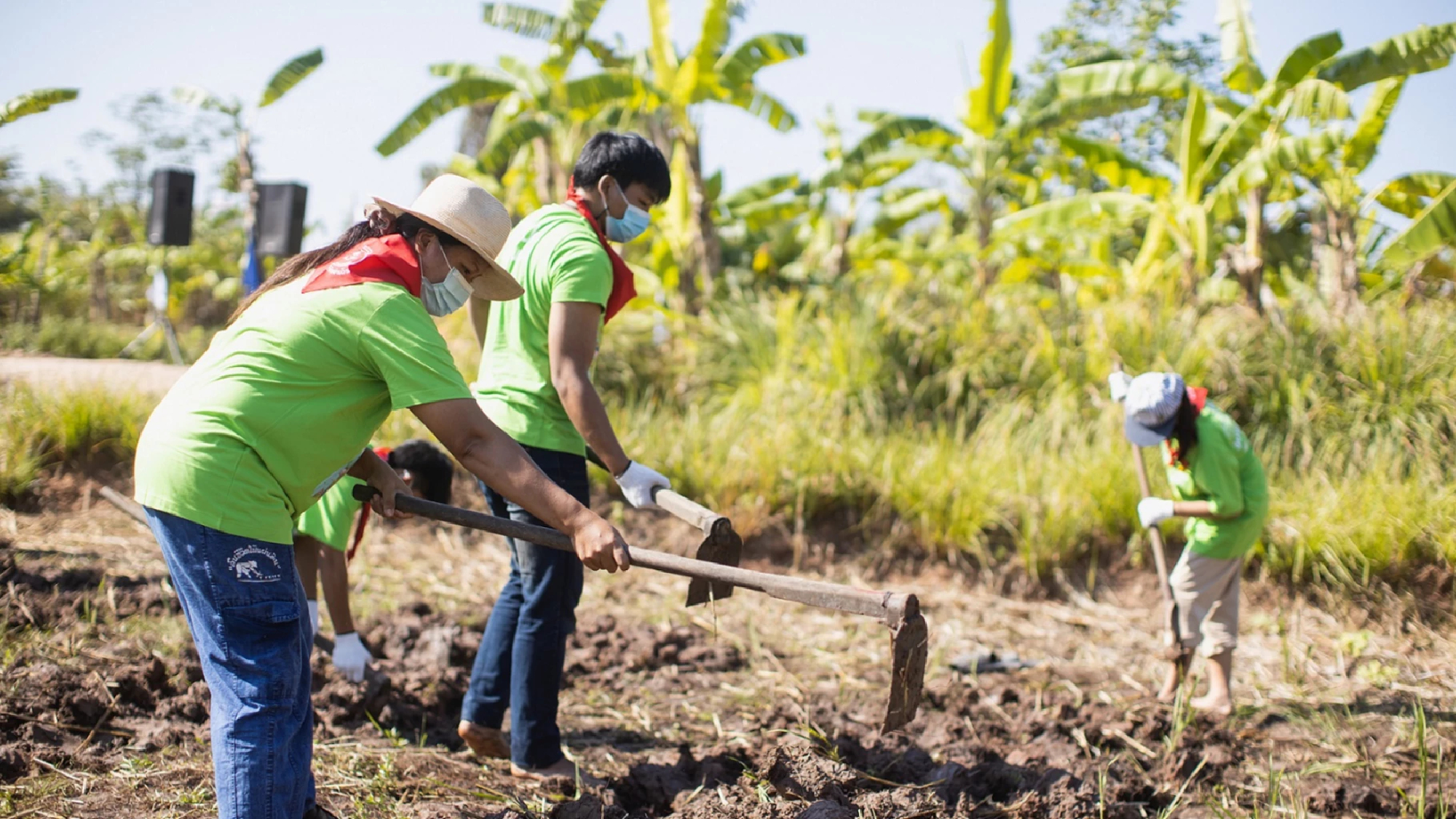
Sunita “Nual” Haewnok, a lawyer by profession, combines her legal learning with indigenous farming practices with so much flair that her Sa-ngiamkam Agriculture Farmin Nakhon Ratchasima’s Chakkarat District has been selected as the first destination of 2022 for training sessions and collaborative farming activities known as “Aou Mue” under the “Power of Human Energy: A Journey Inspired by the King” project. Initiated and implemented by Chevron Thailand Exploration and Production, the project promotes His Majesty the late King Bhumibol Adulyadej’s sufficiency economy philosophy in the management of soil, water, forest and human resources.
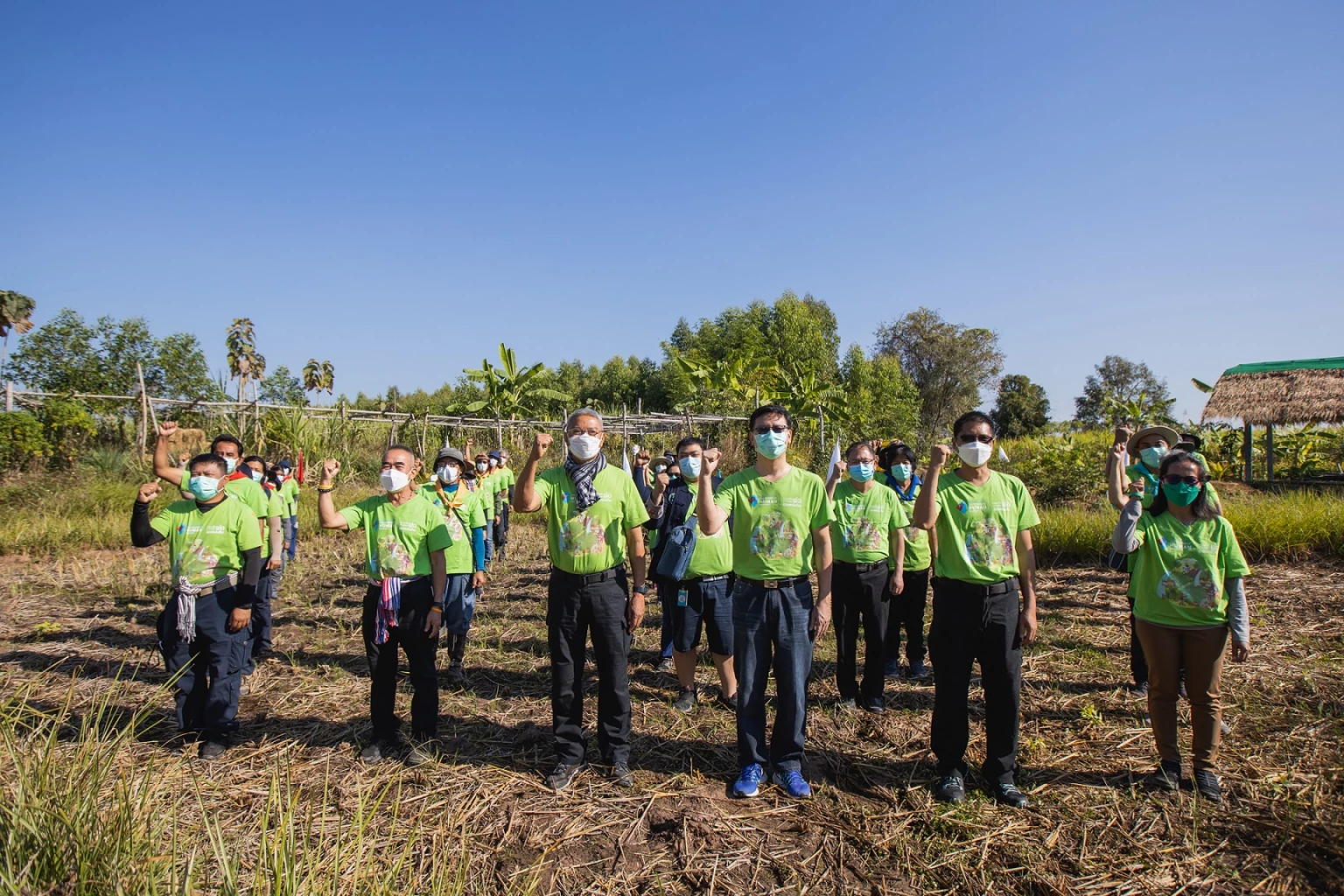 People from everywhere come together on the “Sa-ngiamkam Agriculture Farm” in Nakhon Ratchasima for the “Aou Mue” activity under the “Power of Human Energy: A Journey Inspired by the King” project.
“This year, we will be running ‘Aou Mue’ activities in three provinces in the Pa Sak River Basin. We are starting at Sa-ngiamkam then moving to Ayutthaya in February and Saraburi in March to network, exchange ideas and encourage each other in addition to promoting the project. I believe that this activity will motivate a new generation of farmers just like Nual who was inspired by HM the late King’s philosophy,” says Artit Krichphiphat, Chevron’s business support general manager.
“The aim of this project, which has been running for nine years, is to serve as a driving force in giving knowledge and setting the standard for collaboration on our online platform, which has been very successful with almost 700,000 iews. Many more people are interested in ‘khok nong na’ (indigenous farming practice) to make the best use of their land and these activities help clear up any misconceptions as well as instill new ideas,” he adds.
This year will be the last in the “Power of Human Energy: A Journey Inspired by the King” project, which is designed to motivate people to acknowledge the importance of recovery, development and local wisdom to sustainably solve the problems of floods and drought.
“Natural agriculture is now the best solution for climate-related problems, but it hasn’t been easy to instill the knowledge to achieve this. We need knowledge to transform this world and make it livable but we must practice virtue at the same time. In Buddhism, we learn that ‘dharma that depends on us and other people’ and that we must be virtuous in how we proceed, have a willingness to give a helping hand as well as diligence and skill in managing all affairs of our fellow men,” says Dr Wiwat Salyakamthorn, aka Ajarn Yak, the president of World Soil Association and the founder of Agri-Nature Foundation.
Nual, who is regarded as a driving force in the Pa Sak River Basin, applied the King’s philosophy of “3 forests 4 benefits” on her 6-rai of land but was not supported by her mother and siblings, who prefer to generate their income from sugarcane production.
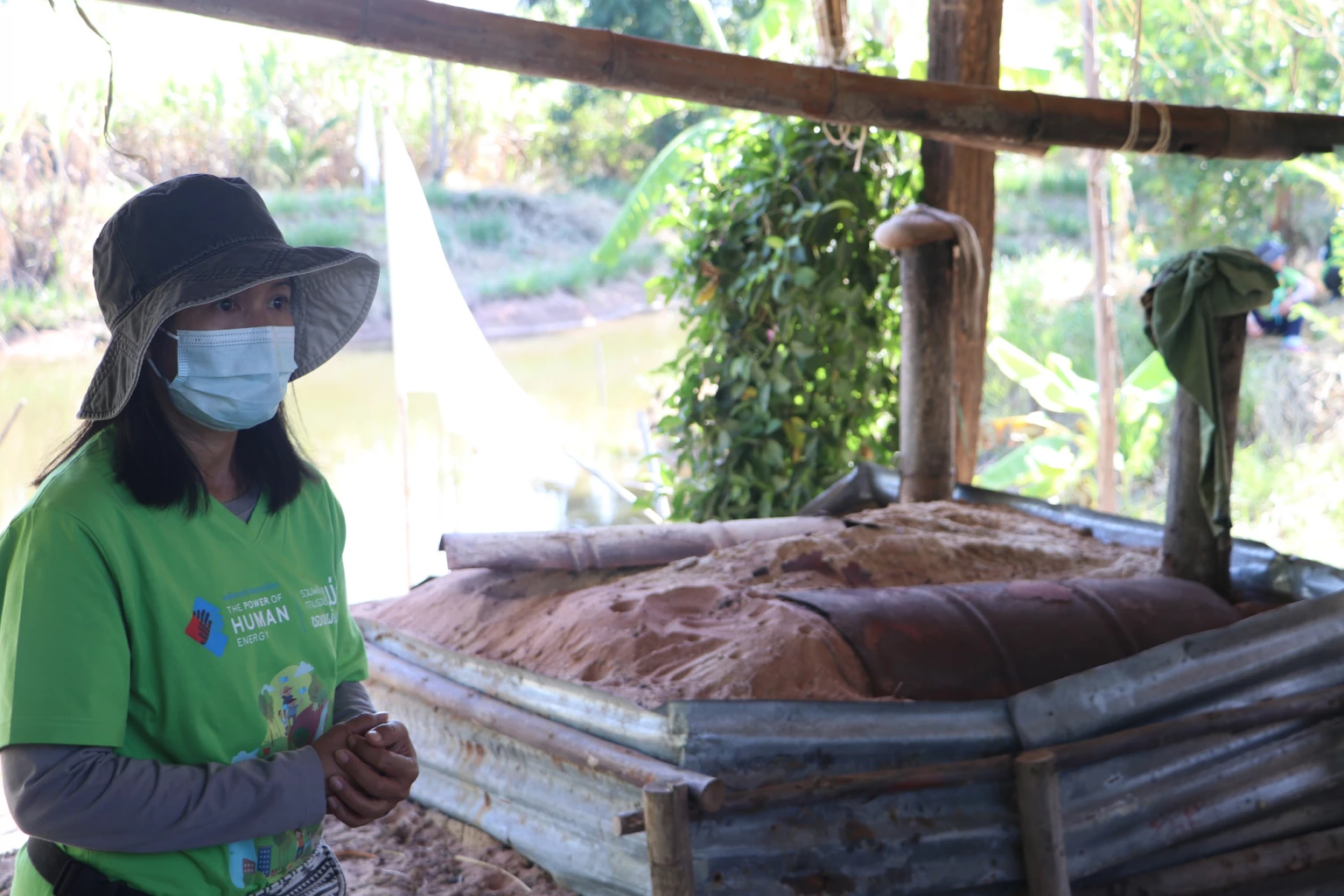 Sunita “Nual” Haewnok, owner of Sa-ngiamkam Agriculture Farm, explains the process for producing wood vinegar at “Khon Aou Than”.
“They have all watched me and seen the results but they still don’t agree with what I have done. I have transformed my share of the sugarcane plantation to ‘khok nong na’ with six ‘nong’ (swamps) and ‘khlong sai kai’ (winding ditches around those swamps). Of course, I don’t earn as much money as they do from their sugarcane plantation but I am happy that they can eat chemical-free vegetables and fruits. Yet even today they pity me for my lack of income,” says Nual.
Nual is the second child of four in a farming family. After completing her compulsory primary education, she helped on the farm, worked in a factory on the orders of her mother while studying at the Department of Non-Formal Education on her day off. Her hard work and keen intelligence paid off and she was picked to work in the legal department of a sugar factory in Phimai District then promoted to the secretariat.
She earned her bachelor’s degree at the Faculty of Law, Nakhon Ratchasima Rajabhat University, and her master’s degree at the Faculty of Law, Ramkhamhaeng University. Today she works as a lawyer at Nakhon Ratchasima Primary Educational Service Area Office 2.
“I enjoyed working with lawyers in the legal department of the sugar factory in Phimai,” recalls the 47 year old. “I also saw the sadness of the farmers at being exploited by a middleman.”
Nual’s interest in HM the King’s philosophy was sparked when she watched “Saeng Chak Phor Soo Khwam Yangyuen”, a special programme on Thai PBS paying tribute to HM the late King. She was later invited by Traiphop Khotwongsa, the president of the Agri-Nature Foundation, to work as a volunteer. That led her to sign on for training in natural agriculture at the Bhumirak Dharmachart Project in Nakhon Nayok, in space design at Wat Nong Song Hong in Chachoengsao and participate in the Pa Sak Watershed Restoration led by Chevron.
 A woman uses dry fertilizer on houseplants that are covered with straw.
This year’s “Aou Mue” activity drew many volunteers from the natural agriculture network in Khorat, Chaiyaphum, Lop Buri and Suan Lom Sri Rin in Saraburi as well as students from Lahan Sai Wittaya School in Buriram and Ban Pong Ket School in Saraburi. They worked together in preparing the plots and fences for growing organic vegetables, mending the winding ditch running around the field and the swamps, building weirs, covering the soil with straw, and applying dry and liquid natural fertilizer. They also learnt how to make a natural water purifier, a solar energy water pump, how to produce wood vinegar as well as how to make soap from squash, shampoo from butterfly pea and fermented bananas, lemon grass tea and salted egg.
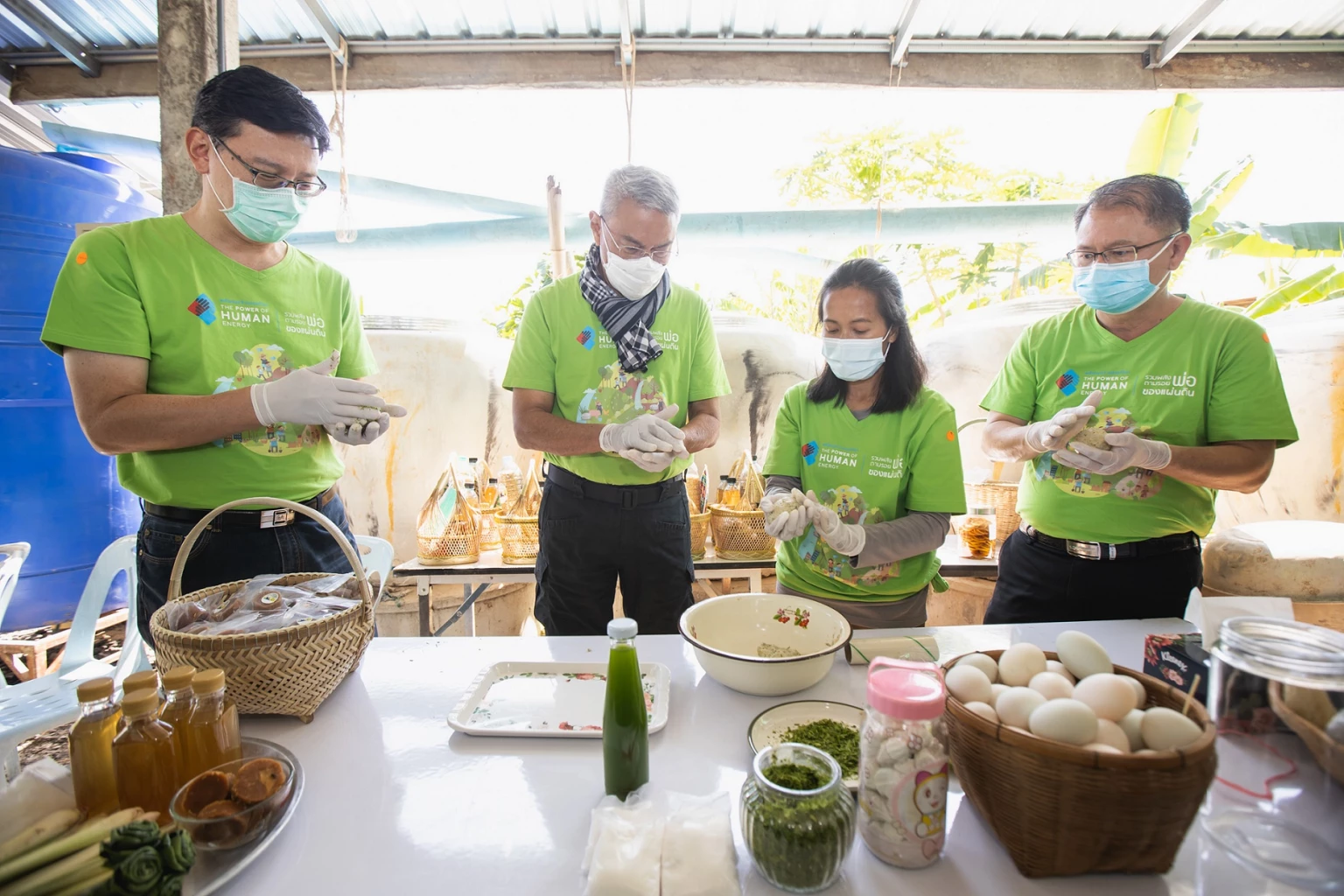 Nual demonstrates how to prepare salted egg.
Ajarn Yak (centre), Artit Krichphiphat (3rd from right) and others admire the processed products from Nual
 Villagers help building a weir.
Nual was proud to show off her “Khon Aou Than”, a learning base for producing wood vinegar and charcoal, which is protected from the elements by a vetiver roof. Vetiver grass is also used to protecting the banks of the swamps and the ditches.
“When we plant crops using the ‘3 forests 4 benefits’ principle, we will receive benefits from the forest. We cut and clear the small branches and burn them to form charcoal. That reduces the cost of fuel. In addition to charcoal, we make wood vinegar as a natural pesticide. We prepare it in a dehumidification oven made out of a 200-litre steel drum. Natural wood charcoal burns at very high temperatures reaching between 800-1000 degrees but contains a special substance that prevents it from being carcinogenic. At the beginning of the process, the smoke is dark but after three or four hours, it turns white. We then seal all the holes so that the air can’t go inside. The whole process takes two days and produces one to two litres of wood vinegar.”
Nual has also perfected the technique for making a natural water purifier. “Clean water is very important to our life. Today, we pay for bottled water. Formerly, our grandparents could use water from the rain but nowadays that’s full of chemicals. My traditional water purifier consist of four plastic water tanks with four elements – big and small stones, sand and coal, which must be washed for a full month.”
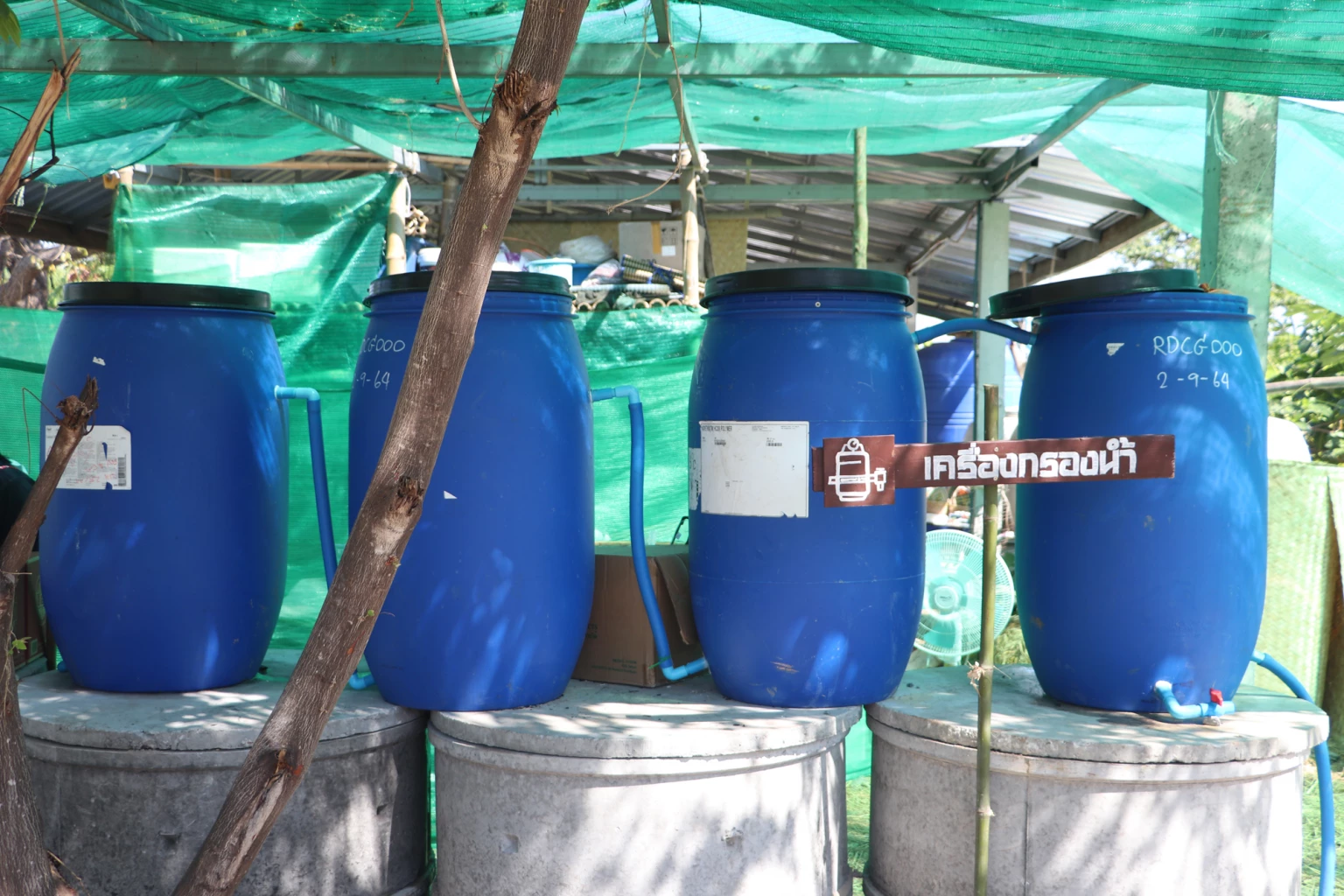 The natural water purifier is filtered through big and small stones, sand and coal.
Of her handmade solar energy water pump priced at Bt30,000, Nual points out that it saves a lot of money, though it must also be used judiciously and that means planning. “First of all, we will have to calculate the water management for one rai, how much water we can store in the swamp, winding ditch, and ‘khok’ (mound). Here, the amount of rainfall is 1,200 millilitres per year. I use the water pump just a few days at a time.”
 The handmade solar energy pump drains water from the biggest swamp into others through a winding ditch.
Kitchana Lersakvanitchakul
Special to The Nation Thailand
Published : January 19, 2022
 SootinClaimon.Com