#SootinClaimon.Com : ขอบคุณแหล่งข้อมูล : หนังสือพิมพ์ The Nation.
https://www.nationthailand.com/international/40013803
North Korea conducted what was suspected to be its largest intercontinental ballistic missile test ever on March 24, South Korean and Japanese authorities said, marking an end to a self-imposed moratorium on long-range testing and drawing international condemnation.
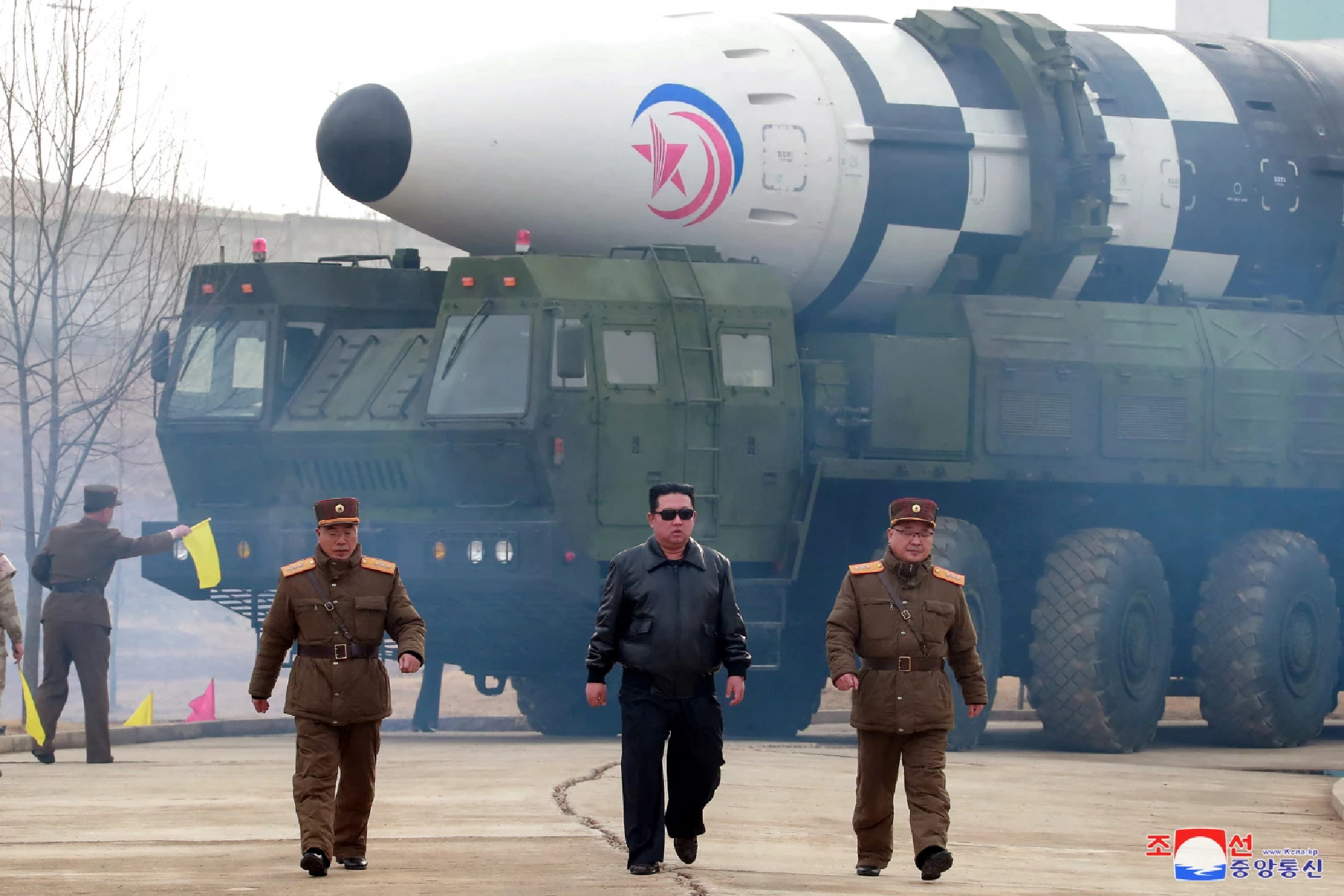
It would be the first full-capability launch of the nuclear-armed state’s largest missiles since 2017, and represents a major step in Pyongyang’s development of weapons that might be able to deliver nuclear warheads anywhere in the United States.
It was not immediately clear which missile was launched, but Ian Williams, deputy director of the CSIS Missile Defense Project in Washington, said signs pointed to the Hwasong-17, which was displayed during a North Korean military parade in October of 2020.
“We’re likely looking at a missile that can carry, for example, more than one warhead, so it could strike multiple targets with a single missile,” Williams explained. It may also be adept at skirting missile defences, he added.
Amid a flurry of diplomacy in 2018, North Korean leader Kim Jong-Un declared a moratorium on testing ICBMs and nuclear weapons but later suggested the North could resume such testing amid stalled denuclearization talks.
That moratorium had often been touted as a success by former U.S. President Donald Trump, who held historic summits with Kim in 2018 and 2019, but never secured a concrete pact to limit the North’s nuclear or missile arsenals.
Williams said Kim has a pattern of taking provocative actions near the beginning of new U.S. administrations but said he may also be trying to capitalize on the West’s preoccupation with Russia’s war on Ukraine.
“Either North Korea is trying to refocus attention on itself, or it thinks that because we are so preoccupied…they may incur fewer repercussions because of all the bandwidth that Ukraine is taking up right now,” he said.
Williams said he expects the U.S. and others to slap North Korea with more sanctions, but should not expect Russia to go along as it did after the ICBM launch five years ago.
“I’d be very surprised if we get any diplomatic cooperation from Russia,” he said. “In fact, moving forward, Russia is going to be looking at all the pressure points and all the ways it can kind of poke the West and poke the United States and make our situation more complicated.”
Williams added that he has long suspected Russia of supporting Russia’s missile developments.
On Tuesday (March 22), Russian Deputy Foreign Minister Igor Morgulov met with North Korea’s ambassador to Russia and discussed developing bilateral relations “in the context of changes happening on the international arena,” the Russian foreign ministry said.
Williams said the new ICBM test may spur the U.S. to renew investment in its homeland missile defence.
Washington currently has a program in the works that could be effective against the Hwasong-17, he said, but it is not likely to be ready for another decade.
“Unless we do…something else to augment our current missile defences, I think our current homeland defences are going to be quite strained by this new threat,” he said.
Published : March 25, 2022
By : Reuters
 SootinClaimon.Com