
#SootinClaimon.Com : ขอบคุณแหล่งข้อมูล : หนังสือพิมพ์ The Nation.
https://www.nationthailand.com/pr-news/more/pr-news/40019904

TU And CU Law Professors Agree NBTC Has All Kinds Of Powers Over True-Dtac Merger
BY LINE : THE NATION
FRI, SEPTEMBER 09, 2022
True-Dtac Deal Is A More Severe Monopoly Than Socialism; NBTC Considered “Stubborn” In Not Recognizing Its Own Powers, Which Are Clearly Laid Out In The Law. NBTC Has The Authority To Give Or Withhold Permission. It Must Use These Existing Powers And Not Neglect Its Compliance With Section 157.
On September 7, the Thailand Consumers Council held a seminar to gather opinions on the case of “Whether NBTC has the authority to manage the True-Dtac merger.” Ideas and solutions were sought in the matter of consumer protection from business mergers.
Until now, National Broadcasting and Telecommunications Commission (NBTC) has not been able to conclude whether it can consider the request to merge the businesses of True and Dtac. It looks as if, even though NBTC board has read the reports from all four subcommittees which it established, it can still cannot yet come to a conclusion. One of these is the legal subcommittee, which clearly voted 10 to 1 that NBTC had authority to consider whether to approve or disapprove. However, NBTC submitted the matter of its own authority to the office of the Council of State to consider such authority for a second round, even though it was not a matter to bring in the executive branch to regulate itself.
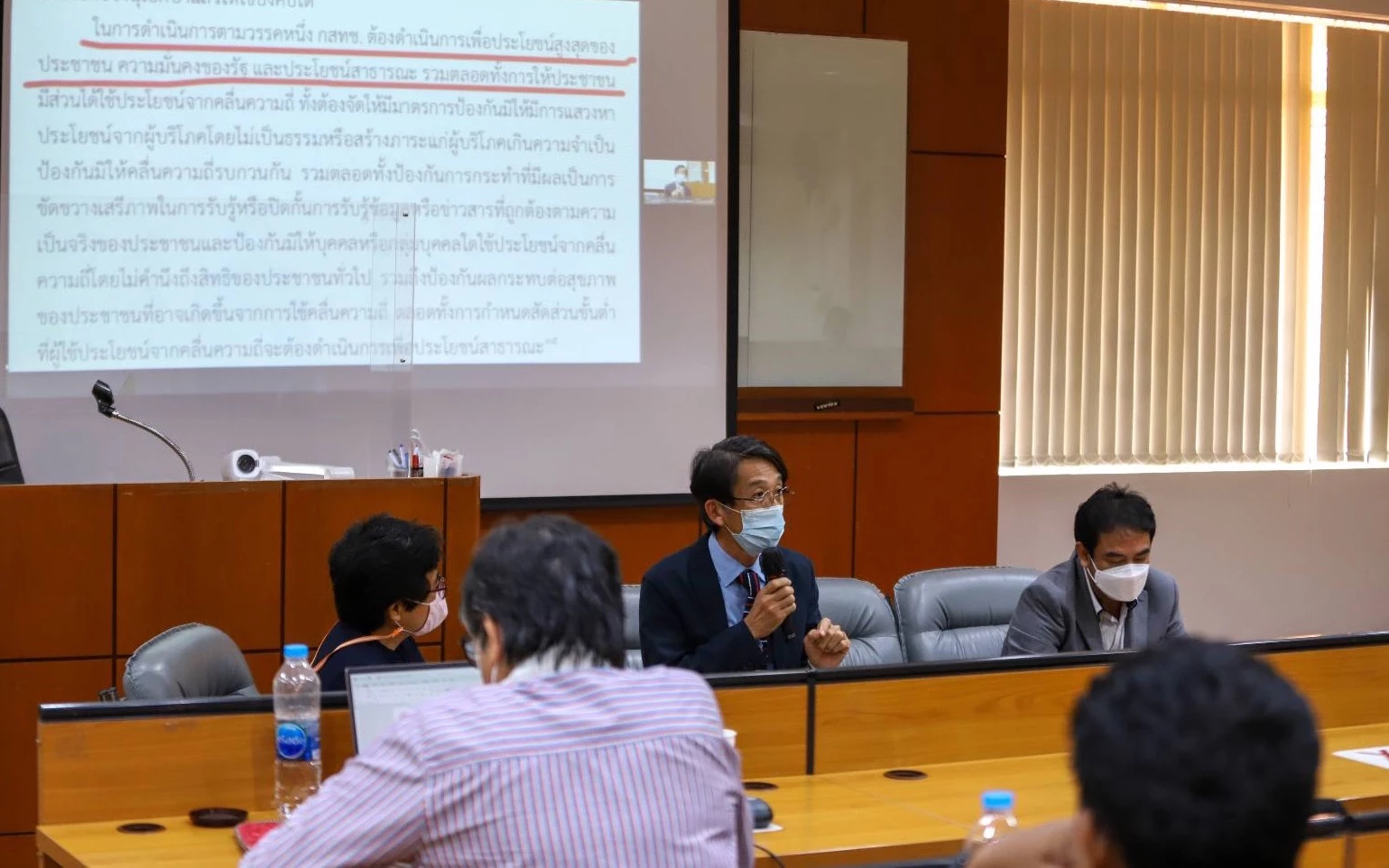
Prof Dr Parinya Thewanarumitkul, a delegate from Thammasat University spoke about NBTC board’s behaviour. He said that looking back at the establishing laws of NBTC, the reason for an independent organization to regulate the national resource of RF spectra was to be compliant with the 2017 Constitution and the Announcement of NBTC concerning regulatory measures for business mergers of 2018. Section 9 of this Announcement stated that the report in Section 5 was considered to be a request for approval from NBTC under Section 8 of the NBTC Announcement concerning measures to prevent actions causing a monopoly or unfair competition in the telecom sector of 2006. NBTC has the authority to forbid a merger, if it falls into the scope of a monopoly, or reducing or limiting competition.
Then there is the objection that previously, nine merger deals had applied the NBTC Announcement of 2018, and that the words “report on the merger” are used to mean that according to the latest Announcement, companies did not have to request permission. They only had to make an acknowledging report, because NBTC did not have the authority for any action.
The nine previous deals should not be cited
Prof Parinya said that the True merger with Dtac could not be compared with these nine previous deals, because it fell into the scope of power over the market, and ownership of spectra, which are a natural resource. They would have a market share more of more than half, and clear power over the market, so why can’t they use the post-merger report system?
It is because of the nine deals mentioned, seven of them were mergers between licensees who are subsidiaries of the same parent group. One deal’s post-deal assets did not exceed the financial limits stipulated by the NBTC Announcement, and one deal was the merger of the state enterprise CAT Telecom with TOT to form NT, pursuant to a Cabinet resolution. Therefore, mergers which exceeded what was stipulated in the law gave the private sector a market share in excess of 50%, the scope of a monopoly more severe than a socialist economy.

Thus, NBTC, as the state organ charged with regulating spectra and providing telecom services has the obligation under Section 27 (11) of the Act on the Organization to Assign Radio frequency and to Regulate the Broadcasting and Telecommunications Services B.E. 2553 (2010) (“Radio Frequency Act”) to determine measures to protect any action which would be a monopoly or be the cause of unfair competition in telecom businesses. It also prevents or manages trade barriers or monopolies, protects consumers and eliminates unfair economic monopolies according to the state policy written in the Constitution, the country’s highest law.
“NBTC may not be confident in its own authority because this is a very large deal happening. However, both the Administrative Court and NBTC legal subcommittee have authority in this matter. Pretending not to know and then asking the Council of State may fall under negligence of duty, or illegitimate actions under Section 157.”
Because spectra are a national resource
Assoc Prof Dr Narongdej Surakosit of Chulalongkorn University’s Law Faculty commented that telecom businesses had to make massive investments which affected the interests of the state and the public. The bodies charged with regulation had to exercise oversight for the maximum benefit, which can be clearly seen written in the Constitution. This is why it was necessary to set up a state agency which was independent in the public interest. In this case, such a body was required to provide measures preventing the seeking of benefits from consumers, or taking advantage of consumers.
Therefore, the status of NBTC is an independent organization, established pursuant to the Act on the Organization to Assign Radio frequency and to Regulate the Broadcasting and Telecommunications Services B.E. 2553 (2010), and whose independence is endorsed by Section 60 of the 2017 Constitution of the Kingdom of Thailand.
Also, pursuant to Section 6, the state is required to maintain radio frequencies and access to satellite orbits as national property in the best interests of the country and its people. The allocation of spectra under Paragraph 1, for broadcasting, telecommunication or any other use, must be in the paramount interest of the general public, national security, public benefit and allowing the public to benefit from those spectra.
“Regulating business concerned with the national benefit must be strictly observed, because the more that it is a limited resource, the more that everything must be for the greatest benefit of the public and the nation in accessing them, and specific powers have been granted to NBTC. Therefore, if you ask whether NBTC has authority to consider this matter, the easy answer is, yes, it has full authority.”
 SootinClaimon.Com