ColumnsJan 07. 2021Trump supporters scale the walls on the Senate side of the Capitol on Wednesday, Jan. 6, 2021. MUST CREDIT: Washington Post photo by Michael Robinson Chavez
By The Washington Post · Robin Givhan · OPINION, OP-ED
Amid the chaos and mayhem at our nation’s Capitol, the flags flew high. Dangerous. Despicable. And familiar.
The day had begun with the results of Georgia’s runoff election, in which Raphael Warnock was the projected winner and fellow Democrat Jon Ossoff declared victory. In the aftermath of his success, Warnock reflected on the hopeful history he had just made, as the first African American senator from Georgia. The country had come so far, a journey measured by the life of his 82-year-old mother, who had gone from picking cotton for the benefit of overseers to casting a vote for her son for the betterment of her country.
Ossoff, who had interned with the civil rights icon John Lewis, would make history, too. He would by nightfall be projected to become the state’s first Jewish senator.
But our grievous history is relentless. And so is hate.
The rioters stormed the U.S. Capitol in hopes of holding on to a past – both near and distant. They hoisted Trump flags aloft because it is he to whom they’ve pledged their allegiance, refusing to accept his defeat in the November election. “USA!” “USA!” they cried. These violent and angry mobs of men and women called themselves patriots – despoiling a beautiful and mighty word – as they clamored up inauguration scaffolding, shattered windows and wreaked terror in the nation’s capital in the name of a single wretched man and his delusions of greatness. They held signs that evangelized that “Jesus Saves,” using religion to justify their attempted coup.
“Fight for Trump!” they chanted. And they let Confederate flags fly on the Capitol steps and inside its hallowed halls, making it plain just how they define the man and the real Americans for whom they claim to be standing firm.
For much of Wednesday afternoon, the president of the United States let the anger of the mob fester as flash bangs echoed off federal buildings and the stink of smoke filled the air. President Donald Trump had incited and encouraged this insurrection. It was his creation, and he put the final flourishes on it in the late morning when he – as well as his family – poured even more accelerant on an already raging fire during a morning rally on the Ellipse.
The Capitol siege was seemingly his end game, the culmination of his campaign of lies and grievances over an election that he lost fair and square.
“We’re going to walk down to the Capitol, and we’re going to cheer on our brave senators and congressmen and women, and we’re probably not going to be cheering so much for some of them,” Trump said from behind a protective clear shield as he was wrapping up his remarks.
“We’re never going to take back our country with weakness. You have to show strength, and you have to be strong.”
His followers did as they were told.
And so, on the sixth day of a new year that has already felt like a suffocating eternity, democracy bled out. It was bludgeoned and pummeled and stabbed through the heart by a mob of Americans who claimed they were fighting against communism, socialism, liberalism and a host of other -isms, when all along they were simply at war with democracy and the inconvenient truth that sometimes you and yours are simply outvoted.
What to call these people? To describe them as protesters is to undermine those who take to the streets in peace, who raise their voices in hopes of making the country better – not to demolish it. Are they traitors? Terrorists? Radicals? Thugs? They are all of those things – a national quilt of our worst impulses and characteristics. They are young and old. They are men. They are women.
They are mostly White. And they rampaged through the Capitol posting photographs of themselves and one another breaking into the offices of the speaker of the House, looting and rioting and threatening – and, at least initially, being greeted like overzealous tourists compared with the way in which some law enforcement have beaten back Black Lives Matter and racial justice demonstrators.
The president-elect made a statement, too. Joe Biden pleaded for peace and insisted that Trump speak up with certitude and passion and to send his supporters home. “This is not dissent,” Biden said. “It’s disorder. It’s chaos. It borders on sedition. And it must end. Now.”
He said the rioters did not represent who we are. But they are, at least in part, who we have become. They’re certainly part of who we’ve always been. They are Americans just as surely as are those who watch them in horror and disgust.
Americans stormed the Capitol, and they did so while flying the Confederate flag. They did this. They brandished it throughout the marble halls. That is who they are. They are proud of it. And they are part of this body politic.
As democracy lay dying under the Capitol dome, Trump finally spoke to the assailants, in a video posted to Twitter. His call for the violence to cease was grudging and without any of the ruthless gusto that he reserves for agitators who don’t look like him, who don’t worship him, who don’t serve his purposes.
“I know your pain. I know your hurt,” Trump said, and then he repeated his lies about having won the election. “But you have to go home now. We have to have peace.”
But what Trump has unleashed cannot so easily be controlled or pushed back. History is relentless. Hatred is fierce.
The rioters want to wallow in the Confederacy. They want to be reborn under the flag of Trump. They want to live in an angry, polluted, heartless world, if only because it means that they get to stand victorious atop the whole, miserable mess.
—
Robin Givhan is senior critic-at-large writing about politics, race and the arts. A 2006 Pulitzer Prize winner for criticism, Givhan has also worked at Newsweek/Daily Beast, Vogue magazine and the Detroit Free Press.
By Chadin Rochananonda, Vut Mahamongkol Special to The Nation
Governments around the world are aware of the environmental problems and challenges besieging the planet. This has led to the framing of public policy focusing on the balancing of economic, social, and environmental issues.
The trend in pushing economic development is increasingly based on innovation being applied to increase productivity and further improve people’s quality of life. Reducing the amount of greenhouse gas emissions and PM2.5 (particles less than 2.5 micrometres in diameter) dust in the air are critical areas of emphasis in framing policies to promote the development of industry and the use of electric vehicles seriously until it becomes a national agenda.
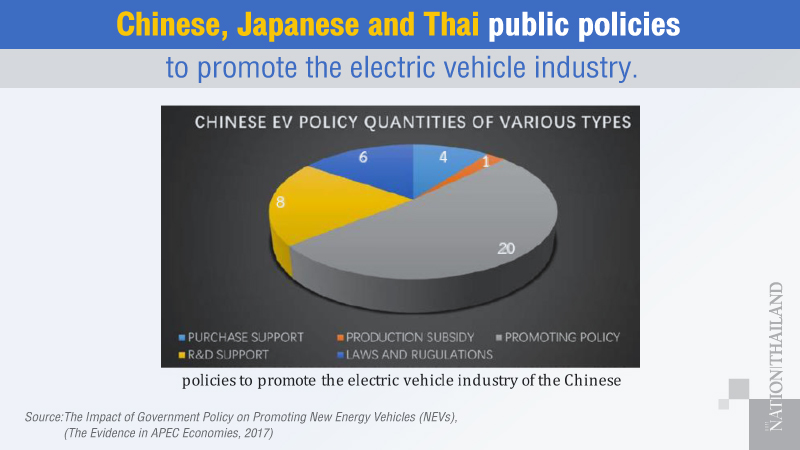
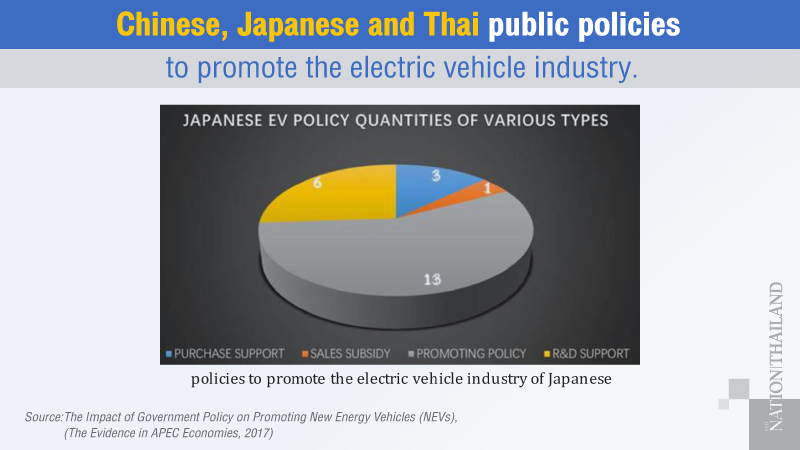
A 2017 Asia-Pacific Economic Cooperation (Apec) study illustrates the policy of supporting the manufacture and use of electric vehicles in the leading industrialised countries, including China and Japan. They have a comprehensive policy package covering five areas. They provide a 10-15 per cent subsidy to customers; offer tax incentives and manufacturing subsidies; offer research and development support for more than 20 years by funding automobile companies to develop batteries and electric startup companies, woo foreign direct investment or determine the proportion of governmental electric vehicles; and, issue laws and regulations limiting the number of fossil-fuel vehicles in big cities.
Public policy in developed countries, including China and Japan, have supported and promoted the manufacture and use of electric vehicles seriously, reflecting the determination of the governments to revolutionise the automotive industry and reduce dependence on fossil fuels, and facilitate environmental conservation.
The Chinese government has issued 39 policies for promotion and support of EVs, while Japan has 26, with the highest priority being on demand-side subsidies, followed by promoting technology research and development. Increased use of EVs and support for production have lowered the prices of electric cars. This is considered a complete stimulus covering both supply and demand.
A master’s degree thesis by Vut Mahamongkol in 2020 from Chulalongkorn University’s Faculty of Political Science, on Electric Vehicle Industrial Promotion Policy Formulation in Thailand has compiled the current policies to promote and support the production and use of electric vehicles by the Thai government. It found that there were only two areas of policies to support and promote EVs, namely the Promotion Policy, especially tax incentives to promote investments from foreign investors, totalling four policies, and for the promotion of research and development. Imposing the condition that foreign companies transfer advanced technology, such as the production of batteries that can charge quickly, would allow Thai entrepreneurs to develop their manufacturing capabilities from just assembly and fabrication.
An overall evaluation shows the Thai government’s policies are not comprehensive enough to cover all dimensions. As a result, the prices of electric cars in Thailand are quite high — about Bt1 million or more. Currently, no foreign company has set up a manufacturing plant for electric cars. All the EVs are imported. The only operator in Thailand is Energy Absolute Pcl (EA). Recently, EA launched an electric vehicle under the Mine Mobility brand. The EV can drive continuously for 200 kilometres per charge, but the cost is still quite high due to lack of government support. If the Thai government explores opportunities in developing the EV industry, it will enhance industrial development as well as Thailand’s economic competitiveness in the future. Therefore, it is necessary to come up with more comprehensive policies, by adding three policy areas — the adoption of pollution control laws, promoting the manufacture, and the use of electric cars.
Proactive moves in this direction will be an important factor in creating an environment that will facilitate the manufacture of electric cars as the main vehicle in Thailand in future, and contribute to sustainable reduction of greenhouse gas emissions and PM 2.5 dust in the country as well.
However to focus on the development of the EV industry, it must rely on occasion and timing since the government must consider the overall readiness of the stakeholders resulting from this important decision because fossil fuel vehicles will eventually be replaced by electric cars.
In 2019, Thailand ranked 11th in the world in the automobile industry (50 per cent of its production for domestic use and 50 per cent for exports). Amid the increasing use of electric cars, it began to wake up to the reality and come up with a significant response. If the Thai government lacks a clear and comprehensive policy to promote the production and use of electric vehicles, it will inevitably affect export income, which is a major engine of growth driving the Thai economy.
—
Chadin Rochananonda is a lecturer at the Faculty of Political Science, Chulalongkorn University, and
Vut Mahamongkol is product supervision manager at Nissan Motor (Thailand)
It is not too early to start absorbing the lessons of Asia’s public-health successes.
In the early stages of the Covid-19 pandemic, it was common to divide countries and their responses according to their political systems, with many attributing China’s success in controlling the virus to its authoritarianism. As of late 2020, however, it is clear that the real dividing line is not political but geographical. Regardless of whether a country is democratic or authoritarian, an island or continental, Confucian or Buddhist, communitarian or individualistic, if it is East Asian, Southeast Asian, or Australasian, it has managed Covid-19 better than any European or North American country.
While this line is not exactly hemispheric, it is close enough to be suggestive. Even Asia’s worst performers (in public-health terms)—such as the Philippines and Indonesia—controlled the pandemic more effectively than did Europe’s biggest and wealthiest countries. Notwithstanding reasonable doubts about the quality and accuracy of the reported mortality data in the case of the Philippines (and India), the fact remains that you were much likelier to die of Covid-19 in 2020 if you were European or American than if you were Asian.
Comprehensive, interdisciplinary research is urgently needed to explain these performance differentials. Because much of our current understanding is anecdotal and insufficiently pan-regional, it is vulnerable to political exploitation and distortion. To help all countries prepare for future biological threats, several specific questions need to be explored. First is the extent to which the experience of SARS, MERS, Avian flu, and other disease outbreaks in many Asian countries left a legacy of health-system preparedness and public receptiveness to anti-transmission messaging.
Clearly, some Asian countries have benefitted from existing structures designed to prevent outbreaks of tuberculosis, cholera, typhoid, HIV/AIDS, and other infectious diseases. For example, as of 2014, Japan had 48,452 public-health nurses (PHNs), 7,266 of whom were employed in public-health centres where they could be mobilised quickly to assist with Covid-19 contact tracing. Although occupational definitions vary, one can compare these figures with those for England, where just 350-750 PHNs served 11,000 patients in 2014. (England’s population is roughly half the size of Japan’s.)
We also will need a better understanding of the effect of specific policies, such as rapidly closing borders and suspending international travel. Likewise, some countries did a much better job than others at protecting care homes and other facilities for the elderly—especially in countries (notably Japan and South Korea) with a high proportion of people over 65.
Moreover, the effectiveness of public-health communications clearly varied across countries, and it is possible that genetic differences and past programmes of anti-tuberculosis vaccination may have helped limit the spread of the coronavirus in some areas. Only with rigorous empirical research will we have the information we need to prepare for future threats.
Many are also wondering what Asia’s relative success this year will mean for public policymaking and geopolitics after the pandemic. If future historians want a precise date for when the ‘Asian Century’ began, they may be tempted to choose 2020, just as the US publisher Henry Luce dated the ‘American Century’ from the onset of World War II.
But this particular comparison suggests that any such judgment may be premature. After all, Luce’s America was an individual superpower. Emerging victorious from the war, it would go on to claim and define its era (in competition with another superpower, the Soviet Union). The Asian Century, by contrast, will feature an entire continent comprising a wide range of countries.
In other words, it is not simply about China. To be sure, the rising new superpower has been notably successful in coping with the pandemic after its initial failures and lack of transparency. But its scope for asserting systemic superiority is circumscribed by the fact that so many other Asian countries have been equally successful without Chinese assistance.
The post-war comparison also may be premature for economic reasons. Asian countries’ economic performance in 2020 did not match the success of their pandemic response. While Vietnam, China, and Taiwan have beaten the rest of the world in terms of GDP growth, the United States has not fared too badly, despite its failure to manage the virus. With forecasts pointing to a 3.6 percent contraction for the year, the US is in better shape than every European economy, as well as Japan, Malaysia, Singapore, Thailand, the Philippines, and others in Asia. The difference is largely a function of interconnectedness: compared to the US, many Asian economies are more exposed to trade and travel bans, which cut deeply into the tourism industry.
Although China’s public health and economic outcomes have been better than the West’s in 2020, it has neither found nor really sought a political or diplomatic advantage from the crisis. If anything, China has become more aggressive toward nearby neighbours and countries like Australia. This suggests that Chinese leaders are not even trying to build an Asian network of friends and supporters.
How China approaches the issue of international debt restructurings—especially those connected with its Belt and Road Initiative—will be a key test in 2021. But, of course, the US and the rest of the West also will be tested, and on a wide range of issues, from international finance to sociopolitical stability.
It may be too soon to announce a new historical epoch; but it is not too early to start absorbing the lessons of Asia’s public-health successes.
The Dewan Rakyat has passed the 2021 Budget at the third reading by a very slim margin of 111 to 108. This means the Perikatan Nasional government can continue to govern until next year.
The thing is, as PM Muhyiddin only has a razor-thin majority support in the Parliament, we cannot expect him to bring about any remarkable change so that the country can be steered back and go down the right way next year.
With his administration so vulnerable, it is within anticipation that the PM will do his utmost to please Umno, a party that upholds racism and populism, as well as the conservative religious party PAS. As a result, the country will remain stagnant without any meaningful progress over much of next year.
As a matter of fact, reform has never been Muhyiddin’s ultimate objective, and Malaysians are expected to continue struggling next year under the weight of political and economic woes and the coronavirus pandemic.
Recent economic developments and numbers point to the fact that this country will continue to suffer economically next year.
First and foremost, Fitch Ratings announced a downgrade for Malaysia’s long-term Issuer Default Rating (IDR) from “A-” to “BBB+” before it cut the sovereign ratings of Petronas and Telekom Malaysia.
Fitch has highlighted the country’s weaknesses, including higher government debts at 76% of the country’s GDP, and political instability that could affect the government’s performance.
Even though the government’s revenue will remain at a pathetically low level of 19.1% of GDP, the PN administration has failed to explore new sources to increase its revenue while expenditures continue to soar, causing the government’s debt level to go out of hand.
The PM has admitted that we used to be a preferred destination for international investors, but due to the pandemic it is very hard to get investors to come here now.
Women and family minister Rina Harun has revealed that her ministry plans to hire additional 8,000 social welfare department (JKM) workers next year, meaning our already bloated civil service sector is set to expand further next year.
Given the ballooning expenditures and mounting public debts, asset disposal is probably the only strategy at hand.
In order to disburse RM34 billion dividend to the government, Petronas has reduced its stakes in MISC and KLCCP Stapled in a bid to raise RM2.8 billion in cash.
Meanwhile, PNB recently disposed of its Grade A Brisbane office tower Santos Place for A$370 million (RM1.14 billion).
Additionally, Asian Development Bank has predicted that Malaysia’s GDP will shrink by 6% this year, worse than the previously projected 5% shrinkage. Meanwhile, October unemployment rose to 4.7% or 748,200 people out of job, while November IPI (industrial production index) contracted by 0.5%, signaling a bleak prospect for the country’s growth in the year to come.
But weirdly, even as the country urgently needs foreign investments to bolster our economy, the PN government seems to have acted the other way. For record, it has terminated the RM43 billion Melaka Gateway project, suspended the MM2H program, and reportedly excluded Singapore from the proposed high speed rail project by making Johor Bahru the terminal station of this costly project.
The country’s international image is poised to suffer further as a consequence of rampant corruption and abuse of power. The government has just canceled the bribery case involving former federal territories minister Tengku Adnan Tengku Mansor, the third major case involving public interests dropped so far this year, prompting Credit Suisse Malaysia to warn that “the country will pay the price for this.”
Actually, Muhyiddin lacks the actions to fight corruption even if he has pledged to do so. In the case of rubber stamp counterfeit case involving immigration officers, a low-ranking officer has been found to possess four luxurious sedans worth over RM2 million. And in the money-laundering case involving a Macau syndicate, a police officer was found to have RM1 million savings in his bank account.
Malaysians generally perceive that the corruption problem has gone from bad to worse. According to Transparency International’s Global Corruption Barometer (Asia), 70% of Malaysians see government corruption as a big problem, 30% think the government has done very badly in addressing the corruption issue, while 36% believe our MPs are corrupt.
Even so, PAS president Hadi Awang has viewed corruption in the same light as alcoholism. Without institutionalized effort to battle corruption, the market will never be convinced.
We cannot pin our hopes on senior politicians who care only about their own interests. We must be bold enough to delegate the responsibility of overhauling this country to young leaders who are our only bet.
By Syndication Washington Post, Bloomberg Opinion · Brian Chappatta · OPINION, BUSINESS, US-GLOBAL-MARKETS
When Jamie Dimon, the head of America’s largest bank, says the U.S. economy is in jeopardy, Federal Reserve policymakers and elected officials ought to take notice.
This detail was tucked away in a Wall Street Journal profile of JPMorgan Chase’s chief executive officer published near Christmas. The article began with his near-death experience in early March just as the covid-19 crisis was escalating worldwide, but sprinkled throughout were multiple warnings from Dimon: Without addressing the underlying economic inequality in the U.S., capitalism could soon meet its demise.
Dimon, of course, is hardly the first billionaire to bemoan the historically wide gap in the U.S. between rich and poor. Ray Dalio, founder of Bridgewater Associates, has said the American dream “does not exist” because of forces like extreme political polarization and wealth inequality. Marc Benioff, CEO of Salesforce.com, wrote about “horrifying inequality” and the need for a new capitalism in October 2019. His net worth has increased by about $2 billion this year to $9 billion, according to the Bloomberg Billionaires Index.
It’s easy to dismiss all this as cheap talk from those who benefited the most from the current system. But there’s only so much even the biggest hedge fund or largest U.S. bank can do to address these persistent problems. The power to narrow the yawning gaps in the world’s largest economy begins and ends in the halls of Congress. Unfortunately, for more than a decade, lawmakers have ceded much of that responsibility to the Fed, an institution that is particularly ill-equipped to address wealth inequality.
When I ask investors what they’ve learned in 2020, the answer is almost always the same: Don’t ever doubt how far the Fed is willing and able to go during periods of crisis. It added $3 trillion to its balance sheet in what seemed like a flash. It purchased corporate-bond exchange-traded funds, backstopped the municipal-debt market and injected enough confidence and liquidity into the financial system to lift the prices of just about all assets. As a result, U.S. household net worth reached an all-time high in the third quarter.
So perhaps there’s another equally important takeaway from 2020: For all the central bank’s plaudits, its one kryptonite remains the same, whether in good economic times or bad. It’s powerless to stop the wealth gap in America from growing wider.
The reason is straightforward: At its core, the Fed sets the level of interest rates in the economy. If interest rates are low, as they are now, that props up the value of stocks and other risky assets, which are disproportionately owned by high-net-worth households. If interest rates increase, as they did in 2018, then growth is strong and wealthy individuals can park more of their accumulated wealth in 10-year U.S. Treasuries and earn 3% or more for a decade, virtually free of risk. It’s a win-win – provided, of course, that you have a sizable amount of money to begin with.
That last part is the context that many Fed critics seem to miss. During a year like 2020, when stock markets raced to record highs even as many workers lost their jobs and small businesses folded, it’s tempting to paint the central bank as a villain; an institution always looking out for Wall Street’s traders, dealmakers and hedge funds instead of the little guys. In reality, higher interest rates and tighter monetary policy are hardly a great wealth equalizer.
Instead, those in search of a foe should focus on Congress.
Yes, lawmakers swiftly passed the Coronavirus Aid, Relief, and Economic Security Act early in 2020, which provided much-needed relief to many of those hit hardest by the pandemic. But over the course of at least the last decade, that sort of legislation has proved to be the exception rather than the norm. More typical was the excruciating back-and-forth over another round of fiscal aid that lasted for months.
The CARES Act showed how fiscal policy can chip away directly at wealth inequality. From March 31 through Sept. 30, the overall wealth of Americans in the bottom half increased by more than 20%, the largest two-quarter jump since late 2013. It was also a bigger boost than any of the other groups tracked by the Fed. Wealth rose 7.9% for those in the 50% to 90% tier, 10.3% in the 90% to 99% range and 15% for the top 1%. The top 10% now have roughly 34 times the wealth of the bottom half, which, while high on a historical basis, is also the lowest ratio since mid-2007, just before the longest recession since the Great Depression.
In that 13-year span, Congress has rarely been so focused on policies that support the most vulnerable Americans. Earlier in President Donald Trump’s term, Republicans passed a tax cut that skewed toward helping corporations and the wealthy. In the final years of Barack Obama’s presidency, deficits declined as congressional Republicans reined in government spending. Without a fiscal jolt to the economy, the Fed had little choice but to keep interest rates near zero. Stocks climbed steadily even as the economy recovered more slowly, with predictable and inequitable results. Research from the St. Louis Fed shows that the inflation-adjusted wealth gap has widened between White households and Black and Hispanic ones since the global financial crisis as well as over the past three decades. White families have a much higher median net worth to begin with and are twice as likely to own equities.
Some on Wall Street are optimistic that the covid-19 pandemic has changed the thinking in Washington around fiscal stimulus. “We see no political appetite for fiscal austerity, even as debt ratios hit historic highs globally. The politics of inequality will likely keep deficit spending high,” according to the 2021 global outlook from the BlackRock Investment Institute. “A post-pandemic recovery requires fiscal stimulus beyond the fiscal life preserver,” strategists at Citigroup wrote. “Without fiscal easing, when the pandemic is brought under control for good, the risk remains for rising inequalities and diminished prospects for living standards.”
Yet there are ample reasons to be skeptical. For one, even after Trump demanded $2,000 stimulus checks, a vast majority of House Republicans balked and prospects are fading fast in the Senate. Assuming the party wins at least one of the two Senate races in Georgia, that sets the stage for years of potential gridlock under President-elect Joe Biden and his pick for Treasury secretary, Janet Yellen. There’s no Fed policy that can avert such a fate.
“Monetary policy cannot change the distribution of wealth, monetary policy cannot get the stimulus to the right places today – it has to be fiscal,” Rick Rieder, BlackRock’s chief investment officer of global fixed income, told me in an interview. When it comes to steering the economy, “Jay Powell will be the co-pilot and the pilot will be Janet Yellen. Because whether its tax redistribution or creating more employment, it has to come through fiscal. Monetary has done virtually everything it can do.”
As one example, Rieder points to the sharp increase in housing prices, which is cheered on by many economic observers, including Powell at his Dec. 16 press conference. Rieder isn’t so sure it’s a clear victory. Look no further than data that shows demand for million-dollar homes has grown faster than any other price tier. “The improvement of prices in housing is not necessarily a good story for a lot of people in the country,” he said. “There’s a whole series of things that can be done around making housing more affordable, but that all has to come through the fiscal side.”
Rieder told me a few years ago that he could see himself one day going into public service. He has a passion for education reform and is chairman of the board of North Star Academy, a charter school network in Newark, New Jersey. I watched him pump up a gym full of middle schoolers by telling them: “Life is not a dress rehearsal! Life is the big event!” So it makes sense that he would see the urgency on fiscal policy as something of a no-brainer.
Channel money to the right places. Improve access to high-quality education and affordable housing. And once the pandemic has passed, perhaps even raise taxes on wealthier Americans after years of financial-market gains. These are all things elected officials can do and the Fed can’t.
I wrote around this time last year that the U.S. seemed to be turning from the Tea Party to Modern Monetary Theory in the past decade. At the time, I certainly didn’t envision the type of fiscal support needed in 2020 to keep the economy from crumbling under the weight of the pandemic. The bigger test might just come later in 2021 when there’s no longer such an imminent crisis. Will politicians embrace their power to send funds to the unemployed and those in lower income brackets or retreat and let the Fed do the heavy lifting again? Will they expand access to health care and bring the nation’s infrastructure up to 21st-century standards? Those are some tough questions.
By contrast, the path ahead is fairly simple for the Fed: It will keep interest rates pinned near zero until the economy approaches full employment and inflation averages 2%. That will be the policy regardless of whether wealth inequality grows even more extreme or reverses the long-term trend.
So in some ways 2020 taught us that the Fed is powerful – except in the area that Dimon and others are warning about.
– – –
This column does not necessarily reflect the opinion of the editorial board or Bloomberg LP and its owners. Chappatta is a Bloomberg Opinion columnist covering debt markets. He previously covered bonds for Bloomberg News. He is also a CFA charterholder.
The Thai Ministry of Foreign Affairs (MFA) was formerly known for its unbelievably complicated entry-exam system and an out-of-reach conservative nature, especially when its former office was located at the Saranrom Palace.
This made it a wonderland for ordinary Thais, as far too few of them were aware of its negative side. The Thai public often dubbed the ministry as an elite department that housed mostly groups of upper-class offsprings from a well-established background. That is not the case anymore. Not long ago, an ambassador-turned-Facebook personality, Russ Charnsongkram, published his official fan page to openly criticise the current government. The MFA was again thrown into the spotlight and is being continuously attacked by large numbers of netizens.
However, the reason that brought it into the crosshairs was not because of its noble background, but its myriad attempts to rationalise the government’s suppression of youth protesters through use of the lèse majesté law in the Criminal Code, after years of dysfunction. To be precise, it is not the first time that the MFA appears to speak for, and in the name of, the government. Last month one of its high-level officials sent an open letter to London-based The Economist magazine, hoping to give a clear picture about the Thai political situation, in response to criticism of the Thai monarchy published by the magazine. Its pro-establishment position conveys an impression to the public that the MFA does not really serve the taxpayers, but the government instead.
Theoretically, the MFA is obliged to serve Thai taxpayers as a civil-servant organisation, since its payroll is bankrolled annually through the tax collections of the Ministry of Finance. Nevertheless, the MFA is not equipped with that much of a choice, in practical terms. At the end of the day, the MFA is still part of the government body where its employees are entitled as career diplomats, a large group of foot soldiers belonging to a bigger network of the establishment’s bureaucratic system and red tape. Therefore, what actually happens in that department is merely a bunch of bureaucrats taking direct orders from the leadership of the Cabinet, orders that they cannot refuse.
Unlike politicians, government officers or career bureaucrats are ones that are not and cannot be independent. Lower-ranking officers are bound to receive commands from higher-ranking officers. If they disagree with the orders, either because they think it is immoral or corrupted, they can only declare in a statement saying that they disagree, but not anything further. And most importantly, they have to submit themselves to loads of regulations and rules. Any disobedience of the superiors will be recorded in their career profiles. It is not worth it for them to harm their careers by resisting the higher government official’s order. They can get bullied or blocked from getting promoted to top positions in the near future. This explains why most government officers, or in this case, career diplomats, just follow orders.
Most of the textbooks related to the use of diplomacy often state that one of the diplomat’s essential tasks is an employment of soft power to protect national interest of the home country. The term “national interest” is also sometimes problematic. It is vague enough to lure career diplomats into a blurred boundary between the government’s interest and the public interest. Thus, when the concept is undoubtedly ambiguous as such, the bureaucratic system just automatically comes in and plays its part in guiding those diplomats towards providing excuses for the government. Most diplomats are aware of what they are assigned to do, yet the channels for their expression are limited. Rather than writing a statement or letter to their superiors, they might as well only be able to secretly write an op-ed article and publish in a newspaper without revealing their names.
Take the Ukraingate case in the US, under outgoing President Donald Trump, as a live example. Many US diplomats were either forced to stay silent or resign from their posts if they did not give useful support to him. And those underlings would have received no protection from Secretary of State Mike Pompeo had they given impeachment testimony against President Trump. What Pompeo personally did last year was parrot the president’s commands and tell his subordinates to just obey what the superiors said. In short, this helps reflect the reality that most career diplomats do not possess that much negotiating power when confronted with problematic cabinet decisions. Even they are aware of those wrongdoings, but the choices while serving in the bureaucracy are limited. The same goes for Thai diplomats. They might have been unwilling to follow such orders, but that was their only choice. So, it would be impossible to expect the MFA and its staffs to stand up, and back the opposition.
As the 2020 General Election nears, posts written by political observers and analysts are getting removed or blocked by Facebook.
Many such posts, with the absence of any swearing or defamatory language, are being removed through targeting by the social media platform.
“It is getting worse. People are asking me to complani to Facebook. I’m not going to do it,” said a Myanmar political analyst Dr Yan Myo Thein.
Dr Yan Myo Thein is a veteran analyst and an author who has written political articles since the reign of the military junta in platforms such as True News, Flower News, Myanmar Post and many news journals. His body work consisted of many perspectives into the political hemisphere, particularly that of the formation of the 2008 constitution and is still continuing to put out political articles in both local and international media.
Ever since 2016-2017, he started noticing that his politics-related posts were getting removed from Facebook.
“It didn’t used to happen. It became quite notable in 2016 and 2017. I have always been critical but no action like this. Lately, a lot of it gets taken down. Even if it is just an observation, it is getting blocked and punished,” said Dr Yan Myo Thein.
Facebook removed his post on October 20 regarding the incident in which candidates from the National League for Democracy (NLD) that were captured by the Arakan Army (AA).
In that post, he shared his thoughts regarding the photos and statements regarding Rakhine NLD candidates captured by the AA. It was removed despite the post stressing the need to release captured candidates and encouraging discourse.
On October 31, Dr Yan Myo Thein wrote two posts concerning the Myanmar election. It only took minutes before it was taken down.
Those posts can be said to be critical of the ruling NLD as it concerns things that can happen to the NLD in the election, particularly in ethnic areas.
In the first one, Dr Yan Myo Thein pointed out that any predictions that claim that the NLD will see a bigger victory than the 2015 election is shallow and lofty, leading to negative consequences. If NLD leadership believes that to be so fully then it is rather detached from the true facts of the situation. It should be expected that as ethnic parties get stronger, the danger of losing many seats to them in the regional parliaments is a danger. It has to be expected that Tanintharyi, Ayeyawady, northern Sagaing and townships outside of Yangon’s municipality will have to be carefully waged competition.
Facebook removed the above mentioned post for 11 times total.
The second post stated that the “insinuation that ethnic parties engaging in fierce rallying to win landslide victories in their areas, causing the Union Solidarity and Development Party (USDP) to gain more power, is one-sided. Ethnic parties fight to win their own region, their own homes. They are the locals. As far as I understand, the NLD was stubborn in negotiating politically with friendly and colleague ethnic parties and thus, the current risk of ethnic parties winning their local seats. They are fighting for the betterment of their own people and that is deserving. But apart from pointing out that ethnic parties winning will strengthen the USDP in a battle between the NLD and USDP by some political analysts, more priority should be given to discussing the NLD not establishing political alliances with ethnic parties. If this goes on, ethnic states will see higher chances of ethnic parties winning as well as the USDP winning. I believe that this is a result of political greed and pride darkening the truth. I wish for the ethcnic parties to win their areas in the 2020 General Election.”
It was also removed as it went against ‘Community Standards’. It was never able to go back up no matter when or how many times was tried.
But those that copy-pasted from his post never had their posts removed.
Facebook is putting restrictions on not only political analysts but also toward some political parties.
Ko Nay Yan Oo, a Pyithu Hluttaw candidate representing Kamaryut Township for the People’s Pioneer Party (PPP), claims that online panel discussions that the PPP does weekly via Facebook Live gets taken down if there ever involved words that criticised the government.
Ko Nay Yan Oo was an IT professional and was also a regular writer regarding the Union government staff. His posts were also removed as it supposedly went against the rules.
“Initially, I just upload things that are part of my life and then, nothing was ever removed. Facebook started digging into me in 2019 when I criticized the union civil servants. I uncovered their mess. So then my post started getting targetted and removed,” said Ko Nay Yan Oo.
He also claims to have faced more restrictions campaigning online after he announced his decision to be a part of the PPP.
“It is worse now, especially more so as I am an opposition politician. It happened before the election period and also during it.”
“Number one is that I couldn’t upload anything on my Campaign Page on the very first day of the election period. No texts, no pictures, no videos, nothing. And it isn’t only the Campaign Page. There is another page that writes about the union government but Facebook had blocked it. So if it is the election campaign time and due to COVID-19, we cannot campaign on the ground so we have to do it online and the online option gets blocked then what do we do? The second thing is that we always hold a panel discussion online weekly every wednesday. We do it live with our voters. We faced this twice; everything was fine until we started criticizing the government. The alleged reason was that whatever we were talking about fringing copyright with BBC Burmese. So the excuse was that BBC reported us. In reality, the BBC did not report us. We have asked. And the other thing is we are talking live. We are not using any photos or texts or videos. We are speaking like we are speaking now on the phoe. There is no way that was getting copyrighted. It happened not the one time but twice. The last one, I think, many people have experienced. Things couldn’t be boosted. I tried boosting my picture with a western suit on (as I don’t have a lot of my photos in traditional clothing and it was COVID period so photo studios were closed) but I couldn’t boost it. Apparently my picture was too sexual. How is it possible that I have a suit on with a necktie that I am being sexually suggestive?” said Ko Nay Yan Oo.
Someone cleared to reply to The Daily Eleven had said that Facebook is working on blocking content that will use the political, religious and racial situation to incite hate.
The Daily Eleven had asked Facebook, in the middle of October, over the email regarding the removal of content from political analysts and how exactly were they qualified to be removed as those posts do not contain any words that may incite hate or utilized inflammatory language.
Facebook sent a reply that until November 22, they will be removing any content that can mislead and obstruct voters with misinformation or unverifiable rumors or anything that can harm the election process will all be removed.
“We have a clear set of rules on action against inciting hate and violence. If those rules were broken in Myanmar or anywhere else, it will be removed. On top of removing any potentially dangerous content, Facebook had also introduced technological products to lower the amount of incidents of inciting violence and hatred before and after the election period,” replied Facebook.
It also said that attacks under the religious or racial guise are being removed such as calling groups like migrants or the Bengali that are without citizenship rights “trespassers” or “illegal immigrants” or any other word that comes close to its meaning.
Facebook had also announced the expansion of their bullying and harrasment policies to include journalists, activisists, humanitarians and other distinguished persons that always easily come under attack.
According to its announcement, Facebook removed around 300 thousand hate speech related content in the second quarter of 2020. It also cited utilizing AI that can recognize and remove content written in a total of 45 languages, including Burmese, with hate speech in them before anybody could see.
But lately, the removal of posts from political analysts and party candidates as well as campaigning by political parties are arguable in its capacity to be removed by Facebook due to infringing ‘Community Standards’.
Even when the usage of inflmmatory language was involved with breaching community standards, users that exercise their right to colourful speech that are supporters of the ruling NLD do not see any action from Facebook while those that go against them will surely be removed or made not visible by Facebook.
Incidents of posts that get removed despite not containing any explicit language amount to censorship of the freedom of speech.
The (6/2017) meeting of the Union Government approved the formation of the Social Media Monitoring Team (SMMT) in order to keep tabs on social media platforms including Facebook. The President’s Office formed the team on Februaruy 7, allowing them a budget of 6.462 billion Kyats from the special presidential reserve to purchase necessary technologies and equipment.
Thus the criticisms that the ruling party is sending to Facebook requests that will benefit the ruling party.
In a nation utilizing the democratic system, the rights of citizens in their freedom of thinking and speech is a basic commodity and Facebook’s restrictions, despite not utilizing language that are inflammatory racially, class or otherwise, it certainly begs the question whether a deal was made with the current government between it and Facebook.
While the act of preventing and removing misinformation, fake news and manipulations is welcome at any time, election period or otherwise, the Facebook Team must be responsible for acting upon the taboo of censoring the people’s freedom of speech.
Moreover, it harms the election ultimately as it restricts the mind of the voters from going through with enough mental exercises with thoughts and opinions derived from political parties campaigns as well as observations of the professionals.
“It makes sense if they were removing criticism based on fake news, hate speech or abusive language. But rethinking is necessary for acts of punishment because it was against their community standards, despite it being real news or me extrapolating and analyzing facts. If they are to go on this way, the reputation of a network that is working towards fariness and free from political bias can be damaged,” said Dr Yan Myo Thein.
Just a month after Joe Biden’s victory in the US presidential election, the European Union recently announced that it had adopted the EU Human Rights Global Sanctions Regime to celebrate the world Human Rights Day on the eve of December 10.
The legislation will equip the EU with transnational powers to impose sanctions on those accused of committing crimes that included mass genocide, arbitrary detentions, slavery and other human rights-related issues. While acting on its own, the move has been widely seen as a symbolic gesture by Brussels to re-emphasise its commitment to democracy alongside the US after a tumultuous decade of the world’s right-wing populist turn.
The EU’s new sanctions regime is commonly known as a twin of the Global Magnitsky Act that grants the US the same absolute power to impose travel bans and freeze assets individually of officials from illiberal regimes. Though it does not target the whole country, it essentially aims to cause difficulties and irritations to most human rights abusers from conducting business with EU member states. Put simply, this development is believed, among diplomats and policymakers from both sides of the Atlantic region, to be a mechanism that halts dictators and political strongmen from acts of despotism against their opposition.
Meanwhile, there is not much of a reaction from Bangkok and its foreign policy community. One possibility is that Bangkok might already be familiar with the EU sanctions regime since Thailand was previously attacked by the illegal, unreported and unregulated (IUU) yellow card, a warning against Thailand’s malpractices in fisheries, and that the new sanctions regime is far less threatening than the IUU. On one hand, the worst damage caused by the IUU sanction regime is that Thailand, as the third-largest seafood provider in the world, will be prohibited from exporting its seafood to the EU. On the other hand, the worst damage that can be done by the new regime is as small as individuals having hardship in accessing and locating assets in Europe.
Moreover, such a minor punishment will have little effectiveness in dealing with the global human rights situation, even when both the US and the EU impose it simultaneously. The world already has witnessed what has happened in Hong Kong, Xinjiang and Myanmar where violent abuses by states are not uncommon. To be clear, under the Global Magnitsky Act, outgoing US President Donald Trump had decisively slapped sanctions against many top military and party officials from those countries for alleged abuses and genocide, with asset freezes. The move, however, did not appear to be sufficient to stop those countries’ hawkish leaders from citizen abuses. Since some officials do not even have houses in the US and the targets of the sanctions are also merely not the true decisionmakers, in the realist’s playbook the twin of the Global Magnitsky Act is therefore not that frightening. Even if Bangkok is one of its targets, persons who hold top jobs in the Thai government are surely out of the radar, as the persons who receive punishment maybe some mid-level or other not-that-top officials from the Army that are not deemed as vital to the government. Besides, the strategy of diverging sanctions targets from the countries or states to individuals separately reveal that the EU does not really have an intention to create a wider range of casualties from its sanctions regime. For, there are still some friendly and strategically useful dictator regimes that are important for the EU’s geopolitics.
The new EU sanctions regime was also firmly criticised by EU diplomats and policymakers as for that consensus from EU member-states is required before drawing up the sanctions lists. And there are no independent organisations or civil society bodies that have an ability to recommend sanctions like that in the US. As a result, it is almost near impossible for the EU to effectively impose sanctions on illiberal regimes, especially in a certain circumstance where many of the European leaders are conservative-oriented. Given that Budapest, Warsaw, and Vienna are unwilling to play by the rule, an initiative from Brussels will merely be a failed attempt.
Plus, there is still an unusual belief among the elite and the foreign-policy community in Bangkok that as long as Thailand maintains its cooperation with the EU in other aspects, to be precise a strategic cooperation, it will easily have the EU’s nod no matter how undemocratically it behaves. The Bangkok elite had mistakenly understood that importing arms and giving a long-term security commitment to either the EU or the US will grant it an all-time pass from the sanctions regime. In practical terms, the new tool from Brussels is not going to bother Bangkok even when it is being critically targeted. Particularly not the current government where conservative military leaders have all the say in its decision-making process.
Extradition and its ugly cousin, hostage-taking, have a long history, East and West, as a byproduct of what legal pundits have called ‘courtesy and goodwill between sovereigns’, ie rulers who have power over their subjects and their territories.
Exile was the flipside of rendition. Socrates, given the choice “exile or hemlock”’ went for hemlock. A puzzling choice for today’s Church of Englanders who, offered the choice between “Cake or Death?” reliably opt for the former.
Whistle-blower Edward Snowden, now resident in Russia, is one prominent example of modern exiles who, metaphorically speaking, went for the C of E option, rather than the Socratic choice.
The US’s ongoing extradition case in Canada against Huawei CFO Meng Wangzhou (aka Sabrina Meng) suggests two things. First that, on returning favours between heads of state, the more things change, the more they stay the same, as the French say. Secondly that conflicting ideas about “what is a sufficient nexus between alleged crimes and the place where they are to be prosecuted?” and “how much does the quality of justice depend on where it is handed down?”, have produced a legal muddle in the field of extradition.
On top of the vestiges of “hostage trades” between heads of state, that will be seen in our case study of the Meng case, the evolving laws of extradition remain shot through with two themes: First, the lingering tradition of crimes normally only being prosecutable in the territory where they are committed (piracy and war crimes being exceptions) and, secondly, finding the right balance between expedition and fairness.
Ancient legal history
In the US, the idea that the courts of, say, Twosticks, Alabama summoning a Palo Alto resident to show up in Alabama, infringed California’s sovereignty, was essentially snuffed out by the US Supreme Court in 1945 in the International Shoe case. This case stands for the principle that, if the defendant had had relevant dealings engaging the territory or laws of the summoning court, those “minimum contacts” were good enough to found jurisdiction, in the courts of Twosticks (for the purposes of our example).
And yet the spells that US lawyers have cast to deem connections to the US, using more or less imaginary territorial connections, include using US payment systems for monetary transactions wherever you may be, having a “dot com” as opposed to a “dot wherever”, and flying over US airspace. After all Uncle Sam can turn off your satnav at will, so its current attitude reflects Thucydides’ axiom – “The strong do what they will and the weak suffer what they must.”
My particular favourite legal fiction, allied to this idea that all jurisdiction is territorial, was that it was unnecessary to seek the permission usually required from the English High Court to serve its proceedings abroad, if the defendant was aboard a British naval vessel anywhere in the world. All British Men O’ War (warships), were deemed by legal fiction to be situated in the parish of Stepney (where the Royal Naval Docks on the Thames were formerly located – obvious really).
Similarly Huawei’s Meng Wangzhou is presently confined to her home in Vancouver, on the theory that a PowerPoint presentation by her in a restaurant in Hong Kong caused HSBC to commit a crime in the US, by wiring money through the US clearing system for the supply of goods to Iran. If the HSBC back office person (who may even have been in India at the time) had “left-clicked” to use Hong Kong’s own clearing system instead, these electronic greenbacks would never have even notionally passed through the good old US’s geography or ecosystem, and Uncle Sam might not even have what US lawyers like to call a “colourable claim” that a crime had been committed – a counterintuitive expression for a claim you can articulate without actually blushing.
Before we get to the Meng, case, however, we need to take a quick look at some common themes in the modernisation of UK and Canadian extradition laws that bear on an assessment of whether the US may get its way in achieving the rendition of Meng to the United States.
The modern legal history
Canada in 1999 and the UK in 2003, for broadly similar reasons, modernised their extradition legislation with a view to making it fit for purpose for modern crime, where it is not so much about people fleeing, as money doing so.
Modern proceeds of crime, legislation essentially began with the 1971 Vienna Convention on Psychotropic Substances, which came up with the bright idea (possibly they were smoking and discussing such substances simultaneously) that the right response to the “victimless crime” of drug trafficking was to seize the profits. This idea was flawed for at least two reasons: first, it impedes criminals’ ambition to make and keep enough money through crime so that their children can “go straight”. The Crown Estates are, after all, an international crime proceed dating to 1066, laundered by the passage of time. The second flaw, is “why stop at drugs? What about financial crime?” Only redressing the second of those two flaws has found favour with the wider legal and political community and hence the ability of states to forfeit the fruits of criminal activity is now more or less ubiquitous and all embracing.
Apart from the EU dimension and the advent of the European Arrest Warrant for the UK, Canada’s modernisation of its extradition laws in 1999 and the UK’s in 2003 (both intended, in part at least, to meet the needs of the new international crime proceeds era) followed similar lines.
In broad terms, four features are especially important:
1. To justify extradition, the offence needs to be one which was a crime where it was committed and would have been a crime if it had been committed in the state asked to extradite. This is called the “double criminality test” (which did not apply for the European Arrest Warrant).
2. The requesting state must demonstrate that is has evidence which would justify a matter being sent to trial, if the conduct had occurred in the state required to extradite.
3. The requesting state must make a fair presentation of the evidence that would justify a criminal trial, but does not have to disclose all its evidence, or even exculpatory evidence, in the way that the prosecuting authorities typically would be obligated to do in a domestic prosecution.
4. If the requesting state has abused the process of the courts of the requested state, the request can get kicked out.
The way that the UK -US extradition arrangements worked following the UK’s modernisation attracted a lot of flak as being “lop-sided” in favour of the US, because the Brits have to show “Probable Cause” to get an extradition from the US, but the Yanks only have to show a “Reasonable Suspicion” to get you all cuffed up and wearing an orange boiler suit. The majority view amongst extradition lawyers today (and following official inquiries into the question of asymmetry) seems to be that, in practice, this is a distinction without a difference.
I suspect, however, that ordinary punters who struggle with lawyers’ “Humpty Dumpty” linguistic distinctions – eg, about why “tax avoidance” may be okay, but “tax evasion”, not so much – instinctively feel that “the accused was seen leaving the deceased’s room” may ground a “reasonable suspicion” whereas it might take “the accused was seen leaving the deceased’s room carrying a gun” to rise to the level of “probable cause”.
Perhaps the more powerful concern on lop-sidedness in favour of the US emerges from the rather extravagant views that Uncle Sam has about what facts constitute a crime being committed in the United States.
The ongoing case in British Columbia of USA v Meng Wangzhou provides ample scope to illustrate not only the extravagant reach of US theories about how people outside the US can be said to be committing crimes within the US, but also how the primal theme of extradition as a favour between sovereigns can produce “abuse of process” grounds as a ‘fig leaf’ for judges to deny extradition, without having to risk embarrassment in international relations by calling out extradition requests as political.
‘Trumpanomics’
The story that is unfolding in continuing proceedings in Vancouver about the arrest and detention of Meng Wangzhou and the US’s case against her, includes the following ‘eyebrow raising’ features, according to the arguments being rolled out by her Defence team.
1. Despite there being a judicial warrant for her immediate arrest, which both the Canadian border officials and the RCMP (the “Mounties”) were empowered and bound to execute, the Mounties stood by whilst the Border guys feigned a regular immigration side check, in which they managed to relieve, Meng of her laptop and phones, including getting her to write down the passwords. They put these in protective bags to stop them being wiped remotely. All of this was done without “immediately arresting” and reading Meng her rights as required. The Border agents also handed her devices and passwords over to the Mounties “by mistake”.
2. Meng lost a preliminary hearing to strike down the extradition as entailing no “double criminality”. It would not be a crime to trade with Iran from Canada (or Hong Kong) per se. But the US’s case theory is that Meng duped HSBC exposing it to potential financial loss, and such alleged deception of HSBC, could count as criminal, had it happened in Canada. Bear in mind that none of the actors were US citizens or entities, and the presentation had been in a restaurant in Hong Kong. But HSBC had a powerful incentive to co-operate with the US by claiming Huawei had misled them, as the bank was still subject to a US Deferred Prosecution Agreement (DPA) relating to allegations that it had laundered drug monies. If HSBC had knowingly infringed US sanctions by using the US clearing system, instead of Hong Kong’s own CHATs system, it could have been accused of breaching DPA conditions, potentially making the money laundering charges “live” once more.
3. Canada’s extradition legislation has the usual carve-out to protect against alleged political crimes, of the sort for example that would ground an asylum claim under international refugee conventions. The way the US and Canadian authorities collaborated, may have just been a coincidence (like Justin Trudeau and his brother both having been born on Christmas Day) but Meng’s disclosure requests to interrogate their dealings yielded a few documents full of redactions for claimed Public Interest Immunity (PII) and Legal Privilege, which the judge has largely refused to have unredacted.
Having encountered the mafia instincts of politicians and the executive branch of government, acting both for and against government interests of various nations around the world over the years, I have learned that an independent judiciary and robust rule of law is essential to prevent laws being wielded by governments to perpetrate injustices.
Standing back from the detail of the Meng case, it is important to bear in mind that the standard of review by the requested court is intended to be a fairly “low resolution” assessment of whether the material presented by the requesting state reaches a prima facie standard sufficient for charges to be sent to trial. The requested court should not conduct a mini trial of the charges the putative deportee will face abroad. The Canadian and other courts will, however, be vigilant if there is a concrete concern that either an individual’s due process rights, or the courts own processes are being abused. On the face of it, there would seem to be some reasonably rich materials for the Canadian judge to throw out the Meng request on abuse of process grounds, without having to “call a spade a bloody shovel” , by condemning the request as politically motivated.
Epilogue?
If and when President Trump leaves the White House, it is plausible to imagine that the line for the “End of Regime Pardon Sale” will stretch a long way down Pennsylvania Avenue, and that those pardons will be flying out of the Oval Office quicker than indulgences from a Borgia-occupied Vatican. Having himself described Meng Wangzhou as “the Ivanka Trump of China”, we shall see whether he spares Canada’s courts their task, in the hope of putting his relationship with President Xi back to the good old days of sharing delicious chocolate cake while “cruising Syrians” from Mar a Largo. I should hastily clarify (to avoid this concluding remark from being mistaken as libellous by Rudy Giuliani) that the verb “cruising” in this context refers to the launch of missiles and not to a method of making new friends in nightclubs.
—–
Tim Taylor QC specialises in international commercial and investment arbitration at King & Wood Mallesons, a law firm that has represented Huawei.
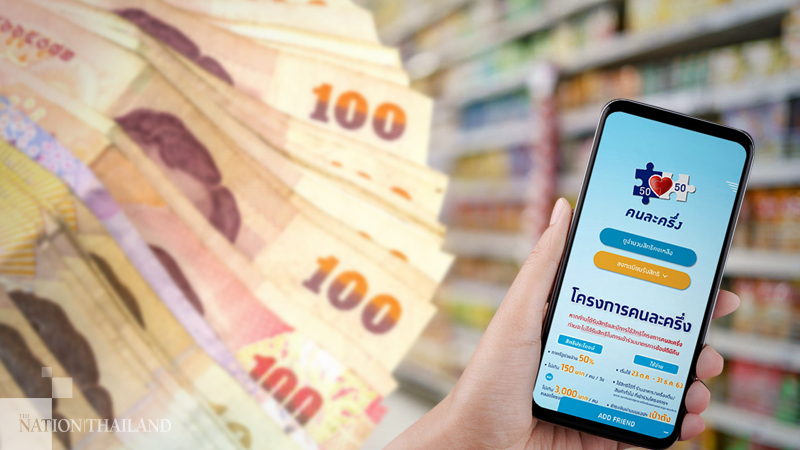
The “Khon La Khrueng” (Let’s Go Halves) subsidised shopping scheme is gaining popularity among people, so much so that the government has decided to launch the second phase to meet the demands of more people. From 10 million, the scheme is being expanded to cover 15 million people.
However, there are some negative views about the scheme, such as loopholes which facilitate corruption.
Even though it cannot be denied that various schemes tend to be misused, but thanks to technology, the government has been able to check damage and arrest participants who violate the scheme’s regulations as soon as possible.
Prime Minister Prayut Chan-o-cha had instructed the Finance Ministry to work on his policy to relieve the people’s sufferings from the Covid-19 impact, especially of low-income people.
As a result, the Finance Ministry launched three measures to help the people:
1. Low-income people: The government paid an extra Bt500 to 14 million state welfare cardholders for six months.
2. Moderate-income people: The government launched the “Let’s Go Halves” scheme to reduce the cost of living for 15 million participants and boosted approximately 1 million retailers’ incomes.
3. High-income people: The government launched the “Shop Dee Mee Kuen” (Shop and Payback) scheme, which enables people to deduct tax from buying goods.
Apart from reducing the cost of living, the scheme helps stimulate spending to boost the economy and enables people to spend via the electronic payment system as well.

 Trump supporters scale the walls on the Senate side of the Capitol on Wednesday, Jan. 6, 2021. MUST CREDIT: Washington Post photo by Michael Robinson Chavez

 Federal Reserve’s building


 SootinClaimon.Com