Margaret Sullivan is The Washington Post’s media columnist.
By The Washington Post · Margaret Sullivan · OPINION, MEDIA, OP-ED
You would think that Adam Ganucheau would be feeling upbeat about the state of local journalism.
After all, Mississippi Today, the nonprofit, all-digital news organization where he is editor in chief, had a triumphant year. Its investigation exposed the state’s system of modern-day debtors’ prisons, where inmates contending with court-ordered fines are forced into low-wage, sometimes dangerous jobs to pay them off, with the state Department of Corrections taking “room and board” fees off the top of their paltry paychecks. The revelations brought a state auditors’ review – and a national award.
It was a model of how journalism can work at this moment: The local reporters collaborated with the Marshall Project, a national nonprofit that covers criminal justice; and the work was republished across the state, including in the Clarion Ledger newspaper.
But when I asked Ganucheau to assess local journalism nationally, he was blunt – and far from positive. “It feels overwhelmingly bleak,” he said.
The 28-year-old journalist elaborated. “I’ve lost a lot of sleep thinking about what Mississippi’s elected officials are getting away with,” he said, “because of how impossible things have become in the shrinking legacy newsrooms across this state.”
With its 14-member newsroom, Mississippi Today is by far the largest in the state, he said. Only 20 years ago, a typical regional newspaper boasted a newsroom staff of at least 100; larger ones, as in Cleveland and Detroit, had 300 journalists or more.
I share his worry.
When I put out a call on Twitter last week, asking for examples of outstanding local journalism of the past year, I was flooded with worthy suggestions of how local journalists held public officials to account, uncovered wrongdoing, stood up for the voiceless.
The Boston Globe investigated how police cover up the crimes of their brethren. The Austin American-Statesman and KVUE dug into the death of Javier Ambler while being arrested by police; and the staff of the Louisville Courier-Journal never let up on the infamous death of Breonna Taylor.
Phil Williams of WTVF, the CBS affiliate in Nashville, uncovered how Tennessee Gov. Bill Lee’s administration has been on an $80 million, no-bid “spending spree” for coronavirus supplies, with some contracts going to politically connected companies.
This watchdog journalism was especially impressive given the troubles of the local-news business. And within the industry itself, there were some hopeful signs: Virginia-based Axios bought a small local news start-up, The Charlotte Agenda, where revenue has soared; there are plans to expand the model into other cities. In Tennessee, the digital Daily Memphian came on strong, competing with Memphis’s 179-year-old Commercial Appealnewspaper: “about as close as a major American city has gotten to a digital news site that can go toe-to-toe with the local daily newspaper,” Harvard’s Nieman Lab wrote. And collaborations such as Spotlight PA and States Newsroom shored up statehouse coverage.
Despite those flickers of good news – and others, like the emergence of the Tiny News Collective that helps people start community news sites – journalism remains in a state of emergency. Increasingly under the control of corporate chains backed by private-equity firm, far too many American newsrooms are hemorrhaging staff.
Fifty-five news outlets have closed for good since the pandemic began – and that’s on top of more than 2,000 newspapers that have folded since 2004. Thousands of local journalists have been fired or furloughed.
“A crisis within a crisis,” as Gabby Miller of the Tow Center for Digital Journalism put it, describing an industry that had already been hit hard by structural change – the precipitous loss of advertising revenue to behemoths like Facebook and Google – before getting walloped by the economic downturn.
Traditional newspapers bore the brunt because their business still depends somewhat on print advertising. And, against the odds, they’re still doing some of the best work.
I spent a lot of this past year fielding questions about the troubled state of local news. My book, “Ghosting the News: Local Journalism and the Crisis of American Democracy,” was published last summer, and because of the pandemic, my real-life book tour was canceled. That had one advantage: I found myself talking, via Zoom, to more far-flung audiences, in “places” from New York City’s Strand Books to Rappahannock County, Va., to Sioux Falls, S.D.
Wherever they were, people pressed me on the same point: OK, you’ve laid out the problem. Now, what’s the solution?
I was forced to give an answer that they found as unsatisfactory as I did: There is no obvious, single fix; there are only pieces of the puzzle that need to be found and fit together – as quickly as possible. Subscribing to your city’s newspaper or supporting your local news website is a necessity, but it’s not enough.
Smart people are working on bigger answers. An initiative from the City University of New York’s journalism school helped bring $10 million in advertising revenue from city agencies to local news outlets. If replicated around the country, the project “could be a game-changer,” Sarah Bartlett, the school’s dean, told me.
The American Journalism Project, the Knight Foundation, the Texas Tribune: All are focused on solutions. And a sweeping antitrust suit against Google could bring relief, if successful, because “the duopoly” – Facebook and Google – have sucked up so much digital advertising revenue.
But all of this takes time. None of it is certain. And meanwhile, the cutbacks and closures keep coming.
Almost miraculously, essential local journalism keeps coming, too. But for how long?
…
Margaret Sullivan is The Washington Post’s media columnist. Previously, she was the New York Times public editor, and the chief editor of the Buffalo News, her hometown paper.
2020 must be one of the toughest years in living memory.
In one year, more than 300,000 people died from coronavirus in the United States, more than the number killed in four years of her involvement in the Second World War. World growth is down between 5-7 percent and many millions are struggling with their health, jobs and livelihood. Many more millions have been driven below the poverty line.
What does the coming 2020s decade portend? Instead of predicting an unknowable future, let’s paint three possible scenarios – using the Italian spaghetti Western movie title, the Good, the Bad and Ugly.
The good scenario is that the incoming Biden Administration will heal America, rebuild the multilateral order, growth will recover in 2021, global trade tensions are reduced, and continued trade will bring better cooperation amongst the Great Powers. Gradually, climate change issues are addressed, social inequality is reduced, there are better jobs from green infrastructure investments, and we have a decade of peace and prosperity. Stock markets will continue to rise as central banks commit to low interest rates, whilst technology companies are rewarded for game-changing innovation.
The bad scenario is more muddling through. This was the opportunity missed during the last 2007/2009 global financial crisis. Instead of addressing fundamental inequality, clean up the bad management that messed up the banks and derivatives, everyone got rewarded with more central bank money. We ended up with worse climate change, huge debt overhang, big asset bubbles, rich got richer and poor were so depressed from failing states that they migrated. The middle class felt they were worst off, blamed immigrants, foreigners, globalization and voted in Brexit and Mr. Trump.
In short, instead of making real structural reforms, most rich countries doubled down on loose monetary policy and avoided rocking the boat. EU Commission Jean-Claude Juncker summed up this period: “We all know what to do, but we don’t know how to get re-elected once we have done it.”
Toxic politics got us where we are today, in a bad place with nowhere to hide.
Today, most politicians are repeating the same mistakes, with bad money politics selling out the interests of the majority to keep a minority in power. Everyone hopes that the vaccine will help the economy recover, but relying only on hope is not good policy. The pandemic is truly a global crisis, because without close cooperation, no single economy is powerful enough to get out of secular stagnation. That Britain can risk a No Deal Brexit signals to the world that emotional nationalism triumphs over economic rationalism.
The recent US Presidential elections reflected this deep polarisation. With a record voter turnout, it was supposed to be a celebration of rationalism over anger. Instead, 47% of voters are backing Trump and the Republican leadership in challenging the legitimacy of the Biden victory in the courts. Although the institutional checks and balances held, it augers badly for the future.
There is an ugly scenario that I could not have dreamed possible even as late as last year.
For 70 years, the world has assumed that the United States will always be united, land of the free, welcoming to immigrants, opportunities and stood for fairness, rule of law and global peace. When Democrat President Franklin Delano Roosevelt created the New Deal and President Truman launched the Marshall Plan, the United States was capitalist but left-leaning in caring for the weak and downtrodden. The United States won world leadership by standing up against the Fascist far right in the Second World War.
What if America swings to the Far Right to set a scene for a very different world? An America that stands for world interests is very different from an America First philosophy that changed the game fundamentally as played by Trump. The Republican Party has moved sharply to the right, and represents today more the white minority that feels threatened by the rising plurality and diversity in US population and cultural values. The roots of the resentment of the Trump supporters are complex, but they signal an emotional anger that most non-Americans have difficulty comprehending. The Democratic Left united just in time to hold back this Right Wing tide. Even they are surprised by the Republicans playing by different rules.
This ugly scenario will unfold if the Republicans block all Biden initiatives, domestic and foreign, to ensure that he does not deliver. By 2022 mid-term elections, the Republicans will regain majority in Congress, and with the Republican Party controlling the Senate, House and Supreme Court, the right wing shift in American values and ideology will be difficult to reverse. Whose rules apply when the game is fixed?
What does that mean for the Rest of the World? No one will feel secure with radical changes in US foreign policy that swing from moderation to possible extremism and back. All will feel insecure and few will think and act for the long-term.
Historically, the Greek and Roman empires went through the same shift, from an open Republican era to an Imperial and autocratic phase. The British empire did not go through this phase because it was always checked by the Europeans and then over-taken by their American cousins. Global neoliberal rules of the game will not hold if the strongest military power will not play by its own rules. Great Power politics will definitely get uglier.
Since we don’t want to spoil the mood for the Christmas festive season, let us hope that the bad and ugly scenarios do not unfold. Most Hollywood films end up with the good guys winning.
But as the Good cowboy (Clint Eastwood) won over the Bad (Lee Van Cleef), it was the Ugly (Eli Wallach), who asked the question many asked themselves during this pandemic: “If you work for a living, why do you kill yourself working?”
The answer is that most have no choice. So let us pray for the Good outcome in 2021.
When it comes to qualifying for a loan to buy a home or to refinance your mortgage, there are plenty of numbers to consider, such as your credit score and the appraised home value. Perhaps one of the most important numbers is your debt-to-income (DTI) ratio, which compares the minimum payments on all debt you must make each month with your gross monthly income.
“The DTI ratio is one of the most important considerations lenders take into account when evaluating the risk associated with a borrower taking on another payment,” says Paul Buege, president and chief operating officer of Inlanta Mortgage in Pewaukee, Wis. “The lower the DTI ratio a borrower has, the more confident the lender is about getting paid on time in the future based on the loan terms.”
It’s not just the lender who benefits from knowing your DTI, says Buege.
“Calculating your DTI ratio can help you determine how comfortable you are with your current debt and whether you have enough income to take on a mortgage payment,” he says.
Your DTI tells a lender what percentage of your income is being consumed by debts, says Joseph Mayhew, chief credit officer of Evolve Mortgage Services in Frisco, Texas.
“Lenders like to see low DTI ratios because it means a borrower has excess income to cover unforeseen emergencies and to save for a rainy day,” says Mayhew. “As DTI ratios go higher, lenders become less willing to lend. In the eyes of a mortgage lender, a high DTI can signify poor credit management, living beyond your means and difficulty saving money for the future.”
– How to calculate your DTI
A simple DTI calculation is to divide your total monthly obligations by your total monthly income to generate a percentage, says Mayhew. For example, if your total monthly debts are $1,000 and your total monthly income is $4,000, your DTI would be 25%.
However, not every monthly bill is included in your DTI.
“Lenders typically look at installment loan obligations, such as auto and student loans, as well as any revolving debt payments such as credit cards or a home equity line of credit,” says Buege. ”Alimony and child support payments are also included. When calculating DTI ratios, lenders don’t include utilities, cable and phone bills or health insurance premiums. Medical bills are generally not included. Everyday items like food and gas are also not included when calculating DTI ratios.
Your mortgage payments, including principal, interest, taxes and insurance, are contained in the DTI calculation, but auto insurance and life insurance payments, 401(k) contributions, income tax deductions and college or private school tuition payments are not, says Mayhew.
– What’s a good DTI?
While an ideal DTI would be 25% or less, says Buege, the lower the DTI the better. Various loan programs have different DTI ratio requirements.
“For consumers with a good credit history, stable income and a down payment of 5% or more, most lenders will easily lend up to 45% DTI,” says Mayhew. “Those with smaller down payments or problems in their credit history may find themselves limited to a DTI around 38%.”
If your DTI is between 45 and 50%, many lenders will still approve a loan, says Mayhew, but they will require a perfect credit history, a larger down payment of 20% or more and plenty of cash in the bank for an emergency. Applicants with a higher level of debt will usually need to reduce their debt and/or increase their income.
ColumnsDec 13. 2020Kaavan has spent nearly a decade alone. (Photo: Reuters)
By Amitava Kar The Daily Star
Amid the sad, the sordid and the sensational, let us look at some other news. On November 30, Kaavan, dubbed the “loneliest elephant” arrived from Islamabad to Cambodia to start a new life. It was the culmination of years of campaigning for his transfer by the animal rights group Free the Wild.
Kaavan was gifted to Pakistan by the government of Sri Lanka in 1985 when he was 1. For more than 30 years, he was kept in shackles in poor conditions in an Islamabad zoo. After the death of his companion Saheli in 2012, he developed multiple physical and psychological issues.
In a landmark verdict earlier this year, Athar Minallah, the Chief Justice of Islamabad High Court observed that Kaavan had been treated harshly which caused him unimaginable pain and suffering. His anguish must come to an end by relocating him to a proper elephant sanctuary, in or outside Pakistan, the verdict held. Like humans, animals have natural rights which must be recognised, the judgment added, and that it is a right of each animal, a living being, to live in an environment that has been contemplated by nature.
Iconic American singer Cher, the founder of Free the Wild, arrived a day earlier to see Kaavan off and thank the government. Animal welfare group Four Paws International had been deployed to move him. When the crew tried to coax the five and a half ton animal into the giant airplane, he got agitated, as he was unaccustomed to close human contact. Amir Khalil, the group’s celebrated Egyptian veterinarian, started singing Frank Sinatra’s classic melody “My Way”, which apparently calmed the elephant. Before taking off, Cher serenaded Kaavan with “A Dream is a Wish Your Heart Makes.”
Why would people go to such great lengths to rescue an animal during a pandemic? So what if he had been suffering? So are humans.
There is, indeed, much to celebrate in this story. It is a story of human tenderness out of the blue which is no less powerful than the stories of death, destruction, and savagery. Have we grown so inured to think the worst of experience constitutes our lives, that evidence of the best of experience is an outlier and thus unworthy of our attention?
It would be naïve to regard the dark caves of the world as an aberration. We know better than that. We have seen too much. Yet, we can recognise the thrilling beauty in this world too, when we see it, and cherish it, and spend time with it. It is not to say that everyone could act the same way. But everyone feels the possibility in themselves. That is the abiding wonder of this story. The news is just what is happening. We, too, can be happening. These are our lives. Should we not attempt to control them? Must we not assert and discover these moments of human sublimity by which we know life, too?
Authoritarians like Trump need elections to hold power. They just don’t need votes.
ColumnsDec 13. 2020Timothy Snyder, the Levin Professor of History at Yale University.
By Special to The Washington Post · Timothy Snyder · OPINION, OP-ED
Twenty-first century authoritarians are against counting votes, but they legitimate themselves through elections. They don’t seem to have any better ideas. Lacking the kind of powerful ideology that fascists and communists once had, they prove their power by faking the vote count and making everyone else go along. President Donald Trump has adopted this approach, and much of the national Republican Party is helping him.
Democracy has trouble with a certain kind of big lie, which is that the best way to give power to the people is to do away with the procedures that make that possible. Contemporary authoritarians have “pretend” voting, which they can never lose. Vladimir Lenin spoke of democratic centralism, the claim that a few men understood history and could direct it for the good of all. Josef Stalin installed governments called “people’s democracies,” the idea being that justice was served when the right people, but not all people, were served by single-party rule. Fascists pushed this thinking to the level of myth, claiming that a leader – “Führer” – mystically embodies the will of the people. These are ideas that have stirred the hearts of millions, people not so different from us, and not necessarily less wise.
It is easy to be tempted by the idea that representing the people means something grander than counting their votes. Americans are not immune to such temptation. Much of our history involves keeping most of our people away from the ballot box. That is the great challenge of democracy, one that is so often not met – to include others rather than claim that only people like ourselves are actually the people.
Trump, like Vladimir Putin and other contemporary authoritarians, most likely has simple reasons for wanting to stay in power. It’s better to die in a comfortable bed than in prison or in exile. But to do so he needed people to claim that democracy would be saved only when votes were ignored, and a number of Republicans obliged.
Texas Attorney General Ken Paxton yielded to that old temptation Dec. 7, when he asked the Supreme Court to install Trump as president for a second term, under the rather feeble guise of a claim that Texas voters had been harmed by other states’ practices. Like authoritarians around the world, Paxton maintained the pretense that he was defending the nation, though his actions aimed to disenfranchise millions of people. Paxton is known for many things, such as being subject to a federal investigation. He is not, however, known for protecting voters. Texas makes it hard to vote, and in some cases it uses digital voting procedures that are impossible to verify. This is not irony. This is not hypocrisy. It is the big lie: that we would somehow be a better democracy if “the people” just meant the right people, and not all people.
The big lie about the present, that Trump won the election, is known to be such by those who propagate it. The big lie challenges our dignity as citizens by portraying our actual votes as fraudulent. Rather than moving the country along, as voting should, the big lie forces us into a story of us and them, those who believe the story and those who do not, with no motion at all. Time stops at the founding moment of fake victimhood, which has to grow into a conspiracy theory that then takes up the space we need for politics and policy.
The big lie turns the aggressors into the victims. It takes away the past from which we might learn. Rather than accept that too many of us have made it too hard for too long for African Americans to vote, we are asked to believe that Black people unfairly dominate our political system by cheating. That is what Paxton’s lawsuit came down to (Paragraph 98: the invention of the “phenomenon of Wayne County election workers running the same ballots through a tabulator multiple times,” a fantasy that someone in Detroit counted the same ballot over and over).
The Supreme Court refused to hear this, but perhaps the real audience was elsewhere. Perhaps Paxton was just campaigning for a pardon from the president. Perhaps the Republican congressmen who filed an amicus brief supporting the suit are just wary of the president’s influence. Perhaps they have not thought about what would happen if they won, what an America without elections would look like – how terribly we would treat one another, how low we would fall before our enemies, how foolish we would look to our children.
Or perhaps they have, and are tempted anyway. Motives don’t matter to scoundrels, who will revise them later anyway. Democracy has trouble with those who traduce it in its own name, whatever their motives might be. Often, as in Germany in 1933, this is how the end looks: an imperfect constitution, a global shock, then an assemblage of cynics, sleepwalkers and vicious fools, working within the system, shouting that there is an emergency, perhaps not all of them entirely sure what they are doing but ready to accept whatever comes next, and treat it as normal.
One attempt will fail, but it creates a myth of victimhood, what the Nazis called a “stab in the back.” This divides the population and discredits the system. And then, a bit later, another attempt succeeds.
Democracy means that our mistakes are temporary rather than permanent. Let’s not make the permanent mistake of giving it up.
– – –
Snyder is the Levin Professor of History at Yale University and the author of “On Tyranny: Twenty Lessons from The Twentieth Century.”
By Yang Xin Chargé d’Affaires of the Chinese Embassy
The Fifth Plenary Session of the 19th Central Committee of the Communist Party of China examined and adopted the CPC Central Committee’s Proposals for the Formulation of the 14th Five-Year Plan (2021-2025) for National Economic and Social Development and the Long-Range Objectives Through the Year 2035, charted the blueprint for China’s economic and social development in the next five years and the long-range objectives for 2035, put forward a series of strategic and innovative measures, and drew
At the 17th China-ASEAN Expo and the China-Asean Business and Investment Summit held recently, Chinese President Xi Jinping briefed friends from Southeast Asia, including Thailand, that China will embark on a new journey of building a modern socialist country in an all-round way next year, and that China will have broader cooperation with Asean.
China is about to embark on a new journey of development, the core meaning of which is mainly reflected as three “new developments”, namely, the new development stage, new development philosophy and new development paradigm.
“The new stage of development” means that, having achieved the first Centenary Goal of building a moderately prosperous society in an all-round way, China will continue to forge ahead towards the second Centenary Goal of building a modern socialist country in an all-round way, which marks a milestone in China’s development.
Faced with complicated domestic and international situations, especially the outbreak of the Covid-19, the CPC Central Committee with Comrade Xi Jinping at its core has been responding to and addressing difficulties in a calm manner. Currently, the achievement of a moderately prosperous society is in sight. China’s per capita GDP has exceeded US$10,000. The average number of people alleviated from poverty has exceeded 11 million annually in the past five years and extreme poverty will be eradicated by the end of this year. China has managed to build the largest social security system in the world, covering more than 1.3 billion people with basic health insurance and nearly 1 billion people with basic pension schemes. China has signed “Belt and Road” cooperation documents with nearly 140 countries and 30 international organisations, with direct investment in relevant countries reaching more than US$110 billion. Standing at a new historical starting point, China has set out a new long-range development goal: by 2035, China’s GDP per capita will reach the level of moderately developed countries, its middle-income group will expand significantly, and the common prosperity of all its people will register more significant and substantive progress. The Chinese nation will embark on the new journey of marching towards the second Centenary Goal of building a modern socialist country in an all-round way.
“The new development philosophy” is the vision of innovative, coordinative, green and open development that is for everyone. Adhering to the new development philosophy is one of the principles that must be followed in China’s economic and social development during the 14th Five-Year Plan period.
Development is the basis of and key to solving all problems. Entering a new stage of development, China will adhere to the core role of innovation in the overall picture of modernization, and regard science and technology independence as the strategic support for national development. Emphasis will be given to enhanced comprehensive and coordinative development. We will adhere to the concept that lucid waters and green mountains are as good as mountains of gold and silver, promote green and low-carbon development, improve the environmental quality continuously, enhance the quality and stability of the ecosystem, and comprehensively improve the efficiency of resource utilization. China will continue to open up to the outside world on a wider scope, in a broader range and at a deeper level, and rely on its big market advantages to promote international cooperation for mutual benefit and win-win results. China will remain committed to honouring the people as masters of the country, make progress towards common prosperity, ensure that development is for the people and relies on the people and that its fruits are shared by the people, promote social equity, improve people’s well-being, and constantly realise people’s aspirations for a better life. The new development philosophy takes innovation as the primary driving force, coordination as the endogenous characteristics, green as the universal form, opening-up as the only way, and sharing as the fundamental purpose, so as to promote China’s economy from high-speed to high-quality growth.
“The new development paradigm” means domestic circulation as the mainstay and domestic and international circulations reinforcing each other. This strategic choice is conducive to enhancing the resilience of China’s economic development and promoting world economic growth.
China will uphold expanding domestic demand as a strategic priority and ensure the smooth economic circulations. China’s dependence on foreign trade has dropped from 67 per cent in 2006 to nearly 32 per cent in 2019, and the ratio of current account surplus to GDP has dropped from 9.9 per cent in 2007 to less than 1 per cent now. Since the international financial crisis in 2008, China’s domestic demand has contributed more than 100 per cent to the economic growth in seven years, and domestic consumption has become the main driving force of the economic growth. In the process of promoting dual circulations of the economy, China’s economic independence and development quality have significantly improved. Building a new development paradigm conforms to the internal needs of China’s economic restructuring and high-quality development promotion. China will continue to deepen the supply-side structural reform, make greater efforts to expand domestic demand, render production, distribution, circulation and consumption more dependent on the domestic market, enhance the adaptability of the supply system to domestic demand, and form a higher level of dynamic balance featuring the demand driving the supply and the supply generating the demand.
It should be emphasized that China’s building of a new development paradigm is not a closed single loop behind closed doors, but open and mutually reinforcing domestic and international dual circulations. Recently, President Xi Jinping stressed multiple times during the 12th BRICS Summit, the 27th Asia-Pacific Economic Cooperation (APEC) Economic Leaders’ Meeting, the 15th G20 Leaders’ Summit, the 17th China-ASEAN Expo and other multilateral meetings that the current world economic globalisation is irreversible, and no country can develop behind closed doors. China has also long been deeply integrated with the world economy and the international system. Under the new development paradigm, China’s market potential will be fully unleashed to create more demands for all countries in the world. China will further open its door to the outside world and share development opportunities with other countries, and its cooperation with other countries will continue to deepen and achieve mutual benefit and win-win results. In 2020, China’s Special Administrative Measures (Negative List) for foreign investment access downsized from 40 to 33, the number of pilot free trade zones increased from 18 to 21, the third China International Import Expo was successfully held in Shanghai, and China actively signed and acceded to the regional comprehensive economic partnership agreement (RCEP), all of which are most powerful proof of its adherence to opening-up.
This year marks the 45th anniversary of the establishment of diplomatic relations between China and Thailand. Over the past 45 years, China and Thailand have always respected and treated each other equally, strengthened political mutual trust, deepened mutually beneficial cooperation and benefited the two peoples. In July, President Xi Jinping and Prime Minister Prayut Chan-o-cha had an in-depth exchange of views on our bilateral relations and mutually beneficial cooperation by phone, reaching a new consensus, injecting new impetus and guiding new directions for further promoting the development of the China-Thailand comprehensive strategic cooperative partnership. At present, both countries are facing the same task of consolidating the anti-pandemic gains and accelerating the economic recovery. Entering the new stage of development, China will implement the new development philosophy, foster the new development paradigm, unswervingly expand opening-up, enhance the coupling effect of domestic and international economies, and contribute to the common recovery of the world with its own recovery, which will provide new important opportunities for China-Thailand cooperation.
China’s super large market size will first benefit Thailand and other neighboring countries. In the first 10 months of this year, the bilateral trade between China and Thailand increased by 9.6 per cent despite the downward pressure. It is estimated that in the next 10 years, China’s cumulative imports of goods are expected to exceed US$22 trillion, which will provide Thailand and other neighbouring countries with a broader export market. In the face of the growing instabilities and uncertainties of the world economy, China is actively forging a new development paradigm, further opening up to the outside world, accelerating the expansion of new markets, creating new business opportunities and injecting new impetus. We welcome Thailand to share the dividends of China’s reform and opening-up and promote the in-depth development of the China-Thailand comprehensive strategic cooperative partnership.
Speeding up high-quality Belt and Road cooperation will help cope with post Covid-19 pandemic challenges. The China-Thailand railway and other major cooperation projects jointly built by the two countries have made steady progress in overcoming the impact of the pandemic and shown strong resilience. Promoting high-quality Belt and Road cooperation is an important part of China’s opening up to the outside world at a higher level and achieving greater win-win cooperation. China is looking forward to working with Thailand to deepen cooperation in infrastructure developmentregional connectivity promotion and the in-depth docking of the EEC of Thailand with the Guangdong-Hong Kong-Macao (GBA), create new highlights of Belt and Road cooperation, and accelerate the connectivity of Lancang-Mekong cooperation (LMC) and the New International Land-Sea Trade Corridor, so as to enhance the mutual promotion and complementary advantages of the LMC and the Tri-River Economic Cooperation Strategy.
China and Thailand’s cooperation in expanding the digital economy and other new economic and business forms is promising. The Covid-19 pandemic is both a crisis and an opportunity. Digital economy has played an important role in ensuring the economic and social development during the pandemic. Based on the new situations and new requirements of the pandemic prevention and control under the new normal, China is willing to further strengthen cooperation with Thailand in such high-tech fields as 5G, artificial intelligence, cloud computing, and make good use of the important development opportunities of China’s speeding up in the development of the new generation of information technology, biotechnology, new energy, new materials, high-end equipment, new energy vehicles, green and environmental protection, aerospace, marine equipment and other industries during the 14th Five-Year Plan period, and constantly cultivate new growth points and new driving forces for China-Thailand cooperation.
“Wind with good force will bring us to greater heights of success.” Standing at the new starting point of development, let’s continue to work hand in hand to grasp the new opportunities under the new situation, open a new journey of China-Thailand cooperation, and jointly enter a new era of prosperity and development!
ColumnsDec 06. 2020Sand and gravel excavators and dumpers near Sohach Bridge in what locals say is ‘the biggest-ever gravel-lifting operation in the Kunhar riverbed’ | Photos by the author / White Star
By DawnDriving from Gilgit to Kaghan, the glittery alpine scenery on the Karakoram Highway (KKH) abruptly changes to a rather desolate — but equally breathtaking — landscape, as one crosses the Indus at Raikot Bridge. A sharp left turn and a hair-raising 45-minute jeep ride to Tattu village, followed by a 2-hour trek, put you in pole position for a night stay at the 13,000-feet-high Fairy Meadows.
The meadows offer a dazzling view of the ‘Killer Mountain’, Nanga Parbat, the world’s ninth highest peak at 26,660 feet. On KKH, 50 kilometres ahead lies Chilas — the gateway to the Kaghan Valley. And after another 30 steep and twisty miles, the dazed driver is on top of Babusar — a mountain pass at 13,700 feet in the north of the valley.
The mountain ranges of Kaghan are offshoots of the great Himalayas, entering from the east through Kashmir. The ones flanking the east bank of Kunhar River are home to the 17,200-feet-high Malika Parbat, and the 13,378-feet-high Musa ka Musalla in the west.
Far from the madding city crowds, to be surrounded by so much natural beauty is a rare treat. The treat however is short-lived. Unfortunately, it seems, humankind cannot help but interfere with nature.
‘A river doesn’t just carry water, it carries life.’ The Kunhar River, which runs all the way from the upper Kaghan Valley to below Muzaffarabad in Azad Jammu and Kashmir is not just an integral part of Pakistan but home to breathtaking landscapes, biodiversity and habitation. But unregulated construction, encroachments, extraction and pollution along it is putting this lifeline under threat
The Kunhar River basin is a humid, sub-tropical zone. Thick forests are still present across the valley but, because of extensive exploitation, thickets are mostly found in the unapproachable areas, especially on the higher slopes.
Another 15 miles from Babusar Top leads to emerald green waters, gleaming with the reflection of the snow-capped mountains fencing Lulusar Lake; the centre of the faerie Lulusar-Dudipatsar National Park. But signs of gradual environmental degradation and callous human behaviour — indicative of unsustainable tourism and a runaway native population growth rate — are starting to show.
To keep this destructive behaviour in check, the Lulusar-Dudipatsar National Park and Saiful Muluk National Parks were established in 2003. The Khyber Pakhtunkhwa Wildlife and Biodiversity (Protection, Preservation, Conservation and Management) Act 2015 extensively covers the do’s and don’ts at National Parks. The Act prohibits many actions that would impact the scenery, flora and fauna of the parks. Prohibited actions include, “logging, felling, tapping, burning or in any way damaging or destroying, taking, collecting or removing any plant or tree”, and “polluting or poisoning water flowing in and through the National Park.”
The Lulusar-Dudipatsar National Park and the Saiful Muluk National Park are true representatives of the alpine ecosystem and an excellent landscape that harbour scores of unspoilt alpine lakes, rich in their unique fauna and flora.
Taking it all in, I decide to make a pit stop at the Demanchi restaurant, perched a little high on the left side of Lulusar Lake. Demanchi offers Pakistani dishes, barbecue and trout fish on the menu, and provides an opportunity for travellers and locals to mingle.
“Is there a place to stay at night near the lake?” I ask one local.
“The Frontier Works Organisation is constructing their rest house in the middle of the lake that should be ready soon,” the local curtly responds, pointing towards the long wall being constructed across the Lake.
But isn’t there a local motel or hotel at present?
“For the last 20 years, no one was allowed to construct in the precincts of the national park,” he says. “You will have to wait for them,” the same chap retorts sarcastically.
Constructions vs the river
Intrigued, I drive to the 1,500-foot under-construction wall. Attempts to encroach upon 20 acres of land around a smaller lake on the western bank of Lulusar are on open display here. One can see boulders and rocks being pushed into the lake.
When I return to Demanchi, the loquacious chap has left and my attempts to engage other wary locals about the blatant violations prove to be futile.
Through sheer abuse of political power, wholesale corruption in the system and the turning of a blind eye by the Suki Kinari consortium, massive illegal mining activity continues unabated till date.
General prohibitions of the North-West Frontier (now Khyber Pakhtunkhwa) Rivers Protection Ordinance, 2002 provide that:
(a) No person shall: construct, or undertake any related physical works of any commercial building or non-commercial building, or undertake any other developmental work, within 200 feet to be measured along the slope (lay of land) beyond high water limit on either side of the rivers or their tributaries or on a space within the limits between the banks of a river; (b) place or deposit or release, directly or indirectly, any substance into the river or their tributaries, in excess of the National Environmental Quality Standards (NEQS) notified by Government from time to time…
The degradation of the Kunhar River seems to have started in Lulusar, but it does not end there. Due to heavy erosion and subsequent degradation, especially in the upper reaches of the valley, these beautiful alpine lakes and glimmering streams are under tremendous threat of erosion and extensive sedimentation.
Driving through Besal, Jalkhand, Burawai and Battakundi, I am struck by the number of local hotels, restaurants, tea shops, fresh and dry fruit vendors, and by the rate of rampant commercialisation. Liquid and solid waste can be seen flowing into the Kunhar.
But these locals are far from the biggest disruptors to nature in the area.
The absence of any meaningful building bylaws or zoning regulations seems to be the reason for the ominous and painful destruction of Kunhar River and this beautiful valley. And the laws that are in place seem not to apply to the rich and powerful.
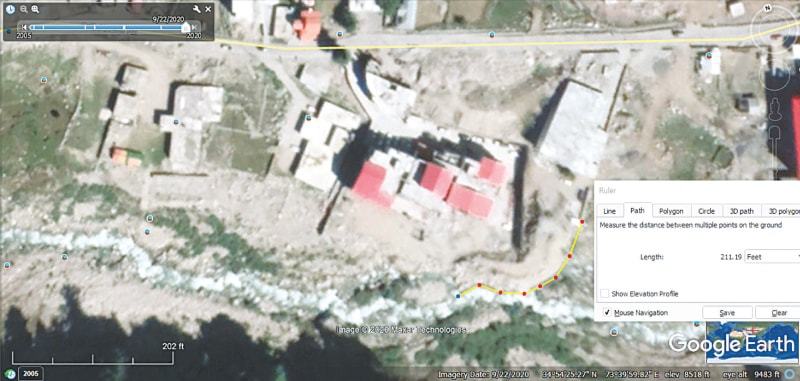
Kunhar River diverted at Sohach for gravel and sand mining (above: Sept 2006; below: Sept 2020) | Dawn GIS
The North-West Frontier Rivers Protection Ordinance, 2002 prohibits construction in the bed of the river. The ordinance also forbids lifting of the gravel in the riverbed. And yet, unfortunately, Kaghan Valley and Kunhar River are both playfields for the well-heeled.
A drive from Battakundi to Kiwai is a sombre testament to the ignorance and callousness of the locals and visitors alike. Heading towards Naran, once considered to be the jewel of the Kaghan Valley, one comes across excavators, dumpers and other earth-moving machines crawling near Sahoch Bridge, inside the riverbed.
Locals feasting in Naran’s Punjab Tikka House say that this is the biggest-ever gravel lifting operation they have witnessed in the Kunhar riverbed and that the excavations are being carried out round the clock for the last six months, in full view of public and district authorities.
According to Deputy Director Kaghan Development Authority (KDA), Mazhar Hussain, when KDA arrested the truck and excavator operators carrying out this massive operation in the riverbed, Syed Humayoun Shah, the brother-in-law of Mansehra’s PTI MPA Syed Ahmed Shah came to defend them. Eventually, the magistrate let them all off with minor fines. However, all attempts to contact Syed Ahmed Shah on the phone and Whatsapp remained unsuccessful and, despite several promises, he did not return calls.
The culprits were also able to brandish leases issued to them by the Khyber Pakhtunkhwa (KP) Mines and Minerals department. According to sources in the district authority, their attempts to stop riverbed mining also attracted the ire of none other than the Secretary, Mines and Minerals, KP.
Locals estimate that around 75 dumpers cross the Naran Bypass everyday, loaded with 8-10 cubic metres of sand and gravel from the riverbed near Sahoch, to the Suki Kinari Dam construction site. This dumper traffic has rendered Naran Bypass in complete shambles. It is estimated that, during the last six months, 125,000 cubic metres, or 200,000 tons, of gravel and sand has been lifted from the riverbed.
The Suki Kinari Hydro Power (SKHP) is an under-construction, run-of-the-river hydropower project being constructed some 20 miles downstream Naran on Kunhar River at Paludrah. The project was originally conceived in 1960 but remained dormant until March 2005, when the Private Power Infrastructure Board invited proposals for its construction. Yet, the project could not advance beyond the feasibility stage for one reason or the other.
Recently, Suki Kinari got a new lease of life. It is now being built under the China Pakistan Economic Corridor’s (CPEC’s) ‘Early Harvest’ projects. In August 2016, the KP government awarded the contract to a Sino-Pak consortium led by the Chinese state-owned Gezhouba Group and the SK Hydro group on a ‘Build, Own, Operate and Transfer’ basis. The Suki Kinari project cost is estimated at 1.8 billion US dollars and is being financed by the Industrial and Commercial Bank of China.
After completion, the dam shall be 54.5 metres high and 336 metres wide. The two-gated spillways and a three-kilometre long reservoir shall hold 9 million cubic metres of water. Its four turbines are expected to generate 870 MW of electricity. However, not only is the dam likely to disturb fish populations and silt-flow downstream, the sand and gravel lifting for its construction upstream will affect water-flow gradients during floods and create more erosion that could lead to the dam silting up at a much faster rate, impacting the long-term feasibility of this expensive project.
Encroachments in the riverbed
The illegally constructed NHA rest house near Naran currently lies sealed
According to sources in the Mansehra district administration, there are 257 blatant encroachments in the Kunhar riverbed and its tributaries. The district administration claims that they plan to move against these soon.
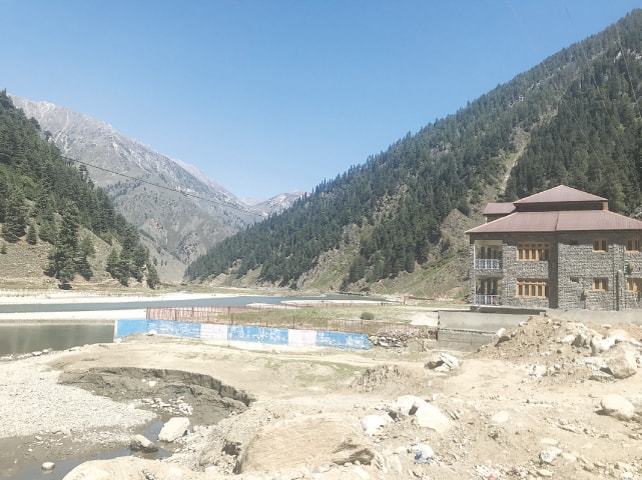
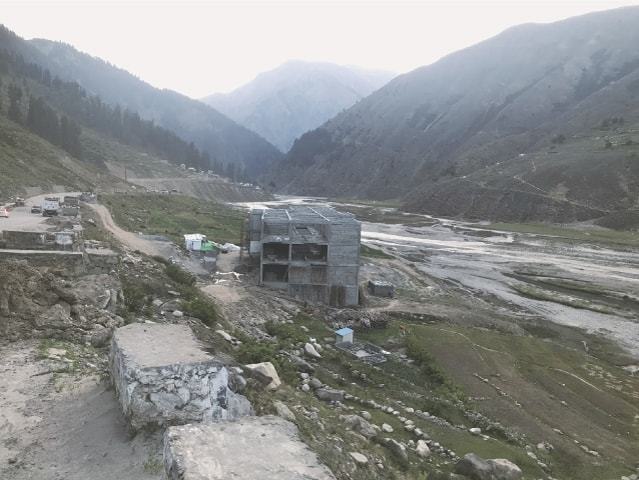
Near Sahoch a hotel is being built on an acre of land that’s either reclaimed in the riverbed or barely on the left bank of the Kunhar. Either way, it’s in violation of general prohibitions under the River Protection Ordinance 2002. It is widely alleged to be owned by a retired lieutenant general of the Pakistan army.
The next peculiar reclamation of land out of the Kunhar riverbed is between Dum Dama and Naran, where three acres of the riverbed have been encroached upon by the military-run Frontier Works Organisation (FWO), for a helipad and a maintenance base for trucks, excavators and other earth-moving machines — with muck and grease oozing into the river. Another six acres of the adjoining riverbed have also been fenced for unknown reasons.
Just a little ahead, the National Highway Authority (NHA) has built their rest house on an acre of reclaimed land inside the left bank. In an attempt to protect the rest house from the vagaries of the Kunhar, the NHA had to reclaim an additional acre of land upstream. Because of blatant violations of the River Protection Ordinance 2002, and illegal construction of the rest house in the riverbed, the KDA sealed the property and is awaiting orders for its demolition. Meanwhile, NHA bosses seem to be in a quandary, as they had already sublet the property to a private operator before the sealing orders, according to sources within the NHA.
The FWO has encroached on the riverbed between Dum Dama and Naran for helipad and maintenance base for vehicles | Dawn GIS
Naran town is situated on the left bank, about a mile off Kunhar River. Dozens of hotels have also been built on two sides of the Naran-Saiful Muluk Road. The town has changed beyond recognition during the last 10 years, with hundreds of densely built hotels, shops and restaurants in the town centre dominating the scenery. More than 60 percent of the 5,000 or so hotel-rooms in Kaghan valley are cramped up in less than a quarter of a square mile, with an equal number of rooms sprouting up in Naran by the day.
Further up in the mountains, Lake Saiful Muluk, another key contributor to the Kunhar River, is located at the foot of Malika Parbat, east of Naran. The lake is rich in biodiversity, stuffed with large brown trout, many species of blue-green algae and over two dozen species of vascular and flowering plants. About a mile long, and half a mile wide, with an average depth of 150 feet, Saiful Muluk covers an area of over 12,000 acres, and is categorised as a glacier-fed lake. It is part of what is classified as a ‘permanent snow, alpine meadow’. Once known for stories of leprechauns dancing on its clear blue waters, Saiful Muluk is also racing towards an environmental disaster.
Thousands of tourists, encouraged by the increasingly dreadful sanitary conditions, callously toss their empty tetra pack cartons, plastic bags and oily newspapers that once held samosas and pakorras, in and around the lake. Occasionally, used baby diapers and other refuse can also be seen floating in the once pristine blue waters.
The North-West Frontier Rivers Protection Ordinance, 2002 prohibits construction in the bed of the river. The ordinance also forbids lifting of the gravel in the riverbed. And yet, unfortunately, Kaghan Valley and Kunhar River are both playfields for the well-heeled.
Many auto-workshops have also cropped up near the lake for the emergency service and repair of vintage Toyota Jeepsters, which are the primary means of transport for the tourists. Most of these open-air workshops service overheated engines, faulty hydraulics etc.
The land around the Kunhar tributary from Saiful Muluk drops 2,500 feet along the six-mile road to Naran, and belongs mostly to the forest department. However, several massive hotels are fast cropping up between the road and the Saiful Muluk nullah. Some of these hotels are encroaching well into the bed of the stream, known for flash floods. The largest of these hotels being built is in the name of Shamail Khan, son of another retired general, and encroaching on 200 feet of the nullah bed.
According to one of the directors of the KDA, the provincial secretary of his department, who raided the subject hotel, “appeared extremely remorseful the next day for having done so.”
Land along the Kunhar tributary from Lake Saiful Muluk has been encroached by a hotel being constructed by the son of a retired general | Dawn GIS
However, the North-West Frontier Rivers Protection Ordinance, 2002 provides that:
(1) Where an offence of encroachment upon a river or its tributary or indiscriminate disposal of solid waste or flow of untreated water into a river or their tributary is committed by a body corporate or a firm, then every director, manager, secretary, or officer of servant of the body corporate, or every partner, manager or official actively concerned in the conduct of business of such firm, as the case may be, shall be deemed to have committed the offence, unless he proves that the offence was committed without his knowledge or that he used all his efforts to prevent the commission of such an offence.
(2) Any offence committed by any person under this Ordinance shall be deemed to have been committed at the instance of the owner, landlord, employer, lessor, licenser, mortgager, manager and any other person in charge of the premises, building or land for the time being, and the burden of proving otherwise shall lie upon such person.
On the matter of punishments, the Ordinance states:
(1) Whoever is found guilty of an offence under the provisions of this Ordinance, shall be punished, with imprisonment which may extend to six months, or with fine which may extend to five hundred thousand rupees, or with both: Provided that the punishment of imprisonment, in no case, shall be less than one month and the amount of fine, in no case, shall be less than ten thousand rupees.
(2) Whoever fails to remove an encroachment within ten days of the receipt of a legal notice shall also be punished with the same punishment as mentioned in subsection (1)
Gravel and sand mining
For thousands of years, sand and gravel have been used in the construction of roads and buildings. However, unregulated sand mining has resulted in the erosion of riverbanks, increasing flooding and causing a severe threat to biodiversity.
“Channel incision is the most common physical impact of sand and gravel mining whereas habitat disturbance, alteration of riparian zones, and changes to downstream sediment transport are other serious impacts of this uncontrolled activity,” says Muhammad Moazzam Khan, Technical Adviser to WWF Pakistan. “Ecosystem attributes affected included macroinvertebrate drift, fish movements, species abundance and community structures, and food web dynamics.”
According to a post on the IUCN ‘Red List of Ecosystems’ website, despite the countless benefits that river ecosystems bring, today they are among the most threatened on the planet. The increasing use of land and associated channeling (dams and hydroelectric plants) have led to the deterioration of the functions and services of these river landscapes.
The illicit gravel and sand mining in the Kunhar riverbed is a serious cause of concern for environmental experts. Mindless excavation lowers the riverbed in different spots, which results in localised changes in gradient and sudden consequent increase in flow velocities. During flood seasons, an abrupt change in bed-gradient amplifies the rate of bed erosion, triggering massive quantities of gravel and sand to move downstream.
Another under-construction hotel in the riverbed near Sahoch allegedly owned by a another retired general
According to sources in the Mansehra district administration, no government agency has conducted any study to assess as to where or how much sand and gravel mining is possible in the bed of Kunhar River.
On September 22, 2020, Dawn reported, “…the chief secretary has written a letter to the Mines and Mineral secretary saying the river sand and gravel [that] is widely being exploited as aggregate for construction is often mined directly from the river channel, floodplain and adjacent river terrace deposits.”
The letter noted that the Mines and Minerals department, in most cases, had issued leases and licences for such mining. “Also, there are reportedly illegal extractions along riverbanks in the province, especially in [the] tourist areas of Malakand and Hazara divisions,” the letter had further stated.
The chief secretary’s office had added that KP Chief Minister Mahmood Khan had ordered a halt to riverbed mining in a recent cabinet meeting, claiming that the impact on the environment was much more than the revenue generated for the government from such activity.
Even earlier, the deputy commissioner Mansehra had repeatedly imposed Section 144, banning the lifting of sand and gravel in the Kunhar riverbed. But through sheer abuse of political power, wholesale corruption in the system and the turning of a blind eye by the Suki Kinari consortium, massive illegal mining activity continues unabated till date.
Killing it softly
Of late, Pakistan has been struck by more than a dozen furious storms, followed by massive flooding, substantial loss of lives and damage to infrastructure. Such events match the World Meteorological Organisation’s projections of frequent and intense weather events during the years to come.
Thoughtless construction and quick solutions only exacerbate the problem.
Desirable change can be brought about if the government is vigilant. We have seen this the past. In December 2010, the Poonch River, its tributaries and their beds were designated as River Poonch Mahseer National Park. According to Sardar Javaid Ayub, secretary Wildlife, Fisheries & Tourism in Azad Jammu and Kashmir (AJK), over the past decade, ever since there have been checks on the illegal lifting of gravel and sand and illegal fishing, the population of the Mahseer fish has multiplied “several folds.”
The Kunhar River | Dawn GIS
“Due to human interventions, usually illegal mining and in-bed constructions by the powerful and the greedy, water channels erode laterally and vertically,” Ayub tells Eos. “Such activities result in flooding, and damage to the natural habitat of endangered species and existing infrastructure in and around the channel.”
Writer Amit Kalantri once wrote, “A river doesn’t just carry water, it carries life.” And so the death of a river doesn’t just impact water, but the life within it. While Kunhar River is an integral part of Pakistan, it is also a natural habitat for many species.
A study conducted by Khalid Usman et al to identify fish fauna at different sampling sites in River Kunhar was published in the Journal of Entomology and Zoology Studies in 2016. Fish samples were identified by using various keys and literature. According to the study, Cyprinidae also known as “carp” are the most commonly found fish in Kunhar River. But other species, such as Nemacheilidae or stone loaches (pathar chatta), a family of traditional bony fish, Salmonidae — ray-finned fishes which include salmon and trout — and Sisoridae — catfish that live in fast-moving waters and often have adaptations that allow them to cling to things in their habitats — are also plentiful in the river.
The study concluded that an increase in anthropogenic activities and pollution — resulting from human activity, illegal fishing and tourism — is threatening the decline of fish fauna in River Kunhar. If requisite conservation steps are not taken, it will result in the endangerment of fish in the river Kunhar.
While the Kaghan Development Authority has recently acquired some machines and equipment for solid waste management, because of topographic challenges, the safe disposal of the solid waste or sewage generated by tourists and the local population appears to be a Herculean task.
Over-pumping of underground water is also putting great pressure on the Kunhar. A rampant VIP culture and political compromises, and an extremely weak enforcement effort by the wildlife department is acutely affecting the safety of migratory and resident fowl, as well as other threatened wildlife.
It is high time we took thoughtful action and learnt to co-exist with nature. We must let the rivers flow freely, and not force them to fight back. Because humankind is no match for Nature’s wrath when it comes.
The writer is a former administrator of Karachi, currently working with the Dawn Media Group
An Indian representative, for perhaps the first time from a global platform, queried this selectivity in a sober, historically accurate and effective manner.
The shambles which is the United Nations with its in-built hypocrisies and behind-the-scenes puppeteers was clinically exposed by India at the UNHQ on Thursday. Fostering of a culture of peace and condemnation of violence against religious groups, the Indian First Secretary to its UN Mission told the General Assembly, cannot be restricted to Abrahamic faiths.
“This august body fails to acknowledge the rise of hatred and violence against Buddhism, Hinduism and Sikhism… India agrees fully that anti-Semitism, Islamaphobia and anti-Christian acts need to be condemned and we firmly condemn such acts… (but) UN resolutions on such important issues speak only of these three Abrahamic religions,” he said while referring to the UN draft resolution on the Freedom of Religion or Belief.
An Indian representative, for perhaps the first time from a global platform, queried this selectivity in a sober, historically accurate and effective manner. It was about time someone called out the double standards of the mutually beneficial global talk-shop for warring Abrahamic traditions in their avatars as post-World War II nation-states that the UN has essentially become.
These countries, it ought to be kept in mind, are not too different ~ with honourable exceptions ~ from the religious monarchical states that fought the viciously violent Crusades in the medieval era. It ought to be a matter of pride for every Indian that it was our representative at the UN who belled the cat, as it were. But this is just the beginning and those with a sense of history would do well not to get carried away.
The political and by extension media narrative is already indulging in juvenile one-upmanship by focussing on the specifics which were cited by India at the UNGA merely as illustrations which do not in any way constitute the definitive stand of the Indian State.
So, while it is true that Pakistan’s move to hand over the decision-making role in the management of the Kartarpur Sahib Gurudwara to non-Sikhs, the Taliban’s blowing up of the Bamiyan Buddhas, the ethnic cleansing of Hindus from Kashmir and the rising tide of Hinduphobia particularly but not exclusively in South Asia are all contemptible, that is not the full story. It is a mindset that needs to change.
And that is a process, not an event. For example, those who (rightly) lionise a towering intellectual such as Edward Said for his pathbreaking academic work in explaining the fault lines between the Islamic and Judeo-Christian traditions, or East and West, fail to even recognise arguably the most seminal philosophical work of the 20th century in locating the Indic dharmic traditions’ encounters with Abrahamic religions by the brilliant academic SN Balagangadhara.
Last but not least, the normalisation of the nomenclature ‘religion’ to define Hindus, Buddhists, Sikhs and followers of other non-Abrahamic traditions needs to be resisted with far greater intellectual force than has been hitherto exhibited.
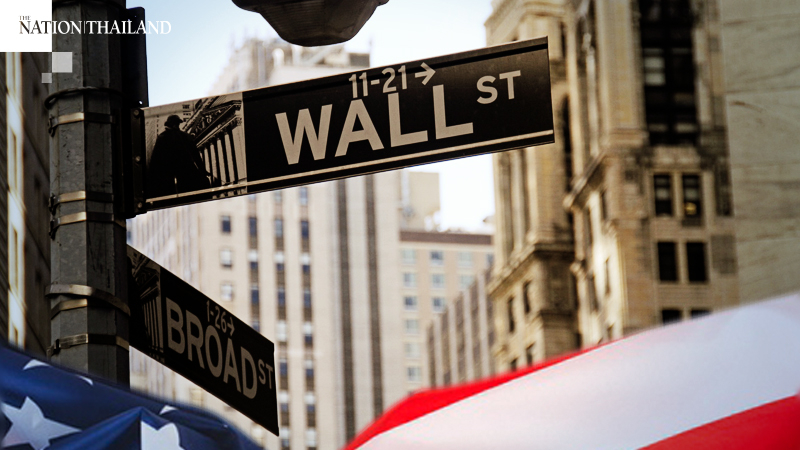
There are only a few basic rules of investing: diversify, keep your costs low and probably most important, hang on when markets tumble occasionally. The last one is the trickiest. It’s not easy watching money vanish as the market plunges, particularly when many people, some of them highly respected, are carping about the end of the world, which invariably accompanies a market collapse.
So it was when covid-19 sent U.S. stocks into a tailspin in late February. The S&P 500 Index shed a third of its value in just more than four weeks, one of the steepest retreats on record, amid widespread chatter that the pandemic would plunge the U.S. into a long depression, wiping out whole industries and permanently damaging broad swaths of the economy.
Hanging on to stocks through that chaos was no small feat, and amazingly, most investors managed to do it. Research firm Dalbar, which attempts to track investors’ moves into and out of mutual funds, concluded in a recent report that “the average investor’s appetite for equities has remained unchanged throughout the covid crisis.” Vanguard Group, which oversees more than $6 trillion in assets, found that less than 0.5% of its retail clients and self-directed investors in its retirement plans panicked and moved to all cash between Feb.19, the market’s pre-coronavirus peak, and May 31.
That’s a big change from previous meltdowns, most recently the 2008 financial crisis, when investors dumped stocks in droves. It seems to have finally sunk in that all crises pass and that the stock market eventually recovers, no matter how desperate things seem at the time.
And true to form, the market recovered sooner than anyone expected. It shot higher in late March and surpassed its pre-covid high in August, even as the coronavirus showed few signs of slowing. As it turned out, the recovery began roughly eight months before news arrived that a highly effective vaccine is in hand and will start to be distributed soon. That sounds about right.
Those who dumped their stocks along the way, gambling that the market is poised for a long slump and would give them an opening to reenter at even lower prices, now face a hard choice. The market is up roughly 60% from its March low, so getting back in means coming to terms with a costly mistake. Say you had $100,000 in the market at the pre-coronavirus peak and sold roughly halfway down, recovering about $83,000. If you had stayed in the market, you would have roughly $107,000 today, or close to 30% more money than when you exited. That’s tough to swallow.
But the alternative is worse. The temptation is to wait stubbornly for the market to revisit its lows, a day that may never come. During the financial crisis, the market turned sharply higher in March 2009, even though it was not yet evident that a collapse of the financial system would be averted. When the all-clear came several months later, the market had risen roughly 60% through October.
Sound familiar? Investors who dumped their stocks during the financial crisis faced the same choice modern-day deserters do now. Those who jumped back in after the crisis eased in 2009 have more than tripled their money despite buying back at what must have seemed like an outrageous price at the time, while those who waited for the elusive ideal reentry are still waiting.
There are countless other examples. With rare exception, when the market surges from the depths of a crisis, it’s a signal that it has moved on, even if some investors have not. Chances are, the market has moved on from covid-19, and investors should, too.
The next time – and yes, there will be a next time – investors are tempted to dump their stocks during a crisis, they should focus not on getting out but getting back in. That should clarify the wisdom of staying put. No one can anticipate the bottom in advance, which means that the reentry will either be too early or too late. And too early is unrealistic. If you’re tempted to run for the exit when the market is down 20%, you probably won’t be in the mood to buy when it’s down 30% or more. That leaves one alternative: buying late, which is the pickle some investors are in now. It’s best to avoid that quandary altogether by remaining invested.
For now, those who got out should recognize that there will never be a better time to get back in, at least one that can be known in advance.
– – –
Kaissar is a Bloomberg Opinion columnist covering the markets. He is the founder of Unison Advisors, an asset management firm. He has worked as a lawyer at Sullivan & Cromwell and a consultant at Ernst & Young.
Putting up the Christmas tree over the weekend, I was reminded once again of all the plans that came to naught this year, including long-planned trips.
Among the ornaments that hang on the tree are baubles and trinkets bought on trips abroad — a rough, handmade snowman bought at an Amish village in Pennsylvania, a Tiffany-style glass ball picked up on a rushed weekend trip to New York. Collected over the years, they remind us of our times there. It goes without saying that there were no new ornaments this year — except for the red felt cloth cross that my daughter bought at Ely Cathedral in England just before the pandemic forced her to return early from her junior semester abroad. Looking for just the right spot on the tree for the cross, I was nevertheless grateful that the family was together and that we were all safe.
It has been a year like no other for everyone around the world. The news of a cluster of pneumonia cases in the Chinese city of Wuhan came to our attention at the end of last year and within a few weeks, the world learned about the emergence of a new respiratory illness, one that is highly contagious and sometimes fatal. Nearly a year later, the world is in the throes of yet another surge of the novel coronavirus.
Without sure means of preventing the spread of the disease, many countries have gone into various forms of lockdown. With its roots going back to the medieval practice of sealing off villages to prevent the spread of the bubonic plague, the word “lockdown” has an air of fatality about it. In the 21st century, with all its technological and medical advances, humans find themselves hapless against an invisible virus that has sickened more than 60.1 million people around the world and killed more than 1.4 million. No country has been spared the virus.
Around this time of the year, Christmas lights light up the streets, carols blare out from shops and merrymakers fill restaurants and bars, celebrating the year-end. But not so this year.
Any social plans for the rest of the year were canceled overnight as the government announced stricter social distancing measures. On Monday, the Seoul Metropolitan Government announced an “emergency pause for 10 million citizens,” urging Seoulites to stay put until the end of the year.
This week came the news of yet another successful COVID-19 vaccine trial, meaning that three vaccines developed by Pfizer-BioNTech, Moderna and AstraZeneca-Oxford University will be made available as soon as they receive regulatory approval.
The vaccine developed by AstraZeneca and Oxford University is reported to be 90 percent effective depending on the dosage, and the other two vaccines report 95 percent effectiveness. There is a light at the end of the tunnel, after all.
Not all countries will have quick access to the vaccines, however. While vaccinations could start as early as mid-December in the US, vaccine rollout in South Korea is expected in March or April next year.
How we ensure that the vaccines are distributed fairly and that the poorest and the most vulnerable are not left out is perhaps the next big challenge for the world. How do we make sure that it is not just the wealthy nations that have access to the vaccines, that the poorer countries will have equal access?
The recent virtual G-20 summit concluded without any concrete action plan for equitable distribution of lifesaving vaccines, leading German leader Angela Merkel to express concerns that poorer countries would not benefit from the vaccines, leaving billions of people unimmunized.
Speaking at a meeting hosted at the Moroccan ambassador’s residence in Seoul earlier this week, International Vaccine Institute Director General Jerome Kim echoed the same concerns. Noting that wealthy countries have secured the first 2 billion doses through preorder, Kim warned that without equitable distribution, we could see a doubling of global deaths.
As UN Secretary-General Antonio Guterres has said, “None of us is safe until all of us are safe.” No effort should be spared in getting COVID-19 treatments and vaccines to everyone who needs them.
Kim Hoo-ran is the culture desk editor at The Korea Herald. — Ed.


 President-elect Joe Biden
 Kaavan has spent nearly a decade alone. (Photo: Reuters)
  Timothy Snyder, the Levin Professor of History at Yale University.
 Sand and gravel excavators and dumpers near Sohach Bridge in what locals say is ‘the biggest-ever gravel-lifting operation in the Kunhar riverbed’ | Photos by the author / White Star



 SootinClaimon.Com