Biden faces a global economy that’s tired of U.S. antics #SootinClaimon.Com

#SootinClaimon.Com : ขอบคุณแหล่งข้อมูล : หนังสือพิมพ์ The Nation.

Biden faces a global economy that’s tired of U.S. antics

ColumnsNov 13. 2020President-elect Joe  BidenPresident-elect Joe Biden 

By Syndication Washington Post, Bloomberg Opinion · Ferdinando Giugliano · BUSINESS, US-GLOBAL-MARKETS 
The election of Joe Biden as U.S. president has prompted sighs of relief across the world – not least because his White House is expected to be a boon for the international economy.

Donald Trump’s erratic behavior on trade and currencies has weighed on foreign companies and governments while doing little to fulfill his domestic objectives. Even though it’s hard to say precisely how damaging the U.S. president’s economic agenda has been, especially with the recent Covid crisis, it’s caused enough uncertainty to undermine key global relationships and institutions. A challenge for Biden will be strengthening a multilateral framework that’s badly in need of repair. 

Trump started trade wars with China and the European Union, renegotiated the North American Free Trade Agreement and weakened the World Trade Organization. He tried to talk down the dollar repeatedly, despite a longstanding agreement among the world’s policymakers to avoid starting “currency wars.” His administration shunned the International Monetary Fund, stopping its efforts to provide greater help to emerging markets during the pandemic.

Far from putting the U.S. in a stronger position, “Trumponomics” largely failed to meet expectations. The country never grew by the 4% a year that Trump promised during the 2016 presidential campaign (it averaged 2.5% during the first three years of the administration). There was no return of sustained inflation that the financial markets had initially bet on. Protectionism failed to close the U.S. trade deficit: In August, the difference between what the U.S. buys from abroad and what it sells rose to $67 billion, a 14-year high, before narrowing slightly in September.

There was also little evidence of large-scale reshoring of companies and jobs from overseas. A recent survey from the American Chamber of Commerce in Shanghai showed that of more than 200 respondents that own or outsource manufacturing operations in China, only 3.7% were moving some production back into the U.S.

The president’s agenda negatively affected the private sector, too. Chief executives had to anxiously monitor Trump’s Twitter feed, fearing he’d sink their shares with a few derogatory tweets. Scott Baker, Nicholas Bloom and Steven Davis, three economists, showed that between 2018 and 2019, U.S. trade policy uncertainty reached its highest point since the mid-1990s. The three authors found that more than a third of the large daily moves in the U.S. stock market during these years were due to trade policy announcements – up from just 0.6% in all the years between 1900 and 2017. 

Globally, the pandemic makes it harder to measure the impact of Trump’s economic policy. However, last year, the IMF predicted the U.S.-China trade war alone would cost the world economy about 0.8% of output by 2020 – roughly $1 trillion.

The exact contours of Biden’s economic plans remain unclear. The ability to pass meaningful fiscal stimulus and alleviate pressure on the Fed will be crucial to a post-pandemic recovery. But the incoming U.S. administration should also seek to reinstate international coordination on economic policymaking. Trade and currency wars increase uncertainty and depress investment. Reversing this is crucial, given the pandemic’s effects on employment and output.

A first step is bringing trade conflicts to a peaceful resolution. As my colleague Noah Smith argues, this is straightforward when it comes to economies such as the EU that have similar wage levels, labor standards and environmental protection laws as the U.S.

The new Biden administration will also have to restore the full functionality of the WTO, after Trump emasculated its dispute settlement system. And the president-elect should restrain from talking down the dollar in an attempt to gain competitiveness for American goods. As the experience of the Trump administration has shown, this does little to help the trade balance but undermines the U.S. Federal Reserve’s independence. 

The U.S. may want to lead the way in other areas too, starting with the global tax system. The Organization for Economic Cooperation and Development is spearheading efforts to reduce tax avoidance, particularly from multinational corporations. But these have been undermined by American opposition. As Maurice Obstfeld, the IMF’s former chief economist, has argued, the U.S. should promote the completion and adoption of the OECD process, which would help restore faith in globalization. 

Finally, the U.S. will need to engage more constructively with the IMF. Many low- and middle-income countries are looking to the fund for support as the global slowdown hits their finances. The White House will need to consider increasing the size of the IMF’s firepower to boost lending and work with it to streamline debt restructuring procedures for countries that risk becoming insolvent.

For the past 75 years, the U.S. has been the guardian of the international economic and financial architecture. The world is ready for the country to resume that role.

– – – 

This column does not necessarily reflect the opinion of the editorial board or Bloomberg LP and its owners. Ferdinando Giugliano is also an economics columnist for La Repubblica and was a member of the editorial board of the Financial Times.
Is Thailand prepared for the carbon war? #SootinClaimon.Com

#SootinClaimon.Com : ขอบคุณแหล่งข้อมูล : หนังสือพิมพ์ The Nation.

Is Thailand prepared for the carbon war?

ColumnsNov 13. 2020

By The Nation Editorial

The result of the US presidential election was clear, and means that Joe Biden will be sworn in on January 20, 2021.

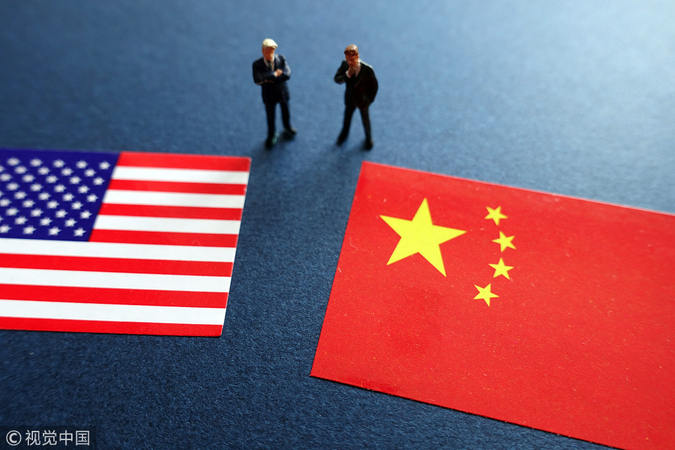
Most observers agree that a Biden presidency will ease tensions in the US-China trade war triggered by his predecessor Donald Trump, helping stabilise the global economy once again.

However, there are concerns that Biden appears to be working with European partners to counter China with what could turn into a technology war, spearheaded by America’s return to the Paris Climate Agreement. Biden has prioritised signing back up to the agreement, which Trump withdrew from in 2017.

During his campaign, Biden declared that the United States would hold a meeting of more than 190 world leaders at next year’s Paris climate change conference (COP21) to set more ambitious goals in reducing greenhouse gas emissions that cause global warming.

Among the outcomes of this meeting will be a US policy to label imports with information on their carbon footprint. The labels will give consumers details of imported products’ carbon content or greenhouse gases emissions throughout their service life. More significantly, carbon tariffs will be imposed on imports – pushing up the price of products with a larger carbon footprint.

Is Thailand ready to tackle this new climate policy?

On the bright side, we may benefit from the United States’ return to COP21. The US will become an important ally in reducing global warming after Thailand signed an agreement to reduce its greenhouse gas emissions (GGE) by 20-25 per cent by the year 2030.

In 2017, Thailand recorded a GGE reduction of approximately 14 per cent, mainly from power plants and transportation.

Thailand’s renewable energy development plan targets 30-per-cent usage of clean energy by 2037, a goal that may lead to easier trade negotiations with the US.

Thai exporters are already preparing for carbon-footprint policies, and many are now working with international certification bodies to measure their emissions and certify their labelling for consumers.

Thailand is currently considered the most carbon-sensitive economy in Asean, with products registered with the Thailand Greenhouse Gas Management Organisation (TGO).

About 4,472 Thailand-made products have already been labelled by the TGO, most of them in the food and beverage sector, followed by construction, petroleum and jewellery.

However, there are tens of thousands of products that are not yet ready. If carbon taxes are imposed by the US and other countries, they will certainly affect both the price and the competitiveness of Thai exports.

Therefore, businesses who export their products to the United States must adapt quickly and prepare for the new US policy to reduce global warming. Although their manufacturing costs will increase, the benefits will soon become obvious. In the end, the whole world will have to play by the same rules. Thai businesses that can adapt quickly to the new carbon tariffs will get a head start on the competition.

Trump wasn’t wrong about China. But here’s how Biden can do a better job. #SootinClaimon.Com

#SootinClaimon.Com : ขอบคุณแหล่งข้อมูล : หนังสือพิมพ์ The Nation.

Trump wasn’t wrong about China. But here’s how Biden can do a better job.

ColumnsNov 12. 2020

By Special To The Washington Post · Stewart Baker · OPINION, OP-ED 

I have been in government for three changes of administration from one party to the next, and there is one mistake the new team always makes. Winning a presidential election feels like proof that you’re smarter than the other side and in better touch with the desires of the American people. That makes it easy to reject everything the previous administration did and simply restore the old order.

But invariably much history has unfolded in the previous years, and that can’t be ignored. Assuming the electoral vote holds, President-elect Joe Biden’s team will find that one of the most significant changes during President Donald Trump’s time in office has involved America’s economic relationship with China.

Officials in the new administration may not like the way Trump confronted China over trade. But the trade war is entrenched on both sides now; it isn’t something they can wish away. And the Chinese supply-chain interruptions we’ve seen during the pandemic will pose a risk in any future conflict. 

How to deal with the risks to homeland and national security posed by trade with China (and Russia) is the focus of a report by the Department of Homeland Security Advisory Council that is scheduled to be released Thursday. I took part in the study, which reinforces and adds to recent bipartisan supply-chain recommendations of the Cyberspace Solarium Commission. 

The danger from U.S. dependence on trade with China has been growing across more than three decades. Administrations before Trump’s clung to an increasingly forlorn hope that opening U.S. markets to Chinese goods would mean cheaper materials for U.S. industries and a growing Chinese commitment to democracy and open markets.

By 2016, though, China’s aims were clear: Create a domestic alternative to practically every technology it bought from the United States, then allow these Chinese tech companies to squeeze out their Western competitors. Safe from competition at home, the flourishing Chinese companies could target foreign markets, too. Meanwhile, the doctrine of “civil-military fusion” would ensure that the People’s Liberation Army benefited from its domestic commercial technology development.

Nothing did more to shape American perceptions of China’s economic plans than the start of the coronavirus crisis, when an op-ed on China’s official news site gloated openly about the leverage that China could exercise over the United States as American deaths began to mount. “If China prohibits the export of masks to the United States,” it said, “the United States will fall into a mask shortage.” And if China banned exports of pharmaceuticals, “the United States would sink into the hell of a novel coronavirus epidemic.” 

That was the moment when many Americans realized that relying on Chinese imports was not the same as relying on imports from, say, Mexico or Italy. In a crisis, when the imports mattered most, they might be held hostage to China’s national-security priorities.

One theme stands out in the reports by DHS’s Security Advisory Council and the Cyberspace Solarium Commission: The United States, facing a major competitor that embraces state-directed industrial policies, must undertake defensive industrial planning of its own. Yes, America is temperamentally and ideologically opposed to such policies, but the nation has taken such steps before, during the Korean War, amid Cold War tensions in the 1980s – and just this year, in allocating scarce medical resources during the covid-19 pandemic.

It is time to rebuild those capabilities purposefully, under a coordinated plan that identifies and ensures the security of industries that the U.S. economy and its military rely on in a crisis.

Central to planning for future crises is the DHS, which might as well be called the Department of Horrible Surprises, given that it is already responsible for responding to everything from hurricanes and terrorist atrocities to cyberattacks on civilian infrastructure. The department’s cybersecurity agency already includes a risk management arm that knows which parts of the nation’s infrastructure must function in a crisis. The Federal Emergency Management Agency already plans for recovery from disasters.

DHS agencies charged with planning for disaster need to ask whether the nation’s response could be derailed by an adversary country that controls the supply of critical components. And given its authority to engage directly with U.S. private companies in a way the rest of the intelligence community cannot, DHS should become the center of a broader joint supply-chain intelligence effort that works more closely with the private sector, where most of the country’s purchasing power and most of its risk can be found.

Biden is already signaling that he wants to use Cold War authorities to overcome the supply-chain challenges posed by the pandemic. That’s a good first step. But in the next crisis, the shortages could be in electric transformers or rare earths or basic computer components – and we’d better be ready.

– – –

Baker is a former assistant secretary for policy in the Department of Homeland Security.

The election through Warren Buffett’s eyes #SootinClaimon.Com

#SootinClaimon.Com : ขอบคุณแหล่งข้อมูล : หนังสือพิมพ์ The Nation.

The election through Warren Buffett’s eyes

ColumnsNov 07. 2020Warren Buffett, chairman and chief executive officer of Berkshire Hathaway, is seen on a laptop computer speaking during the virtual Berkshire Hathaway annual shareholders meeting on May 2, 2020. MUST CREDIT: Bloomberg photo by Andrew Harrer.Warren Buffett, chairman and chief executive officer of Berkshire Hathaway, is seen on a laptop computer speaking during the virtual Berkshire Hathaway annual shareholders meeting on May 2, 2020. MUST CREDIT: Bloomberg photo by Andrew Harrer. 

By Syndication Washington Post, Bloomberg Opinion · Tara Lachapelle · OPINION, BUSINESS, US-GLOBAL-MARKETS 
Warren Buffett has always taken the stance that regardless of who is president or which party holds power, each generation of Americans will be better off than the one that came before it – even if dark moments test our ability to believe it so. 

But that’s not to say the outcome of this election doesn’t matter. It’s pivotal for wealthy people like the 90-year-old Buffett, the future profits of Berkshire Hathaway and the lives of the 392,000 workers his conglomerate employs. Taxes, health care, energy policy and Covid-19 are just some of the big issues on the table and Berkshire – with interests in a range of industries – is a good proxy to gauge the impact any changes may have on businesses as a whole. Berkshire also shows how none of those other issues can be tackled without first reducing the threat of the coronavirus – because when it spreads, everything stops.

On Saturday, Berkshire is set to report third-quarter results. The easing of lockdowns during the period likely made for an improvement from the June quarter, when operating profit slid 10% and Berkshire took a $10 billion impairment charge on Precision Castparts, an aerospace-parts manufacturing subsidiary. Still, the latest results will show at a high level that covid remains the No. 1 challenge across Berkshire’s smorgasbord of businesses – whether it be the BNSF railroad that transports goods and materials, the various Berkshire-owned retailers suffering from a traffic slowdown, or the restaurant-equipment maker Marmon feeling the knock-on effects of an industry under stress. If there’s a silver lining to a year spent at home, though, it’s that auto-insurance claims at Berkshire’s Geico division are down because of fewer accidents. 

Joe Biden promises more aggressive measures to stem the spread of covid, including a national mask mandate, which is a trade-off businesses would take if it meant staying open. But he also promises higher taxes: for corporations like Berkshire, but also for top earners like Buffett. For his part, Buffett doesn’t begrudge paying more. The billionaire has lamented for years that his office staff have paid a higher tax rate than he has. At a Berkshire shareholder meeting eight years ago, Buffett highlighted some eye-opening findings: He said that in 1992, the top 400 incomes in the U.S. averaged out to $45 million, and of those only 16 were taxed at or below the roughly 15% standard rate. Fast forward less than two decades and the average top 400 incomes had swelled to an astounding $270 million; of those, 131 were paying less than 15%. He went on:

“When we’re asking for shared sacrifice from the American public, when we’re telling people that were formerly given promises on Social Security and Medicare and various things, and we’re telling them we’re sorry but we kind of overpromised and have to cut back a little, I would at least make sure that people with these huge incomes get taxed at a rate that is commensurate with what they used to be taxed at not that long ago. The tax law has gotten moved over the years in a way to favor people who make huge amounts of money.”

Buffett’s concern about the lopsidedness of the nation’s tax system led former President Barack Obama to introduce the “Buffett Rule,” which proposed a minimum 30% tax for anyone earning at least $1 million a year. Republicans blocked the effort, and Trump later went on to instead implement a tax cut that was skewed toward the rich. For his part, Biden says he will raise taxes on households making $400,000 a year or more, which isn’t quite what Buffett had in mind. Buffett is also a proponent of expanding the earned income tax credit rather than raising the minimum wage, as Biden has campaigned on. Buffett says a higher minimum wage can backfire and reduce jobs, but “Expand the EITC” doesn’t have the same ring to it. 

Buffett may not have been all that consumed with the machinations of the presidential race, but the pandemic clearly shook him, and government’s mishandling of the virus has cost him. When Buffett said at the virtual shareholder meeting in May that he believes “nothing can stop America,” it was the first time he wasn’t convincing – partly because his words were mismatched by a somber tone, and partly because a virus had very literally stopped America. The economy is better now than it was then, but Berkshire’s earnings will likely show that there’s a long road back to normal.

The Rollercoaster of all Elections #SootinClaimon.Com

#SootinClaimon.Com : ขอบคุณแหล่งข้อมูล : หนังสือพิมพ์ The Nation.

The Rollercoaster of all Elections

ColumnsNov 06. 2020

American voters have made their choice.   But the margins are so narrow that we will only know who wins after all the mail-in ballots are counted.  Trump has already tweeted “stop the count” and legal challenges will be mounted.   In this highly controversial election, the first day of counting showed that the polls predicting a landslide win for Biden were wrong.  Most Republicans voted in person, whereas Democrats depended on the mail-in votes that would be counted late.   Stalwart Republican Senator Lindsay Graham and Senate Majority Leader Mitch McConnell comfortably held their seats and continued to control the Senate.   The Republican right is far more entrenched than expected.

This historical record voter turnover only revealed that the United States remains deeply polarized along race, religion and ideological grounds.  Billions around the world were riveted on the screens, drawing important lessons about how electoral democracy works in theory and practice.   If Biden loses by legal challenge or recounts, the Democrats would have twice won significant majorities in terms of votes, as in 2016, but still lost the presidency because of the complex electoral college system.  Furthermore, the convoluted laws governing counting are different for each state, which means that narrow margins of victory will be subject to very contentious legal challenges over fraud and rigging.  In theory, the trinity of executive, judiciary and legislature provide the checks and balance for electoral fairness.  But if the Supreme Court, Senate and state governments are controlled by the Republicans, a Democrat President will have trouble getting executive decisions through, even with an electoral majority, as Obama and Clinton found in their presidencies. 

Most non-Americans are puzzled why after the mishandling of the pandemic that allowed more than 240,000 deaths, Trump still won over another 8% of the voters on top of his solid 40% support base.  The pollsters were wrong in not tracking how Trump showed courage by rallying his supporters to go house-to-house campaigning to gather new voters, despite the infection risks.  Trump was clearly able to mobilize his supporters’ anger to vote in person.  The Democrats never saw this tidal wave of Republicans who showed up making the record turnout a close call rather than a Blue Wave for the Democrats.

Trump instinctively understood that electoral politics have always been about gut and emotions, so his actions appealed to those who liked his blood and guts push for change from Democratic liberal policies that wanted a return to Obama style normalcy.    The benchmark model for democratic elections has now descended into banana republic-style accusations of vote fraud and election-rigging. 

Given this narrow margin, the transition to the January 2021 swearing in of the new President will be fraught with legal challenges and uncertainties.  Trump will remain in charge of the Executive for another two months and a half amidst an acceleration of coronavirus infections and rising death rates.  With the pandemic again reaching a record 100,000 cases and over 1,000 deaths per day, the damage to the economy has already been done.  

This being the likely scenario, the winning candidate will have to spend all his energies controlling the coronavirus in 2021.  Winter will not be good because the pandemic is still raging almost everywhere except in East Asia.  

We have realistically a situation where the election has only confirmed that the United States is a seriously polarized unipolar power trying to manage its leadership of a multipolarized multi-power world.  The traditional view of the US President’s power is that he has more power to conduct foreign policy than domestic policy, because of the internal checks and balances.  But weakened domestic consensus damages his foreign policy options. 

First, the pandemic shock has narrowed the economic gap between the United States and China.  With GDP declining by 4.3% this year to $20.3 trillion, China’s estimated GDP growth at 1.9% in 2020 would put her GDP at market exchange rates at $15.2 trillion, bringing the gap down to $5.1 trillion.  Different growth speeds, plus an appreciating RMB buoyed by continued trade surpluses, would narrow the gap faster than the expected 2030 parity date.

Second, as everywhere else is still struggling to control the coronavirus, the remaining growth region is East Asia, which is closely networked to the Chinese global supply chain. 

Third, US tech war against China has only served to apply more pressure for China to accelerate her R&D in technology, especially to narrow the gap in the semi-conductor chip area. 

Fourth, none of the legacy problems of US intervention in the Middle East have gone away.  Rather, the global slowdown, depressed oil prices and fractious politics can only make border conflicts and the Arab/Iranian tensions worse.  Trump wants to pull out of Afghanistan, Iraq and Syria, but cannot do so without serious damage to US prestige and influence in the region.  As geopolitical analyst George Friedman correctly surmises, foreign policy for the self-appointed global policeman is often determined by other countries rather than the intentions of the President.  Accidents and unanticipated events, such as the recent Azerbajian-Armenian conflict, can easily escalate with Russia, Turkey and other regional powers involved.

All in all, the global rollercoaster ride, with Donald Trump at the helm since 2016, will not end with the November 2020 elections.  If anything, amidst the pandemic, its twists and turns will not stop.  With weakened mandates, Trump would be willing to take even bigger gambits when the chips are down, whereas Biden may struggle to deal with the mess he has inherited.  All the elections have shown is that the struggle between polarized and fractured factions within nations and between nations is only just beginning. 

Many of us had hoped for a return to quieter times.  But the beginning of the 2020s has shown that we are spiralling in unpredictable directions.   Buckle down for tougher times.

Bicentennial of the first raising of the Argentine flag in the Malvinas Islands #SootinClaimon.Com

#SootinClaimon.Com : ขอบคุณแหล่งข้อมูล : หนังสือพิมพ์ The Nation.

Bicentennial of the first raising of the Argentine flag in the Malvinas Islands

ColumnsNov 06. 2020H.E. Mr. Felipe Solá,

Minister of Foreign Affairs, International Trade and Worship of the Argentine Republic.
H.E. Mr. Felipe Solá, Minister of Foreign Affairs, International Trade and Worship of the Argentine Republic. 

By H.E. Mr. Felipe Solá
Minister of Foreign Affairs, International Trade and Worship of the Argentine Republic
November 6th 2020 marks an anniversary of great relevance in the protracted sovereignty dispute over the Question of the Malvinas Islands: on this date, two hundred years ago, David Jewett took possession of the Malvinas Islands, raising the Argentine flag in the Islands for the first time.

At the time of the May Revolution, the Malvinas Islands –which had been disputed between Spain, France and Great Britain in the 18th Century- were under the sovereignty of the Spanish authorities, which had an exclusive, effective and uninterrupted possession, unchallenged by Great Britain or any other foreign power. As successor State of Spain, those sovereignty rights passed on to Argentina.

The Spanish presence on the Islands came to an end on February 13 1811, when the last Governor of Malvinas during the viceroyalty times withdrew from the Islands, in the context of the conflict with Buenos Aires’ Primera Junta.

In spite of the Spanish withdrawal, the Malvinas Islands did not remain unoccupied or forgotten. A fluid circulation of goods, capitals and people continued to develop with the archipelago, thanks to its natural resources: sea lions and elephant seals, whales and wild livestock. British, North American, French and Argentine ships exploited those resources and used the islands’ and continent’s shoreline for docking, hunting and dressing stations. These activities drew the attention of Buenos Aires’ authorities, which, since 1813, had issued fishing permits, established regulations to prevent the depredation of resources and controlled the establishing of any permanent settlement in the region.

It is in that context that the raising of the national flag and the presence of David Jewett, a United States’ national at the service of the Argentine Navy, gains special relevance.

Since the outset of the independence process in Latin America in 1810, the new national governments had to fight the royalist power that opposed them from sea and land. David Jewett, as many other North American and European sailors, would join the fight at the service of the United Provinces, until 1817.

In January 1820, the Supreme Director of the United Provinces, José Rondeau, named David Jewett as ‘Army colonel at the service of the navy’, with all the attributions and prerogatives it entailed. He set sail on January 20 towards the South Atlantic in command of the frigate “La Heroína”, which was recognized by the Argentine government as a state warship.

By the end of October 1820, ten harsh months later, he reached Puerto Soledad in the Malvinas Islands, where he found vessels of different origins that called at that port temporarily as part of their hunting and fishing trips in the region.

On November 2nd, Jewett sent the other captains a circular informing them that he had been commissioned by the Government of the United Provinces to take possession of the archipelago and invited the other captains to meet him. He also pointed out that, in compliance with the rules set out by the authorities of Buenos Aires, he would seek to prevent the destruction of the Islands’ resources. On November 6th 1820, a ceremony was held where Jewett took possession of the Islands. According to witnesses like British captain James Weddell –who comments on it in his famous ‘A voyage to the South Pole (1822-1824)- and Frenchmen Louis Freycinet, colonel Jewett raised the Argentine flag, read a proclamation and fired 21 cannon shots in the name of the government of Buenos Aires, before the crews of the ships anchored at Puerto Soledad.

Three days later Jewett delivered to the captains present a circular in which he gave an account of the taking of possession of the Malvinas Islands on behalf of the Supreme Government of the United Provinces of South America, and of his willingness to act with justice and hospitality towards foreigners, also requesting that this information be communicated to other vessels.

The circular had a great repercussion in the international press. On August 3, the British newspaper The Times published an article in which it presented Jewett’s act as an act of sovereignty, as did the newspaper El Argos de Buenos Ayres in November.

While news of the events that took place in the Malvinas Islands continued to spread, Jewett stayed on the Islands for several months. He exercised his authority during his stay and until February 1821, when he requested the authorities of Buenos Aires to relieve him of his command. Guillermo Robert Mason was appointed as the new commander of La Heroína.

The solemn taking of possession of the Malvinas Islands was an official and public act which demonstrated the effective exercise of Argentine sovereignty -inherited from Spain-, received wide attention and was not contested by the United Kingdom (nor did it do so in 1825, when it recognized the United Provinces of the River Plate as an independent State by means of the Treaty of friendship, trade and navigation), or any other foreign power. This significant act is a fundamental link in the long chain of measures that, beginning with the first national government and ending with the forced removal of the Argentine authorities from Puerto Soledad in January 1833, demonstrate the young Argentine State’s continued and effective occupation and exercise of sovereignty over the Malvinas Islands.

This usurpation, which took place in times of peace, without a declaration of war, has never been consented by Argentina. Since then, and for the following 187 years, different Argentine governments have permanently claimed for the restitution of the full exercise of sovereignty over the Islands.

The international community’s support has been fundamental in this claim. The unanimous and early pronouncement of the Latin American countries in favor of the Argentine position was followed by those of other regional groups, as the international community organized in different multilateral forums. This support allowed the United Nations to adopt different resolutions directly or indirectly related to the Malvinas Question, which comprises the sovereignty dispute over the Malvinas Islands, South Georgias and South Sandwich Islands and the surrounding maritime areas.

H.E. Mr. Felipe Solá

Minister of Foreign Affairs, International Trade and Worship of the Argentine Republic

The WHO needs Taiwan’s proven expertise in the battle against Covid-19 #SootinClaimon.Com

#SootinClaimon.Com : ขอบคุณแหล่งข้อมูล : หนังสือพิมพ์ The Nation.

The WHO needs Taiwan’s proven expertise in the battle against Covid-19

ColumnsNov 05. 2020Chen Shih-chung, Taiwan’s minister of health and welfare.Chen Shih-chung, Taiwan’s minister of health and welfare. 

By Chen Shih-chung
Special to The Nation

The Covid-19 pandemic has so far killed more than one million people, with over 40 million infections recorded around the globe.

The virus has had an enormous impact on global politics, employment, economics, trade and financial systems. Among countries striving to control the pandemic’s impact, Taiwan and Thailand have both performed excellently. The two countries are ranked No 1 and 4 by Bloomberg Economics on their efforts to combat the spread of Covid-19. The experiences gleaned by these countries during their fight against the virus are invaluable and worthy of sharing with the global community.

Taiwan responded to the threats swiftly by launching a specialised command system, imposing tight border controls, upping production and distribution of medical supplies, deploying home quarantine measures and IT systems, publishing transparent information, and implementing precise screening and testing. As of October 7, Taiwan had had just 523 confirmed cases and seven deaths; meanwhile, life and work have continued practically as normal for the majority of people.

The global outbreak has reminded the world that infectious diseases know no borders and do not discriminate. 

Taiwan believes nations should work together to address the threat of emerging diseases. 

For this reason, once we contained the virus and ensured sufficient medical supplies, we began to share our experience and exchange information on combating Covid-19 with global public health professionals and scholars through forums such as APEC’s High-Level Meeting on Health and the Economy, the Global Cooperation Training Framework, and other virtual bilateral meetings. 

By June this year, Taiwan had held nearly 80 online conferences, sharing the Taiwan Model with experts from governments, hospitals, universities, and think tanks in 32 countries. Taiwan has held 13 online seminars with Thai scholars and experts alone, and many related online discussions with counterparts in various fields. Taiwan and Thailand, two recognised champions in the global fight, have been working closely together to combat the virus. Connections forged between the two countries in the heat of this battle have created a deeper, broader and closer bilateral relationship.

Taiwan’s donations of medical equipment and anti-pandemic supplies to countries in need also continue. By June, we had donated 51 million surgical masks, 1.16 million N95 masks, 600,000 isolation gowns, and 35,000 forehead thermometers to more than 80 countries. Thailand, being one of our valuable partners in our New Southbound Policy, was at the core of our attention. Taiwanese government officials and businesses in Thailand have donated more than Bt8 million worth of medical supplies and daily necessities for local needs. Donations included necessities such as oil and rice and extended to vital medical supplies including 1.35 million surgical masks, Personal Protective Equipment (PPE), oxygen concentrators, and portable ultrasound systems. The donations represent not only our care and love for our Thai friends, but also Taiwan’s unceasing commitment to further strengthen bilateral ties and share our public health experience with the world.

To ensure access to vaccines, Taiwan has joined the Covid-19 Vaccines Global Access Facility (COVAX) co-led by GAVI, the Vaccine Alliance; the Coalition for Epidemic Preparedness Innovations; and the World Health Organisation (WHO). And our government is actively assisting domestic manufacturers in hopes of accelerating the development of vaccines and bringing them to market as quickly as possible to put an end to this pandemic.

To prepare for a possible next wave of the pandemic as well as the approaching flu season, Taiwan is maintaining its strategies of encouraging citizens to wear face masks and maintain social distancing, while strengthening border quarantine measures, community-based prevention, and medical preparedness. Furthermore, we are actively collaborating with domestic and international partners to obtain vaccines and develop optimal treatments and accurate diagnostic tools, jointly safeguarding global public health security.

The Covid-19 pandemic has proven that Taiwan is an integral part of the global public health network and that the Taiwan Model can help other countries combat the crisis. To better aid the world’s recovery, the WHO needs Taiwan. We urge the WHO and related parties to acknowledge Taiwan’s longstanding contributions to global public health, disease prevention, and the human right to health, and to firmly support Taiwan’s inclusion in WHO. Taiwan’s comprehensive participation in WHO meetings, mechanisms and activities would allow us to work with the rest of the world in realising the fundamental human right to health as stipulated in the WHO Constitution.

Chen Shih-chung is Taiwan’s minister of health and welfare.

Accelerating digital transformation of Thai businesses #SootinClaimon.Com

#SootinClaimon.Com : ขอบคุณแหล่งข้อมูล : หนังสือพิมพ์ The Nation.

Accelerating digital transformation of Thai businesses

ColumnsNov 04. 2020Benjamin FingerleBenjamin Fingerle 

By Benjamin Fingerle, partner, Boston Consulting Group

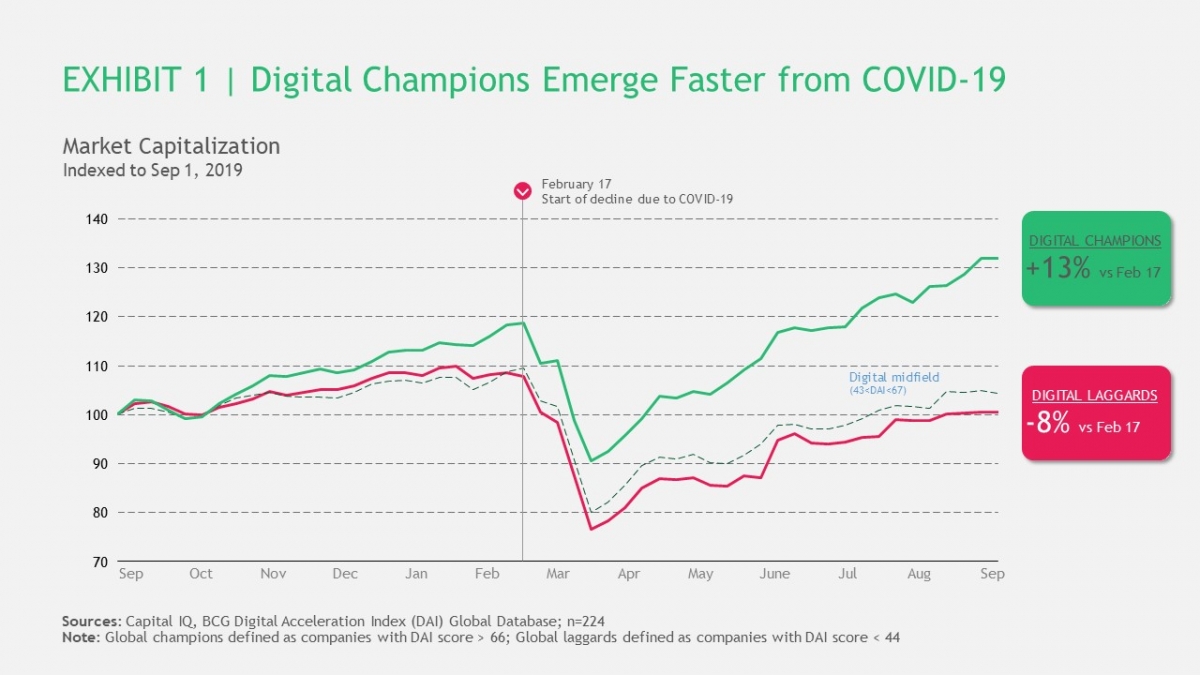
Digital transformation is on the mind of all business executives and government officials in Thailand and across the globe. There is good reason for this. A recent study leveraging BCG’s Digital Acceleration Index (DAI) – a benchmarking methodology designed to assess the digital maturity of businesses with more than 8,500 participating companies across industries and geographies – reveals that companies at the forefront of digital transformation enjoy 1.8 times the annual earnings growth and 2.4 times greater growth in enterprise value than companies that are behind in the race for digital transformation.

Where is Thailand?

Digital transformation is a journey that not only encompasses the adoption of new digital technologies, but also new processes, new ways of working, new organisational structures and capabilities, and new cultural elements – fundamentally changing prevalent business models. This journey takes time, dedication and resources. Through a collaboration between the Thailand Management Association (TMA) and Boston Consulting Group (BCG), a survey was conducted to find out: where Thai companies are on this journey, and what would it take to accelerate digital transformation of the Thai economy?

Digital strategies in Thailand

Using DAI, we surveyed the digital maturity of 60 Thai companies representing key industries ranging from banking to oil and gas, benchmarking the results against regional and global peers. The study reveals that the majority (42 per cent) of Thai companies are still in the early stages of their digital transformation, so far pursuing only isolated digital use cases.

The study did find, however, that companies are moving towards an important inflection point. Most Thai firms score highly on the dimension of digital strategy, ie in line with international peers that integrate digital as driver of value creation in their overall business strategy rather than treating it as an “experiment” carried out in isolation. In other words, Thai companies on average may be “Digital Starters”, but they have the right digital strategies and implementation roadmaps in place to start unlocking significant value from digital once the implementation of these strategies reaches scale.

And there are shining examples of Thai companies that already do so. Particularly, but not exclusively, so in finance and healthcare — the industries identified by our study as the clear leaders in Thailand that perform well against regional and global peers. Four such exemplary companies were awarded the Thailand Digital Excellence Awards, namely Samitivej was awarded for Digital Business Model Innovation, Krungthai Bank for Tech Innovation and Artificial Intelligence, Siam Commercial Bank for Digital Culture and Talent, and Chevron Thailand Exploration and Production for Digitally Optimized Operations.

How to accelerate digital transformation?

But what does it take to accelerate the digital transformation of the Thai business landscape beyond these examples? Our study revealed a number of common shortcomings across several important dimensions of achieving digital maturity.

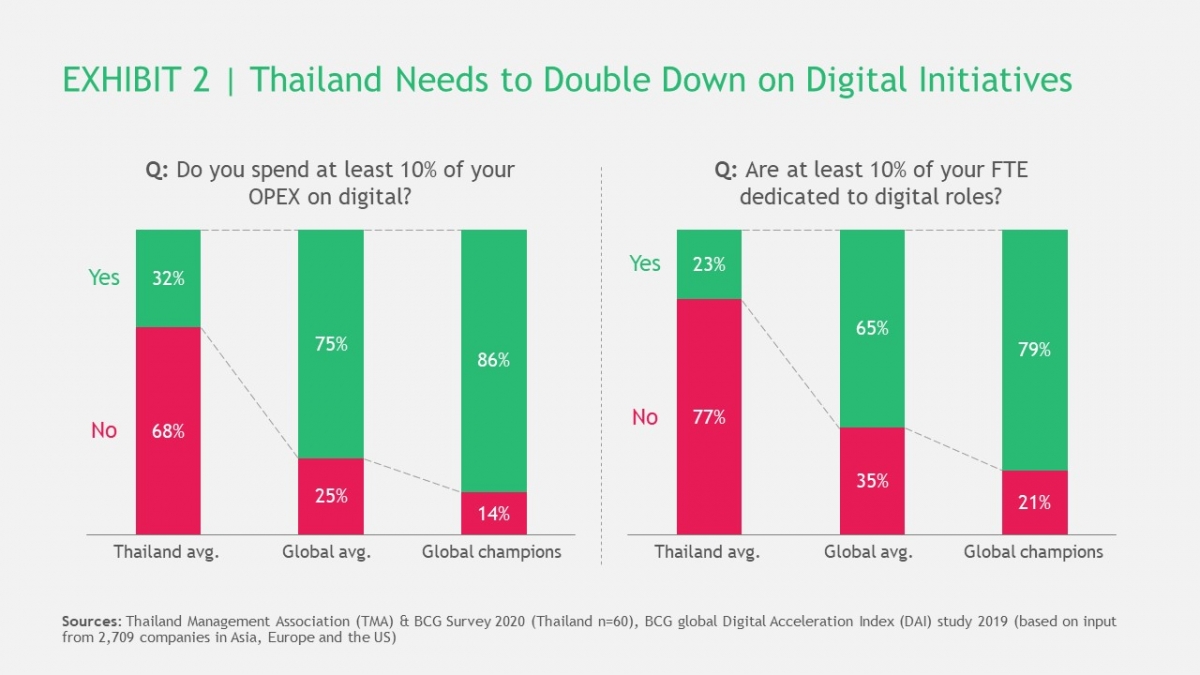
We found that less than one-third (32 per cent) of Thai businesses invest at least 10 per cent of their operating capital into digital. That compares to 75 per cent across the global average, and 86 per cent across Digital Champions. More specifically, the study found that just 23 per cent of Thai businesses dedicate at least 10 per cent of their people to digital roles, compared to 65 per cent and 79 per cent global average and Digital Champions respectively. This is an area in need of transformation, as talent forms the foundation of all successful implementation of digital strategies. Unified data models and process digitisation are further crucial enablers found not to receive sufficient funding today. Another area that does not yet receive the attention and funding it deserves is digital ecosystems. The concept of digital ecosystems provides companies with an efficient opportunity to partner for the benefit of scale and innovation, creating win-win-win scenarios for companies and customers alike.

Moving past inflection point

Thai companies are at the brink of harnessing substantial value from digital transformation. Decisive investments are required to make it past this important inflection point. With 80 per cent of executives anticipating the urgency for digital transformation to increase in the wake of Covid-19, we are hopeful to see companies taking the necessary steps to accelerate their digital agendas. Organisations such as Thailand Management Association and the Digital Economy Promotion Agency are keen to offer support. Ultimately, accelerated digital transformation will be crucial to boost Thailand’s competitiveness in the global marketplace.

Rule of law: A new consensus needed to redefine Thai society #SootinClaimon.Com

#SootinClaimon.Com : ขอบคุณแหล่งข้อมูล : หนังสือพิมพ์ The Nation.

Rule of law: A new consensus needed to redefine Thai society 

ColumnsNov 03. 2020Anti-government protesters gather at the Tha Phra intersection in the Thonburi district of Bangkok on Monday, as they continue to put pressure on the government to resign. Photo by Tanachai Pramarnpanich.Anti-government protesters gather at the Tha Phra intersection in the Thonburi district of Bangkok on Monday, as they continue to put pressure on the government to resign. Photo by Tanachai Pramarnpanich. 

By The Nation Editorial
The Nation

The decision by a court to release pro-democracy protest leaders from prison kindles some hope of a resolution to the current political unrest.

The judiciary  will play an important role in restoring the rule of law, which has been considerably weakened since the 2014 military coup.

Academics have blamed the military-sponsored 2017 Constitution and related laws implemented by the former junta government and the current government for vitiating the legal and political system.

Prime Minister Prayut Chan-o-cha, however, continues to defend the actions of the two governments he has headed as a necessary enforcement of laws to preserve stability in the country. 

Critics counter that Prayut put the country under “Rule by law and fear”. Since the coup, the judiciary has also been widely criticised for applying double standards when judges hand down verdicts in political conflict cases. Among several cases, the most obviously controversial were the disbanding of two anti-junta political parties — Thai Raksa Chart Party and Future Forward Party. The rights of many voters were snatched away from participating in parliamentary democracy.

The cumulative oppression of these actions have forced massive numbers of people across the country to defy the government and pour their frustrations on the streets.

Bold youth-led protesters are standing up to the powers and challenging what they view as unjust laws. At this juncture, judges, prosecutors, military officers, police and those serving in the National Anti-Corruption Commission and Election Commission have to seriously introspect their roles in the past that has snowballed into the current political chaos.

At this moment, judges will play a very important role in solving the political crisis. The question is whether they will rise to the challenge.

Recently,law faculty deans from four universities openly called for lifting the state of emergency in Bangkok. They also reminded the judiciary of its role as a checks and balances executive branch power, by scrutinising whether the government was using its power to infringe on citizens’ rights. Judges must look at the protesters’ demands for fundamental changes in the legal and political system.

Indeed, for genuine participation in politics, not only judges, but everyone has a stake and has the right to participate in shaping a new era of a fair legal and political system.

It is now clear that brute force, intimidation, jailing, discrimination or even espousing traditional values cannot maintain social cohesion, peace, stability and economic prosperity. The narrow nationalistic ideology: “Nation, Religion and King” can no longer accommodate new social forces that want to embrace freedom of expression, human dignity, human rights, equality, transparency, accountability, integrity in governance and democracy.

Thailand needs to fundamentally shift from a narrow vision of nationalism to broader values that will underpin a modern and dynamic state.

Those who strongly cling to old values have to face up to the reality that the new generation thinks differently, has new values and social evolution.

Every single issue related to public affairs needs to be put on the table for a free, frank and fair debate in shaping the outcome. This can be done only if we agree to set fair rules. First, we must all agree that we need fair rules which will ensure that everyone plays by the rules, and nobody, not even the King, is above the law.

Looking forward, the only way to protect everyone’s welfare is an unremitting commitment to the rule of law.

Between respect and provocation #SootinClaimon.Com

#SootinClaimon.Com : ขอบคุณแหล่งข้อมูล : หนังสือพิมพ์ The Nation.

Between respect and provocation

ColumnsNov 01. 2020Photo credit: The StarPhoto credit: The Star 

By Wong Chun Wai
The Star

Calling for violence for reasons drawn from the past or present is simply wrong.

LET’S be honest – Malaysia isn’t exactly smelling like roses right now because the world is familiar with our head-turning financial scandals, corruption cases involving top leaders and endless political intrigue.

We are in the news for the wrong reasons most of the time. So, the last thing we need is for Tun Dr Mahathir Mohamad to put us in the world news.

On Thursday, the former prime minister tweeted that Muslims have the right “to kill millions of French people” after a deadly attack in Nice, sparking widespread anger and prompting Twitter to delete his post.

Three people were killed in a church in the southern French city, with the attacker slitting the throat of at least one, in what authorities were treating as the latest terror assault to rock the country.

Shortly afterwards, Dr Mahathir launched an extraordinary outburst in a series of tweets.

Twitter initially declined to remove the comments, but finally did so following a furious reaction from the French government.

He made it into Quotidien, the most popular talk show in France, and almost all major news networks around the world. Just look it up on the Net.

Many of us, including our business associates, were bombarded with text messages to find out if Malaysia had joined the al-Qaeda Club. We had to assure them the country and people, mostly, had not gone bonkers.

Muslims around the world are outraged at the way French President Emmanuel Macron has handled the complexities of a plural society, what with its racial and religious sensitivities. He has appeared condescending in the eyes of the global Muslim population.

At the same time, Turkey has spiked the political temperature by calling for a boycott of French products. It’s likely both want to engage with their domestic audience to score points, which is what politicians do.

We wonder if Dr Mahathir is also doing likewise since his popularity has taken a dip, what with his newly formed party heading nowhere, because surely, even at his advanced age, his faculties are more intact than the younger ones.

Something has gone terribly awry when we can’t draw a line between right and wrong. Calling for violence for reasons drawn from the past or present is simply wrong.

It can’t be justified and seems far worse coming from a senior leader like Dr Mahathir, whom many of us respect and look up to, even if we disagree with his politics.

The world will not merely look at his tweet as his personal emotional response – they will only remember Malaysia as a country for it.

In his blog later, Dr Mahathir expressed disgust with attempts to “misrepresent and take out of context” what he wrote, saying they had wrongly implied that he promoted the massacre of the French.

He noted that his posting, in its entirety, called for the French to teach their people to respect other people’s feelings.

“There is nothing I can do with FB and Twitter’s decision to remove my posting. To my mind, since they are the purveyor of freedom of speech, they must at least allow me to explain and defend my position, ” he said.

Now, there will be many who say Dr Mahathir merely wants to get the attention of the Muslim audience at home.

Wisma Putra took the right approach by summoning a senior official from the French Embassy in Kuala Lumpur to convey Malaysia’s disdain over the disparaging attitude towards Islam, including the publication of caricatures depicting Prophet Muhammad.

In a statement, Wisma Putra said it had summoned the chargé d’affaires of the French Embassy in Kuala Lumpur as Malaysia sought to express concern over the “growing hostilities, hate speech and defamation of Islam”.

“During the meeting, the ministry reiterated Malaysia’s position to strongly condemn any inflammatory rhetoric and provocative acts that seek to defame Islam as the world has recently witnessed in the forms of populist speeches and publication of profane caricatures depicting the Holy Prophet Muhammad, ” it added.

Foreign Minister Datuk Seri Hishammuddin Hussein said the country “strongly condemns” inflammatory rhetoric and provocative acts that defame Islam.

France has painted itself into a tight corner. To be fair, it has also opened its doors to people from its ex-colonies in Arab and African nations.

France has the highest number of Muslim immigrants at over 5.6 million people, or 8.8% of the country’s population. Let’s not also forget that they chose a secular country like France, instead of a Middle Eastern or African nation with similar cultural and religious leanings.

But like many things with people, it’s never easy to give up one’s roots, especially race, religion and culture. If integration is tough, assimilation is near impossible. Never mind that almost all the immigrants speak French.

When an economy shrinks, immigrants will always be the first to face a backlash. They are always the bogeymen, and this happens to immigrants of other races, too.

In France, the economic disparity between whites and immigrants has grown wider, leading to frustrations.

As the Muslim numbers increase, with Islam as the fastest growing religion in Europe, the congregation finds itself in need of more places of worship, but councils are always concerned about approving the building of more mosques.

So, the result is street prayers, but for local French, they find this unacceptable, and as a recent viral video has shown, some of them have taken to provocation by singing loudly to drown out the prayers. The police have done nothing to quell this behaviour.

Such a video, as it goes viral, would surely anger Muslims around the world. As a non-Muslim, I find such confrontations highly disturbing and wonder why the French police allow this. If democracy and freedom of expression are enshrined in that society, why does this continue to happen?

We can argue steadfastly about rights and all, but wisdom is seriously lacking, especially when caricatures of the Prophet Muhammad are allowed to proliferate.

So, Malaysia needs to distance itself from Dr Mahathir. His views don’t mirror our sentiments.

Even Turkey has swiftly joined the wave of condemnations on the brutal murders of three people by a suspected extremist in France’s coastal city of Nice, despite being in the midst of an escalating row between Ankara and Paris over a broad range of issues spanning the Eastern Mediterranean to the role of Islam.

The assailant is said to have charged at the victims with a knife in the Notre-Dame Basilica in the heart of the city on the French Riviera.

Two of the victims were female, one a 70-year-old who was “virtually beheaded” as she was praying, the BBC reported. The suspect, who has not yet been identified, was shot and detained soon after.

Turkey’s Foreign Ministry said in a statement: “It is clear that those who commit such a violent act in a holy place have no respect for any humanitarian, religious or moral values.”

Turkish presidential spokesman Ibrahim Kalin said: “Terror has no religion, language or colour. We will fight with determination and solidarity against all forms of terrorism and extremism.”

Indeed, there is no religion that encourages any form of violence. If there are ignorant people who want to behead others, in the name of God, then we should thwart that by keeping ourselves level-headed instead.