Boxer Sudaporn guarantees 2nd Olympic medal for Thailand
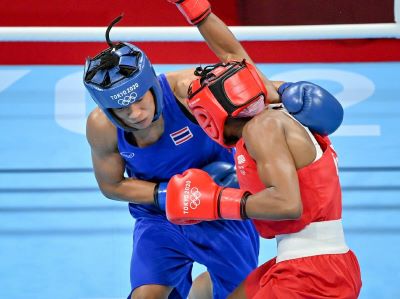
Sudaporn Seesondee became the first Thai female boxer to secure an Olympic medal after she narrowly ousted 2018 Youth Olympics gold medalist Caroline Dubois of Great Britain 3-2 in the women’s 60kg quarter-finals at the Kokugikan Arena on Tuesday.
The Thailand boxing team’s last hope did not let the fans down, producing strategically delivered punches and jabs to edge out the up-and-coming Briton in the third round, after tying at 1-1 in the first two, to reach the semi-finals.
At least a bronze is guaranteed for the 29-year-old Thai, who will go down in history as the first Olympic medalist in women’s boxing from Thailand.
ADVERTISEMENTx
“It was the happiest moment in my life when the referee raised my hand (as the winner),” said the Udon Thani based fighter, who had done her homework on the British southpaw coming into the bout.
“I watched her clips three or four times and had a sparring session with Baison Manikon (team Thailand women’s welterweight) as she is a southpaw. I’m so overwhelmed to finally produce a medal for Thai fans,” added the 2018 World Championships silver medalist.
Sudaporn wished her late father Yodnakhon, who passed away seven years ago, could be with her to cherish the moment.
sudapon
“After the win, I was thinking of my family, especially my father. He was the one who made me box. He was the reason why I am here. I want him to know that I made it. I want him to be proud of me,” the emotional Sudaporn said.
Taew
The Thai fighter will next have to handle her toughest fight in Tokyo so far, against top seed and old rival Kellie Harrington of Ireland who beat Imane Khelif of Algeria 5-0 in the quarter-finals. Sudaporn lost to the Irishwoman 2-3 in the 2018 World Championships final in New Delhi.
“I don’t know if I will go the distance and win the gold. At this point, I will take it one fight at a time,” said Sudaporn, whose semi-final with the 2018 world champion and the 2019 European Games silver medalist is due at 12pm on Thursday.
With a bronze assured, Sudaporn has also produced the second medal for Thailand in the Olympic Games TOKYO 2020 after Panipak Wongpattanakit grabbed the gold in women’s taekwondo 49kg last week. She will receive at least Bt4.8 million – the incentive promised by the National Sports Development Fund for a bronze.
1
Sudaporn also salvaged pride for the Thailand Boxing Association, an Olympic medal hope for the country, after Thai boxers finished the 2016 Rio Games empty-handed.
Roundup: Hassan clinches first Olympic gold, Puerto Rico wins first athletics gold
Several achievements were made on Monday as Sifan Hassan got a gold medal while Camacho-Quinn won the first athletics gold for Puerto Rico.
Sifan Hassan of the Netherlands started her Tokyo 2020 journey with an exciting victory in women’s 5,000 meters race, while Puerto Rican Jasmine Camacho-Quinn delivered the first Olympic athletics gold for her country by winning the women’s 100m hurdles final here on Monday.
ADVERTISEMENTx
In the morning, Hassan was tripped and fell on the ground in women’s 1,500m round 1, but she got up quickly and finished the race in four minutes and 5.17 seconds, qualifying for the semifinals as the first of the heat.
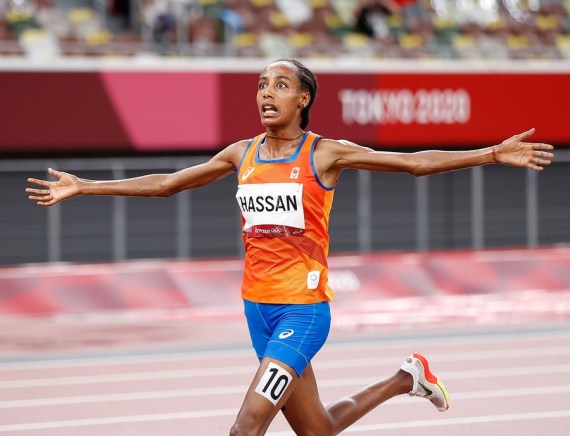
Almost 12 hours later, the Dutch stood on the starting line of women’s 5,000m final. The 28-year-old took the strategy of following the leading group. She remained in the mix with the lead pack with two laps to go, and began to sprint when the bell rang and took the lead in the last 200m, pulling clear to the finishing line to win with 14:36.79.
This was Hassan’s first Olympic gold medal. She is going to compete in 1,500m and 10,000m at Tokyo 2020.
Kenya’s Hellen Obiri settled for a silver with 14:38.36, and Gudaf Tsegay of Ethiopia finished the race in 14:38.87 to bag a bronze.
“I can’t believe it. I used all my energy this morning and I was kind of tired. I couldn’t believe what happened. It was terrible when I tripped, I felt terrible afterwards and I never thought I was going to be an Olympic champion,” said Hassan.
Sifan Hassan of the Netherlands reacts after the Women’s 5000m Final at the Tokyo 2020 Olympic Games in Tokyo, Japan, Aug. 2, 2021.
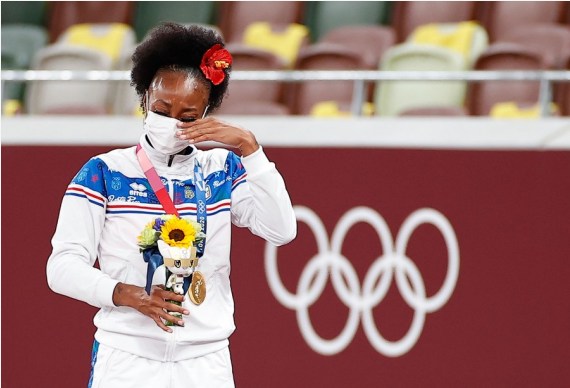
Gold medalist Jasmine Camacho-Quinn of Puerto Rico reacts on the awarding ceremony of the women’s 100m hurdle at the Tokyo 2020 Olympic Games in Tokyo, Japan, Aug. 2, 2021
Miltiadis Tentoglou of Greece celebrates after the Men’s Long Jump Final at the Tokyo 2020 Olympic Games in Tokyo, Japan, Aug. 2, 2021.
Valarie Allman of the United States reacts during the women’s discus throw final at Tokyo 2020 Olympic Games, in Tokyo, Japan, Aug. 2, 2021.
Just in: Denmarks Axelsen wins mens singles badminton gold at Tokyo Olympics
Denmarks world No. 2 Victor Axelsen outclassed Chinas defending champion Chen Long 21-15, 21-12 in the mens singles badminton final to claim the gold medal at the Tokyo Olympics here on Monday.
After tying at 9-9, Axelsen reinforced his strong smashes to take a 21-15 lead. Chen failed to come back and Axelsen wrapped up the second set 21-12.
ADVERTISEMENTx
In their previous encounter at Rio 2016, Chen routed Axelsen 21-14, 21-15 in the semifinal before he beat Malaysia’s legendary shuttler Lee Chong Wei to win his first Olympic gold.
Earlier in the day, Indonesia’s fifth seed Anthony Sinisuka Ginting needed only 38 minutes to defeat the tournament’s dark horse and world No.59 Kevin Cordon from Guatemala 21-11, 21-13 and won the bronze medal.
Harry Kane fails to report back for pre-season with Tottenham as transfer saga continues
Harry Kane seems to have deliberately avoided reporting to Tottenham Hotspur as several clubs are chasing after him.
England captain Harry Kane is seemingly increasing the pressure on his club to allow him to leave after failing to report back for pre-season training with Tottenham on Monday.
Kane should have reported to Tottenham’s training ground for tests of assessing fitness and medical check to see if he was infected by COVID-19 after leading England to the final of the European Championships this summer.
ADVERTISEMENTx
The move looks like an attempt by the player to force his way out of the club after saying he wanted to leave in May, explaining that he wanted to be at a club who can challenge to win major titles.
Manchester City, Manchester United and Chelsea were all thought to be interested, with Premier League Champions Manchester City thought to have had an offer of 100 million pounds (around 140 million U.S. dollars) rejected by the London based club.
Tottenham valued the 28-year-old at around 120 million pounds but president Daniel Levy is a man known for driving a hard bargain when it comes to selling the club’s main assets and with Kane having a contract with Tottenham until 2024, Levy holds most of the cards in his hands.
As the product of Tottenham’s youth system, Kane has scored an impressive 221 goals in 336 appearances for the club since his first team debut in the Europa League in August 2011.
Meanwhile, Manchester City is keen to strengthen their squad after losing last season’s Champions League final to Chelsea and the departure of veteran striker Kun Aguero after his contract expired.
The club coached by Pep Guardiola are also thought to have offered around 100 million pounds for Aston Villa’s England international midfielder, Jack Grealish.
For some athletes, the Olympics arent just a chance to compete – theyre an opportunity to defect
On Sunday, Belarusian Olympic sprinter Krystsina Tsimanouskaya turned up at the Polish Embassy in Tokyo – becoming the latest Olympic athlete to refuse to return to her country out of fear for her personal safety.
The Olympics have served as sites of protest, platforms to isolate discriminatory regimes and theaters for Cold War tensions. For some athletes and coaches, the Games have also offered avenues to defect.
“The Olympics provide a very attractive opportunity for people to escape difficult situations at home, most often political repression,” said Barbara Keys, a historian at Durham University.
Tsimanouskaya says Belarusian Olympic authorities tried to force her to fly back to Belarus after she criticized the country’s Olympic officials. She sought the protection of Japanese authorities at the Tokyo airport Sunday night.
Poland has given the athlete a humanitarian visa, and she will fly to Warsaw on Wednesday to seek asylum, according to Alexander Opeikin, executive director of the Belarusian Sports Solidarity Foundation, a group that opposes the Belarusian government.
Here’s a look at several prominent Olympic defections.
—
ADVERTISEMENTx
1948 Summer Olympics in London
Marie Provaznikova coached the Czechoslovakia women’s gymnastics team to victory in the 1948 London Olympics. But the glimmer of a gold medal stoked little national pride in the 57-year-old president of the International Gymnastic Federation.
The coach announced on Aug. 18, 1948, that she intended to seek asylum in the United States.
Earlier that year, the Communist Party had taken control of Czechoslovakia with Soviet support. Shortly before the London Olympics, Provaznikova led 28,000 female gymnasts in a demonstration in Prague in support of former President Edvard Benes.
The Czechoslovak Embassy said the Communist-led government in Prague had approved her decision to remain abroad, according to a New York Times article at the time. But Provaznikova said she was “a political refugee and proud of it.”
ADVERTISEMENT
She became the first person to defect at the Olympics, at least in the modern era, and a tradition was born.
When Tsimanouskaya made clear her intention to seek asylum Sunday, the Czech Republic offered to welcome her.
—
1956 Summer Olympics in Melbourne
The 1956 Summer Olympics in Melbourne, Australia, were held just weeks after Soviet tanks and troops crushed an uprising in Hungary. Thousands were killed and wounded, and hundreds of thousands fled the country.
ADVERTISEMENT
The Hungarian Olympic team heard the news through the press after landing in Melbourne, according to the New Republic, and many resolved not to return to Hungary.
Tensions came to a head at the water polo semifinal between Hungary and the Soviet Union, which became known as the “Blood in the Water” episode. Fights broke out between players, and Hungarian water polo star Ervin Zador exited the pool with blood pouring from his head after a Soviet player hit him.
Dozens of Hungarian athletes defected from the Games that year, most to the United States.
Some eventually returned home, according to Sports Illustrated, even donning the Hungarian uniform again at the Olympics. But many remained in their adopted country.
Zador found himself working as a lifeguard in Oakland, Calif., for $6 an hour before eventually opening a restaurant and running a hotel. Despite the difficulties of adapting to life in a country where at first he didn’t speak the language, Zador said before his death in 2012 that “there hasn’t been a moment I’ve regretted it,” Sports Illustrated reported.
—
1972 in Munich and ’76 in Montreal
The wave of defections by athletes from the Soviet Union and allied states continued during the 1970s. More than 100 athletes may have defected at the Munich games in 1972, according to the Associated Press, though little is known about them and the exact number is still disputed.
“Defection in the Olympics during the Cold War was almost an unrecognized medal event,” Keys said. Soviet bloc officials often sent minders to prevent their athletes and coaches from stepping out of line, so defections usually required careful planning.
At the 1976 Summer Olympics in Montreal, at least four Romanians and one Russian sought asylum in Canada.
The Russian defector, Sergei Nemtsanov, was a 17-year-old diver when he disappeared from the Olympic Village during the Games. Soviet Olympic officials called it a “kidnapping” and part of an “anti-Soviet campaign” in Canada, according to news reports at the time. They threatened to withdraw from the final two days of the Games but ultimately decided to stay and compete.
For the diver, it seemed politics were not the primary factor at play: He reportedly defected out of love for the daughter of an American millionaire he had met at a diving meet in Florida the previous year.
Canada granted him a special visa allowing him to extend his stay. But a few weeks after his escape from the Olympic Village, Nemtsanov decided to return home.
—
2008 Summer Olympics in Beijing
In the run-up to the 2008 Olympics, after a 1-1 draw against the United States, seven members of the Cuban under-23 soccer team fled from a Tampa hotel during an Olympic qualifying tournament in March. Later that week, the Cuban team took to the field with only 10 players, ESPN reported.
The players left the hotel, bought a cellphone, contacted a lawyer and celebrated with a Cuban meal, the Miami Herald reported, according to ESPN. “We’re fine, calm, feeling hopeful about our new lives,” player Yenier Bermúdez told the Herald. “Of course, we’re nervous because we’re young, have no family here, and we don’t yet know the way of life here, but we hope the Cuban and American communities will help us get started.”
Luiz Muzzi, then-general manager of United Soccer League club Miami FC, told the Herald that he watched the Cuba-U.S. match on TV while “kind of scouting” – “because anytime a Cuban team comes to the United States, there’s a chance someone might defect,” he said.
Athlete defections from Cuba, not only during the Olympics, have been common since the 1959 Cuban revolution. According to DW, an estimated 90 Cuban baseball players have defected to the United States to play for Major League Baseball clubs.
Some of the soccer players who defected in 2008 – under the policy that allowed Cubans to obtain asylum upon reaching U.S. soil – went on to play for other teams. Midfielder Yordany Álvarez played with the Austin Aztex, Orlando City and Real Salt Lake, according to his Major League Soccer profile.
Additionally, after Cuba dominated in boxing during the 2004 Athens Games, none of Cuba’s five boxing champs returned for the 2008 Games – three defected, and a fourth was removed from the team after attempting to flee. The last one retired.
—
2012 Summer Olympics in London
In 2012, around a dozen African Olympians did not return to their home countries, suspected to have instead sought asylum in Britain.
Of Cameroon’s 37 competing athletes, seven went missing, some in the middle of the night from the Olympic Village – a women’s soccer team goalkeeper, a swimmer and five boxers. Four Congolese team members, including a technical athletic director and coach, also didn’t make it back to their home nation after the Olympics’ end. Several Sudanese runners also sought asylum in British police stations.
The man who carried the flag for Eritrea, steeplechaser Weynay Ghebresilasie, along with three others from the Eritrean delegation, also chose to defect, VOA News reported in 2012. The steeplechaser said that he felt conditions at home seemed to be getting worse, according to the news outlet.
Aka Amuam Joseph, a Cameroon Karate Federation member, told CNN: “Back home, they aren’t giving the proper training. They know if they are well trained, they could beat the person from another country. . . . It pains them to be here and see people beat them who they can beat if they are well taken care of.”
CNN reported that Cameroon’s boxing facility offered only one ring with a concrete floor. Its weight room offers “a limited selection and a peeling carpet,” according to CNN.
“I am positively convinced that if the government did more in this field, we would have little of this disturbance,” Joseph told CNN.
Published : August 03, 2021
By : The Washington Post · Claire Parker, Sammy Westfall
Belarusian Olympic sprinter who sought protection in Japan granted Polish visa
MOSCOW – A Belarusian sprinter who refused to fly back to her country out of fear for her safety after she criticized Belarusian Olympic officials will fly to Poland this week to seek asylum there.
Polish Deputy Foreign Minister Marcin Przydacz said on Twitter that Poland has given the athlete a humanitarian visa.
Krystsina Tsimanouskaya “is already in direct contact with Polish diplomats in Tokyo,” Przydacz said. “Poland will do whatever is necessary to help her to continue her sporting career.”
Tsimanouskaya, 24, will fly directly to Warsaw on Wednesday, said Alexander Opeikin, executive director of the Belarusian Sports Solidarity Fund, a group that opposes the Belarusian government.
Tsimanouskaya was seen entering Poland’s embassy in Tokyo on Monday, according to multiple media reports. Late Sunday, Tsimanouskaya asked Japanese police for protection at Haneda Airport in Tokyo and issued a plea to the International Olympic Committee. She said she was forced to pack her things and was escorted to the airport against her wishes by Belarusian Olympic officials.
“I have been pressured and they are trying to take me out of the country without my consent, so I am asking the IOC to intervene,” she said in a video that circulated on social media on Sunday.
The Belarusian Olympic Committee said in a statement that coaches decided to withdraw Tsimanouskaya from the Games on doctors’ advice about her “emotional and psychological state.”
But in an Instagram story, Tsimanouskaya said that was a lie. The 24-year-old was scheduled to run the women’s 200-meter race on Monday. But she said she was removed from the team because “I spoke on my Instagram about the negligence of our coaches,” according to Reuters.
In a video posted on Instagram, she criticized Belarusian Olympic officials for allegedly deciding once she was already in Tokyo that she must run the 4×400-meter relay – for which she had not trained – after other members of the team were found ineligible because they had not completed the proper doping testing.
International Olympic Committee spokesman Mark Adams said IOC officials met with Tsimanouskaya on Sunday night to ensure her safety.
“She has assured us that she feels safe and secure,” Adams said in a news briefing Monday. “The IOC and Tokyo 2020 will continue to have conversations with her and the Japanese authorities to determine the next steps in the upcoming days.”
Tsimanouskaya stayed at an airport hotel on Sunday night, and officials spoke with her again Monday morning, Adams said. IOC officials have asked the Belarusian National Olympic Committee for a full written report and will discuss next steps.
ADVERTISEMENTx
Tsimanouskaya went to the Japanese police station on Sunday night and requested protection when she arrived at Haneda Airport, Adams said. Officials representing the U.N. high commissioner for refugees and Japanese law enforcement agencies are involved with the situation, he said. The athlete was under the supervision of “authorities,” Adams said, but he declined to specify which agency or country. Any criminal matters for potential investigation would be up to the police, he said.
Adams did not have any details about how she ended up at the airport.
“She told us yesterday, very clearly, in no uncertain terms, that she feels safe and secure,” Adams said.
Julie Fisher, the U.S. ambassador to Belarus, praised the “quick action of Japanese and Polish authorities,” writing on Twitter Monday that this enabled the sprinter to “evade the attempts of the [Lukashenko] regime to discredit and humiliate” her for expressing her views.
On Monday, however, the athlete was dealt a blow when the Court of Arbitration for Sport – a Switzerland-based institution that helps settle sports-related disputes – dismissed her request to overturn the Belarusian National Olympic Committee’s decision to block her from participating Monday in the women’s 200-meter qualifying event.
The Belarusian National Olympic Committee said in a Monday statement reported by the Wall Street Journal that it was “closely monitoring the situation” and was “ready to further defend and protect the interests of all Belarusian athletes from any forms of discrimination, if any.”
Although Tsimanouskaya did not directly criticize Belarusian strongman Alexander Lukashenko, the Belarusian National Olympic Committee is run by Lukashenko’s eldest son, Viktor Lukashenko. The IOC has refused to recognize Viktor Lukashenko’s election to the post. In the past year, facing the greatest opposition challenge to his 27-year reign, Alexander Lukashenko has brutally cracked down on any dissent, prompting many citizens to leave the country and seek refuge from its Baltic neighbors.
In a brazen display in May, Lukashenko sent a MiG-29 fighter jet to force a civilian plane to land as it was flying from Athens to Vilnius, Lithuania. Belarusian authorities then arrested one of its passengers, Roman Protasevich, the founder of an opposition media outlet.
Tsimanouskaya told Belarusian sports news outlet Tribuna in an interview Sunday night: “I am afraid that in Belarus they might put me in jail. I am not afraid that I will be fired or kicked out of the national command. I am worried about my safety. And I think that at the moment it is not safe for me in Belarus.”
Tadeusz Giczan, editor in chief of the Belarusian opposition Telegram channel NEXTA, said on Twitter that Tsimanouskaya’s husband has fled Belarus and is now in Ukraine. Franak Viacorka, senior adviser to Belarusian opposition leader Svetlana Tikhanovskaya, said on Twitter Monday that the government was threatening Tsimanouskaya’s parents to put pressure on the athlete.
Published : August 03, 2021
By : The Washington Post · Isabelle Khurshudyan, Michelle Ye Hee Lee, Claire Parker
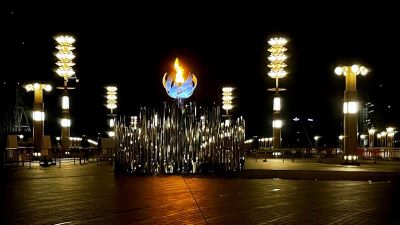
Late at night, on a bridge in Tokyo Bay, the Olympic flame burns alone
TOKYO – The Olympics have closed for the night, and the vast brick promenade that stretches between many of the competition venues is empty after 2 a.m. Normally at an Olympics, such a walk would be filled by a never-ending party. Tonight, in this pandemic-wary city, the lone sound is the clumping of a pedestrians feet.
And then beyond a small rise in the pathway, the Olympic flame appears, an orange glow in a silver cauldron improbably placed in the center of the promenade, a bridge connecting two man-made islands in Tokyo Bay. The flame is so low to the ground that from a distance it looks more like a flaming trash can than the everlasting fire burning from Olympics past.
It’s a jarring sight. Olympic flames are usually robust things, anchored high above the main stadium, ignited on the initial night as a declaration that the Games are open. Even in these darkest hours just before dawn, Olympic flames are mighty and welcoming, an invitation to a 17-day festival. People stare at them in awe.
But these Olympics are the fulfillment of contracts, played before empty stands and amid resentment from much of the host country, whose people don’t welcome the intrusion of outsiders during a pandemic. Each day, the number of positive coronavirus cases hits a new high in Tokyo. Hoisting a flame high above the city center seems a bad idea.
So, the flame is here, on a pedestrian concourse, connecting two sparsely populated places named Ariake and Aomi across a sliver of Tokyo Bay. It burns from a sphere of broken aluminum plates set inside a thicket of silver posts, guarded by a square of steel barricades discouraging anyone from coming too close. It can’t be more than 15 feet high.
In the daytime, people come to see the flame. Some walk dogs; others carry parasols to shade against the scorching afternoon sun. Parents bring children. In the evenings, as the day cools and the sky turns a pastel hue, the flame can be a lure. Everyone pulls out phones, pointing cameras above the railings, careful to stay behind the signs that warn against stepping too close.
ADVERTISEMENTx
Guards lurk nearby holding speakers that tell the curious they must not linger long. Signs attached to street cones say photos can be taking only from one end or the other. The sides, they say, have to be kept open as a walkway despite the fact there are never enough people to clog the sprawling concourse. The crowds are steady but never significant. This isn’t an easy place for many in the city to reach.
And now in the silence that comes well after 2 a.m., with most of Tokyo long asleep, the flame burns alone, apart from three policemen lurking along the bridge’s edge. Tiny flashing red lights comically warn of a giant burning Olympic flame lying just ahead in the concourse’s center.
The flame and surrounding streetlights reflect off the brick walk, this night clear, the promenade dry. Nothing moves but the flickering fire. Drawing close, one can hear it: Who knew the Olympic flame actually makes noise?
The sound is something like a furnace chugging through a winter night, a steady, sturdy mechanical undulation. Standing alone behind the barricades and hearing only that rumble, it’s easy to imagine the flame is alive, to get lost in the dance of its quivering blaze.
Then the trance breaks. Amid the barriers and the flashing red lights, the flame has never looked this vulnerable, burning alone with only a few metal barriers and law enforcement officers to keep it safe.
These have not been the best of times for the Olympic flame. Its torch relay to Tokyo was greeted with constant scorn. Not long before the Games began, a woman tried to douse the torch with a water pistol. The flame’s lone spectacular moment came when Naomi Osaka lit the huge cauldron inside the main stadium at Opening Ceremonies. Hours later, it was quietly moved here to the bridge between two islands in Tokyo Bay, hidden in plain sight.
And while other Olympic flames have burned on city streets – Rio de Janeiro, for instance, had a second flame in a historic part of town – they have been centerpieces, never afterthoughts and never alone. Never like this.
Now, in the silence of the dark night, someone else approaches, a man holding a camera. Boldly, he walks to the side to take a photograph, in defiance of all the signs prohibiting such actions. With no crowds to keep moving and no social distancing to ensure, there seems no reason not to.
Out of the shadows a policeman scurries. No, the policeman says with the wave of his hand. No photos from the side, not even now in the stillness of a barren Tokyo night. Move along, the policeman says with a polite wave of his hand.
The man bows. He pulls down his phone down and walks away. The policeman slides back into the darkness. The Olympic flame is alone again, shimmering proudly on a vacant bridge, performing its eternal dance for an audience of none throughout the silent Tokyo night.
Taekwondo queen ‘Tennis’ seeks boyfriend to protect. Your move, Charyl
Panipak “Tennis” Wongpattanakit has been posting video clips from quarantine in Phuket after returning to Thailand with the country’s first Olympic taekwondo gold medal.
On Sunday, Tennis posted a clip of herself performing a high jump-kick. The clip came with a playful caption stating that whoever became her boyfriend would not need to be strong because she would be the one protecting him.
Three days ago, Tennis received an exclusive fan clip from Charyl Chappuis, a famous midfielder for Thailand national football team. Tennis earlier named Charyl as her favourite athlete, calling him an excellent footballer and a good-looking man.
Olympic canoeist Orasa Thiangkathok is eyeing a semi-final berth in the womens canoe singles 200m, which takes place on Wednesday at the Sea Forest Waterway in Tokyo Bay.
The 23-year-old from Nakhon Ratchasima, the first Thai to compete in an Olympic sprint canoe event, is determined to cause a stir at the Olympic Games TOKYO 2020.
“I’m in my final preparations after spending a week in Japan. I am already used to the conditions here. My coach [David Varga of Hungary] has lightened the training programme as he doesn’t want me to pick up any injuries,” said Orasa, gold medalist in the 2018 Asian Canoe Sprint U23 & Junior Championships and Asian Canoe Sprint Cup in Uzbekistan.
ADVERTISEMENTx
Orasa has also worked on her fitness and made adjustments to her paddling technique, as she puts the finishing touches to her preparation. However, she has not timed herself during practice as this, she said, would only add to the pressure on her shoulders.
For her Olympic debut, the Thai has been drawn in heat No 3 alongside competitors from Cuba, Great Britain, Canada, Australia and Nigeria. She has little information about her rivals but will find out more when she tests her mettle against them on August 4.
“My goal is to reach the semi-final, which means I have to finish top or second in the heat. It will be a lot tougher to reach my goal if I cross the finish line behind second place. If that happens, I will have to compete in the Repechage,” she said.
Orasa is due to begin her Olympic campaign at 8.19am on August 4. A top-two finish will guarantee her a berth in the semi-finals, which take place in the afternoon of the same day along with the Repechage.

 sudapon
 Taew
Taew 1
1 2
2 3
3 4
4








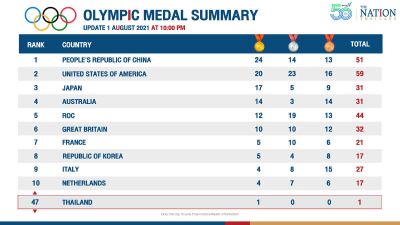
 Thailand slips to 47th on Olympics medals table
 SootinClaimon.Com