Shaping a new labour market for the post-pandemic economy #SootinClaimon.Com

#SootinClaimon.Com : ขอบคุณแหล่งข้อมูล : หนังสือพิมพ์ The Nation.

Shaping a new labour market for the post-pandemic economy

ColumnsJan 29. 2021Angel Gurría (left) and Klaus SchwabAngel Gurría (left) and Klaus Schwab

By Angel Gurría and Klaus Schwab

What took a decade to achieve unravelled within a matter of months.

It seems like another age, but the start of 2020 had marked a decade of decline in the unemployment rate of the world’s advanced economies. When the COVID-19 pandemic struck, the unemployment rate in OECD countries increased by an unprecedented 3.6 percentage points between February and April, to 8.8% – the highest rate in a decade. The OECD unemployment rate has since fallen but is expected to remain above pre-crisis levels throughout 2022.

In the meantime, the devastation to lives and livelihoods around the world caused by the pandemic continues, with the rollout and distribution of vaccines expected to take some time.

As the health crisis continues, its effects on employment risk becoming long-lasting. In addition, accelerated technological adoption risks creating a “double disruption” in labour markets, with many jobs unlikely to return[1]. At the same time the overall projections for job creation in the next five years are still higher than those of job losses. New jobs are expected to emerge due to shifting demand patterns and the use of new technologies in sectors such as the green economy, care economy and the education sector, as well as new roles in Data and AI across all industries and sectors.

How, then, should government and business leaders begin to shape a new labour market in 2021 and beyond – and support workers to thrive in the jobs of tomorrow?

Building a bridge to the recovery phase: public sector support for income, skills and jobs

The immediate responseto the economic challenges posed by the pandemic was unprecedented[2]. Governments around the world pumped trillions of dollars into the global economy, providing the necessary short-term support for businesses and workers in sectors that could not operate at full capacity. The use of short-time work schemes peaked at almost one in five employees across countries in the OECD for which data is available.

As the pandemic continues to unfold, governments must continue some of the urgent measures. They can make income-protection schemes more responsive to the changing situations of people, promote adequate occupational safety and health in all workplaces to ensure a safe return to work, and enhance social protection for those workers who are least covered such as ‘gig work’ and those in informal employment.

At the same time, they must lay the foundations for a more resilient and inclusive recovery, and governments must also turn their attention to preparing workers and re-allocating talent to new, growth jobs and professions in the medium-term.

Government policies can support this agenda with retraining and job creation through subsidies, targeted tax cuts, and investment programs, while social protection provisions can be reshaped to ensure better coverage of workers in non-standard forms of employment. Public and private employment services will also need to be expanded to support unprecedented numbers of jobseekers in their reskilling and job transition from declining occupations to emerging or growing occupations.

Reskilling and upskilling: an urgent task for stakeholder capitalism

It is estimated that 50% of currently employed workers will need reskilling by 2025 to meet the needs of a changing labor market. This will demand a significant expansion of mid-career reskilling and upskilling. For businesses there is a clear return on investment in doing so; two out of three employers expected to see a return within a year.

Employers’ commitments to quality work, fair wage practices and merit-based management practices can further incentivise and complement the learning agenda. Workers in OECD countries whose jobs are at high risk of automation remain 30 percentage points less likely to participate in adult learning than their counterparts in low-risk jobs[3].

The crisis led to a fivefold increase in employer provision of online learning opportunities to their workers and a fourfold increase in the number of individuals seeking online learning on their own initiative[4]. However, these efforts must be further accelerated and coordinated, both to support workers and to ensure adequate talent is available as businesses and economies bounce back. The Reskilling Revolution platform brings together leaders from governments, business and society together to collaborate on providing better education skills and jobs to 1 billion people by 2030.

Ensuring that no one is left behind in the labour markets of tomorrow

The crisis has not affected everyone equally. Women, youth, ethnic minorities and low-income workers are among those hit hardest. Young people have faced disruption to planned assessment and university closures. In addition, as hiring has slowed, young people entering the labor market are facing a reduction in entry-level opportunities, internships and apprenticeships. Top-earning workers have been able to work from home, while low-earning workers have less opportunity to do so.

There is no time to waste to put in place comprehensive policies to avoid creating a lost generation and greater disadvantages for those who were already impeded from full access to learning and earning. Both public and private sector efforts must ensure that as we rebuild, the post-pandemic labour market embeds justice and fairness for all segments of society.

Resilience, inclusion and sustainability must be at the heart of international collaboration in 2021. To that extent, better aligning public and private policies and actions is crucial. By joining forces to address these issues, the OECD and the World Economic Forum will help build a future of work that works for all.

[1] Future of Jobs Report 2020, World Economic Forum

[2] OECD Employment Outlook 2020: Worker Security and the Covid-19 Crisis, OECD

[3] OECD Employment Outlook 2019: The Future of Work, OECD

[4] Future of Jobs Report 2020, World Economic Forum

Angel Gurría is Secretary-General of the Organisation for Economic Co-operation and Development (OECD)

Klaus Schwab is Founder and Executive Chairman of the World Economic Forum, and the Author of “Stakeholder Capitalism: A Global Economy that Works for Progress, People and Planet” (Wiley)

This article is part of the Davos Agenda, a virtual event occurring 25-29 January 2021.

Russia & the West #SootinClaimon.Com

#SootinClaimon.Com : ขอบคุณแหล่งข้อมูล : หนังสือพิมพ์ The Nation.

Russia & the West

ColumnsJan 24. 2021Alexei NavalnyAlexei Navalny

By The Statesman

Navalny has interpreted the crackdown against him as a sign of Putin’s fear. But the Kremlin has insisted that Navalny had violated the law.

Tensions that could sour relations between Russia and the West, pre-eminently Europe and the United States, have intensified ever since Alexei Navalny returned to Moscow after his discharge from a hospital in Germany.

There is an element of bitter irony that clouds his return following treatment for nerve agent poisoning ~ allegedly at the behest of Vladimir Putin.

The Kremlin has claimed that Navalny’s return and the resultant tension with the Western powers represent “an absolutely internal matter”.

Perhaps on the face of it, it is. But it shall not be easy for Joe Biden’s United States and Europe, across the Atlantic to accept the global condemnation of his arrest at the Moscow airport and spirited calls for his early release.

Not the least because Navalny has blamed the Putin government for his poisoning.

Tensions between Russia and the West have distinctly exacerbated over the past three days; some countries of the European Union have even called for an additional cache of sanctions against Russia.

The Kremlin remains ever so adamant, going by the statement of its spokesman, Dmitry Peskov.

“We are talking about a fact of non-compliance with the Russian law by a citizen of Russia. This is an absolutely internal matter and we will not allow anyone to interfere in it and do not intend to listen to such statements.”

For the record, Navalny was detained at passport control at Moscow’s Sherenetyevo airport after flying in on Sunday evening from Berlin, where he was treated for the poisoning in August. Russia’s most prominent opposition figure and anti-corruption campaginer, Navalny allegedly violated the probation terms of his suspended sentence in a 2014 money-laundering conviction, which was deemed arbitrary by the European Court of Human Rights.

Officials are seeking that he serves the three-and-half-year suspended sentence in prison.

Navalny has interpreted the crackdown against him as a sign of Putin’s fear. But the Kremlin has insisted that Navalny had violated the law.

The Kremlin claims that questions the law-enforcement entity had for Navalny have “nothing whatsoever to do with the Russian President”. Attitudes have, therefore, stiffened on either side of the fence that divdes the Kremlin from the anti-establishment segment.

Even the UN Human Rights office has raised alarm over Navalny’s arrest, indeed a response that has been clothed with the demand for his immediate release.

The office of the United Nations High Commission for Human Rights has let it be known that it was “deeply troubled” by Navalny’s arrest.

It has appealed to the Russian government to respect his right to the due process of the law. The government in Moscow is incidentally headed by the prime suspect, named Mr Putin. The Russian President’s defiance of Western democracies cannot be readily agreeable. And thereby hangs a tale.

Alexei Navalny deserves humane treatment. And not behind bars.

Time to heal #SootinClaimon.Com

#SootinClaimon.Com : ขอบคุณแหล่งข้อมูล : หนังสือพิมพ์ The Nation.

Time to heal

ColumnsJan 24. 2021Joe BidenJoe Biden

By Dawn

Wednesday, a sense of normality returned to Washington as Joe Biden took his oath of office as US president, bringing to an end four tumultuous years of Trumpism. Donald Trump’s time in the White House was a veritable roller-coaster ride, with the former president throwing convention to the wind and creating a number of crises domestically and in foreign affairs. Therefore, Mr Biden has a major task ahead of him, and it will require the veteran American politician to go the extra mile to put out

It is a fact that Joe Biden is no revolutionary statesman; in fact, he represents the status quo ante, a return to predictable American politics. However, after Mr Trump, one can say that a return to ‘normal’ may not be such a bad thing. On the home front, Mr Biden has to deal with a raging coronavirus pandemic, a floundering economy and a nation deeply divided along racial and ideological lines.

Overseas, he will have to steer American policy in a positive direction after Donald Trump provoked China as well as Iran. He will also have to coax America out of isolation mode and steer it towards reintegration into the global mainstream.

Within the US, the Trump era exposed racial tensions that had been bubbling under the surface for long and that exploded last summer during the Black Lives Matter protests, following the murder of George Floyd. Meanwhile, the attack on the US Capitol earlier this month by Trump supporters showed that the far right in the US is hardly a spent force, and has literally shaken the corridors of power. Therefore, ensuring racial justice and checking the mushroom growth of far-right white extremism must top Mr Biden’s domestic agenda.

The Covid-19 pandemic also looms large over the US; the new president has already signed a raft of measures to deal with the crisis. Moreover, Mr Biden has reversed the so-called Muslim ban, while saying that the US was back in the Paris climate accord. On the foreign front, a number of issues await the new US leader’s attention. These include the confrontation with China, whom Mr Trump accused of “ripping off” the US, setting in motion a steady decline in Sino-American relations. Mr Biden’s predecessor also ripped up the Iran nuclear accord and at one point brought Washington and Tehran dangerously close to war.

Further, Mr Trump’s mollycoddling of Israel destroyed any illusion of American neutrality in the Arab-Israeli dispute. All these foreign issues will test Mr Biden’s mettle and require progressive thinking. Where Pakistan is concerned, key members of the new president’s team have said this country is an ‘essential partner’ especially where peace in Afghanistan is concerned. It is hoped the Biden administration works to improve the bilateral relationship with Pakistan in order to help bring peace and prosperity to South Asia.

Democracy survived, barely #SootinClaimon.Com

#SootinClaimon.Com : ขอบคุณแหล่งข้อมูล : หนังสือพิมพ์ The Nation.

Democracy survived, barely

ColumnsJan 21. 2021The Field of Flags Art Display is seen along the National Mall on the morning of Joe Biden's inauguration as the 46th President of the United States on Wednesday Jan. 20, 2021, in Washington, D.C. The mall was closed to the general public due to safety concerns. MUST CREDIT: Washington Post photo by Matt McClainThe Field of Flags Art Display is seen along the National Mall on the morning of Joe Biden’s inauguration as the 46th President of the United States on Wednesday Jan. 20, 2021, in Washington, D.C. The mall was closed to the general public due to safety concerns. MUST CREDIT: Washington Post photo by Matt McClain

By The Washington Post · Robin Givhan · OPINION, OP-ED 

The field of flags – 200,000 of them planted across the National Mall which was silent and otherwise empty – was as uplifting as it was sobering. In the silence and the cold, they blew in the breeze as the 46th president was sworn in and the 49th vice president made history.

The words of “The Star-Spangled Banner,” belted out by a pop star with enthusiasm and heart, were gut-wrenching. The tiny flags pinned on so many politician’s lapels seemed less perfunctory and more like an act of faith. American flags welcomed president Joe Biden and the new first lady to the White House when the outgoing administration did not.

The American flag on this Inauguration Day wasn’t a sign of victory as much as it was an emblem of stubborn endurance. Democracy survived for yet another day. And a generation of Americans must reckon with the uncomfortable realization that a democratic tomorrow is not assured.

“We’ve learned again that democracy is precious. Democracy is fragile,” said Biden in his inaugural address. “At this hour, my friends, democracy has prevailed.”

It was a close call for this country and one we won’t soon forget. The civic unrest of 2020, ignited by calls for racial justice, mutated into mobs storming the U. S. Capitol only two weeks ago fueled by a desire to subvert the Constitution. They broke out windows and vandalized historic rooms all while cowering behind the American flag. And while the glass can be replaced, the vandalism scrubbed away, the country’s citizens bear the scars of anger and fear, suspicion and cynicism.

Our volatile history of racial injustice has never been resolved. Instead, we’ve tiptoed around it, whispering and hanging back instead of getting on with the difficult work of defusing it. Over countless generations we’ve been putting out stubborn fires, professing shock when white supremacy flared up and willfully misunderstanding the difference between grievance and justice. We must contend with these threats.

But on January 20, the American flag flew over the U.S. Capitol and despite the recent assault on it – regardless of the civic unrest and the political division – it represented the best of us. Its promised meaning resonated more deeply than ever. Once again, the country moved forward.

We began by taking a step back.

More than 400,000 souls have been lost to covid-19 and the nation finally grieved them on the night before Biden took the oath of office. Their memory was honored by pillars of light shining in the darkness alongside the Reflecting Pool – with Biden noting that the painful act of remembering sets the foundation for a community to collectively engage in recovery.

On Tuesday morning, the flags on the National Mall reminded us of the many citizens who didn’t survive the coronavirus pandemic to see this day. They stood in for the rest of us kept away by unprecedented security. The flags reminded us how much our national pride has been wounded as so many are hungry and unhoused. But the flags also reassured us that because democracy held up, there’s hope.

When Lady Gaga sang “The Star-Spangled Banner,” she lingered on the phrase, “Gave proof through the night that our flag was still there.” Our national anthem is a complicated song if only because our history is so freighted. It rallies the country around the aftermath of a battle; it was written by an enslaver. But in these times, the words speak to a nation that has been through a different kind of battle, one that was not brought to our shores but one that was ignited from within. We have been at war with our own democracy. So far, we’ve failed to topple our own moral code. We’ve failed to annihilate ourselves and for this we can be thankful. Our flag is still there.

Gaga personalized the anthem but still sang it simply, without a circus of musical tricks. She stood on the inaugural platform dressed in a navy cashmere jacket and a buoyant red silk skirt made for her by Schiaparelli, a Paris-based fashion house helmed by Daniel Roseberry. “As an American living in Paris, this ensemble is a love letter to the country I miss so dearly,” Roseberry said in a statement. His sweet missive was a reminder that we are intertwined with the world. We can’t wall ourselves in and we can’t wall others out no matter how hard we try. A gilded dove brooch – a sign of peace – was affixed to the bodice of Gaga’s jacket. It was a plea to calm the national waters.

It’s exhausting, after all, to hold on through the kind of turbulence of late. Anger is exhausting. Rage is disorienting. Everything about this inauguration seemed an effort to soothe a nation, from Garth Brook’s simple rendition of “Amazing Grace,” to the young poet laureate Amanda Gorman who spoke of the need to step into our history before we can move beyond it. We’re a country in need of grace and mercy and no small amount of understanding. That was the message in every speech and every song, every scrap of fabric, every simple gesture.

Fashion played its role as it spoke to the occasion, the history that unfolded and the way in which the administration sees the country moving forward. It celebrated America in its diversity and complexity. President Biden wore a navy suit and overcoat created for him by Ralph Lauren – an iconic American brand that interprets this country’s past and its present through rose-colored lenses that can sometimes seem out of touch and removed from the realities of our daily lives. And yet today, its version of starry-eyed optimism and familiar tradition was an acknowledgment of the way in which we imagine ourselves to be. It reminds us of the things that we once believed to be immutable and universal: the American Dream. We now know that we all dream differently but perhaps somehow we can still find common ground.

The first lady chose a dress and coat by the New York-based label Markarian, which was founded by Alexandra O’Neill in 2017. The 34-year-old designer who grew up in Colorado created the ocean blue tweed coat adorned with crystals paired with a matching dress in her New York workroom. The color, O’Neill said, expresses a sense of calm and stability, The chance to create the ensemble at all feels like a jolt to an entire industry. “I think Dr. Biden recognizes the impact her fashion choices have on American designers, on emerging designers – especially in these trying times,” O’Neill said.

Who will the Biden administration push into the light? Who do all those flags represent? The flag belongs to us all and yet it has been weaponized against so many. It’s been used to elevate one man’s patriotism over another’s, to declare some parts of the country more authentically American than others, to belittle some people’s hurt while carefully nursing others through their pain.

So it meant something to hear Jennifer Lopez, with her Puerto Rican roots, sing “This Land is Your Land” and savor the words: “This land was made for you and me.” It was monumental to watch Kamala Harris take the vice-presidential oath of office becoming a long list of firsts to step into such high office: woman, Black woman, Asian-American woman. She stood on the Capitol where a mostly White mob had tried to declare it theirs and theirs alone. She stood dressed in a purple overcoat and dress by a Black designer Christopher John Rogers.

Harris carried the multitudes with her as she made history. She allowed them to stand under the flag in all of its beautiful, frayed glory.

The flag represents our democracy, of course – the way in which we govern this country. But it also symbolizes the way in which we conduct our lives, relate to our neighbors and define ourselves. And for at least one more day, it was a reminder that we have the capacity to live under the flag with grace and calm.

On the third Wednesday in January, Joe Biden sought to put things back in sync with the nation’s history #SootinClaimon.Com

#SootinClaimon.Com : ขอบคุณแหล่งข้อมูล : หนังสือพิมพ์ The Nation.

On the third Wednesday in January, Joe Biden sought to put things back in sync with the nation’s history

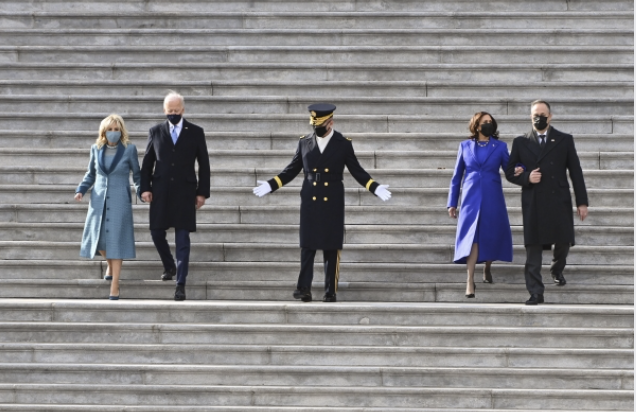
ColumnsJan 21. 2021President-elect Joe Biden and Jill Biden arrive on the West Front of the U.S. Capitol for Inauguration Day on Jan. 20 in Washington. Biden became the 46th U.S. president during the ceremony. MUST CREDIT: Washington Post photo by Toni L. SandysPresident-elect Joe Biden and Jill Biden arrive on the West Front of the U.S. Capitol for Inauguration Day on Jan. 20 in Washington. Biden became the 46th U.S. president during the ceremony. MUST CREDIT: Washington Post photo by Toni L. Sandys

By The Washington Post · David Maraniss · OPINION, ESSAYS 

On the third Wednesday in January, after a first Wednesday of insurrection and a second of impeachment, came an inauguration that promised to be unlike any in American history. In some ways it was. The surrounding atmosphere was haunting, threatening, weird and emotionally charged. Yet in its depth, purpose and artful presentation, what took place during the ceremony on the West Front of the Capitol managed to lift the mood and evoke a sense of reassurance and hope. 

President Joe Biden, first lady Jill Biden, Vice President Kamala Harris and second gentleman Doug Emhoff depart after the inauguration ceremony. MUST CREDIT: Washington Post photo by Ricky Carioti

President Joe Biden, first lady Jill Biden, Vice President Kamala Harris and second gentleman Doug Emhoff depart after the inauguration ceremony. MUST CREDIT: Washington Post photo by Ricky Carioti

As the sun shone at noon, Donald Trump’s presidency was done and gone; Joe Biden’s time had come. He had already taken the oath of office on a five-inch-thick family Bible and was a few minutes into his inaugural address by then. He had just uttered the words “Let’s start afresh.” Those who had been counting down the days and then hours to the end of a toxic presidency could exhale in relief at last. Votes mattered. The system triumphed. “Democracy is precious,” President Joe Biden said. “Democracy is fragile, democracy has prevailed.”

Everything about the inaugural ceremony represented a determined effort to put things back in sync with the nation’s history. The songs, the poem, the prayers, the greetings and oath-takings, a presidential address focused on unity and healing – all were attempts to say this is what America does, this majestic handoff from past to present. It happened, but barely. There was no meaningful handoff from 45 to 46, and the peaceful transfer of power, a notion traditionally evoked to symbolize a resilient democracy, threatened to be a hollow phrase.

There was little peaceful about the transfer. Not after the deadly storming of that very Capitol two weeks ago by an insurrectionist mob invited and incited by Trump in his two-month effort to deny his loss of power through any means necessary, election results be damned. The scars of that deadly riot were still evident in scraped walls and broken windows within a short distance of the inaugural stage. And there was nothing serene about a ceremony taking place within a vast militarized zone ringed by thousands of rifle-toting soldiers and barricaded by high fences, barbed wire, Jersey barriers and hulking army trucks, an armed camp necessitated by what Trump and his conspiracy theory-obsessed true believers had wrought. The National Guard guarding the nation against itself. 

It was not even a transfer in any accepted sense. Soundly defeated and twice impeached, Trump abandoned his post and any semblance of traditional decorum by avoiding the inaugural scene altogether, shunning the Bidens, leaving that greeting to a White House usher. After issuing a flurry of midnight pardons, he play-acted his way out of town with a faux-pomp military send-off at Joint Base Andrews in the morning chill, one last petulant act to feed the wounded ego of a shrunken man, so self-aggrandizing that even his vice president declined to be part of it and the paltry assemblage consisted mostly of family and paid staff.

Trump had always longed for a strongman-style military parade, but this leave-taking – with its trappings of a military band and 21-gun salute – before his exile to Mar-a-Lagoland would have to suffice, though it could not match the display of might he unwittingly left behind on the streets of Washington.

Then came an elegant ceremony at the Capitol, an inauguration marked by who was there and who was not. The Clintons, Bushes, and Obamas were there to greet and induct the new first couple into their select club, and the nonagenarian Carters would have been had circumstances not made traveling perilous. Many congressional Republicans were there, including some who had encouraged and endorsed the antidemocratic lie that Biden won only because of voter fraud. Mike Pence was also there, breaking at long last four years of obsequious vice-presidential fealty. Although from a Biden perspective Trump might have been the only person not missed, he was by no means the only one missing. The anxious convergence of a domestic terrorism threat and the year-long contagion of the coronavirus dramatically diminished the throng that in normal circumstances would have flooded into Washington to cheer a new president into office. 

When Biden and Barack Obama were first inaugurated as vice president and president 12 years ago, the National Mall teemed with expectant masses stretching from the Capitol back to the Washington Monument and on toward the Lincoln Memorial horizon. This time, although Biden had won the votes of 81 million citizens, more than anyone before, few of his supporters could witness the culminating event of the 2020 election. At the end of a virtual campaign in a virtual year came a largely virtual inauguration. Biden’s crisp and forward-looking inaugural address, his call to “end this uncivil war” and find unity in its place, resounded past a scattering of socially distanced guests below the stage and echoed into the haunting beyond, an eerily silent rectangular expanse artistically filled with 200,000 American flags flapping in the winter wind that were meant to represent the crowd that was not there. 

If Biden promised a clean break from the immediate past, with a resolve to lead America out of recession and plague and into a more diverse and equitable future, he did so with the distinction of being the oldest president – 78 at his inauguration. The average age of his predecessors upon taking office was 56, making him 22 years above par, and the two most recent Democratic presidents were far younger than that. Bill Clinton was 46 and Barack Obama 47. Along with age in Biden’s case, unlike Trump’s, came political experience. Biden entered the White House having spent 36 years in the Senate and eight more as vice president, more time accumulated on both ends of Pennsylvania Avenue than any president before him, surpassing even Lyndon B. Johnson in that realm. He was also the first president from the first state, Delaware, and the second who happened to be Catholic, after John F. Kennedy.

A more important breakthrough comes from his vice president, Kamala Harris, the first woman and first person of Black and South Asian American heritage to hold that position. In a nation riven by racism, in an era afflicted by resurgent white nationalism, it was notable that Harris was sworn in by the first Latina justice on the Supreme Court, Sonia Sotomayor, on a Bible that belonged to the first African American justice, the late Thurgood Marshall. The trajectory of racial progress, uneven as it has been, could be traced from there back 160 years to the first inauguration of Abraham Lincoln. Swearing in Lincoln that March day was Chief Justice Roger Taney, the jurist who oversaw the 1857 Dred Scott decision decreeing that enslaved African Americans, even if living in a free state, were not citizens and did not deserve freedom. 

Lincoln was inaugurated in 1861 on the other side of the Capitol, on the East Portico, but in many ways the atmosphere then was most comparable to what Biden encountered. Like Biden, Lincoln entered an anxious city in a divided nation. With seven Southern states already split from the Union and threats on his life evident, his inauguration also had a martial feel, the Capitol guarded by a cordon of infantry troops. Lincoln arrived in Washington by train, rolling through Wilmington, Del., on the route from Illinois, but when he reached Baltimore the danger was so great he was secretly switched in the middle of the night to another locomotive. Biden, the ultimate train enthusiast, had hoped to ride the rails from his home in Wilmington into the capital as well, but those plans were scuttled because of the threatening circumstances. 

Biden’s public posture since the November election was to convey a sense of calm amid the clanging chaos of the moment. In some quotidian ways, his administration will return to a governing style that exudes old-school normality. Daily news briefings. Intense policy discussions. Decisions based on fact and science. More debates about substance, less posturing and propaganda. Dare to be boring. No governing by predawn Twitter and gut and whim and insult and narcissistic need. 

But some things will not be so easy to change. Barack Obama’s first election was greeted by a satirical headline in the Onion newspaper that captured the difficulties of inheriting an economy in free fall: “Black Man Given Nation’s Worst Job.” As Biden entered the White House Wednesday afternoon, he faced Obama’s worries multiplied. Jobs lost by the millions. Businesses shuttered in every city and town. The nation’s children struggling with closed or virtual schools. The medical world battling a contagion that had already taken an unthinkable toll of 400,000 dead. A political opposition that had lied about his election victory and continued to argue that his legitimate claim to the presidency was somehow still illegitimate. All that piled on top of other pressing domestic and foreign policy concerns.

The contrast between past and future was never starker than one moment on the morning of the Final Half Day. At 8:47, after a meandering final speech at the airfield in which he uttered the immortal last words, “Have a nice life, we will see you soon,” Trump, the congenital divider, disappeared into Air Force One, taking with him the nuclear briefcase, which would be his only until noon, suitcases full of grievances that would be his forever, the lowest end-of-term poll ratings of any president since polls have been taken, and a growing consensus among historians that he would rank at the bottom of the presidential barrel. 

Seconds after Trump stepped inside the plane, Joe and Jill Biden emerged from their overnight lodging at Blair House. As an irrepressible uniter, Biden was on his way to make his first small unifying effort by convening congressional leaders of both parties at a morning church service at the Cathedral of St. Matthew the Apostle. It was a classic move by a refreshingly optimistic man who promised in his address to devote his “whole soul” to that cause even as he understood that unity was “the most elusive of all things in a democracy.” In today’s political cauldron, what unity meant depended on who was talking and for what purpose. 

Back on the frigid January day in 2009 when Obama and Biden were first inaugurated, several hundred people who held purple-coded tickets never got to witness the ceremony, stuck for hours behind a checkpoint that backed them up deep inside the Third Street Tunnel. They huddled and shivered and cried and sang in what became known as the Tunnel of Doom. At noon on Jan. 20, 2021, there was a sense that America might finally be emerging out of a long tunnel of doom of a more dangerous sort. Or not. The future is uncertain, but one thing seemed like a sure bet in the sunlight of a new day. President Biden would not order his press secretary to lie about the size of his inaugural crowd. 

Caution v haste #SootinClaimon.Com

#SootinClaimon.Com : ขอบคุณแหล่งข้อมูล : หนังสือพิมพ์ The Nation.

Caution v haste

ColumnsJan 17. 2021

By The Statesman

To import vaccines at high cost, to store them in special facilities and then have people refuse them is a daunting prospect.

While some countries ~ principally the United States, the United Kingdom and a few others ~ have already launched ambitious vaccination programmes and others including India plan to do so in the next few days, the studied reluctance of some countries that had fared relatively well in controlling the coronavirus epidemic to commence vaccination drives must invite attention.

These countries have not yet approved any of the vaccine candidates on offer and have opted to observe developments across the world before taking a decision. Among them are Japan, South Korea, New Zealand and Australia.

Even Hong Kong’s local administration has opted for a cautious approach, notwithstanding China offering vaccines, with a medical expert on the island territory’s Executive Council telling a news agency that “it’s not a bad thing to sit back a bit and see how others are doing.”

Many experts in these countries have explained their concern by saying that the vaccines for the first time ~ and following accelerated development programmes ~ use mRNA technology that makes the human body produce proteins that then develop protective antibodies and must thus be evaluated very carefully.

But there are other factors at play, too. South Korea, for instance, has expressed concern at the manner in which pharmaceutical companies have sought and obtained legal immunity following rushed negotiations where one party ~ the supplier ~ has held all the cards. The country’s Health minister Park Neung-hoo told a recent news briefing, “It is nearly universal around the world that extensive immunity from liability is being demanded.”

He added that rushing to vaccinate populations “before we identify risks is not so necessary for us.”

Despite Opposition criticism, New Zealand’s approach has been similarly measured, aided no doubt by the fact that the country’s early anti-virus measures that won Prime Minister Jacinda Ardern acclaim have largely controlled the epidemic.

Another concern cited by these countries is that a botched roll-out of the vaccination programme could further erode public confidence in the efficacy of the vaccines. A recent survey had found that the numbers of those willing to take the vaccine had dropped a whopping 9 percentage points from last October to November.

To import vaccines at high cost, to store them in special facilities and then have people refuse them is a daunting prospect. In any event, experts argue that jumping the gun without analysing all factors is inadvisable, unless a country faces a galloping rise in numbers of afflictions, as reported in the USA and UK, making vaccination, even in a worst-case scenario, the lesser of two evils.

With most Asian countries having achieved relatively greater success in controlling the virus, and with people having embraced safety precautions with far greater enthusiasm than in parts of Europe and the US, policy-makers believe there is no need to panic, even if the delay in vaccination draws political backlash, as indeed it is now beginning to.

Flying the flag of fascism for Trump #SootinClaimon.Com

#SootinClaimon.Com : ขอบคุณแหล่งข้อมูล : หนังสือพิมพ์ The Nation.

Flying the flag of fascism for Trump

ColumnsJan 07. 2021Trump supporters scale the walls on the Senate side of the Capitol on Wednesday, Jan. 6, 2021. MUST CREDIT: Washington Post photo by Michael Robinson ChavezTrump supporters scale the walls on the Senate side of the Capitol on Wednesday, Jan. 6, 2021. MUST CREDIT: Washington Post photo by Michael Robinson Chavez
By The Washington Post · Robin Givhan · OPINION, OP-ED 

Amid the chaos and mayhem at our nation’s Capitol, the flags flew high. Dangerous. Despicable. And familiar.

The day had begun with the results of Georgia’s runoff election, in which Raphael Warnock was the projected winner and fellow Democrat Jon Ossoff declared victory. In the aftermath of his success, Warnock reflected on the hopeful history he had just made, as the first African American senator from Georgia. The country had come so far, a journey measured by the life of his 82-year-old mother, who had gone from picking cotton for the benefit of overseers to casting a vote for her son for the betterment of her country.

Ossoff, who had interned with the civil rights icon John Lewis, would make history, too. He would by nightfall be projected to become the state’s first Jewish senator.

But our grievous history is relentless. And so is hate.

The rioters stormed the U.S. Capitol in hopes of holding on to a past – both near and distant. They hoisted Trump flags aloft because it is he to whom they’ve pledged their allegiance, refusing to accept his defeat in the November election. “USA!” “USA!” they cried. These violent and angry mobs of men and women called themselves patriots – despoiling a beautiful and mighty word – as they clamored up inauguration scaffolding, shattered windows and wreaked terror in the nation’s capital in the name of a single wretched man and his delusions of greatness. They held signs that evangelized that “Jesus Saves,” using religion to justify their attempted coup.

“Fight for Trump!” they chanted. And they let Confederate flags fly on the Capitol steps and inside its hallowed halls, making it plain just how they define the man and the real Americans for whom they claim to be standing firm.

For much of Wednesday afternoon, the president of the United States let the anger of the mob fester as flash bangs echoed off federal buildings and the stink of smoke filled the air. President Donald Trump had incited and encouraged this insurrection. It was his creation, and he put the final flourishes on it in the late morning when he – as well as his family – poured even more accelerant on an already raging fire during a morning rally on the Ellipse.

The Capitol siege was seemingly his end game, the culmination of his campaign of lies and grievances over an election that he lost fair and square.

“We’re going to walk down to the Capitol, and we’re going to cheer on our brave senators and congressmen and women, and we’re probably not going to be cheering so much for some of them,” Trump said from behind a protective clear shield as he was wrapping up his remarks.

“We’re never going to take back our country with weakness. You have to show strength, and you have to be strong.”

His followers did as they were told.

And so, on the sixth day of a new year that has already felt like a suffocating eternity, democracy bled out. It was bludgeoned and pummeled and stabbed through the heart by a mob of Americans who claimed they were fighting against communism, socialism, liberalism and a host of other -isms, when all along they were simply at war with democracy and the inconvenient truth that sometimes you and yours are simply outvoted.

What to call these people? To describe them as protesters is to undermine those who take to the streets in peace, who raise their voices in hopes of making the country better – not to demolish it. Are they traitors? Terrorists? Radicals? Thugs? They are all of those things – a national quilt of our worst impulses and characteristics. They are young and old. They are men. They are women.

They are mostly White. And they rampaged through the Capitol posting photographs of themselves and one another breaking into the offices of the speaker of the House, looting and rioting and threatening – and, at least initially, being greeted like overzealous tourists compared with the way in which some law enforcement have beaten back Black Lives Matter and racial justice demonstrators.

The president-elect made a statement, too. Joe Biden pleaded for peace and insisted that Trump speak up with certitude and passion and to send his supporters home. “This is not dissent,” Biden said. “It’s disorder. It’s chaos. It borders on sedition. And it must end. Now.”

He said the rioters did not represent who we are. But they are, at least in part, who we have become. They’re certainly part of who we’ve always been. They are Americans just as surely as are those who watch them in horror and disgust.

Americans stormed the Capitol, and they did so while flying the Confederate flag. They did this. They brandished it throughout the marble halls. That is who they are. They are proud of it. And they are part of this body politic.

As democracy lay dying under the Capitol dome, Trump finally spoke to the assailants, in a video posted to Twitter. His call for the violence to cease was grudging and without any of the ruthless gusto that he reserves for agitators who don’t look like him, who don’t worship him, who don’t serve his purposes.

“I know your pain. I know your hurt,” Trump said, and then he repeated his lies about having won the election. “But you have to go home now. We have to have peace.”

But what Trump has unleashed cannot so easily be controlled or pushed back. History is relentless. Hatred is fierce.

The rioters want to wallow in the Confederacy. They want to be reborn under the flag of Trump. They want to live in an angry, polluted, heartless world, if only because it means that they get to stand victorious atop the whole, miserable mess.

Robin Givhan is senior critic-at-large writing about politics, race and the arts. A 2006 Pulitzer Prize winner for criticism, Givhan has also worked at Newsweek/Daily Beast, Vogue magazine and the Detroit Free Press.

Why the Thai government needs to get on the fast track in promoting EVs #SootinClaimon.Com

#SootinClaimon.Com : ขอบคุณแหล่งข้อมูล : หนังสือพิมพ์ The Nation.

Why the Thai government needs to get on the fast track in promoting EVs 

ColumnsJan 06. 2021

By Chadin Rochananonda,
Vut Mahamongkol
Special to The Nation 

Governments around the world are aware of the environmental problems and challenges besieging the planet. This has led to the framing of public policy focusing on the balancing of economic, social, and environmental issues.

The trend in pushing economic development is increasingly based on innovation being applied to increase productivity and further improve people’s quality of life. Reducing the amount of greenhouse gas emissions and PM2.5 (particles less than 2.5 micrometres in diameter) dust in the air are critical areas of emphasis in framing policies to promote the development of industry and the use of electric vehicles seriously until it becomes a national agenda.

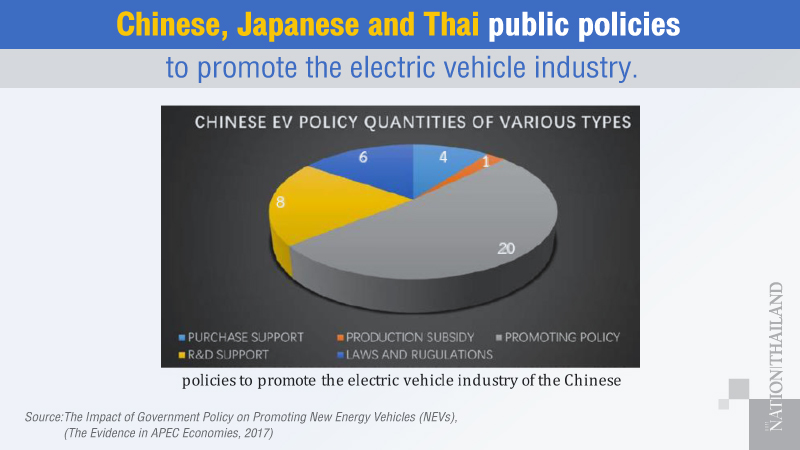
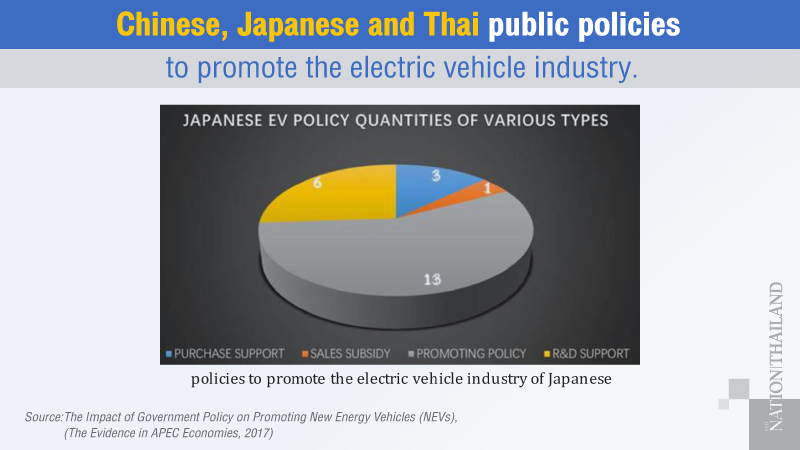
​A 2017 Asia-Pacific Economic Cooperation (Apec) study illustrates the policy of supporting the manufacture and use of electric vehicles in the leading industrialised countries, including China and Japan. They have a comprehensive policy package covering five areas. They provide a 10-15 per cent subsidy to customers; offer tax incentives and manufacturing subsidies; offer research and development support for more than 20 years by funding automobile companies to develop batteries and electric startup companies, woo foreign direct investment or determine the proportion of governmental electric vehicles; and, issue laws and regulations limiting the number of fossil-fuel vehicles in big cities.

​Public policy in developed countries, including China and Japan, have supported and promoted the manufacture and use of electric vehicles seriously, reflecting the determination of the governments to revolutionise the automotive industry and reduce dependence on fossil fuels, and facilitate environmental conservation. 

The Chinese government has issued 39 policies for promotion and support of EVs, while Japan has 26, with the highest priority being on demand-side subsidies, followed by promoting technology research and development. Increased use of EVs and support for production have lowered the prices of electric cars. This is considered a complete stimulus covering both supply and demand.

A master’s degree thesis by Vut Mahamongkol in 2020 from Chulalongkorn University’s Faculty of Political Science, on Electric Vehicle Industrial Promotion Policy Formulation in Thailand has compiled the current policies to promote and support the production and use of electric vehicles by the Thai government. It found that there were only two areas of policies to support and promote EVs, namely the Promotion Policy, especially tax incentives to promote investments from foreign investors, totalling four policies, and for the promotion of research and development. Imposing the condition that foreign companies transfer advanced technology, such as the production of batteries that can charge quickly, would allow Thai entrepreneurs to develop their manufacturing capabilities from just assembly and fabrication.

​An overall evaluation shows the Thai government’s policies are not comprehensive enough to cover all dimensions. As a result, the prices of electric cars in Thailand are quite high — about Bt1 million or more. Currently, no foreign company has set up a manufacturing plant for electric cars. All the EVs are imported. The only operator in Thailand is Energy Absolute Pcl (EA). Recently, EA launched an electric vehicle under the Mine Mobility brand. The EV can drive continuously for 200 kilometres per charge, but the cost is still quite high due to lack of government support. If the Thai government explores opportunities in developing the EV industry, it will enhance industrial development as well as Thailand’s economic competitiveness in the future. Therefore, it is necessary to come up with more comprehensive policies, by adding three policy areas — the adoption of pollution control laws, promoting the manufacture, and the use of electric cars. 

Proactive moves in this direction will be an important factor in creating an environment that will facilitate the manufacture of electric cars as the main vehicle in Thailand in future, and contribute to sustainable reduction of greenhouse gas emissions and PM 2.5 dust in the country as well.

​However to focus on the development of the EV industry, it must rely on occasion and timing since the government must consider the overall readiness of the stakeholders resulting from this important decision because fossil fuel vehicles will eventually be replaced by electric cars. 

In 2019, Thailand ranked 11th in the world in the automobile industry (50 per cent of its production for domestic use and 50 per cent for exports). Amid the increasing use of electric cars, it began to wake up to the reality and come up with a significant response. If the Thai government lacks a clear and comprehensive policy to promote the production and use of electric vehicles, it will inevitably affect export income, which is a major engine of growth driving the Thai economy.

Chadin Rochananonda is a lecturer at the Faculty of Political Science, Chulalongkorn University, and

Vut Mahamongkol is product supervision manager at Nissan Motor (Thailand)

Whose post-pandemic century? #SootinClaimon.Com

#SootinClaimon.Com : ขอบคุณแหล่งข้อมูล : หนังสือพิมพ์ The Nation.

Whose post-pandemic century?

ColumnsJan 05. 2021

By Bill Emmott
Kathmandu Post

It is not too early to start absorbing the lessons of Asia’s public-health successes.

In the early stages of the Covid-19 pandemic, it was common to divide countries and their responses according to their political systems, with many attributing China’s success in controlling the virus to its authoritarianism. As of late 2020, however, it is clear that the real dividing line is not political but geographical. Regardless of whether a country is democratic or authoritarian, an island or continental, Confucian or Buddhist, communitarian or individualistic, if it is East Asian, Southeast Asian, or Australasian, it has managed Covid-19 better than any European or North American country.

While this line is not exactly hemispheric, it is close enough to be suggestive. Even Asia’s worst performers (in public-health terms)—such as the Philippines and Indonesia—controlled the pandemic more effectively than did Europe’s biggest and wealthiest countries. Notwithstanding reasonable doubts about the quality and accuracy of the reported mortality data in the case of the Philippines (and India), the fact remains that you were much likelier to die of Covid-19 in 2020 if you were European or American than if you were Asian.

Comprehensive, interdisciplinary research is urgently needed to explain these performance differentials. Because much of our current understanding is anecdotal and insufficiently pan-regional, it is vulnerable to political exploitation and distortion. To help all countries prepare for future biological threats, several specific questions need to be explored. First is the extent to which the experience of SARS, MERS, Avian flu, and other disease outbreaks in many Asian countries left a legacy of health-system preparedness and public receptiveness to anti-transmission messaging.

Clearly, some Asian countries have benefitted from existing structures designed to prevent outbreaks of tuberculosis, cholera, typhoid, HIV/AIDS, and other infectious diseases. For example, as of 2014, Japan had 48,452 public-health nurses (PHNs), 7,266 of whom were employed in public-health centres where they could be mobilised quickly to assist with Covid-19 contact tracing. Although occupational definitions vary, one can compare these figures with those for England, where just 350-750 PHNs served 11,000 patients in 2014. (England’s population is roughly half the size of Japan’s.)

We also will need a better understanding of the effect of specific policies, such as rapidly closing borders and suspending international travel. Likewise, some countries did a much better job than others at protecting care homes and other facilities for the elderly—especially in countries (notably Japan and South Korea) with a high proportion of people over 65.

Moreover, the effectiveness of public-health communications clearly varied across countries, and it is possible that genetic differences and past programmes of anti-tuberculosis vaccination may have helped limit the spread of the coronavirus in some areas. Only with rigorous empirical research will we have the information we need to prepare for future threats.

Many are also wondering what Asia’s relative success this year will mean for public policymaking and geopolitics after the pandemic. If future historians want a precise date for when the ‘Asian Century’ began, they may be tempted to choose 2020, just as the US publisher Henry Luce dated the ‘American Century’ from the onset of World War II.

But this particular comparison suggests that any such judgment may be premature. After all, Luce’s America was an individual superpower. Emerging victorious from the war, it would go on to claim and define its era (in competition with another superpower, the Soviet Union). The Asian Century, by contrast, will feature an entire continent comprising a wide range of countries.

In other words, it is not simply about China. To be sure, the rising new superpower has been notably successful in coping with the pandemic after its initial failures and lack of transparency. But its scope for asserting systemic superiority is circumscribed by the fact that so many other Asian countries have been equally successful without Chinese assistance.

The post-war comparison also may be premature for economic reasons. Asian countries’ economic performance in 2020 did not match the success of their pandemic response. While Vietnam, China, and Taiwan have beaten the rest of the world in terms of GDP growth, the United States has not fared too badly, despite its failure to manage the virus. With forecasts pointing to a 3.6 percent contraction for the year, the US is in better shape than every European economy, as well as Japan, Malaysia, Singapore, Thailand, the Philippines, and others in Asia. The difference is largely a function of interconnectedness: compared to the US, many Asian economies are more exposed to trade and travel bans, which cut deeply into the tourism industry.

Although China’s public health and economic outcomes have been better than the West’s in 2020, it has neither found nor really sought a political or diplomatic advantage from the crisis. If anything, China has become more aggressive toward nearby neighbours and countries like Australia. This suggests that Chinese leaders are not even trying to build an Asian network of friends and supporters.

How China approaches the issue of international debt restructurings—especially those connected with its Belt and Road Initiative—will be a key test in 2021. But, of course, the US and the rest of the West also will be tested, and on a wide range of issues, from international finance to sociopolitical stability.

It may be too soon to announce a new historical epoch; but it is not too early to start absorbing the lessons of Asia’s public-health successes.

—Project Syndicate

2021: nothing rosy on the horizon #SootinClaimon.Com

#SootinClaimon.Com : ขอบคุณแหล่งข้อมูล : หนังสือพิมพ์ The Nation.

2021: nothing rosy on the horizon

ColumnsJan 04. 2021

By Lim Sue Goan
Sin Chew Daily

The Dewan Rakyat has passed the 2021 Budget at the third reading by a very slim margin of 111 to 108. This means the Perikatan Nasional government can continue to govern until next year.

The thing is, as PM Muhyiddin only has a razor-thin majority support in the Parliament, we cannot expect him to bring about any remarkable change so that the country can be steered back and go down the right way next year.

With his administration so vulnerable, it is within anticipation that the PM will do his utmost to please Umno, a party that upholds racism and populism, as well as the conservative religious party PAS. As a result, the country will remain stagnant without any meaningful progress over much of next year.

As a matter of fact, reform has never been Muhyiddin’s ultimate objective, and Malaysians are expected to continue struggling next year under the weight of political and economic woes and the coronavirus pandemic.

Recent economic developments and numbers point to the fact that this country will continue to suffer economically next year.

First and foremost, Fitch Ratings announced a downgrade for Malaysia’s long-term Issuer Default Rating (IDR) from “A-” to “BBB+” before it cut the sovereign ratings of Petronas and Telekom Malaysia.

Fitch has highlighted the country’s weaknesses, including higher government debts at 76% of the country’s GDP, and political instability that could affect the government’s performance.

Even though the government’s revenue will remain at a pathetically low level of 19.1% of GDP, the PN administration has failed to explore new sources to increase its revenue while expenditures continue to soar, causing the government’s debt level to go out of hand.

The PM has admitted that we used to be a preferred destination for international investors, but due to the pandemic it is very hard to get investors to come here now.

Women and family minister Rina Harun has revealed that her ministry plans to hire additional 8,000 social welfare department (JKM) workers next year, meaning our already bloated civil service sector is set to expand further next year.

Given the ballooning expenditures and mounting public debts, asset disposal is probably the only strategy at hand.

In order to disburse RM34 billion dividend to the government, Petronas has reduced its stakes in MISC and KLCCP Stapled in a bid to raise RM2.8 billion in cash.

Meanwhile, PNB recently disposed of its Grade A Brisbane office tower Santos Place for A$370 million (RM1.14 billion).

Additionally, Asian Development Bank has predicted that Malaysia’s GDP will shrink by 6% this year, worse than the previously projected 5% shrinkage. Meanwhile, October unemployment rose to 4.7% or 748,200 people out of job, while November IPI (industrial production index) contracted by 0.5%, signaling a bleak prospect for the country’s growth in the year to come.

But weirdly, even as the country urgently needs foreign investments to bolster our economy, the PN government seems to have acted the other way. For record, it has terminated the RM43 billion Melaka Gateway project, suspended the MM2H program, and reportedly excluded Singapore from the proposed high speed rail project by making Johor Bahru the terminal station of this costly project.

The country’s international image is poised to suffer further as a consequence of rampant corruption and abuse of power. The government has just canceled the bribery case involving former federal territories minister Tengku Adnan Tengku Mansor, the third major case involving public interests dropped so far this year, prompting Credit Suisse Malaysia to warn that “the country will pay the price for this.”

Actually, Muhyiddin lacks the actions to fight corruption even if he has pledged to do so. In the case of rubber stamp counterfeit case involving immigration officers, a low-ranking officer has been found to possess four luxurious sedans worth over RM2 million. And in the money-laundering case involving a Macau syndicate, a police officer was found to have RM1 million savings in his bank account.

Malaysians generally perceive that the corruption problem has gone from bad to worse. According to Transparency International’s Global Corruption Barometer (Asia), 70% of Malaysians see government corruption as a big problem, 30% think the government has done very badly in addressing the corruption issue, while 36% believe our MPs are corrupt.

Even so, PAS president Hadi Awang has viewed corruption in the same light as alcoholism. Without institutionalized effort to battle corruption, the market will never be convinced.

We cannot pin our hopes on senior politicians who care only about their own interests. We must be bold enough to delegate the responsibility of overhauling this country to young leaders who are our only bet.