PTTEP net profit surges 40% from strategic acquisitions #ศาสตร์เกษตรดินปุ๋ย

#ศาสตร์เกษตรดินปุ๋ย : ขอบคุณแหล่งข้อมูล : หนังสือพิมพ์ The Nation

https://www.nationthailand.com/business/30381307?utm_source=category&utm_medium=internal_referral

PTTEP net profit surges 40% from strategic acquisitions

Jan 30. 2020
By THE NATION

PTT Exploration and Production (PTTEP) reported a net profit of US$1.569 billion last year, representing an increase of 40 per cent year on year, due mainly to growth in sales volume and capacity following new acquisitions and the purchase of additional stakes in the Bongkot field.

The reserve-to-production (R/P) ratio also rose to 7.5 years, ensuring steady growth of the company and energy security of Thailand in the long run. PTTEP targets to raise sales volume by 11 per cent in 2020.

Phongsthorn Thavisin, president and chief executive officer, said total revenue last year amounted to $6.413 billion, increasing from $5.459 billion in 2018 or a rise of 17 per cent, resulting mainly from the acquisitions of Murphy Oil Corporation’s assets in Malaysia and Partex Holding BV.

Consequently, the average sales volume last year reached 350,651 barrels of oil equivalent per day (BOED) or an 15-per cent increase from 305,522 BOED in 2018.

Meanwhile, the average selling price also slightly improved from $46.66 per barrel of oil equivalent (BOE) in 2018 to $47.24 BOE in 2019.

Due to the higher sales volume in 2019, PTTEP’s net profit hit $1.569 billion, a 40-per cent increase from US$1.120 billion in 2018.

PTTEP’s financial position remains strong with operating cash flow of $3.540 billion while Earnings before Interest, Tax, Depreciation, and Amortization (EBITDA) margin stands at 71%.

Phongsthorn Thavisin

Phongsthorn Thavisin

Phongsthorn said the “expand” strategy which included both domestic and international acquisitions and winning bids, drove the average sales volume to reach an record high of 350,651 BOED last year.

This successful strategy also improved the company’s proven reserves (P1) from 677 million BOE (MMBOE) to 1,140 MMBOE, representing a 68 per cent surge from 2018 and at the same time, pushing up the R/P ratio from 5 to 7.5 years.

“In addition to higher petroleum sales volume, we have also increased petroleum reserves as targeted. We are capable of adding more reserves in the future if our exploration projects are proved successful. This is not only building growth for PTTEP but also elevating the country’s energy security in the long term. This year, PTTEP targets to raise the average sales volume by 11 per cent,” said Phongsthorn.

Based on the company’s performance, the board of directors on Thursday (January 30) approved a total dividend payment of Bt6 per share for 2019.

PTTEP had already paid an interim dividend for the first six months of Bt2.25 per share. Dividend for the second half of 2019 will be paid at Bt3.75 per share on April 10, 2020, after obtaining approval from the 2020 Annual General Shareholders’ Meeting.

Share registration date for the right to receive the dividend is scheduled for February 14, 2020.

In 2020, PTTEP will focus on smooth transitions of the newly-acquired projects, especially the G1/61 (Erawan) and G2/61 (Bongkot), to ensure timely delivery of petroleum as stated in the profit-sharing contracts.

The preparation includes drilling plans, construction of production platforms and gas pipelines, as well as other related activities.

For the Erawan field, PTTEP is now working closely with the existing concessionaire and the Department of Mineral Fuels to ensure production continuity during the transition period.

PTTEP also plans to accelerate exploration activities in high potential areas including Malaysia and Myanmar, such as the Myanmar MD-7 project and the Lang Lebah-1RDR2 exploration well in Malaysia’s block Sarawak SK410B, where it made the biggest gas discovery in the company’s history. Also a priority is the other nearby exploration projects in Malaysia which PTTEP plans to develop as a cluster.

Furthermore, PTTEP will focus on utilising technology to maximise the value of existing projects and proceeding with the developments of the Mozambique Area 1 and the Algeria Hassi Bir Rekaiz projects in line with the long-term growth strategy of the company.

KBank set to buy back 24m shares to solidify capital #ศาสตร์เกษตรดินปุ๋ย

#ศาสตร์เกษตรดินปุ๋ย : ขอบคุณแหล่งข้อมูล : หนังสือพิมพ์ The Nation

https://www.nationthailand.com/business/30381305?utm_source=category&utm_medium=internal_referral

KBank set to buy back 24m shares to solidify capital

Jan 30. 2020
Banthoon Lamsam

Banthoon Lamsam
By THE NATION

Kasikornbank is preparing to repurchase 23.93 million shares at a lower price and pay a dividend, it announced on Thursday (January 30).

The bank said it would use excess liquidity to repurchase up to Bt4.6 billion worth of shares, ensuring a strong capital fund and sufficient liquidity to support long-term operations.

The dividend payment from 2019 operating results will be Bt5 per share, up from Bt4 in 2018.

Chairman Banthoon Lamsam said directors had approved the repurchase in order to manage liquidity for the utmost benefit to the bank and its shareholders, with the number of shares not exceeding 1 per cent of the total paid-up capital.

The repurchase will be conducted on 10 consecutive business days beginning on February 14.

The repurchase price must not exceed the average closing price in the five consecutive business days prior to each repurchase date, plus 15 per cent of the average closing price.

KBank also has a capital adequacy ratio of at 19.62 per cent, sufficiently sturdy to support the implementation of strategic plans and businesses, Basel IV, and factors with potential future impacts.

And it still has sufficient financial liquidity with unappropriated retained earnings of up to Bt299.2 billion.

The share repurchase will lower the bank’s liquid assets and the book value of the shareholders’ equity and enable it to maximise efficiency of its excess liquidity and capital management.

Liquid assets and equity book value will be lowered by the amount equivalent to the repurchased amount, raising the return on equity and the earning per share ratios.

The directors might later decide to resell the repurchased shares through the SET or a public offering, whichever is more appropriate at the time. This would take place between six months and three years of completing the repurchase.

The directors resolved to concur with the dividend payment from 2019 operating results to ordinary shareholders at the rate of B5 per share, of which the bank paid an interim dividend of Bt0.50 per share last September 26.

The bank will on April 10 announced the names of shareholders entitled to be paid the remainder. The dividend payment will be discussed at the shareholders’ annual general meeting and payments will be made on April 30.

Coronavirus and drought crises to take a toll on Thai economy #ศาสตร์เกษตรดินปุ๋ย

#ศาสตร์เกษตรดินปุ๋ย : ขอบคุณแหล่งข้อมูล : หนังสือพิมพ์ The Nation

https://www.nationthailand.com/business/30381354?utm_source=category&utm_medium=internal_referral

Coronavirus and drought crises to take a toll on Thai economy

Jan 31. 2020
Thanavath Phonvichai
By THE NATION
Negative factors like the new coronavirus outbreak and the drought situation in the country could cost the country Bt226.7 billion this year, according to estimates by the Centre for Economic and Business Forecasting of the University of the Thai Chamber of Commerce (UTCC).

UTCC president Thanavath Phonvichai said this week that the centre had evaluated the effects on the Thai economy of the coronavirus outbreak — which affects the tourism sector and also the demand for Thai goods — the ongoing drought, the PM2.5 dust crisis and the delay in the 2020 budget disbursement.

The centre, however, has not yet revised down its forecast for Thai economic growth this year from 2.8 per cent, as it was waiting to see if the government’s current and upcoming remedial measures could successfully ameliorate the problems.

The centre estimated that in case the coronavirus outbreak could be contained by March, the number of tourist arrivals in Thailand would be lower by 2.41 million, of which 1.84 million would be Chinese. This will cost the Thai economy about Bt117.3 billion.

If the epidemic prolongs till May, it will cost Thailand Bt189.2 billion.The outbreak in China is predicted to pull China’s economic growth this year below the current forecast of 5.9 per cent. Its slowing economy will result in a decline in the global economy, which will affect the demand of Thai goods accordingly.

The centre estimated that if China can control the virus spread by March, the impact on Thai exports would be limited to Bt15.5 billion. If China can control the situation only in May, the impact on Thai goods would be much higher at Bt36.7 billion.

In the case of budget disbursement, which should have been released last October, if the disbursement begins in April, will cost the gross domestic product (GDP) Bt77.5 billion. If the disbursement starts as late as June, it will hurt GDP by around Bt167 billion.

The PM2.5 dust pollution, if not at a serious level for more than two weeks, will affect GDP by Bt3.8 billion. If the situation prevails for not more than one month, it will cost Bt6.2 billion, according to UTCC’s estimates.

Egat prepares to bring in third LNG shipment #ศาสตร์เกษตรดินปุ๋ย

#ศาสตร์เกษตรดินปุ๋ย : ขอบคุณแหล่งข้อมูล : หนังสือพิมพ์ The Nation

https://www.nationthailand.com/business/30381317?utm_source=category&utm_medium=internal_referral

Egat prepares to bring in third LNG shipment

Jan 31. 2020
By THE NATION

The Electricity Generating Authority of Thailand (Egat) is planning to procure and import more liquified natural gas (LNG) in accordance with Energy Ministry policy.

Egat deputy governor Tawatchai Jakpaisal said this week the new shipment would be fed into its three power plants – Bangpakong, Wangnoi and South Bangkok.

The state enterprise is determining the LNG volume each will use, expected to be not more than one million tonnes this year.

He added that Egat expected to import the new lot in the second half of the year.

Egat imported 65,000 tonnes in December and will import the same amount in April.

U.S. economy grew 2.3% in 2019, the slowest of Trump’s presidency #ศาสตร์เกษตรดินปุ๋ย

#ศาสตร์เกษตรดินปุ๋ย : ขอบคุณแหล่งข้อมูล : หนังสือพิมพ์ The Nation

https://www.nationthailand.com/business/30381341?utm_source=category&utm_medium=internal_referral

U.S. economy grew 2.3% in 2019, the slowest of Trump’s presidency

Jan 31. 2020
Photo by: The Washington Post — The Washington Post

Photo by: The Washington Post — The Washington Post
By The Washington Post · Heather Long, Andrew Van Dam 

WASHINGTON – The U.S. economy grew 2.3 percent in 2019, a solid pace that was boosted by strong consumer and government spending but fell short of President Donald Trump’s promise to deliver at least 3 percent growth.

Last year’s growth was the weakest since Trump took office, according to Commerce Department data released Thursday, as Trump’s escalating trade war with China triggered a major pullback in business spending and investment. From April through December, business investment contracted as corporate leaders preferred to sit on cash or return it to investors instead of using it to build new factories or buy equipment.

The falloff in growth – from 2.9 percent in 2018 to a more typical pace in 2019 – suggests that the stimulus from the tax cuts is wearing off and the trade war is cancelling out many of its benefits. The tax cuts came with a hefty price tag that many Republicans hoped would be offset by stronger growth for years.

But last year’s growth also shows the economy’s resilience, as it rebounded from recession fears in August to close out the year on solid footing thanks largely to American consumers.

Economists predict the U.S. economy will cool further in 2020, with growth coming in around 2 percent, but few anticipate a recession. The big question mark is whether businesses will start spending again now that Trump has paused his trade battle with China.

If companies begin deploying more cash and investing, growth could pick up and return closer to 2018′s levels. But an increasing number of forecasters say growth could slide further thanks to headline-making head winds, such as the production stoppage at Boeing and the fast-spreading coronavirus in China.

“You can see the sugar high in 2018 in consumption and business investment that has gone away in 2019,” said Constance Hunter, chief economist at KPMG. “We don’t see a corporate investment rebound in 2020. It’s going to be a very sluggish year.”

Trump and his fellow Republicans have portrayed the U.S. economy’s performance as “unprecedented,” “historic” and in the “fast lane” after the GOP tax cuts. Many economists paint a different picture, though, describing the economy as slightly above potential.

The president’s top economic adviser predicted growth would top 3 percent for at least two quarters this year.

“I think we’ll see a big pickup in growth in the spring, if not the winter,” Larry Kudlow, head of the National Economic Council, said on Fox Business. “It’s a fundamentally healthy economy,” he said, touting the 3.5 percent unemployment rate and “tremendous wage gains.”

Last year, Kudlow offered a similar prediction that did not come to fruition. Growth was 2.1 percent in the final three months of the year, slightly better than many economists expected but below this expansion’s 2.3 percent average.

American consumers continue to drive the U.S. economy. Numerous polls and surveys show consumer confidence remains high. Americans believe that it is easy to get a job and that their incomes are likely to stay the same or improve in the coming months.

Government spending increased markedly during the Trump presidency, boosting economic growth. The deficit – or gap between spending and tax revenue – neared $1 trillion in 2019, an unprecedented level during good economic times when there is not an all-consuming war effort underway. Trump’s tax cuts and additional funding for the military and domestic programs have pushed the gap wider.

Despite the additional government stimulus, Trump has yet to achieve a year of the 3 percent growth he promised before taking office.

Trump repeatedly has blamed the Federal Reserve for the shortfall, but most economists say Trump’s escalating trade war and economic weakness abroad dragged down growth last year. The ongoing fallout at Boeing after the two 737 Max plane crashes and the General Motors strike that idled production at GM factories for much of October also dampened growth. Boeing is usually the largest U.S. exporter, but orders dried up after the tragedies.

“The United States is by far the strongest economic power in the world,” Trump said in a speech last week at the World Economic Forum in Davos, Switzerland. “It’s despite the fact that the Fed has raised rates too fast and lowered them too slowly.”

Trump frequently boasts about his stewardship over the economy. The growth during his tenure has exceeded the average in the first and second terms of Presidents George W. Bush and Barack Obama, but it is not unprecedented. Presidents Ronald Reagan and Bill Clinton oversaw faster expansions.

Economists caution against giving presidents too much credit for the economy, but surveys show voters often feel otherwise. Late last year, a Washington Post-ABC News poll found 44 percent of Americans said the economy had improved under Trump, and among that group, nearly 4 in 5 said he deserves at least a good amount of the credit.

When the president cites the economy’s strength, he often references stock market gains. Last year, the widely watched Standard & Poor’s 500-stock index soared nearly 29 percent, helping boost the fortunes of the roughly half of Americans who have some money in equities. But many economists note a disconnect between a surging stock market and a slowing, unspectacular economy.

Business confidence plummeted over the summer as Trump escalated his trade war with China and threatened to hit Mexico with extensive tariffs. Business investment shrank for three consecutive quarters last year to end 2019.

“I don’t think it’s within the ability of this president to really relieve uncertainty all that much,” said Vincent Reinhart, chief economist at investment firm Mellon. “Immediately after completing the Phase One trade deal with China, the president rattled the cage by threatening Europe with auto tariffs.”

Trump’s tax cuts that took effect in 2018 gave businesses the biggest reduction in their tax bills in U.S. history. The vast majority of Americans also paid less in taxes. But most economists say the cuts’ benefits were heavily curtailed by Trump’s trade war.

“The tax cuts likely did provide some boost to consumer spending, but that boost was temporary. Any benefits have been overshadowed by the headwinds come from trade policy uncertainty,” said Matthew Luzzetti, chief U.S. economist at Deutsche Bank.

Trump had said the tax cuts would lure factories back to the United States, but business investment in structures like warehouses and buildings fell more than 10 percent last year.

Only investment in intellectual property and residential housing rose. For all the insults Trump lobs at the Fed, Reinhart, the economist at Mellon, points out that spending on housing and home construction went up in the second half of the year after the central bank cut interest rates. If the Fed had not acted, growth would likely have been even slower.

Job growth is expected to cool further this year as businesses struggle to find workers with the skills they need. Typically wages would surge in such a tight labor market, but earnings growth actually slowed slightly last year. For now, many Americans say it is still easy to find a job, but there are early signs companies are taking down job postings and demand has started to decline.

Labor Department data show no increase in corporate layoffs through November, though headwinds loom — this week, industrial heavyweight 3M announced it would cut about 1,500 jobs worldwide, and key Boeing suppliers have announced cuts as well. The manufacturing sector was in a recession in 2019, but that pain has not spread to the service sector.

“With the economy as stable as it is, it would take a very large shock indeed to materially alter the economy’s basic trajectory,” said Eric Winograd, a senior economist at AllianceBernstein, in a note to clients.

Stock slide accelerates on fear over virus impact #ศาสตร์เกษตรดินปุ๋ย

#ศาสตร์เกษตรดินปุ๋ย : ขอบคุณแหล่งข้อมูล : หนังสือพิมพ์ The Nation

https://www.nationthailand.com/business/30381332?utm_source=category&utm_medium=internal_referral

Stock slide accelerates on fear over virus impact

Jan 31. 2020
By Syndication Washington Post, Bloomberg · Rita Nazareth, Vildana Hajric 

Stocks slumped and bonds rallied on speculation that the coronavirus epidemic could rattle the fragile state of the global economy.

The Dow Jones Industrial Average erased its advance for the year as the Centers for Disease Control and Prevention reported the first case of human-to-human transmission of the deadly virus in the U.S. United Parcel Service Inc., seen as a barometer of economic growth, tumbled after its profit outlook fell short of analyst estimates. Facebook and Verizon Communications also declined on results that underwhelmed investors.

A key slice of the Treasury yield curve inverted for the first time since October, which may be a signal that traders are concerned about policymakers’ ability to counter headwinds as the coronavirus threatens to disrupt global growth. Federal Reserve Chairman Jerome Powell said Wednesday that the viral outbreak will likely hit the Chinese economy and could spill wider, but it was too early to judge what impact it would have on the U.S.

“The market maybe doesn’t really know how to process the impact of this particular event,” Kathryn Kaminski, chief research strategist at AlphaSimplex Group, said by phone. “People may be moving on headlines or there may also be general concern about not being sure what this means.”

Global corporations are grappling with the rapidly spreading of the coronavirus that’s threatening a key growth market. Tesla Inc. expects a production delay in China, McDonald’s Corp. and Starbucks Corp. closed thousands of stores in the country while Apple Inc. is preparing for supply-chain disruptions.

Some other corporate highlights:

– Carnival Corp. plunged as a cruise ship owned by the company was blocked from leaving an Italian port after a passenger showed symptoms that raised concerns about a possible case of coronavirus.

– Microsoft Corp. rallied as its sales beat analysts’ projections by more than $1 billion.

– Tesla soared after reporting record revenue that beat estimates.

– Coca-Cola Co. climbed on better-than-expected revenue growth.

–Later Thursday, Amazon.com Inc., Visa Inc. and United States Steel Corp. are due to report their results.

Elsewhere, China’s offshore yuan briefly weakened past 7 for the first time this year. The pound jumped just before the Bank of England surprised the market by voting 7-2 to keep its key rate unchanged. Oil slumped as concern over the coronavirus outbreak prompted OPEC to consider an emergency meeting.

Here are the main moves in markets:

Stocks:

– The S&P 500 fell 0.8% as of 12:48 p.m. New York time.

– The Stoxx Europe 600 Index decreased 1%.

-The MSCI Emerging Market Index sank 2.7%.

Currencies:

– The Bloomberg Dollar Spot Index fell 0.1%.

– The euro gained 0.2% to $1.1032.

– The Japanese yen appreciated 0.3% to 108.67 per dollar.

Bonds:

– The yield on 10-year Treasuries declined four basis points to 1.55%.

– Germany’s 10-year yield decreased three basis points to -0.41%.

– Britain’s 10-year yield advanced three basis points to 0.542%.

Commodities:

– The Bloomberg Commodity Index decreased 1%.

– West Texas Intermediate crude fell 2.5% to $51.98 a barrel.

– Gold increased 0.8% to $1,588.20 an ounce.

OPEC may call early meeting as virus puts oil demand at risk #ศาสตร์เกษตรดินปุ๋ย

#ศาสตร์เกษตรดินปุ๋ย : ขอบคุณแหล่งข้อมูล : หนังสือพิมพ์ The Nation

https://www.nationthailand.com/business/30381330?utm_source=category&utm_medium=internal_referral

OPEC may call early meeting as virus puts oil demand at risk

Jan 31. 2020
By Syndication Washington Post, Bloomberg · Grant Smith, Nayla Razzouk
OPEC members are considering holding an emergency meeting next month as oil prices sink on concern the coronavirus outbreak will hit demand.

Algerian Energy Minister Mohamed Arkab said the producer group’s meeting scheduled for March is likely to be moved to February, the Algerie Presse Service reported. A decision may be taken “in the coming days,” he said. He currently holds the rotating post of OPEC President, giving him the authority to convene emergency meetings in consultation with the Secretary-General and other members.

One delegate from an OPEC member said privately it could happen as soon as next week, and another floated mid-February as a date. Still, several delegates said they were unaware of discussions to bring the March 5-6 meeting forward.

There’s good reason to be skeptical about the prospective change of dates. If the group convenes an emergency meeting without announcing new measures, the disappointment among traders could push prices even lower. It already unveiled deeper production cuts just over a month ago, and as these are put into effect, Saudi Arabia — which has borne the greatest burden in reducing supply – has slashed output to the lowest since 2014.

Any meeting would probably include non-members such as Russia, as the latest production targets have been set in concert with those allies. One delegate said the availability of Russian Energy Minister Alexander Novak would be a factor in deciding whether an early meeting could be called. Novak’s schedule has been an obstacle to meetings in the past, and he is due to participate in a Russian Investment Forum from Feb. 12 to 14 in the coastal resort of Sochi.

The March 5-6 meeting is for OPEC+, and they’re due to discuss the future of oil-production cuts that expire at the end of March.

The outbreak of the pneumonia-like coronavirus has left 7,800 people infected and 170 dead since the first case was reported on Dec. 30 in Wuhan, the capital of China’s Hubei province. As airlines across the globe suspend flights to China, oil prices have slumped, adding to the pressure on OPEC to extend or deepen the group’s oil-production cuts.

Brent crude has dropped more than 10% this month even after the U.S. killed a key Iranian general and Libya’s oil production was cut to near zero following a blockade of the nation’s ports that virtually halted exports. Saudi Arabia has said it’s “closely monitoring” the effect of the virus on the oil market.

Trade helps U.S. economy grow 2.1% while consumption slows #ศาสตร์เกษตรดินปุ๋ย

#ศาสตร์เกษตรดินปุ๋ย : ขอบคุณแหล่งข้อมูล : หนังสือพิมพ์ The Nation

https://www.nationthailand.com/business/30381327?utm_source=category&utm_medium=internal_referral

Trade helps U.S. economy grow 2.1% while consumption slows

Jan 31. 2020
By Syndication Washington Post, Bloomberg · Reade Pickert · BUSINESS
U.S. consumer spending moderated and business investment continued to deteriorate at the end of 2019, while a smaller trade deficit and more home construction helped keep economic growth steady.

Gross domestic product expanded at a 2.1% annualized rate in the October-December period for a second straight quarter, according to Commerce Department data Thursday. The median forecast in a Bloomberg survey of economists called for 2% growth.

Consumer spending decelerated to a 1.8% pace, below projections and the weakest since the first quarter, while a key gauge of prices watched by the Federal Reserve rose less than expected. Nonresidential business investment declined for a third straight period, the longest stretch since the last recession.

Bigger cutbacks in business investment remain a risk if they translate into weaker job gains and slower consumer spending. The suspension of production for Boeing’s 737 Max, for one, is set to weigh on the economy at least through the first half.

Nonetheless, healthy job creation, cheap borrowing costs and signs of stabilization in global manufacturing after trade agreements between the U.S. and its biggest trading partners should support the economy as President Donald Trump seeks re-election.

Even so, full-year GDP grew 2.3% in 2019, the slowest of Trump’s presidency and below his promised target of 3%. Economists expect growth to further moderate in 2020, as the waning effects of tax cuts and cooling wage gains make achieving that goal difficult in the late-stage expansion.

“The consumer is starting to pull back a bit,” said Kevin Cummins, senior U.S. economist at NatWest Markets.

While the Fed has signaled it will hold rates steady barring a major shift in the outlook, further weakness in inflation could spur the Fed to lower interest rates this year after three reductions in 2019, Cummins said.

A closely watched gauge of underlying demand grew at the slowest rate of the year. So-called final sales to domestic purchasers, which exclude the volatile trade and inventories components of GDP, expanded 1.6% in the fourth quarter. Excluding government purchases, final sales advanced just 1.4%, the weakest in four years.

Slower consumption growth is consistent with the message from central bank policymakers. The Fed, in a statement Wednesday at the conclusion of a two-day policy meeting, softened its characterization of household spending growth to “moderate” from “strong” as “business fixed investment and exports remain weak.”

Nonresidential business investment declined an annualized 1.5% after falling at a 2.3% pace in the previous three months. Spending on structures and equipment weakened, particularly in the slumping energy sector, and trade uncertainty continued to weigh on companies.

“The outlook for the business investment side of things is pretty dark,” Cummins said.

Meanwhile, the autoworkers’ strike at General Motors represented a drag on fourth-quarter growth. Motor vehicle output subtracted 0.81 percentage point from GDP, the most since late 2015, following the largest boost since 2009. GDP excluding auto production climbed 3% in the fourth quarter after 1.3% in the previous period.

At the same time, a pickup in home building helped soften the blow. Residential construction outlays increased at a 5.8% rate, the strongest in two years and following a 4.6% advance in the third quarter.

A narrowing in the trade deficit — largely due to a sharp drop in imports amid the U.S.-China trade war — gave a significant boost to the main GDP number. Net exports added 1.48 percentage points to growth, the most since 2009. That helped to offset a 1.09 percentage point drag from inventories.

Meanwhile, the Fed’s preferred underlying inflation measure, the personal consumption expenditures price index excluding food and energy, rose at a 1.3% annualized pace in the quarter, well below policy makers’ 2% objective.

A separate Labor Department report out Thursday showed initial filings for unemployment benefits fell by 7,000 to 216,000 in the week ended Jan. 25. The four-week average, a less volatile measure, decreased to 214,500. The historically-low figure suggests a solid labor market.

The fourth-quarter GDP figures will be revised in February and March as additional source data are compiled.

What happens to ‘remainers’ after Brexit? #ศาสตร์เกษตรดินปุ๋ย

#ศาสตร์เกษตรดินปุ๋ย : ขอบคุณแหล่งข้อมูล : หนังสือพิมพ์ The Nation

https://www.nationthailand.com/business/30381326?utm_source=category&utm_medium=internal_referral

What happens to ‘remainers’ after Brexit?

Jan 31. 2020
By The Washington Post · William Booth, Karla Adam, Michael Birnbaum
LONDON – During the psychodrama of Brexit, Britain has been tearing itself apart – politically, emotionally – between “Leavers” and “Remainers.”


The Leavers won, by just a little bit in the 2016 referendum, but big time in December’s general election. And as a result, Britain exits the European Union on Friday.

The Remainers, meanwhile, are like a defeated, shattered army, its university-educated, city-dwelling, europhile troops wondering what to do next, whether to resist or submit, to head for the Chiltern Hills outside Oxford or hunker down in the garden flats of Islington North.

Their leaders have been sacked, their “People’s Vote” websites are going dark, and their invitations to hold forth on TV political affairs shows evaporating.

Gone, gone is all hope that any parliamentary maneuvers could block Brexit. That is so 2019.

The withdrawal bill is now law, both in Britain and in Brussels.

There’s no getting around the fact that Prime Minister Boris Johnson, the cheer-leading Brexiteer, now has a 80-seat majority in the House of Commons. Pundits say Johnson will rule for five years, maybe ten.

Dashed, too, is any hope of a second referendum to reverse Brexit. Parliament and the government would have to agree to stage such plebiscite, and there is absolutely no will.

So, there are no more lawsuits to file, no more marches to attend. Instead, there are very sad dinner parties planned.

As victor, Johnson is planning a “healing” speech on Friday night. And a light show at Whitehall, stressing the unity of the United Kingdom. Down the road in Parliament Square, thousands of ardent Brexit-supporters will gather to party hearty – and cheer pre-recorded bongs of Big Ben.

Paul Bernal, an ardent foe of Brexit and law professor at the Univerisity of East Anglia, tweeted, “Let the Brexiters have their bong. Let them have their festival. Let them have their coin. Let them have their blue passports (even if the old ones were really black). If that matters to them, let them enjoy them. But. Fight like hell to protect our rights and mitigate the harm.”

In the fading last light, Will Hutton, an Oxford political economist and top Remainer, urged his followers on Twitter to “light a candle at 11pm on January 31st as we leave the EU. By yourself or with friends. One day we will be back.”

But, truly, will they?

Hutton said his Remainer friends “feel very emotional about this right now. It’s a very charged atmosphere. They think it is all unbelievable.”

They talk of living in a waking nightmare.

Hutton and his comrades in the grassroots say they will keep fighting the good fight. Not to block Brexit – impossible – but to try as hard as they might to keep Britain as closely aligned with the European Union as possible, on future trade deals, citizen’s rights, climate change, defense and foreign policy.

And then, maybe, someday to return.

Like when?

Hutton imagined it would take years, maybe decades.

At present there is no major mainstream politician who will wave the European Union flag.

The Remain leadership has been annihilated.

Jo Swinson, who led the Liberal Democrats, the one party to stake its future on reversing Brexit in the December elections, was herself voted out of office, and her party’s numbers in the House of Commons seats were cut in half, to 11.

The opposition Labour Party was also beaten like drum in the elections, and its flummoxed leader Jeremy Corbyn – who could never make up his mind on Brexit – is now on the way out. His replacement may either support Brexit, as many Labour voters do, or just want to avoid the topic all together.

Andrew Adonis, a British politician and leading anti-Brexit campaigner, said he felt “unutterable sadness” about the imminent departure, but added, in the words of Winston Churchill, it may be only the “end of the beginning,” not the “beginning of the end.”

That might be wishful thinking, but he reckoned that Friday’s exit could be the “high point of Brexit” and everything to come will be downhill, because so far “we’ve committed the action without any consequences.” And now come the consequences.

“Most of us who opposed Brexit haven’t changed our minds,” Adonis said, adding that while he accepted Brexit was happening, he still didn’t regard the decision as “fully legitimate.”

“I don’t think this issue has been democratically resolved,” he said. “If all the fears turn out to be realized, in the future I and many of my associates in the remain campaign will return to call for another referendum.”

Diehard Remainers believe they “won the argument” – but lost the war.

Since the 2016 Brexit referendum, with its 52%-48% result favoring “leave,” polls show. a slight shift in favor of “remain.” A poll this month found 52% of people would opt to stay in the E.U., and 48% would vote to leave.

Pollsters say this is more about changing demographics than about people changing their mind. Some older leavers have died, and younger people (the future) are overwhelming pro-E.U.

Doire Finn, 24, managed the Northern Ireland branch of the “Our Future Our Choice” campaign, a U.K.-wide movement for a second referendum.

“I am upset we are leaving on Friday as we, particularly young people in Northern Ireland, will lose out on so much,” said Finn.

“We need to keep momentum with young people who are engaged and encourage them to actively participate,” she said. “In the transition period, we need to make sure our rights aren’t eroded. So, that’s where the energy is going now.”

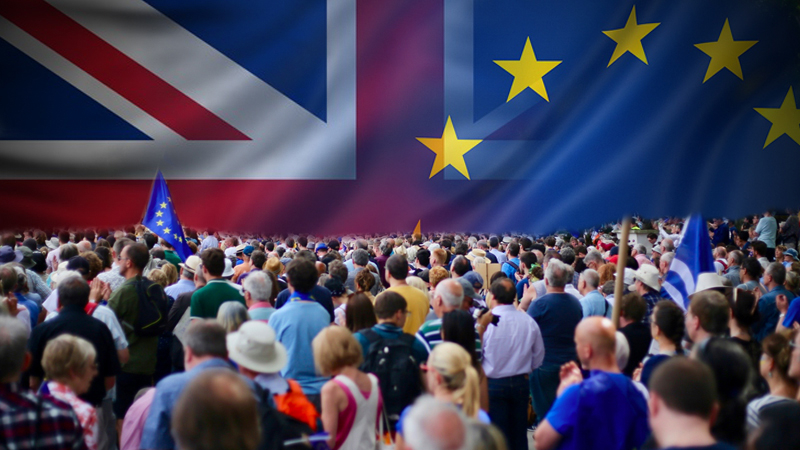
Those who voted against Brexit didn’t go gently into that good night. There were huge anti-Brexit rallies last year, with a million people on the streets of London, demanding a fresh Brexit vote with the option to remain in the European Union. These were some of the biggest protests in Britain’s history. Where do these people go?

The resistance showed itself in various forms.

There were groups like “Led By Donkeys,” a political campaign group that became something of a national phenomena. Four dads in their 40s began sneaking out in the middle of the night with buckets of wallpaper paste. Their aim was to hold leading Brexiteers to account by taking tweets and quotes from politicians and plastering them on giant billboards for the world to see.

Pictures of their billboards went viral.

One of their signs was a quote from the arch-Brexiteer David Davis, which was held aloft by thousands of anti-Brexiteers during a massive rally last March. The quote read: “If a democracy cannot change its mind, it ceases to be a democracy.”

“It showed a real hunger for that accountability,” said Ben Stewart, 45, one of the Donkey activists. He noted the signs were funny, too. “We tried to put humor at the center of it. These were dark times, if you’re a progressive internationalist, and hopefully we made people laugh and help them get through this and maybe contributed a little bit to holding power to account.”

Stewart said that although he was bummed about Brexit Day, “there’s much still to fight for.” He said his group would continue campaigning in 2020. “Our future relationship with Europe has not yet been defined,” he said. “And there’s still a role for groups like us to hold them to account.”

In the European capital of Brussels, many policymakers appear to be struck by grief that Brexit is really happening. Some of the most passionate voices in favor of Britain’s remaining a member of the club have come from non-Brits there, where for decades, whip-smart British diplomats helped guide discussions and shape the direction of the union.

No ceremonies are planned in Brussels to mark the big day on Friday. But on Wednesday, as lawmakers gathered in the European Parliament to give the final approval to Britain’s departure deal, one person after another spoke in passionate tones about close relations with Britain.

“Only in the agony of parting do we look into the depth of love,” said European Commission President Ursula von der Leyen, quoting George Eliot. “We will always love you, and we will never be far.”

Manfred Weber, the German leader of the center-right European People’s Party bloc in the parliament, said that some of his first discussions about the European Union took place over pints of Guinness in London when he was in college.

He said he hoped Britain would someday return.

“To the colleagues who will leave us, I tell you, I hope our work in the next years will make Europe so strong, so attractive, that your children and grandchildren will want to be part of the European Union once again,” he said.

After the vote, lawmakers joined hands to sing Auld Lang Syne and bid Britain a fond farewell.

Actual tears were shed.

Banks in concerted drive to offset virus impact on clients #ศาสตร์เกษตรดินปุ๋ย

#ศาสตร์เกษตรดินปุ๋ย : ขอบคุณแหล่งข้อมูล : หนังสือพิมพ์ The Nation

https://www.nationthailand.com/business/30381320?utm_source=category&utm_medium=internal_referral

Banks in concerted drive to offset virus impact on clients

Jan 30. 2020
Payong Srivanich

Payong Srivanich
By THE NATION

Several banks have launched urgent measures to cushion the impact of coronavirus crisis on their clients.

Krungthai Bank announced on Thursday (January 30) a loan programme to offset the pressure on its corporate customers in the tourism and export sector, especially companies that ship their products to China.

Under the campaign, customers in the hotel and export businesses, are offered a grace period on repayment of the loan principle for a maximum of 12 months.

Payong Srivanich, the bank’s president said the board was aware of the hardship of its clients in the tourism and export sectors.

On the same day (January 30), Government Housing Bank (GH Bank) announced an allocation of Bt1 billion for an emergency loan programme in support of existing clients affected by the novel coronavirus crisis.

Under the campaign, it will slash interest rate on current borrowing to 0.01 per cent for six months. This will lead to lower monthly installment payment as a result of the rate cut.

Eligible borrowers under the new programme must be existing customers of the bank before January 30.

They must also prove that their incomes have been affected by the virus outbreak, such as tour guides, hotel staff, or businesses selling products to Chinese tourists. Loan application period is set from January 30 to March 31 at GH Bank branches nationwide.

The bank wanted to provide relief to customers, said GH Bank President Chatchai Sirilai.

On January 29, Siam Commercial Bank (SCB) said it was offering a six-month grace period on repayment of the loan principal to existing customers in the hotel business. If the crisis prolongs, SCB said it would introduce further measures.

On the same day (January 29), Kasikornbank (KBank) announced its offering of a 12-month grace period on repayment of the loan principle to its existing clients of small and medium-sized enterprises (SMEs) in the tourism sector.

Meanwhile, the Bank of Thailand (BOT) on Thursday (January 30) urged financial institutions to provide assistance to clients affected by the crisis.