CorporateFeb 01. 2021EGCO Group President Thepparat Theppitak
By The Nation
Electricity Generating Plc (EGCO Group) today announced its investment in a 972-megawatt natural gas-fired cogeneration plant located at Linden in the US state of New Jersey, and owned by Linden Topco LLC (Linden Topco).
EGCO has agreed to purchase a 28 per cent stake in the Linden Topco plant, according to EGCO Group’s president, Thepparat Theppitak. EGCO expects the deal to be finalised in the second quarter of this year.
The Linden cogeneration plant sells energy, capacity and ancillary services to the operators of the New York and New Jersey electricity grids, two of the most congested and capacity-constrained power markets in the United States. The plant also enjoys long-term contracts for the sale of process steam and electricity to large investment-grade industrial off-takers, said EGCO.
“This acquisition marks the first investment by EGCO in the US, a large market with over 1,100GW of installed capacity and vast opportunities in renewable and supporting gas-fired power facilities,” said Theppitak. “The investment will allow EGCO to enter the US market, and position it for new investment opportunities in the US.”
HSBC launches private banking for Thailand’s ultra-wealthy
CorporateFeb 01. 2021Saranya Arunsilp, Thailand Head of Global Private Banking at HSBC
By The Nation
HSBC Thailand today unveiled its new private banking business for high net worth and ultra-high net worth clients.
HSBC said the new private bank will provide clients access to international capital markets by leveraging its existing infrastructure of advisory, investment methodologies, controls and systems in Asia. The team in Thailand will cover client management and advisory services while clients’ assets will be booked in HSBC Private Banking in Singapore, where HSBC continues to expand its services.
“In Thailand and across Asean, private wealth is closely tied to businesses and the strengthening of intra-regional trade is only expected to accelerate international expansion and stimulate people and wealth flows, even amid the pandemic,” said HSBC Thailand CEO, Kelvin Tan.
HSBC expects assets held by high net worth investors in the region to reach US$40 trillion by 2025. Meanwhile the assets of more than 100,000 high net worth investors in Thailand are expected to rise 12.4 per cent to $548 billion by 2025, the second highest growth in the Asia-Pacific region. Rising wealth is driving greater demand for wealth planning, investment diversification and international banking, said HSBC.
It adds that since 2016, the Bank of Thailand has been introducing a series of additional measures to relax foreign exchange regulation and encourage greater flexibility in the financial markets under the Capital Account Liberalisation Master Plan, opening up opportunities for selective offshore investments.
Robinhood narrows trading restrictions to eight companies
CorporateFeb 01. 2021The Robinhood logo. MUST CREDIT: Bloomberg photo by Gabby Jones
By Syndication Washington Post, Bloomberg · Yueqi Yang
Robinhood reduced the number of companies with trading restrictions to eight from 50, ahead of Monday’s trading session, according to an update on its website.
The current list includes GameStop, AMC Entertainment, BlackBerry, Express, Genius Brands, Koss, Naked Brand Group and Nokia.
Opening new positions in these securities is limited, according to Robinhood’s website, which listed the maximum number of shares and options contracts each user can hold. For those whose current holdings already exceed the limits, their positions will not be sold or closed.
Robinhood put buying restrictions in place after its clearinghouse deposit requirements for equities increased last week, the company said in a blog post on Friday. “It was not because we wanted to stop people from buying these stocks,” Robinhood said.
The trading app, popular among retail investors who fostered the rise of GameStop stock, has been under fire across the political spectrum for its decision to restrict trading of highflying stocks that surged after being touted on social media.
Sen. Elizabeth Warren, D-Mass., on Sunday called for a broader review by the Securities and Exchange Commission on recent trading swings and said a broker-dealer such as Robinhood that invites a lot of individual investors needs to operate “under some basic rules.”
“You can’t do that in the middle of a trading cycle,” Warren said of Robinhood’s trading limits on CNN’s “State of the Union.” “It’s not about protecting people from making bad trades. It’s about keeping the playing field level.”
A representative for Robinhood declined to comment beyond the website’s update.
Lawsuits have been filed against Robinhood, mostly alleging restrictions by the trading platform that amounted to a breach of contract. Still, investors who sued online brokerages over claims that they were unfairly blocked from trading shares may have a long wait before their cases are resolved.
In a bid to adapt to the “new normal”, Kasikornbank (KBank) has redefined its strategies to aim for loan growth of 4-6 per cent.
Kattiya Indaravijaya, KBank’s chief executive officer, said despite the Covid-19 vaccine, the global economy will only see a gradual recovery.
With this in mind, KBank has announced its financial targets for 2021 as follows:
• Loan Growth: 4-6 per cent. The bank expects strong retail loan growth of 11 to 14 per cent, SME loan growth of 2 to 4 per cent, and corporate loan growth of 1 to 3 per cent.
• Net Interest Margin: 3.1 to 3.3 per cent in line with interest rate trends.
• Net Fee Income Growth: Low single-digit growth. Net fee income will grow from credit-card business, loan-related and fund management business.
• Cost to Income Ratio: Mid-40s. Revenue growth is under pressure due to slow economic recovery. However, the bank will focus on cost management and productivity improvement, with new investments for future growth.
• Non-performing loan ratio (gross): 4 to 4.5 per cent. The pandemic has had an impact on asset quality, while the bank is closely monitoring and reviewing asset quality.
• Credit cost per year: Up to 160 bps. Maintaining conservative assumptions and prudent financial policy amid high uncertainty.
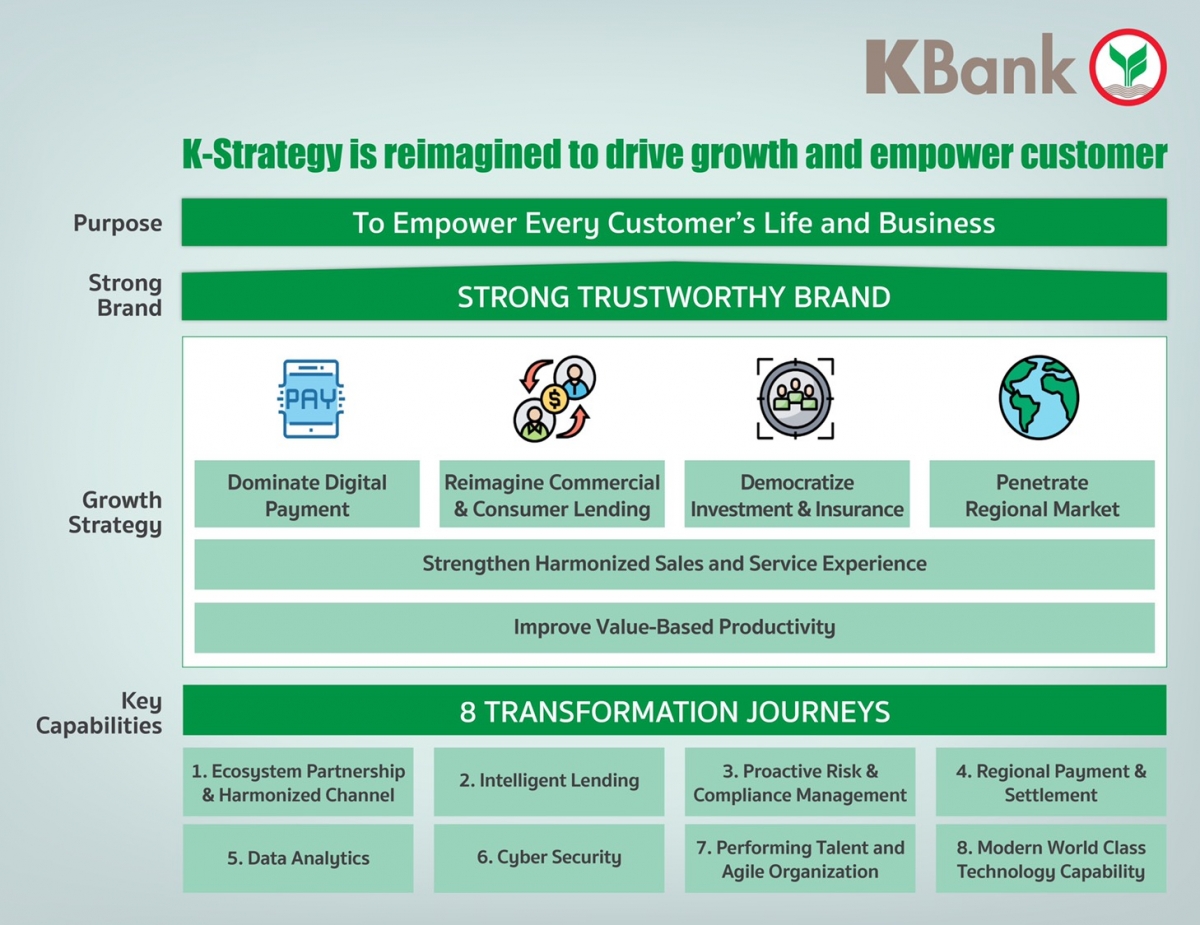
Kattiya said amid drastic changes in consumer behaviour and economic conditions owing to the pandemic, KBank has reviewed its business strategies so they are consistent with the new business context. These include a commitment to the principles of sustainability with adherence to the “customer-centricity” philosophy and a goal to empower every customer’s life and business by offering end-to-end services that meet customers’ needs.
To achieve this, KBank has set the following imperatives:
• Developing strategies for business growth and customer responsiveness
– Upgrading digital platforms to allow customers to make payments, as well as keep track of their financial data.
– Reimagining commercial and consumer lending to meet customers’ lifestyle and business needs while also increasing income for KBank with an acceptable risk appetite.
– Introducing relationship managers to help retail customers make informed decisions on investment.
– Penetrating regional markets to boost the opportunity to access customers in other Asean countries.
– Strengthening sales and service by integrating all channels so customers can conduct transactions anytime and anywhere.
– Improving value-based productivity by optimising human resources, data, financial and technological capabilities.
• Creating a trusted brand via communication and management of experience.
• Enhancing competitiveness through:
– Ecosystem partnership and harmonised channels.
– Leveraging customer data to offer a personalised lending experience and achieving fair, risk-adjusted returns.
– Proactively identifying potential risks and establishing loss prevention and detection.
– Regional payment and settlement.
– Expanding data analytics capability to enhance business opportunities and operational efficiency.
– Cybersecurity.
– Developing talent for an agile organisation.
– Adopting modern, world-class technology to make
KBank a top financial service provider in the region.
Kattiya said with a strategic plan to move forward efficiently, prudent financial management and preparedness for future uncertainties, KBank will continue to maintain its strength and help the Thai economy successfully navigate this crisis.
CorporateJan 29. 2021President Roongrote Rangsiyopash, centre
By The Nation
Siam Cement Group (SCG) has targeted growth in sales revenue of 5-10 per cent this year from Bt399.94 billion last year, its president Roongrote Rangsiyopash said on Thursday.
The growth will be driven by its two core businesses – chemicals and packaging.
Roongrote said he expected demand for cement and building materials to rebound in the second half of the year.
The company has set its investment budget this year at Bt65 billion-Bt75 billion. Most of that money will be spent to expand promising projects.
Last year SCG spent Bt58 billion of its Bt60 billion investment budget.
Thai Life Insurance invites online application for tax exemptions
CorporateJan 29. 2021Sawat Naruvorawong, senior executive vice president of Thai Life Insurance Public Company
By The Nation
Thai Life Insurance (TLI) has advised customers to submit the consent form for exemptions on tax last year via its Thai Life Insurance app or at http://www.thailife.com. The company said that to reduce the Covid-19 risk, there was no need to apply in-person at its branches.
However, customers unable to complete the process online could still fill in a physical consent form at any TLI branch or customer service centre.
In the 2020 tax year, the Revenue Department increased the exemption limit for health insurance premiums from Bt15,000 to Bt25,000. Eligible for tax exemption in 2020 are combined policies (health, life insurance and living allowance deposits) of up to Bt100,000,” said Sawat Naruvorawong, senior executive vce president and chief life operation officer of Thai Life Insurance Public Company.
The BTS Skytrain is offering a six-month extension on tickets due to expire between December 21 and January 30.
The move, which is aimed at softening the financial impact of Covid-19, comes ahead of schools reopening on February 1.
Passengers can ask to have their tickets extended at ticket booths from February 1 to July 31, said Keeree Kanjanapas, president of Bangkok Mass Transit System (BTS).
He also asked passengers to cooperate in preventing the spread of the virus by wearing face masks on the Skytrain and checking in via the Thaichana app, BTS Skytrain app or via Line @btsskytrain.
BTS has boosted its rush-hour service to one train every 2 minutes 25 seconds in order to avoid crowding and lessen the Covid-19 risk.
CorporateJan 28. 2021SCG president Roongrote Rangsiyopash
By The Nation
Siam Cement Group (SCG)’s unaudited operating results for 2020 show a 7-per-cent boost in profits year-on-year worth Bt34.14 billion thanks to better performance in all its businesses, SCG president Roongrote Rangsiyopash said on Thursday.
However, revenue from sales dropped 9 per cent y-o-y to Bt399.94 billion largely due to the drop in chemical prices and sales volume.
The company attributed its success to the dedication of SCG staff who complied with strict Covid-19 measures combined with operational agility and use of digital technology to explore new opportunities.
The 2020 operating results by business units are as follows:
• Chemicals: Sales revenue dropped 17 per cent y-o-y to Bt146.87 billion due to a drop in product prices and lower sales volume. Profit for the period rose 14 per cent y-o-y to Bt17.67 billion as a result of higher product spread.
• Cement and building materials: This unit recorded a sales revenue of Bt171.72 billion, dropping 7 per cent y-o-y due to the pandemic and challenging economic environment. However, profit for the period came in at Bt6.42 billion, an increase of 18 per cent y-o-y due to efficiency improvements and lower production cost.
• Packaging: Sales revenue of Bt92.79 billion, up by 4 per cent y-o-y. Profit for the period also rose 23 per cent y-o-y to Bt6.46 billion.
SCG said the operation of its chemical business has been running smoothly both locally and overseas with robust business continuity and sales portfolio management.
The business has increased the sale of plastics for the production of consumer products that are in high demand such as food packaging, beverage packaging, and e-commerce packaging.
In markets that are hit hard by Covid-19, the business has shifted sales to markets less affected by lockdowns. The chemicals business has also applied digital technology, like a digital commerce platform that links purchase orders directly with supply management.
SCG has expanded its downstream businesses and is exploring new businesses to create product differentiation and enhance business flexibility.
For circular economy solutions, SCG has started the production of post-consumer recycled resins utilising used plastics.
The cement and building materials unit has boosted its operational efficiency by adjusting operations and business models so they are ae in line with increased consumer appetite for hygiene products and e-commerce.
The packaging business has adapted itself to cope with economic fluctuations by further reinforcing its integrated business model to build sustainable growth in Asean.
The company has recently acquired shares in Bien Hoa Packaging to fortify its position and strength in upstream packaging business in Vietnam. On top of that, the company also acquired Go-Pak UK Limited (Go-Pak), a leading foodservice solution provider in the UK, Europe, and North America, with its production facilities in southern Vietnam. These acquisitions will augment market potential in the food-packaging business.
Nation Multimedia Group (NMG) launched Nation Coffee on Thursday, as a step into the food and beverage industry.
Nation Coffee will sell food and beverages, especially tea, coffee and baked goods, and will also supply goods to other businesses in the sector, as per the company’s objectives. Its registered capital is Bt10 million, divided into 100,000 ordinary shares at the par value of Bt100 per share. Of the total capital, Bt2.5 million has been paid up.
The new subsidiary’s shareholding structure is as follows:
• NBC Next Vision (NNV), a subsidiary of Nation Broadcasting Corporation, holds a 60 per cent stake with 60,000 shares.
• NMG holds a 39.99 per cent stake with 39,997 shares.
• Warangkana Kalayanapradit, Aura-orn Akarasanee and Supawat Sa-nguan-ngam hold one share each or a stake of 0.001 per cent.
Exim bank resilient despite rising bad debt, president says
CorporateJan 28. 2021Pisit Serewiwattana, president of Export-Import Bank of Thailand
By The Nation
The Export-Import Bank of Thailand (Exim) is in a strong financial position despite non-performing loans (NPLs) rising to 3.81 per cent (or Bt5.2 billion) at the end of last year, its president Pisit Serewiwattana said on Wednesday.
Pisit is due to retire at the end of this month after serving as president of the state-owned bank since 2016. In 2015, Exim’s NPLs stood at 3.2 per cent of its outstanding loans.
Provisions to bolster financial strength in the face of Covid-19 cost the bank Bt1.34 billion last year, he revealed. Exim’s credit loss as of the end of December 2020 amounted to Bt11.97 billion. However, the bank had lowered risk with high coverage ratios of 232.44 per cent – compared to commercial banks’ standard ratio of just above 100 per cent – helping Exim record Bt2.3 billion in profit before credit loss.
Exim has responded to the new wave of virus infections by maintaining aid for liquidity-hit businesses and suspending principal interest repayments for customers in red, orange and yellow zones. It has also extended its investment and production efficiency enhancement scheme to ease burdens on businesses.
Pisit said Exim is paying special attention to supporting small and medium enterprises (SMEs), who are often ignored by commercial banks.
While supporting Thai exporters and investors, the bank has been careful to obey World Trade Organisation rules that prevent state agencies from subsidising companies to give them unfair advantages over foreign competitors, he added.
Exim forecasts economic recovery this year will see Thai exports grow 2.5-4 per cent, after 6 per cent contraction last year.
Pisit projects Exim’s role will grow further in line with Thailand’s recovery blueprint. The bank has embarked on organisational transformation under the 10-year Master Plan (2017-2027) to adapt to external circumstances even amid the Covid-19 pandemic, he said.
Exim had maintained satisfactory operating results and was on track to becoming a regional Export Credit Agency (ECA) by 2022 and a global ECA by 2027.
Those prospects were reflected by Exim’s credit facilities for Thai trade and investment, which stand at 1.6 per cent of gross national income (GNI), compared to 0.5-0.7 per cent of other ECAs in Asean. The bank’s operating results in 2020 showed a five-year high across all areas, he added.
Exim and other state-owned banks, commercial banks and financial institutions have joined forces with the government to provide debt holidays, loans and debt restructuring since Covid-19 first emerged early last year. The impact of providing those measures is reflected in their operating results last year.

 EGCO Group President Thepparat Theppitak

 Saranya Arunsilp, Thailand Head of Global Private Banking at HSBC
 The Robinhood logo. MUST CREDIT: Bloomberg photo by Gabby Jones
 Kattiya Indaravijaya, KBank’s chief executive officer

 President Roongrote Rangsiyopash, centre
 Sawat Naruvorawong, senior executive vice president of Thai Life Insurance Public Company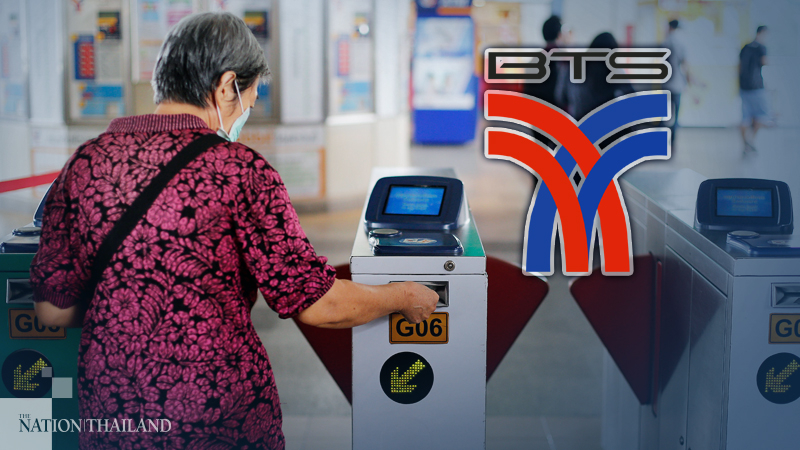
 SCG president Roongrote Rangsiyopash
 Pisit Serewiwattana, president of Export-Import Bank of Thailand
