The Stock Exchange of Thailand (SET) Index closed at 1,568.69 on Tuesday, down 21.00 points or 1.32 per cent. Transactions totalled 159.49 billion baht with an index high of 1,612.10 and a low of 1,565.95.
The index dipped for the fourth day running after falling by 1.30 per cent on Monday, 2.30 per cent on Friday and 0.08 per cent on Thursday.
The 10 stocks with the highest trade value today were KBANK, AOT, EA, SCC, BBL, SCB, PTT, CPALL, ADVANC and PTTGC.
Other Asian indices were mixed:
Japan’s Nikkei Index closed at 27,821.76, down 462.16 points or 1.63 per cent.
China’s Shanghai SE Composite closed at 3,563.89, up 1.19 points or 0.033 per cent, while the Shenzhen SE Component closed at 14,795.73, down 14.46 points or 0.098 per cent.
Hong Kong’s Hang Seng Index closed at 23,475.26, down 376.98 points or 1.58 per cent.
South Korea’s KOSPI Index closed at 2,839.01, down 70.31 points or 2.42 per cent.
Taiwan’s TAIEX Index closed at 17,427.76, up 99.67 points or 0.58 per cent.
The 4-per-cent expansion of gross domestic product (GDP) in 2022 is achievable even though Thailand and global communities are facing the threat of the variant of concern Omicron, Finance Minister Arkhom Termpittayapaisith said on Monday.
He was speaking at the online seminar “Investment Minutes in Late 2021” hosted by the Thai News Agency.
The minister said Thailand may not take that long to fully recover from the Covid-19 crisis compared to the 1997 Tom Yam Kung crisis, which took more than two years to overcome.
“The government has been working to gradually reopen the country and unlock more businesses even though the pandemic is not completely eliminated,” he said. “At this rate, the economy will recover slowly, with a 1 per cent GPD expansion expected this year and a 3.5-4.5 per cent growth in 2022.”
Thailand’s finance minister confident of 4% growth in 2022 despite Omicron threat
Arkhom pointed out that though the tourism industry, which accounts for 12 per cent of the GDP, has been severely affected by the pandemic, steady growth in the export sector has helped Thailand’s economy stay in the positive realm this year.
“We estimate that the total export of 2021 could expand up to 17 per cent, which is the highest in the past 12 years,” he said. “Other factors that help mitigate the impact of Covid-19 are the government’s different stimulus measures, such as ‘Rao Mai Thing Gun’ [We Won’t Leave Anyone Behind], Eat, Shop, Spend, Let’s Go Halves and Let’s Travel Together campaigns.
“As the threat of Covid-19 still lingers with the emergence of Omicron variant, we need to continue keeping our guard up by following strict disease control measures. By working together across public and private sectors, the 4 per cent GDP expansion in 2022 is certainly achievable,” he said.
Arkhom also said the government may consider reducing the stimulus measures once the economy starts gaining pace in 2022 and more businesses can continue their operation as usual.
“The government will then shift its spending focus from economic stimulation to infrastructure projects such as transportation routes and irrigation system to serve as a foundation for future investments,” he said.
The baht opened at 33.65 to the US dollar on Tuesday, strengthening from Monday’s closing rate of 33.73.
The Thai currency is likely to move between 33.55 and 33.75 to the greenback during the day, Krungthai Bank market strategist Poon Panichpibool predicted.
Poon said that the baht might weaken because foreign investors sold short term bonds for 35 billion baht in four days as they tried to cut their loss.
Moreover, the market was worried about the “Omicron” variant of Covid-19 that will affect transportation. It will also affect travelling and the recovery of the tourism sector in Thailand.
According to technical signs in the short term, it also said that the baht is still pressured by weakening factors.
Poon added that investors should speculate the gold price in the short term because the gold price might go up from the worry of the “Omicron” variant. Investors who bought on dips previously will sell the gold which will support the baht to not weaken much more.
The key resistance level for the baht would be from 33.80 to 34 to the dollar, which is the level at which exporters might sell the US currency.
The baht’s key support level would be at 33.40, the level some importers are waiting for so they can buy dollars, he added.
Poon said that the currency market will be highly volatile in this period. Business operators should be cautious and use hedging tools to manage the risk.
The price of gold crashed by THB200 in morning trade on Tuesday.
AGold Traders Association report at 9.28am said the buying price of a gold bar was THB28,400 per baht weight and selling price THB28,500, while the buying and selling price of gold ornaments is THB27,894.40 and THB29,000, respectively.
At close on Monday, the buying price of a gold bar was THB28,600 per baht weight and selling price THB28,700, while gold ornaments were THB28,091.48 and THB29,200, respectively.
The spot gold price on Tuesday morning hovered around US$1,789 (THB60,248) per ounce after Comex gold at close on Monday dropped by $2.9 to $1,785.5 per ounce due to pressure from the appreciation of the US dollar, including selling gold as a safe-haven asset after the US stock market rebounded strongly.
Krungsri Securities forecast the Stock Exchange of Thailand (SET) Index on Tuesday (November 30) would rebound to the resistance level at 1,600 points.
It said uncertainty over the newest Omicron Covid-19 variant has been relieved after the US announced that it will not impose lockdown to contain the spread of virus.
Meanwhile, an expert virologist said people who have been infected with the virus develop mild symptoms and do not lose sense of taste and smell.
However, it predicted that uncertainty over the new Covid-19 wave in Europe would pressure the index.
It also recommended buying of the following companies’ shares as an investment strategy:
▪︎ BCH, CHG, MEGA, STA and STGT, which benefit from the Covid-19 crisis.
▪︎ HANA, KCE, TU, ASIAN, NER, EPG and XO, which benefit from the weakening baht.
▪︎ JMT, JMART, TH, AS and FORTH, which gained specific positive sentiment.
German inflation surged more than expected in November, complicating the European Central Banks mission to convince consumers that the current spike will soon ease.
Prices increased an annual 6% under a European-Union harmonized measure. A national gauge rose to 5.2%, the highest since 1992.
German bonds extend declines slightly, pushing the 10-year yield four basis points higher to minus 0.30%.
Earlier on Monday, Spain reported a rate of 5.6% that was bolstered by more expensive food. Prices in Belgium jumped 5.6%. Data for the euro area due Tuesday are set to show a 4.5% gain.
Inflation rates far exceeding the ECB’s 2% goal across vast parts of the region have prompted officials including President Christine Lagarde to reassure citizens that price pressures won’t run out of control. A large portion, they argue, is due to temporary factors that will fade with time. Her colleague Isabel Schnabel attempted to assuage concerns in Germany this morning, explaining in a TV interview that “November will prove to be the peak.”
The Bundesbank warned last week that inflation could climb to just under 6% this month, and attributed about 1 1/2 percentage points to a temporary cut in value-added tax and very low prices for travel-related services in 2020.
“As shocking as the headline number might be, the drivers of this surge should be well-known by now,” said Carsten Brzeski, an economist at ING. “The December inflation number could be a new record high since German reunification.”
While the German central bank predicts price pressures will retreat in coming months, it said inflation could remain well above 3% for a longer period of time.
Adding to the ECB’s communication challenge is the sudden emergence of the omicron coronavirus strain. Just as officials try to reassure citizens that price surges are temporary, the possibility of new restrictions is another source of uncertainty they want to contain.
“There is a risk, but I think we’ve learned a lot, we know this enemy, we know the instruments we need to use and precautions we need to take, people have been vaccinated, there are new therapies,” Lagarde told Italy’s RAI 3 on Sunday night.
Employees of Germany’s federal states won a 2.8% raise and a tax-free one-time payment of $1,467 (1,300 euros) on Monday, in a deal that will ultimately cover nearly 3.5 million people. Meanwhile, Olaf Scholz’s new government is planning to lift the country’s minimum wage to $13.60 (12 euros) toward the end of next year.
Both could have consequences that might be difficult to ignore. One reason officials have been able to classify the current inflation spike as “temporary” is that secondary effects have failed to materialize so far.
Schnabel, a contender to succeed Jens Weidmann at the helm of the Bundesbank when he leaves at the end of the year, told Bloomberg last week that inflation risks are “skewed to the upside.” It’s a signal she might push for a faster than currently anticipated reduction in monetary stimulus when the ECB gathers in December.
Both the Council of Economic Advisers and Germany’s national tabloid Bild have issued warnings on ultra-loose monetary policy.
The ECB is set to determine next month whether its pandemic bond-buying program will end in March as planned, and how an older asset-purchase plan might need to be adjusted to address lingering uncertainty. The emergence of the new Omicron coronavirus strain risks new containment measures after the Netherlands and Germany already imposed new curbs and Austria and Slovakia went into lockdown.
Asian stocks looked set for a steady start on Tuesday after U.S. shares rebounded amid easing concerns about the impact of the omicron coronavirus strain on global reopening.
Futures for Japan and Australia rose while Hong Kong’s slipped. The S&P 500 wiped out its November losses and the technology-heavy Nasdaq 100 more than recouped Friday’s rout.
Ten-year U.S. Treasury yields rose to about 1.5% but are below pre-omicron levels. Federal Reserve Chair Jerome Powell said the variant poses risks to both sides of the central bank’s mandate for stable prices and maximum employment.
Commodity-linked currencies gained against the U.S. dollar Monday as oil retraced a portion of its Friday slump. Separately, traders are awaiting purchasing-manager indexes from China to assess the outlook for the second-largest economy.
President Joe Biden cautioned Americans against panicking over the new variant and said lockdowns won’t be necessary, while pharmaceutical firms are working on adapting vaccines. Scientists are still evaluating of the strain, which has already buffeted international travel and could add to inflation pressures if it exacerbates supply-chain disruptions.
“We’ll get a new variant, we’ll get new waves but the market, and we all as investors, see how that might play out,” Jason Brady, president at Thornburg Investment Management, said on Bloomberg Television. “I’m much more interested in inflation and potentially rising rates causing some of the market leaders of 2020 and 2021 to falter a little bit more.”
Powell, in prepared testimony released Monday, said the “recent rise in covid-19 cases and the emergence of the omicron variant pose downside risks to employment and economic activity and increased uncertainty for inflation.”
He didn’t discuss specific monetary policy actions or the possibility of changing the pace of the tapering of Fed bond purchases — a key issue that other officials have flagged in recent remarks.
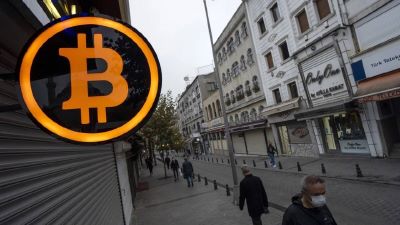
Meanwhile, crude oil pared a gain of as much as 7% from Friday’s rout. In cryptocurrencies, Bitcoin traded above $58,000, maintaining a recent rally.
Some key events to watch this week:
–Federal Reserve Chair Jerome Powell will appear at a Senate Banking Committee hearing alongside Treasury Secretary Janet Yellen on Tuesday. They’re set to speak again on the following day at the House Financial Services Committee.
Bitcoin is staging a comeback along with other riskier assets on Monday, bouncing back from its Black-Friday lows.
The largest digital asset rose as much as 3.4% during the session to trade around $58,266. Other coins also posted snap-backs, with the Bloomberg Galaxy Crypto Index adding 5.5% at one point. So-called alternative coins like Polkadot and Dogecoin gained too.
A brutal selloff Friday saw investors fleeing a number of riskier assets, including cryptocurrencies, with Bitcoin posting its worst day in roughly two months. The drubbing came after the announcement of a new coronavirus variant named omicron that was identified in southern Africa and which experts are now trying to understand. The session’s decline saw Bitcoin drop 20% below a record high notched earlier in November, which for many strategists showcases the coin’s tendency to closely track moves of the broader stock market.
“It highlights that Bitcoin is a risk-on/risk-off asset,” said Matt Maley, chief market strategist for Miller Tabak + Co.
Meanwhile, in a development that is quintessentially cryptonian, a coin called Omicron crashed and then recovered as news of the eponymous variant spread. Though little is known about the coin thus far, data on CoinGecko.com shows it’s been in existence for a few weeks and that its market cap hovers around $370 million.
Bitcoin has been under pressure since reaching a record of almost $69,000 Nov. 10 on enthusiasm over the first U.S. exchange-traded fund linked to futures of the digital asset. But a multitude of factors have weighed on returns since then, including greater regulatory risks as well as many tokens having run up very quickly in a short period of time. Maley says that Bitcoin’s recent moves also show that should the Federal Reserve withdraw its stimulus in a more aggressive fashion next year, cryptos could become vulnerable.
Fiona Cincotta, senior financial markets analyst at City Index, says Bitcoin does tend to act like a riskier asset that tracks moves in the stock market, but that there are times when that relationship isn’t as strong — for instance, when hotter-than-expected inflationary prints come through, Bitcoin can hold up well during those periods.
“So there are times when I think Bitcoin does act as a riskier asset and it traces the stock market higher, but there are times as well when that’s not necessarily the case,” she said by phone. “It does have other contributing factors which drive it.”
Now, nervous traders are again turning to technicals for clues as to where certain cryptocurrencies could head next. Bitcoin on Sunday bounced off its 100-day moving average, an intermediate-term trendline. Meanwhile, Ether on Monday sprung off its 50-day moving average, which many chart-watchers see as a bullish development.
Still, Peter Tchir, head of macro strategy at Academy Securities Inc., says he was surprised by Bitcoin’s Friday selloff based on the coronavirus news. To him, it seems there is a group of aggressive risk-takers who own crypto and likely also own some high-flying tech stocks.
“They could be forced to sell one or the other if they move in tandem,” said Tchir. “Bitcoin going up relieves that pressure. Now that we’ve had what seemed like a likely rally — everyone dismissing omicron fears — we can see if it lasts.”
The new Laos-China railway, which will start running from Thursday, should serve as a good delivery channel for the agriculture industry, the Agriculture and Cooperatives Ministry said on Monday.
The railway will initially only provide freight services to Chinese companies based in Laos, transporting goods like rubber, dried cassava, industrial salt, ore, etc.
However, Thai businesses should be able to take advantage of the railway by travelling across the Thai-Laos Friendship Bridge to load cargo at the Vientiane Southern Cargo Terminal, the ministry’s spokesman, Chantanon Wannakhajorn said.
He said using the railway can shorten the transit time from two days by road to 10 to 15 hours.
China and Laos have set the goal of transporting 8 million tonnes of goods per year via the railway by 2025 and increasing that to 15 million tonnes per year by 2030.
The Thai economy should grow by 3.5 to 4.5 per cent next year with the government’s planned spending of about 1 trillion baht, Finance Minister Arkhom Termpittayapaisith said on Monday.
“Asound fiscal policy is necessary to drive the economy, and I will ensure that the government spends money to nourish it,” he said.
Arkhom explained that the economic “nourishment” will come in the form of infrastructure and stimulus measures.
He also listed the factors that will affect the overall economic recovery and government policies next year, namely:
• Implementation of policies concerning the promises Thailand made at the United Nations Climate Change Conference (COP26).
• Boosting the use of digital infrastructure by government agencies as well as the capital market, cryptocurrencies and fintech.
• Unlocking international travel.
• Promoting more intense capital market development plans, especially in the digital industry.
• Pandemic situation, especially in relation to the new variant of concern, Omicron.
Arkhom also said that the economy is expected to grow 1 per cent with exports rising by around 17 per cent.



 Thailand’s finance minister confident of 4% growth in 2022 despite Omicron threat