Gold opens steady in Thai market depite spot price slump
The price of gold in Thailand on Friday morning was unchanged from Thursdays close.
The Gold Traders Association report at 9.29am showed buying price of a gold bar at THB28,350 per baht weight and selling price at THB28,450, while gold ornaments were priced at THB27,833.76 and THB28,950, respectively.
Spot gold on Friday morning dropped to US$1,801 (THB60,099) per ounce after Comex gold price at close on Thursday dropped by $5.6 to $1,808.9 per ounce, due to the rise in US government bond yield, momentum in gold sales after a robust performance by the US stock market reacting to a decline in unemployment claims.
ADVERTISEMENT
Hong Kong gold price dropped by HK$70 to $16,720 (THB71,742) per tael, the Chinese Gold and Silver Exchange Society reported.
The Stock Exchange of Thailand (SET) Index rose by 7.16 points, or 0.47 per cent, to 1,534.82 on Friday morning.
The SET Index closed at 1,527.66 on Thursday, down 18.20 points or 1.18 per cent. Transactions totalled THB81.29 billion with an index high of 1,547.38 and a low of 1,526.91.
Krungsri Securities forecast the SET Index on Friday would fall to between 1,515 and 1,520 points despite positive sentiment from the decline in US weekly jobless claims.
It predicted higher domestic Covid-19 cases which have impacted the economy, weakened the baht and led to foreign funds outflow would pressure the index.
ADVERTISEMENTx
It recommended selective buys as an investment strategy:
▪︎ HANA, KCE, TU, CPF, GFPT, ASIAN, EPG and SUN, which would benefit from the weakening baht.
▪︎ BCH, CHG, BDMS, DOHOME, CKP, CBG, OSP, ICHI, GPSC, BEC, GUNKUL, JWD, WICE, SONIC, NER, PSL, TTA, RCL, SINGER, JMT and JMART, whose second-quarter business turnover is expected to improve.
Baht slides to 33.27, the lowest in nearly three years
The baht hits its lowest level in nearly three years, opening at 33.27 to the US dollar on Friday, weakening from Thursday’s closing rate of 33.24.
It was the lowest the baht had slid to in two years and nine months.
The Thai currency is likely to move between 33.25 and 33.35 during the day, Krungthai Bank market strategist Poon Panichpibool said.
Poon said that the baht would continue to weaken due to the Covid-19 situation. Importers have also purchased US dollars, as they are afraid the baht could weaken quickly and sharply, he said.
Poon believed the Thai currency could easily weaken to 33.50 per US dollar in the short term if the Covid situation worsened and the dollar momentum rose. The momentum would rise if supported by the US Federal Reserve’s statement to decrease quantitative easing or the economy of the US was better than expected.
ADVERTISEMENT
Moreover, the baht will continue to weaken until the Covid-19 situation gets better, which is expected to be in early September, Poon added.
Covid-19 and wildfires spell big business for the air purifier industry
Between Covid-19s airborne transmission and more recently choking smoke sent aloft by western wildfires – some of which drifted thousands of miles to settle over East Coast cities – the very air Americans breathe has gone from afterthought to worrisome threat.
One sector that’s managed to benefit from these dual crises is the air purifier industry. Sales have been climbing since the onset of the pandemic in 2020, a trend that’s been turbocharged this year by unprecedented, climate change-induced infernos raging across the West.
Researchers who spend their days thinking about air quality say some purifiers can be an effective way to make inside air cleaner – and that when it comes to the coronavirus, potentially help lower risk of transmission – when coupled with other, traditional precautions.
The air treatment systems market is expected to expand by 29% this year, according to research and consulting firm Verify Markets, driven in part by the spreading delta variant of Covid-19 and smoke from wildfires in the West. It follows a growth rate of 57% in 2020, when Americans rushed to buy anything that they thought might prevent them from getting infected.
This year, when it comes to the consequences of western wildfires, Environmental Defense Fund air pollution specialist Maria Harris said “there’s no place in the U.S. not potentially vulnerable.”
As long as users follow certain guidelines and don’t get swayed by hyperbolic marketing claims, portable purifiers can be helpful in dealing with poor air quality. And you won’t necessarily have to shell out thousands of dollars to get a solid machine either.
In the U.S., search-engine queries for related terms have jumped over the past month, with the phrase “air purifier for smoke” becoming 140% more popular, according to Google Trends. Unsurprisingly, interest appeared stronger in the Northwest, where fires have been terrible this summer. But it was also robust across the country in places such as Mississippi, underscoring the broad-ranging impact of the disasters.
Wildfire smoke has been linked to a range of negative health effects, including asthma attacks and more susceptibility to respiratory infections, Harris said.
That’s “particularly concerning in the context of the Covid-19 pandemic,” she said. “The pollutants in smoke can harm health in many different ways, so anything we can do to reduce exposure is a good idea.”
Choosing a product, however, can seem daunting with so many brands and models on the market. The first step is ensuring the purifier has a high efficiency particulate air filter, most commonly known as HEPA, according to Lew Harriman, the retired director of research at consulting firm Mason-Grant.
When it comes to combatting the spread of the coronavirus, Illinois Institute of Technology engineering professor Brent Stephens said the empirical evidence supporting air purifiers is newer and less concrete. But he added that he believes they can be helpful. He highlighted a July report from the U.S. Centers for Disease Control and Prevention, which found in a study performed this year that a HEPA air cleaner can reduce exposure to Covid-19 indoors, particularly when combined with masking.
ADVERTISEMENTx
Stephens normally avoids add-ons such as ionization systems aimed at inactivating viruses, because the literature on them is limited, he said. Moreover, he said there’s some indication these technologies could prove counterproductive. Some HEPA models include such features, which he just turns off.
He does recommend checking an air purifier’s clean-air delivery rate, an industry standard that helps measure efficacy. The higher the rate, the more particles the unit can filter and the larger area it can serve, according to the U.S. Environmental Protection Agency. For wildfire smoke, users might want to buy a model that filters out odors in addition to pollutants, Stephens said. Harris, with the Environmental Defense Fund, also advises scanning third-party effectiveness tests.
To make sure people are getting clean air wherever they are in the home, Harriman suggests buying several small purifiers and scattering them around the house – which could also come at a lower cost than buying a larger machine. It’s more effective to be near a working air purifier when inside, he said, rather than rely on the reach of a big one in another room.
Overall, there’s no need to spend a fortune, either. Some “workhorse models” cost around $500 to $600, Stephens said, but it’s also possible to get “really good products” for $200 to $300. The price will of course depend on what’s available in a particular area and whether others are also rushing to buy the appliances.
Reliable HEPA cleaners include those made by Blueair AB, Honeywell International and Coway, among others, Harriman said. In the past three months, Coway purifier sales increased by 102.8% compared to the same period in 2020, spokesperson Jordan Weintraub said in an email. The company usually sees a spike when air quality worsens amid wildfires.
Harris said she’s experienced the reassurance air purifiers provide in reducing pollution on smoky days, in terms of how the atmosphere in her house feels and smells. But she notes that relying on appliances to deal with the threat posed by a deadly pathogen or fallout from global warming is not a long-term strategy.
Many people “lack the resources to make purchases like private air purifiers to help reduce their exposure,” Harris said. “There are societal solutions needed here, very clearly.”
Published : August 06, 2021
By : Syndication Washington Post, Bloomberg · Daniela Sirtori-Cortina
Markets wrap: Stocks gain as earnings outweigh virus concerns
U.S. equities gained ahead of Fridays jobs report as investors balanced corporate results and jobless claims against the economic threat of the delta virus variant.
The S&P 500 and Nasdaq 100 rose to record highs, with Booking Holdings Inc., Fox Corp. and MercadoLibre Inc. higher after earnings. Meanwhile, the dollar was weaker, gold fell and Treasuries slid after initial unemployment claims declined for a second week.
In Europe, the Stoxx 600 index also notched an all-time high following more mixed corporate earnings. Drugmakers Novo Nordisk A/S and Merck KGaA gained after raising forecasts while Bayer AG plunged on margin concerns. The pound also extended a gain against the greenback after the Bank of England left its benchmark interest rate unchanged.
“This continues to be a favorable market for equities and will probably remain that way as long as the Fed stays accommodative and companies’ earnings continue to rebound,” Carter Henderson, portfolio manager at Fort Pitt Capital Group, said by phone. “That being said, the market is up 17% for the year. We believe room to the upside is probably limited.”
The U.S. job market remains a key window onto the economic outlook, with the latest reports showing a much softer-than-expected ADP employment report but a record expansion for U.S. service industries. Data on new unemployment claims Thursday also suggested incremental improvement, with the focus now turning to Friday’s key non-farm payrolls numbers.
“While jobless claims have been a bit erratic over the last few months, we’re starting to see less file for unemployment week over week, suggesting that more are taking jobs. And the historic low on the trade deficit front is a testament to the demand we’re seeing from consumers,” Mike Loewengart, managing director of investment strategy at E*Trade Financial, said. “So while there may be supply shortages on the labor and goods front, it’s encouraging to see robust demand in the face of delta fears weighing on investors.”
Crude oil was higher after several days of losses. Bitcoin rose above $40,000. And in Asia, equities edged up in Japan but slipped in Hong Kong and China.
Here are some key events to watch this week:
– Reserve Bank of India monetary policy decision, briefing Friday
– The U.S. jobs report is expected to show another robust month of hiring Friday
ADVERTISEMENTx
These are the main moves in markets:
– – –
– The S&P 500 rose 0.6% as of 4 p.m. New York time
– The Nasdaq 100 rose 0.7%
– The Dow Jones Industrial Average rose 0.8%
ADVERTISEMENT
– The MSCI World index rose 0.4%
– – –
– The Bloomberg Dollar Spot Index was little changed
– The euro was little changed at $1.1836
– The British pound rose 0.3% to $1.3931
ADVERTISEMENT
– The Japanese yen fell 0.2% to 109.75 per dollar
– – –
– The yield on 10-year Treasuries advanced four basis points to 1.22%
– Germany’s 10-year yield was little changed at -0.50%
– Britain’s 10-year yield advanced one basis point to 0.52%
– – –
– West Texas Intermediate crude rose 1.5% to $69.20 a barrel
– Gold futures fell 0.4% to $1,806.70 an ounce
Published : August 06, 2021
By : Syndication Washington Post, Bloomberg · Vildana Hajric
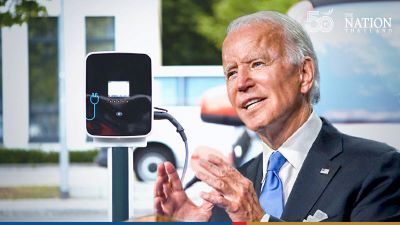
Biden calls for half of new cars to be electric or plug-in hybrids by 2030
WASHINGTON – President Joe Biden on Thursday unveiled a far-reaching, multipronged plan to make U.S. cars and light trucks more fuel-efficient and to begin a shift to electric vehicles over the coming decade. The move marks one of the administrations most consequential pushes so far to combat climate change and tackle the nations biggest source of greenhouse gas emissions.
The suite of new goals and mandates, forged after months of talks with car manufacturers, autoworkers and environmental groups, is meant to transform the kind of vehicles Americans drive and to reduce the country’s reliance on fossil fuels. The move comes with political risks for Biden, who has faced pressure from activists and industry representatives alike. But it represents a key part of his promise to try to slow rising global temperatures and propel the country toward a future in which the vehicles on roads and highways rely on little or no gasoline.
“Today, labor and industry, state and local leaders, are all working together to write the next chapter in the American story,” Biden said on the White House’s South Lawn. “We’re in competition with China and many other nations for the 21st century. To win, we’re going to have to make sure that the future will be made in America.”
But it remains to be seen whether Biden’s call to action will be enough to get the American auto industry to shift gears to cleaner cars quickly enough as part of a broader effort to tackle global warming.
The president signed an executive order calling for half of new passenger car sales to be of electric vehicles powered by batteries and fuel cells or plug-in electric hybrids by the end of the decade. Executives from auto companies, including Ford and General Motors, as well as lawmakers and United Auto Workers members joined Biden at the White House on Thursday afternoon.
Biden, a self-described “car guy,” turned to GM chief executive Mary Barra during his remarks and quipped: “When they make the first electric Corvette, I get to drive it.”
In the near term, the Environmental Protection Agency and the Transportation Department were also set Thursday to propose new requirements on greenhouse gas emissions and fuel efficiency for cars, SUVs and pickup trucks through model year 2026.
That rulemaking represents the Biden administration’s first major effort to use the federal government’s regulatory authority to cut carbon emissions. It also is a repudiation of a freeze on fuel-efficiency standards imposed under Donald Trump, one of the former president’s biggest environmental rollbacks. Trump scaled back the requirements put in place under the Obama administration in 2012, which would have ramped up average fuel economy to 54.5 miles per gallon by model year 2025.
The Biden administration expects its actions to conserve about 200 billion gallons of gasoline and forestall around 2 billion metric tons of carbon pollution.
Looking further out, the Biden team is also kicking off its push to set longer-term pollution standards for everything from tiny sedans to huge semitrailers made in the second half of the decade.
Taken together, the administration’s effort to spur the sale of electric vehicles aims to slash emissions from the nation’s top driver of global warming: The transportation sector, in which more than 90 percent of the fuel used today is derived from petroleum.
Yet to get Americans into cleaner cars, the administration faces a bumpy road ahead.
“What we need to be doing is figuring out how to get really dramatic reductions [in emissions] going forward,” said Mary Nichols, the former chair of the California Air Resources Board who helped forge a deal with five major automakers in 2019 to tighten their mileage standards beyond what the Trump administration set.
ADVERTISEMENTx
The Biden team modeled its near-term tailpipe targets on the California agreement. “We’ve been heating up, choking up and burning up on the West Coast of the United States,” California Gov. Gavin Newsom (D) said in an interview Thursday. “We’ve been waiting for this announcement for years.”
A fast-growing fire that tore through the Northern California town of Greenville this week, he added, underscores “the fact that we need to step up our efforts to address the underlying cause here.”
But it is difficult to make up for lost ground in improving engines after the Trump administration eased regulations. Dave Cooke, senior vehicles analyst for the Union of Concerned Scientists, said that while he had not yet seen the administration’s final proposal, his group and others have been pressuring the White House to push beyond the parameters of the California deal.
“They are not really forcing the industry to do a full course correction after the Trump [rollback],” Cooke said. “It puts us far behind where we need to be.”
And it’s still unclear whether the Biden administration will do enough to put the country on the path to reach its goal under the Paris climate agreement. The president wants to cut U.S. emissions in half by 2030, compared with 2005 levels. With his executive order Thursday, Biden hopes to send a signal to other countries to set their own aggressive climate goals ahead of a major climate conference in Scotland in the fall.
ADVERTISEMENT
In Detroit and other industrial cities, electric vehicles represent a challenge to autoworkers as factories shift from making internal combustion engines to battery-powered ones. A concern among factory workers is that their employers may be able to get by with fewer workers on the assembly line since electric vehicles have fewer parts. Both Ford and GM are investing in battery factories in the United States.
Brian Rothenberg, a spokesman for the United Auto Workers, which endorsed Biden last year, said the union’s focus “is not on hard deadlines or percentages, but on preserving the wages and benefits that have been the heart and soul of the American middle class.”
Meanwhile, the nation’s Big Three automakers – Ford, GM and Stellantis, formerly Fiat Chrysler – rallied around a “shared aspiration” less ambitious than the Biden goal. They are proposing that 40 to 50 percent of their annual U.S. sales be battery electric, fuel cell and plug-in hybrid vehicles by 2030. Ford chief executive Jim Farley said that based on early demand for electric F-150 trucks and other vehicles his company is “well positioned” to meet that mark.
But in a joint statement, the automakers said the shift “can be achieved only with the timely deployment of the full suite of electrification policies” from the federal government, including new financial incentives for drivers to buy zero-emission vehicles.
On Twitter, Elon Musk, a chief executive of electric vehicle giant Tesla, suggested his company was snubbed from Biden’s event. It “seems odd that Tesla wasn’t invited,” Musk wrote.
ADVERTISEMENT
Reaction was mixed from environmental groups.
Simon Mui, deputy director for clean vehicles and fuels at the Natural Resources Defense Council, praised Biden’s proposal for getting the country “back on the road to cleaning up tailpipe pollution.” But he added: “This proposal delivers less carbon pollution reductions than the Obama-era standards and includes unfortunate loopholes that undercut progress.”
Without a quick transition, the United States risks sliding even further behind Europe and Asia in making batteries and other key components for electric vehicles. Biden’s action will undoubtedly face comparisons with what other developed nations are doing to speed the shift to electric vehicles.
“Whether U.S. manufacturers and workers see the benefits of this transition really depends on actions now,” said Zoe Lipman, director of manufacturing and advanced transportation at the BlueGreen Alliance, a coalition of labor and environmental groups.
The European Union last month proposed changes that would effectively phase out the sale of new gasoline-powered engines by 2035, part of a far-reaching package of measures intended to put the 27-country bloc on pace to reach net zero emissions throughout its economy by mid-century.
The U.S. government must play a role in hastening its own shift, Nichols said, because some automakers are reluctant to move away from selling the highly profitable but gas-guzzling SUVs and trucks that remain popular today.
“They are not going to do it any faster than they have to,” said Nichols, who is now a visiting fellow at Columbia University’s Center on Global Energy Policy.
Advocates for electric vehicles, in both government and industry, must also sway an American driving public worried about not being able to find spots to plug in and recharge.
“The auto companies are there. We need the consumers to be there,” said Don Stewart, executive vice president of public affairs at the Alliance for Automotive Innovation, a trade group that represents carmakers. “And the federal government plays a huge role in that.”
A big question is how much financial support Congress will provide.
Plans to provide new tax breaks for buying electric vehicles hinge on Democrats passing a budget bill with razor-thin majorities in the House and Senate. And a bipartisan infrastructure plan includes just $7.5 billion for dotting U.S. corridors with vehicle chargers – half the amount Biden first called for to build 500,000 recharging spots.
“Now Congress has to act because this goal won’t be met just by setting it,” said Rep. Daniel Kildee, D-Mich., whose district has been decimated by factory closures. “We have to have industrial policy in this country that is about something.”
Published : August 06, 2021
By : The Washington Post · Dino Grandoni, Brady Dennis
SET slides as Covid cases surpass 20,000 for 2nd day in a row
The Stock Exchange of Thailand (SET) Index closed at 1,527.66 on Thursday, down 18.20 points or 1.18 per cent. Transactions totalled THB81.29 billion with an index high of 1,547.38 and a low of 1,526.91.
The index was pressured by rising Covid-19 cases as Thailand’s daily caseload surpassed 20,000 for the second day running. Thailand logged 20,920 new infections and 160 deaths on Thursday.
The 10 stocks with the highest trade value today were 7UP, IVL, PTT, KCE, PTTGC, GPSC, SCB, GULF, ADVANC and PSL.
ADVERTISEMENTx
Other Asian indices were down with one exception:
Japan’s Nikkei Index closed at 27,728.12, up 144.04 points or 0.52 per cent.
China’s Shanghai SE Composite Index closed at 3,466.55, down 10.67 points or 0.31 per cent, while the Shenzhen SE Component Index closed at 14,872.23, down 117.88 points or 0.79 per cent.
Hong Kong’s Hang Seng Index closed at 26,204.69, down 221.86 points or 0.84 per cent.
South Korea’s KOSPI closed at 3,276.13, down 4.25 points or 0.13 per cent.
Taiwan’s TAIEX closed at 17,603.12, down 20.77 points or 0.12 per cent.
The Stock Exchange of Thailand (SET) Index fell by 1.28 points or 0.08 per cent to 1,544.58 on Thursday morning.
The volume of transactions was THB6.84 billion with an index high of 1,546.56 and a low of 1,542.59.
The 10 stocks with the highest trade value were 7UP, PTT, PSL, GPSC, TTA, SNNP, Gulf, PTTGC, Ace and RCL.
The SET Index closed at 1,545.86 on Wednesday, up 5.35 points or 0.35 per cent. Transactions totalled THB66.89 billion with an index high of 1,548.63 and a low of 1,533.36.
The price of gold dropped by THB50 per baht weight in morning trade on Thursday.
AGold Traders Association report at 9.25am showed the buying price of a gold bar at THB28,250 per baht weight and selling price at THB28,350, while gold ornaments cost THB27,742.80 and THB28,850, respectively.
At close on Wednesday, the buying price of a gold bar was THB28,300 per baht weight and selling price THB28,400, while gold ornaments cost THB27,788.28 and THB28,900, respectively.
The spot gold price on Thursday morning was moving around US$1,812 (THB60,041) per ounce after Comex gold at close on Wednesday rose by 40 cents to $1,814.50 per ounce due to support in the acquisition of safe assets after US private sector employment growth came in lower than expected. However, the gold price slightly rose due to pressure from a strengthening US dollar.
ADVERTISEMENTx
The Hong Kong gold price meanwhile dropped by HK$40 to $16,780 (THB71,488) per teal, the Chinese Gold and Silver Exchange Society reported.
While vacations and family visits have come roaring back this summer, one segment of travel is still tiptoeing after a pandemic-force hiatus: business travel.
When will it resume in full? That seems to be anyone’s guess, though estimates stretch as far as 2025.
The emergence of the delta variant, uncertainty around border restrictions and the slow rollout of vaccinations to some parts of the world are variables that make it tough to predict when the old patterns of work travel will return, if ever.
In recent earnings calls, Delta and American said domestic business travel had reached 40 and 45 percent, respectively, of 2019 levels by June. Even with the business recovery fairly muted, the number of passengers at Transportation Security Administration checkpoints was up significantly compared to 2020, nearing or topping 2 million almost every day of the past month.
But while it may be fine for a traveler to jet off to Hawaii or Mexico for a pleasure trip, it is trickier for a company to send an employee off into the pandemic.
“Businesses are much more risk averse,” said Suzanne Neufang, chief executive of the Global Business Travel Association.
Another issue, she said: Where would those travelers go?
“With so many offices not completely open, there’s no place to meet,” she said. “You can have coffee, but it’s hard to show a PowerPoint in a coffee shop.”
ADVERTISEMENTx
Experts say the return to office life, expected in the fall, will spur more business travel. But it is unclear whether the delta-variant-fueled surge in coronavirus cases will widely delay that comeback. Already, major corporations such as Apple, Google, Twitter and Uber have delayed their back-to-office plans.
Tori Emerson Barnes, executive vice president of public affairs and policy at the U.S. Travel Association, said the variant has added some uncertainty and anxiety to the outlook. The trade group’s forecast predicts that business travel will reach only about half of 2019 levels by the end of this year.
Another stumbling block: Restrictions keep many would-be business travelers out of important markets – especially the United States. The country is still closed to travelers from many countries, including China, India, Brazil, the United Kingdom, Ireland and nations in the European Schengen area.
“Definitely government restrictions are the biggest barrier at this point in time,” said Paul Abbott, CEO of American Express Global Business Travel, which manages business travel, meetings and events for clients around the world. He said the company has seen numbers soar in places where the virus is well under control and workers can move about freely.
“Where travel is permitted and restrictions have been removed and there is trust and confidence in the processes, travel is returning in significant numbers and there’s very strong demand,” he said.
ADVERTISEMENT
Steve Hafner, CEO of the travel search company Kayak – which launched a corporate travel tool earlier this year – said continued mask requirements and recommendations are also working against a return to business trips.
“No one wants to wear a mask on a plane for a long trip. No one wants to wear a mask in an office either,” he said. “As long as masking is out there, I think that’s going to be a head wind for business travel.”
Both the U.S. Travel Association and Global Business Travel Association have predicted a full recovery by 2025. A recent report from professional services firm Deloitte projects U.S. corporate travel could reach a “new normal” of about 80 percent of pre-pandemic levels by the end of next year.
Bill Gates predicted that 50 percent of business travel would go away. An analysis by the Wall Street Journal was more generous, estimating that between 19 and 36 percent of business trips by air are likely to never return.
“I think this variant has done nothing more than to exacerbate the existing situation, which in my mind will never be the same as it was pre-COVID,” said Robert Quigley, senior vice president and global medical director at International SOS, a medical and travel security firm. “It opened up our collective eyes to the idea that maybe we don’t need to be constantly traveling. Maybe we can Zoom.”
ADVERTISEMENT
Those who are already traveling for work say their trips are meeting the needs that teleconferencing tools like Zoom just can’t.
Christine Choi, a New York-based partner at investment firm M13, travels to Los Angeles quarterly or every other month to meet with team members, welcome new colleagues and see product demonstrations. She said being on Zoom meetings 12 hours a day reminded her how important face-to-face interaction was to get to know people and learn what they need.
“It’s hard to expect humans to lean so dramatically on the digital experience and the screen experience,” she said.
Abbott said companies also realize they might need to get more workers on the road for competitive reasons.
“It’s all very well saying, ‘Could we continue to exist on Zoom?’ Yes,” he said. “But is the objective of your company ‘We want to continue to exist’ or is it ‘We want to grow, we want to win, we want to acquire new clients’?”
Still, even the biggest promoters of business travel acknowledge that the experience will be different, from the types of trips that people take to the length and frequency.
Abbott said he believes there will be a more dispersed workforce in the future, which means those spread-out employees will need to get together.
“That will absolutely create more business travel,” he said.
Neufang, of the Global Business Travel Association, said the group has been emphasizing “the right travel in the right way.” She said some companies are linking their business travel comeback to new sustainability goals – for example, cutting back on single-day jaunts in favor of fewer but longer trips.
“Fewer takeoffs and landings: That is better for the planet,” she said.
Describing himself as an optimist, Hafner said he expects business travel to eventually surpass 2019 levels. But, he predicted, he expects to see “a lot fewer day trips and hopefully a lot more ‘bleisure'” – or the combining of leisure and business, sometimes with a partner or family.
“Now you know you can work from anywhere. Why make it a day trip?” he said. “Go more days.”
Choi said she has extended her trips as she navigates covid-era necessities like trying to avoid layovers, choosing hotels with outdoor spaces for meetings and implementing activities like outside coffees and walks into her visits.
“My trips are getting slightly longer because I want to make it worth the strange travel,” she said. “The complexities makes me want to pack as much into my visits as possible.”