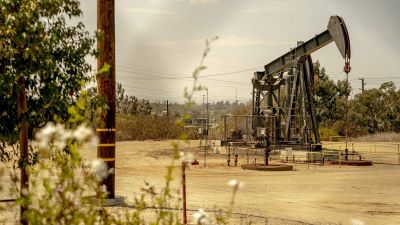
IEA warns of much tighter oil market unless OPEC+ boosts supply
Global oil markets are set to “tighten significantly” unless the OPEC+ alliance resolves its standoff and agrees to increase production, the International Energy Agency warned.
Deadlocked by a dispute between Saudi Arabia and the United Arab Emirates, OPEC+ is set to keep output levels unchanged next month even as fuel consumption bounces back from the pandemic and summer driving demand peaks.
The group’s impasse threatens to inflict a “deepening supply deficit,” with “the potential for high fuel prices to stoke inflation and damage a fragile economic recovery,” the IEA said in its monthly report. Brent crude is trading close to a two-year high above $75 a barrel.
The Organization of Petroleum Exporting Countries and its partners had been gradually restoring the vast quantities of oil production they shuttered during the pandemic, but the spat between the two Middle East nations — centered around the output quota of the UAE — is holding up the process.
Their standoff comes at a particularly inopportune moment, the IEA report shows. The oil inventory glut that amassed during the pandemic has cleared, and stocks are now below average levels. Meanwhile, world demand is set to rebound by a vigorous 5.4 million barrels a day this year from the unprecedented slump seen in 2020.
“Robust global economic growth, rising vaccination rates and easing social distancing measures will combine to underpin stronger global oil demand for the remainder of the year,” said the Paris-based agency, which advises most major economies.
In Limbo
OPEC+ was on the cusp of approving a plan to revive output in monthly installments of 400,000 barrels a day through to late 2022. The group’s talks broke down on July 5 after a third attempt to find an agreement, and despite mediation efforts the deal remains in limbo.
With August sales fixed and most Gulf countries preparing for an Islamic holiday, the discussion will have shifted to September supply volumes by the time the coalition reconvenes, delegates said.
Even if OPEC+ clinches an accord, the IEA report shows that the 400,000 barrel-a-day output hike under consideration will fall far short of consumers’ needs.
The 23-nation group pumped 40.9 million barrels a day in June, the IEA estimates. Even if OPEC+ proceeds with increases planned for this month, its output will still be significantly below the 43.45 million a day that the IEA projects will be required from the cartel in the second half of the year.
That could cause inventories to dwindle further. Oil stockpiles in developed nations are already 10.8 million barrels below the average level of 2015 to 2019, the agency said. They had been roughly 250 million barrels above average at the peak of the glut last summer.
Prices have remained volatile since the OPEC+ clash as traders grapple with an alternative outcome, in which the group descends into another price war like the one seen in early 2020.
“The possibility of a market share battle, even if remote, is hanging over markets,” the agency said. Whatever the eventual result, the volatility buffeting markets in the meantime isn’t “in the interest of either producers or consumers,” it warned.
Published : July 14, 2021
By : Syndication Washington Post, Bloomberg · Grant Smith
Prices rise 5.4% in June over last year, largest spike since 2008, as economy continues to recover
WASHINGTON – Prices rose 5.4% in June compared to a year ago, marking the largest spike since 2008 as the pandemic-battered economy regains its footing and questions build over how long this steady climb in inflation will last.
Inflation has been on a steep rise for about four months as the recovery gains steam, President Joe Biden’s $1.9 trillion stimulus package revs up the economy and consumer demand rebounds much faster than supply chains can catch up. Policymakers at the Federal Reserve and the White House have consistently said the price pops aren’t here to stay, and that it will take patience for the economy to come back to full strength and for prices to simmer down.
“We expected a pop in inflation like this,” San Francisco Fed President Mary Daly said of the inflation data on CNBC on Tuesday. “Right now it’s really remain steady in the boat. Don’t read too much signal out of any month of data. And let’s get through this volatile period so we can really see where the economy is.”
However, that message is being increasingly tested, especially as Americans feel the strain at the grocery store and the gas station and in the housing market. The pandemic exacted an unprecedented toll on the global economy, and no one knows for sure how long it will take for inflation to reverse its aggressive climb.
Meanwhile, Republicans and some prominent economists say the Fed is already behind the curve when it comes to tamping down inflation.
“We need to acknowledge that inflation is with us and it’s more severe than expected,” Sen. Patrick Toomey of Pennsylvania, the top Republican on the Senate Banking Committee, said during a Tuesday hearing. “The Fed has assured us that it’s all transitory . . . I remain concerned that they put themselves in a position of being behind the curve if they’re wrong.”
One big challenge for the policymakers is Americans’ perceptions of inflation, which can influence consumer spending choices. If Americans expect the cost of goods and services will keep rising, they may be more likely to buy more furniture or plane tickets now, before the price tag stings even worse. That cycle of behavior only pushes prices higher, making those very inflation expectations self-fulfilling.
If inflation continues to mount through the rest of 2021 and beyond, policymakers may find it harder to convince Americans that higher prices will be short-lived.
“What really matters for peoples’ pocketbooks is what’s happening with the prices that they face,” said Michael Strain, director of economic policy studies at the right-leaning American Enterprise Institute. “If households keep getting hit with 4 or 5 percent inflation month after month, at what point does that change their expectations about future inflation? And do those expectations then become self-fulfilling?”
A look at prices for two major categories – used cars and trucks, along with shelter – demonstrates how murky it can be to parse out temporary inflation dynamics from more persistent ones.
Prices for used cars and trucks have risen 45.2% in the past year. They soared 10.5% in June alone, after adjusting for seasonality, and accounted for more than a third of that month’s overall inflation.
A global microchip shortage has hamstrung supply chains for new cars. That trickles down to the used-car market, which relies heavily on trade-ins and auto parts. Adding to the strain is that many plants also tend to slow down production over the summer for maintenance, said Michelle Krebs, executive analyst at Cox Automotive.
For now, the expectation is that those backlogs will clear. Economists don’t expect used-car prices to keep up their historic surge forever.
But at the same time, auto industry experts say the chip shortage doesn’t have a quick fix. And for drivers who have been trying desperately to get an affordable car, the search has been difficult for months already.
ADVERTISEMENT
“We have to brace ourselves for a tough summer,” Krebs said.
For the category called “shelter,” prices rose 2.6% compared with a year ago, and 0.5% from May to June. Drilling down deeper in that category, hotel prices have risen – up 7.9% compared to the previous month, adjusted for seasonality – plus the cost of rent was also up 0.2%. Despite a recent rapid recovery from their pandemic collapse, hotel prices have yet to fully return to pre-pandemic levels.
Yet hotels and rent could end up telling different stories about inflation. Many hotels sat vacant for much of 2020, if they stayed open at all. Now, as more Americans become vaccinated and excitedly book long-awaited vacations, demand is surging, pushing the price of hotel rooms back up. Economists and policymakers expect that as the tourism industry reemerges from the pandemic, prices for hotels, along with airline tickets and rental cars, will normalize, too.
At the same time, in pockets all over the country, rents are rising, with tenants facing steeper bills. Economists and housing advocates fear that if landlords can lock in more expensive leases, rent won’t come back down.
Higher rents are adding pressure to an already-fraught housing market. Renters behind on bills have largely been able to stay in their homes because of a federal eviction moratorium. But when that protection lifts on July 31, it could be all the more expensive for people to keep roofs over their heads.
ADVERTISEMENT
Soaring home prices also make it harder for first-time buyers to purchase homes. Low interest rates and a booming stock market have helped wealthier Americans scoop up the few homes available. That reality has also prompted questions about whether the Fed’s vast moves to rescue the economy, even indirectly, propped up the housing market in a way that is cutting more people out.
Other snapshots of the consumer price index show how spending habits are changing as people resume their pre-pandemic spending habits. For example, the measure for “food away from home” – including restaurant food – rose 4.2% over the last year, the largest 12-month increase in that index since May 2009. The gasoline index also rose 2.5% over the month.
Tuesday’s data release from the Bureau of Labor Statistics is unlikely to prompt any policy change from the Fed or Biden administration. One reason why is because prices in 2021 are being compared to those from 2020, when the pandemic caused the economy to shut down and prices fell.
A White House official said much of the price increases – including a huge share from used cars and steeper hotel costs – still revolve around ongoing supply issues. Asked about rising rents, the official said the administration was pushing for a major investments in the country’s housing supply, which would help make housing more affordable for all Americans.
Federal Reserve Board Chair Jerome H. Powell is expected to face questions about the rise in inflation, how long it will last, and the Fed’s response, when he testifies on Capitol Hill on Wednesday and Thursday. Powell has repeatedly said that a clearer picture on inflation will come with more time and more data. In the meantime, he pledges that the central bank is keeping a close watch.
“I think we have to be humble about our ability to understand the data,” Powell said last month. “It’s not a time to try to reach hard conclusions about the labor market, about inflation, about the path of policy. We need to see more data.”
The Fed’s main policy tools revolves around interest rates. The Fed slashed rates to near zero at the beginning of the pandemic, and central bankers say they won’t consider raising rates until there’s been substantial progress in the labor market, which is still down 6.8 million jobs from February 2020.
As the labor market appears to be gaining steam, Fed leaders recently moved up their expectations for a rate hike in 2023. But first, the Fed will have to decide how and when to scale back its $120 billion a month in bond purchases. Some economists and policymakers are becoming especially critical of the Fed’s ongoing purchases of agency mortgage-backed securities, arguing the housing sector doesn’t need any more support.
“Chair Powell is going to have to further clarify and provide a definition of what transitory is to a public who is not sensitive to the ebb and flow of data,” said Joe Brusuelas, chief economist at RSM. “He needs to talk to them about where they live.”
Republicans and some prominent economists such as Lawrence H. Summers, however, argue that the higher prices are an urgent concern. They warn that the Fed’s low interest rates and other supports for the markets are excessively juicing the economy – and that the Fed will have missed the mark by the time it decides to step in.
How Americans respond to rising prices in the meantime could make that target even harder to nail down.
“Let’s say you started to see expectations creep up into troubling territory,” said Strain, with the American Enterprise Institute. “The response . . . has always been, ‘Hey, we have a Fed, and maybe the Fed can slow the economy without putting it into reverse. I’m just not super optimistic about that.”
Markets wrap: Stocks, bonds fall as inflation debate intensifies
Stocks retreated from record highs and bond yields rose as investors debated whether the Federal Reserve risks letting inflation get out of hand.
Yields climbed for a third day after the Treasury Department sold $24 billion in 30-year bonds at levels higher than just before its bidding deadline. The benchmark S&P 500 fell for the first time in three trading sessions with JPMorgan Chase & Co. and Goldman Sachs Group Inc. reporting mixed results as second-quarter earnings season gets under way. Technology shares had outperformed much of the day, briefly sending the Nasdaq 100 to another all-time high, before finishing marginally lower.
“Tech hung in because long rates fell pre-auction, and now that the whole yield curve is seeing a rise in rates, tech is being sold and it was the only thing keeping the indices up,” said Peter Boockvar, chief investment officer for Bleakley Advisory Group. “And with the S&P 500 and the Nasdaq 100 up almost every day for three weeks, we are overbought, so it wasn’t going to take much.”
A report earlier showed prices paid by U.S. consumers surged in June by the most since 2008, topping all forecasts and showing higher costs associated with the economy’s reopening continue to fuel inflationary pressures. The consumer price index jumped 0.9% in June and 5.4% from the same month last year.
Expectations for a solid earnings season have supported the stock rally, as investors ponder how central banks will unwind stimulus driving the recovery from the pandemic. Still, inflationary pressures remain a concern amid speculation around when the Fed will start cutting back bond purchases.
“This is not going to be music to the Fed’s ears,” Saira Malik, chief investment officer of global equities at Nuveen, said in an interview on Bloomberg TV. “The Fed is going to be acknowledging that inflation is going to be running hotter going forward. We’re also dealing with peak earnings growth in the second quarter and also the delta variant. That makes for a tough climb in the second half of this year.”
Oil rose to the highest price in more than 2 1/2 years as prospects of an imminent flood of crude exports from Iran and other major producers waned while the International Energy Agency warned of a deepening supply crunch.
Here are some events to watch this week:
– The Reserve Bank of New Zealand’s latest interest rate policy Wednesday
– Bank of Korea monetary decision Thursday
– China second-quarter GDP, key economic indicators Thursday
– Federal Reserve Chair Jerome Powell appears before the Senate Banking Committee to deliver the semi-annual Monetary Policy Report to Congress Thursday
– Bank of Japan interest rate decision Friday
These are some of the main moves in financial markets:
– – –
– The S&P 500 fell 0.3% as of 4 p.m. New York time
– The Nasdaq 100 was little changed
– The Dow Jones Industrial Average fell 0.3%
– The MSCI World index fell 0.2%
– – –
– The Bloomberg Dollar Spot Index rose 0.5%
– The euro fell 0.7% to $1.1776
– The British pound fell 0.5% to $1.3813
– The Japanese yen fell 0.2% to 110.61 per dollar
– – –
– The yield on 10-year Treasuries advanced five basis points to 1.41%
– Germany’s 10-year yield was little changed at -0.29%
– Britain’s 10-year yield declined two basis points to 0.63%
– – –
– West Texas Intermediate crude rose 1.6% to $75.30 a barrel
– Gold futures rose 0.1% to $1,808.60 an ounce
Published : July 14, 2021
By : Syndication Washington Post, Bloomberg · Katie Greifeld
Cabinet issues relief measures for lockdown provinces
The Cabinet on Tuesday approved relief measures for those affected by the curfew and Covid restrictions imposed in Greater Bangkok and the deep South.
The measures cover the Dark Red Zone provinces of Bangkok, Nakhon Pathom, Nonthaburi, Pathum Thani, Samut Prakan, Samut Sakhon, Narathiwat, Pattani, Yala and Songkhla.
Thai employees under the social security system will receive half their salary in compensation, up to a maximum 10,000 baht (or 7,500 baht for non-Thais).
Self-employed people registered for social security will get payments of 5,000 baht.
Employers under the social security system will be compensated 3,000 baht per employee, up to a maximum 600,000 baht.
Households and businesses will also get two months of discounted utility bills.
The relief measures cover the hotel and food industry, construction, entertainment/cultural venues, transportation and warehouses, wholesale and retail operators, administration and services, science and academia, and communications.
Space Affairs Act gives Thailand’s moon mission extra lift
Thailand launched a new era of space exploration on Tuesday as ministers gave the green light to the draft Space Affairs Act. The Cabinet said the law will lay foundations for the country’s “Space Economy”.
Higher Education, Science, Research and Innovation Minister Anek Laothamatas said the new law would help support Thailand’s development.
In December, Anek announced a seven-year mission to send a Thai spaceship to the moon.
The space- technology industry is already up and running in Thailand with investment from the government, and both Thai and foreign companies.
Thailand has more than 35,600 enterprises related to the aerospace industry and downstream industries, 95 per cent of which are small and medium enterprises (SMEs), start-ups and other businesses. The government says the growing industry creates economic and social benefits and generates about 56.122 billion baht.
The draft Space Affairs Act will be sent for review by the Council of State and Parliament before being enacted.
The Stock Exchange of Thailand (SET) Index closed at 1,570.99 on Tuesday, up 21.15 points or 1.36 per cent. Transactions totalled 75.22 billion baht with an index high of 1,571.82 and a low of 1,555.88.
In the morning session, Krungsri Securities forecast the SET Index on Tuesday would fluctuate between 1,540 and 1,560 points despite the rising oil price and hopes of more economic relief measures from the Thai government.
However, the rise in domestic Covid-19 cases and volatility in foreign fund flows would pressure the index, it added.
The 10 stocks with the highest trade value today were PTTGC, CPF, BANPU, GUNKUL, PTT, KCE, CBG, KBANK, CPALL and HANA.
Other Asian indices were up:
Japan’s Nikkei Index closed at 28,718.24, up 149.22 points or 0.52 per cent.
China’s Shanghai SE Composite Index closed at 3,566.52, up 18.69 points or 0.53 per cent, while the Shenzhen SE Component Index closed at 15,189.30, up 27.77 points or 0.18 per cent.
Hong Kong’s Hang Seng Index closed at 27,963.41, up 448.17 points or 1.63 per cent.
South Korea’s KOSPI closed at 3,271.38, up 24.91 points or 0.77 per cent.
Taiwan’s TAIEX closed at 17,847.52, up 33.19 points or 0.19 per cent.
Funds outflows expected to pressure SET despite oil price recovery
The Stock Exchange of Thailand (SET) Index rose by 7.60 points, or 0.49 per cent, to 1,557.44 on Tuesday morning.
The SET Index had closed at 1,549.84 on Monday, down 2.25 points or 0.14 per cent. Transactions totalled THB75.44 billion with an index high of 1,561.72 and a low of 1,544.71.
Krungsri Securities predicted that the SET Index on Tuesday would fluctuate between 1,540 and 1,560 points despite higher oil price and hopes from the government’s economic relief measures.
However, it said the rise in domestic Covid-19 cases and volatility in foreign funds flows would pressure the index.
It recommended that investors buy:
▪︎ HANA, KCE, TU, CPF, ASIAN and EPG, which benefit from the weakening baht.
▪︎ BCH, CHG, BDMS, HMPRO, GLOBAL, DOHOME, BEM, CKP, CBG, ICHI and GPSC, whose second-quarter business turnover is expected to improve.
Effectiveness of measures to contain Covid to determine bahts direction
The baht opened at 32.67 to the US dollar on Tuesday, weakening from Monday’s closing rate of 32.65.
The Thai currency is likely to move between 32.60 and 32.75 during the day, Krungthai Bank market strategist Poon Panichpibool said.
Poon said that foreign investors had decided to sell their assets in Thailand due to uncertainty caused by the Covid-19 situation in the country. He said this situation would lead to a gradual weakening of the baht.
However, the situation could improve if preventive measures by the authorities are effective in containing the Covid-19 crisis.
On Monday, Poon predicted that the baht could fall to 33 to the US dollar if it passed a resistance between 32.70 and 32.80.
The price of gold in Thailand rose by THB100 per baht weight on Tuesday morning. The price has moved in positive territory for two consecutive days this week.
The Gold Traders Association report at 9.29am showed buying price of a gold bar at THB27,850 per baht weight and selling price at THB27,950, while gold ornaments were priced at THB27,348.64 and THB28,450, respectively.
At close on Monday, the buying price of a gold bar was THB27,750 per baht weight and selling price THB27,850, while gold ornaments were priced at THB27,257.68 and THB28,350, respectively.