The Stock Exchange of Thailand (SET) Index closed at 1,552.09 on Friday, up 8.42 points or 0.55 per cent. Transactions totalled THB85.26 billion with an index high of 1,554.60 and a low of 1,535.69.
In the morning session, Krungsri Securities forecast the SET Index on Friday would fall to between 1,530 and 1,535 points amid surging Covid-19 caseloads in many countries that are slowing global economic recovery.
It said the index would also be pressured by Thailand’s move to impose a partial lockdown in Greater Bangkok to deal with rising Covid-19 cases.
The 10 stocks with the highest trade value today were KBANK, GUNKUL, PTT, SCB, BBL, TU, CPF, CPALL, AOT and BDMS.
Other Asian indices were mixed:
Japan’s Nikkei Index closed at 27,940.42, down 177.61 points or 0.63 per cent.
China’s Shanghai SE Composite Index closed at 3,524.09, down 1.42 points or 0.040 per cent, while the Shenzhen SE Component Index closed at 14,844.36, down 38.55 points or 0.26 per cent.
Hong Kong’s Hang Seng Index closed at 27,344.54, up 191.41 points or 0.70 per cent.
South Korea’s KOSPI closed at 27,344.54, up 191.41 points or 0.70 per cent.
Taiwan’s TAIEX closed at 17,661.48, down 204.61 points or 1.15 per cent.
Thai firms will issue bonds worth up to THB400bn in 2nd half: ThaiBMA
The Thai Bond Market Association (ThaiBMA) expects local private firms to continue raising funds by launching bonds to deal with uncertainties in the second half of this year, such as a surge in Covid cases and large companies’ refinancing.
Private firms are expected to launch bonds worth at least 400 billion baht in the second half compared to 522.07 billion baht worth of corporate bonds launched in the first half, said ThaiBMA president Tada Phutthitada.
He added that the value of bonds launched in the first half of this year was 63 per cent higher than the 319.38 billion baht issued at the end of last year.
“The expectation was based on uncertainties over Covid-19 impact on Thai and global economies,” he said, adding that the pandemic situation should improve in the fourth quarter.
He went on to say that individual investors had bought up 35.25 per cent of corporate bonds in the first half of this year, higher than 34.81 per cent in 2020 and 31.58 per cent in 2019.
“To ensure that individual investors will not face huge losses from investing in corporate bonds, ThaiBMA will discuss with the bond issuers on how they can diversify investment risks,” he said.
He added that nine Thai companies in the second quarter of this year extended their bond repayment worth 9.8 billion baht to 12 months from between six and nine months.
“We expect more firms to extend their bond repayment, but it will not worth more than 2 billion baht as they need to seek permission from shareholders first,” he said.
He went to say that foreign investors’ stakes in corporate bonds in the second quarter of this year was 908.38 billion baht, up from 849.08 billion baht at the end of last year.
“However, we expect foreign investors’ funds to flow out from the Thai bond market in the fourth quarter of this year as they have turned from long-term bonds to short-term ones to escape volatility from the US Federal Reserve’s move to ease its quantitative easing programme,” he added.
The Stock Exchange of Thailand (SET) Index fell by 2.97 points, or 0.19 per cent, to 1,540.70 on Friday morning.
The SET Index had closed at 1,543.67 on Thursday, down 32.93 points from Wednesday, or 2.09 per cent.
Transactions on Thursday totalled THB110.95 billion with an index high of 1,567.33 and a low of 1,540.56.
Krungsri Securities predicted that the SET Index on Friday would fall to between 1,530 and 1,535 points due to uncertainty over the Covid-19 outbreak in several countries that has caused an impact on the global economic recovery.
It said the news of Thailand’s move to impose semi-lockdown measures in the Greater Bangkok to deal with rising Covid-19 cases would pressure the index.
The Centre for Covid-19 Situation Administration said it would consider the measures at an emergency meeting on Friday.
Krungsri Securities recommended that investors buy:
▪︎ HANA, KCE, TU, CPF, ASIAN and EPG, which benefit from the weakening baht.
▪︎ BCH, CHG, BDMS, HMPRO, GLOBAL, BEM, CKP, CBG, ICHI and GPSC, whose second-quarter business turnover is expected to improve.
The price of gold rose by THB100 per baht weight on Friday morning amid the weakening dollar and falling US bond yield.
The Gold Traders Association report at 9.24am showed buying price of a gold bar at THB27,800 per baht weight and selling price at THB27,900, while gold ornaments were priced at THB27,303.16 and THB28,400, respectively.
At close on Thursday, buying price of a gold bar was THB27,700 per baht weight and selling price THB27,800, while gold ornaments were priced at THB27,197.04 and THB28,300, respectively.
Spot gold price on Friday was US$1,804 (THB59,018) per ounce after Comex gold on Thursday dropped by $1.9 to $1,800.2 per ounce.
Hong Kong gold price, meanwhile, dropped by HK$90 to $16,690 (THB70,287) per tael, the Chinese Gold and Silver Exchange Society reported.
Applications for U.S. state unemployment insurance edged up last week, though remained near a pandemic low, as the labor market grinds its way toward a full recovery.
Initial claims in regular state programs increased by 2,000 to 373,000 in the week ended July 3, Labor Department data showed Thursday. The median estimate in a Bloomberg survey of economists called for 350,000 new applications.
Even with the latest increase, new weekly filings for jobless benefits have more than halved since the beginning of the year as health concerns abate and pent-up demand fuels hiring at businesses like hotels and restaurants.
Economists expect further labor market improvement in the second part of this year, with the unemployment rate forecast to fall below 5% in the fourth quarter.
More than half of U.S. states are ending enhanced federal unemployment benefit programs amid an ongoing debate about whether they are hampering hiring efforts.
Continuing claims for ongoing state benefits fell to a pandemic low of 3.34 million in the week ended June 26. That could reflect more Americans taking jobs and falling off benefit rolls now that the $300 weekly supplement has ended in those states.
States including Oklahoma, Nebraska and Indiana — which have ended Pandemic Unemployment Assistance for self-employed workers — saw no initial claims in that program last week.
Meanwhile, initial claims in Texas and Nebraska picked up last week, which could reflect attempts to transition to regular state programs now that PUA has been phased out in those states.
“There is a chance that some people may file initial claims to redetermine their eligibility if they lose benefits from one of the expiring programs, but we think that in most cases these people would not be eligible for benefits,” JPMorgan Chase economists said in a recent note.
Pennsylvania and New York reported the largest increases in initial claims last week, while claims in Oklahoma and Maryland fell.
The latest jobs report showed payrolls increased 850,000 in June, the largest advance in 10 months, suggesting firms were having greater success a month later in recruiting workers to fill open positions. Still, vacancies stood at a record high in May, pointing to a mismatch between labor supply and demand.
Published : July 09, 2021
By : Syndication Washington Post, Bloomberg · Olivia Rockeman
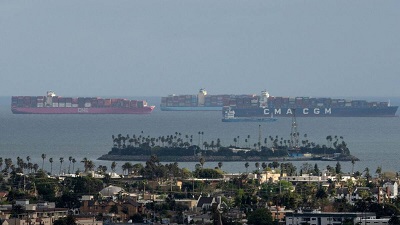
The cost to ship a boxload of goods to the U.S. from China edged close to $10,000 as the worlds biggest economy keeps vacuuming up imports amid slower recoveries from the pandemic from Europe to Asia.
The spot rate for a 40-foot container from Shanghai to Los Angeles increased to $9,631, up 5% from the previous week and 229% higher than a year ago, according to the Drewry World Container Index published Thursday. A composite index, reflecting eight major trade routes, rose to $8,796, a 333% surge from a year ago. Drewry said it expects rates to increase further in the coming week.
While the surging rates represent a profit bonanza for container lines including Copenhagen-based A.P. Moller-Maersk and China’s Cosco Shipping Holdings Co., they’re making it more difficult for importers to absorb higher costs. Some are raising retail prices, adding to inflationary pressures that worry central banks, while Covid-related supply bottlenecks are also holding back economic activity.
The cost for a container from Shanghai to Rotterdam passed the $10,000 threshold in late May and has continued to rise. It reached $12,795 this week, according to Drewry. That’s up nearly 600% from a year ago.
The prospect of $10,000-a-box charges for the busy Asia-to-U.S. route would’ve been unthinkable to most shipping analysts before the pandemic. The average rate for shipping from Shanghai to Los Angeles was less than $1,800 per container from 2011 to March 2020, Drewry data show.
While demand from American consumers and companies is one reason for the rate spike, a shortage of containers remains another reason for the tight market.
Container capacity is particularly scarce for eastbound transpacific shipments, with Covid outbreaks at a port in southern China recently snarling both exports and imports. Meanwhile, a queue of vessels waiting to enter the twin ports of Los Angeles and Long Beach, California — the largest U.S. gateway for ocean-going trade — showed little signs of going away.
The number of container ships anchored in San Pedro Bay totaled 18 as of late Tuesday, nearly double the queue of two weeks earlier, according to officials who monitor harbor traffic. That bottleneck has persisted since late last year, peaking around 40 vessels in early February.
The average wait for berth space was 5.3 days, compared with 4.6 in early June, according to the L.A. port. That number peaked around 8 days in April.
Published : July 09, 2021
By : Syndication Washington Post, Bloomberg · Brendan Murray
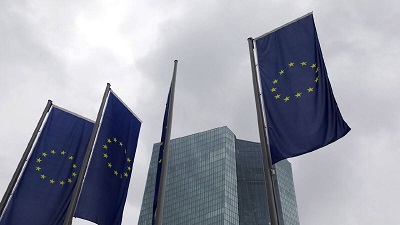
The European Central Bank raised its inflation goal and said it is willing to tolerate a limited overshoot of the target, the outcome of a strategy revamp aimed at bolstering the economy after years of lackluster prices and growth.
In the culmination of an 18-month review published Thursday, policymakers agreed to seek consumer-price growth of 2% over the medium-term with a “symmetric” aim that could “imply a transitory period in which inflation is moderately above target.”
That’s a significant change from the “below, but close to, 2% over the medium term” wording which some monetary officials felt was too vague and led to calls for tighter policy too soon.
The euro and government bonds extended gains after the announcement. The common currency climbed to a day high of $1.1846, while German 10-year yields held near a three-month low of -0.34%.
The announcement “can be perceived as net dovish in the short-term,” said Ima Sammani, FX Market Analyst at Monex Europe. “The new symmetric inflation target gives the central bank ample room to run accommodative monetary policy for longer without having to fight markets.”
On climate change, another controversial topic for some central bankers, the institution said it will now include considerations on that matter in its monetary policy operations. Meanwhile officials also said they will start considering owner-occupied housing costs in their supplementary measures of inflation.
“While taking the ECB’s primary mandate of price stability as a given, the review has allowed us to challenge our thinking, engage with numerous stakeholders, reflect, discuss and reach common ground on how to adapt our strategy,” ECB President Christine Lagarde said in a statement. “The new strategy is a strong foundation that will guide us in the conduct of monetary policy in the years to come.”
The strategy review is the first by the Frankfurt-based institution since 2003, and the most comprehensive and ambitious attempt to rethink its role in serving the euro zone’s 342 million citizens since the creation of the single currency.
The ECB’s revamped mission follows a similar effort by the Federal Reserve to question its approach to the economic challenges of the 21st century after years of elusive attempts throughout the advanced world to sustainably revive consumer prices.
The outcome also reflects a grand bargain among policymakers that gives Lagarde a chance to draw a line on divisions on the Governing Council over how far the central bank should go in supporting the economy.
Officials from Germany in particular found that the stance of her predecessor, Mario Draghi, represented a bias toward easy money that undermined the postwar inflation-fighting steadfastness of the Bundesbank on which the ECB was modeled as a condition for the country’s participation in the euro.
Policymakers studied a wide range of economic trends and tools to understand why they’ve struggled to boost inflation despite negative interest rates and trillions of euros of monetary stimulus.
“The big question is really now, how do you follow this up?,” said Anatoli Annenkov, an economist at Societe Generale. “Does it mean that they’ll be more aggressive in easing, which I think is difficult. We’re looking at a more delayed reaction function as inflation raises to the target. that should imply a very dovish ECB going forward.”
Published : July 09, 2021
By : Syndication Washington Post, Bloomberg · Carolynn Look, Jeannette Neumann
U.S. stocks dropped the most in almost three week amid growing anxiety that the spread of covid-19 variants will upend growth expectations, undoing popular reflation trades. Treasuries gained for an eighth day.
The S&P 500 fell 0.9%, with the economically-sensitive industrial and material sectors helping to lead all 11 industry groups lower. The benchmark index had set all-time closing highs in eight of the last nine trading sessions. Banks were the biggest losers with the U.S. 30-year Treasury yields fell briefly below 1.90% for the first time since February.
Traders are getting edgy over whether the rapid spread of the delta strain will knock back growth and prospects for central bank normalization.
“It feels like we have moved from thinking inflation will be transitory, to fearing growth will be transitory,” said Art Hogan, chief market strategist at National Securities.
Central bank stimulus plans remain critical to the market outlook. While the Federal Reserve mulls the timetable for tapering $120 billion in monthly bond purchases, the European Central Bank stands ready to extend ultraloose policy. In the culmination of an 18-month review published Thursday, ECB policymakers raised their inflation target to 2% and said they would tolerate moderate overshoots.
“The minutes of the Fed yesterday pointed to a slowing of the bond purchase, though the lower interest rate on the 10-year, which indicated higher demand,” said Kim Forrest, founder and chief investment officer at Bokeh Capital Partners. It “looks like the bond people are ignoring the Fed’s future moves.”
Oil rebounded after a U.S. government report showed rapidly declining inventories and record-high fuel demand in the midst of the peak summer travel season.
Meanwhile, the pandemic’s global death toll has surpassed 4 million as the delta variant spreads, and the World Health Organization urged caution on reopenings worldwide.
These are some of the main moves in markets:
Stocks
– The S&P 500 fell 0.9% as of 4:01 p.m. New York time
– The Nasdaq 100 fell 0.6%
– The Dow Jones industrial average fell 0.8%
ADVERTISEMENT
– The MSCI World index fell 1%
Currencies
– The Bloomberg Dollar Spot Index fell 0.2%
– The euro rose 0.5% to $1.1847
– The British pound fell 0.1% to $1.3785
ADVERTISEMENT
– The Japanese yen rose 0.8% to 109.78 per dollar
Bonds
– The yield on 10-year Treasurys declined two basis points to 1.29%
– Germany’s 10-year yield was little changed at -0.31%
– Britain’s 10-year yield advanced one basis point to 0.61%
Commodities
– West Texas Intermediate crude rose 1.3% to $73.13 a barrel
– Gold futures were little changed
Published : July 09, 2021
By : Syndication Washington Post, Bloomberg · Claire Ballentine, Natalia Kniazhevich
Thai household debt in the first quarter of 2021 reached 90.5 per cent of GDP, the highest among developing countries, according to Siam Commercial Bank’s Economic Intelligence Centre (EIC).
Total household debt rose 4.6 per cent from last year to 14.1 trillion baht as incomes were hit by slow recovery from the Covid-19 crisis, the centre said.
It was also the biggest rise in five quarters, following higher borrowing from commercial banks (up 4.9%) and specialised financial institutions (5.5%), with the latter recording their highest level in five years.
The EIC estimates that the actual household debt situation may be worse than the debt-to-GDP ratio indicates since the household debt-to-income ratio tends to be higher than the debt-to-GDP figure.
The severe impact on households is reflected by the record number of unemployed and lost income for workers. In the first quarter of 2021, workers’ income dropped by 8.8 per cent from the same period last year, while nominal GDP dropped only 2.1 per cent.
While a strong export recovery is boosting the Thai economy, the export sector uses less labour compared to the service sector, the EIC said. Moreover, export income is concentrated in a small number of large companies.
Rising household debt and falling incomes mean people may turn to loan sharks and fall into a cycle of debt, said the centre. To prevent this, the government should offer financial relief and labour-skills training for households. Such measures were necessary as the household economy remains highly vulnerable, it added.
The EIC warned that “debt overhang” in the household sector will likely hamper spending and economic recovery in the foreseeable future.
The Stock Exchange of Thailand (SET) Index closed at 1,543.67 on Thursday, down 32.93 points or 2.09 per cent. Transactions totalled THB110.95 billion with an index high of 1,567.33 and a low of 1,540.56.
In the morning session, Krungsri Securities forecast the index on Thursday would drop to between 1,565 and 1,570 points due to the falling oil price and moves for a partial lockdown in Thailand after health authorities warned Covid-19 cases could soar to 10,000 per day next week.
Thailand recorded a new high of 7,058 new cases and 75 deaths on Thursday in a third-wave outbreak driven by the super-transmissible Delta variant.
Also pressuring the SET Index is the outflow of foreign funds in line with the weakening baht, Krungsri Securities said.
The 10 stocks with the highest trade value today were KBANK, PTT, PTTEP, BDMS, BANPU, BBL, RCL, SCB, CHG and GUNKUL.
Other Asian indices were on the fall except for Taiwan:
Japan’s Nikkei Index closed at 28,118.03, down 248.92 points or 0.88 per cent.
China’s Shanghai SE Composite Index closed at 3,525.50, down 28.21 points or 0.79 per cent, while the Shenzhen SE Component Index closed at 14,882.90, down 57.14 points or 0.38 per cent.
Hong Kong’s Hang Seng Index closed at 27,153.13, down 807.49 points or 2.89 per cent.
South Korea’s KOSPI closed at 3,252.68, down 32.66 points or 0.99 per cent.
Taiwan’s TAIEX closed at 17,866.09, up 15.40 points or 0.086 per cent.