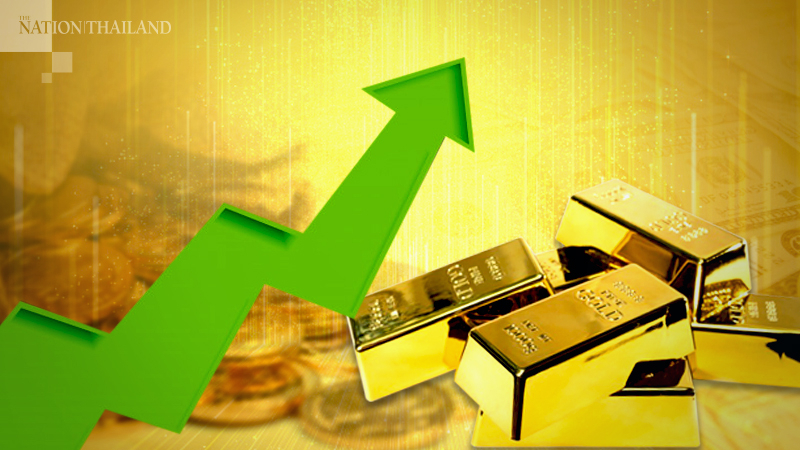
The price of gold rose by Bt200 per baht weight in morning trade on Thursday, the Gold Traders Association reported.
As of 9.40am, the buying price of a gold bar was Bt25,400 per baht weight and selling price Bt25,500 while gold ornaments cost Bt24,938.20 and Bt26,000, respectively.
At close on Wednesday, the buying price of a gold bar was Bt25,200 per baht weight and selling price Bt25,300 while gold ornaments cost Bt24,741.12 and Bt25,800, respectively.
The spot gold price moved to US$1,752 (Bt53,831) per ounce after falling by $3.80 to $1,727.10 on Wednesday due to the rise in the US bond yield before the results of a key US Federal Reserve meeting were to be announced. The gold price surged after the Fed signalled it would maintain the interest rate at a low level until 2023.
The Hong Kong gold price meanwhile rose by HK$130 to $16,200 (Bt64,105) per tael, the Chinese Gold and Silver Exchange Society reported.
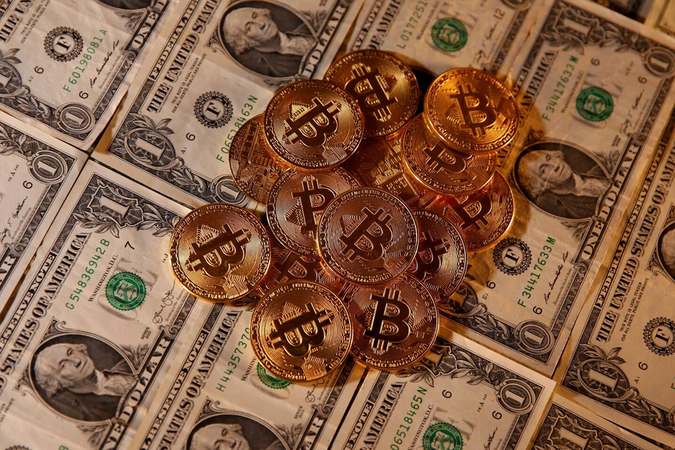
Twenty-seven bidders are outdoing one another in a scramble to claim a fraction of a bitcoin, sending the price well above market rates in a first-of-its kind auction at the General Services Administration.
Officials at the federal agency placed a 0.7501 share of a bitcoin on the auction block for a two-day bidding event this week, marking the first time the GSA – which typically offers up surplus government vehicles and office supplies – has allowed the public to place bids on cryptocurrency.
With just hours remaining in the auction, the highest bid would claim the bitcoin share at $48,755. That’s about 13% higher than the market value, meaning the government auction is set to generate a significant premium, so long as the price of bitcoin does not suddenly spike before Wednesday evening.
Bidders have one-upped themselves throughout the auction. The GSA’s bidding history shows that the auction participants – who are not identified – have raised the top bid by more than $5,000 since Monday, in increments ranging from $5 to $600. The financial battle to win the bitcoin slice has outpaced the broader market, where the price of bitcoin has fallen slightly since the start of the week.
The auction comes amid an extraordinary rally in cryptocurrency markets, and as bitcoin recently surpassed $60,000 for the first time. Bitcoin’s value has climbed 90% since the start of the year, riding a staggering comeback from the lows of last spring, when investors rushed to sell during the early weeks of the pandemic.
Experts say the recent bitcoin surge is driven in part by investors seeking protection from inflation and as an alternative store of value. “People buy it outright as an investment, but increasingly it’s also being bought in order to diversify traditional portfolios,” said Shane Edwards, global head of investment products at Diginex, a digital asset financial services company.
While the cryptocurrency bidding event is a first for the GSA, the U.S. Marshals Service has been auctioning bitcoin since 2014, following the FBI’s crackdown on the digital black market Silk Road, seizing more than 170,000 bitcoin. The law enforcement agency has administrated a total of nine bitcoin auctions.
The GSA declined to share where its bitcoin fraction came from, citing privacy concerns. Items up for GSA auctions can come from a range of sources, the agency said, including seized property.
The winner of the auction must send the full payment by Friday, through a wire transfer, and needs to have a digital wallet to receive the piece of bitcoin.
By Syndication Washington Post, Bloomberg · Olivia Raimonde, Lu Wang
Stocks rose to record highs and yields on longer-maturity U.S. debt retreated from more than one-year highs after the Federal Reserve continued to project near-zero interest rates at least through 2023 despite rising inflation concerns.
The yield on the benchmark 10-year note retreated from its highs of the day as Fed Chairman Jerome Powell reiterated that the central bank wants to see inflation moderately above 2%. and said the recent move higher in yields wasn’t disorderly. The S&P 500 pushed higher to the highest level on record, led by the consumer discretionary, industrial and materials sectors.
“It seems like the inflation bulls are starting to gain momentum, with more votes for a rate hike in 2023,” said Mike Bailey, director of research at FBB Capital Partners. “But overall a big sigh of relief for equities since interest rates are still likely to remain near zero for an extended period, despite the massive double stimulus from the Fed and Congress.”
Expectations of a strong recovery from the covid-19 slump put an intense focus on Fed officials’ projections for interest rates displayed in their “dot plot.”
Seven of 18 officials predicted higher rates by the end of 2023 compared with five of 17 at the December meeting, showing a slightly larger group who see an earlier start than peers to the withdrawal of ultra-easy monetary policy, according to the FOMC’s quarterly economic projections also issued Wednesday.
“The Fed was dovish relative to some fears of ‘hawkish dots’, but since we didn’t get that ‘hawkish’ outcome, stocks are having a relief move,” said Dennis DeBusschere, head of portfolio strategy at Evercore ISI. “Bottom line, the inflation/growth forecasts the Fed has along with no rate hikes for three years is a positive backdrop for risk assets.”
The yield on 30-year Treasurys had spiked to a level unseen since 2019 and the 10-year hit 1.69%. Market-implied inflation expectations were at 12-year highs. The dollar weakened versus most major peers.
Elsewhere, the Stoxx Europe 600 Index fell, and South Korean stocks retreated as Samsung Electronics Co. warned it’s grappling with the fallout from a “serious imbalance” in semiconductors globally.
WTI crude oil was little changed with the International Energy Agency saying markets aren’t on the verge of a new price supercycle. Bitcoin climbed off the lows of the day back toward the weekend record of above $61,000.
These are the main moves in markets:
Stocks
The S&P 500 Index gained 0.3% to 3,974.16 as of 4:01 p.m. EDT, the highest on record.
The Dow Jones industrial average jumped 0.6% to 33,016.16, the highest on record.
The Nasdaq Composite Index climbed 0.4% to 13,525.20, the highest in more than two weeks.
The Nasdaq 100 Index advanced 0.4% to 13,202.38, the highest in more than two weeks.
The Stoxx Europe 600 Index declined 0.4% to 424.91, the largest drop in more than a week.
Currencies
The Bloomberg Dollar Spot Index fell 0.5% to 1,134.14, the lowest in more than two weeks.
The euro jumped 0.6% to $1.1976, the largest climb in almost six weeks.
The British pound jumped 0.5% to $1.3963, the biggest increase in almost four weeks.
The Japanese yen strengthened 0.1% to 108.89 per dollar.
Bonds
The yield on two-year Treasurys dipped one basis point to 0.14%, the lowest in more than two weeks on the biggest dip in almost three weeks.
The yield on 10-year Treasurys advanced two basis points to 1.64%, the highest in more than 13 months.
The yield on 30-year Treasurys climbed three basis points to 2.41%, the highest in 16 months.
Germany’s 10-year yield gained five basis points to -0.29%, the highest in more than a week on the largest climb in two weeks.
Commodities
West Texas Intermediate crude declined 0.4% to $64.57 a barrel, the lowest in a week.
Gold strengthened 0.8% to $1,745.72 an ounce, the highest in almost three weeks on the largest gain in more than a week.
The Stock Exchange of Thailand (SET) Index closed at 1,566.76 on Wednesday, up 2.73 points or 0.17 per cent. The volume of total transactions was Bt92.17 billion with an index high of 1,571.53 and a low of 1,559.22.
In the morning session, a Krungsri Securities analyst expected the day’s index to fall to 1,560 points due to a lack of positive sentiment.
He said uncertainty over inflation and some European countries’ suspension of AstraZeneca Covid-19 vaccinations could pressure the index.
“Meanwhile, investors would delay trading to await the outcome of a key US Federal Reserve meeting [on Wednesday],” he added.
The 10 stocks with the highest trade value today were OR, PTT, HANA, IRPC, KBANK, PTTGC, GUNKUL, PTTEP, CPALL and KCE.
Other Asian indices were mixed:
Japan’s Nikkei Index closed at 29,914.33, down 6.76 points or 0.023 per cent.
China’s Shang Hai SE Composite Index closed at 3,445.55, down 1.18 points or 0.034 per cent, while the Shenzhen SE Component Index closed at 13,809.77, up 166.81 or 1.22 per cent.
Hong Kong’s Hang Seng Index closed at 29,034.12, up 6.43 points or 0.022 per cent.
South Korea’s KOSPI closed at 3,047.50, down 19.67 points or 0.64 per cent.
Taiwan’s TAIEX Index closed at 16,215.82, down 97.34 points or 0.60 per cent.
The number of Thai households shopping online has shot up 58 per cent during the Covid-19 pandemic, which has accelerated the region’s shift to e-commerce. The dramatic rise in households buying online signals a turning point for e-commerce in Asia, says global marketing research firm NielsenIQ.
“We have entered the end of the beginning of e-commerce in Asia and those who rest now will sleep through the most formative time of growth for e-commerce,” said Vaughan Ryan, NielsenIQ’s Consumer Intelligence managing director in Asia.
NielsenIQ warns retailers that as e-commerce transitions to the next phase, there are five challenges that retailers need to face. These are greater fragmentation in retail, redefining of the role of physical stores, divergent realities, increased fight for consumer attention, and the race to last-mile fulfilment.
In Thailand, e-commerce has been historically dominated by the non-food category. But NielsenIQ observed soaring growth in 2020 for the food category. From January to December 2020, it reports that the food category grew by 74 per cent versus 60 per cent growth shown by non-food. The challenge according to NielsenIQ is how retailers and brands can make this momentum sustainable.
To meet that challenge, retailers and brands will have to connect their various channels – online and offline – to provide a seamless shopping experience for customers across all platforms, said Pornvadee Porningmast, NielsenIQ’s Consumer Intelligence head in Thailand. The shift to this “omnichannel” model of e-commerce is now inevitable in Thailand, NielsenIQ said.
The Stock Exchange of Thailand (SET) Index dropped by 0.21 points or 0.01 per cent to 1,563.82 in the morning session on Wednesday.
A Krungsri Securities analyst expected the day’s index to fall to 1,560 points due to a lack of positive sentiment.
He said uncertainty over inflation and some European countries’ suspension of AstraZeneca Covid-19 vaccinations could pressure the index.
“Meanwhile, investors would delay trading to await the outcome of a key US Federal Reserve meeting,” the analyst added.
He recommended investors buy:
▪︎ AOT, Mint, Centel, AAV, BA, CPN, CRC and Major, which benefit from positive news of a Covid-19 vaccine in Thailand.
▪︎ Hana, KCE, TU and CPF, which benefit from the weakening baht.
▪︎ CBG, Ichi, Sappe, RBF, DOD, IP, TACC, Gunkul and Kiss which benefit from positive news on hemp production and its general use.
The SET Index closed at 1,564.03 on Tuesday, down 1.70 points or 0.11 per cent. Total transactions amounted to Bt88.29 billion, with an index high of 1,573.13 points and a low of 1,562.35.
The price of gold rose by Bt50 per baht weight in morning trade on Wednesday, the Gold Traders Association reported.
As of 9.26am, the buying price of a gold bar was Bt25,150 per baht weight and selling price Bt25,250 while gold ornaments cost Bt24,695.64 and Bt25,750, respectively.
At close on Tuesday, the buying price of a gold bar was Bt25,100 per baht weight and selling price Bt25,200 while gold ornaments cost Bt24,650.16 and Bt25,700, respectively.
The spot gold price moved to US$1,734 (Bt53,367) per ounce after rising by $1.70 to $1,730.90 on Tuesday. However, investors are delaying trading as they watch the outcome of the US Federal Reserve meeting on Wednesday and Thursday, an analyst said.
The Hong Kong gold price meanwhile rose by HK$10 to $16,050 (Bt63,608) per tael, the Chinese Gold and Silver Exchange Society reported.
By Syndication Washington Post, Bloomberg · Lu Wang, Vildana Hajric
U.S. stocks fluctuated near record highs while yields on benchmark Treasury notes lingered close to more than one-year highs as investors weighed the strength of the global economic recovery.
The S&P 500 was little changed amid a drop in the energy and industrials sectors. Apple Inc. and Microsoft Corp. briefly led the tech-heavy Nasdaq 100 to a two-week high, while the Dow Jones industrial average fell from a record high, with Boeing Co. and Goldman Sachs Group Inc. among the biggest decliners. Treasury 10-year yields fluctuated as the Federal Reserve began its two-day policy meeting.
“The actual growth numbers keep coming out ahead of almost all of what experts predict, so the market is trying to sort out what that means over the longer term,” said Stephen Dover, chief market strategist and head of the Franklin Templeton Investment Institute. “Growth had so far outperformed value that there was a rotation, but a lot of that rotation has happened, and so now they’re closer to each other and there’s a tug and pull back and forth between those areas and sectors.”
In Europe, traders shrugged off decisions by Germany, France and Italy to suspend the AstraZeneca Plc vaccine ahead of a meeting of regional health ministers to discuss the future of the covid-19 shot. The Stoxx 600 Index advanced 0.9%.
Markets saw modest gains in Japan and China, where investors were watching for a possible broader crackdown on the internet sector. Oil retreated for a third day, while the dollar was mixed versus its major peers.
With the global economy increasingly on a path out of the pandemic, focus turns to the Fed’s communications on Wednesday, which will include fresh economic and interest-rate projections. Reflation trades stand to benefit if the central bank maintains a hands-off approach to the recent rise in yields. Bets on a faster economic recovery have already helped push one market gauge of inflation to its highest level since 2008, and a renewed climb in yields could spur the rotation from growth to value stocks.
“As bond vol drops and rates are pinned by European risk near term, the pain trade that started yesterday continues,” with growth stocks outperforming, said Dennis DeBusschere, head of portfolio strategy at Evercore ISI. “Eventually bond yields will catch up to inflation expectations again.”
Looking further ahead, investors are assessing the potential for an infrastructure spending package and tax increases in the U.S.
Elsewhere, Bitcoin traded around $56,000, down from a weekend peak above $61,000.
These are the main moves in markets:
Stocks
The S&P 500 Index fell 0.2% to 3,962.71 as of 4:04 p.m. EDT, the first retreat in more than a week.
The Dow Jones industrial average decreased 0.4% to 32,825.95, the first retreat in more than a week.
The Nasdaq Composite Index gained 0.1% to 13,471.57, the highest in more than two weeks.
The Nasdaq 100 Index increased 0.5% to 13,152.28, the highest in more than two weeks.
The Stoxx Europe 600 Index increased 0.9% to 426.82, the highest in about 13 months on the largest climb in more than a week.
Currencies
The Bloomberg Dollar Spot Index was little changed at 1,139.61.
The euro dipped 0.2% to $1.1905, the weakest in a week.
The British pound was little changed at $1.3897, the weakest in a week.
The Japanese yen strengthened 0.1% to 109 per dollar, the largest advance in a week.
Bonds
The yield on two-year Treasurys fell less than one basis point to 0.15%.
The yield on 10-year Treasurys climbed one basis point to 1.61%.
Britain’s 10-year yield dipped one basis point to 0.785%.
Germany’s 10-year yield declined less than one basis point to -0.34%, the lowest in two weeks.
Commodities
West Texas Intermediate crude fell 1.1% to $64.66 a barrel, the biggest fall in a week.
Gold was little changed at $1,731.90 an ounce, the highest in two weeks.
Kasikorn Research Centre expects sales of hybrid electric vehicles (HEV) and plug-in hybrid electric vehicles (PHEV) to rise between 63 and 70 per cent this year, as Thailand makes the transition from combustion engines.
KResearch estimates 48,000 to 50,000 HEV and PHEV units will be sold in 2021, becoming the standard model for certain types of car.
It also expects sales of 4,000-5,000 battery electric vehicles (BEVs) this year, an increase of 210 to 288 per cent.
The price of EVs and the number of charging stations will be key factors in the EV market’s rapid expansion, said the centre.
Domestic EVs will account for 55 per cent of total car sales in the next decade, and also make up more than 50 per cent of Thailand’s domestic auto production, it forecasts.
Government measures in collaboration with the private sector – including tax breaks to stimulate investment/consumption and building charging stations – will accelerate expansion of the EV market, KResearch said.
The Stock Exchange of Thailand (SET) Index closed at 1,564.03 on Tuesday, down 1.70 points or 0.11 per cent. Total transactions amounted to Bt88.29 billion with an index high of 1,573.13 and a low of 1,562.35.
In the morning session, a Krungsri Securities analyst expected the day’s index to fall to 1,560 points despite hopes of US economic relief measures and the global rollout of Covid-19 vaccination.
The index would be under pressure due to uncertainty over US bond yield and volatility in funds flows, while investors would delay trading to hear the outcome of Wednesday’s US Federal Reserve meeting, said the analyst.
The 10 stocks with the highest trade value today were GUNKUL, SAWAD, PTT, STA, KBANK, HANA, COM7, IRPC, SCC and PTTEP.
Other Asian indices were on the rise:
Japan’s Nikkei Index closed at 29,921.09, up 154.12 points or 0.52 per cent.
China’s Shang Hai SE Composite Index closed at 3,446.73, up 26.79 points or 0.78 per cent, while Shenzhen SE Component Index closed at 13,642.96, up 122.89 points or 0.91 per cent.
Hong Kong’s Hang Seng Index closed at 29,027.69, up 193.93 points or 0.67 per cent.
South Korea’s KOSPI closed at 3,067.17, up 21.46 points or 0.70 per cent.
Taiwan’s TAIEX Index closed at 16,313.16, up 63.83 points or 0.39 per cent.