
GSB issues loan packages, relief for flood victims in South #SootinClaimon.Com

#SootinClaimon.Com : ขอบคุณแหล่งข้อมูล : หนังสือพิมพ์ The Nation.

GSB issues loan packages, relief for flood victims in South (nationthailand.com)

GSB issues loan packages, relief for flood victims in South

EconDec 04. 2020
By The Nation

The Government Savings Bank (GSB) has launched loan packages to relieve the burdens of flood victims in the South.

GSB president Vitai Ratanakorn said flooding in many southern provinces had taken a toll on livelihoods.

In response, the bank has also provided victims with 3,500 bags of relief supplies and drinking water.

Among the worst-affected provinces are Nakhon Si Thammarat and Surat Thani, where GSB has more than 957,000 deposit and loan customers.

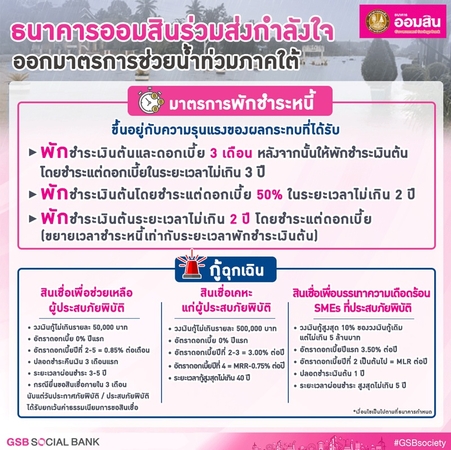
To relieve customers’ burdens, the bank has launched a debt suspension programme for all loan types. The suspensions come in three grades.

Those suffering the highest impacts will be allowed to suspend principle and interest repayments for three months.

Those flooded for over seven days and needing to repair or renovate their residences are allowed to suspend principle payment and pay 50 per cent of interest for up to two years.

For the lowest impact level, those flooded for over seven days can suspend principle payment for up to two years and pay only the interest.

The bank is also offering special disaster-relief loans of up to Bt50,000 per person, with no interest for the first year, then a monthly flat rate of 0.85 per cent over 3-5 years with a grace period in the first three months.

Meanwhile the GSB will extend mortgage loans for flood-related house repairs at a rate of 100 per cent of the appraised damage, up to Bt500,000. Annual interest in the first year is 0 per cent before rising to 3 per cent in the following two years. The rate from the fourth year onward is MRR-0.75 per cent per year.

GSB is also offering loans to its corporate customers at a maximum 10 per cent credit limit of their existing loan but not exceeding Bt5 million. The repayment term is five years with a one-year grace period for principle payment. The annual interest rate in the first year is 3.5 per cent and the rate from the second year onward is MLR (GSB’s current annual MRR rate is 6.245 per cent and the MLR is 6.15 per cent).

SET up 0.80% as vaccines, oil price lift investors’ mood #SootinClaimon.Com

#SootinClaimon.Com : ขอบคุณแหล่งข้อมูล : หนังสือพิมพ์ The Nation.

SET up 0.80% as vaccines, oil price lift investors’ mood (nationthailand.com)

SET up 0.80% as vaccines, oil price lift investors’ mood

EconDec 04. 2020

By The Nation

The Stock Exchange of Thailand (SET) Index closed at 1,449.83 on Friday, up 11.51 points or 0.80 per cent. Total transactions amounted to Bt82.7 billion with an index high of 1,454.94 and a low of 1,439.14.

In the morning session, an analyst at Krungsri Securities expected the day’s index to hit 1,445 points as foreign funds continue to flood the Thai stock market amid hopes of a US stimulus package, positive news of Covid-19 vaccines and a rising oil price after Opec+ decided to extend the cap on oil production.

“However, we advise investors to speculate for short-term profit as the index’s price-to-earnings ratio is 28 times,” he cautioned.

The 10 stocks with the highest trade value today were PTT, KBANK, IVL, TMB, BAM, PTTEP, AOT, SCGP, SCB and ADVANC.

As of 5pm, the price of oil rose by US$0.67 or  1.47 per cent to $46.31 per barrel, while gold rose by $4.30 or 0.23 per cent, to $1,845.40 per ounce.

Other Asian indices were mixed:

Japan’s Nikkei Index closed at 26,751.24, down 58.13 points or 0.22 per cent.

China’s Shang Hai SE Composite Index closed at 3,444.58, up 2.45 points or 0.071 per cent, while Shenzhen SE Component Index closed at 14,026.66, up 55.97 points or 0.40 per cent.

Hong Kong’s Hang Seng Index closed at 26,835.92, up 107.42 points or 0.40 per cent.

South Korea’s KOSPI Index closed at 2,731.45, up 35.23 points or 1.31 per cent.

Taiwan’s TAIEX Index closed at 14,132.44, up 155.35 points or 1.11 per cent.

Covid-19 will trigger more downgrades, S&P global credit outlook for 2021 shows #SootinClaimon.Com

#SootinClaimon.Com : ขอบคุณแหล่งข้อมูล : หนังสือพิมพ์ The Nation.

Covid-19 will trigger more downgrades, S&P global credit outlook for 2021 shows (nationthailand.com)

Covid-19 will trigger more downgrades, S&P global credit outlook for 2021 shows

EconDec 04. 2020

By The Nation

The Covid-19 pandemic will continue putting a heavy strain on global credit conditions next year, despite positive news on a vaccine, S&P Global Ratings said in its “Global Credit Outlook 2021: Back on Track?” report.

“Even if a vaccine becomes widely available by mid-year, which we assume in our baseline, the containment of the pandemic will be very uneven worldwide,” said Alexandra Dimitrijevic, global head of research at S&P Global Ratings.

“Until then, the main risk for the first half of 2021 is that further waves of Covid-19, requiring renewed containment measures, may harm a fragile economic recovery and lead to further credit deterioration, particularly in sectors most exposed to social distancing and travel restrictions.”

S&P Global Ratings’ key forecasts for 2021 include:

• With economic momentum fading as Covid cases surge again, we are forecasting a weaker start to 2021, although our 2022-2023 GDP forecast is broadly unchanged. We expect full-year global GDP growth at 5 per cent, down 30 basis points from our previous forecasts.

• For China – first into the crisis and first out – we see GDP expanding by 7 per cent next year as acute downside risks ease and some upside emerges.

• The US and Europe are mired in a second wave of Covid-19, but extensive vaccine purchases lined up by their governments support prospects of a turnaround in the second quarter. We forecast 4.2 per cent GDP growth in the US and 4.8 per cent for the eurozone in 2021. For emerging markets, financial pressures may hamper the pace of recovery.

• After peaking at 265 per cent of global GDP at the end of 2020, global leverage is likely to ease only slightly in 2021, and mostly as a result of a rebound in global GDP.

• With vaccine availability and a rebound in the global economy, the focus in the second half of 2021 will likely turn to the gradual unwinding of extraordinary fiscal support, revealing the extent of credit losses for banks.

• Governments, meanwhile, face the difficult task of balancing the near-term risks of premature austerity with a medium-term need to put debt on a declining path.

• Our rated corporates and governments have a 36 per cent negative bias, pointing to more downgrade potential in 2021. However, our base-case economic and credit assumptions do not suggest a large second wave of changes akin to that necessary in the post-March adjustment to the Covid shock. Instead, changes will reflect the widening outlook gaps between and within sectors and regions. Those hit hard by Covid-19 – such as leisure, transportation and retail – will only recover by 2022 or later; those least affected should be back on track next year.

• Defaults will continue to rise. Even though we expect central banks to preserve very low funding costs through 2021, higher leverage and a large share of vulnerable corporates are likely to induce further defaults, resulting in the 12-month speculative-grade default rate rising to around 9 per cent in the US and 8 per cent in Europe by September 2021, versus 6.3 per cent and 4.3 per cent in September 2020.

IVL among major gainers as petrochem stocks rise #SootinClaimon.Com

#SootinClaimon.Com : ขอบคุณแหล่งข้อมูล : หนังสือพิมพ์ The Nation.

IVL among major gainers as petrochem stocks rise (nationthailand.com)

IVL among major gainers as petrochem stocks rise

EconDec 04. 2020

By The Nation

The price of petrochemical stocks surged amid hopes of a Covid-19 vaccine, experts said.

On Thursday, the share price of Indorama Ventures Pcl (IVL) rose by 7.03 per cent, or Bt2.25, to Bt34.25 per share, Global Green Chemical Pcl (GGC) rose by 3.30 per cent, or Bt0.30, to Bt9.40 and PTT Global Chemical Pcl (PTTGC) rose by 2.64 per cent, or Bt1.50, to Bt58.25.

Kasikorn Securities senior analyst Jakapong Chawengsri said the price of petrochemical stocks often rose at the beginning of a global economic recovery.

Meanwhile, he said the rise in China’s purchasing managers’ index also reflects high petrochemical demand as China is the world’s largest petrochemical user.

“Therefore, the rise in petrochemical shares amid positive news of a Covid-19 vaccine pointed to signs of an economic recovery,” he said.

He added that investors were still able to buy petrochemical shares because its price was still lower than book value (BV) of one time.

“Before the Covid-19 era, petrochemical stocks were traded at a price higher than BV,” he added.

CGS CIMB Securities senior vice president of research Kitichan Sirisukarcha said the price of IVL shares had risen sharply as one foreign brokerage firm had adjusted its fair price to Bt38 per share, while its price did not increase much compared to other stocks in the group.

Also, he said IVL is expected to perform even better next year as it has gained positive sentiment from the difference in polyester product price.

“However, we advise investors to speculate on profit from IVL shares because its price has risen higher than our target price of Bt28.50 per share,” he said.

Gold price remains unchanged during morning trade #SootinClaimon.Com

#SootinClaimon.Com : ขอบคุณแหล่งข้อมูล : หนังสือพิมพ์ The Nation.

Gold price remains unchanged during morning trade (nationthailand.com)

Gold price remains unchanged during morning trade

EconDec 04. 2020

By The Nation

The price of gold remained unchanged in the morning trade on Friday after rising by Bt100 per baht weight at close on Thursday, the Gold Traders Association reported.

As of 9.27am, the buying price of a gold bar was Bt26,150 per baht weight and selling price Bt26,250, while the buying and selling price of gold ornaments stood at Bt25,681.04 and Bt26,750, respectively.

Spot gold price moved to US$1,840 (Bt55,526) per ounce in the morning, while the Comex (Commodity Exchange) gold price to be delivered in February next year rose by $10.9 to $1,841.1 per ounce on Thursday over hopes for the US economic stimulus package and weakening dollar.

However, the Hong Kong gold price dropped by HK$10 to $17,010 (Bt66,210) per tael, the Chinese Gold and Silver Exchange Society reported.

Influx of foreign funds keeps SET on upward trajectory #SootinClaimon.Com

#SootinClaimon.Com : ขอบคุณแหล่งข้อมูล : หนังสือพิมพ์ The Nation.

Influx of foreign funds keeps SET on upward trajectory (nationthailand.com)

Influx of foreign funds keeps SET on upward trajectory

EconDec 04. 2020

By The Nation

The Stock Exchange of Thailand (SET) Index rose by 5.73 points, or 0.40 per cent, to 1,444.05 in the morning session on Friday.

An analyst at Krungsri Securities expected the day’s index to hit 1,445 points as foreign funds are still flowing into the Thai stock market amid hopes of a US economic stimulus package, positive news of a Covid-19 vaccine and rising oil price after Opec+ decided to extend the cap on oil production.

“However, we advise investors to speculate on profit in the short term as the index’s price-to-earnings ratio is 28 times,” he said.

He recommended that investors buy:

▪︎ PTTEP, PTTGC, TOP, IVL and SPRC that will benefit from rising oil price.

▪︎ ICHI, TKN, CBG and TNP that benefit from the givernment’s “Khon La Khrueng” (Let’s Go Halves) subsidy scheme.

▪︎ MINT, CENTEL and AOT that benefit from positive news of a Covid-19 vaccine.

The SET Index closed at 1,438 on Thursday, up 20.37 points or 1.44 per cent, with total transactions amounting to Bt83 billion due to mass buy-ups in large-cap stocks in response to the UK’s approval of Pfizer’s Covid-19 vaccine.

Stocks pare gains after Pfizer said to cut target #SootinClaimon.Com

#SootinClaimon.Com : ขอบคุณแหล่งข้อมูล : หนังสือพิมพ์ The Nation.

Stocks pare gains after Pfizer said to cut target (nationthailand.com)

Stocks pare gains after Pfizer said to cut target

EconDec 04. 2020

By Syndication Washington Post, Bloomberg · Vildana Hajric, Lu Wang

U.S. stocks pared gains after a report said Pfizer Inc. will deliver fewer doses of its vaccine this year than earlier expected.

The S&P 500 had reached a record high for third consecutive day before briefly turning negative. Investors had focused on a bipartisan stimulus proposal endorsed by Democratic leaders as a basis for negotiations is luring increased interest from Republicans, raising the chances for a deal by year-end.

“We continue to see the push-pull of short-term versus long-term,” said Chris Gaffney, president of world markets at TIAA Bank, said by phone.

Investor focus has turned to a Democratic proposal to break the stimulus deadlock that could provide a potential driver to the rally. Senate Majority Leader Mitch McConnell said Thursday that it was “heartening” that Democrats embraced a smaller price tag for a stimulus package but gave no indication he was willing to raise his own offer to get a deal.

“The market continues to keep its fingers crossed for a stimulus package, no matter what the size,” said CFRA Research’s Chief Investment Strategist Sam Stovall. “Investors just want to know if Biden can ‘reach across the aisle’ and sway the Republicans. That would offer optimism for additional actions from a working relationship between the parties once he is sworn in.”

While markets advanced up in Asia, European shares were mixed. Britain’s pound more than recouped Wednesday’s drop as traders took in stride France’s threat to veto a Brexit deal.

The dollar added to its slump this week that has sent the euro, Australian dollar and the Korean won to their highest levels versus the greenback in more than two years, and the Swiss franc to its strongest since 2015.

Oil edged higher as OPEC+ reached an agreement to ease its oil-output cuts next year more gradually than previously planned, giving a fragile market more time to absorb the extra supply.

These are some key events coming up:

– The U.S. employment report on Friday is expected to show more Americans headed back to work in November, though at a slower pace than October.

– German factory orders for October are due Friday.

These are some of the main moves in markets:

– – –

– The S&P 500 Index declined 0.1% to 3,666.72 as of 4:11 p.m. New York time.

– The Dow Jones Industrial Average climbed 0.3% to 29,969.52, the highest in more than a week.

– The Nasdaq Composite Index advanced 0.2% to 12,377.18, the highest on record.

– The Stoxx Europe 600 Index was little changed at 391.72.

– The MSCI All-Country World Index jumped 0.3% to 628.29, the highest on record.

– – –

– The Bloomberg Dollar Spot Index declined 0.5% to 1,130.40, the lowest in more than two years.

– The euro increased 0.3% to $1.2146, the strongest in more than two years.

– The British pound climbed 0.7% to $1.3454, the strongest in more than two years.

– The Japanese yen appreciated 0.5% to 103.87 per dollar, the strongest in almost two weeks on the largest rise in four weeks.

– – –

– The yield on 10-year Treasuries dipped three basis points to 0.91%.

– Germany’s 10-year yield dipped four basis points to -0.56%, the largest decrease in more than 10 weeks.

– Britain’s 10-year yield declined three basis points to 0.322%, the first retreat in a week.

– – –

– West Texas Intermediate crude advanced 0.9% to $45.67 a barrel, the highest in more than a week.

– Gold strengthened 0.6% to $1,841.53 an ounce, the highest in almost two weeks.

Consumer Confidence Index rises for two months running #SootinClaimon.Com

#SootinClaimon.Com : ขอบคุณแหล่งข้อมูล : หนังสือพิมพ์ The Nation.

Consumer Confidence Index rises for two months running (nationthailand.com)

Consumer Confidence Index rises for two months running

EconDec 04. 2020UTCC president Thanavat Phonvichai UTCC president Thanavat Phonvichai 

By The Nation

The Consumer Confidence Index in November rose for two straight months to 52.4 thanks to the government’s continued launch of stimulus packages to revive the subdued economy, a survey conducted by the Centre for Economic and Business Forecasting of the University of the Thai Chamber of Commerce (UTCC) showed.

UTCC president Thanavat Phonvichai said on Thursday that this is the highest figure in the past nine months since March. The centre surveyed 2,241 samples.

He added that the rise in the consumer confidence index indicated that the government’s stimulus measures are indeed helping to push up the economy.

The government’s plan to repeat some stimulus packages and boost benefits in others is expected to inject Bt200 billion into the economy. This will result in an economic expansion of between 3 per cent and 4 per cent in the first quarter next year, Thanavat said.

The centre has forecast Thai economic growth of between 3.5 per cent and 4.5 per cent next year.

SET will recover to pre-Covid level next year: Federation of Thai Capital Market Organisations #SootinClaimon.Com

#SootinClaimon.Com : ขอบคุณแหล่งข้อมูล : หนังสือพิมพ์ The Nation.

SET will recover to pre-Covid level next year: Federation of Thai Capital Market Organisations (nationthailand.com)

SET will recover to pre-Covid level next year: Federation of Thai Capital Market Organisations

EconDec 04. 2020Paiboon Narintarangkul, chairman of FETCO/ file photo Paiboon Narintarangkul, chairman of FETCO/ file photo 

By The Nation

Thai stocks will recover to pre-Covid level next year thanks to capital inflows and economic recovery, the chairman of the Federation of Thai Capital Market

Organisations (FETCO), predicted on Thursday. 

Paiboon Narintarangkul forecast the Thai stock market would rise further next year due to Thailand’s strong economic fundamentals and success in containing coronavirus.

Earnings per share next year are expected to grow at 40 per cent, largely due to the low base this year, he said.

Foreign investors are showing growing interest in Thai stocks as they look for upside opportunities, he added.

Capital inflows will continue from the first quarter next year, he said.

Paiboon was speaking after the Stock Exchange of Thailand (SET) Index jumped 17.9 per cent in November, the highest gain among Asian markets and among the highest in the world. Much of that rise was driven by overseas inflows.

Investors are betting, among other things, on the recovery of Thai tourism once Covid-19 vaccines are rolled out next year.

Paiboon said the impact of current political protests may be short term if there is no major change that leads to a general election.

“Investors are paying more attention to capital inflows and signs of economic recovery,” he explained.

Investor confidence in November surged 161 per cent to 161.41 from the previous month, according to the investment sentiment index. 

“Investors are very bullish for the first time in the past two years,” Paiboon commented.

They are betting on large capital inflows, economic recovery, US Federal Reserve’s accommodative policy and the availability of Covid-19 vaccine, he said.

However, political uncertainty remains a concern.

Economic sectors standing to benefit from the recovery include consumer goods, retail and banking. Forecast to recover more slowly are tourism-related businesses such as hotels and airports.

The energy sector is the most attractive to investors, while there is little interest in insurance and life assurance, according to Paiboon.

“The SET index next year is expected to recover to pre-Covid-19 levels of 1,580 and could rise higher to match markets which have already risen above their pre-pandemic level,” he predicted.

The SET index closed at 1,438.32 on Thursday, up 1.44 per cent and with a large trade volume of Bt82.6 billion.

Trump keeps hammering China just weeks before Biden takes over #SootinClaimon.Com

#SootinClaimon.Com : ขอบคุณแหล่งข้อมูล : หนังสือพิมพ์ The Nation.

Trump keeps hammering China just weeks before Biden takes over (nationthailand.com)

Trump keeps hammering China just weeks before Biden takes over

EconDec 03. 2020President TrumpPresident Trump 

By Syndication Washington Post, Bloomberg · Bloomberg News · WORLD, ASIA-PACIFIC 

President Donald Trump isn’t letting his election loss stop him from beating up on China.

On Wednesday alone, his administration restricted travel visas for members of the Chinese Communist Party and banned cotton imports from a military-linked firm it accused of “slave labor.” He’s also expected to soon sign a bill passed by the U.S. House of Representatives that could ultimately lead to Chinese companies getting kicked off American exchanges.

The question now is just how bad things could get in the next seven weeks before President-elect Joe Biden takes over. Trump’s administration faces a mid-December deadline to name banks who do business with officials accused of undermining Hong Kong’s autonomy, and could sanction others — including possibly more senior party members.

“Trump’s measures will box Biden in,” said Shi Yinhong, director of the Center on American Studies at Renmin University of China and an adviser to the Chinese government. “It’s a constant escalation. The starting point for negotiations keeps rising. It’s unlikely for the U.S. side to return to a time before decoupling.”

For Biden, the moves could either be seen as adding leverage against the Chinese or potentially tying his hands. The long-time senator and former vice president told the New York Times this week he would conduct a full review in consultation with U.S. allies before making big moves on China, including whether to rework the “phase-one” trade deal reached between the world’s biggest economies in January.

Trump’s moves this week are likely to further strain a relationship already roiled by a trade war, intensified geopolitical competition, and mutual recriminations about the origins of the covid-19 pandemic. Secretary of State Mike Pompeo said in November that the U.S. was “not finished yet” when it came to getting tough on China, describing the Communist Party as a “Marxist-Leninist monster” whose rule is “authoritarian, brutish and antithetical to human freedom.”

On Wednesday, the House approved legislation with bipartisan support that would allow U.S. inspectors to review the financial audits of Chinese companies and require them to disclose whether they were under government control. The U.S. Department of Homeland Security also said that customs officers would impound “shipments containing cotton and cotton products originating from” the Xinjiang Production and Construction Corps, a military-affiliated entity that’s one of China’s largest producers.

Under the new visa rules, Communist Party members and their immediate families would be restricted to single-entry visas, which will be limited to one month. Previously, party members could obtain multiple-entry visitor visas as long as 10 years in duration.

“The CCP and its members actively work in the U.S. to influence Americans through propaganda, economic coercion, and other nefarious activities,” a U.S. Embassy spokesperson said in an emailed statement. “For decades we allowed the CCP free and unfettered access to U.S. institutions and businesses while these same privileges were never extended freely to U.S. citizens in China.”

While Foreign Ministry spokeswoman Hua Chunying said she wasn’t aware of the visa actions, she urged the U.S. to reverse course. “China lodges representations with the U.S. side and we hope people in the U.S. will adopt a common rational view toward China and give up their hatred and abnormal mindset toward the CCP,” Hua told a regular news briefing Thursday in Beijing.

The new visa rules fit with the Trump administration’s efforts to create tension between the ruling party and the broader Chinese population. Chinese President Xi Jinping has sought to make the party more central in every day life, echoing Mao Zedong’s edict that the party leads everything — “east, west, south, north and center.” In September, Xi vowed to “never allow any individual or any force to separate the CCP and Chinese people, and to pitch them against each other.”

The Communist Party has around 92 million members, including national and local government leaders. Its ranks also include millions of business people, such as China’s third-richest man, Jack Ma, co-founder of Alibaba Group Holding, and members of the media and academia. It could also impact the children of party members, many of whom study in the U.S.

“We don’t know if Biden would agree with these moves,” said Shi, the adviser to China’s government. “Even if he doesn’t, he is more limited in what he can do after the policies are in place.”