Lockdown 2.0 shows Europe’s businesses are learning from the pandemic #SootinClaimon.Com

#SootinClaimon.Com : ขอบคุณแหล่งข้อมูล : หนังสือพิมพ์ The Nation.

Lockdown 2.0 shows Europe’s businesses are learning from the pandemic (nationthailand.com)

Lockdown 2.0 shows Europe’s businesses are learning from the pandemic

EconNov 22. 2020Stefan Brandl, chief executive officer of EBM-Papst, during an interview at the company's headquarters in Mulfingen, Germany, on May 15, 2018. MUST CREDIT: Bloomberg photo by Dominik Osswald.Stefan Brandl, chief executive officer of EBM-Papst, during an interview at the company’s headquarters in Mulfingen, Germany, on May 15, 2018. MUST CREDIT: Bloomberg photo by Dominik Osswald. 

By Syndication Washington Post, Bloomberg · Catherine Bosley, Alexander Weber · BUSINESS, WORLD, US-GLOBAL-MARKETS, EUROPE
European small businesses that survived the first coronavirus lockdowns are getting creative to weather the second wave and the long-term fallout from the pandemic.

Faced with the prospects of another recession and uncertainty over how long the crisis may last, firms are fighting to retain existing customers and hunting for new ones to stay afloat. Many have learned from the painful experience of the first lockdown to navigate some of the drastic long-term changes to work and consumer behavior brought about by the virus.

In Brussels, Laurent Gerbaud was determined not to be caught out again after his downtown tea room had to close during the initial outbreak. His plan amid the pandemic-induced recession was simple, if unexpected: expand.

With fewer tourists and office workers in the city center, he opened a second shop in a residential neighborhood to capture more business from the work-from-home crowd, responding to one of the big changes of 2020, and one that may persist.

“It’s very different from the first confinement. We are much more ready,” Gerbaud said.

While the current round of restrictions are expected to cause the euro-area economy to shrink this quarter, they’re less severe than the blanket lockdown imposed in March. The wide usage of masks, better testing, and social distancing rules are allowing more businesses to stay open. 

For many, however, it’s about damage limitation until a vaccine arrives. That won’t be easy.

A report by McKinsey last month showed that one in five small business owners fear they’ll default on a loan. More than half worried their business wouldn’t survive longer than five months.

In response, lobby groups are demanding more government support. Cesare Fumagalli, the head of Italy’s trade association for artisans and small businesses, last week pushed the government to widen protection, saying it “needs to fund all the businesses that have suffered grave revenue losses.”

The future of small businesses is vital for the euro area. They constitute the backbone of the region’s economy, accounting for about half of employment. Companies employing less than 50 people account for 99% of all non-financial enterprises in Europe.

One sector doing well is manufacturing, which helped to lead Europe’s economic recovery in recent months as services – particularly hotels and restaurants – faced setbacks.

But even there it’s far from all clear. A survey by German industry body DIHK found that one in five engineering firms faces a liquidity squeeze. Nearly half were scaling back investment, unwilling to commit much-needed funds at a time of heightened uncertainty.

That caution is on display at German industrial fan-maker EBM Papst, even though it didn’t need government loans and no longer has staff on furlough programs.

We are “keeping investments and expenditures down, because we don’t know yet how sustainable business levels are,” said Chief Executive Officer Stefan Brandl.

For retailers, the immediate worry is the Christmas season, when they make a huge chunk of annual revenue. While economists at JPMorgan Chase have said they expect activity to bounce back ahead of the holiday season, governments aren’t so sure. France will only gradually lift its lockdown, with bars and restaurants remaining closed beyond the initial Dec. 1 end date, and Italy will continue its regional lockdown system, with various levels, through the winter.

In Rome, Sarah Petrucci is busy putting together contingency plans.

Her toy store Il Pesciolino Rosso is on a small cobbled street near the Spanish Steps, an area normally packed with tourists. That business is gone, while the semi-lockdown has wiped out much of the local trade too.

To combat an exodus of clients to larger online shopping sites, Petrucci is pushing a personalized approach and using food delivery app Glovo to hold onto clients. The store sends emails with photos of new toys and special offers. All it takes is a few clicks and the toys are wrapped and packed, handed to a Glovo runner and sent across town.

“We try to innovate,” said Petrucci. “If a client is close I deliver personally. If they want to see new things in the store I can videoconference with them and show them around so they can pick things they like.”

Self-employed Dutch agent Terry Groenen said companies are booking models again, though sometimes days pass without any contact with clients. She fills the gap by working on her online branding to “keep herself on the radar.”

“People are finding creative solutions,” she said. “What can you do, right? You can’t just do nothing. We need to go on.”

But for some businesses, the options to adapt are limited because they can’t survive without customers coming in the door. The optimism that Spanish businesswoman Maria Teresa Coris tried to hold onto earlier this year has vanished, just like the tourists on the Mediterranean coast where she runs a 24-room hotel in the town of Tossa de Mar.

Coris is wary of tapping more government-backed loans state because she doesn’t want to keep accumulating debt.

“Companies can try to do all they can to survive, but they might still end up in ruin,” she said. “That’s the dark cloud we all have hanging over us.”

BOT must cut policy rate close to zero to rein in baht’s appreciation #SootinClaimon.Com

#SootinClaimon.Com : ขอบคุณแหล่งข้อมูล : หนังสือพิมพ์ The Nation.

BOT must cut policy rate close to zero to rein in baht’s appreciation (nationthailand.com)

BOT must cut policy rate close to zero to rein in baht’s appreciation

EconNov 22. 2020Graphic Credit: ThaiBMAGraphic Credit: ThaiBMA 

By The Nation

The latest measures by the Bank of Thailand (BOT) designed to encourage capital outflows would have some impact on the value of the baht but they would not be effective in controlling the Thai currency’s rise, said Anusorn Tamajai, a former BOT director and ex-dean of Rangsit University’s Faculty of Economics.

‘ The BOT on Friday liberalised the foreign exchange rate market, allowing residents to freely deposit funds in foreign currency deposit (FCD) accounts, raised the limit for investment in foreign securities and required investors to make bond pre-trade registration.

Anusorn said these measures may not be adequate in stopping the baht from appreciating further, as foreign investors had still bought Thai bonds on Friday after the central bank had introduced the new measures.

He predicted that the baht would rise beyond Bt30 to the dollar to between Bt28 and Bt29 by the end of this year or in the first quarter of next year.

He suggested that the central bank  introduce the yield curb control (YCC) measure in dealing with the exchange rate market.

The BOT should target the yield of Thai bonds, for example set the target yield rate of the bond with 1-2 years maturity at 0.5 per cent, 3-4 years maturity at 0.75 per cent and 7-10 years maturity at 1.4 per cent.

The central bank could do it via purchasing and selling bonds in the market in order to achieve those targets, he noted.

If the BOT controlled the bond interest rates, it would make fiscal policy more effective as consumers would spend more money.

It would also reduce the financial cost for consumers and businesses who have bank loans with repayment period between three and 10 years, he assured.

To implement YCC, the central bank’s Monetary Policy Committee (MPC) has to lower the policy rate to zero or close to zero, he said.

Currently, the policy rate is 0.5 per cent and the MPC at its meeting last week left the rate unchanged.

Anusorn pointed out that the Thai policy rate remains higher than those of many countries, therefore it has provided incentives for investors to buy Thai bonds and stocks, pushing the baht’s value up and hurting Thai exporters.

He warned that current market intervention by selling and buying US dollars risked retaliation from the US government which monitors trade partners who have been classified as currency manipulators for unfair trade.

Over the last 12 months, Thailand has run a trade surplus with the US of $22.4 billion, and last year Thailand had a current account surplus equivalent to 7 per cent of gross domestic product (GDP). The country also has high foreign currency reserves at 2 per cent of GDP. These conditions bring Thailand under US scrutiny.

The high current account surplus has also been blamed for the stronger baht.

Pandemic casts economic shadows on virtual G-20 summit #SootinClaimon.Com

#SootinClaimon.Com : ขอบคุณแหล่งข้อมูล : หนังสือพิมพ์ The Nation.

Pandemic casts economic shadows on virtual G-20 summit (nationthailand.com)

Pandemic casts economic shadows on virtual G-20 summit

EconNov 22. 2020

G-20 summit

G-20 summit

By The Washington Post · Miriam Berger · BUSINESS, WORLD, HEALTH, US-GLOBAL-MARKETS, MIDDLE-EAST
BEIRUT – Leaders from the Group of 20 nations urged for greater global cooperation Saturday to ensure coronavirus vaccines reach beyond the wealthiest regions, drawing clear contrasts with the Trump administration’s break with the World Health Organization.

The comments also struck at questions over whether U.S.-made vaccines would become widely available beyond commercial deals once President-elect Joe Biden takes office and possibly restores ties with the WHO – even as the United States struggles with the world’s highest death toll from the coronavirus.

With leaders connecting by video link – and Saudi Arabia as the host – attention quickly turned to vaccines as promising results from U.S.-based labs Pfizer and Moderna raise hopes of additional weapons soon against the pandemic, with China and Russia already planning expansion beyond trials of their vaccines.

In brief comments to the group, President Donald Trump said the United States has “marshaled every resource” against the coronavirus and noted the “record-setting speed” to develop vaccines and other therapies, according to a White House summary of the remarks. 

He made no pledges, however, on expanding the availability of U.S. vaccines.

Chinese President Xi Jinping China was “willing to strengthen cooperation” with other countries to accelerate vaccine development and distribution. 

“We will fulfill our commitments, offer help and support to other developing countries, and work hard to make vaccines a public good that citizens of all countries can use and can afford,” Xi said. 

China has opened trials for several state-backed vaccines in nations from Southeast Asia to Latin America. It also has become a leading backer of international vaccine collaborations such as Covax, a WHO-linked effort to expand vaccine distribution in the developing world. Trump had refused to join Covax as his administration pulls away from the United Nation’s public health agency.

Pfizer and Moderna have focused on eventual domestic distribution under the Trump administration’s Operation Warp Speed program. The European Union and other wealthy allies have cut separate deals for supplies of vaccines from Moderna and Pfizer, which has teamed up with Germany-based BioNTech.

Russian President Vladimir Putin said his country is ready to share its vaccines for “humanitarian considerations,” warning that the pandemic is battering the global economy and raising risks of “mass, long-term unemployment and the accompanying rise in poverty and social dislocation.”

“And the role of the G-20 is to ensure this doesn’t happen,” said Putin, according to the Kremlin translation of his remarks.

Turkey’s President, Recep Tayyip Erdogan, told the meeting that the G-20 should endorse “affordable and fair distribution of covid-19 vaccine for everyone.” Similar messages were shared by Canadian Prime Minister Justin Trudeau and South African President Cyril Ramaphosa, who said all nations should have “equitable and affordable access” to a vaccine. 

Expectations remain low that the two-day summit will produce significant results in its toned-down setting for issues such as global economic crises and climate change. Members are expected to finalize a framework for providing poorer nations with debt relief and vaccine initiatives such as Covax. 

The gathering brought backlash from Saudi and international human rights groups – as well as some U.S. and European lawmakers – calling on world leaders to boycott or downgrade their representation over the kingdom’s abuses, including jailings of female activists and the killing of Washington Post contributor Jamal Khashoggi at the Saudi Consulate in Istanbul in 2018.

For Trump, the meetings marked another closing lap on the world stage before handing power to the Biden administration in January.After attending some of the virtual summit from the White House, Trump left to go golfing. 

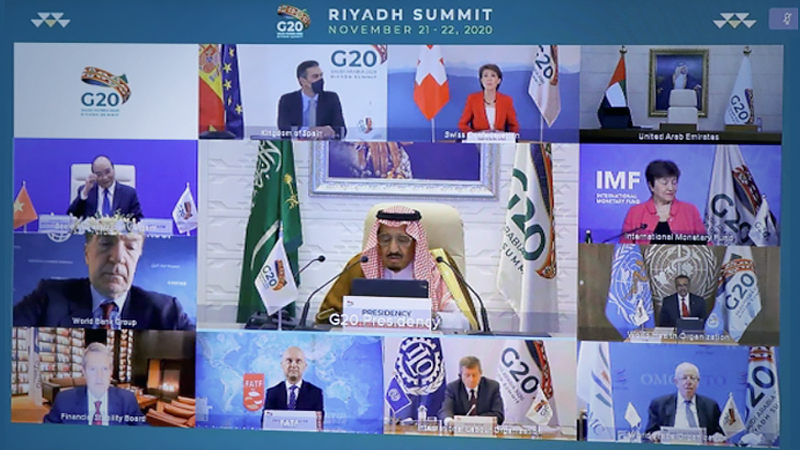
In his opening remarks, Saudi Arabia’s King Salman spoke to a screen of international leaders, including Trump, and highlighted the economic support G-20 members had contributed to combating the coronavirus pandemic and economic fallout. He urged the G-20 to forge a collective path forward. 

“In the near future, we must address the vulnerabilities exposed by covid-19 by working to protect lives and livelihoods,” said the 84-year-old monarch, who spoke slowly in a raspy voice. 

To the king’s right was Crown Prince Mohammed bin Salman, the kingdom’s de facto ruler, who has sought to reform Saudi’s economy and society alongside a years-long crackdown on dissent that has brought him increased scrutiny and criticism.

Saudi Arabia had hoped for an in-person Riyadh summit, but in September announced it would be held virtually because of the coronavirus.

It was initially unclear whether Trump would attend, but he announced Friday he would.

In a statement Friday, European Commission President Ursula von der Leyen said she planned to push members to continue to provide pandemic-related economic support until recovery from the virus is certain.

She also expressed hope that the United States’ “new President-elect” Joe Biden will “increase multilateral cooperation” in areas such as health and climate change, noting that until now “the United States has resisted engaging,” in a rebuke of Trump’s isolationist policies. 

On Friday, U.N. Secretary General António Guterres said that $28 billion remains needed to fund the manufacturing and distribution of coronavirus vaccines. While G-20 members previously agreed to suspend debt payments for the world’s poorest nations through mid-2021, he also urged them to extend relief until the year’s end so that governments could prioritize tackling the virus and economic fallouts. 

Italy, who takes over the presidency next in 2021, has said debt relief for Africa will be among its priorities. 

The Group of 20 nations, who produce about 85% of global economic output, include countries with among the highest coronavirus cases, led by the United States.

Trump is one of three leaders attending the summit who have had confirmed cases of the coronavirus, along with British Prime Minister Boris Johnson and Brazilian President Jair Bolsonaro.Johnson, who in April required intensive care after catching the virus, is in quarantine after recent exposure to someone who tested positive for the virus. 

SET likely to be influenced by export data, political situation next week #SootinClaimon.Com

#SootinClaimon.Com : ขอบคุณแหล่งข้อมูล : หนังสือพิมพ์ The Nation.

SET likely to be influenced by export data, political situation next week (nationthailand.com)

SET likely to be influenced by export data, political situation next week

EconNov 21. 2020

By The Nation

Kasikorn Securities has advised investors to follow Thailand’s export data in October, the Covid-19 outbreak and the political situation in Thailand and US as factors that would affect the Stock Exchange of Thailand (SET) Index next week.

An analyst at Kasikorn Securities predicted the SET Index’s support line at between 1,375 and 1,360, and resistance line at between 1,400 and 1,420.

Among international economic data, he advised following the US third-quarter gross domestic product (GDP), the minutes of the US Federal Reserve, the US new homes and durable goods sales, US personal income and spending in October, US and the euro zone composite purchase managers index in November and China’s industrial profit in October.

The SET Index closed at 1,389.34, up 3.18 per cent from the previous week, while average daily transaction was Bt81.68 billion, down 25.88 per cent from the previous week.

The Market for Alternative Investment rose by 1.48 per cent, closing at 320.99.

Thai stock indices closed in positive territory over an improvement in the country’s third-quarter GDP, positive news in the development of a Covid-19 vaccine, S&P Global Ratings’ move to maintain the country’s credibility, Bank of Thailand’s lenient currency supervision measures, and foreign investors’ mass buy-ups of Thai stocks.

Markets wrap: U.S. stocks decline amid Fed dispute with Treasury #SootinClaimon.Com

#SootinClaimon.Com : ขอบคุณแหล่งข้อมูล : หนังสือพิมพ์ The Nation.

Markets wrap: U.S. stocks decline amid Fed dispute with Treasury (nationthailand.com)

Markets wrap: U.S. stocks decline amid Fed dispute with Treasury

EconNov 21. 2020

By Syndication Washington Post, Bloomberg · Katherine Greifeld, Claire Ballentine · BUSINESS, US-GLOBAL-MARKETS

The S&P 500 Index extended a weekly decline as traders weighed a conflict between the White House and Federal Reserve over emergency lending programs along with assurances that the government has plenty of room to help the economy.

The benchmark equity gauge slumped in the wake of the disagreement over releasing government funds to further shore up growth, even as Treasury Secretary Steven Mnuchin said he will try to revive stimulus talks with congressional Democrats. Pfizer Inc. rose after filing for emergency approval of its Covid-19 vaccine. Gilead Sciences Inc. fell after authorities advised against using its remdesivir drug to treat Covid-19.

The Stoxx Europe 600 index posted its third week of gains – the best streak since July – amid a rotation into economically sensitive sectors. Mining and energy firms led the gauge higher Friday.

Global stocks hit a record Monday, but have eased off the highs in a choppy week of trading, with investors now trying to look beyond the rare show of discord between Mnuchin and Fed Chair Jerome Powell that erupted amid a resurgence of virus cases and with months to go before a vaccine is widely available. The S&P 500 was set for a 0.7% weekly decline.

“This public spat between the Fed and the Treasury is not a very good sign for the markets,” said John Praveen, managing director at QMA. “It kind of casts a shadow on market confidence.”

Mnuchin said lawmakers should redirect unspent stimulus funding, including money he’s pulling back from the Fed. But the Fed pushed back, saying the programs served a vital role.

In other markets, Asian equities climbed. Precious metals gained. Bitcoin advanced past $18,500.

These are the main moves in markets:

– – –

– The S&P 500 index fell 0.4% as of 3:41 p.m. in New York.

– The Stoxx Europe 600 index gained 0.5%.

– The MSCI Asia Pacific Index rose 0.5%.

– The MSCI Emerging Market Index advanced 0.7%.

– – –

– The Bloomberg Dollar Spot Index rose less than 0.1%.

– The euro slipped 0.2% to $1.1857.

– The pound rose 0.2% to $1.3281.

– The yen slipped 0.1% to 103.83 per dollar.

– – –

– The yield on 10-year Treasuries was little changed at 0.83%.

– Germany’s 10-year yield dipped one basis point to -0.585%.

– The U.K.’s 10-year yield fell two basis points to 0.3%.

– – –

– West Texas Intermediate crude rose 1% to $42.15 a barrel.

– Gold rose 0.4% to $1,873.42 an ounce.

Oil poised for weekly increase on covid-19 vaccine optimism #SootinClaimon.Com

#SootinClaimon.Com : ขอบคุณแหล่งข้อมูล : หนังสือพิมพ์ The Nation.

Oil poised for weekly increase on covid-19 vaccine optimism (nationthailand.com)

Oil poised for weekly increase on covid-19 vaccine optimism

EconNov 21. 2020

By Syndication The Washington Post, Bloomberg · Andres Guerra Luz 

Oil is poised for a third weekly gain with positive covid-19 vaccine developments paving the way for a more sustained recovery in oil demand.

Futures are up 4% this week in New York with Pfizer and BioNTech planning to request emergency authorization of their covid vaccine later Friday. Moderna has also released positive interim results from a final-stage trial and has said it’s close to seeking emergency authorization.

Despite a strong week, prices traded little changed Friday as investors assessed the impact of a dispute between the White House and the Federal Reserve over emergency lending programs.

“The oil market continues to hold up well with optimism generated with the progress of covid-19 vaccines,” said Harry Tchilinguirian, head of commodity-markets strategy at BNP Paribas SA. “At the same time, we should also be getting the results from AstraZeneca and the University of Oxford soon, and if similar to those of Pfizer and Moderna, this means that the light at the end of the tunnel is going to burn a little brighter and risk assets like oil can continue to ascend.”

Even with vaccines on the horizon, a recovery in oil demand faces obstacles with governments under pressure to tighten restrictions and curb the spread of the virus. Americans are being urged not to travel for Thanksgiving, and European road use is once again depressed because of lockdowns.

As prices push toward the top of a range they’ve held for months, many of the biggest moves have been in timespreads — the difference in price between futures contracts. On Friday, the closely watched spread between December 2021 and 2022 West Texas Intermediate crude contracts is close to flipping into backwardation.

Pfizer and BioNTech’s vaccine could be the first to be cleared for use, but first it must undergo a thorough vetting. The filing could enable its use by the middle to the end of December, the companies said in a statement. Yet, it could take at least three weeks for a U.S. Food and Drug Administration decision.

Uncertainty over a recovery in the oil market will be one of the challenges for the Organization of Petroleum Exporting Countries and its allies when they meet in less than two weeks to discuss whether to add crude oil to a still-saturated market in January.

Ahead of the OPEC+ meeting, which could see a possible extension of the current output cuts by three-to-six months, a buying spree by Asian refiners is complicating the outlook amid surging production from countries such as Libya. Crude stockpiles in China have fallen in five out of the past seven weeks, according to data from Ursa Space Systems.

Shippers’ council predicts strong export growth in first half of 2021 #SootinClaimon.Com

#SootinClaimon.Com : ขอบคุณแหล่งข้อมูล : หนังสือพิมพ์ The Nation.

Shippers’ council predicts strong export growth in first half of 2021 (nationthailand.com)

Shippers’ council predicts strong export growth in first half of 2021

EconNov 21. 2020

By The Nation

The Thai National Shippers’ Council predicts the export sector will grow between 3 and 5 per cent next year, vice chairman Visit Limluecha said on Friday.

He said the council expects the sector to show strong growth in the first half of 2021, and has also forecast a lower contraction in exports during the fourth quarter of this year.

The export of food, IT products, vehicles and medical equipment will continue to expand in the fourth quarter this year.

The council said the export sector is not expected to drop more than 7 per cent this year.

Meanwhile, gem and jewellery exports during the first nine months this year rose 23.72 per cent to US$16.130 billion, according to the Gem and Jewelry Institute of Thailand (Public Organisation).

Excluding gold, exports over the same period fell 46.45 per cent to US$3.360 billion.

Exports of gold alone grew 88.85 per cent to US$12.769 billion.

BOT’s move to rein in rising baht not working: experts #SootinClaimon.Com

#SootinClaimon.Com : ขอบคุณแหล่งข้อมูล : หนังสือพิมพ์ The Nation.

BOT’s move to rein in rising baht not working: experts (nationthailand.com)

BOT’s move to rein in rising baht not working: experts

EconNov 21. 2020Kobsidthi Silpachai, Kasikornbank’s head of capital markets research, says monetary policy will not be effective in curbing the baht’s rise.Kobsidthi Silpachai, Kasikornbank’s head of capital markets research, says monetary policy will not be effective in curbing the baht’s rise. 

By The Nation

Analysts are sceptical about the central bank’s latest measures to curb the rising baht, despite praise for the move from business quarters.

The Bank of Thailand (BOT) on Friday announced measures to encourage capital outflow in order to restrain rapid appreciation of the baht.

However, foreign funds continued to flow into the Thai stock exchange on Friday, with foreign investors making net buys of Bt2.38 billion. 

“It seems that the market is not reacting, the measures seem to be more of the same old thing,” Kobsidthi Silpachai, head of capital markets research at Kasikornbank, told The Nation.

Though the central bank was encouraging capital outflows, it had not imposed “scary” measures like Tobin tax [on currency conversions], he said.

Thus he was pessimistic the measures would slow down the baht’s rise.

“The fundamentals have not changed: our current account will remain in surplus,” he said.

While the new measures may address the “symptoms”, they would not cure the underlying cause of the strong baht – an imbalanced economy, he argued.

After years of relying on monetary measures, it was time to try fiscal measures like tax reform, he added.

He was also sceptical of the BOT’s recent move to loosen restrictions on foreign currency deposit accounts. Focusing on foreign capital flows might not be effective, as exporters need to convert their US dollar revenue to baht for working capital, he said.

The measure risked upsetting long-term inflation management by spurring outflow of capital and indirectly discouraging investment in Thailand, which would dampen future economic activity and inflation, he warned.

He suggested that if authorities really want the baht to weaken, they need to rebalance the economy. This is where tax reforms comes in, because high taxes, high household debt and a strong baht are all related.

“Excise tax on imported goods is high, suppressing imports and forcing the current account surplus even higher, which leads to a strong baht,” he said.

US President Donald Trump has proven that cutting taxes actually boosts tax revenue, because the tax base increases, Kobsidthi added.

Naris Sathapholdecha, executive director at TMB Analytics, shares a similar view, saying that foreign investors were undeterred by the latest measures as they still bought short-term bonds worth US$700 million in Friday’s intra-day trading.

He suggested that to rein in the baht, the central bank should reduce its issuance of short-term bonds. The BOT could also raise costs for foreign investors investing in Thai stocks and bonds by stipulating they must buy insurance against baht exchange rate risk.

He predicted a slight short-term weakening of the baht due to two factors outside Thailand. First, while the more trade-friendly Joe Biden had wo the US presidential election, his Democrat Party had not won a majority in the Senate. Second, a Covid-19 vaccine may not be available as soon as expected. Therefore, investors may sell Thai assets.

The baht would stay at around Bt30.50 per dollar and is unlikely to strengthen beyond Bt30, Naris added.

Meanwhile, Kriengkrai Thiennukul, vice chairman of the Federation of Thai Industries, expressed support for the BOT’s moves. 

“The action of the central bank will prevent a rapid rise beyond the Bt30/dollar level. Doing nothing would have seen the baht appreciate further, making Thai exports even less competitive,” he said.

The baht’s rise would also benefit Thai investors seeking to acquire businesses in Europe, where many companies are expected to go bankrupt amid the second wave of Covid-19. But foreign businesses could yield high returns when the pandemic eases. 

He also predicted the baht would remain strong for the  foreseeable future since the Biden presidency will inject more money into US economy.

BTS ‘must meet 3 conditions’ to win Green Line contract renewal #SootinClaimon.Com

#SootinClaimon.Com : ขอบคุณแหล่งข้อมูล : หนังสือพิมพ์ The Nation.

BTS ‘must meet 3 conditions’ to win Green Line contract renewal (nationthailand.com)

BTS ‘must meet 3 conditions’ to win Green Line contract renewal

EconNov 20. 2020

By The Nation

Democrat Party deputy leader Samart Ratchapolsitte said on Friday that the Transport Ministry is opposed to a move to extend the Bangkok Mass Transit System Plc (BTS)’s contract to run the Green Line because the fare is too expensive.

BTS has warned it will halt the Green Line extension service unless the Bangkok Metropolitan Administration (BMA) pays the Bt8 billion owed for operating costs.

The Interior Ministry on Tuesday proposed extending BTS’s current contract to run the Green line for another 30 years, until 2059.

Posting on Facebook, Samart said that to earn the contract extension, BTS would have to comply with three BMA conditions:

1. The maximum fare must not exceed Bt65, down from the previous maximum of Bt158.

2. BTS must bear the BMA’s debt of over Bt70 billion for the Green Line extension from Mo Chit to Khu Khot and Bearing to Samut Prakan.

3. BTS must share operating revenue from 2029 to 2059 worth over Bt200 billion with the BMA.

He added that the Green Line fare would be higher than the MRT Blue Line’s Bt42 maximum for two reasons.

First, the Green Line was mostly paid for by the BTS itself, while the Blue Line was paid for by the Mass Rapid Transit Authority of Thailand (MRTA), which then hired the Bangkok Expressway and Metro Plc (BEM) as operator.

Second, the BTS must share its revenue with BMA, while the BEM shares no revenue with the MRTA.

“Also, the BTS gains a return on its investment of 9.6 per cent, lower than BEM’s 9.75 per cent because the government’s joint investment with BTS was lower than with the BEM,” he said.

He added that it would be good news for commuters if the government could cut the fares for electric trains.

SET rises almost 1.5% with trades worth Bt90bn #SootinClaimon.Com

#SootinClaimon.Com : ขอบคุณแหล่งข้อมูล : หนังสือพิมพ์ The Nation.

SET rises almost 1.5% with trades worth Bt90bn (nationthailand.com)

SET rises almost 1.5% with trades worth Bt90bn

EconNov 20. 2020

By The Nation

The Stock Exchange of Thailand (SET) Index closed at 1,389.34 on Friday, up 19.92 points or 1.45 per cent. Total transactions amounted to Bt90.57 billion with an index high of 1,390.37 and a low of 1,368.20.

The day’s rise defied expectations, after a Krungsri Securities analyst predicted a drop from foreign investors making net sales for the first time in three days. Instead, foreign investors today made net buys of Bt2.38 billion.

The 10 stocks with the highest trade value today were KBANK, ADVANC, BBL, SCB, PTT, BANPU, CPF, TASCO, SCGP and AOT.

As of 5pm, the price of oil rose by US$0.02 or 0.05 per cent to $41.76 per barrel, while gold rose by $3.90 or 0.21 per cent, to $1,865.40 per ounce.

Other Asian indices were mixed:

Japan’s Nikkei Index closed at 25,527.37, down 106.97 points or 0.42 per cent.

China’s Shang Hai SE Composite Index closed at 3,377.73, up 14.64 points or 0.44 per cent, while Shenzhen SE Component Index closed at 13,852.42, up 74.97 points or 0.54 per cent.

Hong Kong’s Hang Seng Index closed at 26,451.54, up 94.57 points or 0.36 per cent.

South Korea’s KOSPI Index closed at 2,553.50, up 6.08 points or 0.24 per cent.

Taiwan’s TAIEX Index closed at 13,716.44, down 5.99 points or 0.044 per cent.