Economy will improve next year, with unemployment falling to 5.5% by the end of 2021, Fed predicts #ศาสตร์เกษตรดินปุ๋ย

#ศาสตร์เกษตรดินปุ๋ย : ขอบคุณแหล่งข้อมูล : หนังสือพิมพ์ The Nation.

Economy will improve next year, with unemployment falling to 5.5% by the end of 2021, Fed predicts

EconSep 17. 2020
By The Washington Post · Rachel Siegel · NATIONAL, BUSINESS, US-GLOBAL-MARKETS 
WASHINGTON – Federal Reserve leaders predict that unemployment will fall to 7.6% by the end of this year, and to 5.5% by the end of 2021, even as much about the path of the virus and its influence over the economic recovery remain unknown.

As the Fed concluded two days of policy meetings on Wednesday, the projections suggest Fed leaders are growing more optimistic about the recovery than they were earlier this summer. By 2023, policymakers’ projections put the unemployment rate at 4%.

“The recovery has progressed more quickly than generally expected. Even so, overall activity remains well below, and the path ahead remains highly uncertain,” Chairman Jerome Powell said at a news conference.

At the same time, Fed officials signaled the benchmark interest rate could stay at or near zero through 2023. The Fed also said it would increase holdings of Treasury securities and agency mortgage-backed securities at the current pace. Fed leaders say these moves have staved off an even deeper financial crisis.

“We think our stance is appropriate today, and with this very strong powerful forward guidance…rates will remain highly accommodative unless we are very far along in our recovery,” Powell said. “Right now we think our policy support is enough to support the expansion.”

By August, the unemployment rate had already fallen to 8.4%, lifting hopes that the economy was finding its footing. The last time Fed policymakers released their projections in June, they expected the unemployment rate to fall to 9.3% by the end of the year, 6.5% by the end of 2021 and 5.5% by the end of 2022.

Policymakers’ estimates for how far GDP would fall this year also improved. Officials now predict a decline of 3.7% by the end of the year, compared to June expectations of a 6.5% drop.

“The COVID-19 pandemic is causing tremendous human and economic hardship across the United States and around the world,” policy makers said in a statement released Wednesday. “Economic activity and employment have picked up in recent months but remain well below their levels at the beginning of the year.”

The projections, which are completed anonymously by Fed policymakers, offer a snapshot into how Fed leaders think unemployment will trend in the years to come. But there is plenty the estimates do not account for.

For example, economists and policymakers fear that the upcoming flu season, paired with a potential rise in coronavirus cases, could weigh on the broader recovery. Congress is also stalled on another massive stimulus bill, so the projections don’t factor in what the economic benefits of a rescue package might be, or how the absence of more aid could weigh on struggling households and businesses.

At the news conference, Powell said that his “sense is more fiscal support is likely to be needed.” Powell said that Congress’s relief through the Cares Act, including the now-expired $600 enhanced unemployment benefits, “has been essential” and warned of the hazards of cutting off all aid prematurely. 

“If there’s no additional support…that’s going to show up in economic activity, and in things like evictions and foreclosures and things that will scar and damage the economy,” Powell said. “That’s a downside risk. I think the questions [of another stimulus bill] of when and how much and what will be the content – and no one has any certainty around that. If we don’t get that, there would certainly be downside risks.”

The Fed, for its part, can lend to struggling businesses and local governments, as it is doing through two of its emergency programs. But the Fed cannot offer grants. Powell noted that for many businesses in need of relief, “getting a loan that may be difficult to repay may not be the answer.”

“In these cases, direct fiscal support may be needed,” Powell said.

Fed policymakers expect rates to remain at zero “until labor market conditions have reached levels consistent with the Committee’s assessments of maximum employment and inflation has risen to 2 percent and is on track to moderately exceed 2 percent for some time,” according to the statement.

That’s due to the scale of the current crisis and the Fed’s new policy framework, which signals that the central bank won’t increase interest rates to respond to low levels of unemployment, and that leaders won’t worry as much about low rates triggering a rise in prices. Still, the Fed has offered little concrete information on how the new framework will be put into practice.

The framework also allows for a temporary overshoot of the Fed’s 2 percent inflation target to balance out periods when inflation skirted below. According to the latest projections, officials did not see inflation topping 2 percent by the end of 2023, raising further questions about how the Fed expects prices to rise in such a way that the new strategy is put to the test.

The economy added 1.4 million jobs in August, an encouraging sign that people were able to go back to work after Powell warned that a summer surge in coronavirus cases was starting to slow the pace of the recovery. The auto and residential real estate sector have also posted strong sales. And retail sales figures released Wednesday showed positive signs for consumer spending.

But there’s a long way to go. Just over half of the 22 million total jobs lost between February and April have not returned. Many of the Fed’s interventions lift the stock market but do little for Americans who don’t hold investments. And as more time passes, many businesses teetering on the brink risk permanent closure.

U.S. retail sales rebound slows after extra jobless aid lapses #ศาสตร์เกษตรดินปุ๋ย

#ศาสตร์เกษตรดินปุ๋ย : ขอบคุณแหล่งข้อมูล : หนังสือพิมพ์ The Nation.

U.S. retail sales rebound slows after extra jobless aid lapses

EconSep 17. 2020Customers wearing protective masks wait to shop in an appointment only open-air boutique suite inside The Pavilion at South Coast Plaza in Costa Mesa, Calif., on Aug. 11, 2020. MUST CREDIT: Bloomberg photo by Patrick T. Fallon.
Customers wearing protective masks wait to shop in an appointment only open-air boutique suite inside The Pavilion at South Coast Plaza in Costa Mesa, Calif., on Aug. 11, 2020. MUST CREDIT: Bloomberg photo by Patrick T. Fallon. 

By Syndication Washington Post, Bloomberg · Reade Pickert · BUSINESS, RETAIL
The rebound in U.S. retail sales slowed by more than expected in August as federal relief for jobless Americans and small businesses dried up and the pandemic continued to weigh on activity.

The value of overall sales increased 0.6% after a downwardly revised 0.9% increase the prior month, Commerce Department figures showed Wednesday. The median estimate in a Bloomberg survey of economists called for a 1% advance.

So-called control group sales, which exclude food services, car dealers, building-materials stores and gasoline stations, fell 0.1%, also missing forecasts. The measure is often considered more reflective of underlying consumer demand.

With many more stores and restaurants now open, the initial boost in spending driven by reopenings is moderating. At the same time, the expiration of the supplemental $600 weekly payments at the end of July as well as slowdowns in back-to-school spending likely weighed on retail activity during the month.

Those benefits bolstered incomes during the pandemic, and without them, millions of unemployed Americans will have significantly less cash to support the nation’s retailers. Meanwhile, federal support for small businesses is running dry with the Paycheck Protection Program closing in early August. Lawmakers appear increasingly unlikely to approve additional stimulus until after the election, despite still-elevated joblessness.

“These are disappointing numbers, and they’re probably a hint of what’s to come in the wake of the ending of enhanced unemployment benefits,” Ian Shepherdson, chief economist at Pantheon Macroeconomics, said in a note. “The key story here is that momentum has faded, but sales continue to rise.”

With total retail sales data above pre-pandemic levels, the data underscore a shift in where consumers are spending their money. Some categories, like restaurants and clothing stores, are still below year-ago levels. Meanwhile, purchases at nonstore retailers are up 22.4% from August of last year.

Nine out of 13 major categories increased in August, led by restaurants, clothing stores and furniture outlets. Receipts at motor vehicle and parts dealers posted a modest gain, while sales at nonstore retailers barely improved. Sporting goods and hobby stores posted the biggest percentage decline from the prior month and receipts at department stores weakened. Grocery store sales fell as well.

Retail sales don’t capture all consumer spending though, and the pandemic continues to have a clear impact on services outlays. While the value of retail receipts exceeded February levels back in June, personal consumption — which includes spending on goods and services — was still below its pre-pandemic level in July, the latest available data. The Commerce Department will release the August figures Oct. 1.

Another factor to keep in mind is the Lost Wages Assistance program. That’s the program President Donald Trump authorized in early August to temporarily offset part of the income gap unemployed Americans faced after the expiration of the extra $600 in weekly benefits. However, rollout of the program has been patchy across states.

Fed to weigh near zero rates through 2023 #ศาสตร์เกษตรดินปุ๋ย

#ศาสตร์เกษตรดินปุ๋ย : ขอบคุณแหล่งข้อมูล : หนังสือพิมพ์ The Nation.

Fed to weigh near zero rates through 2023

EconSep 17. 2020Jerome Powell, chairman of the Federal Reserve, speaks during a Senate Banking Committee hearing in Washington on Feb. 12, 2020. MUST CREDIT: Bloomberg photo by Andrew Harrer.Jerome Powell, chairman of the Federal Reserve, speaks during a Senate Banking Committee hearing in Washington on Feb. 12, 2020. MUST CREDIT: Bloomberg photo by Andrew Harrer. 

By Syndication Washington Post, Bloomberg · Steve Matthews, Emily Barrett · BUSINESS, US-GLOBAL-MARKETS 
Federal Reserve officials, who recently unveiled a more relaxed strategy on inflation, have an opportunity Wednesday to back up the plan with details as they look to accelerate the U.S. economic recovery.

The Federal Open Market Committee is all but certain to keep its benchmark overnight rate in a target range of 0% to 0.25%, where it’s been since March 15 to help soften the covid-19 pandemic’s blow. The committee, in its final scheduled meeting before the U.S. election on Nov. 3, will release a statement and economic forecasts at 2 p.m. Washington time. Chair Jerome Powell will hold a press briefing 30 minutes later.

Officials are expected to project rates staying near zero though 2023, reinforcing the message delivered by Powell in late August that they will delay tightening policy to achieve inflation that averages 2% over time. The new strategy, announced at the Fed’s virtual Jackson Hole conference, tolerates inflation overshooting to make up for past misses and explicitly views maximum employment as a broad-based and inclusive goal.

“Powell will bring home the message that the Fed wants to level the playing field and allow wages more room to run,” said Diane Swonk, chief economist at Grant Thornton in Chicago. “The real goal here is to allow more of those hit hardest by the crisis a better chance at getting reemployed as quickly as possible. They won’t sweat a little inflation for that.”

The Fed has discussed linking rate liftoff to reaching — or overshooting — 2% inflation or to unemployment, in a variation of the thresholds it deployed in 2012. That’s a close call this meeting: 39% of economists surveyed by Bloomberg expect that to happen this week, while others look for a 2021 announcement or no change at all.

Several regional Fed presidents, including Atlanta’s Raphael Bostic and Chicago’s Charles Evans, have said they see no rush to provide additional clarity with markets anticipating a long run of near-zero rates.

“The Fed’s forward guidance thus far has been exceptionally well received, so why would they feel a need to strengthen it with an additional policy response?” said Michael de Pass, head of Treasuries trading at Citadel Securities LLC.

Rates have held relatively steady over the past week, with traders waiting for the FOMC meeting. Most are looking for the Fed to elaborate on how long it plans to hold interest rates near zero, with many expecting policy makers to link any increase to the path of inflation.

Anticipation of the Fed’s new strategy has helped the Treasury yield curve to steepen, and expectations for consumer prices to recover close to 2020 highs, judging by signals from market breakeven rates. If the Fed disappoints investors hoping for more detail, the Treasury curve could steepen further.

JPMorgan Chase & Co. strategists including Jay Barry see a risk that the Fed doesn’t deliver on the market’s hopes for more detail, which “risks unwinding some of the goodwill that has been created in recent months.”

The FOMC could tweak its rationale for its purchases of Treasury and mortgage-backed securities to say the program, widely viewed as quantitative easing, is intended to stimulate the economy, not just smoothing market functioning. While an increase in buying or a shift to explicitly cap yields isn’t expected, some say more is needed.

“Doing more QE would be a good follow-up to the new strategy, but now the risk is the post Jackson Hole ebullience falls like a pancake,” said Thomas Costerg, senior U.S. economist at Pictet Wealth Management in Geneva.

The Fed releases new quarterly forecasts. In addition to signaling rates on hold through 2023, officials are also likely to project lower unemployment and the potential for some above-2% inflation forecasts for 2023.

“The unemployment rate forecast has to come down, for 2020 at least, but the forecast is still going to be a gloomy one,” said Jonathan Wright, an professor at Johns Hopkins University and a former Fed economist. Beyond the jobless rate, “other indicators are not strong,” so keeping rates near zero will be the consensus.

While recent economic data including the fall in the unemployment rate have been stronger than expected, the FOMC is likely to continue to emphasize risks to the outlook and uncertainty. Powell gave a hint on Sept. 4 when he told National Public Radio: “The recovery is continuing; we do think it will get harder from here.”

Forward guidance is likely to be a major focus of the press conference, and the chairman can expect to be asked how much and how long of an inflation overshoot he would be willing to tolerate without action.

“Powell is likely to give more clarification to the inflation targeting change announced at Jackson Hole,” said Lindsey Piegza, chief economist with Stifel Nicolaus in Chicago. He may address “why flexibility is necessary and a benefit, how hot is hot, and why there is no near term concern of inflation.”

Powell is also likely to repeat his call for additional fiscal support, with Congress not close to passing additional aid.

TCG warns of debt nightmare for SMEs as moratorium expires #ศาสตร์เกษตรดินปุ๋ย

#ศาสตร์เกษตรดินปุ๋ย : ขอบคุณแหล่งข้อมูล : หนังสือพิมพ์ The Nation.

TCG warns of debt nightmare for SMEs as moratorium expires

EconSep 17. 2020

By The Nation

The state-owned Thai Credit Guarantee Corporation (TCG) has warned that SMEs’ bad debts could rise by up to Bt400 billion after the government’s debt moratorium expires at the end of this month.

About 1.1 million small and medium-sized enterprises (SMEs) suspended repayment of Bt2 trillion in debts, which is now at risk from the Covid-19 fallout, said Surachai Kampalanonwat, president of TCG’s SMEs Financial Advisory Centre.

“If the economy has not recovered, many SMEs’ debts may turn bad and creditors may enforce the law to seize their assets,” he said.

SMEs’ current total of Bt490 billion in bad debts could rise to Bt890 billion after the moratorium expires, he added.

He recommended using Bankruptcy Court restructuring as a way of allowing SMEs to pay off their debts over three years.

“So far, only two groups of creditors and debtors had opted for rehabilitation plans under Bankruptcy Act No 9, designed to help SMEs,” Surachai said. This may be because debtors don’t know about the act, while creditors prefer to seize assets than to follow debtors’ rehabilitation plans, he added.

The act covers SMEs with debts of less than Bt10 million and collateral of Bt1,000 to Bt10,000. It also allows the debtor or creditor to administrate the rehab plan themselves, he explained.

“After the court approves the rehab plan, creditors cannot enforce the law to seize debtors’ assets – just like rehab procedures for large enterprises.”

The debts must come from the SME’s business operation.

“For personal debts, the principal and interest must be at least Bt2 million, while debt owed by a partnership or company must total at least Bt3 million. The rehab plan needs to be approved by 75 per cent of creditors, just as with large enterprises,” he explained.

He added that since TCG had guaranteed SME loans via 18 financial institutions, it can act as a broker in rehabilitation plan negotiations to benefit both creditors and debtors.

Debt restructuring was the last choice for SMEs seeking to prevent a business takeover, he said.

Govt eyes new visa rules in bid to woo investors #ศาสตร์เกษตรดินปุ๋ย

#ศาสตร์เกษตรดินปุ๋ย : ขอบคุณแหล่งข้อมูล : หนังสือพิมพ์ The Nation.

Govt eyes new visa rules in bid to woo investors

EconSep 16. 2020

By The Nation

The government’s Centre for Economic Situation Administration (CESA) on Wednesday (September 16) approved in principle amendments to the criteria of granting permanent residence and smart visa to foreigners in a bid to woo more investment, the National Economic and Social Development Council’s deputy secretary-general Danucha Pichayanan said.

The centre is considering the option of granting permanent residence to buyers of condominium units, provided applicants do not mortgage, sell or transfer this asset for five years after purchase.

CESA has also broadened guidelines for granting smart visa, which will now cover those who want to develop start-ups or create jobs in fields other than science and technology.

It may also broaden smart-visa criteria to cover independent experts who do not have a work contract in Thailand. Holders of smart visas will in some cases be allowed to do jobs other than the one specified in the visa. Criteria on work experience and educational background for high-ranking executives applying for a visa should also be relaxed.

Thailand’s smart visa programme was launched to woo skilled manpower, investors, executives and start-up entrepreneurs to work in targeted industries here.

Related story: Bt51bn consumption stimulus package gets green light

Prayut meets economists to exchange views on Thailand’s future #ศาสตร์เกษตรดินปุ๋ย

#ศาสตร์เกษตรดินปุ๋ย : ขอบคุณแหล่งข้อมูล : หนังสือพิมพ์ The Nation.

Prayut meets economists to exchange views on Thailand’s future

EconSep 16. 2020

By The Nation

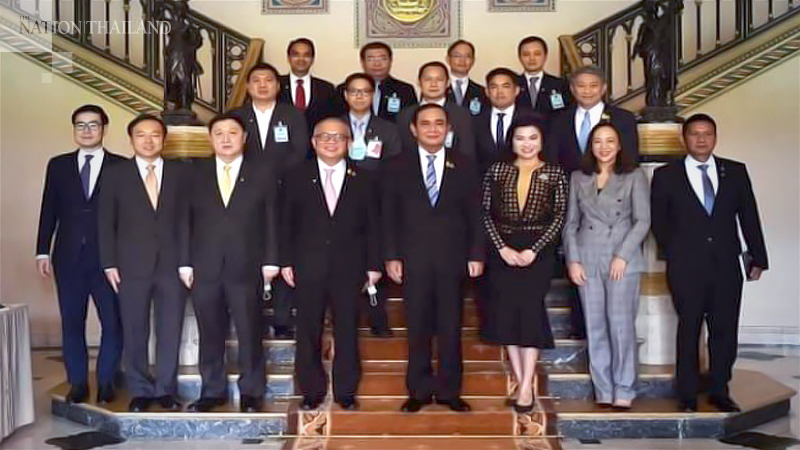
Prime Minister Prayut Chan-o-cha held a meeting with economists from independent institutes, universities and financial institutions at Government House on Wednesday (September 16) to exchange ideas on steering the country forward.

In a Facebook comment, Prayut said the topics of discussion included fiscal and monetary policies, tax system, upskilling of workers as well as measures the government should put in place to ensure economic recovery.

The prime minister added that he was willing to listen to opinions from all sectors.

Also present at the meeting was Deputy PM and Energy Minister Supattanapon Punmeechaow.

SET buoyed by Thai visa move, rising oil #ศาสตร์เกษตรดินปุ๋ย

#ศาสตร์เกษตรดินปุ๋ย : ขอบคุณแหล่งข้อมูล : หนังสือพิมพ์ The Nation.

SET buoyed by Thai visa move, rising oil

EconSep 16. 2020

By The Nation

The Stock Exchange of Thailand (SET) Index closed at 1,293.48 today (September 16), up 7.30 points or 0.57 per cent. Total transactions amounted to Bt52.70 billion with an index high of 1,295.80 and a low of 1,284.09.

In the morning session, an analyst at Krungsri Securities expected the index to fluctuate between 1,275 and 1,295 points over the day.

“Although the market responded positively to the Cabinet approving long-stay visas for foreigners and to the rising oil price, we expect investors to sell stocks to reduce risks following the US Federal Open Market Committee meeting [on Thursday] and the [September 19] political rally by students,” the analyst said.

The 10 stocks with the highest trade value today were TASCO, AOT, MINT, BBL, PTT, SAWAD, KBANK, BDMS, CPF and PTTEP.

As of 4.30pm, the price of oil rose by US$1.01 or 2.64 per cent to $39.29 per barrel, while gold rose by $8.10 or 0.41 per cent, to $1,974.30 per ounce.

Other Asian indices were mixed:

Japan’s Nikkei Index closed at 23,475.53, up 20.64 points or 0.088 per cent.

China’s Shang Hai SE Composite Index closed at 3,283.92, down 11.76 points or 0.36 per cent, while the Shenzhen SE Component Index closed at 13,011.28, down 132.18 points or 1.01 per cent.

Hong Kong’s Hang Seng Index closed at 24,725.63, down 7.13 points or 0.029 per cent.

South Korea’s KOSPI Index closed at 2,435.92, down 7.66 points or 0.31 per cent.

Taiwan’s TAIEX Index closed at 12,976.76, up 131.11 points or 1.02 per cent.

Tetra Pak unwraps its sustainable future #ศาสตร์เกษตรดินปุ๋ย

#ศาสตร์เกษตรดินปุ๋ย : ขอบคุณแหล่งข้อมูล : หนังสือพิมพ์ The Nation.

Tetra Pak unwraps its sustainable future

EconSep 16. 2020

By The Nation

Tetra Pak says its 2020 sustainability report, “Enabling transformation”, marks a new stage of its approach to sustainability, encompassing the entire value chain.

The food-packaging giant uses the concept of protecting food, people and futures as the chapters of the company’s sustainability story, which it says underpins its brand promise to “protect what’s good”. Tetra Pak uses UN Sustainable Development Goals (SDGs) to guide its sustainability effort.

The company said it is contributing to SDGs 2 (end hunger) and 12 (responsible consumption and production), by building sustainable value chains, such as through participation in school feeding programmes for 68 million children in 56 countries, and the Dairy Hub model, which collects 389,470 litres of milk per day from smallholder farmers.

The company said it protects people by enabling its employees, promoting growth and development for all, and driving actions to ensure a diverse workforce and an inclusive culture. For example, Tetra Pak has demonstrated a 14 per cent rise in women in top management and 8 per cent reduction in lost time accidents at plants.

Tetra Pak said it now uses 69 per cent of renewable energy in its operations. Last year, 50 billion Tetra Pak packages were recycled, and the company said it successfully achieved its goal to reduce carbon emissions by saving 10 million tonnes of CO2 across the value chain over the decade.

Tetra Pak Thailand has installed 3,076 solar panels at its factory in Rayong to provide 1,350 MWh of renewable electricity every year, saving over 850 tonnes of CO2. The company said it also achieved a major 10-year milestone with “The Green Roof Project for Friends in Need Volunteers Foundation” by collecting over 2,300 tons of used cartons to be turned into more than 65,000 roofing sheets for victims of natural disaster and other people in need.

Meanwhile, its “Beverage Carton Recycling Project” (BECARE) has collected over 2,300 tons of used beverage cartons, plus over 1 million sheets of recycled paper that were donated to 13 schools for the blind in Thailand. Last year, the company supported the launch of the School Milk Carton Recycling project at more than 350 Bangkok schools.

“Our joined-up approach to three of our sustainability pillars — protecting food, people and futures — also shares a common commitment to partnership,” said Bert Jan Post, managing director of Tetra Pak (Thailand) Limited. “By working together with our customers, suppliers and other stakeholders we can lead the sustainability transformation and drive the most meaningful positive change.”

Health services department proposes guidelines for reopening wellness sector #ศาสตร์เกษตรดินปุ๋ย

#ศาสตร์เกษตรดินปุ๋ย : ขอบคุณแหล่งข้อมูล : หนังสือพิมพ์ The Nation.

Health services department proposes guidelines for reopening wellness sector

EconSep 16. 2020

By The Nation

The Department of Health Service Support has come up with “wellness quarantine” guidelines to serve foreign customers if Thailand decides to reopen its wellness sector.

The guidelines, submitted to a sub-committee under the Centre for Covid-19 Situation Administration (CCSA), are in line with the centre’s decision in early July to allow foreigners to come to Thailand for medical and wellness tourism. CCSA said it will start by reopening the medical sector to see if the arrival of foreigners poses any problems, after which it will consider reopening spas and other wellness centres.

Since the CCSA has been satisfied with the reopening of the medical sector, the department decided to come up with guidelines to reopen the wellness sector.

Saowapa Jongkitipong, head of the international healthcare division of the Department of Health Service Support, said guidelines for wellness quarantine included the mandatory 14-day quarantine, and also required that foreign consumers of wellness services travel by prearranged vehicles with no stops on the way and that tracking devices be used to track the foreign customers. The wellness tourists will also undergo three Covid-19 tests.

Meanwhile, participating wellness centres will need to go into contracts with hospitals and will also be required to get additional certification.

Commerce Ministry discusses moves to boost trade with EU-Asean Business Council #ศาสตร์เกษตรดินปุ๋ย

#ศาสตร์เกษตรดินปุ๋ย : ขอบคุณแหล่งข้อมูล : หนังสือพิมพ์ The Nation.

Commerce Ministry discusses moves to boost trade with EU-Asean Business Council

EconSep 16. 2020Vice Commerce Minister Sansern SamalapaVice Commerce Minister Sansern Samalapa 

By The Nation

The Commerce Ministry recently talked with the EU-Asean Business Council (EU-ABC) about the steps Thailand has taken to curb the spread of Covid-19 and how it plans to revive its economy.

In the teleconference on Tuesday (September 15), Vice Commerce Minister Sansern Samalapa said the subject of a free trade agreement with EU was also touched upon.

“With more than 50 European companies doing business in the Asean region, Thailand recognises the importance of enhancing trade relations with the European Union, facilitating trade using digital technology, promoting foreign investment, intellectual property protection, and raising the standard of local export products, especially in the agriculture and food sector,” he said.

Both sides also exchanged views on other trade matters, such as the revival of a Thai-EU FTA, progress of the Regional Comprehensive Economic Partnership (RCEP) and a reduction of Asean barriers on non-tax measures etc.

These talks received strong interest from the EU, with EU-ABC scheduled to hold a round of talks with trade ministers from Vietnam, Malaysia and Singapore later this month. These talks will reflect future trade opportunities between Europe and Asean.

The EU-Asean Business Council was established in 2014 to promote business cooperation between the European private sector and Asean. It currently comprises European chambers of commerce from nine Asean countries and more than 30 large European multinationals covering a wide range of businesses such as automotives, electronics, medicines and medical supplies, consumer goods, finance, logistics, etc.