SET edges up as Thailand readies for third round of lockdown easing #ศาสตร์เกษตรดินปุ๋ย

#ศาสตร์เกษตรดินปุ๋ย : ขอบคุณแหล่งข้อมูล : หนังสือพิมพ์ The Nation.

https://www.nationthailand.com/business/30388743?utm_source=category&utm_medium=internal_referral

SET edges up as Thailand readies for third round of lockdown easing

May 29. 2020
By The Nation

The Stock Exchange of Thailand (SET) Index closed at 1,342.85 today (May 29), up 5.34 points or 0.40 per cent. Total transaction volume was Bt96.186 billion with an index high of 1,342.88 and a low of 1,323.12.

The SET edged up ahead of the third-phase relaxation of lockdown measures from Monday (June 1), which will allow venues such as gyms and cinemas to reopen. Curfew hours will also be cut to 11pm to 3am, and foreigners will be allowed to enter Thailand on a case-by-case basis.

A Krungsri Securities stock analyst expected the index to fall to between 1,325 and 1,330 points before rebounding, due to uncertainty amid US-China tensions after Beijing passed new national-security legislation for Hong Kong,

“A renewal of the trade war might emerge as the US prepares to announce a new policy towards China today [Friday],” the analyst said. “Meanwhile, the index will also be under pressure from the tight SET valuation.”

However, the SET will rebound on expectation of the third phase of lockdown easing, while investors can speculate on stocks which have been added to the MSCI calculation.

The 10 stocks with the highest trade value today were BAM, BANPU, AWC, PTT, GULF, KTC, ADVANC, CPALL, MINT and KBANK.

As of 4.30pm, the price of crude oil dropped by US$1.30 or 3.86 per cent to $32.41 per barrel, while the gold price rose by $10.50 or 0.61 per cent, to $1,738.80 per ounce.

US and European indices were on a downward trend, while Asian indices had a mixed day.

Japan’s Nikkei Index closed at 21,877.89, down 38.42 points, or 0.18 per cent.

China’s Shang Hai SE Composite Index closed at 2,852.35, up 6.13 points, or 0.22 per cent, while Shenzhen SE Component Index closed at 10,746.08, up 92.58 points, or 0.87 per cent.

Hong Kong’s Hang Seng Index closed at 22,961.47, down 171.29 points, or 0.74 per cent.

South Korea’s KOSPI Index closed at 2,029.60, up 1.06 points, or 0.052 per cent.

Taiwan’s TAIEX Index closed at 10,942.16, down 2.03 points, or 0.019 per cent.

SET shows signs of recovery as investors slowly buy back stocks #ศาสตร์เกษตรดินปุ๋ย

#ศาสตร์เกษตรดินปุ๋ย : ขอบคุณแหล่งข้อมูล : หนังสือพิมพ์ The Nation.

https://www.nationthailand.com/business/30388731?utm_source=category&utm_medium=internal_referral

SET shows signs of recovery as investors slowly buy back stocks

May 29. 2020
By The Nation

The Stock Exchange of Thailand (SET) Index rose to over 1,300 points in the second quarter as retail and institutional investors bought back stocks worth Bt133 billion and Bt68.3 billion respectively, though foreign investors sold stocks worth almost Bt200 billion.

Monrat Phadungsit, president of Land and Houses Fund Management, said investors were buying back stocks at this time because they have a large amount of cash in hand.

“Most investors have 10 to 15 per cent of cash in their investment portfolios now, compared to just 5 per cent under normal conditions,” he said, adding that the economy is likely to recover as the Covid-19 situation is improving and many countries are gradually easing lockdown measures.

“We expect the index next year to hit 1,550 points, while this year it is expected to move between 1,300 and 1,450 points,” he said.

“However, investors must be careful because the index could drop below 1,200 points due to uncertainty following the second wave of Covid-19 infections, creating an outbreak that may be worse than the first one.”

Somchai Amornthum, executive vice-president at Krung Thai Asset Management said the index gained positive sentiment from lockdown easing measures, progress in the search for Covid-19 vaccine, central banks’ moves to inject liquidity and governments issuing Covid-19 relief measures.

“We expect the index at the end of the year to be at 1,350 points as it will rely on the Covid-19 outbreak and when the vaccine is completed,” he said.

Chai Sophonpanich, chairman of Bangkok Insurance, said his company expected the index in the next three months to drop to 1,200 points due to uncertainty over the country’s political situation.

“We expect the index at yearend to be 1,340 points, less than 1,500 points in the previous year, though the index should rise to 1,900 points in the next two years,” he said.

He added that in the next three months, the company aims to buy stocks in the food and energy industries as they have a greater chance to grow and will sustain less impact.

Gold price drops amid rising tensions between US and China #ศาสตร์เกษตรดินปุ๋ย

#ศาสตร์เกษตรดินปุ๋ย : ขอบคุณแหล่งข้อมูล : หนังสือพิมพ์ The Nation.

https://www.nationthailand.com/business/30388718?utm_source=category&utm_medium=internal_referral

Gold price drops amid rising tensions between US and China

May 29. 2020
By The Nation

The price of gold dropped by Bt50 per baht weight in morning trade on Friday (May 29), the Gold Traders Association reported.

As of 9.28am, buying price of a gold bar was Bt25,750 per baht weight and selling price Bt25,950, while gold ornaments were priced at Bt25,286.88 and Bt26,450, respectively.

At close on Thursday (May 28), buying price of a gold bar was Bt25,800 per baht weight and selling price Bt26,000, while gold ornaments were priced at Bt25,332.36 and Bt26,500, respectively.

The Gold Spot Index price on Friday morning moved to around US$1,721 (Bt54,797) per ounce after the price rose by $1.5 to $1,728.3 per ounce at close on Thursday.

Investors were selling gold as a safe haven asset due to tensions between US and China. Recently, President Donald Trump said US was preparing to announce a new policy towards China on Friday in reaction to Beijing’s move to enforce a new national-security legislation in Hong Kong.

Gold price in Hong Kong dropped by HK$20 to $15,890 (Bt65,261) per tael.

SET falls amid rising tensions between US and China #ศาสตร์เกษตรดินปุ๋ย

#ศาสตร์เกษตรดินปุ๋ย : ขอบคุณแหล่งข้อมูล : หนังสือพิมพ์ The Nation.

https://www.nationthailand.com/business/30388717?utm_source=category&utm_medium=internal_referral

SET falls amid rising tensions between US and China

May 29. 2020
By The Nation

The Stock Exchange of Thailand Index opened at 1,331.98, down 5.53 points, or 0.41 per cent, on Friday morning (May 29).

The index is expected to fall to between 1,325 and 1,330 before rebounding, due to uncertainty following the conflict between US and China after Chinese lawmakers approved new national-security legislation for Hong Kong, a Krungsri Securities stock analyst said

“A renewal of the trade war might emerge as the US prepared to announce a new policy towards China today [Friday],” the analyst said. “Meanwhile, the index would be under pressure from the tight SET valuation as well.”

However, the index would rebound from hopes of the third phase of lockdown easing this week, while investors could speculate on stocks which have been added to the MSCI calculation.

He recommended investors to buy:

▪︎ Stocks which have been added to the MSCI calculation – AWC, BAM and KTC.

▪︎ Stocks which will benefit from the government’s tourism stimulus measures, such as MINT, CENTEL, ERW and AOT.

▪︎ Stocks which will benefit from the third phase of lockdown easing, such as MAJOR and SPA.

▪︎ Stocks whose second quarter performance will improve, such as CKP, TASCO, STA and RS.

Oil rallies with investors eyeing demand recovery, output cuts #ศาสตร์เกษตรดินปุ๋ย

#ศาสตร์เกษตรดินปุ๋ย : ขอบคุณแหล่งข้อมูล : หนังสือพิมพ์ The Nation.

https://www.nationthailand.com/business/30388703?utm_source=category&utm_medium=internal_referral

Oil rallies with investors eyeing demand recovery, output cuts

May 29. 2020
A refinery stands next to Charles H. Milby Park in Houston on March 8, 2020. MUST CREDIT: Bloomberg photo by Sharon Steinmann.

A refinery stands next to Charles H. Milby Park in Houston on March 8, 2020. MUST CREDIT: Bloomberg photo by Sharon Steinmann.
By Syndication Washington Post, Bloomberg · Olivia Raimonde · BUSINESS, US-GLOBAL-MARKETS 

Oil rallied as investors looked past an increase in U.S. crude stockpiles to focus on tentative signs of a recovery in fuel demand as well as output cuts.

Futures in New York rose 2.7% Thursday. While U.S. government data showed that American crude stockpiles rose last week, the demand outlook is improving. The four-week average of gasoline supplied to the market has steadily risen as parts of the country emerge from coronavirus lockdowns. The Energy Information Administration again posted a large negative adjustment factor, indicating that production is probably lower than official data show.

“You still have a significant amount of production offline, which is helping bring supply and demand in balance, all the while, you have demand starting to recover as states open up in various stages,” said Nick Holmes, a portfolio manager at Tortoise. “People are looking more to the supply and demand equation.”

Rallying equity markets also supported oil’s rise. Stocks have recovered globally to levels last seen in early March on fresh stimulus measures and hopes that economies are on the mend as lockdowns ease. U.S. unemployment filings shrank for the first time since the outbreak began, even as millions more Americans filed for unemployment benefits.

Economic improvement and declining crude supplies are key to lifting prices as the market contends with both a massive global inventory glut and diminished demand due to the pandemic. Production cuts and the easing of lockdowns have helped boost oil nearly 80% this month. But the market remains fragile, with high prices likely to spur producers to restart wells and undercut gains.

The physical market has been showing some signs of strength, with refiners across Asia buying distressed cargoes in an indication of demand. OPEC+ is set to meet June 9-10 to decide whether to extend output cuts beyond July. Russian President Vladimir Putin and Saudi Arabian Crown Prince Mohammed bin Salman reiterated their cooperation on the deal ahead Wednesday. The Kremlin described the call as positive on Thursday.

Additionally, Abu Dhabi National Oil Co. said it will reduce crude production in line with the OPEC+ agreement and government directives, according to a company notice to buyers, agreeing to cut shipments of all crude grades by 5% for July.

U.S. stocks end rally with China tensions rising #ศาสตร์เกษตรดินปุ๋ย

#ศาสตร์เกษตรดินปุ๋ย : ขอบคุณแหล่งข้อมูล : หนังสือพิมพ์ The Nation.

https://www.nationthailand.com/business/30388701?utm_source=category&utm_medium=internal_referral

U.S. stocks end rally with China tensions rising

May 29. 2020
By Syndication Washington Post, Bloomberg · Claire Ballentine · BUSINESS 

U.S. stocks erased gains and ended lower after President Donald Trump said he’d hold a news conference Friday to discuss China, potentially stoking tensions between the world’s two largest economies.

The S&P 500 lost an advance of more than 1% on Trump’s announcement, with investors speculating the U.S. will take action against China that could destabilize the global economy, although the precise agenda was unclear. Traders have warily been watching an escalation between Washington and Beijing even as stocks surged for the past two days. Chinese lawmakers earlier approved a proposal for new national-security legislation in Hong Kong, a move Trump’s economic adviser called a “huge mistake.”

“The market’s going to trade on headlines. Could he come out and say something that might spook markets temporarily? Sure, but you know what’s more important than that? The fact that the Fed’s going to stand there with their safety-net,” David Spika, president of GuideStone Capital Management, said by phone.

Stocks fell for the first time in four days falling short of the longest rally of the pandemic era. Small caps that had been surging tumbled 2.5%, while bank and energy shares — darlings of the latest rotation — fell at least 1.6%. Tech also slipped, with Twitter losing almost 5% after Trump turned his ire on the company, threatening to loosen legal protections for social-media platforms.

Earlier gains came as data showed the economic damage from the coronavirus pandemic was less severe than anticipated. U.S. states’ jobless rolls shrank for the first time during the outbreak even as millions more Americans filed for unemployment benefits, while readings on durable-goods orders and personal consumption beat forecasts. Federal Reserve Bank of St. Louis President James Bullard said the economy may already have bottomed.

“The stock market believes the recovery will be about as swift as it possibly can be. It certainly seems to be pricing a very quick and vigorous recovery,” said Jared Kizer, chief investment officer of Buckingham Wealth Partners.

Elsewhere, European stocks climbed amid optimism over economies reopening and a European Union fiscal stimulus plan. Shares rose throughout most of Asia, though the Hang Seng Index flirted with the lowest level since March after the U.S. said it could no longer certify Hong Kong’s political autonomy, a move that could have far-reaching consequences.

These are some of the main moves in markets:

Stocks

– The S&P 500 fell 0.2% as of 4 p.m. EDT.

– The Russell 2000 lost 2.5% and the Dow Jones industrial average fell 0.6%.

– The Stoxx Europe 600 Index gained 1.6%.

– The MSCI Asia Pacific Index climbed 0.9%.

Currencies

– The Bloomberg Dollar Spot Index dipped 0.3%.

– The euro increased 0.5% to $1.106, the strongest in two months.

– The Japanese yen strengthened 0.1% to 107.63 per dollar.

Bonds

– The yield on 10-year Treasurys climbed one basis point to 0.69%.

– Germany’s 10-year yield declined one basis point to -0.42%, the biggest fall in a week.

– Britain’s 10-year yield increased one basis point to 0.206%.

Commodities

– The Bloomberg Commodity Index rose 0.1%.

– West Texas Intermediate crude dipped 2.6% to $33.65 a barrel.

– Gold futures climbed 0.3% to $1,732 an ounce.

Blockchain trading of palm oil to be trialled next month #ศาสตร์เกษตรดินปุ๋ย

#ศาสตร์เกษตรดินปุ๋ย : ขอบคุณแหล่งข้อมูล : หนังสือพิมพ์ The Nation.

https://www.nationthailand.com/business/30388698?utm_source=category&utm_medium=internal_referral

Blockchain trading of palm oil to be trialled next month

May 29. 2020
By The Nation
The Energy Ministry will begin trialling blockchain to trade palm oil next month in a bid to boost incomes for farmers by cutting out middlemen.

Energy Minister Sontirat Sontijirawong said that following talks with palm oil producers, the ministry will launch the pilot blockchain project in the next two weeks to link farmers, traders and B100 biodiesel production plants and extraction plants.

The ministry will select B100 factories to take part in the project, favouring those which have their own palm oil exactor. The trial is expected to last one month before blockchain trading is rolled out to the whole palm oil industry.

The Energy Ministry is in talks with PTT over its readiness to join the trial, as almost 50 per cent of Thailand’s oil refineries belong to the PTT Group. It will also discuss the possibility of B100 stock procurement, before expanding the talks to other oil traders, such as Bangchak and Esso.

The trial blockchain system has been developed by the Federation of Thai Industries (FTI). The system will name the purchase price, based on the crude palm oil (CPO) price, in line with the price of B100 fuel. The aim is to drive up the price of bunches grown by farmers. The ministry’s Department of Energy Business will be responsible for determining the CPO price that will be used in the trial, which will be calculated according to a formula and price structure that avoids affecting the market price.

The Energy Ministry wants the palm oil sector and all farmers to enter into blockchain trading, or the system for online trading, by the end of this year so as to solve the problem of palm underpricing and also prevent smuggling.

Green shoots emerge in world economy as virus lockdowns ease #ศาสตร์เกษตรดินปุ๋ย

#ศาสตร์เกษตรดินปุ๋ย : ขอบคุณแหล่งข้อมูล : หนังสือพิมพ์ The Nation.

https://www.nationthailand.com/business/30388691?utm_source=category&utm_medium=internal_referral

Green shoots emerge in world economy as virus lockdowns ease

May 28. 2020
File photo

File photo
By Syndication Washington Post, Bloomberg · Rich Miller, Fergal O’Brien, Michelle Jamrisko · BUSINESS 

Slowly but not surely, the world economy is emerging from its coronavirus-enforced hibernation.

As governments ease lockdowns of businesses and allow consumers to travel and shop again, measures of high-frequency data and confidence increasingly suggest a bottom has been reached in the worst global recession since the Great Depression. A new set of daily activity gauges from Bloomberg Economics finds almost all of the economies it monitors witnessed a pickup in activity since late March and early April, although no country is yet approaching its pre-virus levels. Germany, Japan and France are among those rebounding the fastest, while Spain and the U.K. remain relatively weak.

A legacy of higher unemployment, bankruptcies and health fears also means recoveries are likely to be slow and sluggish after an initial bounce, with a full rebound unlikely before the discovery of a vaccine. The risk remains that the deadly virus could spike again, forcing constraints to be slapped back on.

“The picture is generally getting better, but it is a slow crawl out,” Deutsche Bank Securities Chief Economist Torsten Slok told Bloomberg Television. “We are standing at the bottom of the canyon and looking up.”

Policy-makers are working to add momentum to the climb back with yet more economic stimulus. Japan on Wednesday announced more than $1 trillion of extra help for households and businesses, while the European Commission unveiled a package worth as much as $825 billion (750 billion euros) to help the continent’s worst-hit economies. Investors, for their part, are showing signs of confidence. European stocks rose on Thursday, and shares climbed in most of Asia as continued signs of economies reopening were weighed against the increase in Sino-American tensions over Hong Kong.

In China, which was the original epicenter of the virus, the earliest indicators for May suggest its recovery is continuing. Official purchasing managers’ indexes should show the recovery making more headway, with the services sector probably continuing to rebound at a robust pace, according to Bloomberg Economics.

Asia’s policy-makers continue to add stimulus to counter concerns in export-oriented economies that the blow to global demand will weigh on their outlooks. The Bank of Korea cut its key interest rate to a record low on Thursday.

Among the trade engines in Asia, signs that manufacturing is improving haven’t yet been accompanied by a pickup in services. South Korea’s first 20-day export orders showed mild improvement in May, while still in double-digit decline, while export orders for Taiwan in April grew for a second month.

Those figures from Korea and Taiwan are favorite early indicators for Shaun Roache, Asia-Pacific chief economist at S&P Global Ratings in Singapore. He says “global demand for tech is proving quite robust,” while services data “are still weak almost everywhere.”

In India, where the world’s biggest lockdown threatens to push 12 million into extreme poverty, there may be glimmers of hope in high-frequency figures. A basket of such indicators, including traffic congestion, electricity demand, and employment, point to a “modest lift off lows,” Radhika Rao, an economist at DBS Group Holdings Ltd. in Singapore, said in a report Thursday.

In the U.S., some green shoots are evident with most indicators on Bloomberg Economics latest weekly dashboard of high-frequency, alternative and market-based data showing slight but steady improvement from distressing levels. Those include filings for unemployment benefits, mortgage applications and travel by air and public transit. Air travel and table booking in restaurants are also picking up, albeit they are still far below their peaks.

Some monthly data are also exhibiting signs of steadying or edging up. New-home sales in the U.S. unexpectedly increased in April, while consumer confidence as measured by the Conference Board stabilized in May after a sharp decline the previous month.

“The U.S. economy appears set to turn the corner on the Covid-19 recession as businesses quickly reopen across the country,” said Mark Zandi, chief economist for Moody’s Analytics.

At the end of last week, 575 counties, accounting for about 13% of the U.S. gross domestic product, were still locked down, according to Zandi. That’s down from a peak of 2,600 counties — with nearly 30% of GDP — at the end of April.

“Maybe we’re near the bottom in terms of the economic downturn and hopefully we’ll start seeing improvement in coming months,” Federal Reserve Bank of New York President John Williams said in a May 27 Bloomberg Television interview. “I expect to see a pretty significant rebound in the second half of this year.”

If the recovery does take hold in June, it would mark the U.S. downturn as perhaps the shortest recession in records going back to 1854, but among the most severe. The unemployment rate more than tripled in April to 14.7%, the highest since the Great Depression, as employers cut an unprecedented 20.5 million jobs. A further rise in joblessness is expected this month. “While the decline in confidence appears to have stopped for the moment, the uneven path to recovery and potential second wave are likely to keep a cloud of uncertainty hanging over consumers’ heads,” said Lynn Franco, senior director of economic indicators at The Conference Board.

As for Europe, an easing of restrictions has also allowed a pickup in economies. Stores are reopening, as are restaurants in many countries, and high-frequency data measuring peoples’ movement to restaurant bookings show the start of a revival.

Some measures of confidence and activity have also stabilized after plunging in the previous two months, helping to embed the idea that the euro-area economy is at the trough of the slump. German business expectations improved in May, and a regional measure of manufacturing and services activity jumped from a record low.

On Thursday, the European Commission’s euro-wide sentiment index showed a small pickup in May.

In the U.K., the country is moving into a key month in June. Schools will be allowed to restart, and there’s a timetable for stores to open their doors again after two brutal months. But it’s going to be cautious progress. The U.K. has overtaken Italy and Spain in terms of virus cases, and has the highest number of deaths in Europe.

While Germany has already reopened restaurants, the U.K. may not do so until at least July. That’s captured in data from booking website OpenTable, which shows a bounce in German dining versus the U.K.

Despite the emergence of activity, most economists have discarded the idea of a V-shaped recovery. Social distancing rules are still going to impinge on everything from how factories operate to consumers’ willingness to visit stores, car showrooms and bars. Many temporary job losses will prove permanent and debt-ridden companies will be forced to close for good. That leaves economists warning 2022 may be the earliest before economies recover the ground they have lost despite the euphoria in stocks. “There is divergence between Wall Street and Main Street,” Nouriel Roubini, a professor at NYU Stern School of Business, told Bloomberg Television. “The recovery is going to be anemic. Something like a U.”

New York gold traders are drowning in a glut they helped create #ศาสตร์เกษตรดินปุ๋ย

#ศาสตร์เกษตรดินปุ๋ย : ขอบคุณแหล่งข้อมูล : หนังสือพิมพ์ The Nation.

https://www.nationthailand.com/business/30388690?utm_source=category&utm_medium=internal_referral

New York gold traders are drowning in a glut they helped create

May 28. 2020
By Bloomberg · Justina Vasquez · BUSINESS 

The New York gold market has been flipped on its head in just a couple of months, with a scramble for the metal turning into a glut.

Earlier this year, traders who had sold contracts paid a steep premium to close positions after the coronavirus pandemic grounded flights, sparking worries about the ability to get gold to New York. That drove futures to the highest premium to the spot price in four decades, attracting a flood of metal to the U.S. from around the world. Now, contract holders are trying to avoid taking delivery from the massive inventory.

June futures sank to more than $20 an ounce below August this week, from a premium in mid-April. Notices to deliver on June contracts will begin to be filed Thursday. The June contract is also below spot prices, after fetching a $12 premium as recently as mid-May and $60 in March.

The steep discount echoes some of what oil traders saw earlier this year, when crude stockpiles surged after fuel demand plunged. In that extreme case — which no one expects to be repeated in gold — prices plunged below zero as traders who had bought futures but weren’t able to take delivery were forced to pay buyers to unload the contracts.

“It’s a little bit of a game of chicken,” said Tai Wong, head of metals derivatives trading at BMO Capital Markets. “All of a sudden you get into a similar problem that you had in crude, but slightly different: for crude they literally didn’t have a place to put it — whereas in this case speculative longs don’t want the logistical hassle of holding physical metal, which is why cost to roll has blown out.”

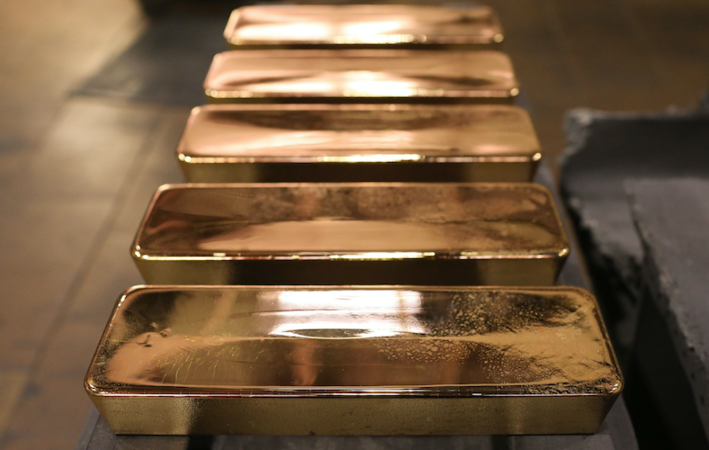
Since the end of March, 16.8 million ounces have flowed into Comex. That’s more than the total increase in ETF holdings last year, and almost equivalent to India’s annual jewelry demand. Inventories stand at a record 26 million ounces as of Tuesday, dwarfing the 9.6 million ounces worth of June contracts still open.

To be sure, the imbalance in the New York market is a localized phenomenon: gold remains in high demand around the world among investors concerned about the state of the global economy.

The seeds of the current glut were sown when the coronavirus shut down commercial flights earlier this year and forced some gold refineries to close. The shutdowns strangled the supply routes that allow physical bullion to move around the globe, and prompted banks to step back from arbitraging between the London and New York markets. At the same time, demand for gold as a haven grew amid fears of the pandemic’s economic toll.

The premium for New York futures over London surged as traders rushed to avoid delivering in April, instead buying back contracts they had sold short.

Traders trying to capture that premium were able to arrange physical delivery, swelling inventories. Key refining hub Switzerland shipped a record amount of gold to the U.S. in April, according to figures dating back to 2012. Australia’s Perth mint also ramped up production last month and shipped bars to the Comex.

“It is a seller’s market because of the premium and the buyers are stuck right now,” Peter Thomas, a senior vice president at Chicago-based broker Zaner Group, said in a telephone interview. “Do you want to deliver now, or do you want to deliver into the back, where the premium is high?”

U.S. durable goods orders fall sharply for second straight month #ศาสตร์เกษตรดินปุ๋ย

#ศาสตร์เกษตรดินปุ๋ย : ขอบคุณแหล่งข้อมูล : หนังสือพิมพ์ The Nation.

https://www.nationthailand.com/business/30388689?utm_source=category&utm_medium=internal_referral

U.S. durable goods orders fall sharply for second straight month

May 28. 2020
By  Bloomberg · Elizabeth Dexheimer · BUSINESS 

U.S. orders for durable goods sank sharply for a second month in April as the coronavirus pandemic wreaked havoc on the manufacturing industry.

Bookings for goods meant to last at least three years decreased 17.2%, the most since August 2014, after a revised 16.6% decline in March, Commerce Department data showed Thursday. The median projection in a Bloomberg survey of economists called for a 19% decrease.

Revised data on Thursday from the Commerce Department showed first-quarter gross domestic product shrank at an annualized 5% pace as consumer spending and business investment dropped sharply.

Factories in the last two months bore the brunt of the sharp cutback in demand amid the nationwide lockdown. While states have begun letting business reopen, manufacturing will be slow to recover as fewer people shop and businesses rein in capital spending projects.

Closely watched core capital goods orders, which exclude aircraft and military hardware, dropped 5.8% in April after a 1.1% decrease a month earlier. Shipments of those goods, a proxy for equipment investment in the government’s gross domestic product report, fell 5.4%.

The Commerce Department’s revised GDP data showed business fixed investment dropped at a 7.9% annualized rate. Equipment spending plummeted at a 16.7% pace. The report signals the end of the longest U.S. economic expansion and the start of what’s likely to be the deepest recession in at least eight decades.

Corporate profits slumped an annualized 13.9% in the first quarter, according to the GDP report, indicating companies may continue to pull back on capital spending projects until earnings improve.

The durable goods data showed broad declines in orders, including a 47.3% plunge in bookings for transportation equipment such as motor vehicles. Excluding transportation, durable goods orders fell 7.4%, the most since January 2009.

In a separate report released Thursday, initial jobless claims for regular state programs totaled 2.12 million in the week ended May 23, while benefit rolls declined for the first time during the pandemic.