Bids planned for Red Line extension project in June #ศาสตร์เกษตรดินปุ๋ย

#ศาสตร์เกษตรดินปุ๋ย : ขอบคุณแหล่งข้อมูล : หนังสือพิมพ์ The Nation

https://www.nationthailand.com/business/30384351?utm_source=category&utm_medium=internal_referral

Bids planned for Red Line extension project in June

Mar 19. 2020
By THE NATION

The State Railways of Thailand (SRT) is expected to call bids for the extension project of the suburban Red Line mass transit system in June, said acting governor Worawut Mala today (March 18), adding that the work will be split into three contracts.

The Bt21.6- billion project comprises the Rangsit-Thammasat University ( Rangsit campus) section costing Bt5.97 billion; the Talingchan-Siriraj Hospital section, Bt5.98 billion; and the Talingchan-Salaya sector worth Bt9.67 billion.

Start of construction is expected next year.

Meanwhile, construction of the Bangsue central station is expected to be completed in June while the Red Line mass transit system’s Bangsue-Rangsit section and Bangsue-Talingchan section with a total of 13 stations will commence commercial operations in January next year. Fares for the two routes will be from Bt15 to Bt50.

The state agency plans to set up a company to operate the Red Line routes. It will ask for Cabinet approval to borrow a loan of Bt3 billion as the company’s registered capital.

Banks told to step up relief efforts for borrowers #ศาสตร์เกษตรดินปุ๋ย

#ศาสตร์เกษตรดินปุ๋ย : ขอบคุณแหล่งข้อมูล : หนังสือพิมพ์ The Nation

https://www.nationthailand.com/business/30384353?utm_source=category&utm_medium=internal_referral

Banks told to step up relief efforts for borrowers

Mar 19. 2020
Central bank governor Veerathai Santiprabhob

Central bank governor Veerathai Santiprabhob
By The Nation

The Bank of Thailand has asked banks to accelerate and widen financial assistance for businesses affected by the Covid-19 pandemic.

After the February 28 announcement of the central bank’s incentives encouraging banks to offer relief measures to their clients, 30,000 borrowers have seen their debts restructured with a combined value of Bt234 billion through rate reduction and extension of repayment periods, Central bank governor Veerathai Santiprabhob said on Wednesday (March 18).

Some banks have even set up one- stop service for this purpose, he added.

However, the number is insignificant when compared to the vast spread of businesses reeling from the Covid-19 impact, he said.

Bankers have been asked to step up and widen relief measures in support of borrowers, especially small and mid-sized enterprises, Veerathai said .

Moreover, they were also told to brace for plan B should the virus spread intensify. For example, they would have to prepare enough cash in case more money are being withdrawn for various purposes. Banks also have to make sure capacities of their electronic payment systems can cope with a sudden spike in transactions, he said.

Central bank will work closely with commercial banks and state-owned financial institutions to ensure smooth functioning of the financial system at this time, he added.

Veerathai held the VDO conference on Wednesday with bankers on the business impact of the virus and its latest development .

U.S. stocks, global debt, oil tumble #ศาสตร์เกษตรดินปุ๋ย

#ศาสตร์เกษตรดินปุ๋ย : ขอบคุณแหล่งข้อมูล : หนังสือพิมพ์ The Nation

https://www.nationthailand.com/business/30384373?utm_source=category&utm_medium=internal_referral

U.S. stocks, global debt, oil tumble

Mar 18. 2020
By Syndication Washington Post, Bloomberg · Robert Brand · BUSINESS, US-GLOBAL-MARKETS 

Financial markets continued to spasm Wednesday, with U.S. stocks reversing Tuesday’s rally, as the economic fallout from the pandemic outpaces the massive response from governments and central banks.

The S&P 500 fell almost 6%, wiping out Tuesday’s rally, sparked when the Trump administration considered upward of $1 trillion in spending and the Federal Reserve dusted off crisis-era programs to stabilize financial markets.

Treasuries were steady after the biggest yield jump since 1982 and municipal bonds extended deepest rout since 1987 as markets braced for the potential flood of spending. European bonds came in for a bashing. Oil dropped to an 18-year low. The dollar strengthened a seventh straight day, while the pound hit its lowest level against the greenback since 1985.

Governments have pledged or are considering massive fiscal support to offset the economic shock from the pandemic, with the Trump administration moving toward a big package, but the virus continues to spread at a pace that is forcing massive shutdowns across the globe.

“The missing fundamental ingredient for a sustainable recovery in risk appetite is some evidence that the growth of global Covid-19 infection rates is peaking,” said Paul O’Connor, head of multi-asset at Janus Henderson Investors. “Clearly, we are not there yet.”

The planned U.S. stimulus could amount to $1.2 trillion, aiming to stave off the worst impact of a crisis that already looks set to plunge many of the world’s economies into recession. Meantime, the Federal Reserve reintroduced additional crisis-era tools to stabilize financial markets. Those responses came after stresses appeared in the short-term funding markets.

“I don’t think we’re out of the woods yet in terms of liquidity,” Mark Konyn, chief investment officer at AIA Group in Hong Kong, told Bloomberg TV. “It’s a question of when the fiscal measures will have the most efficacy.”

In Germany, Angela Merkel said the government will not rule out joint European Union debt issuance to help contain the impact.

These are the main moves in markets:

Stocks:

– The S&P 500 Index fell 5.7% to 2,385.51 as of 11:26 a.m. New York time.

– The Dow Jones Industrial Average decreased 5.8% to 20,004.37, the lowest in more than three years.

– The Nasdaq Composite Index dipped 4% to 7,041.18.

– The MSCI All-Country World Index declined 4.7% to 404.20, the lowest in more than three years.

Currencies:

– The Bloomberg Dollar Spot Index gained 1.5% to 1,272.78, hitting the highest in more than three years with its seventh straight advance and the largest rise in almost four years.

– The Japanese yen depreciated 0.3% to 108.04 per dollar, the weakest in more than two weeks.

– The euro declined 1.1% to $1.0879, the weakest in more than three weeks.

– The British pound decreased 2.1% to $1.1798, reaching the weakest on record with its seventh consecutive decline.

Bonds:

– The yield on 10-year Treasuries dipped one basis point to 1.07%.

– Britain’s 10-year yield increased 20 basis points to 0.756%, the highest in almost 10 weeks on the biggest climb in more than six years.

– Germany’s 10-year yield advanced 16 basis points to -0.27%, hitting the highest in eight weeks with its seventh straight advance.

– Ireland’s 10-year yield gained 15 basis points to 0.499%, reaching the highest in about 10 months on its fifth consecutive advance.

Commodities:

– West Texas Intermediate crude fell 13.2% to $23.39 a barrel, the lowest on record with the largest fall in more than a week.

– Gold depreciated 1.8% to $1,501.13 an ounce, the weakest in 12 weeks.

German bunds post longest losing streak in 2 ½ years #ศาสตร์เกษตรดินปุ๋ย

#ศาสตร์เกษตรดินปุ๋ย : ขอบคุณแหล่งข้อมูล : หนังสือพิมพ์ The Nation

https://www.nationthailand.com/business/30384372?utm_source=category&utm_medium=internal_referral

German bunds post longest losing streak in 2 ½ years

Mar 18. 2020
By Bloomberg · John Ainger · BUSINESS, WORLD, US-GLOBAL-MARKETS, EUROPE

German bonds — some of the safest assets in the euro area — are throwing a tantrum. Bunds, as they’re called in the market, have fallen for seven consecutive days, taking their yield more than 60 basis points higher from a record low of -0.91%. It’s their longest run of losses in two-and-a-half years.

For traders, it is bringing back memories of 2015, when German bonds sold off rapidly following a weak auction. That snapped a rally built on expectations for quantitative easing from the European Central Bank.

In terms of sheer speed, the sell-off is even quicker this time round — it has seen the biggest five-day jump in yields since 1990.

The ECB is currently seen as being almost out of ammunition to combat another slowdown, yet governments are finally taking up the baton with huge spending pledges. While Germany has very stringent debt-limit rules, those are showing signs of coming loose as the coronavirus disrupts the economy.

“A move in 10-year bund yields back above zero is not sustainable but it is a very real possibility over the next week,” said Richard Kelly, head of global strategy at Toronto-Dominion Bank in London. “We are in the eye of the storm for market pricing in both the liquidity strains and fiscal fears.”

Other factors are at play too. Fund managers are looking to sell assets in a bid to hold cash, which provides more flexibility and also allows them to prepare for potential redemptions by investors. There are also calls for euro-wide bond issuance, which would dampen the allure of bunds. Liquidity too is very poor, exacerbating the sell-off.

“Market participants are selling everything that still has value to build up defenses against outflows or liabilities they are facing,” said Christoph Rieger, head of fixed-rate strategy at Commerzbank. “A lot of longs had been built in recent weeks.”

German 10-year yields rose as much as 23 basis points to minus 0.21%, the highest level since January. Those on 30-year bonds rose into positive territory for the first time since February.

Still, the prospect of the whole curve soon emerging from negative territory is an unlikely one for ING Groep.

“It is possible only if the ECB confirms they intent on letting markets to their own devices,” said Antoine Bouvet, senior rates strategist at ING. “It is a possibility but honestly given the degree of volatility, I think the probability of them realizing their mistake is growing fast.”

Warren Buffett says negative rates are puzzling, but not scary #ศาสตร์เกษตรดินปุ๋ย

#ศาสตร์เกษตรดินปุ๋ย : ขอบคุณแหล่งข้อมูล : หนังสือพิมพ์ The Nation

https://www.nationthailand.com/business/30384369?utm_source=category&utm_medium=internal_referral

Warren Buffett says negative rates are puzzling, but not scary

Mar 18. 2020
Warren Buffett, chairman and chief executive officer of Berkshire Hathaway Inc., speaks to media Omaha, Neb., on May 3, 2019. MUST CREDIT: Bloomberg photo by Houston Cofield.

Warren Buffett, chairman and chief executive officer of Berkshire Hathaway Inc., speaks to media Omaha, Neb., on May 3, 2019. MUST CREDIT: Bloomberg photo by Houston Cofield.
By Syndication Washington Post, Bloomberg · Katherine Chiglinsky · BUSINESS, US-GLOBAL-MARKETS

Warren Buffett said the prospect of negative interest rates is a bit confusing. “They puzzle me, but they don’t scare me,” Buffett said in a Yahoo Finance interview when asked if negative rates frighten him.

U.S. policymakers have been seeking to grapple with the economic fallout of the coronavirus pandemic, with the Federal Reserve on Sunday cutting its benchmark interest rate by a full percentage point to near zero. While Fed Chairman Jerome Powell said at the time that he did not think negative rates would be appropriate policy in the U.S., markets have seen the yield on the 10-year U.S. Treasury dip as low as 0.31% earlier this month.

Buffett, the chairman and chief executive officer of Berkshire Hathaway Inc., said earlier this month the effects of the virus and an oil shock were “a big one-two punch.” He later announced that shareholders would be barred from attending his company’s annual meeting given the spread of the virus.

The billionaire investor has long favored investing in stocks over bonds, building up an equity portfolio that topped $248 billion at the end of last year. Buffett said in his annual shareholder letter, released in February, that it was almost certain that equities would outperform long-term, fixed-rate debt instruments in the long run if current interest rates and low corporate taxes were to persist.

But he cautioned in the Yahoo Finance interview, conducted last week and released Wednesday, that he’s not an expert on forecasting the path of rates.

“I have never been able to predict interest rates,” Buffett said. “Interest rates are important, but we don’t think they’re knowable.”

Fitch revises outlook on Thailand to ‘Stable’ ; affirmed at ‘BBB+’ #ศาสตร์เกษตรดินปุ๋ย

#ศาสตร์เกษตรดินปุ๋ย : ขอบคุณแหล่งข้อมูล : หนังสือพิมพ์ The Nation

https://www.nationthailand.com/business/30384347?utm_source=category&utm_medium=internal_referral

Fitch revises outlook on Thailand to ‘Stable’ ; affirmed at ‘BBB+’

Mar 18. 2020
By THE NATION

Fitch Ratings has revised its Outlook on Thailand’s Long-Term Foreign-Currency Issuer Default Rating (IDR) to Stable from Positive and has affirmed the rating at ‘BBB+’, according to its statement relaesed on Tuesday (March 17).

Key rating drivers

The outlook revision reflects the evolving impact of the global Covid-19 outbreak on Thailand’s economy through its tourism sector as well as lingering uncertainty in Thailand’s political environment following the country’s transition to civilian rule.

The ‘BBB+’ rating reflects Thailand’s sound external and public finances, which serve as cushions against economic and financial shocks. These strengths are balanced by weaker structural features relative to peers, including lower World Bank governance scores and, to a lesser extent, lower income per capita.

Fitch forecasts that Thailand’s economic growth will weaken to 1 per cent in 2020, from 2.4 per cent in 2019, on account of the Covid-19 pandemic.

This would mark a second consecutive year of slowing growth, and the lowest pace of expansion since 2014. A combination of factors led to the economic slowdown last year to 2.4 per cent, from 4.2 per cent in 2018, including weaker external demand amid US-China trade tensions, a sharp appreciation of the baht, delayed approval of the budget for the fiscal year ending-September 2020 (FY20), and drought conditions in the agricultural sector.

The growth outlook for 2020 is subject to considerable downside risk due to the uncertainty surrounding the duration of the virus shock. Thailand’s tourism sector is especially vulnerable.

The sector and related business account for around 20 per cent of GDP, according to the Bank of Thailand (BOT).

Preliminary figures indicate that tourist arrivals for the month of February declined by almost 44 per cent year-on-year. Fitch baseline assumes the global outbreak is gradually contained, setting the stage for a gradual recovery of tourism inflow.

In the meantime, there are other factors supporting growth. In particular, the long-awaited approval of the FY20 budget will help to boost infrastructure investment in the remainder of 2020; the budget was delayed by over four months due to the lengthy formation of the new government coalition and legal issues about the validity of some parliamentary votes.

The government has also adopted various relief measures to support tourism and other sectors, such as extending the income-tax return deadline from March to June 2020 and tax deductions.

More recently, the government approved an estimated Bt400 billion (2.4 per cent of GDP) stimulus package, which includes targeted soft loans for small and medium enterprises (SMEs) to alleviate the impact of Covid-19 on the slowing economy.

Additional stimulus measures, such as tax benefits, debt payment extensions and financial assistance, may be adopted to maintain the debt-service ability of households and small private businesses if downward pressure on the economy persists in the next couple of quarters.

The rating agency expects momentum to regain traction in 2021, with growth projected at 3.8 per cent as external and domestic demand gradually recover in line with regional trends.

Continued public expenditure and implementation of the government’s infrastructure programme under the 20-year national strategy and the Eastern Economic Corridor should support modest economic growth in the coming years, which Fitch estimates at 3.5 per cent over the medium term. Thailand will nevertheless continue to face structural challenges from an ageing population and human capital constraints.

The Bank of Thailand (BOT) cut its benchmark policy rate by 25 basis points to a historical low of 1 per cent at its last policy meeting on 5 February, adding to two rate cuts of a cumulative 50 basis points since August.

We expect one more rate cut in 2020 to bolster the economy in the near term. Headline consumer inflation increased to 0.7 per cent year-on-year in February 2020, well below the BOT’s 1-3 per cent target band. We expect inflationary pressure to remain muted for the remainder of 2020, Fitch said.

Fitch expects Thailand’s record of sound fiscal management to remain intact, supported by the enactment of the Fiscal Responsibility Act in April 2018.

It forecast a wider general government deficit (Government Finance Statistics basis) of 1.3 per cent of GDP in FY20, from 0.8 per cent in FY19, due to the reduced government revenue and the government’s stimulus measures.

Fiscal measures from the recent stimulus package are unlikely to significantly widen the FY20 budget deficit, and we project the government to have fiscal space to counter a prolonged economic downturn.

Fitch expects the general government debt-to-GDP ratio to gradually increase to 43.3 per cent by FY24, from 35.9 per cent in FY19, as the government utilises its fiscal space to boost infrastructure investment. Thereafter, we project the debt ratio to revert to a downward trend.

Fitch forecasts Thailand’s external finances to remain robust relative to peers, a core strength of the country’s credit profile. We forecast the current account surplus to remain high at 5.8 per cent of GDP in 2020. Official reserves covered an average of 8.2 months of current external payments in 2018-2019; we forecast coverage of 8.7 months and a net external creditor position at around 44 per cent of GDP in 2020, both well above the ‘BBB’ and ‘A’ median peer levels.

Thailand’s political environment remains divisive, exacerbated by the ruling coalition’s thin parliamentary majority and vocal opposition.

However, the coalition’s majority increased somewhat after nine members of parliament from the Future Forward Party joined a coalition party supporting the government. As such, the coalition government will likely be less constrained in parliament, reducing risks around its ability to implement its policy agenda and ensures policy continuity.

Nevertheless, a degree of lingering political uncertainty remains. In late February 2020 Thailand’s Constitutional Court dissolved the Future Forward Party – a main opposition party that received the third-highest share of seats in the legislature – over claims of illegal donations to political parties. These actions have led to limited discontent at university campuses.

Fitch believes financial-sector risks will be contained amid the economic downturn. Thailand’s household debt-to-GDP ratio at the end of 3Q/19 was 79.1 per cent (seasonally adjusted), which remains high compared with peers, and households’ ability to service debts may worsen as economic conditions deteriorate.

However, Thai banks are well-capitalised, with high excess provisions and sound liquidity, providing a buffer against potential shocks, particularly for low-income households.

Related story:

Weaker outlooks for Thai banks and corporates: Fitch

Weaker outlooks for Thai banks and corporates: Fitch #ศาสตร์เกษตรดินปุ๋ย

#ศาสตร์เกษตรดินปุ๋ย : ขอบคุณแหล่งข้อมูล : หนังสือพิมพ์ The Nation

https://www.nationthailand.com/business/30384346?utm_source=category&utm_medium=internal_referral

Weaker outlooks for Thai banks and corporates: Fitch

Mar 18. 2020
By THE NATION

Asset quality and earnings of Thai banks will be significantly weaker in 2020 while Thai corporates face challenging credit conditions as the country’s economy will be one of the hardest hit by the coronavirus pandemic in the APAC region, Fitch Ratings analysts told Fitch Ratings (Thailand) Limited’s webinar today (March 18) .

Thailand’s economy has a high reliance on tourism and exports, said Jeremy Zook, Associate Director, Sovereign Ratings at Fitch Ratings.

Fitch has just revised the sovereign rating Outlook to Stable from Positive in view of the rapidly evolving impact of the pandemic on the Thai economy and lingering political uncertainty.

It forecast growth to slow to 1.0 per cent in 2020, mainly due to slowing tourism, but a weaker global economy and the drought.

There are considerable downside risks to this forecast as more stringent quarantine measures are being imposed on travellers and a rising number of domestic Covid-19 cases could dampen consumption.

Despite the challenging near-term growth outlook, in Fitch’s view, Thailand’s strong external and public finances serve as a cushion against the current economic and financial shock, consistent with the ‘BBB+’ sovereign rating.

Fitch’s Director of Corporate Ratings, Obboon Thirachit, cautioned issuers and investors that credit conditions for Thai corporates will be challenging in 2020 as downside risks increase across portfolios and as some business-specific pressures weigh in.

Even before the coronavirus, Thai corporates had already been affected by slow economic growth and subdued earnings. Further economic downturn stemming from the pandemic could delay earnings recovery, putting additional pressure on the credit profiles of the issuers with high leverage.

Fitch expects further negative rating actions to continue for the rest of 2020 because of the higher proportion of corporates with Negative Outlooks and increasing downside risk, although the majority of Thai corporates should remain on Stable Outlook in light of their resilience and rating headroom.

In 2020, among corporate sectors, the oil and gas and petrochemical sectors are likely to be adversely affected by the combination of demand shock from the coronavirus and the low oil price from oil supply shock.

Still, some of the issuers have mitigating strategies, resources or rating headroom that could place them at less immediate risk.

For the building material sector, the financial profiles of major cement producers are already stretched following large M&A and high investment over the past few years. Slow demand recovery and oversupply situation could further delay the pace of deleveraging. Telecoms also face high capex need ahead of the 5G investment cycle. Ongoing price competition and weak data monetisation will continue to put pressure on revenue and earnings growth.

Weaker economic conditions are affecting the banking sector, said Parson Singha, Senior Director of Financial Institutions at Fitch Ratings Thailand.

The magnitude of the impact depends on the downturn’s severity and duration, but we expect banks’ asset quality and earnings to be significantly weaker in 2020 compared with prior years. SMEs make up around one-third of bank lending and are particularly vulnerable to economic shocks.

Furthermore, bank earnings, even before the outbreak, had already been under pressure due to low interest rates and slowing fee income growth. The business outlook is weak, although the banking sector has sound buffers that protect against downturns – for example, as of end-2019, the common equity Tier 1 ratio was 16 per cent and the loan loss reserve coverage was 145 per cent . Domestic liquidity also remains relatively strong.

Related story:

Fitch revises outlook on Thailand to ‘Stable’ ; affirmed at ‘BBB+’

SET back on its feet but dizzy #ศาสตร์เกษตรดินปุ๋ย

#ศาสตร์เกษตรดินปุ๋ย : ขอบคุณแหล่งข้อมูล : หนังสือพิมพ์ The Nation

https://www.nationthailand.com/business/30384345?utm_source=category&utm_medium=internal_referral

SET back on its feet but dizzy

Mar 18. 2020
By The Nation

The Stock Exchange of Thailand (SET) index on Wednesday (March 18) recovered from Tuesday’s tumble, closing at 1,048.15 for an increase of 12.98 points or 1.25 per cent over the previous day.

Total transaction volume was Bt59.186 billion with an index high of 1,076.16 and a low of 1,026.89.

A stock analyst at Krungsri Securities said he expected the index to fluctuate between 1,020 and 1,050 points.

“Although the market has gained positive sentiment after the US launched a big set of economic stimulus measures, the index will fall again due to uncertainty following the global economic recession from the impact of Covid-19 and the decline in crude oil price,” the analyst said.

The 10 stocks with the highest trade value on Wednesday were BAM, CPALL, PTT, ADVANC, AOT, PTTEP, GULF, SCC, KBANK and INTUCH.

Elsewhere in Asia:

Japan’s Nikkei Index closed at 16,726.55, down 284.98 points or 1.68 per cent.

China’s Shanghai SE Composite Index closed at 2,728.76, down 50.88 or 1.83 per cent.

Shenzhen’s SE Component Index closed at 10,029.57, down 173.18 or 1.7 per cent.

Hong Kong’s Hang Seng Index closed at 22,291.82, down 971.91 or 4.18 per cent.

South Korea’s KOSPI Index closed at 1,591.20, down 81.24 or 4.86 per cent.

Taiwan’s TAIEX Index closed at 9,218.67, down 220.96 or 2.34 per cent.

Gold down Bt350/baht at the close #ศาสตร์เกษตรดินปุ๋ย

#ศาสตร์เกษตรดินปุ๋ย : ขอบคุณแหล่งข้อมูล : หนังสือพิมพ์ The Nation

https://www.nationthailand.com/business/30384341?utm_source=category&utm_medium=internal_referral

Gold down Bt350/baht at the close

Mar 18. 2020
By The Nation

Gold price dropped by Bt350 per baht weight at close today (March 18), the Gold Traders Association reported.

As of 15.53pm, buying price of a gold bar stood at Bt22,950 per baht weight and selling price Bt23,050, while buying price of gold ornaments was Bt22,542.92 per baht weight, selling price Bt23,550.

Prices dropped from the morning session where a gold bar was priced at Bt23,300 to buy and Bt23,400 to sell, gold ornaments cost Bt22,876.44 to buy and Bt23,900 to sell.

Gold contracts in COMEX futures to be delivered in April rose by US$39.30 to $1,525.80 per ounce at close since investors buy gold contracts for speculation after the gold price dropped the previous day.

The price of gold dropped by 3 per cent in the beginning amid concerns that the Covid-19 outbreak would cause an impact on the global economy.

Covid-19 continues to drag oil prices down #ศาสตร์เกษตรดินปุ๋ย

#ศาสตร์เกษตรดินปุ๋ย : ขอบคุณแหล่งข้อมูล : หนังสือพิมพ์ The Nation

https://www.nationthailand.com/business/30384322?utm_source=category&utm_medium=internal_referral

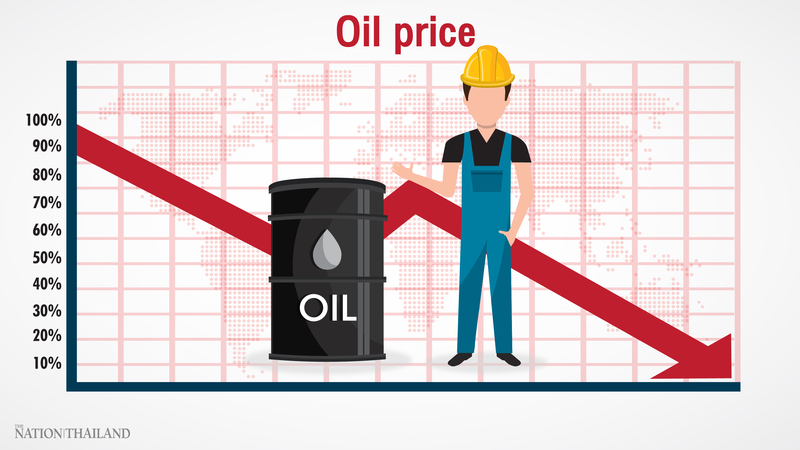
Covid-19 continues to drag oil prices down

Mar 18. 2020
By The Nation

Oil prices hit a four-year low following the Covid-19 outbreak, which is hammering the global economy, an energy analyst at Thai Oil said on Wednesday (March 18).

Brent oil price dropped below US$30 per barrel for the first time since 2016 due to uncertainty following the decline in oil demand as many governments worldwide announced suspension of activities and travels to prevent the spread of Covid-19.

Crude oil price remains under pressure due to the price war between Saudi Arabia and Russia. Saudi Arabia’s Energy Minister revealed that the country’s crude oil exports in April this year was expected to be more than 10 million barrels per day.

The US Department of Energy is preparing to purchase crude oil for the Strategic Petroleum Reserve (SPR) within two weeks to help oil companies affected by the decline in crude oil price.

Benzene fuel prices dropped more than those of Dubai crude oil since demand for benzene fuel has decreased after many countries announced lockdown of their cities due to the Covid-19 outbreak. However, benzene fuel prices still gained support from a Japanese oil refinery being closed for maintenance.

Diesel fuel prices dropped lower than those of Dubai crude oil due to a Kenyan move to import diesel fuel. However, the amount of diesel fuel in the market is still at a high level, according to experts.