Fed Chair Powell warns Congress that $1 trillion budget deficits are unsustainable #ศาสตร์เกษตรดินปุ๋ย

#ศาสตร์เกษตรดินปุ๋ย : ขอบคุณแหล่งข้อมูล : หนังสือพิมพ์ The Nation

https://www.nationthailand.com/business/30381984?utm_source=category&utm_medium=internal_referral

Fed Chair Powell warns Congress that $1 trillion budget deficits are unsustainable

Feb 12. 2020
Fed Chair Powell

Fed Chair Powell
By The Washington Post · Heather Long · BUSINESS, CONGRESS, US-GLOBAL-MARKETS

WASHINGTON – Federal Reserve Board Chair Jerome Powell told Congress on Tuesday that now would be a good time to reduce the federal budget deficit, which is expected to top $1 trillion this year.

“Putting the federal budget on a sustainable path when the economy is strong would help ensure that policymakers have the space to use fiscal policy to assist in stabilizing the economy during a downturn,” Powell said in testimony to the House Financial Services Committee.

In past recessions, the Fed has played a large role in reviving the economy by sharply cutting interest rates. But Powell has been warning lawmakers that the central bank won’t have much ammunition left to fight the next downturn because interest rates are so low (the benchmark rate is just below 1.75 percent, far below rates above 5 percent in the past).

More government spending is likely to be needed to aid the economy in the next recession.

The Fed chair’s warning comes as the U.S. federal debt has grown by about $3 trillion since President Donald Trump took office, and the president’s latest budget proposal submitted this week would add another $5 trillion to the debt over the coming decade. Economists worry that so much U.S. government debt can dampen private investment by driving investors to buy public bonds instead of private ones.

“A more sustainable federal budget could also support the economy’s growth over the long term,” said Powell, who spent time before he joined the Fed educating Congress about the debt limit as a Bipartisan Policy Center scholar.

Trump blasted Powell, tweeting in the middle of the congressional hearing that the Fed chair was keeping interest rates too high.

“When Jerome Powell started his testimony today, the Dow was up 125, & heading higher. As he spoke it drifted steadily downward, as usual, and is now at -15. Germany & other countries get paid to borrow money. We are more prime, but Fed Rate is too high, Dollar tough on exports,” Trump wrote on Twitter.

The United States has never had a negative interest rate. When asked about that possibility on Tuesday, Powell said that’s “not a tool we are looking at.” Economists widely view negative interest rates as only worth doing when the economy is in a terrible situation. Trump keeps calling for lower interest rates to further boost growth and the stock market.

For now, the Fed chair does not see any signs of a recession on the horizon. He told Congress that the U.S. economy is in a “very good place” and has remained “resilient” to numerous punches in recent months. He expects growth to remain solid, although he said the coronavirus is a major unknown for the economy.

“We know that there will be some – very likely – be some effects on the United States” from the coronavirus, Powell said, but he was hesitant to predict how big of an impact it will have on the economy.

“I think it’s too early to say. We have to resist the temptation to speculate on this,” Powell said. He reiterated that the Fed is “closely monitoring” the situation for possible “disruptions in China that spill over to the rest of the global economy.”

Powell stressed to Congress that his concerns for the economy are more long term. In addition to reducing the deficit, he once again said there is a great need to invest in programs to get more people back to work and to boost productivity.

“Finding ways to boost labor force participation and productivity growth would benefit Americans and should remain a national priority,” Powell said.

The share of working-age Americans who are in the labor force is at its highest rate in more than a decade, according to a Labor Department report Friday, but it remains well below most of the nation’s competitors.

Powell’s fairly positive assessment of the U.S. economy was echoed by other Fed leaders this week.

“Policy is in a good place. The economy is in a good place,” San Francisco Fed President Mary Daly said in a speech Monday in Ireland.

Daly was also careful to lower concerns about the effect of the coronavirus on the U.S. economy so far.

“For now I’m watching the coronavirus carefully to see if it has any longer-term effects on the economy or deeper effects than we’ve penciled in right now,” Daly said. “But to date, none of those have materialized.”

Philadelphia Fed President Patrick Harker said Monday that the negative effects on China were “something to watch.”

The U.S. economy is heavily driven by consumer spending, which remains healthy. Other economies are more dependent on trade, which is starting to be affected by the shutdown of many factories in China.

U.S. household debt exceeds $14 trillion for the first time #ศาสตร์เกษตรดินปุ๋ย

#ศาสตร์เกษตรดินปุ๋ย : ขอบคุณแหล่งข้อมูล : หนังสือพิมพ์ The Nation

https://www.nationthailand.com/business/30381977?utm_source=category&utm_medium=internal_referral

U.S. household debt exceeds $14 trillion for the first time

Feb 11. 2020
By  Syndication Washington Post, Bloomberg · Alex Tanzi · BUSINESS, PERSONAL-FINANCE

Americans increased their borrowing for the 22nd straight quarter as more households took out loans to buy homes or refinance existing mortgages, according to a report released Tuesday from the Federal Reserve Bank of New York.

Total U.S. household debt rose by $601 billion in the fourth quarter, or 1.4%, surpassing $14 trillion for the first time, the New York Fed’s quarterly household credit and debt report showed. That’s $1.5 trillion above the previous peak in the third quarter of 2008. Overall household debt is now 26.8% above the second-quarter 2013 trough.

Mortgage borrowing rose by $120 billion to $9.56 trillion. The rate for a 30-year mortgage has fallen by about 100 basis points over the past year, adding to home purchasers’ buying power. For example, a $500,000, 30-year loan costs about $300 less per month.

“Mortgage originations, including refinances, increased significantly in the final quarter of 2019,” Wilbert Van Der Klaauw, vice president at the New York Fed, said in a statement.

Mortgage loans for young adults age 18 to 29 rose to a the highest level since the third quarter of 2007. Originations for 30-year-olds rose to $210.1 billion last quarter — the highest level since the end of 2005.

Total debt for people ages 18 to 29 rose to a record $1.04 trillion.

Student debt increased to $1.51 trillion from $1.46 trillion at the end of 2018. More than $100 billion in student debt is held by those age 60 and over. Auto loans rose to $1.33 trillion, while credit card debt rose to a record $930 billion.

Auto debt, which has risen for 35 consecutive quarters, increased $16 billion from the previous quarter. Almost 5% of auto loans are 90 days of more delinquent. This is the highest percentage since the third quarter of 2011.

Credit card delinquencies rose to 8.36% an 18-month high.

Among student debt, one in nine borrowers were 90+ days delinquent or in default in 2019, and this figure may be understated. About half of student loans are currently in deferment, in grace periods or in forbearance and therefore temporarily not in the repayment cycle. Once these loans enter that cycle, delinquency rates are projected to be roughly twice as high, according to the Fed report.

Powell says risks to outlook remain, Fed monitoring virus #ศาสตร์เกษตรดินปุ๋ย

#ศาสตร์เกษตรดินปุ๋ย : ขอบคุณแหล่งข้อมูล : หนังสือพิมพ์ The Nation

https://www.nationthailand.com/business/30381976?utm_source=category&utm_medium=internal_referral

Powell says risks to outlook remain, Fed monitoring virus

Feb 11. 2020
Jerome Powell, chairman of the Federal Reserve, speaks during a House Financial Services Committee hearing in Washington on Feb. 11, 2020. MUST CREDIT: Bloomberg photo by Andrew Harrer.

Jerome Powell, chairman of the Federal Reserve, speaks during a House Financial Services Committee hearing in Washington on Feb. 11, 2020. MUST CREDIT: Bloomberg photo by Andrew Harrer.
By Syndication Washington Post, Bloomberg · Christopher Condon, Max Reyes

Federal Reserve Chairman Jerome Powell said the U.S. central bank is keeping a close eye on fallout from the deadly coronavirus outbreak in China, singling it out among risks threatening the U.S. and world economy.

“In particular, we are closely monitoring the emergence of the coronavirus, which could lead to disruptions in China that spill over to the rest of the global economy,” Powell said in remarks before U.S. lawmakers Tuesday.

Powell stopped short of saying the outbreak had changed the Fed’s baseline outlook for the U.S. economy, or the expectation among many members of the Federal Open Market Committee that rates will remain on hold this year. U.S. equities climbed as investors digested the latest views from the Fed chair and Treasuries slipped.

“The FOMC believes that the current stance of monetary policy will support continued economic growth, a strong labor market and inflation returning to the committee’s symmetric 2% objective,” Powell said. “As long as incoming information about the economy remains broadly consistent with this outlook, the current stance of monetary policy will likely remain appropriate.”

Coronavirus, which has killed more than 1,000 people, has prompted the world’s largest-known quarantine effort and slowed large portions of China’s economy, disrupting travel and commerce worldwide.

Powell faced questions from lawmakers of the House Financial Services Committee about the potential impact of the virus on the U.S. economy.

“We know that there will be some, very likely be some effects on the United States,” he said, adding that the question for the Fed is whether they’ll be “persistent” and “material.”

“It’s just too early to say,” Powell said.

The Fed chief is also scheduled for a hearing before the Senate Banking Committee at 10 a.m. Wednesday as part of his semi-annual testimony to Congress.

Fed officials have dialed up their concern over the coronavirus in public remarks in recent days. Vice Chairman Richard Clarida called it a “wild card” on Jan. 31. The Fed’s Semiannual Monetary Policy Report, released Feb. 7, said it was a “new risk” that could potentially interfere with trade, depress commodity prices and cause the U.S. dollar to appreciate.

Some private-sector economists have been less cautious, marking down their estimates for first-quarter growth in the U.S., while investors are betting the Fed will respond with an interest rate cut later this year.

In his prepared remarks, Powell provided a mostly positive picture of the U.S. economy — which was dented but not significantly damaged by slower global growth and international trade disputes in 2019.

“Economic activity increased at a moderate pace and the labor market strengthened further, as the economy appeared resilient to the global headwinds that had intensified last summer,” he said.

His comments followed data released last week showing U.S. employers added a better-than-expected 225,000 new jobs in January.

Powell said the central bank had been successful in containing a sudden September spike in overnight funding rates that briefly pushed the Fed’s benchmark lending rate to stray outside its target range.

The central bank has conducted emergency lending into the market for repurchase agreements and, in October, began purchasing $60 billion a month in Treasury bills. The latter move has boosted bank reserves, allowing banks to feed money into the repo market in place of the Fed.

“As our bill purchases continue to build reserves toward levels that maintain ample conditions, we intend to gradually transition away from the active use of repo operations,” he said. “We intend to slow our purchases to a pace that will allow our balance sheet to grow in line with trend demand for our liabilities.”

Powell repeated his concerns over longer-term issues holding back growth in the U.S. economy.

“Finding ways to boost labor force participation and productivity growth would benefit Americans and should remain a national priority,” he said.

He also warned lawmakers the economy would need support from fiscal policy in the event of a downturn, and pressed them to put the federal budget on a sustainable path.

The White House on Monday released President Donald Trump’s proposed 2021 federal budget, which included deficit spending of about $1 trillion. Trump has repeatedly criticized Powell for not lowering interest rates further.

Coronavirus emerged as an economic threat in recent months just as the global outlook was beginning to brighten. Powell and his colleagues cut rates three times in 2019 to guard against the risks posed by trade tensions, slow global growth and below-target inflation. Since late last year, however, Fed officials have said monetary policy was in a good place and would remain unchanged unless their outlook for the economy changed materially.

Completion of the China phase-one trade deal, Britain’s avoidance of a sudden, no-deal exit from the European Union and a slight improvement in global manufacturing data pointed to a more stable outlook for 2020 after a decidedly rocky 2019.

“Some of the uncertainties around trade have diminished recently, but risks to the outlook remain,” Powell said.

Trump offers $4.8 trillion budget plan that seeks big cuts to domestic programs #ศาสตร์เกษตรดินปุ๋ย

#ศาสตร์เกษตรดินปุ๋ย : ขอบคุณแหล่งข้อมูล : หนังสือพิมพ์ The Nation

https://www.nationthailand.com/business/30381929?utm_source=category&utm_medium=internal_referral

Trump offers $4.8 trillion budget plan that seeks big cuts to domestic programs

Feb 11. 2020

President Donald Trump's budget proposal for 2021 Photo by: The Washington Post — The Washington Post

President Donald Trump’s budget proposal for 2021 Photo by: The Washington Post — The Washington Post
By The Washington Post · Jeff Stein, Erica Werner
WASHINGTON – The White House on Monday proposed a $4.8 trillion election-year budget that would slash major domestic and safety net programs, setting up a stark contrast with President Donald Trump’s rivals as voting gets underway in the Democratic presidential primary.

The budget would pursue hundreds of billions of dollars in cuts to Medicaid and seek reductions in the Children’s Health Insurance Program while wringing some savings from Medicare despite Trump’s repeated promises to safeguard the program for older Americans.

The budget is a proposal to Congress, and lawmakers have mostly rejected the White House’s proposed cuts in the past. Still, the budget plan sets up the Trump administration’s policy priorities heading into the November elections and are likely to draw scrutiny in Washington and on the campaign trail. Trump has in the past not shown much interest in pursuing the budget cuts his aides have offered, and he didn’t make public comments about the plan on Monday.

Instead, one of his top advisers defended the proposed cuts, even as Democratic presidential candidates blasted the reductions.

Russell Vought, acting White House budget director, touted the proposed spending increases in the budget for NASA, immigration, opioid mitigation and veterans, while denying it would lead to benefit reductions for Medicare and Medicaid, as Democrats charged. Vought also said the budget includes widespread cuts to federal waste that would bring down the deficit.

“This continues to be a budget that funds priorities where the president supports spending money,” Vought told reporters. “We are trying to fund what his priorities are, what his campaign commitments are, and finding savings and inefficiencies where we possibly can.”

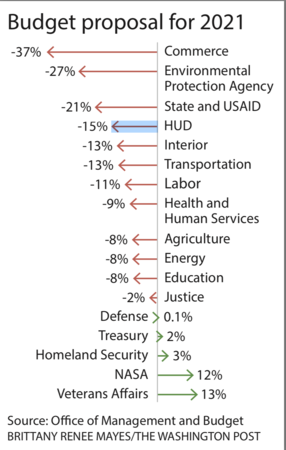
A central theme of the new budget is its attempt to scale back domestic programs. It would slash the Environmental Protection Agency budget by 26.5% over the next year, and cut the budget Department of Health and Human Services budget by 9%. The HHS includes the National Institutes of Health and the Centers for Disease Control and Prevention, which would see a budget cut even as it is under intense scrutiny over its response to the coronavirus. Officials said the part of the CDC that responds to emergencies such as the coronavirus would be protected.

“This is the future President Trump envisions for our nation,” said House Budget Committee Chairman John Yarmuth, D-Ky. “One where the federal government relinquishes any responsibility for the well-being of the American people in our nation. What the president has put forth is a destructive and irrational budget that intentionally goes after working families and vulnerable Americans.”

The plan would target the Education Department is for a nearly 8% cut, the Interior Department would be cut 13.4%, and the Housing and Urban Development department would be cut 15.2%. The State Department and U.S. Agency for International Development would be cut by 22%.

Trump has sought spending cuts in the past, only to back down immediately during negotiations with Democrats. For example, he has sought to cut numerous federal agencies multiple times and then reversed himself and approved budget increases. That’s because Trump has pushed for huge increases in military spending, and Democrats have said they would only go along with such a change if Trump backed more money for housing, education, and health care.

Proposing the cuts again, on the eve of the New Hampshire Democratic primary, gave Democrats a fresh target to attack.

“The old cliche is that a budget is a moral document,” Sen. Bernie Sanders, I-Vt., said in a statement. “What kind of unbelievable moral framework allowed this White House to propose $182 billion in cuts to nutrition assistance from needy families, when nearly 1 in 7 households with children are food insecure?”

Trump did not defend any of the cuts in public. Over the weekend, he commented on the budget proposal briefly, noting on Twitter that he would not touch Social Security or Medicare.

But even some of Trump’s staunchest allies criticized his sharp cuts for domestic agencies, such as the Agriculture Department, which he is targeted for an 8% overall reduction. That was an indication that the budget will get a cold shoulder on Capitol Hill from the lawmakers of both parties who will be responsible for writing spending bills into law that will actually fund the government when the 2021 fiscal year begins Oct. 1.

“I applaud the Administration for aiming to tackle the debt and deficit by addressing federal spending, but I do not support the disproportionate cuts to important agricultural programs,” Sen. Kevin Cramer, R-N.D., said in a statement. “The cuts proposed today would save little but inflict severe pain in American agriculture.”

Trump has made homelessness a key focus in the past year, but his budget would seek a big reduction in housing funds. He proposed an $8.6 billion cut for the Department of Housing and Urban Development for 2021, a 15.2% decrease from the amount enacted for 2020. The cuts, as in previous years, include eliminating the four-decade-old Community Development Block Grant program popular among congressional Democrats and Republicans as well as affordable housing grants to states and municipalities to help with the construction, purchase or rental of homes.

The block grants, funds that Congress has restored in past budgets, provides cities with money for affordable housing and other community needs, such as fighting blight, improving infrastructure and delivering food to homebound seniors. The administration, in its budget documents, said the program “has not demonstrated sufficient impact.”

Housing advocates were not surprised by the proposed cuts, which were similar to past proposals, and they urged Congress to reject them as it has largely done in the past. Advocates pointed to the flat funding of homeless assistance grants as a sign of the administration’s lack of seriousness on ending homelessness, especially given Trump’s recent focus on the housing crisis in California. The budget plan indicated that the administration will begin a new initiative to reduce street homelessness, targeting select cities but provides no further details.

Parts of the budget, however, show how the White House has shifted in the face of political blowback from past plans. It would preserve, for example, a handful of politically sensitive programs that in some cases have provoked uproars and caused Trump to backpedal when he’s tried to cut them in the past.

These include the Special Olympics and the Great Lakes Restoration Initiative – a program important to Michigan, Ohio, and Wisconsin, critical states for the 2020 election. Even as White House officials kept the Great Lakes fund steady, as it did for an ecosystem protection program in South Florida, similar programs in other, less politically important states are cut in the Trump budget.

The budget plan would also preserve State Department and Pentagon aid for Ukraine, something the White House tried to delay last year in a move that led to Trump’s impeachment by the House of Representatives. However, the Ukraine portion of a State Department anti-corruption program called International Narcotics Control and Law Enforcement would fall under the budget proposal, to $13 million from $30 million this year. Congress has rejected that proposed cut in the past.

Still, some agencies would be spared from cuts or even see a proposed increase.

Trump’s new budget calls for an increase in funding for the Department of Homeland Security, while keeping Pentagon spending mostly flat. The NASA budget would increase by 12% with new money aimed at putting U.S. astronauts back on the moon.

Even with all the other proposed spending cuts, the budget would not eliminate the federal deficit over the next 10 years, missing a longtime GOP fiscal target. Instead, White House officials said their budget proposal would close the deficit by 2035.

But it would only achieve this if the economy grows at an unprecedented, sustained 3% clip through 2025, levels the administration has failed to achieve for even one year so far. The U.S. economy grew 2.3% in 2019, the weakest level since Trump took office. Many economists believe economic growth will remain sluggish this year.

Because the government spends so much more money than it brings, the Treasury Department must borrow the difference by issuing debt. The debt has grown by roughly $3 trillion since Trump took office, and the budget plan would add more than $5 trillion to it over the next decade. There is currently more than $20 trillion in government debt, something Trump had vowed to eliminate by 2025 when running for office.

Trump’s budget aims to cut spending on safety-net programs such as Medicaid and food stamps, cutting food stamp spending by $181 billion over a decade. It proposes to squeeze hundreds of billions of dollars from Medicare over a decade through cost-saving proposals such as reforming medical liability and modifying payments to hospitals for uncompensated care.

A senior administration official defended the Medicaid cut, noting that it reflects a decrease in the rate at which spending would grow rather than a reduction from current spending levels. The official said the administration would save money on Medicaid spending through new work requirements and recouping payments incorrectly spent by the federal government.

Liberal economists rejected that argument. “This is a budget that would cause many millions of people to lose health care coverage. That is unambiguous,” said Aviva Aron-Dine, a former Obama official and vice president at the Center on Budget and Policy Priorities, a left-leaning think tank.

During the last year President Barack Obama was in office, the deficit was less than $600 billion, but it has grown significantly since.

As part of the new budget plan, the White House would seek to make permanent parts of the 2017 tax cut that are set to expire after 2025. The budget says extending these tax cuts through the end of the decade would amount to a $1.4 trillion tax cut.

Americans say they feel the current economy is the best since the late 1990s #ศาสตร์เกษตรดินปุ๋ย

#ศาสตร์เกษตรดินปุ๋ย : ขอบคุณแหล่งข้อมูล : หนังสือพิมพ์ The Nation

https://www.nationthailand.com/business/30381922?utm_source=category&utm_medium=internal_referral

Americans say they feel the current economy is the best since the late 1990s

Feb 11. 2020

Photo by: The Washington Post — The Washington Post

Photo by: The Washington Post — The Washington Post
By The Washington Post · Heather Long
WASHINGTON – Americans increasingly rate this as the best economy since the late 1990s, with a recent surge in optimism, even though many economic metrics show striking similarities to the final years of the Obama administration.

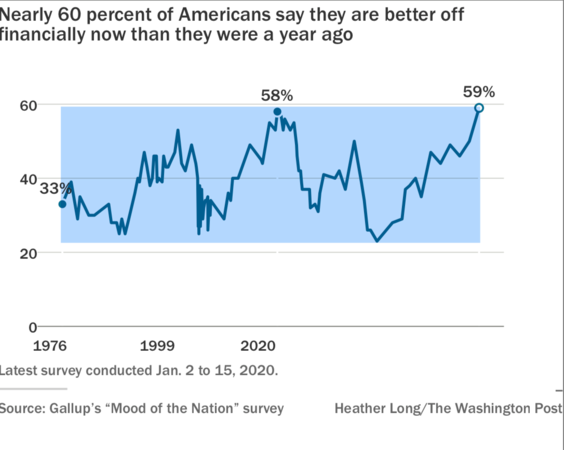
Fifty-nine percent of Americans say they are better off financially today than they were a year ago, the highest since 1999, according to a Gallup survey released last week. And nearly three-quarters predict they will do better a year from now, the most optimistic reading that Gallup’s annual “Mood of the Nation” survey has ever recorded.

Photo by: The Washington Post — The Washington Post

Photo by: The Washington Post — The Washington Post

Other polls and surveys aren’t quite as ebullient, but nearly all show that Americans are far less worried about the economy and their personal financial situations than they were during the last presidential election.

Upbeat sentiment is critical for the U.S. economy because it motivates consumer spending, the most important driver of U.S. economic growth. And President Donald Trump is counting on a strong economy to motivate voters to turn out at the polls and reelect him.

Bryan DeHenau runs a roofing business in Macomb County, Michigan, just outside Detroit. Around the time of the last presidential election, he had enough jobs to keep one crew busy, but some of the gigs were barely profitable. Today he can keep three crews busy during the spring and summer months, and he has been able to raise prices, regularly giving people estimates of $20,000 to totally redo a roof and finding that “they don’t even bat an eye about it anymore.”

“I’m driving a brand-new 2019 Ford F-250. I’ve got work coming out the ying-yang. I’m doing OK,” DeHenau said. “Four years ago, I couldn’t sleep at night. That’s a pretty big turnaround.”

Some of the biggest recent increases in consumer confidence have come from independent voters and less affluent households, according to Richard Curtin, director of the University of Michigan Surveys of Consumers. His team always asks people to explain why they feel confident, and lately they are hearing near-record levels of people saying their income and wealth are rising.

“We’ve only seen this many people mention income gains twice before: 1966 after the 1960s expansion and 2000 after the 1990s expansion,” Curtin said.

In interviews with six small-business owners across the country, all acknowledged that the economy had turned around under President Barack Obama, but they pointed out that several more years of steady growth, solid job gains and additional stock market records under Trump had turned “cautious optimism” into full-blown optimism.

Business owners varied in how much credit they would give Trump personally, but all had examples of how they had more work than they could handle and were buying equipment and bringing on new people in ways that had not happened since before the Great Recession. Trump’s approval rating on the economy hit an all-time high last month, according to a Washington Post-ABC News poll.

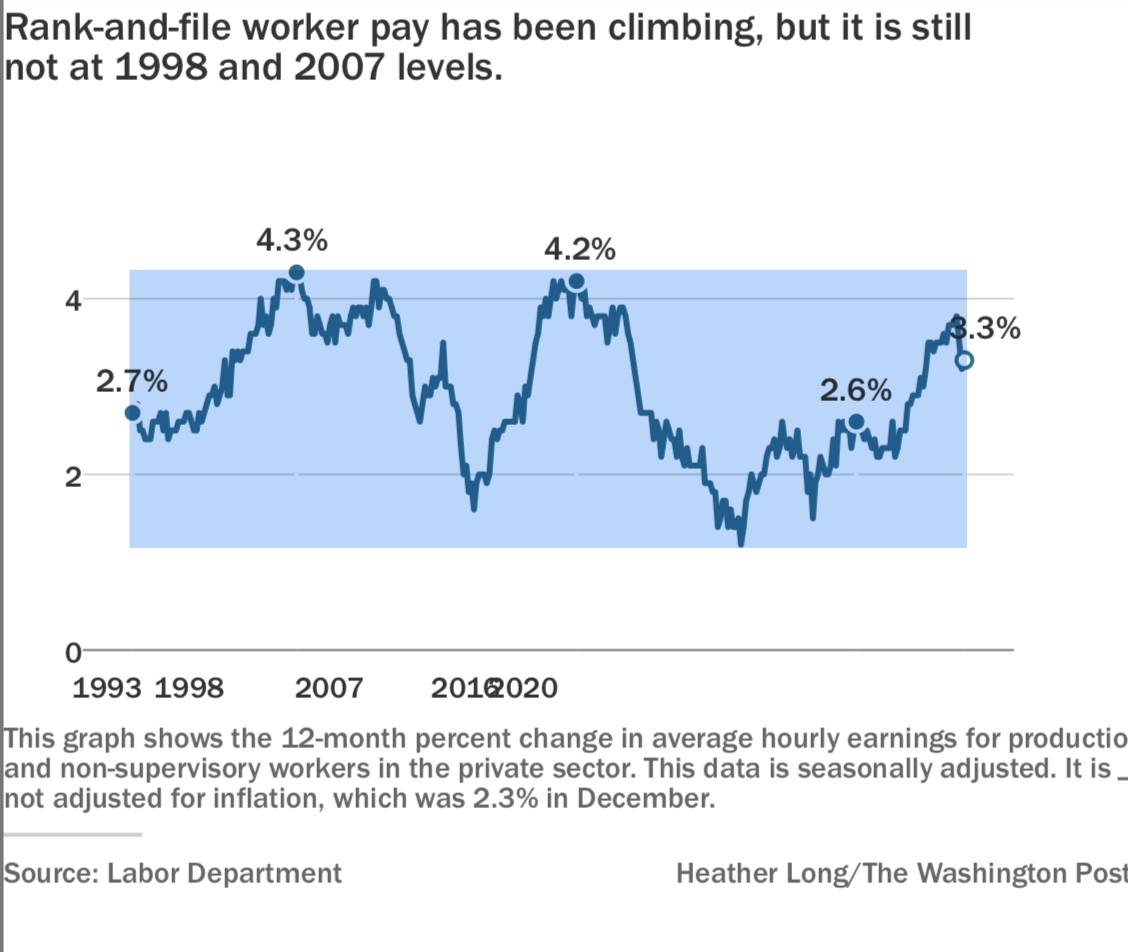
On Friday, the Labor Department reported that the U.S. economy added 225,000 jobs in January, beating forecasters’ expectations and further dampening concerns about a recession. Many workers have also felt better off financially thanks to tax cuts, cheaper gas prices and minimum-wage increases in more than 20 states. Wage growth has inched up for rank-and-file workers in recent months, although it remains below the stellar levels of the late 1990s.

Economists say one of the biggest drivers of consumer confidence is job quantity. Confidence rises when people feel as if it is easy to get a job, even if it is not a high-paying one.

Job growth has slowed lately, averaging 182,000 a month under Trump vs. 220,000 a month in the 37 months at the end of Obama’s tenure. But the health of the labor market is evident, with the unemployment rate near half-century lows at 3.6 percent. The nation has added over 2 million jobs every year for the past nine years, an unprecedented streak of steady gains.

“Your chance of going to work tomorrow and getting laid off is lower than it’s ever been going back to 1948,” said Ian Shepherdson, chief economist at Pantheon Macroeconomics. “That feeling of job security is very important.”

DeHenau, 33, calls this the best economy of his working years. He voted for Obama and then Trump. He gives Obama credit for getting the upswing going, but he thinks the economy would not be as good as it now without Trump.

“I give Trump 80 to 90 percent of the credit,” DeHenau said. “Even under Obama when it was good, there was no profitability.”

There has been less praise for Trump in the manufacturing sector, which tumbled into a technical recession last year as the president’s trade war drove up prices and hurt purchases from other parts of the world.

Jamison Scott, who runs a small manufacturing company in Woodbridge, Connecticut, remembers the ugly surprise he got after Trump enacted steel tariffs in March 2018 and steel prices soared about 20 percent.

Scott, who manufactures and distributes air ducts and says he uses American steel, was worried how his company could manage the extra cost – or even keep getting enough steel. One steel shipment he ordered that year showed up with about a quarter less material than what he requested.

But steel prices have come back down in recent months, a welcome relief for Scott, and his business from throughout the country has picked up. Enough cash has been coming in that he bought a new plasma cutter and seam welder, the types of big purchases he had not made in years.

“Customers we haven’t heard from in a while are coming out of the woodwork,” said Scott, the executive vice president of Air Handling Systems. “The biggest difference for me is the volatility is gone.”

Manufacturing is now a smaller part of the overall U.S. economy, which is driven largely by the fast-growing service sector. Still, there are signs of a potential pickup, even for manufacturing. A popular manufacturing gauge, the Institute for Supply Management survey, recently reported its first expansionary reading since July.

Trump’s recent “Phase One” trade deal with China includes promises that China will buy more U.S. manufacturing and agricultural products in the next two years, another reason for optimism in sectors hit hard by the trade war.

“The Chinese are sticking to the Phase One deal,” Larry Kudlow, Trump’s top economic adviser, said in an interview. “The president had a good phone call [Thursday] night with [Chinese President] Xi Jinping. Xi said, ‘Look, the expected purchase of U.S. exports may be slightly delayed, but we will make it.’ ”

Michael Canty, president of Alloy Bellows & Precision Welding in Cleveland, is more confident about manufacturing after the recent China deal and Trump’s signing of the U.S.-Mexico-Canada Agreement.

“All boom cycles have an end – we all know that. But I think this is going to continue for at least another two years,” Canty said. “The reason for that is the trade deals and the regulations that have come off. They are having an effect now.”

There are two big question marks for the U.S. economy this year – how bad the impact of the coronavirus will be and whether business spending will pick up. Kudlow and many private-sector economists have predicted a small impact from the deadly coronavirus on the U.S. economy, shaving off about 0.2 percent from first-quarter growth. But it is yet another reason for leaders of large multinational companies to worry.

While consumers have continued spending at a healthy rate, business investment outside the housing sector contracted from April through December. Many leaders of large corporations do not hold the same economic ebullience that consumers and small-business owners do.

“When we look at the CEO confidence survey, it’s quite a different story,” said Lynn Franco, director of economic indicators and surveys at the Conference Board. “They are much more pessimistic. Trade has taken a toll on business investment.”

There are also concerns about the U.S. economy that Democratic presidential candidates have been talking up frequently, especially the lack of higher-paying jobs and the often burdensome costs of health care, child care and college.

Jobs that pay middle-class wages have been going away in recent years, replaced with really high-wage and really low-wage work. That trend is ongoing despite Trump’s repeated promises of a “blue-collar boom.”

“By and large, we are producing a lot of low-quality jobs,” said Mark Muro, director of the Metropolitan Policy Program at the Brookings Institution. “But a job is a job for a jittery nation.”

U.S. revokes WTO subsidy preferences for some developing nations including Thailand #ศาสตร์เกษตรดินปุ๋ย

#ศาสตร์เกษตรดินปุ๋ย : ขอบคุณแหล่งข้อมูล : หนังสือพิมพ์ The Nation

https://www.nationthailand.com/business/30381921?utm_source=category&utm_medium=internal_referral

U.S. revokes WTO subsidy preferences for some developing nations including Thailand

Feb 11. 2020
By Syndication Washington Post,  Bloomberg · Bryce Baschuk 

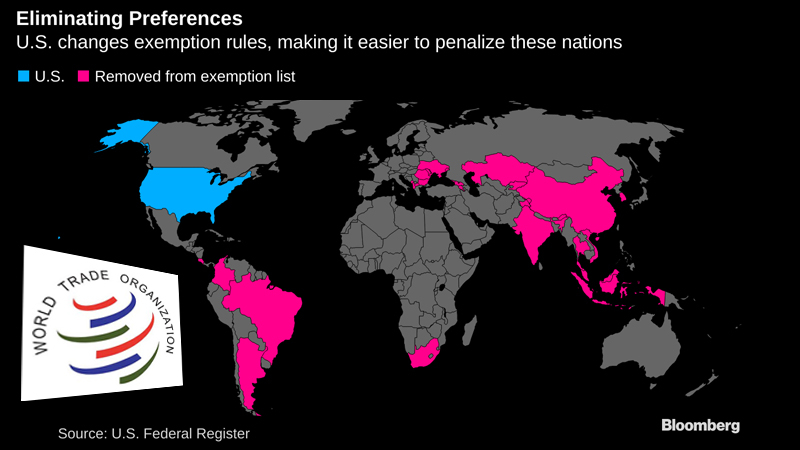
The Trump administration is changing a key exemption to America’s trade-remedy laws to make it easier to penalize about two dozen so-called developing countries including China, India and South Africa.

The U.S. on Monday narrowed its internal list of developing and least-developed countries in order to reduce the threshold for triggering a U.S. investigation into whether nations are harming U.S. industries with unfairly subsidized exports, according to a U.S. Trade Representative notice.

In doing so, the U.S. eliminated its special preferences for a list of self-declared developing countries that includes: Albania; Argentina; Armenia; Brazil; Bulgaria; China; Colombia; Costa Rica; Georgia; Hong Kong; India; Indonesia; Kazakhstan; the Kyrgyz Republic; Malaysia; Moldova; Montenegro; North Macedonia; Romania; Singapore; South Africa; South Korea; Thailand; Ukraine; and Vietnam.

USTR said the decision to revise its developing country methodology for countervailing duty investigations was necessary because America’s previous guidance – which dates back to 1998 – “is now obsolete.”

The development marks a noteworthy departure from two decades of American trade policy regarding developing nations that could result in more stringent penalties for some of the world’s top exporters.

The move also reflects President Donald Trump’s frustration that large economies like China and India are permitted to receive preferential trade benefits as developing nations at the World Trade Organization.

During his visit to Davos, Switzerland, last month Trump said the WTO hasn’t treated America fairly. “China is viewed as a developing nation. India is viewed as a developing nation. We’re not viewed as a developing nation. As far as I’m concerned, we’re a developing nation, too.”

The goal of the WTO’s special preferences for developing nations is to help poorer countries reduce poverty, generate employment and integrate themselves into the global trading system.

Under WTO rules, governments are required to terminate their countervailing duty investigations if the amount of foreign subsidy is de minimis, which is normally defined as less than 1% ad valorem.

But WTO rules provide a different standard for so-called developing nations that requires investigators to terminate duty investigation if the amount of subsidy is less than 2% ad valorem.

The Trump administration has sought to end these special preferences for nations that fall under certain categories, like those who are members of global economic clubs like the Group of 20, the OECD or who are classified as high-income nations by the World Bank.

Last July, Trump issued an executive memo that asked U.S. Trade Representative Robert Lighthizer to determine whether there’s been “substantial progress” toward limiting the number of countries considered developing nations. The U.S. may act unilaterally if not, Trump said.

Several of the de-listed countries in the USTR notice have already agreed to relinquish their developing-country rights in future trade negotiations, including Brazil, Singapore and South Korea.

U.S. stocks hit record despite coronavirus fears #ศาสตร์เกษตรดินปุ๋ย

#ศาสตร์เกษตรดินปุ๋ย : ขอบคุณแหล่งข้อมูล : หนังสือพิมพ์ The Nation

https://www.nationthailand.com/business/30381920?utm_source=category&utm_medium=internal_referral

U.S. stocks hit record despite coronavirus fears

Feb 11. 2020
By Syndication Washington Post, Bloomberg · Claire Ballentine, Vildana Hajric
U.S. equities started the week strong as investors looked past the potential economic hit from the spreading coronavirus to prepare for more corporate earnings.

The S&P 500 Index rose to a new high Monday, with most sectors advancing. Energy company shares proved the exception, declining as West Texas crude fell below $50 a barrel. Treasuries and European bonds edged higher, and the dollar held steady versus a basket of its major peers.

Asia’s main equity gauges fell everywhere other than Shanghai. Traders monitored the restart of Chinese factories and the possible chaos that may ensue as several hundred thousand people begin returning to work at companies such as Apple supplier Foxconn. General Motors says it will restart production in China beginning Feb. 15.

With cases of the coronavirus outside China on the rise and various companies pulling back from international meetings, investors are trying to figure out whether the rate of contagion is stabilizing. In the meantime, monetary authorities across emerging markets have stepped in to help shore up the financial system. The People’s Bank of China moved to keep liquidity ample Monday through reverse-repurchase agreements.

“As disconcerting as the spread of the coronavirus has been to date, the global focus on the illness is likely to produce a solution to stem its spread before long,” John Stoltzfus, chief investment strategist at Oppenheimer Asset Management, wrote in a note. “Economic data released last week underscored strength and resilience in the U.S. labor market and pointed toward the sustainability of the U.S. economic expansion.”

The euro declined after the region was buffeted by political headlines. German Chancellor Angela Merkel’s succession plan collapsed, and polls put Sinn Fein in place for a possible role in Ireland’s government, depressing the country’s banking stocks. European equities closed higher.

Earnings are due this week from major names such as Alibaba Group Holding, Credit Suisse Group and Nestle.

Elsewhere, emerging-market currencies steadied against the dollar. Bitcoin traded just below $10,000, having risen above that mark over the weekend for the first time since October.

– – –

Here are some key events coming up:

– Earnings season continues with reports including MGM Resorts and Cisco Systems on Monday; Softbank on Wednesday; and Alibaba, Nissan, Credit Suisse, Airbus, Nestle and AIG on Thursday.

– Federal Reserve Chairman Jerome Powell delivers his semiannual testimony in Congress on Tuesday and Wednesday; ECB President Christine Lagarde speaks at the European Parliament in Strasbourg on Tuesday.

– Thursday brings a gauge of underlying U.S. inflation, the core consumer price index. It’s expected to increase to 0.2% in January, a faster pace than in December.

– China and the U.S. on Friday lower tariffs on billions of dollars of respective imports, as part of the trade deal signed last month.

– – –

These are the main moves in markets:

Stocks

– The S&P 500 Index increased 0.7%, to 3,352.13, as of 4:01 p.m. New York time, the highest on record.

– The Stoxx Europe 600 Index rose 0.1%, to 424.64.

– The MSCI Asia Pacific Index decreased 0.5%, to 168.88.

– The MSCI Emerging Market Index fell 0.4%, to 1,086.80.

Currencies

– The Bloomberg Dollar Spot Index was little changed at 1,207.56, the highest in more than 10 weeks.

– The British pound climbed 0.2%, to $1.2912.

– The euro dipped 0.3%, to $1.0913, hitting the weakest in 19 weeks with its sixth consecutive decline.

– The Japanese yen was little changed at 109.74 per dollar.

– The offshore yuan strengthened 0.3%, to 6.9854 per dollar, the largest increase in four weeks.

Bonds

– The yield on 10-year Treasuries decreased three basis points, to 1.56%, the lowest in a week.

– Germany’s 10-year yield fell three basis points, to -0.41%, the lowest in a week on the largest drop in more than a week.

– Britain’s 10-year yield declined one basis point, to 0.557%, the lowest in a week.

Commodities

– West Texas Intermediate crude fell 1.5%, to $49.58 a barrel, the lowest in more than 13 months on the largest fall in a week.

– Gold strengthened 0.2%, to $1,573.67 an ounce, the highest in a week.

– LME copper dipped 1.3%, to $5,663 per metric ton, the largest decrease in two weeks.

Banks face rules on service fee calculation #ศาสตร์เกษตรดินปุ๋ย

#ศาสตร์เกษตรดินปุ๋ย : ขอบคุณแหล่งข้อมูล : หนังสือพิมพ์ The Nation

https://www.nationthailand.com/business/30381782?utm_source=category&utm_medium=internal_referral

Banks face rules on service fee calculation

Feb 11. 2020
The Bank of Thailand will introduce guidelines on service fee calculation by all financial institutes in the third quarter this year, said central bank’s assistant governor Thanyanit Niyomkarn, adding that it will lead to fair and reasonable charges.

The guidelines will apply to all service fee types and cover all kinds of customers from major corporate customers to individual customers.

She said it might affect banks’ revenues but will create fair treatment of customers and set a standard for the financial industry.

Kiatnakin Bank President Philip Chen Chong Tan said the bank was ready to comply with the guidelines.

He added that the guidelines are unlikely to affect revenue as it is a small bank.

Siam Commercial Bank’s president Apiphan Charoenanusorn believes the guidelines will affect banks but not to the extent that it will lead to zero service fee revenue this year.

Naris Sathapholdeja, head of TMB Analytics, said that total service fees of commercial banks last year amounted to Bt191 billion, compared to interest income of Bt480 billion.

Pockets of currency volatility may signal tide is changing #ศาสตร์เกษตรดินปุ๋ย

#ศาสตร์เกษตรดินปุ๋ย : ขอบคุณแหล่งข้อมูล : หนังสือพิมพ์ The Nation

https://www.nationthailand.com/business/30381915?utm_source=category&utm_medium=internal_referral

Pockets of currency volatility may signal tide is changing

Feb 11. 2020
By Syndication Washington Post, Bloomberg · Robert Fullem
As broader gauges of implied currency volatility remain near all-time lows, pockets of turbulence are emerging in a potential signal that the foreign-exchange market could be less stable in 2020.

Take the yuan. After rising more than 1.5% in the month prior to the Jan. 15 signing of the U.S.-China trade agreement, the currency has relinquished those gains amid concerns that Chinese growth could stumble as the coronavirus spreads. Singapore, a key financial hub, is seeing historic price swings due to angst around the outbreak.

The uncertainty has helped lift Asian currency volatility to its highest level in six months and the greenback to a two-month high, a development that could rekindle efforts by the U.S. administration to “talk down” the dollar.

In addition to anxiety about growth, the yuan may also sway more freely due to a clause in the phase-one trade deal that reaffirms commitments to refrain from competitive devaluation, said Alan Ruskin, Deutsche Bank’s chief international strategist.

China “will have a harder time in general containing volatility if the U.S. is on the lookout for intervention, or surrogate intervention,” Ruskin said by phone.

Both the Australian dollar-yen and New Zealand dollar-yen are “risk blow-up pairs” and can be used as proxies for capturing potential volatility in Asia, Ruskin said. One-year volatility in both pairs is relatively cheap compared to most other Group-of-10 peers, he said.

Record low implied volatility in Europe’s common currency against the U.S. dollar may have an outsized impact on depressing broader gauges of price swings. But it doesn’t mean the euro isn’t subject to choppiness elsewhere. Implied volatility in euro-Swiss franc, a barometer of global risk appetite, has climbed to a premium to euro-dollar volatility. At the lowest in more than two years in the spot market, euro-franc is teetering near a key technical level, a breach of which could spark a sharp move lower by the common currency.

Meanwhile, Eastern European currencies have also seen price swings as central bank policy rates diverge. On Thursday, the Czech central bank unexpectedly raised rates 25 basis points to 2.25% to tame inflation pressures.

Whether these pockets of turbulence spread to the broader market could depend on several factors. To be sure, volatility may not return to levels seen a decade ago should central banks continue to actively use their balance sheets to manage liquidity issues or regulatory barriers to capital movement arise.

Still, the efficacy of persistent central bank accommodation is already being questioned by policy makers including European Central Bank President Christine Lagarde. It may be a more contentious topic should inflation rise and business activity pick up.

Meanwhile, American targeting of currency devaluations may prompt global officials to slow the pace of intervention. Geopolitical events such as the U.S. presidential elections add an element of uncertainty.

Falling euro volatility has not prevented realized volatility, as measured by the Deutsche Bank CVIX index, from climbing above its implied counterpart, making conditions more appealing for option-buyers. For funding currencies like the euro and yen to move out of a low-volatility regime, short-term realized volatility needs to demonstrate that it has staying power, a condition that would likely require a rise in long-term implied volatility and a weeding out of mean-reverting trading strategies.

Markets may have to strap in as early as this week, when Federal Reserve Chairman Jerome Powell gives his semi-annual congressional testimony.

Bitcoin drops from $10,000 while technicals point to pain ahead #ศาสตร์เกษตรดินปุ๋ย

#ศาสตร์เกษตรดินปุ๋ย : ขอบคุณแหล่งข้อมูล : หนังสือพิมพ์ The Nation

https://www.nationthailand.com/business/30381910?utm_source=category&utm_medium=internal_referral

Bitcoin drops from $10,000 while technicals point to pain ahead

Feb 11. 2020
By Syndication Washington Post, Bloomberg · Vildana Hajric 

Euphoria around bitcoin’s break above $10,000 over the weekend appears to be short-lived.

The largest cryptocurrency found resistance just above that level, reaching as high as $10,194 on Sunday before pulling back, according to data compiled by Bloomberg. It similarly struggled with that level in September when it crossed $10,000 — the month that followed saw it lose more than 14%.

In addition, the token is overbought based on the 14-day relative strength index (RSI), which crossed the 70 mark. Assets are considered overbought if the RSI exceeds 70. Those two factors suggest a potential retreat ahead as the coin struggles to meaningfully break out from its recent trading range.

“It’s a consolidating bull market,” Mike McGlone, an analyst with Bloomberg Intelligence wrote in a recent note. “Volume and open interest in futures, and on-chain addresses used, are primary Bitcoin-adoption metrics that have soundly increased vs. a month ago, supporting price appreciation. The next key story for the benchmark crypto will be its bid to exit the $8,000-$10,000 range.”

On Sunday, Bitcoin surged above the $10,000, marking only the third such major breakout in its history. The first occurred in 2017 before it rose to near $20,000 and, more recently, it broke above it in mid-2019 before retracing.

Bitcoin was up 1.4% as of 10:44 a.m. in New York to trade around $9,884. Litecoin and Ether each gained 1.9%, while the Bloomberg Galaxy Crypto Index — which tracks some of the largest crypto assets, gained 1.8%.