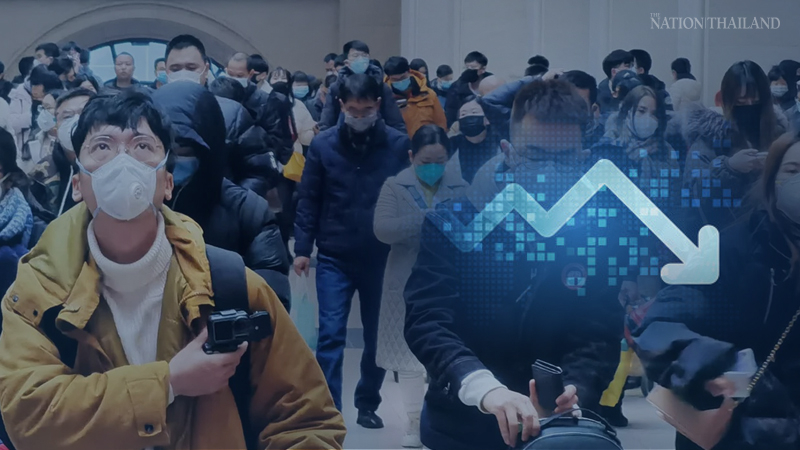
As Chinese tourists stay home, a world that has grown dependent on them feels their absence #ศาสตร์เกษตรดินปุ๋ย

#ศาสตร์เกษตรดินปุ๋ย : ขอบคุณแหล่งข้อมูล : หนังสือพิมพ์ The Nation

https://www.nationthailand.com/business/30381800?utm_source=category&utm_medium=internal_referral

As Chinese tourists stay home, a world that has grown dependent on them feels their absence

Feb 08. 2020
By The Washington Post · Chico Harlan, Stefano Pitrelli 

CIVITA DI BAGNOREGIO, Italy – The village is 2,500 years old, perched on a sheer hilltop, rising into the sky like a storybook illustration. A little more than a decade ago, it was on the verge of extinction. It’s survived with the help of the world’s most powerful tourism force: a flood of Chinese visitors.

“It’s become like a Chinatown,” said Fabrizio Rocchi, a restaurateur in the village, which has a full-time population of eight people and typically hosts seven or eight tour buses per day, more than 100,000 people in a year.

The past week, though, has offered a vision of a daunting alternative reality.

To contain the spread of coronavirus, China has suspended all outbound tour groups. International airlines have cut back on or suspended routes. A handful of countries, including Italy, have closed themselves off entirely to air traffic from China.

And so, after years of racing to accommodate Chinese visitors and growing reliant on their spending, tourist destinations large and small are starting to feel what happens when the world’s most populous country hunkers down and stays home.

Of course, part of why a virus that originated in Wuhan, China, has shown up in so many places around the world is because Chinese have become such avid travelers. They constitute more than 10% of the global tourism industry and the fastest-growing market for long-haul flights. During the 2003 SARS outbreak, some 20 million Chinese went abroad every year; in 2018, that number was 150 million.

The most popular destinations are in Northeast and Southeast Asia, according to Chinese government figures. Chinese still make up only a fraction of Europe’s overall visitors. But, more and more, they’re visiting niche destinations on the continent – not just the Colosseum and the Louvre, but French towns famed for particular wines and cheese, and picturesque Italian villages that make for the perfect social media backdrop.

“Chinese tourism is in total evolution,” said Alberto Corti, the director of Confturismo, Italy’s main tourism association. “We think of the bus tours, people only eating Chinese food – yes, it exists. But the number of tours is decreasing, and the number of individual travelers is increasing. The average age is going down.”

And when abroad, an ascendant Chinese middle class spends money in a way few other tourists do. In Paris, the average Chinese tourist spends 60% more than those from other destinations, according to data collected by Paris’s regional tourism board and shared with Reuters. In Italy, Chinese travelers account for nearly 30% of tax free shopping.

Except now, suddenly, coronavirus has brought all that to a halt.

At the grand department stores of Paris and the luxury flagships of Rome, specially hired Mandarin-speaking employees are finding fewer customers to greet. The museums and monuments of the Italian capital are still mobbed by tourists, but at the famed Trevi Fountain on a recent afternoon, there was only one tour group – from Taiwan.

Hotels and travel agencies catering to Chinese have seen what one employee in Rome called a “bloodbath” of cancellations, affecting everywhere from Swiss ski resorts, which had been expecting to fill ski school classes taught in Madarin, to Trier, Germany, the birth place of Karl Marx.

Corti said hotels and other businesses stand to lose hundreds of millions of euros – a number that will grow if the travel restrictions carry into the spring and summer.

“In a while, we might have to [temporarily] shutter too,” said Jin Lili, the operator of a Rome-based travel agency that works with Chinese customers. “There is no work.”

In Italy’s Civita di Bagnoregio, the last trickle of tours have been coming through, with people who started their travels before the virus exploded. And even some of those groups are smaller than they would have been, because of travelers who were unable to leave China as the virus began to spread.

“We were supposed to be 20 people. Instead, we’re 10,” said Han Hui, 30, a painter from Hainan, who was wandering past the village’s vine-covered stone homes.

Chinese visitors still in Europe say they feel they’re being viewed with trepidation. There have been a handful of cases of blatant xenophobia – jeering on trains or public buses, for instance. But the more common scenario comes in hotel lines, where other visitors keep their distance, or in restaurants, where even healthy Chinese feel like they’ll be stared at if they let out a cough.

Only three cases of coronavirus have been identified in Italy. Two Chinese tourists who had been staying in Rome tested positive, as did one Italian who had been evacuated from Wuhan, China.

This past week, one tourist in Civita di Bagnoregio hesitated before walking into a perfume shop, uncertain whether she would be welcomed.

“Is it okay to enter?” the tourist asked, explaining where she was from.

“You can come in, don’t worry,” said the employee, Gessica Cirica, who has taught herself to speak a few words of Mandarin and Cantonese, as well as Japanese.

Amid the outbreak, others in the village have wondered whether it was risky to have Chinese visitors. The town’s mayor, Luca Profili, said there had been “clearly a bit of worry,” given that some days Chinese account for 90% of foreign tourists.

“Some were asking if I’d take action,” Profili said. “Once [the Italian government] shut down flights, everybody felt more at ease.”

Any reassurance about the chances of the virus making its way here, though, is counterbalanced by unease about what the drop in visitors might mean for the local economy.

Among the places that had been lifted by the wave of Chinese tourism, Civita di Bangnoregio is among the most unlikely. It’s a two-hour drive from Rome, accessible only by footbridge, and, until a decade ago, it was just one of Italy’s crumbling, evocative hilltop towns.

But the village worked to promote itself as a precarious, endangered treasure. The town also had the fortune of resembling a dreamy world depicted in a Hayao Miyazaki anime film, “Laputa: Castle in the Sky.”

Tourists started coming in droves.

The village charges a five-euro entrance fee for visitors crossing the bridge. It has used the money for renovations, to provide access to people with disabilities and to update public restrooms. Some people who’d left the town came back to turn their homes into bed-and-breakfasts. Restaurants added tables and saw the number of visitors grow year-by-year. Last year, Chinese accounted for more than one-quarter of foreign visitors.

This past week, the remaining flow of Chinese visitors was still enough to fill several tables at one of the village’s restaurants. The owner, Arianna Bastoni, said tourism has benefited her family and her business. But the equation was less complicated before the virus. If Chinese tourists stopped coming, she’d lose money. She’d also feel temporarily more secure until the virus runs its course.

“Of course we are happy when they bring us work,” Bastoni said. “[But] there is a bit of fear.”

The economy added 225,000 jobs in January, showing continued strength #ศาสตร์เกษตรดินปุ๋ย

#ศาสตร์เกษตรดินปุ๋ย : ขอบคุณแหล่งข้อมูล : หนังสือพิมพ์ The Nation

https://www.nationthailand.com/business/30381798?utm_source=category&utm_medium=internal_referral

The economy added 225,000 jobs in January, showing continued strength

Feb 08. 2020
By Adding reaction, details from report
The Washington Post · Eli Rosenberg, Heather Long
WASHINGTON – The unemployment rate ticked up slightly to 3.6%, mostly due to more people rejoining the labor force. The jobless rate remains near a 50 year low.

The areas of strongest job growth came in construction, health care, as well as transportation and warehousing, according to the Bureau of Labor Statistics. Retail and manufacturing were the two areas with the most significant job loss.

“I can say that it pretty much blew estimates out of the water,” said Beth Ann Bovino, the Chief U.S. Economist at S&P Global. “It’s just a really nice report. I’d also say that the recession fears of last year seem to be a thing of the past when you look at this report.”

The number of jobs added for the month was well above the average of 176,000 jobs per month in 2019, and 223,000 jobs added each month of 2018. In 2019, the U.S. added 300,000 jobs in January, an impressive uptick that federal statisticians surmised had spiked because of the government shutdown as people took on part-time jobs.

Business experts had expected a more modest monthly total of around 150,000 jobs, saying a slowdown was inevitable with the economy’s long expansion. January was the 112th straight month of job growth since 2010.

The report comes on the heels of a milestone December, when women outnumbered men in the workforce for only the second time in history. That number was mostly unchanged in January, with women continuing to make up just over 50 percent of the non-farm labor force.

Perhaps the most encouraging news in the latest jobs report is that the share of working Americans who have jobs or are actively looking for work – known as the labor force participation rate -which ticked up to its highest level in seven years, about 63.4%. It’s another sign that the tight labor market is wooing more people back to the job market.

“It’s a really strong start to the year, and another sign that this expansion has really astounded to continue to pull folks into the labor force,” said Nick Bunker, an economist at the Indeed Hiring Lab. “The strong labor gains are great – we’re not only seeing a rise in labor force participation but a pick up in employment as well. It’s a sign that the labor market has some momentum and could keep going for quite some time.”

President Donald Trump is staking his reelection campaign in part on the strength of the economy – touting the job creation under his administration repeatedly during the State of the Union address, for example.

But analysts have urged caution, pointing to other economic measures. Relatively modest wage growth, around 3.1%, remains a puzzle for economists who say it has not grown as expected given the increasingly tight labor market. Business investment has fallen for three straight quarters. And problems at Boeing as well as fears about the coronavirus have raised fears about more economic head winds on the horizon.

“It’s a powerful antidote, in many ways, with respect to what’s been happening in Washington,” said Mark Hamrick, a economic analyst at Bankrate. “In many ways we’ve seen a political environment that is violently ill, and yet the economy appears to be very robust…. A year or so ago we were thinking we could be on the precipice of a recession. The reality is that the expansion looks good for some time to come for the future.”

The Labor Department also released data Friday showing that 514,000 fewer jobs were added between April 2018 and March 2019 than originally thought. The initial data reported each month in the jobs report comes from a survey sample of businesses to see how many people were added or subtracted from payrolls. The revised data encompasses nearly all businesses in the United States, but it takes longer to gather the information, which is why there is a delay in releasing it.

The revisions show that there 2019 was the weakest year of job growth in eight years and that there wasn’t such a big job boom in 2018 after the Trump Administration’s tax cuts. Instead, what has become clearer is the job market remains fairly hot, but job growth has been gradually slowing since it peaked in 2014.

“Job growth still looks very healthy,” said economist Ernie Tedeschi, a managing director at research firm Evercore ISI. “But the story that the tax cuts heated up the labor market in 2018 changes a bit. Instead of job growth really accelerating in 2018, it looks more like it stayed pretty flat.”

The jobs report is the first since President Trump signed the U.S.-Mexico-Canada Agreement in January, and weeks after Trump signed a partial trade deal with China, ending months of uncertainty over some of his major economic proposals.

Of the 12,000 jobs lost in manufacturing, 10,600 came from the car and parts production.

The economy added 225,000 jobs in January, showing continued strength #ศาสตร์เกษตรดินปุ๋ย

#ศาสตร์เกษตรดินปุ๋ย : ขอบคุณแหล่งข้อมูล : หนังสือพิมพ์ The Nation

https://www.nationthailand.com/business/30381788?utm_source=category&utm_medium=internal_referral

The economy added 225,000 jobs in January, showing continued strength

Feb 07. 2020
File Photo

File Photo
By The Washington Post · Eli Rosenberg 

WASHINGTON – The U.S. economy added 225,000 jobs in January, surpassing analysts predictions in a sign of continued growth for the economy.

The unemployment rate ticked up slightly to 3.6 percent, remaining near a 50 year low.

Job gains picked up in construction, health care, as well as transportation and warehousing, according to the Bureau of Labor Statistics.

The number of jobs added for the month was well above the average of 176,000 jobs per month in 2019, and 223,000 in 2018. In 2019, the U.S. added 300,000 jobs in January, an impressive uptick that federal statisticians surmised had spiked because of the government shutdown as people took on part-time jobs.

Business experts had expected a more modest monthly total, saying it was inevitable with the economy’s long expansion. January was the 112th straight month of job growth since 2010 and many analysts predicted the total would be around 150,000 or 160,000.

The report comes on the heels of a milestone December, when women outnumbered men in the job force for only the second time in history.

President Trump is staking his reelection campaign in part on the strength of the economy – touting the job creation under his administration repeatedly during the State of the Union address, for example.

But analysts have urged caution, pointing to other economic measures that suggest economy may be cooling. Relatively modest wage growth remains a puzzle for economists who say it has not grown as expected given the increasingly tight labor market. Business investment has fallen for three straight quarters. And problems at Boeing as well as fears about the coronavirus have raised fears about more economic head winds on the horizon.

The jobs report is the first since President Donald Trump signed the U.S.-Mexico-Canada Agreement in January, and weeks after Trump signed a partial trade deal with China, ending months of uncertainty over some of his major economic proposals.

Russia a clear winner in U.S. embargo of Venezuelan oil #ศาสตร์เกษตรดินปุ๋ย

#ศาสตร์เกษตรดินปุ๋ย : ขอบคุณแหล่งข้อมูล : หนังสือพิมพ์ The Nation

https://www.nationthailand.com/business/30381773?utm_source=category&utm_medium=internal_referral

Russia a clear winner in U.S. embargo of Venezuelan oil

Feb 07. 2020
Miners erode river banks in search of gold in Canaima National Park in Parai-Tepui, Venezuela, on May 14, 2019. MUST CREDIT: Washington Post photo by Michael Robinson Chavez

Miners erode river banks in search of gold in Canaima National Park in Parai-Tepui, Venezuela, on May 14, 2019. MUST CREDIT: Washington Post photo by Michael Robinson Chavez
By The Washington Post · Anthony Faiola, Karen DeYoung 

In the year since the Trump administration declared what amounted to economic war against the Venezuelan government of President Nicolás Maduro – an oil embargo that cut it off from its biggest petroleum buyer, the United States – the move has yielded some clear losers, including U.S. investors now shut out of the market.

It has also produced one clear winner: Vladimir Putin’s Russia.

U.S. officials, oil industry insiders and analysts say secret deals between Moscow and Caracas to produce, transport and sell oil to other markets have become a cash cow for Russia that is earning its state-controlled enterprises an estimated $120 million a month.
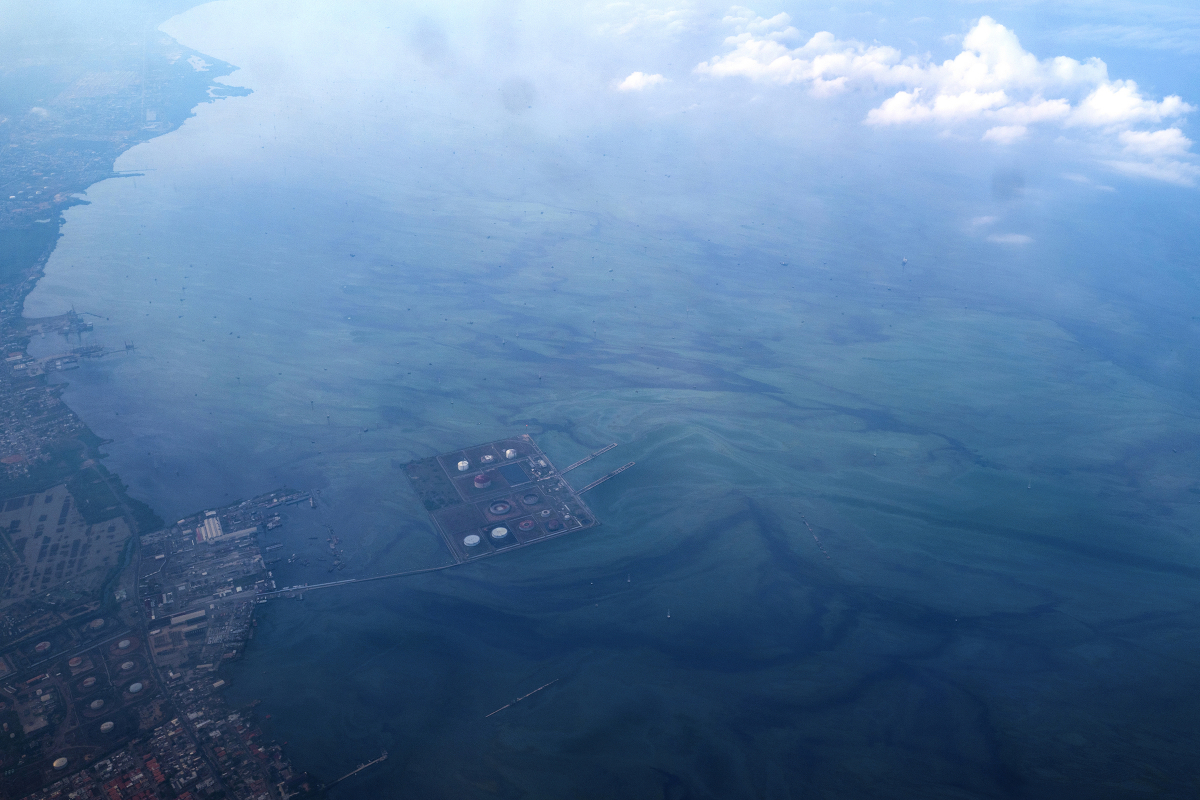
Oil streaks the surface of Lake Maracaibo just offshore from the oil production centers of Cabimas, Venezuela. MUST CREDIT: Washington Post photo by Michael Robinson Chavez

Oil streaks the surface of Lake Maracaibo just offshore from the oil production centers of Cabimas, Venezuela. MUST CREDIT: Washington Post photo by Michael Robinson Chavez

The Russians describe their relationship with the South American nation, home to the world’s largest proven oil reserves, as one of “mutual cooperation.” Since Hugo Chávez founded the socialist state in 1999, Russia has become Venezuela’s primary supplier of military equipment and advisers, a consistent supporter in international bodies and a key source of government loans and investment.

But now, observers say, the Russians are to some extent extorting Maduro, Chavez’s successor, who has been boxed in by the United States. Washington is blacklisting ships that transport Venezuelan crude and threatening secondary measures against any entity, including international banks and customers, that “materially assist” Maduro’s government. That’s made Venezuela’s greatest asset – its oil – a globally toxic brand.

The Russians have been willing to absorb the risk of sanctions. They’re chartering vessels from third parties and obscuring the origin of the crude as they market it around the world.

But they’re also charging Maduro dearly for their efforts – sometimes through fees but more often by demanding deep discounts on crude that can be flipped for a tidy profit.

U.S. officials and industry analysts say Russian state companies – chiefly the state-controlled oil giant Rosneft – are handling 70% to 80% of Venezuela’s total oil exports.

In sharp contrast to the drain on the coffers of the Soviet Union resulting from Moscow’s Cold War-era support of communist Cuba, today’s relationship with socialist Venezuela is providing Russia with a rare opportunity to make a mint as it strengthens its foothold in the backyard of the United States.

Neither the Russian Foreign Ministry nor Rosneft responded Thursday to requests for comment. PDVSA, Venezuela’s state-owned oil company, and Venezuela’s communications ministry were similarly unresponsive.

In an interview last month with The Washington Post, Maduro said Rosneft was responsible for “15 to 20%” of Venezuela’s oil production, and was making “important investments to multiply that production.” He did not address Russian marketing or transport of the oil.

U.S. officials and industry sources say the Russians also have been supplying Venezuela with the chemicals it needs to keep its troubled oil sector functioning as well as with refined gasoline. Much of Venezuela’s supply of chemicals was previously provided by U.S. companies. But Maduro appeared to play down Venezuela’s reliance on Russia.

“The U.S. has tried to block all of the imports we need for energy production, but for now we’ve succeeded in avoiding being impacted by it,” he said. “Those relations are diversified. They don’t depend on just one international actor.”

This article, which reveals new details of Russia’s economic involvement with Venezuela, is based on more than a dozen interviews with people familiar with Russia-Venezuela deals, several of whom spoke on the condition of anonymity to discuss sensitive matters.

The Russians have made no secret of their support for Maduro, who is considered illegitimate by the United States and more than 50 other governments, or of their political and economic interest in Venezuela, a broken and isolated country in search of any benefactors it can find. Russian Foreign Minister Sergei Lavrov is due in Caracas on Friday, when the Russian Foreign Ministry says he will discuss “practical steps to deepen cooperation between the two countries in such areas such as energy, mining, transport, agriculture, medicine, pharmaceuticals and military-technical cooperation.”

“The Russians have learned that they don’t need another Cuba, they don’t need to engage in imperial overstretch,” said Russ Dallen, a managing partner at Caracas Capital Markets, a financial and consulting firm that tracks Venezuelan oil. “This time, they are making their colonies pay and are sucking everything they can out of Venezuela.”

U.S. officials estimate that Rosneft is handling 400,000 barrels of Venezuelan crude a day – more than half of Venezuela’s production, by some accounts – and reaping a profit of roughly $120 million a month. Venezuelan oil insiders with access to data from PDVSA put the number slightly lower, depending on production levels in any given month. Venezuela’s oil output has fallen by about 35% since the embargo was imposed in January 2019.

Other companies, including Spain’s Repsol, India’s Reliance and U.S.-based Chevron, which has been given a renewable sanctions waiver, remain relatively minor players in the Venezuelan oil industry.

Rosneft remains by far the most important foreign company doing business in Venezuela, not only as an investor in five joint oil ventures but also as a force in marketing and sales.

“Rosneft is making a lot of money in Venezuela,” said Elliott Abrams, the U.S. special representative on Venezuela. “If you think about the number of barrels a day they are handling, it turns into a neat profit.”

Russia has said the oil it ships from Venezuela is not subject to U.S. sanctions, which restrict U.S. companies and individuals from doing business with the Venezuelan government and PDVSA. Russia has also received Venezuelan oil as repayment of Rosneft loans.

U.S. officials say they are considering ways to cut the lifeline Rosneft and its subsidiaries are providing to Maduro.

“We’re letting the Russians and we’re letting the company know that their support of the Maduro regime is – it’s not a good business decision, but it’s also immoral, what it’s doing to the people of Venezuela,” White House national security adviser Robert O’Brien said at a forum in Washington on Wednesday.

“So I think you’re going to see some action, either voluntarily from the company, or the U.S. will likely take action in the near future on that issue.”

But sanctions against one of Russia’s largest companies is a controversial decision within the Trump administration. U.S. imports of Russian crude oil have surged over the past year. According to Dallen, Russia is now the second largest supplier to American refineries.

Venezuela’s opposition has supported U.S. sanctions on Maduro’s government.

“If we assume that the way forward is to increase diplomatic, economic and financial pressure on the dictatorship, then I believe that all sources of oxygen to Maduro to maintain his repressive apparatus must be addressed,” senior opposition figure Leopoldo López said in an interview.

Abrams said the approach is working. He pointed to the extraordinary steps Maduro has taken to sustain the economy under the embargo – including embracing a de facto dollarization of the economy and holding talks to give control of oil sites to foreign companies.

“When people say to me the sanctions are not working, I look at Maduro committing treason against Chavismo, and I say, this can only be explained by the impact of sanctions,” he said.

– – –

At 8 p.m. on Nov. 6, two men representing themselves as senior members of Russian intelligence – Oleg Antonov, 50, and Tsvetan Kirilov, 40 – held a meeting in a midrise building in central Caracas. Several executives from Venezuela’s oil and other industrial sectors were present, according to four people who said they had direct knowledge of the event.

Trump administration sanctions, the Russians argued, had largely targeted the state-owned oil firm. So they pitched a way around them, with oil exploration and export deals conducted through joint ventures between Russian companies and private Venezuelan entrepreneurs. Such arrangements, the two men suggested, could exploit a loophole that would make it easier to sell Venezuelan crude to leery foreign buyers.

Under a deal struck between Chávez and the Cuban leader Fidel Castro, Venezuela provides free or heavily discounted oil to the communist island, which keeps some and sells the rest. The Trump administration, which accuses Cuba of running Venezuela’s repressive intelligence service, has been studying the possibility of a limited naval blockade to prevent the shipments, and it has blacklisted several ships and maritime companies based in countries such as Cyprus and Panama.

The Russians, the people with knowledge of the meeting said, floated the idea of flying Russian flags on tankers leaving Venezuela’s ports, essentially daring the United States to interfere. They also discussed the possibility of expanding cooperation in gold and other commodities mined in Venezuela’s mineral-rich south.

U.S. sanctions block Venezuela’s government and specific individuals close to it from using the U.S. financial system or conducting transactions in U.S. dollars, measures that have led many European banks to stay away rather than complicate their relations with the United States.

But the Russians discussed expanding a system already employed by the Maduro government to sidestep U.S. sanctions: the use of Russian banks to store cash and make international transactions on Venezuela’s behalf.

“The Russians were talking about everything, about more business, about how to get around U.S. sanctions,” said one person with direct knowledge of the meeting.

Asked about the reported meeting and the Russian individuals, the CIA declined to comment.

Russia’s Federal Security Service, the alleged employer of the two visitors, did not respond to a request for comment.

Putin has long criticized U.S. sanctions against Russia and other countries, and he has suggested that other currencies be used to replace the dollar as international tender.

The Russians are expanding their stakes in Venezuela in other ways. Rosneft in recent months has increased its operational control over existing joint ventures in the oil sector, including the largest such enterprise, Petromonagas. It has also engaged in talks about creating arrangements in which foreigners would hold majority ownership. Such arrangements, first reported by Bloomberg News and confirmed by two people familiar with the discussions, would effectively defy a Chávez-era policy against allowing foreign entities to control any part of the nation’s energy sector.

In an interview with The Washington Post, Juan Guaidó, the opposition figure recognized by the United States and more than 50 other nations as Venezuela’s true leader, would not say whether he backed harsher U.S. sanctions on Rosneft. But he said “it’s clear that in 2019, the primary economic beneficiary [in Venezuela] were companies of Russian origin.”

Others argue that the administration has overshot on sanctions. In last month’s interview, Maduro suggested that U.S. companies could once again profit from Venezuela’s oil sector should sanctions be relaxed. Some U.S. industry players – most of whom have been shut out of Venezuela – say Washington is imposing an “America last” policy that is effectively granting the Russians exclusive access to Venezuela’s wealth.

Sanctions have “empowered and enriched the U.S.’s strategic adversaries, particularly the Russians who have used the crisis to regain a military foothold in our hemisphere, as Rosneft plunders a fortune by monopolizing the trade of hydrocarbons in and out of Venezuela,” Harry Sargeant, a principal of the U.S. firm EREPLA Services, said in a statement. The company entered into a potentially lucrative contract with the state-owned Venezuelan oil firm PDVSA in 2018 but has been prevented by sanctions from launching operations.

The financial relationship between Russia and Venezuela has changed over time. During the Chávez years, the Russians extended $3.15 billion of credit for the purchase of Sukhoi fighter jets, air defense systems, tanks and other weapons. In 2014, the year after Chávez died and Maduro took over, Russia, through Rosneft, provided some $6.5 billion in loans to PDVSA. Venezuela has repaid that loan with oil at a rate of nearly $2 billion a year. The full amount is set to be paid off by the first quarter of this year.

The Russians could offer new loans to Venezuela for repayment in oil. In the meantime, analysts say, they are engaging in obfuscation and logistical tricks to hide the extent of their involvement in Venezuelan’s oil export trade.

Though China largely ceased direct imports of Venezuelan oil last year in a nod to U.S. sanctions, the Chinese appear still to be receiving Maduro’s crude – now delivered by the Russians.

In December, for example, Rosneft chartered the Princess Mary, a Liberian-flagged freighter, according to port documents obtained by Caracas Capital. The ship had previously been used to transport crude to an India refinery co-owned by Rosneft. India is an importer of Venezuelan oil that has resisted U.S. appeals to stop.

On Dec. 3, the Princess Mary picked up a large cargo of oil from an offshore platform near the Puerto Jose refinery on Venezuela’s northern coast.

For the next 12 days, according to captures of the ship’s transponder, it sailed to a point off Togo on the West African coast, Caracas Capital says. There, it rendezvoused with two smaller ships, the Ridge U and the Ridge A. The Princess Mary’s crude was transferred to the smaller ships at sea. They then sailed toward Asia, according to transponder data and satellite images.

The Ridge A stopped sending transponder signals on Jan. 15. Five days later, the vessel turned up in the Chinese port of Zhanjiang. As of this week, the Ridge U remained in the Singapore Strait, reporting its destination as Shandong, China.

“The Russians are now acting as the personal Uber drivers for Venezuelan oil,” Dallen said.

The Chinese Foreign Ministry did not respond Thursday to a request for comment.

House passes bill to rewrite labor laws and strengthen unions #ศาสตร์เกษตรดินปุ๋ย

#ศาสตร์เกษตรดินปุ๋ย : ขอบคุณแหล่งข้อมูล : หนังสือพิมพ์ The Nation

https://www.nationthailand.com/business/30381748?utm_source=category&utm_medium=internal_referral

House passes bill to rewrite labor laws and strengthen unions

Feb 07. 2020
By The Washington Post · Eli Rosenberg

One of the most significant bills to strengthen workers’ abilities to organize in the past 80 years passed the House on Thursday, the latest sign of momentum for the labor movement.

The Protecting the Right to Organize Act, known as the PRO Act, would amend some of the country’s decades-old labor laws to give workers more power during disputes at work, add penalties for companies that retaliate against workers who organize and grant some hundreds of thousands of workers collective-bargaining rights they don’t currently have. It would also weaken “right-to-work” laws in 27 states that allow employees to forgo participating in and paying dues to unions.

The House passed the bill with a vote of 224 to 194, mostly along party lines.

The bill is unlikely to be taken up by the GOP-controlled Senate, as Republicans and business groups have argued forcefully against it, saying it would hurt employers, violate privacy rights and be a major boon for national unions.

Whatever the bill’s fate, it highlights the growing push to reexamine the country’s decades-old labor laws.

The National Labor Relations Board, which is charged with upholding workers’ rights to unionize or work together to improve their workplaces, currently has no ability to levy fines when it finds that companies have broken the law, such as firing a worker for starting a union campaign.

This bill would give the NLRB, which enforces federal labor law, the power to fine companies up to $50,000 per violation. It would also award workers’ compensation for the damages they experience when they are retaliated against, not just back pay and reinstatement, as they are currently entitled to.

The bill would also allow more people currently classified as contractors to be given the status of employees for the purposes of union organizing, potentially paving the way for gig workers at companies such as Lyft, Uber and DoorDash to organize with unions or among themselves.

The bill would also weaken right-to-work laws passed in predominantly red states, which allow employees in many states to be exempt from paying fees to unions that represent them.

A group formed to oppose the bill from many business groups, the Coalition for a Democratic Workplace, has sharply criticized a provision in the bill that requires employers to provide a list of their employees’ information, including jobs, shift information, cellphone numbers and addresses, to union leadership as an NLRB-sanctioned election nears.

The staff of Sen. Lamar Alexander, R-Tenn., chairman of the Committee on Health, Education, Labor and Pensions, has said the committee will not consider the legislation this session.

How Switzerland could find itself labeled a currency manipulator #ศาสตร์เกษตรดินปุ๋ย

#ศาสตร์เกษตรดินปุ๋ย : ขอบคุณแหล่งข้อมูล : หนังสือพิมพ์ The Nation

https://www.nationthailand.com/business/30381740?utm_source=category&utm_medium=internal_referral

How Switzerland could find itself labeled a currency manipulator

Feb 07. 2020
By Syndication Washington Post, Bloomberg · Catherine Bosley

Switzerland may be hoping that it’s just too small for President Donald Trump to care about it.

The export-reliant economy at the heart of Europe risks letting history repeat itself if it becomes a target in the U.S. president’s trade war, a decade after it ran afoul of Washington with banking secrecy.

Switzerland is in danger of being labeled a currency manipulator. U.S. Treasury officials put it back onto a shortlist for that designation last month, citing its high capital-account surplus and bilateral trade balance.

Another barrage of foreign exchange interventions by the Swiss National Bank to limit the franc’s gains could be all that’s needed to qualify.

“There’s quite a big danger of Switzerland, with its high current account balance, winding up in the cross hairs of U.S. politics, and on Donald Trump’s Twitter feed, in the medium term,” said Adriel Jost, an economist at consultancy Wellershoff & Partner.

With the franc, one of the world’s most-traded currencies, near a three-year high against the euro, SNB officials might be tempted to act. But the Trump administration’s push for the power to apply punitive tariffs on countries accused of manipulating currencies serves as a reminder of the potential consequences.

Such an initiative could open a new front in Trump’s trade wars after only a brief lull marked by the signing of an initial agreement on commerce between the U.S. and China.

Publicly, at least, Swiss officials don’t seem worried about being back on the watchlist they escaped in 2018. SNB policy makers insist the U.S. understands Switzerland’s position — and that may be true.

“We never intend to weaken the Swiss franc to get an advantage over other countries but rather we have to avoid that the Swiss franc becomes too strong,” SNB President Thomas Jordan said in an interview last month.

Interventions are a key part of Swiss monetary policy, because too strong a currency will choke off growth. The franc was little changed at 1.0716 per euro at 10:18 a.m. in Zurich.

Still, there’s plenty of precedent for the Swiss to ponder. International pressure forced the Bern government to change the way multinational corporations were taxed. Just last year, the European Union threatened to cripple the Swiss stock exchange as it sought to extract concessions in a political dispute.

Most famously, during the global financial crisis, the U.S. led a crackdown on Switzerland’s policy of letting bank customers keep account details from tax authorities. A decade later, after more than $6 billion in fines paid by banks, secrecy has been abolished for non residents.

As the U.S. president trains his sights on Europe, Switzerland might make an appealing target. The country of 8.5 million lacks the clout of the EU, which it has refused to join.

It’s big enough to make an example of to bully others, but too insignificant to fight back. While the U.S. is Switzerland’s biggest extra-European destination for exports, for the U.S. it accounts for less than 2%.

For its part, the Swiss government has said relations with the U.S. are “excellent” and that there are regular discussions of financial matters.

If the U.S. deems a country a currency manipulator, under a 2015 law the U.S. must embark on talks. If the problems aren’t corrected, the U.S. can impose foreign-investment restrictions and seek redress through the International Monetary Fund.

But the fund has already said the SNB’s monetary policy is “appropriate.”

Switzerland’s exports of more than $40 billion a year might appeal as a target to the White House. But the lion’s share of those sales are pharmaceuticals, including cancer drugs made by Basel-based Roche Holding and gene therapies by rival Novartis. Punitive tariffs might not curb demand.

Bern may lack trump cards, but it does hold a joker. The Swiss represent the U.S. in Iran. The country’s channeling of dialog between the two may have helped avert war at the start of this year.

“Trying to forecast Trump’s trade policy is probably a thankless task,” said Peter Rosenstreich, head of market strategy at Swissquote Bank. But Switzerland may just be too small “to make the splash that Trump likes.”

Lagarde says ECB running out of room to fight global threats #ศาสตร์เกษตรดินปุ๋ย

#ศาสตร์เกษตรดินปุ๋ย : ขอบคุณแหล่งข้อมูล : หนังสือพิมพ์ The Nation

https://www.nationthailand.com/business/30381736?utm_source=category&utm_medium=internal_referral

Lagarde says ECB running out of room to fight global threats

Feb 07. 2020
File Photo: European Central Bank President Christine Lagarde/ Syndication Washington Post, Bloomberg

File Photo: European Central Bank President Christine Lagarde/ Syndication Washington Post, Bloomberg
By Bloomberg · John Ainger, Fergal O’Brien

European Central Bank President Christine Lagarde said a decade of crisis fighting has left policymakers with few options for more monetary stimulus, just as new concerns such as the coronavirus outbreak arise.

Lagarde said that while the euro zone’s domestic economy remains “resilient,” lingering global threats could undermine the recent stabilization in activity, and uncertainties remain elevated. The warning came just hours after data showed a huge drop in Germany factory orders, indicating the manufacturing recession in Europe’s largest economy is far from over.

Fundamental economic trends and “the legacy of the financial crisis have driven interest rates down,” Lagarde told European Parliament lawmakers on Thursday. “This low interest rate and low inflation environment has significantly reduced the scope for the ECB and other central banks worldwide to ease monetary policy in the face of an economic downturn.”

The reference to “significantly” reduced space was stronger than the ECB’s statement late last month, when it announced a strategic review into the reasons for low inflation and how to tackle it. It’s partly an acknowledgment of rising concern that the loose policy threatens financial stability by squeezing bank margins and driving asset prices — such as stocks and real estate — to unsustainable levels.

Vice President Luis De Guindos said at a separate event in Madrid that the side effects from policies such as negative interest rate and quantitative easing are becoming “more tangible.”

Lagarde’s message was also aimed at governments though — signaling that they need to step in with fiscal support.

“We have indicated clearly that where there is fiscal space it would be appropriate for policymakers to actually use that fiscal space in order to support the euro-area economy,” she said, while declining to name specific countries.

Lagarde said structural changes in the global economy — aging populations and declining trend growth — mean it’s the right time for the ECB to embark on its review. While the inflation goal of “below, but close to, 2%” will be the primary focus, the president also said climate change, technology and finance will impact prices.

The coronavirus outbreak has become the most immediate concern for some central bankers. The Bank of Thailand on Wednesday cut its key interest rate to a record low, and the Philippine governor hinted a similar move was imminent there. The Monetary Authority of Singapore said there is “sufficient room” for its currency to ease if the virus weakens the economy.

Lagarde said a day earlier that the outbreak has added to economic uncertainty, as did Executive Board member Philip Lane, the ECB’s chief economist. Lane’s predecessor, Peter Praet, told Bloomberg Television on Thursday that the ECB should be wary of rushing in too soon though.

“What worries me probably more — the sort of of perception you know, especially in financial markets, that central banks always have to react,” he said. “Every time you get a shock in the system you get high expectations of a reaction of the central bank that’s quickly incorporated in market expectations. But there’s only so much a central bank can do.”

Lagarde’s two-hour conversation with lawmakers also touched on the U.K.’s departure from the European Union, an event that she said should be the spur for the EU to develop its own capital markets union. Brexit raises question marks over the role of London’s enormous financial center in funding European companies.

“If that is not a triggering factor to engage all of us, I don’t know what else we need,” Lagarde said. “Capital markets union has to happen fast.”

U.S.Stocks climb to records with virus impact unknown #ศาสตร์เกษตรดินปุ๋ย

#ศาสตร์เกษตรดินปุ๋ย : ขอบคุณแหล่งข้อมูล : หนังสือพิมพ์ The Nation

https://www.nationthailand.com/business/30381731?utm_source=category&utm_medium=internal_referral

U.S.Stocks climb to records with virus impact unknown

Feb 07. 2020
By Syndication Washington Post, Bloomberg · Claire Ballentine 

U.S. stocks continued their push higher even as the economic impact from the deadly coronavirus remains murky. Treasuries were mixed, and gold advanced.

The S&P 500 Index’s four-day rally hit 3.7% as major equity benchmarks added to all-time highs on the strength of solid corporate results and signs that central banks stand ready to act if growth falters. The torrid ascent has some firms warning about a sense of euphoria taking over among investors, especially as the coronavirus epidemic continues to spread and China’s economy remains virtually locked down. Treasuries edged higher and gold climbed in a sign of some demand for haven assets.

In corporate news, Boeing spiked 3.6% after saying it fixed a software bug in its grounded plane. Twitter Inc. rallied 15% after topping projections for fourth-quarter revenue. Strong results helped powered the Stoxx Europe 600 Index to a record. Crude oil edged above $51 a barrel in New York.

“A lot of the moves this week have been explained by a relief rally that the coronavirus seems to be slowing somewhat, clearly there was a lot of uncertainty embedded in market behavior coming in,” said Mark Heppenstall, chief investment officer at Penn Mutual Asset Management. “It does still have a number of question marks still out there.”

– – –

Here are some key events coming up:

– A report on German industrial production is due Friday.

– The U.S. employment report for January is set for Friday release.

– Australia’s central bank chief speaks and takes questions at a parliamentary committee.

– – –

And these are the main moves in markets:

Stocks

– The S&P 500 Index rose 0.3% as of 4 p.m. New York time.

– The Stoxx Europe 600 Index increased 0.4%.

– The MSCI Asia Pacific Index increased 1.8%.

– The MSCI Emerging Market Index gained 1.3%.

Currencies

– The Bloomberg Dollar Spot Index rose 0.2%.

– The euro fell 0.2% to $1.098.

– The onshore yuan was little changed at 6.9708 per dollar.

– The Japanese yen fell 0.1% to 109.98 per dollar.

Bonds

– The yield on 10-year Treasuries fell one basis point, to 1.65%.

– Germany’s 10-year yield fell one basis point, to -0.37%.

– Japan’s 10-year yield rose two basis points, to -0.024%.

Commodities

– West Texas Intermediate crude rose 0.5%, to $51.01 a barrel.

– Gold futures rose 0.5%, to $1,570 an ounce.

Rate cut not a cure-all monetary tool, said BOT boss #ศาสตร์เกษตรดินปุ๋ย

#ศาสตร์เกษตรดินปุ๋ย : ขอบคุณแหล่งข้อมูล : หนังสือพิมพ์ The Nation

https://www.nationthailand.com/business/30381710?utm_source=category&utm_medium=internal_referral

Rate cut not a cure-all monetary tool, said BOT boss

Feb 07. 2020
File photo:  Veerathai Santiprabhob

File photo: Veerathai Santiprabhob
By THE NATION

Though the Bank of Thailand still has sufficient monetary tools in its armory to support the economy, it should be known that no single tool could cure all the problems, said central bank governor Veerathai Santiprabhob on Thursday (February 6).

He made the remark at a seminar on economic issues, hosted by Phatra Securities.

The novel coronavirus outbreak has affected various industries to different extent and the policy rate cut alone might not be enough to offset the damages.

He warned that use of the interest rate policy might bring unwanted repercussion, saying that diverse fiscal and monetary tools are needed to tackle the problems.

The central bank’ Monetary Policy Committee on Wednesday voted unanimously to trim the policy rate by 0.25 percentage point from 1.25 per cent to the historic low of 1 per cent, effective immediately.

The reduction was in line with MPC’s estimate that Thai economy growth would be lower than its previous forecast, due mainly to the new coronavirus outbreak, delay of the 2020 fiscal budget disbursement and drought.

The rate cut has prompted many banks to follow suit, trimming their lending interest rates for corporate customers.

He added that the MPC move reflected the need for swift action in support of the declining economy and ease financial burden of businesses.

After the rate cut on Wednesday, he said, the central bank called a meeting with executives of many banks urging them to provide more financial assistance to customers affected by the economic slowdown.

PTT ready to help quench eastern factories’ thirst #ศาสตร์เกษตรดินปุ๋ย

#ศาสตร์เกษตรดินปุ๋ย : ขอบคุณแหล่งข้อมูล : หนังสือพิมพ์ The Nation

https://www.nationthailand.com/business/30381718?utm_source=category&utm_medium=internal_referral

PTT ready to help quench eastern factories’ thirst

Feb 07. 2020
By The Nation

PTT has urged the Office of National Water Resources (ONWR) to invite bids on a public-private joint venture that would more carefully manage water use in the East, home to hundreds of thirsty factories and with more development imminent.

President and chief executive Chansin Treenuchagron said on Thursday (February 6) that PTT Group is concerned about the drought situation in the East, noting that conditions depend heavily on the amount of rain that falls in May and June.

In the long run, he said, PTT would like to see a joint venture established to turn seawater into potable water in the Laem Chabang-Map Ta Phut areas of Chon Buri and Rayong, and PTT companies including PTTGC and Thai Oil were ready to participate.

He said the government should accept public-private bids on land reclamation and procuration and offer tax incentives to ease the high costs involved. The technology exists for turning seawater into freshwater, Chansin noted.

The currently strong baht has opened investment opportunities for PTT in the past few years, he said. Phase 3 of the Map Ta Phut Industrial development is expected to rise this year on land reclaimed from the sea. Phase 3 of the Laem Chabang port development will begin drawing investments at the end of the year or early next year.

“PTT Group operations this year still face many risks, including drought, the slow domestic economy and especially the coronavirus outbreak in China, which could affect global demand for oil and plastic beads,” Chansin said. “PTT has adjusted in the last two years to reduce its reliance on the Chinese market by turning to India, Africa and the rest of Southeast Asia, and this may be Thailand’s opportunity to produce substitutes for Chinese goods as well.”

He said PTT, at the direction of Energy Minister Sontirat Sonthichirawong, is negotiating with gas producers in the Gulf of Thailand and providers in Myanmar to reduce purchases in order to preserve resources, and is instead importing more liquefied natural gas, which is cheaper for producing electricity.

However, the negotiations are conducted cautiously so that they don’t affect major purchase agreements or “global daily contracted quantity”. The negotiations are expected to conclude within the first quarter of the year.

LNG for increasing electricity production must be purchased in “appropriate amounts” so as not to increase the “take or pay” burden, Chansin said. PTT might initially procure it in the form of “spot markets” on short-term contracts.

Government measures aimed at reducing the impacts of the baht’s appreciation and the relatively cheaper global price of LNG will lower the cost of producing electricity, he said.

PTT hopes to start importing LNG to spot markets in the second or third quarter, probably less than a million tonnes for short-term use by industries with no access to gas pipelines.

The users would have to switch over to LNG from costlier and more environmentally damaging fossil fuels such as palm oil and coal.