Minister moves to attract more Japanese investment to Thailand
SUNDAY, JANUARY 15, 2023
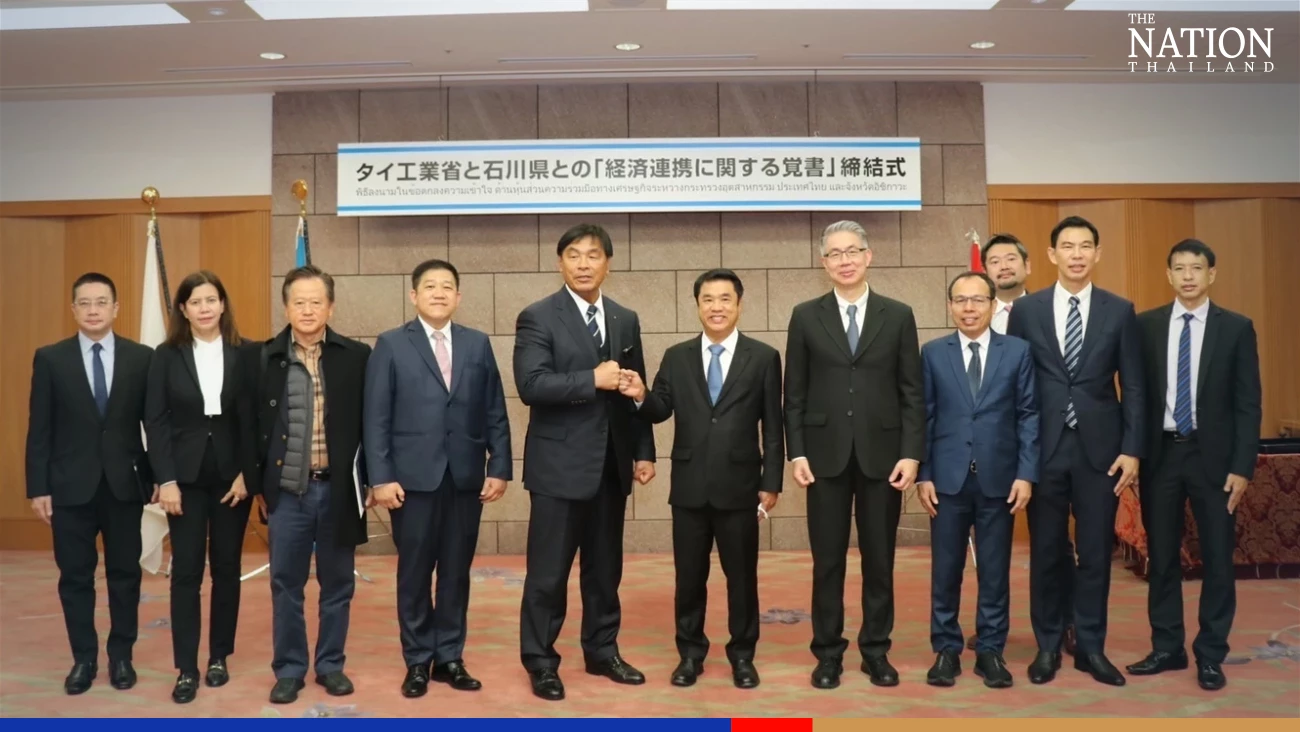
The Industry Ministry’s Department of Industrial Promotion has signed a memorandum of understanding with Ishikawa Prefectural Government Office to promote industrial development between Thailand and Japan, Industry Minister Suriya Juangroongruangkit said on Sunday
The agreement was signed during a recent visit by ministry officials to Japan to attract investment in Thailand.
“This move aims to boost Japanese investors’ confidence in the potential of Thailand’s industrial sector, enhance Thailand’s competitiveness and promote collaboration between Thai and Japanese small and medium enterprises,” Suriya said.
The department and Ishikawa Prefectural Government Office will organise activities to promote industrial development between two countries, such as knowledge exchange seminars, exhibitions and meetings, he said.
“The 22nd Otagai Forum will be held in Nanao city at the beginning of February to promote collaboration in the carbon-fibre-reinforced polymers and food processing industries,” the minister said. “Meanwhile, Kanazawa University will send its students to study in Thai companies in a bid to create a business network between Thailand and Ishikawa Prefecture,” he added.
The ministry is promoting Thai industrial estates to Japanese investors. More than 6,000 Japanese companies have investments in Thailand.
Developing Asia’s productivity growth is slowing, IMF warns
SATURDAY, JANUARY 14, 2023
Nongluck Ajanapanya
Asia’s developing nations should urgently solve technological constraints to sustain productivity growth, a recent report by the International Monetary Fund (IMF) said.
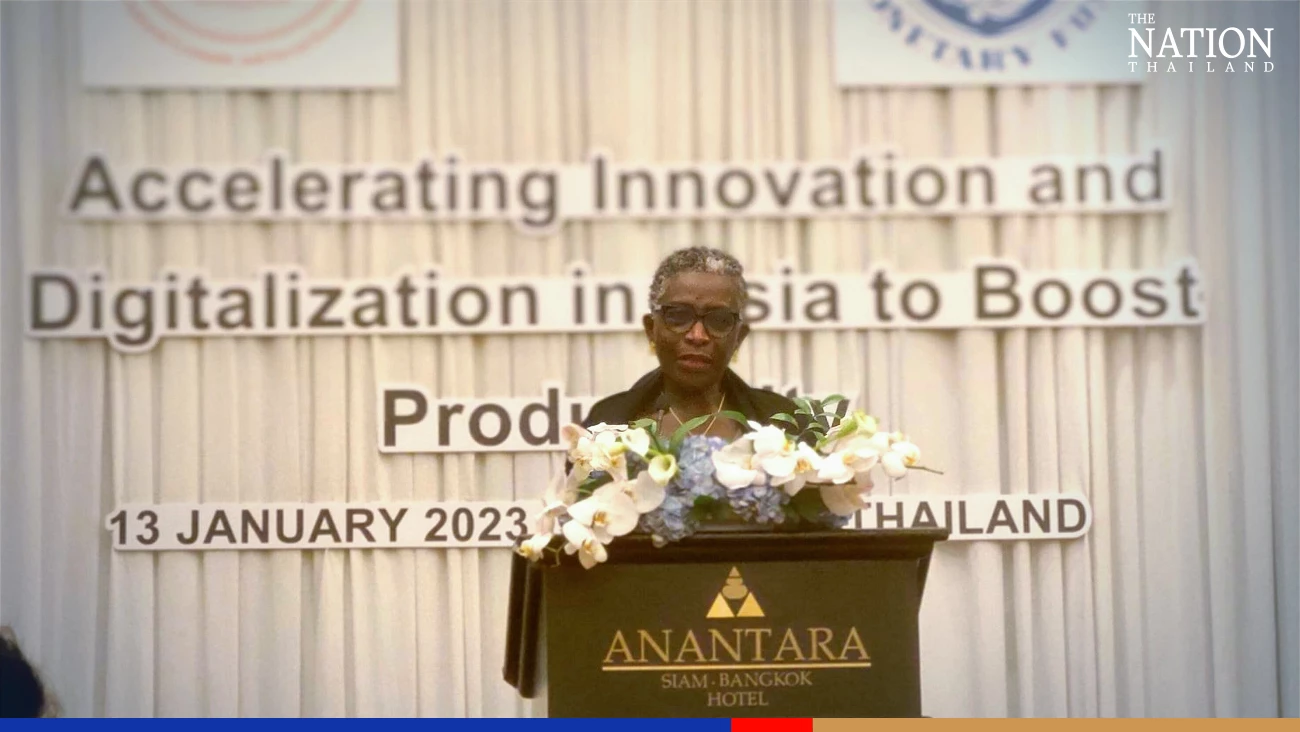
Asia has become a digital and innovation powerhouse, IMF deputy managing director Antoinette Sayeh said on Friday.
Half of the world’s patents are issued in Asia, so there is no doubt that Asia is at the forefront of innovation and technological development, she told a seminar in Bangkok at which the IMF report “Accelerating Innovation and Digitalization in Asia to Boost Productivity” was released.
The seminar was co-hosted by Thailand’s National Economic and Social Development Council.
Still, even though Asia is a growth engine, its productivity growth is slowing, according to the IMF report, which says this is a result of a failure to digitise quickly enough.
Sayeh said two factors are missing from the region’s development.
“There is no question that Asia leads in innovation, but there is a difference in the quality level of patents … Not all patents are the same. Not all patents are equal and … contribute to productivity growth,” she said.
The lack of technological diffusion is the second factor constraining growth, she said.
Antoinette Sayeh
“The second [factor], which is probably more relevant to a country like Thailand, is that technological diffusion has been very limited. So, the technology has vanished and is only available to a small proportion of the economy’s firms,” she explained.
Eteri Kvintradze, director of the IMF Capacity Development Office in Thailand, said the concentration of research and development (R&D) in a smaller number of companies deters the progress of innovation and productivity in Asia.
According to the IMF report, nearly half of small- and mid-sized enterprises and one-third of large firms in emerging and developing Asia identified obtaining financing as the most significant barrier to adopting technology.
Restrictive trade and regulations on foreign direct investment impede technology diffusion, the report says, adding that innovation has not translated into broad-based productivity growth in Asia.
“The concentration in R&D, digital, managerial, funds, and skilled talent widened Asia’s productivity gaps,” Kvintradze said. “However, digitisation and global exposure can assist in closing productivity gaps.”
Asia should foster innovation by providing R&D tax credits, increasing public spending on basic research, supporting intellectual property rights, and rewarding disruptive innovation, the IMF report advises.
Asian governments should also ensure a level playing field and a simplified and efficient insolvency framework to facilitate resource reallocation, the report says.
“Asian nations should really lower trade barriers and streamline FDI regulations, facilitate knowledge sharing between foreign and domestic firms, improve business-university R&D collaboration while upgrading labour skills, close digital divides, and improve digital infrastructure and the legal environment,” Kvintradze said.
Suriyon Thunkijanukij, the National Economic and Social Development Council’s senior advisor on policy and planning, said the innovation-aggregated productivity link isn’t working well in Thailand because the country lacks serious consistency in implementation.
“We’ve already set the right target, direction, and structural system. However, no actions are properly taken. We also need a monitoring mechanism to ensure that our policies are implemented,” Suriyon said.
Thailand should focus on increasing the capacity of youths to accelerate change in the next decade, he said.
Suriyon suggested that the government should provide access to reproductive health and childcare services, offer inclusive maternity support, promote universal child benefit policies, improve education quality and accessibility, and propose legislation that legally allows different types of families to have children.
However, he pointed out that these policies cannot be implemented unless people also formalise their participation in the system.
Meanwhile, Atip Asavanundd, executive director of the Digital Council of Thailand, and Kiatipong Ariyapruchaya, senior country economist at the World Bank, agreed that Thailand urgently requires education reform.
Thailand, according to Atip, has everything except well-educated people.
All Thai students should have access to digital devices and proper English language education, Atip said. Furthermore, students should be encouraged to study mathematics and science until they complete high school.
“Our educators must focus on pattern quality rather than pattern quantity,” he said.
Kiatipong added that basic education for all was essential, and that the country must adopt a more resilient and agile growth mindset.
Meanwhile, he advised Thailand to improve its government data system in order to boost the country’s competitiveness and overall service quality.
Pan-Arj Chairatana, director of the National Innovation Agency, said Thailand requires both innovative entrepreneurs and innovative politics.
“We need to put innovation on the national agenda. We already have science, technology, and innovation policies in place. We have a variety of mechanisms. We have a lot of incentives. However, it is not comprehensive enough to be called a national agenda,” he said.
Thailand needs to change its perception of innovation to move forward, Pan-Arj said.
Unprecedented events have been challenging for all of us, pandemic, the war in Ukraine, inflation pressures, and hence, aggressively increasing policy rates were seen in various regions. Thailand, is no exception, had increased the interest rate by 0.25% for the first time in August 2022 since the pandemic occurred in order to battle inflation situation.
As entered to 2023, Thai economy seems to gain recovery from the resuming tourism and private consumption. Both IMF and the Bank of Thailand also announced that Thailand’s GDP would grow at 3.7% for 2023 amidst the global slow down.
Tourism, known as Thailand’s key engine for economic growth in pre-Covid, is recovering from more relaxed measurements and reopening of the border. As of December 2022, the country had already reached the 2022’s target of 10 million of foreign tourists, mainly contributed by Malaysia, India, and Laos, and is expected to reach around 22 million for 2023. Besides, China’s faster-than-expected to reopen the border would also push up number of foreign tourist arrivals.
Cost-of-living crisis, pushed by inflation and production costs, saw improving as Thailand’s headline inflation had peaked at 7.9% in August 2022, decelerated to 5.6% in November 2022, and is expected to return to the target rate at 3% by the end of this year. However, Thailand would still face high energy prices as the country is a net importer of crude oil.
By comparing our currency to peers, Thai baht depreciated to 38 per USD in October 2022 mainly from the US’s rising interest rate. Recently, Thai baht has been stronger in response to Fed’s announcement in slowing down the US interest rate increase. TDRI’s forecast in November 2022 also indicated the value 36.87 per USD for 2023.
Looking at industries in Thailand, they are performing in varied directions. Those saw recovering and better-than-Covid19 level are wholesale and retail, department stores with the supports from government scheme, purchasing power from the middle to high income group, and rising tourists. Surge in internet usage also would lead information and communication industry bloom, while changing behavior since Covid will also drive e-commerce, delivery services, and electrical equipment. However, those saw less sign of recovery are internal combustion engine automotive industry due to prolonged semiconductor shortage, high cost of raw material, and rising trend of electric vehicles, while metal industry from the high raw material price which both of the finished steel consumption and import also contracted by 23% in October 2022 (YoY), according to ISIT.
Thailand’s 2023 Key risks and opportunities
Key risks that could deter Thai economic recovery are geopolitical tensions (e.g. war in Ukraine, China-Taiwan tension), resulting in supply disruption or rising energy prices and costs of raw material. FED and other regions to further increase interest rate in response to the inflation would also lower purchasing power, together with, Thailand’s current high level of household debt. China’s economic recovery which might recover slower-than-expected also saw influence on tourism sector and Thai export. However, the bright sides are rising tourist arrivals from other regions’ reopening their borders, recovery in domestic consumption after Covid, and the relocation of production from China.
Looking ahead for 2023 Business Trends
Digital transformation and ESG are two major global trends for all businesses regardless of which industry they are in. It is vital that business leaders need to comprehend and make the most use of these trends.
Digital transformation is no longer an optional for business, as pandemic pressure and consumer trends change to be more digital. As recent Deloitte Tech Trend 2023 articles, the impact of emerging technology is widely affected organization in both challenge and opportunities.
Startups’ mantra – move fast, fail fast and break things – might not be applicable to established companies, as they don’t have any legacy to protect. Successful businesses must realize that they can’t risk breaking thing, as Startups, in pursuit of new. It is crucial that leaders need to balance their digital transformation initiatives from modernizing its core business technologies/processes to extending its business capability or even reimagine their business models.
Hence the roles of leadership are vital in driving successfully digital transformation initiatives. Leaders is in the position to foresee what the business trends & challenges in the future, then set the vision of what their business would be. This aspiration and ambition will be the key to define what the role and level of involvement of leaders.
Organizational readiness is another key factor; leadership, culture, structure and capabilities. Leadership in C-suite level must be motivated and capable of executing the vision with positive attitude and willingness to transform. Culture of innovation, take risk must be instilled against those bureaucratic or risk-averse mindset. The proper talents & team structure are needed to be designed supporting the initiatives with the capabilities in scalability and nimbleness. Both leadership ambition and organizational readiness will help business shape and structure on how they should manage and drive successful digital transformation initiative in a sustainable way.
ESG issues are more crucial at this moment. Investor interest in companies taking ESG goals seriously is also becoming prevalent. According to Deloitte Thailand’s ESG and sustainability survey 2022, most business leaders prioritize awareness of ESG in the organization and integrating ESG into the corporate strategy. Additionally, 34% of respondents already have sustainable committee to oversee or drive ESG in their businesses. Majority of the respondents also view that better corporate sustainability performance will bring about three key benefits: operational efficiency and cost saving, brand credibility and image, and risk management.
By Narain Chutijirawong, Executive Director – Clients & Markets and Tasada Sangmanacharoen, Senior Consultant – Clients & Markets at Deloitte Thailand
Next election to boost liquidity in Thai economy by up to 50 billion baht
THURSDAY, JANUARY 12, 2023
An estimated 40-50 billion baht is expected to be circulating in the Thai economy during the next general election to be held later this year, the University of the Thai Chamber of Commerce (UTCC) said on Thursday.
That is regarded as a positive factor in addition to an expected jump in the number of tourists coming to Thailand this year. Economic growth is predicted in the vicinity of 4%.
The Election Commission has tentatively scheduled May 7 for the next national vote if the current House of Representatives completes its four-year term as scheduled on March 23. An earlier date can be expected in case of a premature House dissolution.
UTCC president Assoc Prof Thanavath Phonvichai said on Thursday that the risk of a global economic recession would ease in the first half of 2023, and the Thai economy would see a clear recovery in gross domestic product in the latter half of the year, with the GDP expected to grow between 3.5% and 4%.
He said that signs of an economic recovery included the earlier-than-expected return of Chinese tourists.
Thanavath pointed to an easing of the tight situation in the global economy, including improvement in US inflation with less frequent interest rate increases, and “not too expensive” oil prices at $75-$85 per barrel.
He said Thailand’s exports would grow 1-2%.
According to the university’s Centre for Economic and Business Forecasting, the consumer confidence index in December increased for the seventh month in a row, the highest in the last 25 months. The index stood at 49.7 in December 2022, up from 47.9 a month earlier.
The centre attributed the increase to a clear recovery in Thailand’s tourism, improvement in the country’s Covid-19 situation, and lower oil prices when compared to the first half of the year.
Thanavath, who is the chief adviser to the centre, said that Thai consumers were expected to spend more from the first quarter of this year due to increased confidence in an economic recovery.
However, Thai consumers still have concerns about the rising cost of living due to the prolonged war between Russia and Ukraine, as well as the upward trend of interest rates, according to Thanavath.
Arkhom says rising baht a measure of foreign confidence in Thai economy
THURSDAY, JANUARY 12, 2023
Finance Minister Arkhom Termpittayapaisith says the baht is strengthening against the US dollar thanks to inflows of foreign funds to the Thai stock and bond markets.
Speaking on Wednesday, he said foreign investors are attracted by Thailand’s Bio-Circular-Green economy model for sustainable development.
Sustainable stocks are a growing trend in global investment as the world switches to low-carbon economies to stave off environmental destruction from climate heating.
Arkhom added that the rising number of foreign tourists is also helping stimulate domestic consumption in Thailand.
“This proves that foreigners have confidence in Thailand’s economy,” the finance minister said.
However, the Bank of Thailand is continuing to monitor the Thai currency closely. A strong baht would trigger concerns over loss of competitiveness for Thai exports.
The baht slumped to 38 per dollar in September last year before strengthening to 33/dollar this month.
It opened at 33.34 to the dollar on Thursday, unchanged from Wednesday’s close. The currency will likely move between 33.25 and 33.60 against the greenback during the day, according to experts.
Three firms approved for bidding in Sunday’s satellite auction
WEDNESDAY, JANUARY 11, 2023
The National Broadcasting and Telecommunications Commission has given the green light for three companies to bid in Sunday’s auction for satellite orbital slots, a commission member said on Wednesday.
Commissioner Thanapant Raicharoen said the telecom watchdog on Tuesday reviewed the qualifications of the three firms that had submitted bidding documents and gave them approval to bid in the auction.
The three companies are Space Tech Innovation, a subsidiary of satellite service provider Thaicom, Prompt Technical Services, a company registered in 2000 as an electrical installation service firm, and state-run National Telecom.
Approval was granted based on the qualifications, experience and financial capacity of the companies, Thanapant said.
The commission said the five satellite slot packages to be offered for leasing by Thailand are:
● Package 1: 50.5 degrees East slot with C1, N1 and P1R networks and 51 degrees East with 51 network. Bidding starts at 374 million baht.
● Package 2: 78.5 degrees East with A2B and LSX2R networks. Bidding starts at 360 million baht.
● Package 3: 119.5 degrees East with IP1, P3 and LSX3R networks and 120 degrees East with 120E network. Bidding starts at 397 million baht.
● Package 4: 126 degrees East with 126E network. Bidding starts at 8 million baht.
● Package 5: 142 degrees East with G3K and N5 networks. Bidding starts at 189 million baht.
Packages 2, 3, and 4 will likely draw the most interest and the commission expects to raise more than 800 million baht from auctioning them, Thanapant said.
He said the bidding will be completely transparent. The auction will follow the sequential ascending clock system, he said, adding that it gives bidders in each round 20 minutes to decide whether or not to raise their price – by as much as 5% of the minimum bid price.
None of the three firms will have advanced knowledge of how many packages their competitors are bidding for. The commission will determine the order in which the packages are offered on Sunday to prevent collusion and ensure transparency and fairness.
The commission cannot cancel the bidding and hand over the orbital slots to the National Telecom as the labour union of the state enterprise has demanded, Thanapant said, adding that the money raised from the bidding is state revenue and will be given to the Finance Ministry after costs are deducted.
The commission is legally required to ensure that the state receives the most money possible from auctions for access to the orbital slots.
If the auction is cancelled, the International Telecommunication Union may use it as a reason to take back the orbital slots from Thailand, Thanapant said.
Banpu NEXT continues to provide solar power to electricity-deprived schools
WEDNESDAY, JANUARY 11, 2023
With a belief that “Learning is the Power of Change and Development”, Banpu NEXT is making continuous progress in its “Light & Learn” project by bringing solar power systems to electricity-deprived schools in remote areas to help light up learning opportunities and benefit the children.
Most recently, the company took its employees on a field visit to join forces with highland teaching volunteers on the solar power system and storage battery installation for Ban Po Por Kee HACLC in Tak Province and hold edutainment activities for the children, which creatively taught them to appreciate nature and clean energy.
Over the past five years, it has already installed solar power systems for 73 schools in Tak, Mae Hong Son, and Kanchanaburi Provinces.
Sinon Vongkusolkit, Chief Executive Officer of Banpu NEXT, said, “During five years of Banpu NEXT’s Light & Learn project implementation, we installed solar power systems for a growing number of electricity-deprived schools in remote areas because we believe that light is empowerment for education. It brings sustainable benefits to Thai children and teachers in various aspects: 1) in terms of learning, it broadens the kids’ experiences for Thai language skills development and creativity; 2) in teaching, it enables the teachers to utilize a greater variety of learning media and keep abreast of the modern world; 3) on quality of living, it allows a more convenient life; 4) on the environmental front, using electricity from a clean energy source and playing their part in system maintenance will build the kids’ awareness of clean energy; and 5) mental well-being improves as it brings joy to children, giving them smiles and dreams to pursue as they learn from various learning media.”
To neutralize distance and deprivation that used to be learning barriers for the children, Banpu NEXT is making a change and helping them upgrade their learning. The company has already introduced solar power systems to 73 electricity-deprived schools in remote areas with more than 73,000 watts of installed capacity all combined, which benefits over 2,400 children altogether.
The company also provided satellite dishes and TV sets to enable their access to distance learning media, plus many other learning materials and necessities. Of these, Banpu NEXT installed solar power systems complete with storage batteries for 37 Mae Fah Luang HACLCs in 2017 and 2018; 15 schools within the precinct of Mobile Development Unit 36 under the 3rd Regional Development Office, Armed Forces Development Command in Mae Hong Son in 2019; and 15 schools in Kanchanaburi in 2021.
Most recently, it continued with the installation of five schools in Tak Province’s Tha Song Yang District and also took its employees there to, together with highland teaching volunteers, hold nature and solar energy learning activities for children of Ban Po Por Kee HACLC.
Focusing on giving the children a hands-on experience and promoting their creativity, a natural tie-dry fabric and paper mask-making workshop let them use natural materials to make a mask in their individual styles. Other activities include home-grown vegetable planting, educational solar power storytelling, charity lunch, and gift giveaway to the children.
Uthairath Sangprachan, Director of Tha Song Yang District Office of the Non-Formal and Informal Education (NFE), commented, “Ban Po Por Kee HACLC is located in a backcountry area. The kids who come to class here are from a Thai highlander community. They normally use their own dialect and cannot speak Thai, resulting in difficulty both in general communication and education. We appreciate the support of Banpu NEXT for lighting up this learning centre with solar power and provisioning TV sets and learning media. They will build an infinite learning opportunity, giving our kids more fun learning from quality audiovisual media that will help them practice speaking Thai with faster results. People in the community can also come here to watch news and entertainment. I believe that the ‘light’ and these media will give the children and the community a better quality of life.”
Thanawit Wiengkawee, a grade-6 student at Ban Po Por Kee HACLC, shared his joy that the learning centre would have the power supply for learning and other activities: “I will be able to watch news and movies. I will be able to sing and fully practice my Thai language. Moreover, people from Banpu NEXT also taught us how to use and take care of solar power systems to ensure that we will have electric power to use for a long, long time.”
“There are still so many schools out there in remote areas that have no access to electricity. Therefore, Banpu NEXT will keep this project running because electricity is a basic need for education and a decent quality of life. We hope to help the children grow into competent adults and use their knowledge for future development of themselves, their communities, and the nation,” Sinon concluded.
Finance Ministry extends relief for state banks to ease loan fears
TUESDAY, JANUARY 10, 2023
Four state banks will get another year of relief on contributions to the Specialised Financial Institutions Development Fund (SFIF), a Finance Ministry source said on Monday.
Approval to extend the reduction in contributions from 0.25% to 0.125% of total deposits to the end of 2023 was granted at a meeting of fund committees chaired by Finance permanent secretary Krisada Chinavicharana on Monday.
The SFIF is used to reduce the banks’ non-performing loans (NPLs) and relieve financial burdens on bank customers who are unable to make repayments. To be granted SFIF aid, customers must meet Fiscal Policy Office criteria aimed at identifying those most in need.
The extension will be sent to Cabinet for final approval soon.
Chatchai Sirilai, president of the Government Housing Bank and the Government Financial Institutions Association, said the reduction of SFIF contributions coupled with other Finance Ministry measures would enable banks to suppress interest rates to help customers pay back their debts.
Customers of state-run banks could be rest assured they would not suffer sharp hikes of reference interest rates such as MLR, MOR and MRR by 0.4% at a time, as with commercial banks, he said.
“State-run banks will only raise interest rates in line with market conditions and will try to minimise the impact on customers.”
US snack rankings reveal Americans’ growing hunger for Thai flavours
MONDAY, JANUARY 09, 2023
Thailand’s food manufacturers have been urged to harness Americans’ growing hunger for Thai-flavour snacks.
Thai flavours ranked 6th among international cuisines that American consumers want to taste more of in snacks, according to the 2023 Food and Beverage Flavor Report.
Mexican flavours topped the US most-wanted list, which is published by California-based flavour and fragrance producer T Hasegawa USA. Next came Italian, Chinese, Japanese, Latino and Thai.
The ranking shows strong potential for Thai food manufacturers in the US market, said Thailand’s Department of International Trade Promotion (DITP) office in New York on Monday.
The survey of 2,000 respondents found that the snacks Americans want to see in Thai flavours are baked potato chips (39%) followed by tortilla chips (36%) and fried potato chips (34%) while the most popular Thai flavours are tom yum (sour & spicy soup) and larb (spicy meat salad with toasted ground rice).
“These flavours have been made popular by Thai street foods which are booming in the US,” explained Ketsuree Vijaranakorn, head of the DITP’s New York office.
“Food manufacturers should use this popularity to penetrate the American snack market, which is craving spicy and exotic alternatives.”
The DITP reported that snacks are the fastest growing market in the US food & beverage sector, growing 11.4% to $44.9 billion (1.5 trillion baht) in the last 10 months of 2022.
Crunchy and salty snacks (chips, pretzels, and popcorns) dominated the market with a 59.3% share, followed by cookies (18.6%) and crackers (15.3%).
Ketsuree said the DITP will continue holding promotional events in the US to promote Thai foods, beverages and snacks, including at the Winter Fancy Food fair in Las Vegas from January 15-17, and the Summer Fancy Food Show in New York from June 12-14.
Manufacturers and exporters can reach the department at www.ditp.go.th or its 1169 hotline.
Thai exports staring at grim prospects in 2023 global economic scenario
MONDAY, JANUARY 09, 2023
Business councils and bankers are predicting a slowdown in growth or even a contraction for Thailand’s exports this year because of the global economic slump and continued geopolitical conflicts.
The grim picture for Thai exports was forecast by the Thai National Shippers’ Council (TNSC), the Thai Chamber of Commerce, and bankers from CIMB Thai Bank, TMBThanachart Bank (TTB) and Krungthai Compass.
During the Covid-19 pandemic, when tourism came to a standstill, exports were the main saviour of Thailand’s economy, with continued growth from 2020 until the third quarter of 2022.
However, signs of a slowdown became visible in October last year when exports contracted 4.4% year on year while the contraction widened to 6% in November.
TNSC chief Chaicharn Charoensuk said export data for December has not been announced yet but the TNSC expected it to be negative because of the impact from the global economic slump.
Chaicharn said the TNSC expected Thai export growth this year to slow slow down to 1-3% because of several factors:
● High inflation rates would prompt the US Federal Reserve and central banks of major economies to use austere financial measures that would cause their economies to slow down, affecting Thai exports.
● The Covid-19 situation in China has not improved and the Chinese government may be prompted to use restrictive measures, which would affect supply chains of Thai exporters, and cause economic slowdown in China, unavoidably affecting Thai exporters.
● Although the Russia-Ukraine war would benefit Thai exporters of foods, it would raise costs for exporters of other products when global oil prices rise.
● The baht has appreciated against the US dollar and its value increased from 38 baht per dollar two months ago to about 33-34 baht. This would cause Thai products to become less competitive.
The TNSC expects Thailand to export goods worth US$49 billion to the United States, while exports to China would be worth US$36.5 billion and US$49 billion to Europe this year.
Chaicharn said the TNSC wants Thai exporters to look for new markets to offset the decline in demand in some markets.
He said the key alternative markets for Thai exporters are:
Middle East: The TNSC sees Saudi Arabia, the United Arab Emirates and Qatar as capable of becoming important alternative markets for Thai exporters. Key export products to these markets could be rice and foods.
South Asia: Thai exporters can seek to export jewellery, accessories, plastic pellets and chemical products to India, Bangladesh and Nepal.
CLMV: Cambodia, Laos, Myanmar and Vietnam could be important alternative markets for Thai exporters with construction materials, electric appliances, plastic pellets, textiles and clothes, sugar, and machines and parts among key products.
Wisit LImluacha, deputy chairman of the Thai Chamber of Commerce, said the chamber expected export growth of 6% last year but only 2% this year.
He said the economic slowdown in some of Thailand’s major markets, especially the United States, Europe and China, would result in slowdown for exports.
The global economic slowdown, the high inflation rate and the sluggish performance of the manufacturing sector in Thailand’s main markets would remain risk factors this year, he added.
Amornthep Chawala, vice president of CIMB Thai, said the research office of his bank expected exports to suffer 1% negative growth this year. He said the prediction was based on the export situation in the last quarter of last year.
Amornthep said the negative growth could be more severe than one per cent if China faced economic sanctions from the US.
He said the reopening of China would benefit Thailand’s exports in the short term but the situation would reverse if China itself cannot export to the US.
“So, we estimate that the negative growth may be more than 1%. We have to wait and see the export data for two months before we can be sure,” Amornthep said.
He said the government should find new markets for Thai exporters and should ink more free trade agreements with other countries or groups.
Narit Sathapoldecha, head of the TTB Analytics centre, said his bank expected Thailand’s exports to grow at or lesser than 1.6% this year.
He said the main risk factor for Thai exporters is China itself. He said China’s economy could slow down because of the impact of the Covid-19 pandemic and Beijing could try to offset the situation by expanding its own exports, which could be at the cost of Thailand’s exports.
Narit explained that China might dump its products in the global markets and make it more difficult for Thai exporters to sell their products.
Pacharapoj Nantramas, vice president of Krungthai Compass, a research arm of Krung Thai Bank, said his bank foresaw export growth this year at 1.2% or lower.
The grim prediction was based on negative growth during the past several months, he added.



 Antoinette Sayeh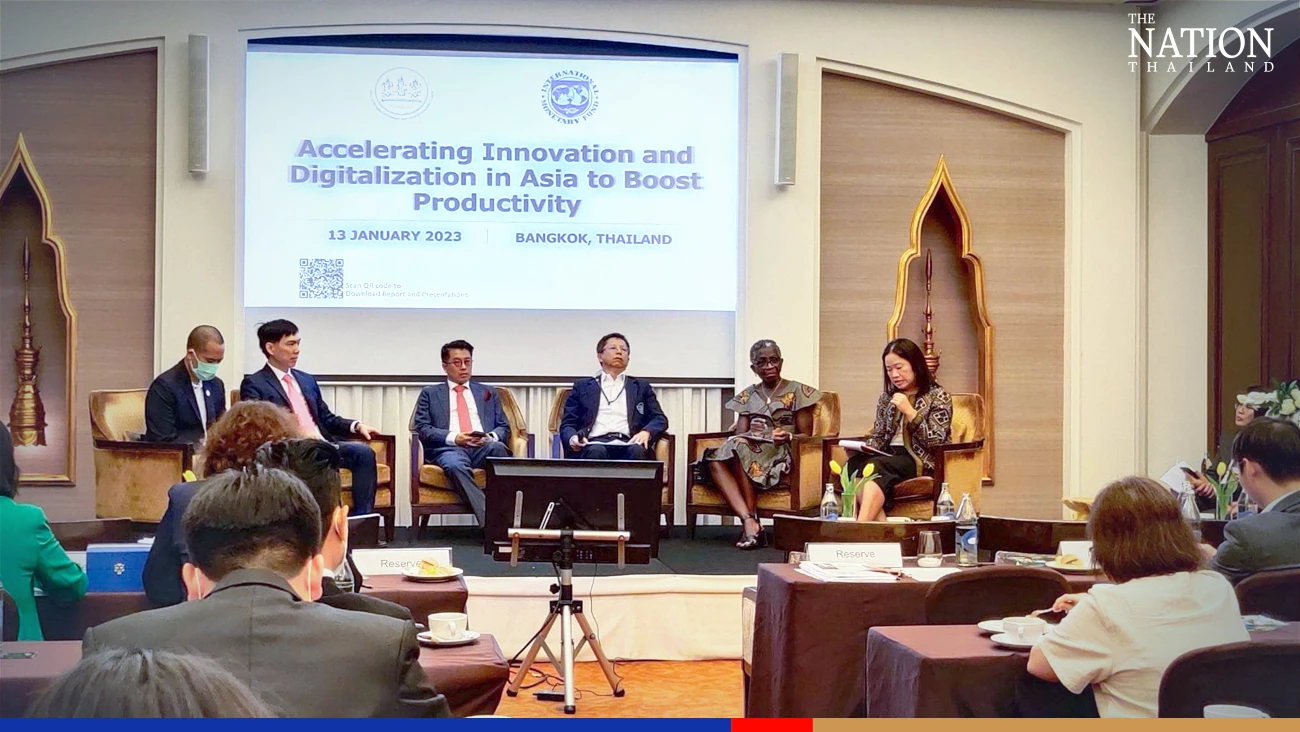









 SootinClaimon.Com