
New York City can’t rebound without Broadway. And Broadway’s road back is uncertain. #ศาสตร์เกษตรดินปุ๋ย

#ศาสตร์เกษตรดินปุ๋ย : ขอบคุณแหล่งข้อมูล : หนังสือพิมพ์ The Nation.

New York City can’t rebound without Broadway. And Broadway’s road back is uncertain.

EntertainmentSep 08. 2020Stephanie Nordstrom strikes a pose with her baby, Sabine Boer, at the Met.  CREDIT: Photo for The Washington Post by Jeenah MoonStephanie Nordstrom strikes a pose with her baby, Sabine Boer, at the Met. CREDIT: Photo for The Washington Post by Jeenah Moon 

By The Washington Post · Peter Marks · NATIONAL, ENTERTAINMENT, STAGEDANCE 
NEW YORK – For months now, Thomas Schumacher’s dining room table has been taken over by a master list of every Broadway show that’s seeking to reopen or schedule an opening night – from the established “The Lion King” to the new “Diana: A True Musical Story.” Since the pandemic-related shutdowns, the Disney Theatrical Group president and his colleagues have been working through various scenarios to get New York theater back on its feet.

But a half-year into an ongoing human tragedy and economic calamity that has drained the cultural lifeblood of the city, neither Schumacher – who is also chairman of the Broadway League trade group – nor anyone else knows for sure when the nation’s premier performing arts district will start up again. The earliest estimates for some of New York’s concert halls and theaters to resume are spring 2021; a few new productions, such as “The Music Man” with Hugh Jackman and “Plaza Suite” with Matthew Broderick and Sarah Jessica Parker, have announced early spring beginnings on Broadway. Even so, those involved in the planning say privately that it could be autumn 2021 before venues reopen.
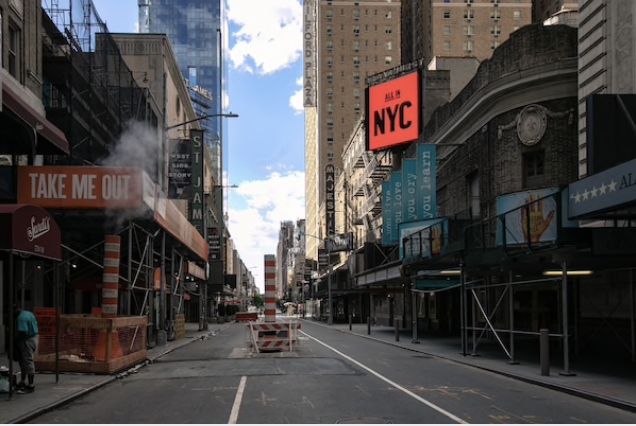
A scene from a deserted Broadway theater district, where venues have been shuttered since March. CREDIT: Photo for The Washington Post by Jeenah Moon

A scene from a deserted Broadway theater district, where venues have been shuttered since March. CREDIT: Photo for The Washington Post by Jeenah Moon

Repeatedly, as science and government grapple with understanding covid-19’s patterns and devastating impacts, arts leaders here – as elsewhere – have had to build and rebuild safety plans for both arts workers and audiences. At the city’s pace-setting institutions – the 41 theaters of Broadway, the campus of Lincoln Center, the dance and music and other performance spaces of downtown and the outer boroughs – dates for reopening have been set and then pushed back, as the logistical questions evolve and multiply.
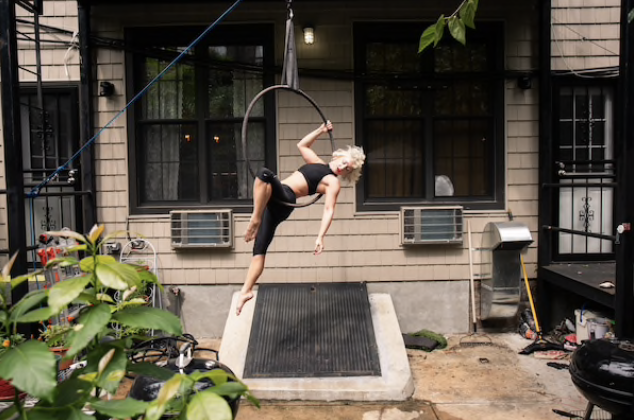
An aerialist and opera singer Marcy Richardson practices her Aerialist and opera singer Marcy Richardson practices her aerial hoop act in her Brooklyn backyard. CREDIT: Photo for The Washington Post by Jeenah Moon

An aerialist and opera singer Marcy Richardson practices her Aerialist and opera singer Marcy Richardson practices her aerial hoop act in her Brooklyn backyard. CREDIT: Photo for The Washington Post by Jeenah Moon

The task has proved far more daunting than anyone could have imagined, amounting to a struggle of wrenchingly complex proportions with no reliable end in sight. And at this point, though, Broadway – the ultimate land of make-believe – is holding on to a hope that early 2021 is still feasible. “I am believing that this spring we will be back because we have to commit to it,” Schumacher said. “We have to come back. And we have to gird our loins.”

Still, he and his colleagues are wrestling with monumental challenges: How do 10 or 20 or possibly even 30 productions – all essentially starting from zero in ticket sales – manage to reanimate Broadway all at once? How is the industry’s limited rehearsal space assigned? How staggered do the reopenings have to be? Should shows that were struggling before be gently encouraged to throw in the towel?

Broadway alone accounts for more tickets sold each year than for all of the metropolitan area’s professional sports teams, and the industry pumps on the order of $13 billion annually into the city economy. It seems fair to say, then, that until the return to health of the performing arts, the city cannot really be said to be back.

The problems for theaters and concert halls – ventilation systems in need of updating, cramped quarters for artists and other workers in backstage areas, a lack of specific federal guidance about what safety measures are required, and a host of other issues – are bedeviling the path back for the purveyors of some of the world’s premier venues and attractions. Some of Broadway’s theaters, such as the Belasco and Lyceum, date back to just after the turn of the 20th century, with narrow passageways and dressing rooms, sometimes shared, that are more like closets. An actor’s quick costume change in a tiny nook backstage can require two or even three assistants, all breathing in the same few cubic feet of oxygen.

Such is the degree of difficulty that while the city’s flagship art museums are already reopening, with state- and city-approved controls on capacity and mandates for masks, theaters have no firm restart date.

The timetable hinges on advances in detection and prevention of the novel coronavirus, via development of rapid testing and vaccines. These are crucial in the commercial domain of Broadway, where social distancing is an untenable remedy for multimillion-dollar productions that require their 1,000- to 2,000-seat spaces to be filled to near-capacity to be profitable. Museum directors like Adam Weinberg of the Whitney Museum of American Art say they have been able to demonstrate that their air-filtration systems and crowd-control procedures are adequate. Performance venues have not.

As Scott Rudin, producer of now-dormant Broadway hits such as “The Book of Mormon” and “To Kill a Mockingbird,” explains, the other variables that must be taken into account are mind-boggling. “How many shows come back and at what level of attendance?” he said in a Zoom interview. “What will labor do? What will [theater] owners do? What does working from home mean for the nightlife of New York? What happens to hotels, restaurants, tourism? How many people leave the city and don’t come back?”

Tallying the financial losses to a bedrock sector of the New York economy is itself a gargantuan task: In the six months since the historic shutdown began – a closure without parallel in American life – the jobs of thousands of performers, directors, designers, stagehands, ushers, box-office workers, administrators, publicists and more have been cast into limbo. The aid doled out by the federal Paycheck Protection Plan and unemployment benefits helped arts staffers hold on, but now, stories abound of performers and other creative-economy workers leaving the city.

The financial losses are staggering, and mounting: Consider that for the period in 2019 of the second week in March to Sept. 1 – the length of the shutdown so far – Broadway alone took in $853 million in ticket sales.

“In my neighborhood, I’m watching three people move away a day,” said Warren Adams, a choreographer who, with actor T. Oliver Reid, created the Black Theatre Coalition to help bring more people of color into the industry. Reid added: “I have friends, couples, who are both in the business – people with Tony nominations – their work stopped and they have no money coming in. How are we looking at this as a culture, as an industry?”

Marcy Richardson is hanging on, but only barely, and she’s both angry and illustrative of how the pandemic has upended artists’ lives. A classically trained opera singer who lives in Brooklyn, she honed a second specialty as an acrobat and has worked steadily for years in variety shows and high-end burlesque, with avant-garde troupes such as Bushwick’s Company XIV and event producers including Susanne Bartsch. Now, as the $75,000 she made last year as a singing aerialist goes to zero, Richardson, 40, doesn’t understand why government aid has not been solidified to help sustain backbone-of-the-city steady earners like herself.

“We are small, locally owned businesses that are trying to make art a business,” she said. “I’ve never felt less valued and so disrespected as an artist. I want to know, ‘Do you not care if we disappear into thin air?’ “

At this point, federal aid for the arts sector exists on paper only: Sens. Amy Klobuchar, D-Minn., and John Cornyn, R-Tex., introduced the “Save Our Stages” bill this summer, seeking $10 billion in relief aid for live venues. But its chances in the short term are not good.

“It felt more realistic in June than in August of an election year,” said Narric Rome, vice president of government affairs and arts education for Americans for the Arts, an advocacy group. “There are definitely not too many members of Congress who want to talk about that right now.”

Richardson’s plea resonates with another issue outlined by Henry Timms, president of Lincoln Center for the Performing Arts, which runs 30 indoor and outdoor facilities on a 16-acre campus housing the Metropolitan Opera, New York City Ballet, Lincoln Center Theater and nine other organizations: how this turbulent time affects not only the bottom line, but also the psychology of a city that prides itself on its cosmopolitanism.

“We frame this conversation in terms of economic recovery,” Timms said in an interview. “But actually the biggest question is about social recovery. The arts in general have a critical place in terms of recovering from the pandemic, and the really interesting challenge for the arts – when we are seeing some of the worst of ourselves – is that the arts represents the best of ourselves. The job of the arts is to be part of that human recovery.”

Culture is one of New York’s most invigorating lures: In 2019, leisure travel, of which the arts is a huge component, accounted for 53 million visitors to the city. Privately, Broadway insiders report they have had to explain to New York state officials, eager for Times Square to come alive again, that even with new protocols in place, revival is a months-long endeavor, requiring facilities upgrades, marketing campaigns and a coordinated strategy for unveiling new shows and reintroducing long-running hits. A new TV spot by NYC & Company, the city’s official convention and visitors bureau, hints at how far off normalcy remains: The 30-second commercial, telecast during the crowdless 2020 U.S. Tennis Open in Queens, stresses the city’s people and its neighborhoods. “Big emotions. Intimate moments. Grit,” reads the spot’s messaging, intermingled with shots of everyday New Yorkers.

No words appear about more traditional tourist attractions – because there are no tourists to appeal to, foreign or domestic, and few for the foreseeable future.

The emphasis, said Chris Heywood, NYC & Company’s executive vice president of global communications, is to motivate local residents to explore the city.

“We really need New Yorkers to help us rebuild the vibrancy of the city,” he said. 

The needs, though, of musicals and symphonies and ballet companies are profoundly intertwined with other amenities, like restaurants and hotels, being back in full swing, too. As one arts leader, speaking on the condition of anonymity because of the sensitivity of the issue, observed: “The city can’t come back without Broadway. But Broadway can’t come back without the city being somewhat what it was before.”

The practical challenges of recovery are so vast that Broadway has set up, through its trade group, the Broadway League, 42 task forces to address the crisis. Some 350 of its 800-plus members are involved. “There are 20 labor task forces, one for each union,” said Charlotte St. Martin, the league’s president. Ten others are tackling marketing issues; five are set up to interact with the city, state and federal agencies. Two Washington lobbyists, one with ties to Democrats, the other to Republicans, have been hired to seek stimulus funding for arts venues and artists in proposed legislation; epidemiologists and industrial hygienists are advising on safety and air filtration. The issues are as diverse as how to handle intermissions, when longer bathroom breaks may be required, to what kind of financial aid or tax credits the government might devise.

“We have developed protocols for over 200 actions,” St. Martin added, “everything down to the minutest protocols, for example, for how to protect wig dressers. And we are talking to the city. They may very well close down some of the side streets [of Times Square] to give us easier theater ingress and egress.”

Among the most pressing concerns is the health of the people who will be in the theaters and halls every day.

“From our perspective, the top of the list is safety,” said Kate Shindle, president of Actors’ Equity Association, which represents 51,000 actors and stage managers. The union has been evaluating the protocols being put in place by companies across the country, recently okaying a plan by the producers of “Diana: A True Musical Story,” about Princess Diana, to film a performance on a Broadway stage without an audience. It will appear on Netflix before a Broadway run currently set for next spring.

Still, the lack of basic guidance from the federal government has contributed to the slow progress, the union says.

“This is a frustrating thing for live performance to be open, because there is not a national strategy on testing,” said Mary McColl, executive director of Actors’ Equity.

Another problem is a fragmentation of responsibilities: Union members on Broadway are employed by producers, not theater owners, and it is the latter who would have to pay for structural upgrades such as ventilation. According to Schumacher, of Disney Theatrical Group, before his company moved its now shuttered musical “Frozen” to Broadway, he split the $1.5 million expense of upgrading the entire heating, ventilation and air conditioning system of the St. James Theatre with its owner, Jujamcyn Theaters. Other theaters will need to improve their air-scrubbing capabilities, too, to meet contemporary mandates. The costs could run to $500,000 per venue.

The “legacy shows” – “The Lion King,” “Hamilton,” “Wicked” – are expected to get back up to speed. But an anxiety, industry insiders say, is that other shows will limp along and then fold, contributing to an image of diminished strength. As the producer who spoke on the condition of anonymity put it: “The damage that those shows can do to us is great because they’re going to waste a lot of people’s attention just to sell no tickets.”

And then, of course, lowering ticket prices to lure audiences back may also mean negotiating temporary salary reductions for the various unions. “Is there going to be a robust dialogue about pay rates? Of course there is,” Schumacher said. “But people want to come back to work and be safe.” However, Actors’ Equity’s Shindle said that pay cuts “have not been discussed with us.”

Off-Broadway and off-off-Broadway artists and companies are engaged in their own struggle to come back. Risa Shoup, interim executive director of the Alliance of Resident Theaters/N.Y., a support arm of off- and off-off Broadway, says shows produced outdoors are the first signs that companies are poised to weather the crisis.

Last month, in a community garden in Bushwick, a troupe guided by Rachel Chavkin’s organization, the Team, produced Camilo Quiroz-Vazquez’s “Quince,” an immersive playlet with music about a quinceañera celebration. Audience members and the actors wore masks, and the crew was trained by a certified covid-19 infection control agent. As 40 or so spectators sat in socially distanced chairs, an emcee on a PA system kept the performers in line.

“Cindy, pull your mask up over your nose!” she demanded of one of the actors onstage.

Other performative seedlings are starting to take root. At Lincoln Center, Timms said, plans are being worked out for a 400-seat socially distanced outdoor space for ballet and other arts, and the New York Philharmonic sponsors a truck circulating all five boroughs and presenting pop-up concerts.

“The challenge is a new way for us to meet our missions,” he said, adding that the campus has been repurposed for other community uses: It served this summer as one of the distribution sites for the Food Bank for New York and is being offered as a polling place this fall.

The old missions remain vital as well. Jeffrey Seller, lead producer of “Hamilton,” said that when things do finally get back to something recognizably functional, he’ll have a backlog of four new musicals waiting to be unveiled, in four successive seasons.

“There will be an explosion of creativity when we return,” he said. “I believe in my heart and in my soul that when we feel confident, we’re all going to be back together. We need it. We yearn for it.”

Disney criticized for filming ‘Mulan’ in Xinjiang where Uighurs are detained #ศาสตร์เกษตรดินปุ๋ย

#ศาสตร์เกษตรดินปุ๋ย : ขอบคุณแหล่งข้อมูล : หนังสือพิมพ์ The Nation.

Disney criticized for filming ‘Mulan’ in Xinjiang where Uighurs are detained

EntertainmentSep 08. 2020

By Syndication Washington Post, Bloomberg · Shirley Zhao · BUSINESS, WORLD, ENTERTAINMENT, ASIA-PACIFIC, FILM

Walt Disney Co.’s big bet on “Mulan,” a $200 million live-action remake of a Chinese folk tale, is facing fresh criticism days after its North American streaming debut and just before its planned premiere at cinemas in China.

A newspaper columnist and some social media commentators have faulted Disney for filming in China’s Xinjiang region and for thanking government departments there in the film’s credits. As many as 1 million ethnic Uighurs in Xinjiang have been detained in camps that China calls “voluntary education centers.”

“Mulan” is crucial to Disney’s recovery after the pandemic forced cinemas around the world to close or operate under tight restrictions this year, prompting delays of the originally planned March debut. The Uighur human rights issue adds to other political opposition the film has sparked, including calls for a boycott after Liu Yifei, who stars as the title character, voiced support for the police last year amid pro-democracy protests in Hong Kong.

Disney didn’t immediately respond to a request for comment. Zhao Lijian, a spokesman for China’s Foreign Ministry told reporters Tuesday that some “anti-China forces” have been “smearing” Beijing’s policies in Xinjiang. Denying the existence of “reeducation camps” in Xinjiang, he said some “vocational and educational training centers” have been set up lawfully there to prevent terrorism and radicalization.

In July, the U.S. sanctioned a top member of China’s ruling Communist Party and three other officials over human rights abuses in Xinjiang, a major escalation in the Trump administration’s tensions with the country.

Disney debuted the film in the U.S. Sept. 4 over its recently launched Disney+ streaming service, where it’s available for a special fee of $30. Downloads of Disney’s streaming app rose 68% to 890,000 over the weekend, a sign that “Mulan” helped drive demand in a market where cinemas are still not fully reopened.

Before the pandemic, the film was expected to play big in China, with a simultaneous debut in the world’s largest movie market after the U.S.

Now, China is the first major market to fully reopen cinemas, with “Mulan” set to debut Sept. 11 in a key test of whether moviegoers in the increasingly important market are ready to crowd back into theaters for a blockbuster.

Chadwick Boseman, actor who took on heroic roles, including ‘Black Panther,’ dies at 43 #ศาสตร์เกษตรดินปุ๋ย

#ศาสตร์เกษตรดินปุ๋ย : ขอบคุณแหล่งข้อมูล : หนังสือพิมพ์ The Nation.

Chadwick Boseman, actor who took on heroic roles, including ‘Black Panther,’ dies at 43

EntertainmentAug 30. 2020Actor Chadwick Boseman, a graduate of Howard University, gives a Wakanda salute to the crowd at the school's commencement ceremonies in May 2018. CREDIT: Washington Post photo by Bill O'LearyActor Chadwick Boseman, a graduate of Howard University, gives a Wakanda salute to the crowd at the school’s commencement ceremonies in May 2018. CREDIT: Washington Post photo by Bill O’Leary 
By The Washington Post · Matt Schudel · NATIONAL, OBITUARIES
Chadwick Boseman, an actor who portrayed such monumental African American figures as Jackie Robinson, James Brown and Thurgood Marshall, then became a superstar with the billion-dollar 2018 superhero blockbuster “Black Panther,” died Aug. 28 at his home in Los Angeles. He was 43.

The cause was colon cancer, according to a statement on his official Twitter account. He had battled the disease for four years, as he rose to become one of Hollywood’s biggest stars. 

His illness was not widely known, and his unexpected death at the height of his career brought an outpouring of tributes on social media from countless figures in the entertainment and political worlds, including Oprah Winfrey, Oscar winners Viola Davis, Octavia Spencer and Denzel Washington, and former president Barack Obama and first lady Michelle Obama. 

Others expressing sympathies included Martin Luther King III, Sen. Tim Scott, R-S.C., Democratic presidential nominee Joe Biden and his running mate Sen. Kamala Harris, D-Calif., who knew Boseman as a fellow graduate of Howard University. South Carolina Gov. Henry McMaster, a Republican, ordered that state flags be flown at half-staff in honor of Boseman, who was from the state.

Boseman’s role in “Black Panther,” the first superhero film to be nominated for an Oscar for best picture, proved to be something of a cultural landmark. With a largely Black cast and a Black director (Ryan Coogler), the lavish production turned the tradition of fantasy and superhero films on its head. 

As T’Challa, the king of the fictional African country of Wakanda, Boseman presided over an advanced civilization that had resisted colonial incursion and, through its technological capabilities, remained hidden from the outside world. He adopted an accent that seemed to be from no country on Earth – pure Wakandan, in other words.

“You might say that this African nation is fantasy,” Boseman told Time magazine in 2018. “But to have the opportunity to pull from real ideas, real places and real African concepts, and put it inside of this idea of Wakanda – that’s a great opportunity to develop a sense of what that identity is, especially when you’re disconnected from it.”

Boseman was praised for the depth he brought to his performance. He adopted a distinctive accent for his role was the Wakandan king who reigned as a benevolent monarch, protected by a phalanx of female warriors. When forced by circumstance, he could transform himself into Black Panther, protected not just by his magical black suit but by a power drawn from within. 

The films special effects-enhanced fights were more than physical combat between Black Panther and his chief antagonist, Erik “Killmonger” Stevens, played by Michael B. Jordan: They were an epic battle for the existence of Wakanda and the preservation of its civilization and independent traditions. Boseman’s “Wakanda forever” salute, with his arms crossed over his chest, became a cultural touchstone. 

The film was a huge box-office hit, with more than $1.3 billion in worldwide ticket sales. Boseman fully recognized that his role as T’Challa/Black Panther represented something more than just the escapades of a cinematic superhero who could deflect bullets and pull a wheel off a speeding car. “Black Panther” became a symbol of pride for many Black moviegoers who had never before seen a superhero on the screen who looked like them.

“Most African Americans have had a moment where they’re like, ‘I know I’m of African descent – but I don’t have that connection,’ ” Boseman told the Los Angeles Times in 2018. “That’s something that needs to be healed. That’s something that’s broken and has to be made whole. 

Virtually unknown until he portrayed Robinson in 2013’s “42,” about the integration of baseball in the 1940s, Boseman went on to play other historical figures, including Brown, the Godfather of Soul, in “Get on Up” (2014) and Marshall in a 2017 film about the civil rights lawyer who became the first African American justice on the U.S. Supreme Court.

Among those paying tribute to Boseman was actress Angela Bassett, who played his mother in “Black Panther.” She wrote on Instagram that during the film’s premiere party two years ago, “Chadwick reminded me of something. He whispered that when I received my honorary degree from Howard University, his alma mater, he was the student assigned to escort me that day. And here we were, years later as friends and colleagues, enjoying the most glorious night ever!”

Chadwick Aaron Boseman was born Nov. 29, 1976, in Anderson, S.C. His father worked in a textile mill and his mother was a nurse. 

In high school, Boseman played basketball. After one of his teammates was shot and killed, he turned to writing as a form of personal expression. He also became interested in the arts through an older brother, Kevin Boseman, who studied dance and later was a member of the Alvin Ailey and Martha Graham companies.

At Howard University, Boseman studied playwriting and took acting courses with Phylicia Rashad, best known for her role as Clair Huxtable on “The Cosby Show.”

“The only reason I started acting was because I felt like I needed to understand what the actors were doing and their process so that I could better guide them,” Boseman told Vanity Fair in 2013. “During the course of that, I caught the acting bug.”

After graduating from Howard in 2000, he moved to New York and wrote a number of short plays that incorporated dance and music. He found occasional acting jobs as well, including on the soap opera “All My Children” and in the television series “Law & Order” and “ER.” He had a small part in the 2008 film “The Express,” a biopic about football player Ernie Davis, then had a steady role in the TV drama “Lincoln Heights.”

Boseman beat out more than 20 other actors to be cast in the role of baseball pioneer Robinson in “42.” (The film’s name derives from Robinson’s uniform number.) Boseman died on the same day that every major league player wore No. 42 in Robinson’s honor.

He trained for months with baseball coaches and spent hours with Robinson’s widow, Rachel Robinson, to learn about the private side of the stoic player who endured racial taunts as baseball’s first Black player in the 20th century.

“I was thrilled by Chad’s depiction of Jack,” she told Time magazine. “I was moved to tears by the performance. I felt the warmth and passion that Jack and I felt for each other.”

Amid lackluster reviews for the film, Boseman’s evocative performance was consistently praised. 

In 2014, Boseman appeared in another biopic, “Get on Up,” portraying the equally driven Brown. He performed the singer’s intricate dance moves and learned his songs, although Brown’s voice was heard in the movie. After several other roles, Boseman starred in “Marshall,” about a 1940s court case that was a key moment in the legal titan’s career.

“I don’t think I would’ve been ready for ‘Black Panther,’ ” Boseman later said, “had I not done those three roles.”

In “Black Panther,” he stood out in a cast that included Jordan, Bassett, Forest Whitaker and Oscar winner Lupita Nyong’o. The film won three Oscars, for music, costumes and production design, and won a Screen Actors Guild award for best acting ensemble.

Boseman’s performance seeped into popular culture. When he hosted “Saturday Night Live” in 2018, he appeared in character as T’Challa in a comedy skit of “Black Jeopardy.” 

In May 2018, he was the commencement speaker at Howard University, telling the students to define their lives by a sense of purpose. 

“Purpose crosses disciplines,” he said. “Purpose is an essential element of you. It is the reason you are on the planet at this particular time in history.” 

While battling his cancer, Boseman continued to act, appearing as a soldier in Spike Lee’s recent Netflix production, “Da 5 Bloods,” about soldiers returning to Vietnam, and in a filmed version of playwright August Wilson’s “Ma Rainey’s Black Bottom,” directed by George Wolfe and scheduled for release later in the year.

Survivors include his wife, Taylor Simone Ledward, whom he married shortly before his death; his parents, Leroy and Carolyn Boseman; and two brothers.

Boseman said he was offered roles in more biopics than he could count, but he felt a special responsibility to depict prominent Black men from history.

“I’ve always felt it was important to play these historical figures,” he told Esquire in 2018. “There is something about that experience that is profound, a profound expression of humanity to show what James Brown went through, what Thurgood Marshall went through, what Jackie Robinson went through as African Americans. Because you get that double consciousness. The character is not existing separate from his blackness. I feel like our stories are some of the best American stories because of that.”

Netflix celebrates mothers with 100 mum-oriented films and series #ศาสตร์เกษตรดินปุ๋ย

#ศาสตร์เกษตรดินปุ๋ย : ขอบคุณแหล่งข้อมูล : หนังสือพิมพ์ The Nation.

Netflix celebrates mothers with 100 mum-oriented films and series

EntertainmentAug 11. 2020

By The Nation

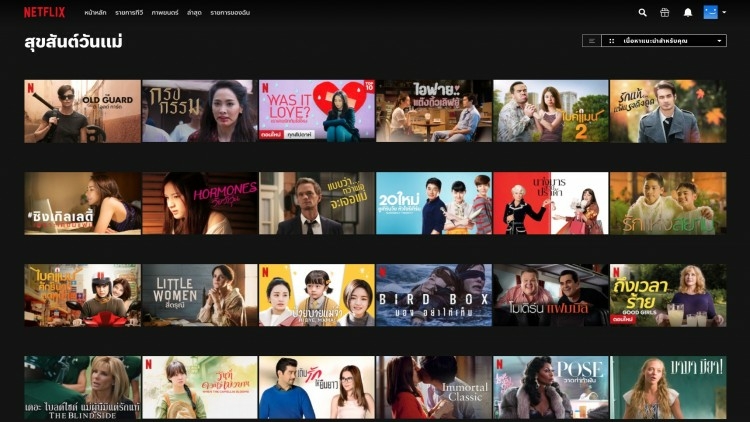
Netflix is joining Mother’s Day celebrations in Thailand on Wednesday (August 12) by offering a collection of 100 films and series that tell stories and mothers from across the world.

This special collection is available on the main page of the Netflix app on smart TVs, computers or smartphones. Viewers can also search for “Happy Mother’s Day” in the app or the website netflix.com/สุขสันต์วันแม่

Thai dramas to be promoted in more foreign markets #ศาสตร์เกษตรดินปุ๋ย

#ศาสตร์เกษตรดินปุ๋ย : ขอบคุณแหล่งข้อมูล : หนังสือพิมพ์ The Nation.

Thai dramas to be promoted in more foreign markets

EntertainmentAug 11. 2020Somdet Susomboon, director-general of the Department of International Trade Promotion.
Photo credit:Ch3thailandSomdet Susomboon, director-general of the Department of International Trade Promotion. Photo credit:Ch3thailand
By The Nation

More Thai dramas will be pitched in the international entertainment market to tap their growing popularity, the government’s trade promotion department said.

Somdet Susomboon, director-general of the Department of International Trade Promotion, said that Thai dramas based on the theme of “mother-in-law and daughter-in-law” are quite popular in places like China, South Korea, Japan, Hong Kong, Asean countries and Latin America. Therefore, the department will accelerate promotion of Thai dramas abroad and organise activities in Thailand for the awareness of foreigners, Somdet said.

He said that Thai dramas were likely well known abroad due to many foreign tourists, including Asians, visiting Thailand and liking the content.

Chanida Inpa, director of Thai Trade Center in Qingdao, China, said that since the Covid-19 epidemic, consumers in China are seeking more online entertainment. As a result, the Chinese online entertainment market continues to gain popularity, especially in the consumer groups aged 20-29 and aged 10-19. It was also found that the rural market will become a major new consumer segment of China’s online entertainment platform.

“Online entertainment that is popular include short videos, live broadcasts, cartoons, animation, games, and music. The service providers are now diversifying and becoming more interesting. It is also developing e-commerce, education and tourism-related entertainment,” said Chanida.

BLACKPINK’s ‘How You Like That’ tops 400 mln YouTube views #ศาสตร์เกษตรดินปุ๋ย

#ศาสตร์เกษตรดินปุ๋ย : ขอบคุณแหล่งข้อมูล : หนังสือพิมพ์ The Nation.

BLACKPINK’s ‘How You Like That’ tops 400 mln YouTube views

EntertainmentAug 09. 2020BLACKPINK

BLACKPINK “How You Like That” (YG Entertainment)

By Korea Herald

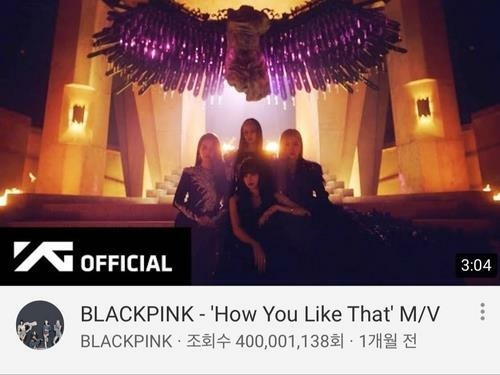
The music video for BLACKPINK’s hit song “How You Like That” topped the milestone of 400 million YouTube views Sunday.

The music video surpassed the threshold only 43 days after its release on Jul. 26.

The feat makes it the fastest to reach the mark among all K-pop music videos on YouTube. The previous record was by “Kill This Love,” another hit by the four-member act, which took 63 days to garner the view total.

“How You Like That” is the first of two pre-release singles that will become part of BLACKPINK’s first studio album, coming out on Oct. 28.

The second single will be rolled out on Aug. 28, the group’s management agency YG Entertainment said.

BLACKPINK debuted in 2016, topping multiple music charts with the hip-hop tracks “Whistle” and “Boombayah.” (Yonhap)

The great Gadsby: How a love of art fostered the comedian’s appreciation for history #ศาสตร์เกษตรดินปุ๋ย

#ศาสตร์เกษตรดินปุ๋ย : ขอบคุณแหล่งข้อมูล : หนังสือพิมพ์ The Nation.

The great Gadsby: How a love of art fostered the comedian’s appreciation for history

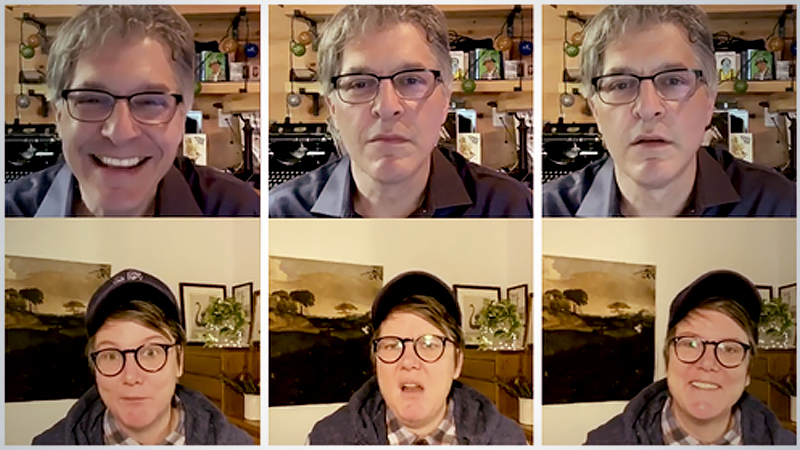
EntertainmentAug 02. 2020Geoff Edgers and Hannah Gadsby on July 17 in Edgers' twice-weekly Instagram Live show Geoff Edgers and Hannah Gadsby on July 17 in Edgers’ twice-weekly Instagram Live show “Stuck with Geoff.” MUST CREDIT: The Washington Post
By  The Washington Post · Geoff Edgers · ENTERTAINMENT, COMEDY 

Like so many, national arts reporter Geoff Edgers has been grounded by the novel coronavirus. So he decided to launch an Instagram Live show from his barn in Concord, Mass. 

Every Friday, and many Tuesday afternoons, Edgers hosts “Stuck With Geoff.” So far, he has interviewed actress Pamela Adlon, musician David Byrne, Bill Nye “The Science Guy” and basketball legend Kareem Abdul-Jabbar, among others. 

Recently, Edgers chatted with comedian Hannah Gadsby from her home in Australia. Here are a few excerpts from their conversation.

Geoff Edgers and Hannah Gadsby on July 17 in Edgers' twice-weekly Instagram Live show
https://www.washingtonpost.com/video/c/embed/070c3e29-e698-44e3-bdf2-689d61370e45?ptvads=block&playthrough=false

Q: We’re living in a weird moment of time. Two things have happened: the pandemic, which has changed everything, and the horrific killing of George Floyd. When I originally wanted to have you on here, you said: “I don’t think it’s my time to come on. I think it’s the wrong time.” That was interesting to me because you were theoretically promoting a comedy special, and it’s rare that people in the entertainment industry will decline to promote something. 

A: It just felt gross to promote a comedy show at that time. It still feels a little weird. Self-promotion is not my natural habitat. “Go watch it!” The killing of George Floyd didn’t seem to me, as an outsider, a particularly new thing. These things keep happening, and they happen here as well. We have Aboriginal deaths in custody here. I didn’t feel like me going, “Watch my comedy show, please” seemed appropriate.

Q: It is hard to know how to proceed at a moment like this. I think you have two options: One is if you’re working, you have to decide how you go about doing what you’re doing because it seems inconsequential in the universe. You also have to ask: What can I do to help in this situation? 

A: It should feel like that all the time. Even when there isn’t mass upheaval, how can you be a productive citizen? I think that’s a decent question. Also, there’s an intense amount of pressure to go, “I’ve got to do the right thing right now.” There’s no harm in a long-term strategy. I’ve only just figured out how to help in the post-bush fires here six months down the track, because I’m really slow. Sometimes we just react to whatever’s hot in the news. And then, you know, the devastation of the fires is still occurring, but we’re not talking about it anymore. So I always think: Play the long game. It’s not just about the moment, but long-term strategic, systemic change. And you’ve got to do whatever you can in your sphere of influence, I believe. 

Q: Your relationship to art history is fascinating. I love how you take art history and art into our world and mock it openly. But you must have a great love for art as well. 

A: I love art. I’m a visual thinker and seem to be able to get a lot more information out of pictures than I do words. To this day, I still prefer my books have pictures in them. When I was a kid struggling at school, I discovered the art books, and the whole world opened up and sparked my curiosity and depths of thinking. I’ve been kind of obsessed ever since. And I studied art history as a way, I think, of trying to understand the world I like. I have a greater appreciation of history because of art history. What I tend to mock in art history is the decisions people have made of what should be remembered. 

Q: You have always identified as someone who doesn’t really fit in. But suddenly your Netflix special “Nanette” comes out and everybody is hailing you as a revolutionary and someone who changed the face of comedy. But where do you fit in in the world of comedy? Do you hang out with, like, Gilbert Gottfried, or do you feel like comedians in the States have embraced you? Rejected you? 

A: I don’t know that they embraced me or not. Just the thought of going to a comedy club and hanging out with comics fills me with dread. Like, “Oh, I’m going to wait backstage in this cool room and go onstage to a bunch of people who don’t care because they just come in from the suburbs.” … I hate comedy. 

Q: You hate comedy? You don’t mean that, do you? 

A: Wow. You ask the hard questions. No, I don’t hate comedy. I just think I got to a certain age where that lifestyle was killing me. And in some ways, it was easy when I first started because I would go onstage and no one knew who I was. And then it was like, “What is this strange creature? I’ll let them entertain me while I wait for the big guy, the big guy at the end.” And then as my career developed, I became, in Australia, the headliner. I’m sure if I made an active effort to be involved in the U.S. comedy scene, maybe people would like me, but I didn’t. And now I don’t feel like I want to because I’m old. 

BLACKPINK to drop first full-length album on Oct. 2 #ศาสตร์เกษตรดินปุ๋ย

#ศาสตร์เกษตรดินปุ๋ย : ขอบคุณแหล่งข้อมูล : หนังสือพิมพ์ The Nation.

BLACKPINK to drop first full-length album on Oct. 2

Jul 28. 2020

By Yonhap

K-pop quartet BLACKPINK will drop its first full studio album in October, the group’s management agency said Tuesday.

On its official blog, YG Entertainment posted an album teaser poster titled “The Album,” with a pink tiara in the middle and the date “2020.10.02” at the bottom.

It is expected to be the first full-length album produced by the foursome, which debuted in 2016.

“In 2020, BLACKPINK will target the global music market on the back of systemic and thorough plans,” a YG Entertainment official said. “For a bigger expansion of BLACKPINK, our global project in cooperation with Universal Music Group is going on smoothly.”

Under a 2018 deal with Interscope, a record label under Universal Music Group, the U.S. company will represent the group’s music outside Asia.

“How You Like That,” released on June 26 as the first of two pre-release singles from the group’s inaugural studio album, landed at No. 33 on Billboard’s Hot 100 chart last month. It also debuted at 20th on the British official singles chart.

The second single is expected to hit global charts next month.

One of the biggest K-pop girl groups today, BLACKPINK of YG Entertainment landed a successful debut in 2016, storming multiple music charts back to back with its edgy hip-hop tracks “Whistle” and “Boombayah.” Other hits include “Playing With Fire” and “Kill This Love.” (Yonhap)

Emitt Rhodes, cult-figure musician called ‘one-man Beatles,’ dies at 70 #ศาสตร์เกษตรดินปุ๋ย

#ศาสตร์เกษตรดินปุ๋ย : ขอบคุณแหล่งข้อมูล : หนังสือพิมพ์ The Nation.

Emitt Rhodes, cult-figure musician called ‘one-man Beatles,’ dies at 70

EntertainmentJul 22. 2020Emmit Rhodes is pictured in 2002. MUST CREDIT: Photo by Jonathan Alcorn for The Washington PostEmmit Rhodes is pictured in 2002. MUST CREDIT: Photo by Jonathan Alcorn for The Washington Post
By The Washington Post · Matt Schudel · NATIONAL, WORLD, ENTERTAINMENT, OBITUARIES, MUSIC

Emitt Rhodes, who was a rising pop star in the early 1970s, with songwriting and singing skills likened to those of Paul McCartney, then gave up performing for more than 40 years, becoming a cult figure among musicians, died July 19 at his home in Hawthorne, Calif. He was 70.

The death was confirmed by Chris Price, a musician who produced Rhodes’s 2016 comeback album, “Rainbow Ends.” He did not know the specific cause.

Rhodes was something of a prodigy of pop music, playing in bands by 14 and signing his first major-label contract at 16, when he was with the group Merry-Go-Round. 

By 19, he had become a solo performer, writing all of his songs, playing all the instruments and producing the recordings in a shed in his backyard – practically creating the idea of the home studio. 

His self-titled debut album from 1970, which showed Rhodes on the cover moodily peering through a scorched windowpane, led a critic for Billboard to call him “one of the finest artists on the music scene today.” The album reached No. 29 on the Billboard charts, and one of its singles, “Fresh as a Daisy,” topped out at No. 54.

The music was bright, catchy and meticulously arranged, and Rhodes’s soaring tenor voice invited immediate comparisons with McCartney. Rumors began to circulate that “Emitt Rhodes” was a pseudonym for McCartney or that the Beatles had recorded an unreleased album that was appearing under a made-up name; others suggested that the recently broken-up Beatles were working incognito as Rhodes’s backup band. 

When it became apparent that Rhodes was playing the parts of John, Paul, George and Ringo – and their producer, George Martin – all by himself, he was dubbed the “one-man Beatles.”

“It was really flattering,” the very real Rhodes told The Washington Post in 2002. “Those guys were my idols.”

A second album, “Mirror,” appeared in 1971, and Rhodes – slender, clean-shaven and darkly handsome in those days – toured the country, seemingly on his way to stardom.

“I was chased, I had underwear thrown at me, I had groupies,” he told The Post. “It was like being in ‘A Hard Day’s Night.’ “

In 1973, Rhodes released the aptly titled “Farewell to Paradise,” his somewhat disillusioned goodbye to the life of a budding rock star. He was 23.

When he had agreed to his record deal with the Dunhill label four years earlier, Rhodes was required to produce a new album every six months for three years. Moreover, he had signed away the royalty rights to his songs “in perpetuity.”

Busy writing the songs, singing, playing all the instruments and producing polished little power-pop gems, Rhodes fell behind the schedule dictated by his contract. His record company withheld his royalties and sued him for $250,000 – “more money than I’d ever seen,” Rhodes later said. “I was horribly confused.”

He fell silent. He stopped writing music and went through personal problems, which he said included depression, drinking, drugs and divorce. The backyard studio went unused.

Rhodes spent the next 30 years working as a staff engineer and producer with Elektra and other recording studios. Nonetheless, his music endured, even as his mystery grew. 

“He was a deep, deep cult figure,” said filmmaker Tony Blass, who interviewed Rhodes for a 2009 Italian-produced documentary, “The One Man Beatles.”

In the 1980s, the all-female band the Bangles recorded Rhodes’s “Live,” which he had written and performed on television at 17. Other musicians hailed him as a lost musical hero, a misunderstood pop genius not unlike Brian Wilson, the troubled leader of the Beach Boys – who had grown up blocks away from Rhodes in Hawthorne, a working-class Los Angeles suburb.

A more apt comparison might be with songwriter Tandyn Almer, who wrote the 1966 hit “Along Comes Mary” for the Association and contributed to some Beach Boys songs before living his final years in obscurity in a basement apartment in Northern Virginia. 

In 2001, director Wes Anderson – on a suggestion from actor Jason Schwartzman – used one of Rhodes’s songs, the wistful “Lullabye,” in the movie “The Royal Tenenbaums.” When Rhodes saw the movie with his 10-year-old daughter, he heard the words he had written in 1970: 

Tears that angels cry

And they darken all the sky

When the one you love says goodbye

“I’d forgotten the tune,” he told The Post, but added, “My little girl was proud of me.”

Because of the contract he signed as a teenager, Rhodes did not see any royalties from “Lullabye” or any of his other songs. Eventually, new agreements were worked out, allowing him to profit from his earlier work.

The 2009 documentary about Rhodes received several awards in Europe and helped raise his profile. He also became friends with musician Chris Price, who knocked on Rhodes’s door in 2007 and began to meet him for lunch. 

Rhodes gave Price, now with the group Bebopalula, musical pointers but refused to discuss his earlier life. There had been occasions in the 1980s and 1990s when record labels tried to bring Rhodes back to the studio, but the plans always fell through. 

Eventually, he warmed up to Price and showed him manila folders containing more than 20 new songs. Many of them, such as “What’s a Man to Do,” were marked by a mature, wounded lyricism: 

I hear the whispers

I hear the talk

I count the minutes

I watch the clock

I fear she’s leaving

Won’t change her mind

The door is closing

I’m out of time

Price convinced Rhodes that it was time to sing again. The old studio, which had shag carpet from the 1970s and was being used as a storage shed, was cleaned out and put back in service. 

Musicians who had long idolized Rhodes were brought in, including guitarist Jason Falkner, keyboardist Roger Joseph Manning Jr. and drummer Joe Seiders, with special appearances by singers Aimee Mann and Susanna Hoffs. Rhodes was back in his element, his voice as expressive as it had been in his youth. 

Rhodes’s first album in 43 years, “Rainbow Ends,” appeared to glowing reviews in 2016.

“He wouldn’t put his name on just anything,” Price said in an interview. “We went through every song, every chord, every bar.”

Emitt Lynn Rhodes was born Feb. 25, 1950, in Decatur, Ill., and moved with his family to Hawthorne at age 4. His father was a machinist, his mother a homemaker.

Rhodes was interested in music from an early age and began his career as a drummer in a band with friends from his high school. By 16, he was the lead guitarist and singer for Merry-Go-Round, penning the minor hit “You’re a Very Lovely Woman,” along with “Live.” 

“I wouldn’t call him a perfectionist,” Price said of Rhodes’s songwriting style. “I would say he had very keen instincts and seemed to know what would make a listener respond to a song emotionally.”

Perhaps a more lasting influence, however, was Rhodes’s single-minded dedication to his craft, exemplified by his professional-quality home studio.

“He was a home recording guy before anybody else was doing it,” Price said. “He made it so that you couldn’t distinguish something he made from something made at Capitol Records. He did something out of necessity to him that later became commonplace.

“This has fundamentally changed the way music is made.”

Rhodes’s marriages to Kathy Sharp and Charnelle Smith ended in divorce. Survivors include his fiancee, Valerie Eaton of Toronto; two sons from his first marriage; and a daughter from his second marriage.

After releasing his 2016 album, Rhodes seemed to have decided he had nothing more to say. He canceled a comeback appearance scheduled at the South by Southwest festival in Austin, choosing to stay at home in Hawthorne, in the same house he had lived in for decades. In the title track of “Rainbow Ends,” he sang: 

I wanna be somewhere far away

Somewhere where I won’t be afraid

I wanna be sheltered safe and warm

I wanna be somewhere far from harm.

Enjoy Beethoven’s happiest symphonies via live-streaming on July 21 #ศาสตร์เกษตรดินปุ๋ย

#ศาสตร์เกษตรดินปุ๋ย : ขอบคุณแหล่งข้อมูล : หนังสือพิมพ์ The Nation.

Enjoy Beethoven’s happiest symphonies via live-streaming on July 21

Entertainment

Jul 17. 2020

By The Nation

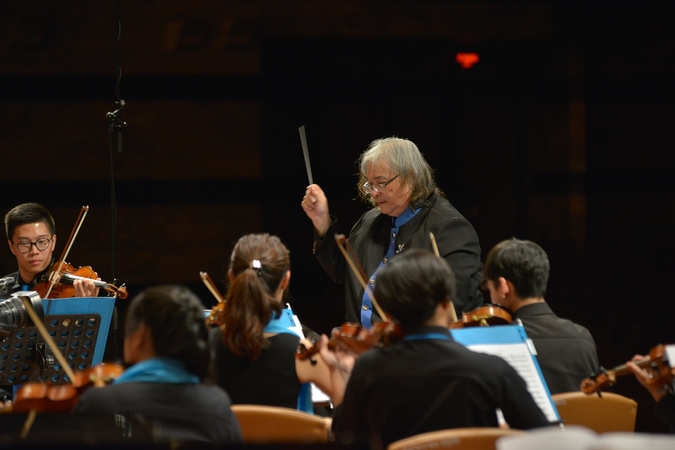
Thailand’s Siam Sinfonietta is finally kicking off its “Beethoven Year” by performing Symphonies 2 and 8 under the batons of Somtow Sucharitkul and Mickey Wongsathapornpat.

The long-awaited concert will be live-streamed on OperaSiam’s Facebook page on July 21 at 5pm and again on the OperaSiamTV.com website.

Before the Covid-19 outbreak, Siam Sinfonietta and other youth orchestras in Thailand were planning to perform all nine of Beethoven’s symphonies.

Now, since all these plans are in flux, the Bangkok Art and Cultural Centre has stepped in to set the process in motion, by starting off with Symphonies 2 and 8 – both compositions of sheer joy and exuberance that were ironically written during Beethoven’s darkest hours.

Due to social-distancing measures, only 50 special guests are allowed to attend in person. Tickets cost Bt2,000 each, which will be put towards Sinfonietta’s Covid-19 project, education, online programming and the creation of new live stream events.

Contact OperaSiam via Line (@operasiam) or email info@bangkokopera.com if you want to attend the event in person.