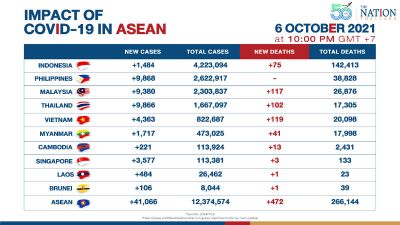
The number of Covid-19 cases crossed 12.37 million across Southeast Asia, with 41,066 new cases reported on Wednesday (October 6), higher than Tuesday’s tally at 39,342. New deaths are at 472, increasing from Tuesday’s number of 436. Total Covid-19 deaths in Asean are now at 266,144.
Singapore’s Manpower Minister announced that more foreign maids will be able to enter Singapore from November 1 but only those who are vaccinated will be considered for approval. The government will accept new entry applications for vaccinated foreign maids from October 15. Priority will continue to be given to homes with urgent and challenging caregiving needs, especially those with sick and elderly family members as well as those with special needs.
Meanwhile, Vietnamese Communist Party secretary-general announced that Hanoi will enter the economy recovery phase while promoting the ‘living with Covid-19 safely’ approach among its citizens. The city’s several businesses have been allowed to open since September 16 amid the risk of new infections spiking. Vietnam reported 4,363 new Covid-19 cases and 119 deaths of Wednesday, bringing cumulative cases in the country to 822,687 patients and total 20,098 deaths.
WASHINGTON – A bipartisan group of lawmakers plans to introduce legislation this week that for the first time would require trust companies, lawyers, art dealers and others to investigate foreign clients seeking to move money and assets into the American financial system.
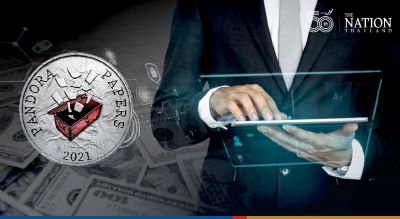
The bill’s sponsors cited the findings of the Pandora Papers investigation, the result of a sweeping international collaboration published this week that exposed how the global elite conceal their wealth in tax havens that increasingly include the United States.
Stories by The Washington Post and the International Consortium of Investigative Journalists (ICIJ) showed that little-known trust companies in Sioux Falls, S.D., established nearly 30 trusts holding assets connected to people or companies accused of corruption, human rights abuses or other wrongdoing in some of the world’s poorest communities. The investigation also found that King Abdullah II of Jordan secretly used offshore companies to purchase three properties in Malibu and revealed the use of two offshore trusts by an art dealer, now deceased, who was accused by U.S. prosecutors of trafficking in looted Cambodian artifacts.
ADVERTISEMENT
The proposed law, known as the Enablers Act, would amend the 51-year-old Bank Secrecy Act, by requiring the Treasury Department to create basic due-diligence rules for American gatekeepers who facilitate the flow of foreign assets into the United States.
Banks are already required to investigate their clients and sources of wealth, but trust companies, lawyers, investment advisers, accountants, art dealers, public relations firms and other professionals have been excluded from due-diligence rules – a loophole regularly criticized by financial crime experts and international watchdogs.
The proposed legislation, experts say, represents the most significant change of anti-money-laundering rules since 9/11.
“If we make banks report dirty money but allow law, real estate, and accounting firms to look the other way, that creates a loophole that crooks and kleptocrats can sail a yacht through,” Rep. Tom Malinowski, D-N.J., co-sponsor of the proposed bill and co-chair of the Congressional Caucus against Foreign Corruption and Kleptocracy, said on Wednesday. “Our bill closes that loophole and encourages the administration to move in the same direction.”
Malinowski called on the White House to support the legislation, co-sponsored by Reps. Steve Cohen, D-Tenn., co-chair of the bipartisan Commission on Security and Cooperation in Europe; Joe Wilson, R-S.C., ranking member of the commission; and Maria Elvira Salazar, R-Fla., a member of the caucus.
“All around the world, countries are being looted and the most vulnerable people victimized by their elites,” Cohen said. “These kleptocrats then launder that money to the West, where they enjoy the high life – spending the money on luxury cars, penthouses, jets and opulent parties. Some also spend it on intervening in our democracy . . . working to undermine the rule of law. In order to fight corruption, we must curb the enablers.”
If passed, the law would give the Treasury Department until December 2023 to create anti-money-laundering rules for the gatekeeper industries. A new national security task force would oversee the effort.
After 9/11, banks and shell companies – criticized for serving and shielding terrorists, drug traffickers and dictators – shored up their due-diligence practices. Financial crime experts say that such measures encouraged wrongdoers to find other financial gatekeepers, including the U.S. trust industry.
“Global criminals, kleptocrats, dictators, they’re going to look for new ways to launder their money and we’re going to try to close them down, but the gap right now is just massive – we basically left our financial defenses wide open,” said Paul Massaro, a congressional anti-corruption adviser who helped work on the proposed legislation.
In South Dakota, now considered a top destination for global wealth, trust companies oversee more than $360 billion in assets, state data shows. The Post and the ICIJ investigation identified a series of international clients who moved their assets into trusts in South Dakota in recent years, including a Colombian textile mogul implicated in an international scheme to launder drug proceeds and a Brazilian orange juice executive accused of colluding to underpay local farmers.
“Regulating professional enablers is how the United States could stop being the world’s top offshore financial haven, begin treating dirty money as a leading national threat and start demonstrating how democracies can deliver against corrupt adversaries and powerful special interests,” said Josh Rudolph, a member of the National Security Council staff in the Obama and Trump administrations who recently published an analysis on the role of financial gatekeepers.
The proposed legislation comes as new information surfaces about Abdullah’s steps to contain the impact of the Pandora revelations before the articles about him were published.
Newly filed U.S. federal disclosure forms show that Abdullah hired a law firm and a crisis management public relations company after learning that his use of shell companies to purchase luxury properties costing more than $106 million was about to become public. The moves reflect apparent concern about the potential fallout both in Washington and in Jordan, where there has been scant coverage of the Pandora stories and at least one news outlet said it was contacted by the Jordanian intelligence service and told to take down an article about the Abdullah revelations.
The forms were filed by DLA Piper, a law firm hired by Abdullah, to comply with laws requiring U.S. firms to disclose when they have been hired to represent a foreign government. A letter attached to the filing shows that the DLA Piper was hired at an hourly rate of $1,335 to represent Abdullah “related to potential defamation and other legal remedies associated with inquiries and/or articles concerning His Majesty.”
A lawyer for DLA Piper did not immediately respond to a request for comment. The firm was quoted in The Post and other news stories saying that Abdullah had not misused aid money and that his use of offshore companies was driven by security concerns.
A second federal filing shows that Abdullah and DLA Piper also hired Stripe Theory, an Atlanta-based consulting and public relations firm that describes itself online as a provider of strategic marketing advice “when your brand is on the line.”
Craig Kronenberger, listed on the letter as an executive at Stripe Theory, did not respond to an email sent to his company address requesting comment.
On Sunday, The Washington Post and the ICIJ broke the story about Abdullah’s property purchases in the United States. All told, 150 media partners contributed to the Pandora Papers, which revealed the financial secrets of 35 current and former world leaders and more than 330 politicians and public officials with assets around the world, including in the United States.
“If we are serious about fighting dictatorship, we need U.S. professionals to do the most basic due diligence – no American should be accepting money from Chinese Communist Party operatives, Iranian mullahs, Russian oligarchs or others,” Wilson said. “The Enablers Act is a critical national security measure.”
– – –
Will Fitzgibbon is a reporter for the International Consortium of Investigative Journalists.
The Pandora Papers is an investigation based on more than 11.9 million documents revealing the flows of money, property and other assets concealed in the offshore financial system. The Washington Post and other news organizations exposed the involvement of political leaders, examined the growth of the industry within the United States and demonstrated how secrecy shields assets from governments, creditors and those abused or exploited by the wealthy and powerful. The trove of confidential information, the largest of its kind, was obtained by the International Consortium of Investigative Journalists, which organized the investigation.
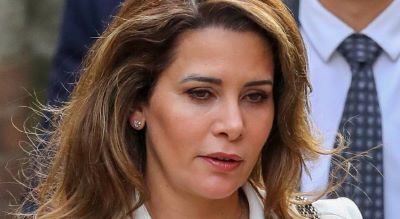
The ruler of Dubai used NSO Groups Pegasus spyware to hack the phones of his estranged wife, Princess Haya, and the closest members of her inner circle, a U.K. high court judgment released Wednesday shows.
The ruling offers strong confirmation for key elements of the Pegasus Project, an investigation published in July by The Washington Post and 16 other news organizations into NSO Group, the Israeli surveillance giant that sells its powerful spyware to government agencies around the world.
The phone numbers for Princess Haya and members of her legal and security teams were on a list of 50,000 numbers that formed the basis for the investigation. Reporters were able to identify more than 1,000 people whose numbers were on the list, including 85 human rights activists, 189 journalists, and more than 600 politicians and government officials. Forensic examination of 67 phones included on the list found 37 had been targeted by Pegasus.
ADVERTISEMENT
The phones of Haya and her inner circle were not examined as part of the news outlets’ investigation, but the numbers had been added to the list around the time Haya fled to London with her two young children following a campaign of harassment and threats from her then-husband, one of the Persian Gulf’s most powerful men.
The U.K. High Court of Justice ruling found that Haya, her personal assistant, two of her lawyers and two members of her security team had been subjected to “unlawful surveillance” carried out by agents of Sheikh Mohammed bin Rashid al-Maktoum, who, in addition to ruling Dubai, serves as the vice president, prime minister and defense minister of the United Arab Emirates.
The court’s family division has been investigating the surveillance amid a bitter custody battle over Haya and the sheikh’s children. The division’s president, judge Andrew McFarlane, said in the ruling that the findings represent not only “serial breaches of domestic criminal law” but a vast “abuse of power” by a head of state and a “total abuse of trust.”
In a statement, Sheikh Mohammed denied the allegations and said the matters concern “supposed operations of State security.”
The judgment, he added, was an “incomplete picture” and “unfair” because it was based on evidence not disclosed to him or his advisers. He also asked that the media “respect the privacy of our children and do not intrude into their lives in the U.K.”
Princess Haya’s attorney, Fiona Shackleton, declined to comment, saying the proceedings are ongoing. Her phone was among those hacked, the ruling found.
Haya’s legal team told the court that she “has been living in fear of her life, frankly, and in fear of the children’s security” since leaving Dubai in April 2019. “It feels as if I am being stalked, that there is literally nowhere for me to go to be safe” from him, she told the court.
The High Court judgment, which was written in May but released to the public only Wednesday, also found that Cherie Blair, the wife of former British prime minister Tony Blair, had alerted Haya’s attorneys to the invasion after being notified by a top official at NSO, where she served in an advisory role. Blair declined to comment.
Pegasus is one of the world’s most formidable spyware tools, allowing operatives to take over a phone without its owner even clicking a link. The spyware can silently send back vast amounts of data stolen from an infected phone, including call logs, emails, GPS coordinates, text messages and recordings from its cameras and microphones.
NSO officials have said Pegasus is licensed to governments solely for use in tracking terrorists and criminals, and that it investigates reports of misuse and can revoke contracts if the tool’s surveillance powers are abused.
On Wednesday, a person familiar with the operations of NSO, who spoke to The Post on the condition of anonymity to discuss internal operations, said that the company terminated its contract with Dubai after it learned the spyware had been used to surveil Haya and her allies. The deal would have been worth roughly $150 million over the next few years, the person said.
Haya’s phone was hacked 11 times during the summer of 2020 on Sheikh Mohammed’s “express or implied” orders, the judgment found. During one of the hacks, the ruling found, more than 250 megabytes of data were “covertly extracted” from the phone – a bundle big enough to include hundreds of photos, hours of video or audio recordings, and reams of text messages or emails.
The judgment, which was first reported by The Guardian, said the hacks had occurred during a “particularly busy” time of Haya’s life, in which she was preparing for critical custody hearings related to the long-term care of herself and her children.
The ruling also said that agents of Sheikh Mohammed had attempted to buy a sprawling 77-acre estate overlooking Haya’s new home, so close that it would have been “in prime position for direct or electronic surveillance.”
The person familiar with NSO operations said a confidential informant had told the company in August 2020 that the spyware was being used to target Haya and her attorneys. According to the judgment, a senior member of NSO’s management team called Blair, who advised the company on business and human-rights issues, around midnight Israel time on Aug. 5 to seek her help in alerting Haya and her legal team to the fact that their phones had potentially been compromised.
The NSO manager also urged Blair to advise the lawyers to restart their phones, as a way to block the spyware’s interception, the person familiar with NSO operations said. In witness statements provided to the court, Blair said the NSO manager told her the company had taken steps to ensure the phones could not be accessed again.
The person familiar with NSO operations told The Post that phone numbers with the U.K. country code of +44 have been blocked from searches by foreign governments since August 2020. NSO has said that numbers with the United States’ +1 country code also cannot be hacked.
The person said phones in NSO’s home country of Israel as well as in the “Five Eyes” – the intelligence-sharing alliance of the U.S., U.K., Canada, Australia and New Zealand – are now blocked from foreign surveillance, but that law enforcement and government agencies inside of those countries can still use Pegasus to target their own citizens.
Sheikh Mohammed said in his statement that it had not been appropriate for him, as a head of government, to provide evidence as part of private family proceedings in a foreign court. But McFarlane, the High Court judge, has disputed that argument, noting that the sheikh had submitted witness statements and directed his international legal team not to engage in the proceedings.
“At no stage has the father offered any sign of concern for the mother, who is caring for their children, on the basis that her phones have been hacked and her security infiltrated,” McFarlane wrote. “Instead he has marshaled a formidable forensic team to challenge the findings . . . and to fight the case against her on every point.”
Haya, the daughter of the late King Hussein of Jordan, had angered Sheikh Mohammad by questioning how he had behaved toward his daughter, Princess Latifa, previous U.K. judgments showed. Before fleeing Dubai, Haya said she had faced threats of exile to a desert prison and twice found a pistol in her bed.
In 2018, Princess Latifa had staged a dramatic escape from Dubai but was apprehended at sea in what her father declared was a “rescue.” Numbers for Latifa and her closest friends were also found on the list that included Pegasus targets.
The judgment follows a separate fact-finding ruling by the High Court last year that determined Sheikh Mohammed had ordered Latifa’s abduction and orchestrated an intimidation campaign against Haya.
The Post reported in August that one of Princess Haya and Latifa’s close allies, the human-rights activist David Haigh, also had his phone hacked by Pegasus, according to a forensic analysis by researchers with Amnesty International’s Security Lab. Those tests found that the hacks occurred on Aug. 3 and 4, 2020 – only days before NSO blocked the foreign targeting of U.K. numbers, the person familiar with the company’s operations said.
Bill Marczak, a researcher with the University of Toronto’s Citizen Lab who has helped investigate Pegasus use around the world and whose work on the Haya case is cited in the high court’s ruling, noted in a statement to The Post the unusual nature of NSO’s actions in the case.
“The actions that NSO Group took in this case, including sending letters to the court that accorded with my technical findings, notifying Princess Haya’s lawyers shortly after I did, and disconnecting one of their customers, are really quite unusual and extraordinary,” Marczak said.
“In our research at Citizen Lab, we see cases all the time of abusive surveillance of dissidents and journalists with NSO Group’s Pegasus spyware, but rarely if ever do we see NSO take actions resembling the ones they seem to have taken here. I wish they treated journalists and activists the way they treat Princesses and Baronesses.”
France was infuriated when Australia, the U.S. and Britain announced a security partnership known as AUKUS on Sept. 15, whose first initiative is the delivery of a nuclear-powered submarine fleet to Australia by the latter two countries despite the Australian governments multibillion-dollar 2016 contract to buy diesel-electric submarines from France.
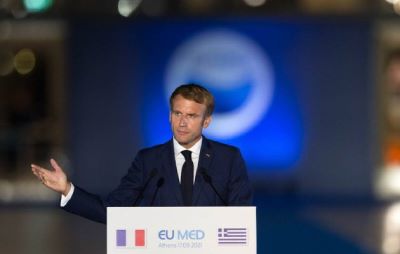
French President Emmanuel Macron held talks here with visiting U.S. Secretary of State Antony Blinken on Tuesday, three weeks after an unprecedented crisis between the two countries sparked by Australia’s decision to scrap a submarine deal with France.
The “at length, face-to-face meeting” between Macron and Blinken, which lasted about 40 minutes according to French media, should “help restore confidence” between the two countries, the Elysee said in a statement.
ADVERTISEMENT
Earlier on Tuesday, Blinken also met with his French counterpart, Jean-Yves Le Drian. They chose not to hold a joint press conference. The objective of their “in-depth exchange” was to “identify the steps that may allow a return of confidence between our two countries,” the French Foreign Ministry said in a statement.
U.S. Secretary of State Antony Blinken testifies before the U.S. Senate Foreign Relations Committee on examining the U.S. withdrawal from Afghanistan, in Washington, D.C. Sept. 14, 2021. (Drew Angerer/Pool via Xinhua)
France is “still angry” and “reserved,” its reception for Blinken has been “distant,” while Washington, “which publicly made amends after the Australian submarine crisis, said nothing more and promised to seek ‘concrete action’ to seal reconciliation,” Agence-France Presse reported.
France was infuriated when Australia, the U.S. and Britain announced a security partnership known as AUKUS on Sept. 15, whose first initiative is the delivery of a nuclear-powered submarine fleet to Australia by the latter two countries despite the Australian government’s multibillion-dollar 2016 contract to buy diesel-electric submarines from France.
Le Drian condemned the trilateral move with harsh words, such as “lying,” “betrayal” and “backstabbing.” Macron recalled France’s ambassadors from Washington and Canberra.
France has never been consulted or notified in advance of the AUKUS deal, Le Drian told a Senate hearing last Wednesday. The crisis “has not ended only because the dialogue has resumed,” he said. “It will continue. And in order to get out of it, serious actions will be needed, not words.”
British Prime Minister Boris Johnson (L) greets Australian Prime Minister Scott Morrison in front of 10 Downing Street, in London, Britain, on June 15, 2021. (Tim Hammond/No. 10 Downing Street/Handout via Xinhua)
The WMOs data show that water-related hazards have increased in frequency over the past 20 years.
Since 2000, flood-related disasters have risen by 134 percent compared with the two previous decades, while during the same period the number and duration of droughts also increased by 29 percent.
The World Meteorological Organization (WMO), a specialized agency of the United Nations (UN), warned on Tuesday that climate change increases the global risk of water-related hazards like floods and droughts, and the number of people affected by water scarcity is also expected to soar.
ADVERTISEMENT
In its new report entitled “The State of Climate Services 2021: Water,” the WMO says that 3.6 billion people globally had inadequate access to water at least one month per year in 2018, and by 2050 this number is expected to exceed five billion.
A boy stands on a flooded road on the outskirts of Bangkok, Thailand, on Sept. 3, 2021. (Xinhua/Rachen Sageamsak)
“The situation is worsening by the fact that only 0.5 percent of water on Earth is useable and available freshwater,” the report says.
The WMO’s data show that water-related hazards have increased in frequency over the past 20 years. Since 2000, flood-related disasters have risen by 134 percent compared with the two previous decades, while during the same period the number and duration of droughts also increased by 29 percent.
Most drought-related deaths occurred in Africa, indicating a need for stronger end-to-end warning systems for drought in that region. Most of the flood-related deaths and economic losses were recorded in Asia, while Africa was hit the most by drought-related deaths.
“Increasing temperatures are resulting in global and regional precipitation changes, leading to shifts in rainfall patterns and agricultural seasons, with a major impact on food security and human health and well-being,” says WMO Secretary-General Petteri Taalas.
Last year saw a continuation of extreme water-related events, which displaced millions of people and killed hundreds across Asia, while in Africa more than two billion people still live in water-stressed countries and suffer lack of access to safe drinking water and sanitation, according to the WMO chief.
Underlining the important role of water resources management in reducing water-related disasters, the WMO recommends that countries, especially small island developing states and least developed countries, increase investment in integrated water resources management and in drought and flood early warning systems.
The WMO also urges countries to fill the capacity gap in collecting data for basic hydrological variables, which underpin climate services and early warning systems, and national level stakeholders to co-develop and operationalize climate services with information users to better support adaptation in the water sector.
Photo taken on Feb. 19, 2021 shows a dam affected by drought in Kandahar city, Afghanistan. (Photo by Sanaullah Seiam/Xinhua)
Northwell Health, New York States largest private hospital system, laid off 1,400 workers who wouldnt get vaccinated against COVID-19, a spokesperson confirmed.
The United States’ vaccination efforts against the coronavirus keep expanding, particularly in the sectors involving frequent movement of large amounts of people such as medical services and aviation, while new booster and multivalent vaccines are being planned under tight schedules in order to counter the pandemic in a more efficient way.
The U.S. Centers for Disease Control and Prevention (CDC) updated on Tuesday that 215,502,382 people have received at least one dose of COVID-19 vaccine, making up 64.9 percent of the whole U.S. population; fully vaccinated people stood at 185,788,098, accounting for 56 percent of the total. A total of 5,711,774 people, or 3.1 percent of the fully vaccinated group, received booster shots.
ADVERTISEMENT
Meanwhile, according to The New York Times’ data analysis, the seven-day average of confirmed cases of the pandemic stood at 103,785 nationwide on Monday, with its 14-day change striking a 24-percent fall. The COVID-19-related deaths were 1,829 on Monday, with the 14-day change realizing a 12-percent decrease.
Photo taken on March 27, 2019 shows Southwest Airlines Boeing 737 Max aircraft parked at the Southern California Logistics Airport, in Victorville, California, the United States. (Xinhua/Zhao Hanrong)
Northwell Health, New York State’s largest private hospital system, laid off 1,400 workers who wouldn’t get vaccinated against COVID-19, a spokesperson for the health care network confirmed Monday afternoon. Now, the hospital’s vaccination compliance rate is up to 100 percent for the roughly 75,000 staff that remain.
Hospital and nursing home workers were required to get at least one dose of the COVID-19 vaccine by Sept. 27, under a state mandate first announced in mid-August. Last week, Northwell said it started warning employees and planned to begin layoffs starting with the highest-paid workers who refused the shots.
“Northwell regrets losing any employee under such circumstances, but as health care professionals and members of the largest health care provider in the state, we understand our unique responsibility to protect the health of our patients and each other,” said Jason Molinet, a Northwell Health spokesperson.
Also on Monday, Southwest Airlines said that its 56,000-person workforce must be vaccinated against COVID-19 by Dec. 8 to continue working at the airline because of new federal rules, joining other carriers who made similar announcements last week.
The U.S. federal government last month said that staff of federal contractors must be vaccinated, unless they are granted a religious or medical exemption. Southwest and other major airlines are federal contractors since they fly government employees, cargo and provide other service.
“Southwest Airlines is a federal contractor and we have no viable choice but to comply with the U.S. government mandate for Employees to be vaccinated, and — like other airlines — we’re taking steps to comply,” Gary Kelly, CEO of the Dallas-based airline, told staff on Monday.
NEW BOOSTER, MULTIVALENT VACCINE
Johnson & Johnson on Tuesday said that it has asked U.S. health regulators to authorize a booster dose for its COVID-19 vaccine, citing studies showing it improved protection among adults who previously received a single shot.
The Food and Drug Administration (FDA) could decide on J&J’s request within weeks. The agency has scheduled an Oct. 15 meeting of an advisory panel to review the evidence of the need for a booster, and to recommend whether the agency should authorize one.
“We’re describing the data to them,” said Mathai Mammen, head of global research and development for J&J’s vaccine arm, Janssen. “The process is not that we asked for a very specific interval — we’re providing them data and we’re going to be presenting to the committee. They’ll take all that into consideration when they ultimately decide on an appropriate interval.”
Meanwhile, several companies are developing multivalent COVID-19 vaccines, which would target SARS-CoV-2 variants, reported The Wall Street Journal on Tuesday. The current vaccines wouldn’t protect against all coronaviruses. The viruses are quite distinct from one another, making it a scientific challenge to create one vaccine that targets them all.
The administration of U.S. President Joe Biden and other funders should give priority to the development of shots that would broadly protect against these variants, Eric Topol, director of the Scripps Research Translational Institute in La Jolla, California, was quoted as saying. “What we really need is a global collaborative effort,” he said.
Recent studies of antibodies in people infected with SARS-CoV-2 are helping to speed vaccine development, Dennis Burton, an immunologist at Scripps Research, told the Journal. He and other researchers have identified “broadly neutralizing antibodies” that ward off both the pandemic virus and close viral cousins.
Placards display signage for Johnson & Johnson and Pfizer COVID-19 vaccinations at a mobile COVID-19 vaccination center in the Brooklyn borough of New York, the United States, Aug. 18, 2021. (Xinhua/Michael Nagle)
“The contract values reflect that the contracted company will benefit from the subsequent sale of scrap steel, iron, and non-ferrous metal ores,” said a spokesman for the Naval Sea Systems Command.
The U.S. Navy has sold two former aircraft carriers, USS Kitty Hawk and USS John F. Kennedy, to a Texas shipbreaking company for one cent each, the Naval Sea Systems Command said on Tuesday.
“The contract values reflect that the contracted company will benefit from the subsequent sale of scrap steel, iron, and non-ferrous metal ores,” said Alan Baribeau, a spokesman for the Naval Sea Systems Command.
ADVERTISEMENT
Both warships are aging and defunct. For the Kitty Hawk, that likely means a tug boat tow from Bremerton, Washington, around the tip of South America; for the John F. Kennedy, a sailing from the Philadelphia Navy Yard, according to a USA Today report.
The contract with International Shipbreaking Limited in Brownsville, Texas, for the tow, remediation, dismantling and recycling of the storied warships makes imminent their departures from the Navy’s mothball fleet, said the report.
No timetable has been established for either ship’s departure and dismantling, said the report.
WASHINGTON – Facebook whistleblower Frances Haugen on Tuesday told lawmakers that the company systematically and repeatedly prioritized profits over the safety of its users, painting a detailed picture of an organization where hunger to grow governed decisions, with little concern for the impact on society.
Her Senate committee testimony – based on her experience working for the company’s civic integrity division and thousands of documents she took with her before leaving in May – sought to highlight what she called a structure of incentivization, created by Facebook’s leadership and implemented throughout the company. By directing resources away from important safety programs and encouraging platform tweaks to fuel growth, these performance metrics dictated operations, Haugen said, a design that encouraged political divisions, mental health harms and even violence.
She pointed to Facebook chief executive Mark Zuckerberg as the enforcer of this system, arguing that he controls the most important decisions made at the company.
ADVERTISEMENT
“Until the incentives change, Facebook will not change. Left alone, Facebook will continue to make choices that go against the common good, our common good,” she said.
The hearing signaled the start of a new crisis for Facebook in Washington, galvanizing lawmakers from both parties around regulatory efforts to tamp down on what they say is a wide-ranging set of the societal ills prompted by the social media giant. Repeatedly, senators compared the company to Big Tobacco, purveyors of products that are addictive and profitable but ultimately bad. The Tobacco industry was ultimately contained by landmark regulation, an action lawmakers promised to replicate.
“I think the time has come for action, and I think you are the catalyst for that action,” Sen. Amy Klobuchar, D-Minn., told Haugen during the hearing.
The Senate panel hearing was Haugen’s first public appearance after she revealed herself Sunday evening as the source of thousands of pages of internal company research, leaked to the Securities and Exchange Commission and the Wall Street Journal. Throughout, Haugen gave a detailed account of the ways that Facebook employees are incentivized to turn a blind eye from the problems its services were causing, coupling her own experiences at the company with data from the internal Facebook documents she took with her.
Already revelations from the documents have intensified concerns on Capitol Hill about Facebook’s influence, particularly on children’s and teens’ mental health, a topic expected to be the key focus of the hearing. But Haugen and lawmakers covered huge swaths of ground, touching on national security risks, the spread of misinformation and the deadly mob attack on the Capitol on Jan. 6.
As she was speaking, Facebook’s representatives tweeted and emailed talking points rebutting Haugen’s testimony. One of their main points: Haugen didn’t work on many of the issues, including teenagers and child safety, that were covered in the documents that she downloaded. Lena Pietsch, Facebook director of policy communications, said Haugen clarified her testimony at least six times to point out that she had not worked on the subject matter in question.
“We don’t agree with her characterization of the many issues she testified about,” Pietsch said in a statement.
Haugen brought specific examples from her time at the company. Because of understaffing, she recognized a pattern where there was “implicit discouragement” from building rigorous systems to detect problematic content, she said. Haugen saw this play out in her work on counterespionage, where her team could only handle about a third of the cases they were made aware of. If Facebook had invested in building a detector, they knew they would have many more cases.
Sen. Marsha Blackburn, R-Tenn., raised concerns about Facebook executive Antigone Davis’s testimony to Congress last week that Facebook had removed 600,000 accounts in a three-month period of children younger than 13. Haugen said that there are probably far more children on the platform, and that the company has ways to determine people’s ages.
“Facebook could do substantially more to detect more of those children, and they should have to publish for Congress those processes . . . they could be much more effective than probably what they’re doing,” Haugen said.
She also said that she provided documents to Congress that show Zuckerberg knew the company could have intervened to prevent the spread of hate speech and misinformation in at-risk countries, but he did not, because it would have negatively affected “meaningful social interaction,” a key metric Facebook uses to measure communications between family and friends. Haugen said the company tied the metric to employees’ bonuses and chose not to make changes that could cost Facebook money.
“People stay or leave the company based on what they get paid, and if you hurt MSI, a bunch of people aren’t going to get their bonuses,” Haugen said.
During congressional testimony and on other occasions, Zuckerberg has insisted that the company does not reward employees based on how much time people spend on the platform. But on Monday, Facebook representatives declined to answer whether rewards or other incentives for employees were tied to the performance of the algorithm.
Engagement-based ranking, which Facebook uses to prioritize posts in people’s feeds that are more likely to elicit reactions – and therefore, clicks – also concerned Haugen. The downside is the recommendation of divisive or harmful content. That has led to Facebook’s algorithms causing teens to be exposed to more anorexia content, encouraging rifts within families, and fueling ethnic violence in Ethiopia, she told lawmakers.
Facebook could shift to posts being ranked in other ways, such as chronologically, and still remain profitable, she said. That argument resonated with lawmakers.
“This company could be vastly profitable but so much safer,” Sen. Richard Blumenthal, D-Conn., said during a news conference after the hearing. “They’ve just chosen the greediest path. . . . If they took a little bit less money but emphasized Facebook in the way they apply algorithms, they could help save lives.”
Facebook has long said that it made the change to its news feed algorithm to prioritize what types of interaction people found most valuable, and the shift was made in the context of a bigger prioritization of friends, family and groups over news publishers. News outlets, including The Washington Post, reported at the time that engagement among younger U.S. users was slowing, and Facebook was interested in finding ways to boost time spent on the platform.
Today, the company says its news feed algorithm takes in more than 10,000 data points when deciding what content to show people, and some of those data points include promoting trustworthy publishers and demoting those that are known to publish clickbait. But engagement – or the amount of likes, clicks, views and shares that a post generates – is still one of the most heavily weighted parts of the algorithm, executives have said.
The wide-ranging revelations marked a stark departure from dozens of other Capitol Hill technology hearings, where lawmakers have grilled company executives. These leaders largely gave non-answers, in contrast to the open and frank information that Haugen delivered on Tuesday.
Haugen’s call for regulation of Facebook was expansive and ambitious. She asked lawmakers to “break out of previous regulatory frames.” She warned lawmakers that some of the most widely debated proposals, including privacy protections or tweaks to Section 230, a decades-old law that protects companies from lawsuits over what users post, would be insufficient.
She proposed changing Section 230 to make Facebook responsible for “the consequences of their intentional ranking decisions.”
Gaining such expansive oversight of Facebook’s closed design will be an uphill battle for lawmakers, who have publicly called for regulation of social media for years but have been unable to pass bipartisan proposals that would force greater transparency. Tuesday’s hearing crystallized that while lawmakers are collectively outraged over Haugen’s allegations, there is little consensus about exactly what kind of legislation they might advance. Lawmakers name-dropped individual bills that they have introduced during the hearing, including proposals that would address children’s online privacy and bills that would increase transparency around tech companies’ algorithms.
Lawmakers from both parties have become increasingly motivated to pass stronger competition laws, and some bills would probably result in a breakup of Facebook’s existing business. But Haugen warned lawmakers against breaking up the company, arguing that it needs all the profitability it can get to properly police itself, especially in areas such as Africa where Facebook-owned services are the primary way people access the Internet.
“If you split Facebook and Instagram apart, it’s likely that most advertising dollars will go to Instagram and Facebook will continue to be this Frankenstein that is endangering lives around the world,” she said. “Only now there won’t be money to fund it.”
The revelations amount to perhaps the most significant crisis in Facebook’s history, one in a slew of such scandals over the years, but Zuckerberg has not publicly commented on them. Blumenthal said the Facebook chief needs to testify before the committee about Haugen’s revelations.
“No apology, no admissions, no acknowledgment, nothing to see here, we are going to deflect it and go sailing,” said Blumenthal, referencing the CEO’s frequent social media photos of his activities on the water.
This will probably not be Haugen’s last appearance on Capitol Hill. She told lawmakers that Facebook’s consistent understaffing of counterespionage staff is a national security concern, and that she is talking about it with members of Congress. Rep. Adam Schiff, D-Calif., a member of the select committee to investigate the Jan. 6 riot, said that committee would need to hear from her about Facebook’s role in the violence at the Capitol.
Blumenthal also called for both the Securities and Exchange Commission and the Federal Trade Commission to investigate Haugen’s revelations. Haugen’s lawyers have made at least eight complaints to the SEC, which has broad oversight of financial markets and the power to bring charges against companies that mislead investors.
Blumenthal is hopeful that Haugen’s decision to speak will inspire other tech workers who wish to expose similar concerns.
“I think there are other truth-tellers in the tech world who want to go forward, and I think you are leading by example,” he said. Haugen is “showing them that there’s a path to make this industry more responsible and more caring about kids and about the nature of our public discourse.”
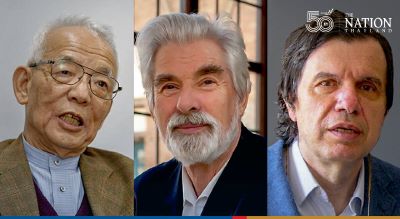
The Nobel Prize in physics was awarded Tuesday to scientists Syukuro Manabe of the United States and Klaus Hasselmann of Germany for laying the foundation of our knowledge of the Earths climate and how humanity influences it, including by reliably predicting global warming.
Giorgio Parisi, a theoretical physicist at the Sapienza University of Rome, also shared the prize for describing fluctuating physical systems and disorder on scales from atoms to planets.
The three scientists were honored “for groundbreaking contributions to our understanding of complex physical systems,” Göran Hansson, secretary general of the Royal Swedish Academy of Sciences, told reporters in Stockholm. They made accurate predictions for phenomena as chaotic as weather and climate. “The notion of global warming is resting on solid science,” Hansson said.
ADVERTISEMENT
Manabe, a meteorologist at Princeton University who was born in Shingu, Japan, has modeled Earth’s climate since the 1960s. He demonstrated how increased levels of carbon dioxide in the atmosphere will lead to increased temperatures at the surface of the Earth.
When the Nobel committee called him early Tuesday to tell him he’d won, Manabe was “gobsmacked,” according to Yale University physicist John Wettlaufer. “He said, ‘But I’m just a climatologist.’ And I think that’s the point . . . He really did construct the models from which all future climate models were built.”
In one such model, Manabe examined the interplay between solar radiation on the planet’s surface and the vertical movement of air due to convection. That model, of a 25-mile-high column of air, required hundreds of computing hours to test what happened with different levels of gases, the Nobel committee said.
The work led to a crucial finding: “If you double the carbon dioxide in the Earth’s atmosphere, the surface temperature would increase by 2 degrees Celsius,” Wettlaufer said.
Manabe’s model confirmed the key role carbon dioxide plays in heating the planet – essential for showing how human industry, which releases this and other greenhouse gases, drives climate change. A U.N. report published in September warned that by the end of the century, the planet could heat by 2.7 degrees Celsius, or 4.9 Fahrenheit, if large nations do not make more robust efforts to curb emissions, as The Washington Post reported last month.
Manabe enthusiastically led the charge to simulate how climate operates, his colleagues said. “He built numerical models of the climate system not just to answer questions about the future evolution of climate, but because he wanted to understand how the climate system works,” Rutgers University climate scientist Anthony J. Broccoli told The Washington Post.
At a Princeton news conference Tuesday afternoon, Manabe said it was a “great surprise and honor” to be selected for this prize. He added: “I never imagined that this thing I began to study has such huge consequences. I was doing it just because of my curiosity.”
Ronald Stouffer, a climate scientist who worked with Manabe at the National Oceanic and Atmospheric Administration’s Geophysical Fluid Dynamics Laboratory, said Manabe is the “father of climate modeling,” driven to simulate aspects of global warming before anyone else.
In addition to his influential carbon dioxide model, Manabe and his colleagues predicted how an influx of fresh water into the sea from melting polar ice would alter ocean circulation, slowing the global conveyor belt that influences continental temperatures and coastal sea levels. He also showed that warming can shape tropical storms.
“One of the things that stands out about Suki’s work is that almost all of it has been confirmed by 50 years of climate research,” said Stouffer, calling Manabe by his nickname. “He didn’t have too many false steps along the way.”
Awarding the physics prize to a meteorologist is unusual. “I was shocked. I had often thought about, and talked to people, whether Suki would win a Nobel Prize in physics – I thought it was reserved for physicists,” Stouffer said.
Hasselmann, an oceanographer at the Max Planck Institute for Meteorology in Hamburg, linked weather with climate about a decade after Manabe developed his model. Hasselmann showed how weather, which works on a time scale of days, influences ocean climate over a time scale of years.
“I’m very happy that they put the attention on the climate problem, which is really important,” Hasselmann said in an interview for the Nobel’s website. “We’ve been warning about climate change for about 50 years or so; it’s just that people are not willing to accept the fact that they have to act now” to prevent the worst effects of climate change.
Parisi, meanwhile, has studied a material called spin glass, in which a bed of copper atoms is randomly sprinkled with iron atoms. The iron atoms act similar to a magnet, except that in spin glass, the magnetic pairs point in different, rather than the same, directions.
A long-standing question in theoretical physics was to determine why the pairs pointed the way they did. Parisi solved this by finding a hidden structure in replicated spin glass systems, a method that became a “cornerstone of the theory of complex systems,” according to the Nobel brief.
Parisi said his approach can be used to explain environmental variation, such as the 100,000-year cycle of ice sheets forming glaciers and then collapsing.
The prize’s two halves are connected by a shared theme of disorder and fluctuation, said Nobel committee for physics chair Thors Hans Hansson, a theoretical physicist at Stockholm University. The natural world has hidden structures, he said, that can be understood if analyzed carefully, as this trio did.
Compared to the preindustrial age, Earth is now 1 degree Celsius warmer. That uptick has already exacerbated drought, flooding, hurricanes and wildfires. “It’s clear that for the future generation we have to act now, in a very fast way,” Parisi said when reached by phone during the Nobel conference.
Manabe acknowledged that trying to understand and respond to climate change can be daunting. “But it’s much easier than understanding current politics,” he said.
The three scientists will split a prize of 10 million Swedish kronor, or about $1.14 million, with half to Parisi and a fourth each to Hasselmann and Manabe.
Two decades ago, Jaime Aleman was looking to re-establish Panamas reputation as a stable business center following the U.S.s 1989 invasion.
So, the Duke-educated attorney brought together heads of the country’s top law firms to back legislation inspired by Liechtenstein’s friendly rules on private foundations. The story, as told by Aleman in his autobiography, “Honesty is Priceless,” was the beginning of an offshore-entity boom, in which world leaders, celebrities and more used hundreds of thousands of shell companies in Panama to hide their assets and take advantage of accounting and tax loopholes.
Now, his law firm — Aleman, Cordero, Galindo & Lee, or Alcogal — is at the center of an investigation by the International Consortium of Investigative Journalists for creating thousands of offshore companies that stashed money in tax havens for politicians and public figures. In sheer size, the leak of those financial records, known as the Pandora Papers, eclipses that of the Panama Papers in 2016.
ADVERTISEMENT
“Over the past three decades, Alcogal has become a magnet for the rich and powerful from Latin America and beyond seeking to hide wealth offshore,” the report said. “The firm acted as corporate middleman for more than 160 politicians and public officials.”
The law firm’s clients included Jordanian King Abdullah II, former presidents of Panama, the president of Ecuador and a presidential candidate in Honduras, according to the report. Almost half of the politicians whose names appear in the leaked records and nearly 2 million of the 11.9 million documents in the Pandora Papers were tied to Alcogal. In total, ICIJ tallied 14,000 entities in Belize, the British Virgin Islands, Panama and other tax havens created with Alcogal’s support as part of efforts to hide money away from public scrutiny for some 15,000 clients over 25 years.
Alcogal said in a letter to ICIJ that company incorporation is only one aspect of its legal services and that it operates in “full compliance with all applicable requirements in every jurisdiction in which we operate.” The firm “performs enhanced due diligence on a client who is determined to be a high-risk customer, regardless of the nature of the relationship or service,” it said. Alcogal didn’t reply to a request for additional comment.
Co-founded in the 1980s by Aleman, a former Panamanian ambassador to Washington, D.C., the firm worked with figures from some of the biggest corruption cases in recent history, including the so-called Carwash scandal that involved Brazil construction giant Odebrecht, the report said.
The report found that Alcogal set up more than 200 shell companies in Panama and other jurisdictions for Banca Privada d’Andorra, a bank based in a European principality between France and Spain, which the U.S. government blacklisted in 2015 for being a “primary money laundering concern.”
Alcogal is just one player in a larger industry. Aleman, 71, said in his autobiography that he helped create Panama’s law on private foundations along with other firms, including Mossack Fonseca, which was at the center of the Panama Papers. That firm closed in 2018 after it faced raids and arrests as part of the Carwash scandal.
Aleman’s book also mentions Morgan & Morgan, as well as Icaza, Gonzalez-Ruiz & Aleman and Arias, Fabrega & Fabrega as part of the group that shaped Panama’s foundation law in the 1990s. But they aren’t necessarily the biggest players in the space. Those Panamanian firms are not in the top ranks of Chambers and Partner’s list of the global offshore law firms, which includes Maples and Walkers in the Cayman Islands, Harneys in the British Virgin Islands, Mourant in Jersey and Appleby in Bermuda.
That may be why Panama feels like it’s being picked on. Former president Ricardo Martinelli, who was named in the ICIJ report because of Alcogal shell companies linked to two of his sons, tweeted that the ICIJ report aimed to “destroy the country.” His sons were held in Guatemala last year after facing U.S. indictments for their alleged roles in the bribery case involving Odebrecht.
Juan Carlos Varela, another former Panamanian head of state, was also named in the report for two companies that Alcogal registered in 2000 and 2001 in the British Virgin Islands, owned by him, family members and other associates.
Varela said in a statement on Twitter that he was transparent by declaring the shareholding as he became president in 2014, and as he left office in 2019.
Panamanian authorities have also recommended that Varela be charged in the corruption case of Brazilian builder Odebrecht, after Varela admitted in 2017 that during his vice presidential campaign, he received donations from the construction firm. But Varela has denied that the money was a bribe, and told ICIJ that the campaign donations were made in accordance with the law and were reported to electoral authorities.
A statement from the Panamanian president’s office says the government is working to “counter negative repercussions” of the leak.
“It’s our duty to defend the interests of the nation and fight so that the name of the country isn’t associated with activities that we repudiate,” said President Laurentino Cortizo Cohen.


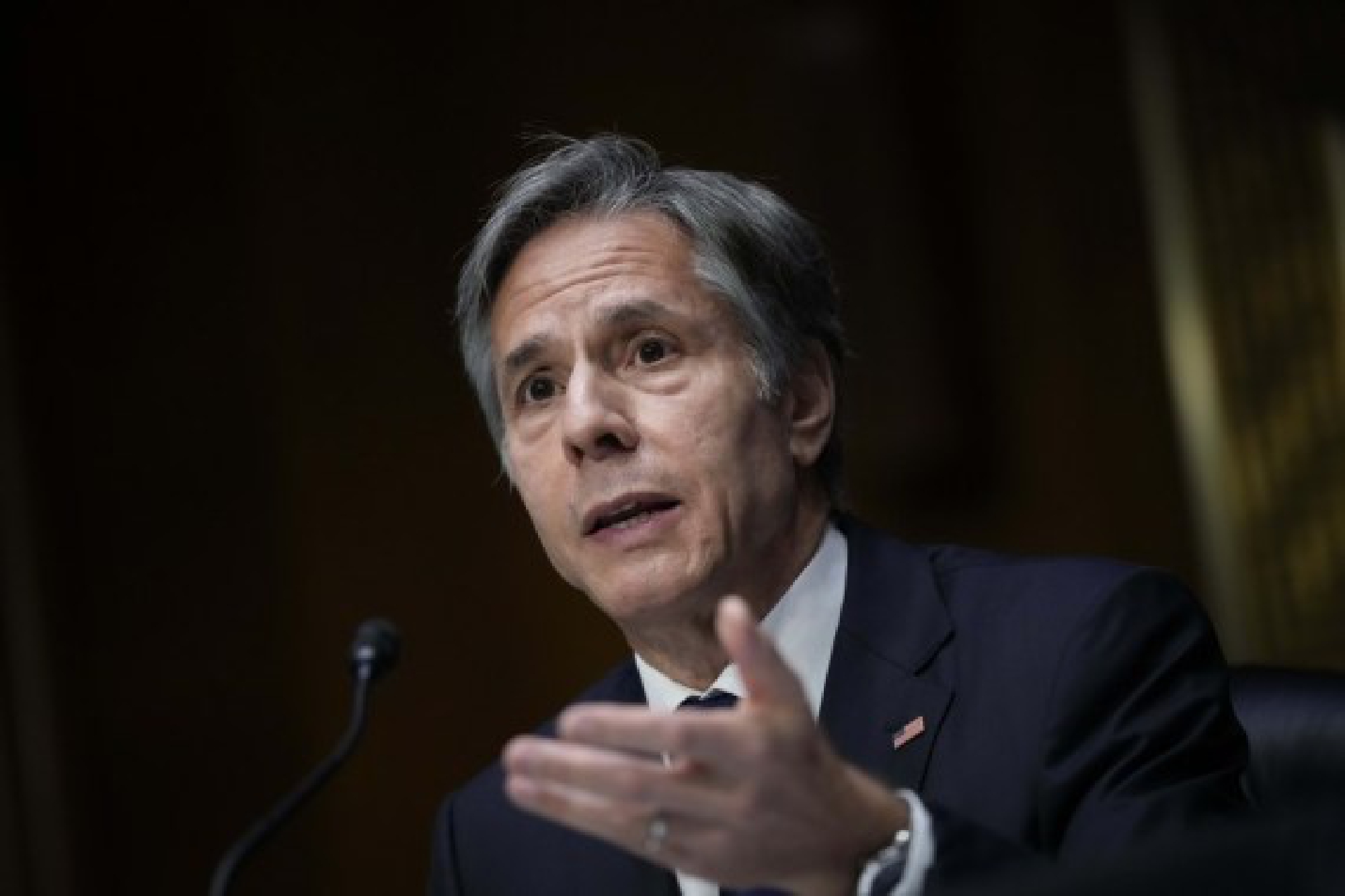 U.S. Secretary of State Antony Blinken testifies before the U.S. Senate Foreign Relations Committee on examining the U.S. withdrawal from Afghanistan, in Washington, D.C. Sept. 14, 2021. (Drew Angerer/Pool via Xinhua)
 British Prime Minister Boris Johnson (L) greets Australian Prime Minister Scott Morrison in front of 10 Downing Street, in London, Britain, on June 15, 2021. (Tim Hammond/No. 10 Downing Street/Handout via Xinhua)
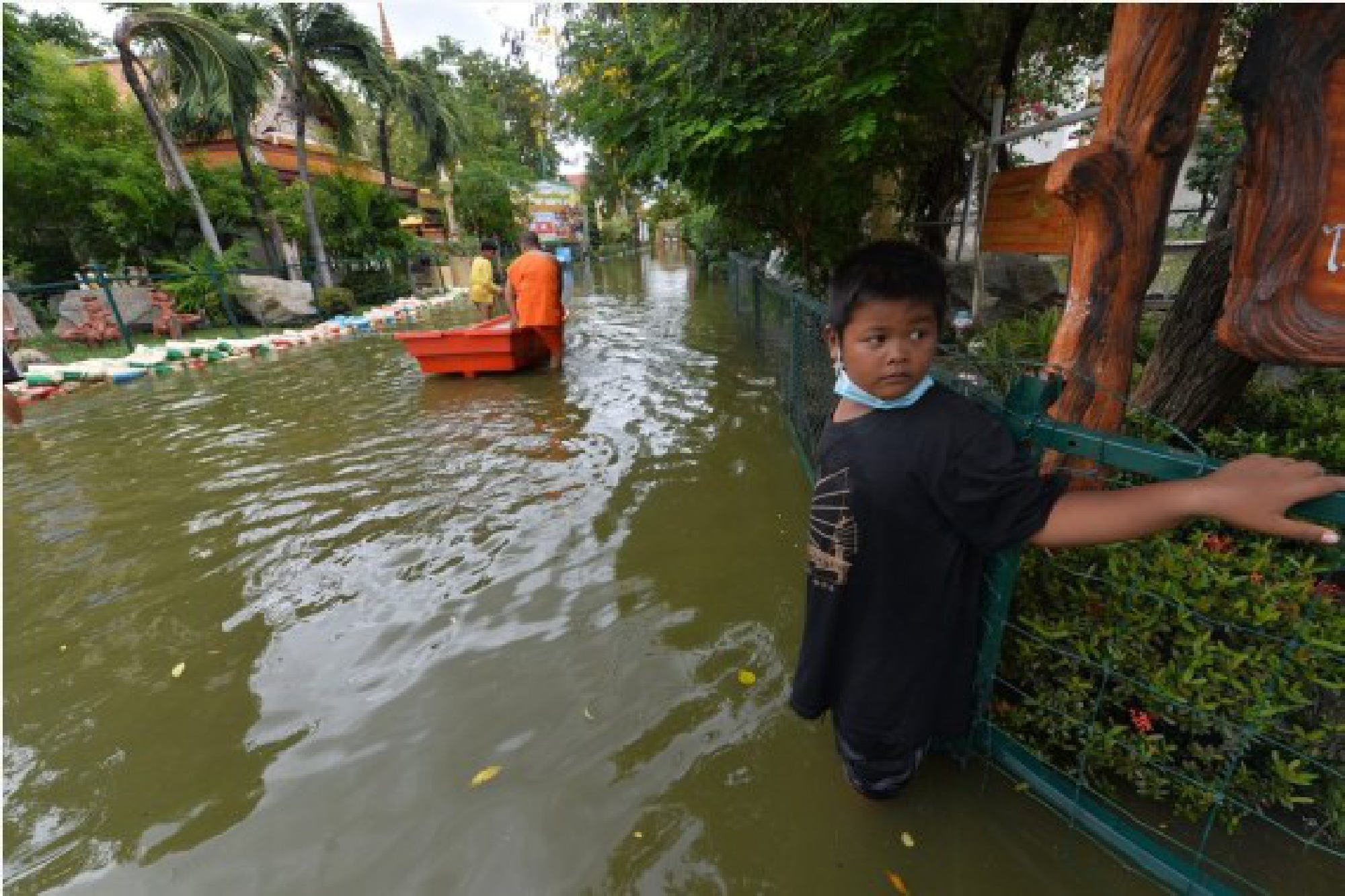 A boy stands on a flooded road on the outskirts of Bangkok, Thailand, on Sept. 3, 2021. (Xinhua/Rachen Sageamsak)
 Photo taken on Feb. 19, 2021 shows a dam affected by drought in Kandahar city, Afghanistan. (Photo by Sanaullah Seiam/Xinhua)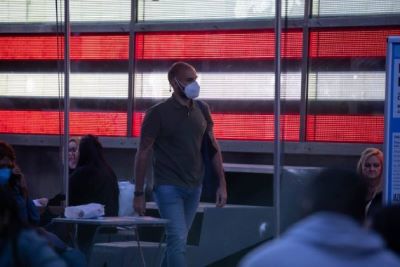
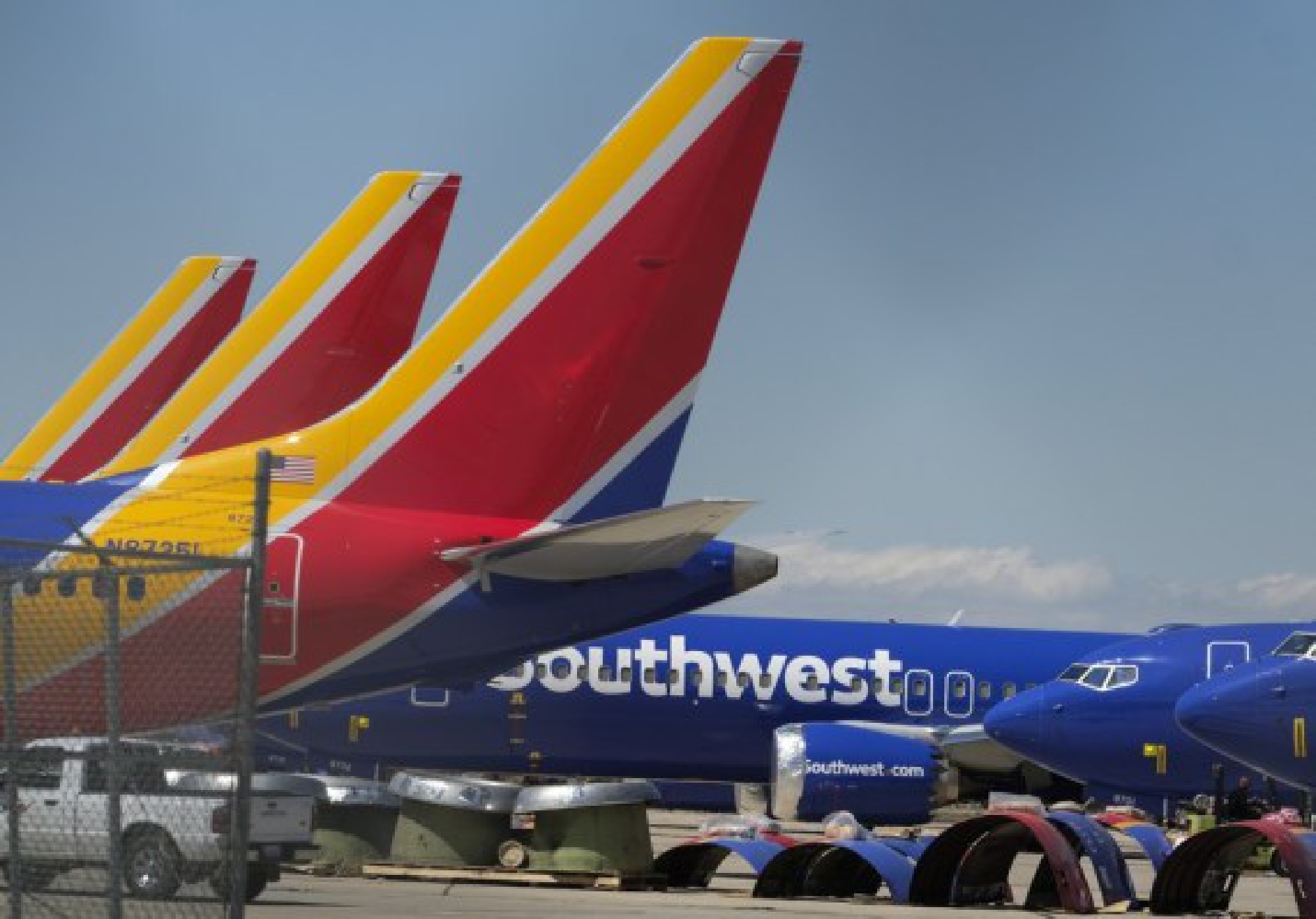 Photo taken on March 27, 2019 shows Southwest Airlines Boeing 737 Max aircraft parked at the Southern California Logistics Airport, in Victorville, California, the United States. (Xinhua/Zhao Hanrong)
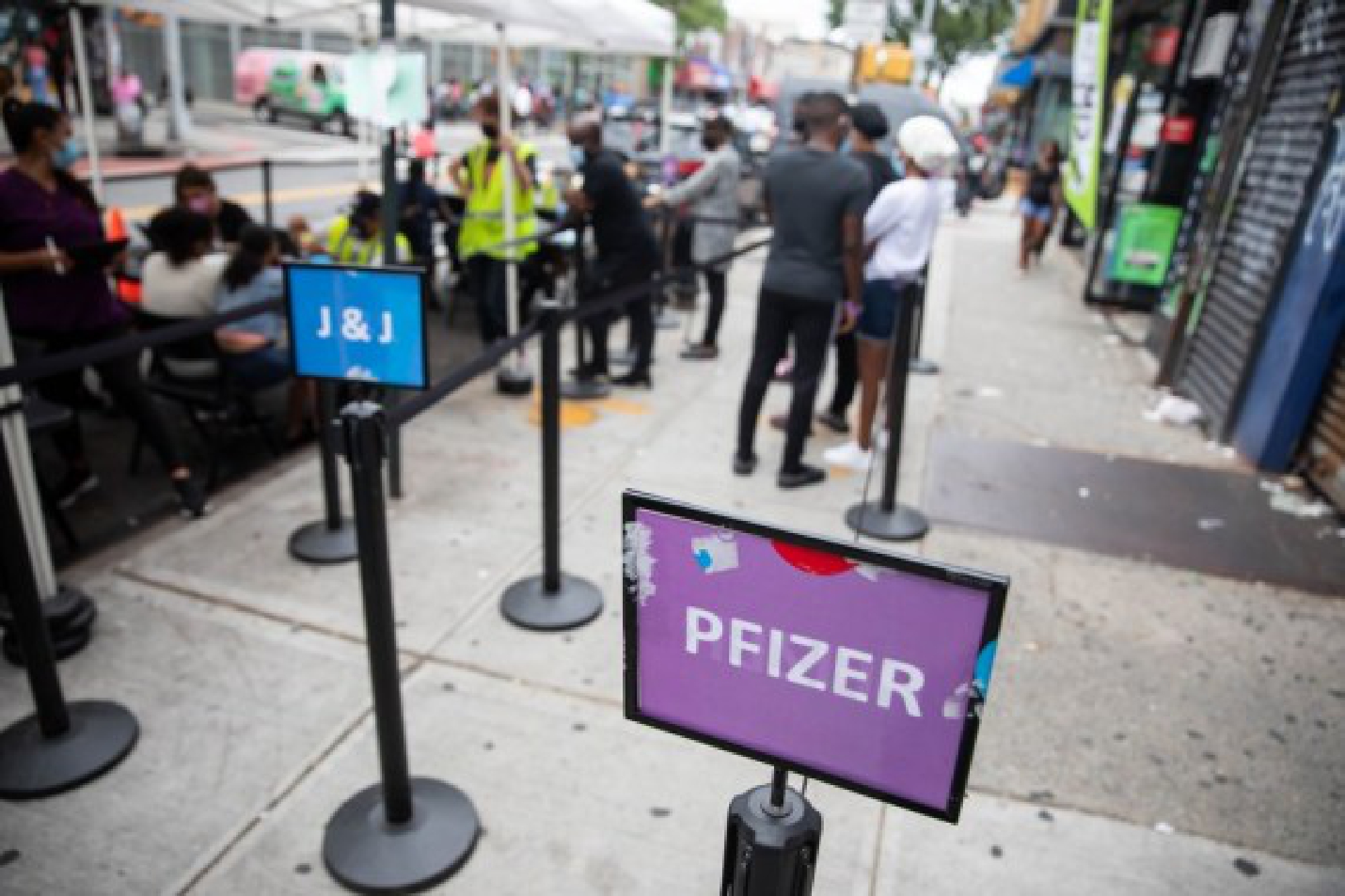 Placards display signage for Johnson & Johnson and Pfizer COVID-19 vaccinations at a mobile COVID-19 vaccination center in the Brooklyn borough of New York, the United States, Aug. 18, 2021. (Xinhua/Michael Nagle)