
Kishida secures Japan premier job, and now must win over voters #SootinClaimon.Com

#SootinClaimon.Com : ขอบคุณแหล่งข้อมูล : หนังสือพิมพ์ The Nation.

https://www.nationthailand.com/international/40006821


Fumio Kishida secured Japans premiership by showing his strength among ruling party insiders. Now, the ex-banker who has conceded some see him as boring will have to prove he can win over voters frustrated with the governments coronavirus policies.
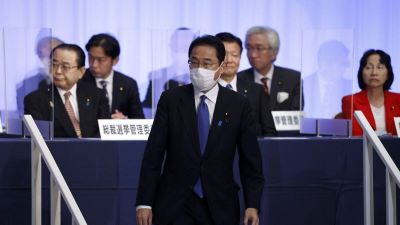
Kishida, 64, is set to become Japan’s prime minister after defeating a more popular reformer, Taro Kono, in an election Wednesday to lead the long-dominant Liberal Democratic Party. While Kishida can all-but guarantee that the LDP will install him as premier at a special session Monday, keeping the job will require convincing a skeptical public he deserves it in a general election within weeks.

“The problem is how far he can appeal to voters as the face of the election,” said Yu Uchiyama, a professor of politics at the University of Tokyo. “He’s managed to become a bit more appealing in the course of the leadership campaign, but it will remain an issue in the run-up to the general election. The other problem is how far he can exercise leadership.”

ADVERTISEMENT

Kishida was seen by party members as the safe choice to succeed outgoing Prime Minister Yoshihide Suga, and guide the world’s third-largest economy as it seeks to rebound from the pandemic. Although the former foreign minister from Hiroshima has promised a leftward shift in spending, he has reaffirmed the government’s core monetary policies and steered clear of the more progressive social agenda outlined by Kono.

Japanese markets, which closed just before the final result was announced, pared some losses, with Topix Index and Nikkei 225 both down 2.1%.

“There’s disappointment that with Kishida there’s a possibility that the LDP will remain the same way it is now, without any changes,” said Shingo Ide, chief equity strategist at NLI Research Institute. “There is also a risk that by trying to reflect input from various people, nothing will get done.”

Kishida must prepare to guide the LDP not only through a general election that must be held by by November, but an upper house poll next year. That schedule probably doesn’t provide enough time before facing voters to make good on promises to deliver tens of trillions of yen in stimulus spending and redistribute the “fruits of growth.”

“The coronavirus has divided the hearts of the people of this country, and I want to bring back the spirit of working together as one team to overcome this national crisis,” Kishida told a post-victory news conference. “We cannot manage the pandemic without the cooperation of the people. I want to put together an economic package of trillions of yen before the end of the year, to create an atmosphere where people work together.”

Masaki Kuwahara at Nomura Securities estimates Kishida’s stimulus package will come to about 30 trillion yen ($270 billion).

Kishida pledged to appoint a younger leadership team and preserve the LDP’s majority in parliament with coalition partner Komeito. He has voiced support for the Bank of Japan’s easing program, suggesting he’ll maintain the government and central bank’s joint pursuit of 2% inflation and leave Governor Haruhiko Kuroda in place for now.

Kishida’s victory caps an unpredictable LDP election, in which two of the four candidates were female. Although Kono and Kishida were nearly tied on the first ballot, Kishida’s stronger support among members of parliament pushed him over the top in the second round after Sanae Takaichi and Seiko Noda — both female former internal affairs ministers — were eliminated.

The outspoken Kono has ruffled feathers in the conservative LDP with his support of same-sex marriage and a proposal to overhaul the pension system — a touchy subject in one of the world’s most elderly countries.

“To the many people who supported Taro Kono — it was my failure and I apologize,” Kono said in a tweet.

Kishida — long seen as a dove on foreign policy for his opposition to nuclear weapons and efforts to resolve a painful decades-old dispute over Japan’s past militarism in the Korean Peninsula — showed a harder edge in his leadership campaign. He has accused China of wanting to export its authoritarian system, and said Japan’s defense spending will probably continue to rise.

Nonetheless he has called for dialogue amid souring relations with China, his country’s biggest trading partner.

Suga, who abandoned a plan to run for re-election after his once strong support rates plummeted to record lows amid criticism of his handling of the pandemic, was seen as a liability for his party heading into the election.

In one of his final acts as premier, Suga lifted a virus state of emergency as of the end of September as case numbers dropped, easing restrictions that have dragged on the economy and limited operations at bars, restaurants and entertainment venues.

“The next focus will be on Kishida’s new policies and how big the next stimulus package will be,” said Takeo Kamai, the head of execution services at CLSA Securities Japan Co. “That said, the upcoming general elections will be the main focus for investors, who want to see if the LDP is still able to maintain a majority given how they have handled the pandemic.”

Published : September 30, 2021

More than 100 killed in Ecuador prison riot as gangs fight for control #SootinClaimon.Com

#SootinClaimon.Com : ขอบคุณแหล่งข้อมูล : หนังสือพิมพ์ The Nation.

https://www.nationthailand.com/international/40006816


More than 100 prison inmates have been killed and dozens more injured this week in one of the deadliest prison riots in Ecuadors history amid an ongoing turf war between rival gangs.

The violence erupted around 9:30 a.m. Tuesday as competing gangs exchanged gunfire and explosives in their battle for control of one of the units in the main prison in Guayaquil, police said. At least five of the inmates killed were decapitated, Gen. Fausto Buenaño, a regional police commander, said Tuesday night. At least 47 others were injured.

On Wednesday afternoon, the country’s director of prisons said that 40 people had been confirmed dead but that authorities had discovered dozens more bodies in one of the prison units.

ADVERTISEMENT

“We’re in the process of evacuating the dead, but we’re surpassing 100,” Bolivar Garzón, the country’s newly appointed director of prisons, told an Ecuadoran TV news anchor Wednesday.

Ecuadoran President Guillermo Lasso on Wednesday afternoon announced he would preside over the security committee in Guayaquil, “to coordinate the necessary actions to control the emergency, guaranteeing the human rights of all those involved.”

Police entered the prison at 10:40 a.m. Tuesday, evacuated personnel – including six cooks – and managed to regain control of the facility by 2 p.m., authorities said. More than 500 officers were involved in quelling the violence, and a contingent of military officers arrived to provide assistance the following morning.

Tuesday’s riot came two months after a similar wave of violence broke out in two of the country’s prisons, including Guayaquil’s Litoral Penitentiary, killing 22 inmates and prompting Ecuador’s president to declare a state of emergency in the prison system.

In February, brawls in three prisons on the same day left about 80 inmates dead, marking the worst prison riots in the country’s history until that date. The fighting was prompted by a feud between rival criminal groups after the killing of the leader of Los Choneros, a local gang that has risen to prominence in part by controlling drug-trafficking routes between Colombia and Ecuador.

“It’s an unfortunate fact that this is happening in our society, in our country,” Garzón said in an interview with The Washington Post on Tuesday night, calling it a “particularly difficult year.”

Garzón stepped into the top role at 11 a.m. Tuesday, just as the prison riot was underway. Speaking hours later on his first day of work, the director said he aimed to find solutions to the growing violence in the country’s prisons, which he attributed to battles between gangs linked to the country’s drug trade.

“I hope we can begin to initiate a change,” Garzón said, adding that he plans to travel to Guayaquil on Wednesday.

The country has struggled to reduce the fighting in its penitentiary system for years. While the government launched a new program in 2019 to boost infrastructure and technology in its prisons, it cut the project’s budget the following year by more than 70%, according to Ecuadoran news site Primicias.

If authorities confirm the more than 100 deaths in this week’s riots, the death toll in Ecuador’s prisons will surpass 221 this year, violence that has been growing steadily since 2018, according to the country’s Ombudsman’s Office. More than 103 inmates were killed in 2020.

Earlier this year, the Inter-American Commission on Human Rights condemned the recent wave of deaths, attributing them to a “failure to adequately design, implement, and assess public policies targeting detainees.”

Last month, the same commission, the human rights arm of the Organization of American States, called on Ecuador’s government to increase prison security personnel and impose effective controls to prevent the entry of weapons and the activity of criminal organizations in its prisons.

Ecuador’s prisons have long suffered from overcrowding and weak security, with an insufficient number of guards to control the country’s prison population, according to Human Rights Watch.

Garzón said the president’s state of emergency remains in effect in the penitentiary system.

“I want to tell the mafias that try to intimidate this country that they are wrong,” Lasso said in July when he declared the emergency. “They are wrong if they think our hand is going to shake. We are going to use all our legal powers to impose the rule of law and guarantee peace and human rights in prisons in Ecuador.”

Published : September 30, 2021

Afghans pin hope on good governance to change difficult situation #SootinClaimon.Com

#SootinClaimon.Com : ขอบคุณแหล่งข้อมูล : หนังสือพิมพ์ The Nation.


“We enjoy good security, but we are concerned as living condition worsens in both urban and rural areas,” a resident in Afghan capital Kabul said. “Good governance is the key to win the hearts and minds of the people. It is a key to change the current difficult situation.”

The continuous rise of poverty and unemployment has led to calls on the Taliban caretaker government to take decisive action to avoid a humanitarian disaster in the post-war Afghanistan.
 

“The Taliban declared the war is over. More than 40 days after the Taliban takeover of Kabul, there still has been no positive change in the living conditions of the people. We enjoy good security, but we are concerned as living condition worsens in both urban and rural areas,” Kabul resident Mohammad Khan told Xinhua on Tuesday.

ADVERTISEMENT

Afghan Taliban members stand guard at a security checkpoint in Kunduz, northern Afghanistan, on Sept. 15, 2021. (Photo by Ajmal Kakar/Xinhua)Afghan Taliban members stand guard at a security checkpoint in Kunduz, northern Afghanistan, on Sept. 15, 2021. (Photo by Ajmal Kakar/Xinhua)

Related Stories

“Good governance is the key to win the hearts and minds of the people. It is a key to change the current difficult situation,” he said.

On Sept. 7, the Taliban announced a lineup of a caretaking government and the Taliban ministers soon assumed office without an oath taking ceremony. However, the government employees’ attendance is still weak in ministries and government general directorates.

“I want the Taliban ministers to try their best to run government offices. People have been facing difficulties in getting identification cards and passports as the related departments are not operating,” an applicant Salim Nawabi told Xinhua outside an interior ministry office.

“Security situation remained calm but security is not the only issue; we need public services. People are concerned about financial and economic situation, health, education, and livelihoods. Most banks are open but with limited cash payment, including salaries for government and private employees,” he said.

Struggling to get passports for his family and having repeatedly visited the related department, Nawabi said passport officials had regularly promised to applicants to start operation, but issuing passports is still being suspended.

An Afghan vendor sells food for consumers in Kandahar city, southern Afghanistan, Sept. 14, 2021. (Photo by Sanaullah Seiam/Xinhua)An Afghan vendor sells food for consumers in Kandahar city, southern Afghanistan, Sept. 14, 2021. (Photo by Sanaullah Seiam/Xinhua)

Some 18 million of Afghanistan’s 30 million population is reliant on emergency relief assistance, with needs continuing to rise, according to UN officials.

They said basic services in Afghanistan are collapsing, and food and other life-saving aid is about to run out.

On Monday, Amir Khan Muttaqi, acting foreign minister of the newly-formed administration, met with Deborah Lyons, special UN envoy and head of the UN Assistance Mission in Afghanistan (UNAMA) in Kabul, discussing various issues, including women’s situation, the UNAMA confirmed.

“Meeting at the Foreign Ministry, the UN envoy discussed with Mr. Muttaqi the humanitarian crisis, the UN’s work around the country, and how all Afghans, men & women, are critically needed to address the daunting humanitarian & development challenges facing the country,” UNAMA wrote on twitter.

Muttaqi gave assurances on behalf of the Taliban that the safety and security of all UN personnel in Afghanistan will be respected “so the organization’s 1,000 staff in the country can continue their work in various sectors, including ramping up delivery of humanitarian help.”

“The Taliban should help UN agencies and other international aid agencies to resume operation,” resident Ahmad Fahim said.

He said that a country of 30 million population needs not only security, but also rights, water, food, jobs, transportation, roads, and public services.

The Taliban should listen to the people’s voices over their legitimate demands, he said.

Earlier this month, UN Secretary-General Antonio Guterres appealed to countries that have pledged 1.2 billion U.S. dollars in relief for Afghanistan to take action quickly.

Besides, the Taliban authorities have vowed to have the aid reach those in need in a completely transparent manner.  

Afghan people are seen at a displaced person camp in Mazar-i-Sharif, capital of Balkh province, Afghanistan, Sept. 16, 2021. (Photo by Kawa Basharat/Xinhua)Afghan people are seen at a displaced person camp in Mazar-i-Sharif, capital of Balkh province, Afghanistan, Sept. 16, 2021. (Photo by Kawa Basharat/Xinhua)


Published : September 29, 2021

Top U.S. general calls Afghan war “strategic failure” #SootinClaimon.Com

#SootinClaimon.Com : ขอบคุณแหล่งข้อมูล : หนังสือพิมพ์ The Nation.

https://www.nationthailand.com/international/40006794


“Strategically, the war is lost, the enemy is in Kabul. So you have a strategic failure while you simultaneously have an operational and tactical success,” said Mark Milley, chairman of the U.S. Joint Chiefs of Staff, referring to the massive personnel evacuation since mid-August.

Gen. Mark Milley, chairman of the U.S. Joint Chiefs of Staff, said on Tuesday during a Senate hearing that it is a “strategic failure” with the Taliban back in power and U.S. withdrawal from Afghanistan.

Milley, alongside Secretary of Defense Lloyd Austin and U.S. Central Command head Gen. Kenneth McKenzie, testified for the first time before Congress since the United States ended its longest war in Afghanistan.

ADVERTISEMENT

“It is obvious, the war in Afghanistan did not end on the terms we wanted, with the Taliban now in power in Kabul,” Milley told the Senate Armed Services Committee.

Taliban members are seen on a military vehicle at Kabul airport in Kabul, capital of Afghanistan, Aug. 31, 2021. (Photo by Saifurahman Safi/Xinhua)Taliban members are seen on a military vehicle at Kabul airport in Kabul, capital of Afghanistan, Aug. 31, 2021. (Photo by Saifurahman Safi/Xinhua)
Related Stories

“Strategically, the war is lost, the enemy is in Kabul. So you have a strategic failure while you simultaneously have an operational and tactical success,” he said, referring to the massive personnel evacuation since mid-August.

Milley and McKenzie said they believed the United States should maintain 2,500 troops in Afghanistan, and a quick drawdown from the country could lead to a collapse of the Afghan government and military.

Such comments seemed to contradict President Joe Biden’s words in an interview last month, in which he said no military officials advised him to keep troops in Afghanistan after the withdrawal deadline.

Meanwhile, Milley and Pentagon chief Austin stressed that the sudden collapse of the Afghan military was beyond their expectation.

“The fact that the Afghan army we and our partners trained simply melted away, in many cases without firing a shot, took us all by surprise,” said Austin.

Milley noted that most intelligence assessments indicated the collapse “would occur late fall, perhaps early winter, Kabul might hold till next spring.”

Top military commanders pointed to the agreement reached between the United States and Taliban in February 2020, which called for a full withdrawal of the U.S. troops from Afghanistan by May 2021 if the Taliban meets the conditions, had a demoralizing impact on the Afghan military.

The U.S. military completed its withdrawal from Afghanistan on Aug. 30 under Biden’s order, ending 20 years of occupation. The hasty and chaotic evacuations drew fierce criticism from both home and abroad.

Milley admitted in the hearing that the withdrawal damaged U.S. credibility. “Damage is one word that could be used.”

He also raised terrorism threats that could potentially emerge from Afghanistan in the near future.

Reflecting on the Afghan war, Austin questioned if the United States had the right strategy in the past two decades, adding that Washington might never fully comprehend the situation on the ground, including the depth of corruption in Kabul.

A poll conducted last month by the Pew Research Center showed only 26 percent of Americans believed the Biden administration handled the Afghanistan situation well, and 69 percent of the public said the United States mostly failed in achieving its goals in Afghanistan.

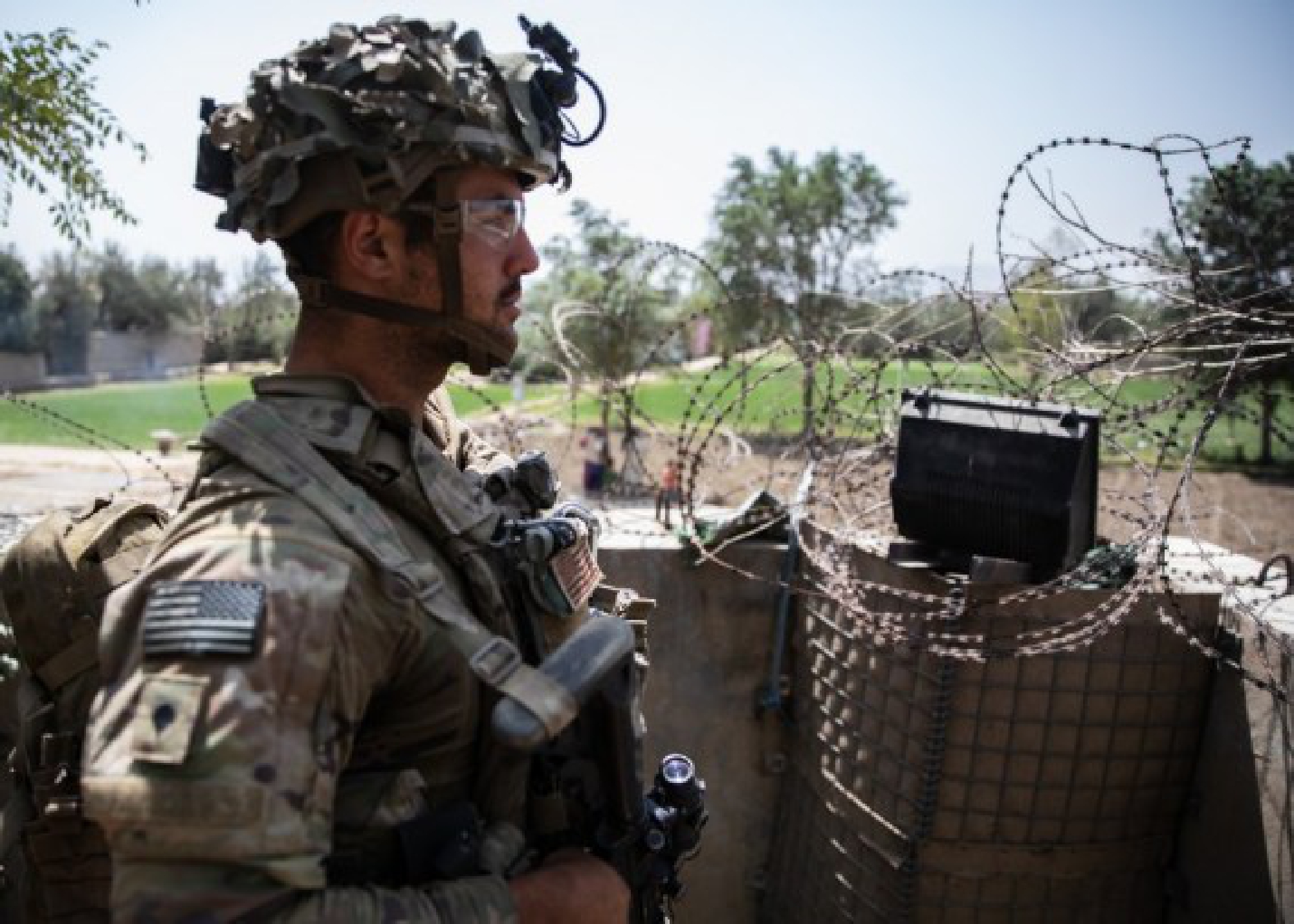
A paratrooper conducts security at Hamid Karzai International Airport in Kabul, Afghanistan, on Aug. 29, 2021.  (U.S. Army Photo by Master Sgt. Alexander Burnett/Handout via Xinhua)A paratrooper conducts security at Hamid Karzai International Airport in Kabul, Afghanistan, on Aug. 29, 2021. (U.S. Army Photo by Master Sgt. Alexander Burnett/Handout via Xinhua)

Published : September 29, 2021

Antibody levels reduce quickly even after 2 vaccine doses: Swedish study #SootinClaimon.Com

#SootinClaimon.Com : ขอบคุณแหล่งข้อมูล : หนังสือพิมพ์ The Nation.

https://www.nationthailand.com/international/40006791


More than 2,000 hospital employees were observed for the study, and the latest findings were based on a subset of more than 460 staff, Swedish Television reported.

 Antibody levels following COVID-19 vaccination decrease more rapidly than previously believed, according to a study of staff at a hospital in Stockholm, Swedish Television reported on Tuesday.
 

Seven months after receiving the second dose, the number of antibodies had decreased by 85 percent among those immunized with the Pfizer vaccine — where staff had not been infected with the virus before vaccination.

ADVERTISEMENT

However, the decrease was considerably slower among those who had been infected with the virus before receiving the vaccine.

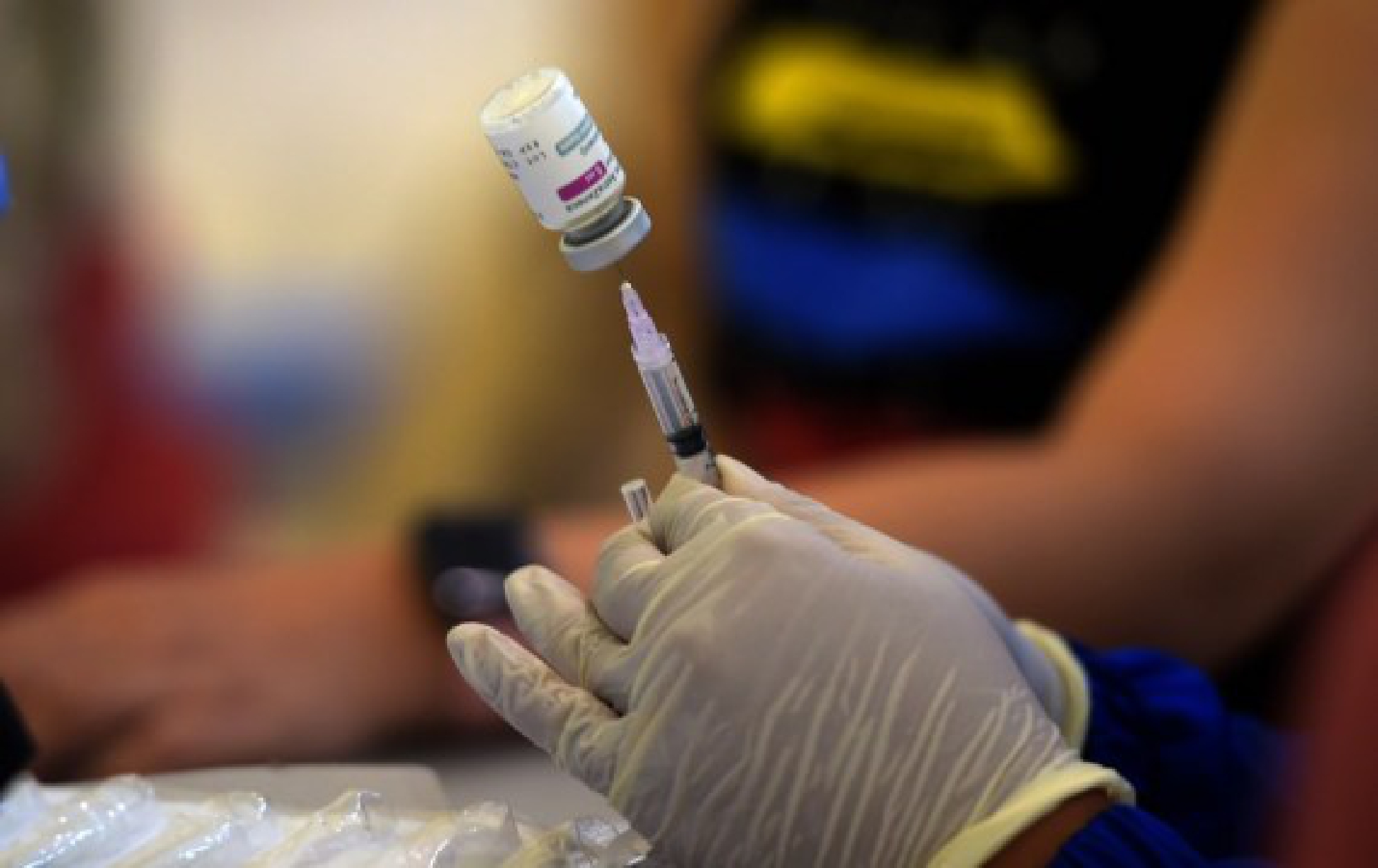
 A health worker prepares a dose of the AstraZeneca COVID-19 vaccine in Jakarta, Indonesia, June 10, 2021. (Xinhua/Zulkarnain)A health worker prepares a dose of the AstraZeneca COVID-19 vaccine in Jakarta, Indonesia, June 10, 2021. (Xinhua/Zulkarnain)

Related Stories

Among those vaccinated with AstraZeneca, researchers observed an even greater decrease.

“As expected, antibody levels fall over time, but I am surprised that they have dropped so significantly in such a relatively healthy and young group,” research leader Charlotte Thalin told Swedish Television.

“The low levels mean that we can have a wide spread of infection even in vaccinated groups, which may have consequences for our elderly. We must, therefore, give them a third dose as soon as we can,” she added.

More than 2,000 hospital employees were observed for the study, and the latest findings were based on a subset of more than 460 staff, Swedish Television reported.   

A man receives a third dose of COVID-19 vaccine in central Israeli city of Modiin, Aug. 17, 2021.  (Photo by Gil Cohen Magen/Xinhua)A man receives a third dose of COVID-19 vaccine in central Israeli city of Modiin, Aug. 17, 2021. (Photo by Gil Cohen Magen/Xinhua)


Published : September 29, 2021

COVID-19 deaths trend up, cases down in U.S. as vaccination remains key to combating variant #SootinClaimon.Com

#SootinClaimon.Com : ขอบคุณแหล่งข้อมูล : หนังสือพิมพ์ The Nation.

https://www.nationthailand.com/international/40006790


The United States hit a 7-day average of over 2,000 deaths for the first time since March on Sept. 18.

The number of COVID-19 deaths in the United States kept hiking above 2,000 per day, while the total numbers of cases and hospitalizations have trended down for days from their highs in early September, according to media reports.

The United States hit a 7-day average of over 2,000 deaths for the first time since March on Sept. 18. The death rate has risen by 23 percent since two weeks ago, when the country was tallying just over 1,650 deaths per day, and by 65 percent from the 1,234 deaths reported each day at this time in August, reported Forbes on Tuesday.

ADVERTISEMENT

Leading the country in recent mortalities are Alabama, which is clocking 2.37 deaths per 100,000 residents after seeing deaths rise 211 percent over the past two weeks, Florida (1.56 per 100,000), South Carolina (1.29), Alaska (1.23) and West Virginia (1.22), said the report.

U.S. President Joe Biden is seen on a screen as he receives his COVID-19 vaccine booster shot in Washington, D.C., the United States, on Sept. 27, 2021. (Xinhua/Liu Jie)U.S. President Joe Biden is seen on a screen as he receives his COVID-19 vaccine booster shot in Washington, D.C., the United States, on Sept. 27, 2021. (Xinhua/Liu Jie)


Related Stories

According to The New York Times (NYT), the 7-day average of confirmed cases of the pandemic stood at 117,966 nationwide on Monday, with its 16-day change striking a 33-percent fall. The COVID-19-related deaths were 2,052 on Monday, with the 14-day change realizing a 12-percent rise.

Meanwhile, per the U.S. Centers for Disease Control and Prevention (CDC) updates on Tuesday, 213,657,193 people have received at least one dose of COVID-19 vaccine, making up 64.4 percent of the whole U.S. population; fully vaccinated people stood at 183,888,907, accounting for 55.4 percent of the total.

The Delta variant of the coronavirus was the main reason behind people’s decision to get vaccinated this summer and why most say they will get boosters when eligible, according to the latest monthly survey on vaccine attitudes released by the Kaiser Family Foundation on Tuesday.

BOOSTER BLUEPRINT

U.S. President Joe Biden on Monday received his COVID-19 vaccine booster shot on camera at the White House, saying that “boosters are important, but the most important thing we need to do is get more people vaccinated.”

Some 20 million Americans are eligible for a third shot of the Pfizer vaccine, while about 23 percent of eligible Americans haven’t gotten any shot, according to media reports.

“What I want to say is, this is a ‘Walk, don’t run’ situation to go get your boost,” CDC Director Rochelle Walensky was quoted by The Atlantic as saying on Monday.

“Booster shots, when doled out at the right time, to the right people, are a boon. They jog the microbe-specific memories of immune cells, reinvigorating the body’s defenses against the pathogens that trouble us,” said the magazine’s report.

The Food and Drug Administration (FDA), under advisement from an independent panel of experts, had green-lit a third shot, at least six months out from dose two, for Pfizer recipients who are over 65 or who are at high risk of getting severe COVID-19 because of health status or increased exposure to the virus.

The CDC actively recommended the booster shots only for the 65-plus population, residents of long-term-care facilities, and those 50 and older with underlying health issues. The 18-to-49 crowd may opt to get shots as well if they had chronic medical issues, it said.

Photo taken on Aug. 23, 2021 shows Pfizer signage at PfizerPhoto taken on Aug. 23, 2021 shows Pfizer signage at Pfizer

VACCINE PLUS ORAL DRUG

Pfizer and BioNTech announced on Tuesday that they had submitted data to the FDA showing that their coronavirus vaccine is safe and effective in children ages 5 to 11.

The companies said that they would submit a formal request to regulators to allow a pediatric dose of their vaccine to be administered in the United States in the coming weeks. Similar requests will be filed with European regulators and in other countries.

Pfizer and BioNTech announced favorable results from their clinical trial with more than 2,200 participants in that age group just over a week ago. The FDA has said that it will analyze the data as soon as possible, reported NYT.

Also a step ahead for the company, Pfizer has started mid-to-late stage trials to test an oral drug designed to prevent COVID-19 in those who have been exposed to the virus, according to its announcement on Monday.

The drugmaker has moved forward in examining the effects of the oral antiviral candidate PF-07321332 after its first trial phase determined the drug was “safe and well-tolerated.” In the next phase, Pfizer will enroll up to 2,660 healthy adults who live in the same household as a person with a confirmed symptomatic COVID-19 infection.

The study aims to “assess safety and efficacy” of the drug in preventing COVID-19 cases and symptoms through two weeks after exposure. Pfizer said in a release that the drug can potentially be administered “at the first sign of infection or at first awareness of an exposure without requiring patients to be hospitalized.”

Published : September 29, 2021

Asean sees drop in new Covid cases #SootinClaimon.Com

#SootinClaimon.Com : ขอบคุณแหล่งข้อมูล : หนังสือพิมพ์ The Nation.

https://www.nationthailand.com/international/40006776


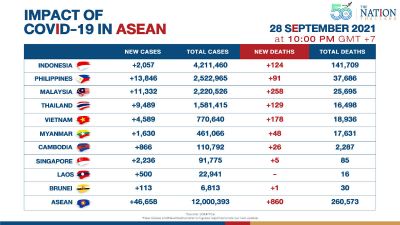
The number of Covid-19 cases in Southeast Asia crossed 12 million, with 46,658 new cases reported on Tuesday, lower than Monday’s tally of 54,998.

But Asean saw an additional 860 deaths, an increase from Monday’s 840, taking total coronavirus deaths to 260,573 so far.

The Philippines approved vaccinations for children aged 12 and over to curb the spreading Delta variant. The inoculation drive will start in 120 primary and high schools from October.

So far, just over a quarter of the country’s adult population has been fully vaccinated almost seven months after the first vaccination.

Meanwhile, Vietnam’s Ho Chi Minh City department of health revealed there could be up to 150,000 unreported Covid-19 cases in the city as cases detected through rapid tests or antigen tests were not included in official tallies.

ADVERTISEMENT

The department added that those who tested positive via ATK tests never received a confirmation testing via the RT-PCR method due to limited medical supplies.

It then proposed that the Public Health Ministry allow it to officially confirm Covid-19 cases through rapid antigen testing in order to accurately analyse the situation.

Published : September 29, 2021

Two transgender women won seats in Germanys parliament – part of a small but growing group around world #SootinClaimon.Com

#SootinClaimon.Com : ขอบคุณแหล่งข้อมูล : หนังสือพิมพ์ The Nation.

https://www.nationthailand.com/international/40006767


Two transgender women were elected to Germanys parliament on Sunday, the first openly trans candidates in the country to become national lawmakers.

Both are members of the Green Party, which came in third in the election: Nyke Slawik, 27, of North-Rhine Westphalia state, and Tessa Ganserer, 44, of Nuremberg.

“It is a historic victory for the Greens, but also for the trans-emancipatory movement and for the entire queer community,” Ganserer told the Reuters news agency.

ADVERTISEMENT

The number of transgender people holding political office is growing around the world – though it remains rare, especially at the highest levels of government.

In the United States, the 2020 elections brought the total number of transgender elected officials from 28 to 32, according to NPR. Forty-two elected officials – mostly at the local level, with eight in state legislatures – openly identify as transgender, according to the Victory Institute, an organization that seeks to elevate openly LGBTQ leaders.

President Biden also tapped Rachel Levine as assistant secretary for health, making her the first openly transgender federal official confirmed by the Senate.

In Brazil – considered one of the most dangerous nations for LGBTQ people – more than 50 transgender candidates ran for state or federal office in 2018, according to the Associated Press. At the local level, the numbers are even greater: In 2020, 281 trans candidates ran for local offices in Brazil – up from 89 in 2016. A total of 30 transgender people won across the country, according to the Columbia Political Review.

In Uruguay, Michelle Suárez Bértora, a lawyer who played a key role in drafting the country’s same-sex marriage bill, became the nation’s first trans senator in 2014. In Venezuela, Tamara Adrián, a lawyer and activist, was elected to the National Assembly in 2015. And Brazil’s Erica Malunguinho was elected to São Paulo state’s legislature in 2018.

In Mexico, political parties have been required to nominate equal numbers of men and women since a 2019 constitutional reform mandated “parity in everything.” Newer rules also require the nomination of candidates from vulnerable groups, including the LGBTQ community.

In Asia, transgender political representation is similarly rare and largely local. There have been several openly transgender mayors in India, parliament members in Thailand and council members in Japan. In the mostly Roman Catholic Philippines, Geraldine Roman, an outspoken member of the transgender community, was elected to Congress in 2016. Roman has advocated for a bill prohibiting discrimination on the basis of sexual orientation or gender identity. The proposal has languished in Congress for more than two decades.

In Europe, Slawik and Ganserer are part of a small group of trans leaders on the national level.

Europe’s first openly transgender member of parliament was Italy’s Vladimir Luxuria in 2006. Last year, Petra de Sutter was appointed Belgium’s deputy prime minister, making her the first openly transgender minister in Europe. Katrin Hugendubel, advocacy director for the LGBTQ rights organization ILGA-Europe, wrote in Politico that the lack of media frenzy around de Sutter’s appointment was a “sign of progress.”

During the campaign season, Ganserer and Slawik highlighted proposals calling for broader equality and LGBTQ rights – including an easier procedure for self-identifying as transgender without a medical certificate and a nationwide plan against trans-hostility and homophobia.

Published : September 29, 2021

U.S. deports Russian hacker convicted of fraud, report says #SootinClaimon.Com

#SootinClaimon.Com : ขอบคุณแหล่งข้อมูล : หนังสือพิมพ์ The Nation.

https://www.nationthailand.com/international/40006766


A convicted Russian hacker was detained at the Moscow airport Tuesday after he was deported by the United States in what appeared to be a rare extradition, Russias Tass news agency reported.

Aleksei Burkov was serving a nine-year sentence in U.S. federal prison for a range of cybercrimes, including identity theft and money laundering. The Justice Department had accused Burkov, a Russian national, of running a cyber forum for the sale of illegal goods and services, as well as a credit card scheme that stole more than $20 million from U.S. consumers.

But his return to Russia is just the latest twist in a criminal saga that has spanned multiple countries since Israeli authorities first arrested Burkov in 2015. Russia later charged him in absentia with a number of financial and hacking crimes and sought his arrest through Interpol, Tass reported.

ADVERTISEMENT

Israel, however, extradited Burkov to the United States in 2019.

The United States does not typically extradite convicted felons to other countries without assurances that they will serve their full sentences. Russia and the United States do not have an extradition treaty.

A spokeswoman for Russia’s Interior Ministry said Tuesday that Burkov had been deported from the United States.

“Today on arrival from New York to Moscow, he was taken into custody by Russian police officers,” Irina Volk said, Tass reported.

Russia has also imprisoned several Americans in a string of recent high-profile cases, further straining relations between the two countries.

Last year, a Russian court sentenced former U.S. Marine Paul Whelan to 16 years of hard labor for espionage – a charge he denied. Another former U.S. Marine, Trevor Reed, was also sentenced to prison last year for allegedly endangering Russian police in a drunken brawl. Reed has dismissed the charges as “clearly political.”

Published : September 29, 2021

Capital Gazette gunman sentenced to life in prison without parole for rampage that killed 5 #SootinClaimon.Com

#SootinClaimon.Com : ขอบคุณแหล่งข้อมูล : หนังสือพิมพ์ The Nation.

https://www.nationthailand.com/international/40006765


ANNAPOLIS, Md. – Jarrod Ramos, the gunman who attacked the Capital Gazette newsroom in Annapolis, Md., in 2018, will serve five consecutive life sentences without the possibility of parole for the murders of Wendi Winters, Rob Hiaasen, Gerald Fischman, Rebecca Smith and John McNamara.

Judge Michael Wachs sentenced Ramos to a sixth life sentence for the attempted murder of a staff photojournalist who survived the shooting, and hundreds more years in prison on gun and assault charges.

Ramos, who meticulously planned the attack, did not address the judge on Tuesday. Nobody but his attorney spoke on his behalf. The defendant, she said, told her not to ask for leniency.

ADVERTISEMENT

But the Anne Arundel County courtroom was full of people from the greater Capital Gazette community, and more than a dozen of them spoke for the victims and the six others who narrowly survived one of the deadliest attacks against journalists in American history. They told the judge about their pain and post-traumatic stress, of their nightmares and their continued commitment to their local newspaper.

Then Anne Arundel State’s Attorney Anne Colt Leitess asked for the maximum sentence. She said Ramos made his rampage a “one-sided fight,” but that he should not get the last word.

Wachs – who had previously denied Ramos’s request to expedite his sentencing date – assured the courtroom that the gunman would receive the sentence he “deserves and has earned.”

“The defendant did not have the final say,” Wachs said. “The First Amendment and the community got the final say.”

The sentence marked an end to the grueling, three-year legal battle that started on June 28, 2018, when Ramos stormed the Annapolis newsroom with the intention of killing as many people as possible.

Front and center on Tuesday were the five lives Ramos cut short. Hiaasen wasn’t alive to learn that his son was having a baby, or to see his youngest child settle into their first full-time job. Winters missed her daughter’s wedding. McNamara was two years and nine months away from retiring to explore the world with his wife. Smith didn’t get to witness her little sister graduate.

And every year since the shooting, Fischman has missed spending Feb. 14 with his wife. Erica Fischman shared a poem her husband wrote on one of their last Valentine’s Days together.

“I love you each day honey, from the moment that I wake,” he wrote. “And I’m going to keep on loving you until the last breath I take.”

This summer, a jury found that Ramos had the mental and emotional capacity to be held criminally responsible for the mass shooting. Although he had pleaded guilty to the murders, his attorneys argued he was not legally sane at the time of the attack. Instead of prison, they said he should be sent to a psychiatric hospital.

The trial began amid the three-year anniversary of the attack, and for three weeks the Annapolis community was transported back to that day. Jurors were shown security footage of Ramos blasting through the glass doors of the Capital Gazette office and stalking the newsroom. First responders and police talked about the decoys he had placed outside the entrance and the barricades he used to prevent his victims from escaping.

The six survivors testified about what they heard and saw while running away or hiding beneath their desks. They talked about how they thought they would die.

But at Tuesday’s sentencing hearing, those closest to the tragedy were given the opportunity to directly address Ramos for the first time.

Family members shared their last memories of their loved ones alive – their final outfit, their final text message.

Winters’s youngest daughter recounted the moment she knew her “mommy” was dead.

Summerleigh Winters Geimer, just 20 years old at the time, was at work when she learned of the shooting. She immediately called her mom, who always answered the phone. But it rang and rang, then went to voice mail.

Her older siblings were scattered across the country and the world, so Geimer went to the family reunification center set up in a desolate department store and sat alone, waiting.

Then she called them one by one to say their mom was one of the five.

“Even with a life filled with love and success,” the now 23-year-old told the courtroom, “I yearn for a lesser life if she were here.”

Others spoke of the lasting psychological scars of the attack.

Judy Hiaasen, the older sister of Rob Hiaasen, told the court she wasn’t sure she would be able to read her statement aloud.

“But then I thought about what Rob had to endure that day in that newsroom,” she said. “And I decided that if he had to face that, I can face this.”

Judy Hiaasen said she had crippling panic attacks after the shooting. As a teacher, she would sit in her classroom and think about the mass shooting that killed her brother – and how one could kill her, too. She watched out her large windows for gunmen. During a school mass shooter training, she was taught how to barricade the door or charge the attacker. But all that made her think about was the barricades Ramos used to block the newsroom exits, and the way Winters charged him with a trash can.

“My little brother was slaughtered, and the impact of that loss is indescribable,” she said. “It is unique. And it is never ending.”

Two survivors of the violence spoke.

Rachael Pacella, still a reporter at the paper, could not get past that barricaded door, so she survived by squeezing between two filing cabinets. While she hid, a clipboard cut into her leg.

She said she now has difficulty giving blood because the sharp pain reminds her of that day.

Selene San Felice, one of the most vocal of the six who survived, used her time to speak about journalism – and directly to Ramos.

She referenced the report of the state’s expert doctor, in which Ramos said he regretted that he wasn’t able to kill San Felice, too.

“He should still regret it,” she said. “Every day since he failed to kill me, I’ve committed my life to becoming a stronger and more outspoken journalist.”

San Felice hid under a desk during the attack. She texted her parents goodbye. She witnessed McNamara take his last breaths.

In the three years since, she said there were days she wondered why she lived, or if she should have lived at all. But now, she told the judge, she knows she lived to “spread the truth.”

Then San Felice turned to her left and faced Ramos.

“Remember this. You can’t kill the truth,” she said. “No matter how many journalists you shoot, there will always be people to shine a light in the darkness.”

Published : September 29, 2021