Tensions erupt in Tulsa as city commemorates 1921 race massacre #SootinClaimon.Com

#SootinClaimon.Com : ขอบคุณแหล่งข้อมูล : หนังสือพิมพ์ The Nation.

https://www.nationthailand.com/international/40001453

Tensions erupt in Tulsa as city commemorates 1921 race massacre


TULSA, Okla. – A “Remember and Rise” concert organized by the Tulsa Race Massacre Centennial Commission was abruptly canceled.

Tensions erupt in Tulsa as city commemorates 1921 race massacre

Oklahoma’s governor was ousted from the commission for pushing limits on how racism is taught in schools. And some residents are planning to boycott the opening of Greenwood Rising, a new museum that construction workers are racing to finish in the heart of Black Wall Street.

As Tulsa commemorates the 100th anniversary of the brutal 1921 race massacre, political tensions and racial divisions have erupted in a city still grappling with how to heal a century after one of the worst incidents of racial violence in U.S. history.

The commission organizing the commemoration has been denounced by some community groups who are staging their own events in Greenwood focused on massacre survivors and descendants.

Amid the strife, the city braced for armed groups to march through Greenwood, including a Second Amendment demonstration that was staged Saturday afternoon by the New Black Panther Party. The armed Panthers shut down streets, passing Standpipe Hill, where Black World War I veterans tried to hold off the White mob in 1921, and shouting “What do we want? Justice! When do we want it? Now! How we gonna get it? By any means necessary!”

President Joe Biden is scheduled to visit Tulsa on Tuesday, the day the city resumes its excavation of a mass grave in Oaklawn Cemetery that could be connected to the massacre.

Much of the acrimony in Tulsa revolves around the issue of reparations for the violence unleashed by a White mob on May 31, 1921, which left as many as 300 dead and 10,000 homeless and destroyed one of the most prosperous Black neighborhoods in the country. No one was ever punished for the attack, and the victims were never compensated for the lives and property lost.

The centennial commission, chaired by state Sen. Kevin Matthews, a Democrat, raised $30 million for the commemoration, the construction of Greenwood Rising and other projects. One of the most highly anticipated events was the “Remember and Rise” gathering on Memorial Day at ONEOK Field, which featured a performance by John Legend and a keynote speech by voting rights activist Stacey Abrams.

On Thursday, the concert was suddenly canceled “due to unexpected circumstances with entertainers and speakers,” the commission said in a statement.

But Tulsa activists and lawyers representing three of the last known massacre survivors – Viola Fletcher, 107, her brother Hughes Van Ellis, 100, and Lessie Benningfield Randle, 106 – said the celebrities pulled out after the commission failed to address requests that it use some of its funds to compensate survivors and descendants for what they lost during the rampage.

Matthews told reporters Friday that the lawyers for the survivors had initially sought inclusion in “Remember and Rise” in return for $100,000 each and a $2 million donation to a reparations fund.

After the commission agreed to those terms, Matthews said, the request changed to $1 million for each survivor and $50 million for the fund. “We could not respond to those demands,” he said.

But his account was disputed by the attorneys representing the survivors in a reparations lawsuit filed last year against Tulsa, Tulsa County, the state and the Tulsa Chamber of Commerce.

The legal team, it said in a statement, submitted a list of seven requests “to ensure the survivors participation with the commission’s scheduled events. The list included pledging to raise money for a fund that would provide direct financial support to the survivors and descendants.”

“There was never a non-negotiable demand for $50 million dollars. The non-negotiable issues were that the fund would provide direct financial support to survivors and descendants and that the fund would be administered by descendants and North Tulsa community members, and the fund be held in a Black bank.”

Tensions erupt in Tulsa as city commemorates 1921 race massacre

https://www.washingtonpost.com/video/c/embed/37073e4d-e371-435e-ab58-14bb703c3857?ptvads=block&playthrough=false

In an interview, Matthews said he would not comment on why the celebrities pulled out of the concert. The commission’s candlelight vigil, a ceremony scheduled for 10:30 p.m. Central time Monday to mark the time the first shot was fired in the 1921 massacre, will go on as planned.

“It is disappointing the national folks who were going to come to ONEOK Field are not coming,” Matthews said, “but that is not as important as the candlelight vigil, where we will honor those who have fallen and gone before.”

A number of activists said Matthews did not include survivors, descendants and Greenwood community activists in the initial stages of planning for the city’s centennial events.

“I’m speaking from experience,” said Jamaal Dyer, senior pastor of Friendship Church in North Tulsa, who resigned from the Tulsa Race Massacre Centennial Commission in 2019. “I was very vocal: ‘If we are going to do this for the community, we need to allow them to be part of the decision-making body.’ That was not welcomed. A year or two later, they went to them, but they had already started making decisions. They are still trying to control the narrative.”

Last week, Oklahoma Gov. Kevin Stitt, a Republican, was ousted from the centennial commission after he signed a bill that would prohibit public school teachers from teaching about “critical race theory” or lessons about race and racism that would make some students uncomfortable.

Carly Atchison, a spokeswoman for Stitt, said in a statement that the governor’s role on the commission “has been purely ceremonial.”

Sen. James Lankford, R-Okla., resigned from the commission earlier this week, with a spokesman telling KTUL that the senator “saw a drift from the original goals of the commission to a more partisan political agenda.”

Meanwhile, city officials have prepared for potential clashes between extremist groups, aware that Tulsa could be a target for white nationalists as well as the New Black Panther Party demonstration.

Carrying guns and marching in formation, dozens of Black Panthers paraded toward Greenwood, where people came out of nearby apartment buildings to shout support. They passed restaurants where White families were dining on patios. Some waved or put their fists in the air in solidarity. Others squirmed, looking uncomfortable.

“Don’t worry, this is the safest place in Tulsa!” one heavily armed marcher told them.

Tulsa Mayor G.T. Bynum, a Republican, said the city has been working with state and federal officials to make sure “people who want to participate in activities and mourn this event, the worst event in our city’s history, feel comfortable being in public doing that with different groups coming to town.”

“It’s the classic case of hope for the best and prepare for the worst,” said Bynum, who reopened the investigation into whether there are mass graves from the massacre.

On Friday, Greenwood bustled with speeches, parades, vendors and a concert headlined by gospel legend John Kee that were organized by the Black Wall Street Legacy Festival.

“The Black Wall Street Legacy Festival is the only community-centered series led by survivors and descendants commemorating the 1921 Tulsa Race Massacre,” said organizer Tiffany Crutcher, who testified before Congress on May 19 alongside the three massacre survivors to call for reparations.

Her group arranged for a parade Friday morning that featured the survivors – Fletcher, Ellis and Randle – in a procession through Greenwood and down Black Wall Street. They rode in a white carriage, drawn by a white horse, as they waved to crowds.

Last month, Randle issued a cease-and-desist letter demanding the commission to halt using her name or likeness to promote the official commemoration.

The survivors have accused the city of enriching itself by appropriating the massacre for “cultural tourism” that would benefit White developers.

During the May 19 hearing before a House Judiciary subcommittee, Damario Solomon-Simmons, the lead attorney in the reparations lawsuit, told Congress that the city and the centennial commission had not shared any of the $30 million raised for the commemoration with survivors.

“As I speak, the same perpetrators of the massacre – the city, the county, the chamber, the state – are utilizing a massacre to pad their own pockets,” Solomon-Simmons testified.

“Not one penny has been given to any of the survivors. Not one dime has been paid for any of the outstanding claims.”

Tulsa officials have said they cannot comment on the pending lawsuit.

In Oklahoma City, the state capital, state Rep. Regina Goodwin, a Democrat, fought to keep the word “reparations” in a resolution she introduced to commemorate the massacre, pointing out that the 2001 report by the Tulsa Race Riot Commission called for reparations – a recommendation that was ignored.

Republican lawmakers opposed to reparations urged her to remove the word “reparations” from the resolution.

After much debate, the word was allowed to stay in the House resolution, but it was removed from a resolution introduced in the state Senate.

When Biden arrives in Tulsa on Tuesday, where he goes will be watched closely. Will he visit the long-established Greenwood Cultural Center or the new Greenwood Rising? Will he meet with the survivors?

“Any president that comes to Tulsa to recognize the centennial of the Tulsa Race Massacre should be centering the survivors and descendants in every single aspect of their visit and should not lose sight of the fact they just came back from Washington pleading for their humanity to be recognized and that they not leave this earth without reparations,” said Dreisen Heath, who wrote the Human Rights Watch report “The Case for Reparations in Tulsa.”

On Friday, Heath watched the unveiling of the new Black Wall Street Memorial and the lighting of an eternal flame in Greenwood.

“There can be no justice without reparations,” Heath said. “Anything short of that has grand implications of the survivors’ lives, the descendants and broader Black community.”

The present-day struggles over a century-old massacre are unlikely to be settled anytime soon, said Michael Mason, a Tulsa journalist and founding member of the Center for Public Secrets, a counterculture arts center.

When Archbishop Desmond Tutu visited this city in 2004, “he called Tulsa a powder keg,” Mason said. “That is more true now than it was before because of unresolved tensions surrounding the massacre.”

Published : May 30, 2021

By : The Washington Post · DeNeen L. Brown
With nearly 28,800 new Covid-19 cases, Asean sees biggest rise in over 2 weeks #SootinClaimon.Com

#SootinClaimon.Com : ขอบคุณแหล่งข้อมูล : หนังสือพิมพ์ The Nation.

https://www.nationthailand.com/international/40001451

With nearly 28,800 new Covid-19 cases, Asean sees biggest rise in over 2 weeks


Southeast Asia continued to see a rising trend in new Covid-19 cases, with Saturdays total being the highest in over two weeks.

With nearly 28,800 new Covid-19 cases, Asean sees biggest rise in over 2 weeks

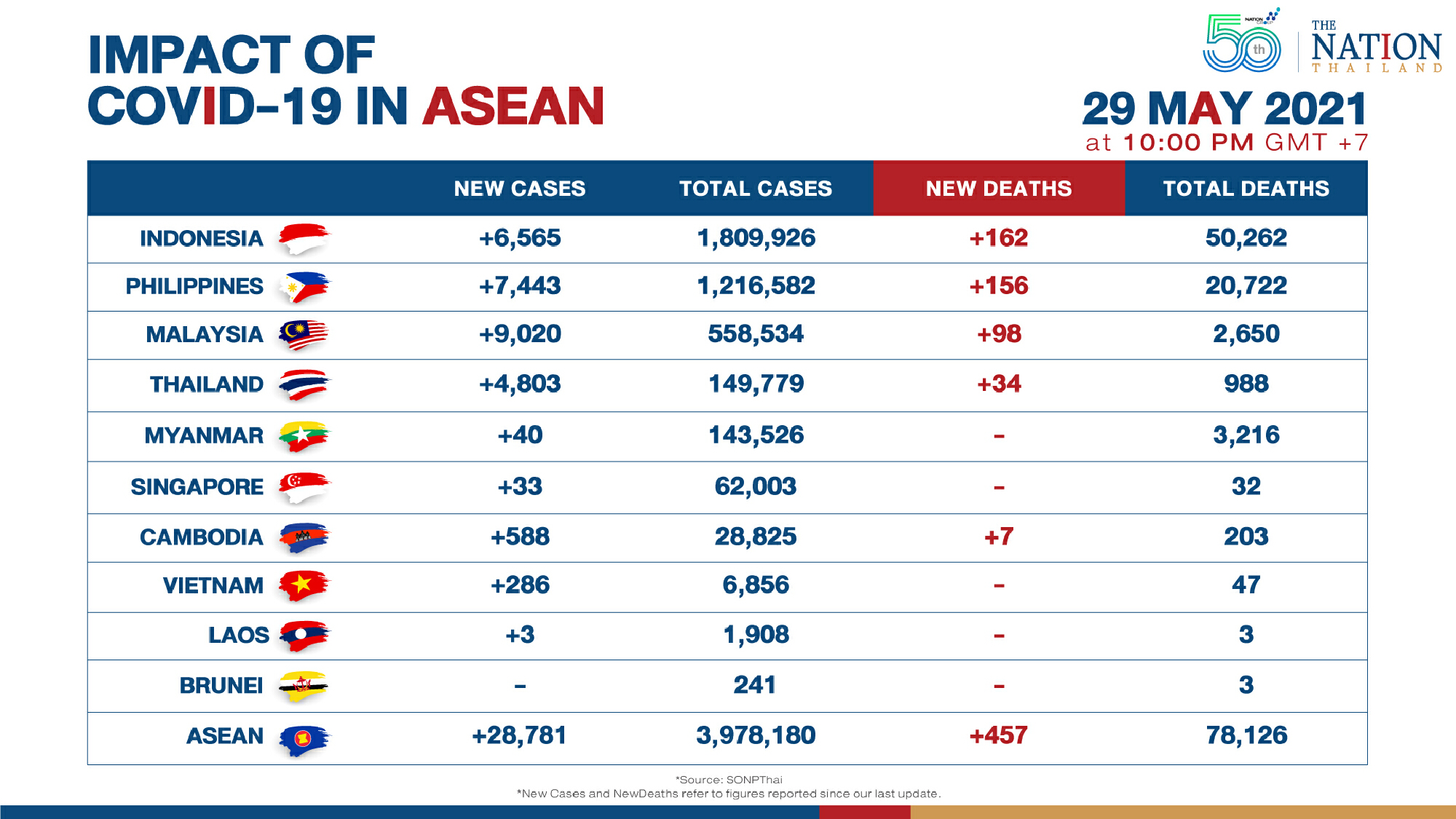
Asean countries reported 28,781 new cases on Saturday, higher than Friday’s 27,656.

However with 456 deaths, the numbers were less than Friday’s 479.

Total Covid-19 cases in the region crossed 3.97 million since the outbreak, while the death toll rose to 78,126.

Malaysia reported 9,020 cases, a new high for the fifth consecutive day, and 98 deaths, bringing cumulative cases in the country to 558,534 and 2,650 deaths.

Malaysia’s Health Ministry admitted that the rising number of Covid-19 cases in the country was partly due to people’s travels across states during the Ramadan festival.

Vietnam reported 286 cases on Saturday, bringing cumulative cases in the country to 6,856, while 47 have died. So far, 2,896 people have been cured and discharged.

The health minister reported that the country had detected a new coronavirus variant that is a combination of the strains found in India and the UK. He believed that the virus could spread quickly in confined areas, such as in factories.

Published : May 30, 2021

By : The Nation

Covid lab leak theory goes from mocked to maybe #SootinClaimon.Com

#SootinClaimon.Com : ขอบคุณแหล่งข้อมูล : หนังสือพิมพ์ The Nation.

https://www.nationthailand.com/international/40001437

Covid lab leak theory goes from mocked to maybe


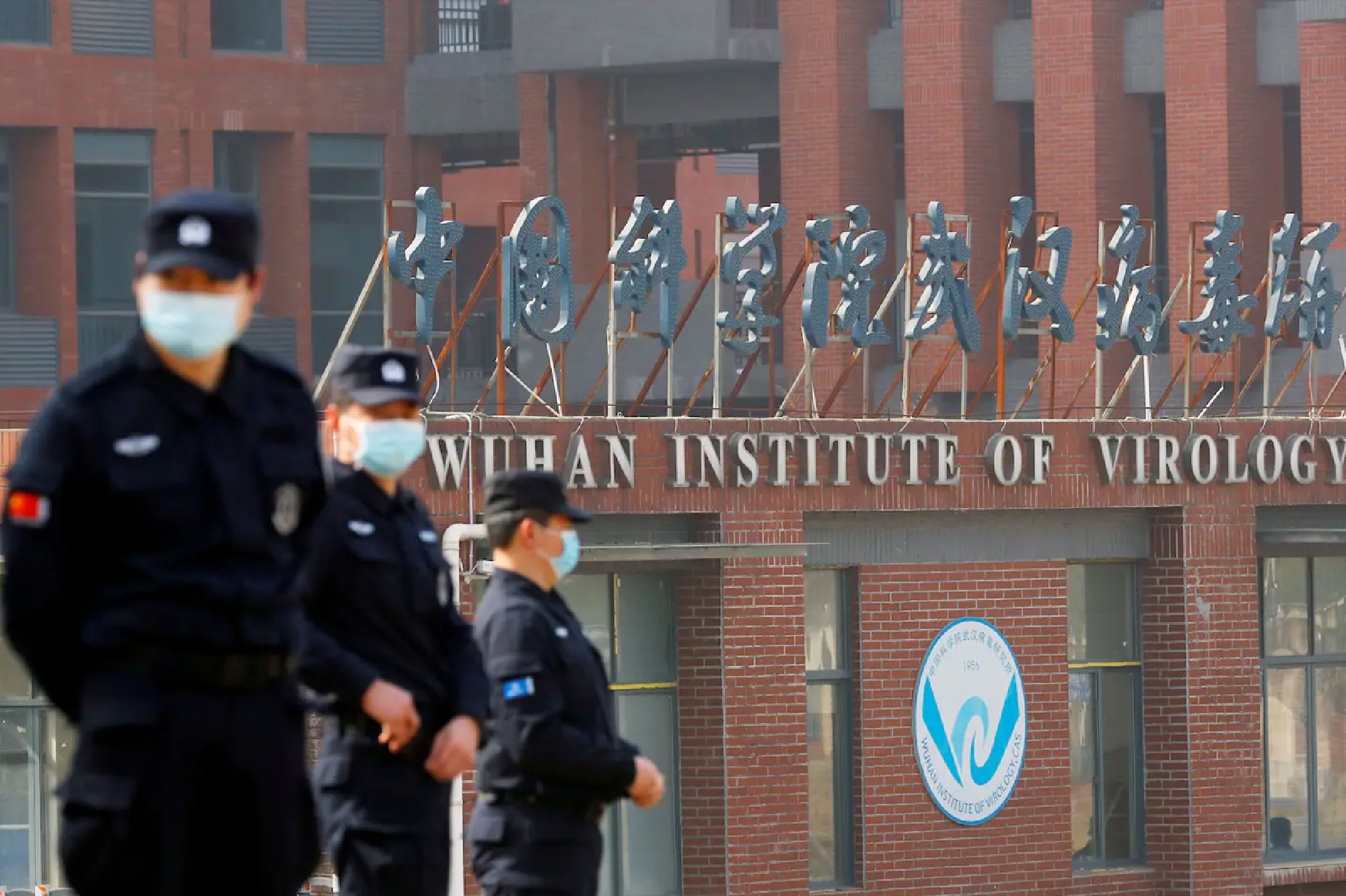
WASHINGTON – In the spring of 2020, as the coronavirus ripped through U.S. cities on its way to claiming more than 592,000 American lives, a group of senior U.S. national security officials warily eyed a laboratory in Wuhan, China.

Covid lab leak theory goes from mocked to maybe

The Wuhan Institute of Virology was well known in the scientific community for its research on coronaviruses to defend against outbreaks like the SARS epidemic, first identified in China in 2002. But to some of the officials, some of whom worked in the State Department and the White House, the lab’s location in the same city where the coronavirus pandemic began was a troubling coincidence.

Over the course of the pandemic, the officials joined forces, searching for information that might show whether the pandemic had been sparked by reckless or sloppy research in the lab, several of the now-former officials and others aware of their work said in interviews. Their search was partly conducted by a State Department group under Secretary Mike Pompeo that had initially examined China’s compliance with international weapons treaties, and then turned its attention to the lab and evidence of suspected Chinese military activity there.

Throughout much of the pandemic, the “lab leak” hypothesis has been ridiculed by scientists as a baseless conspiracy theory, fueled by President Donald Trump in an effort to deflect attention from his administration’s botched pandemic response.

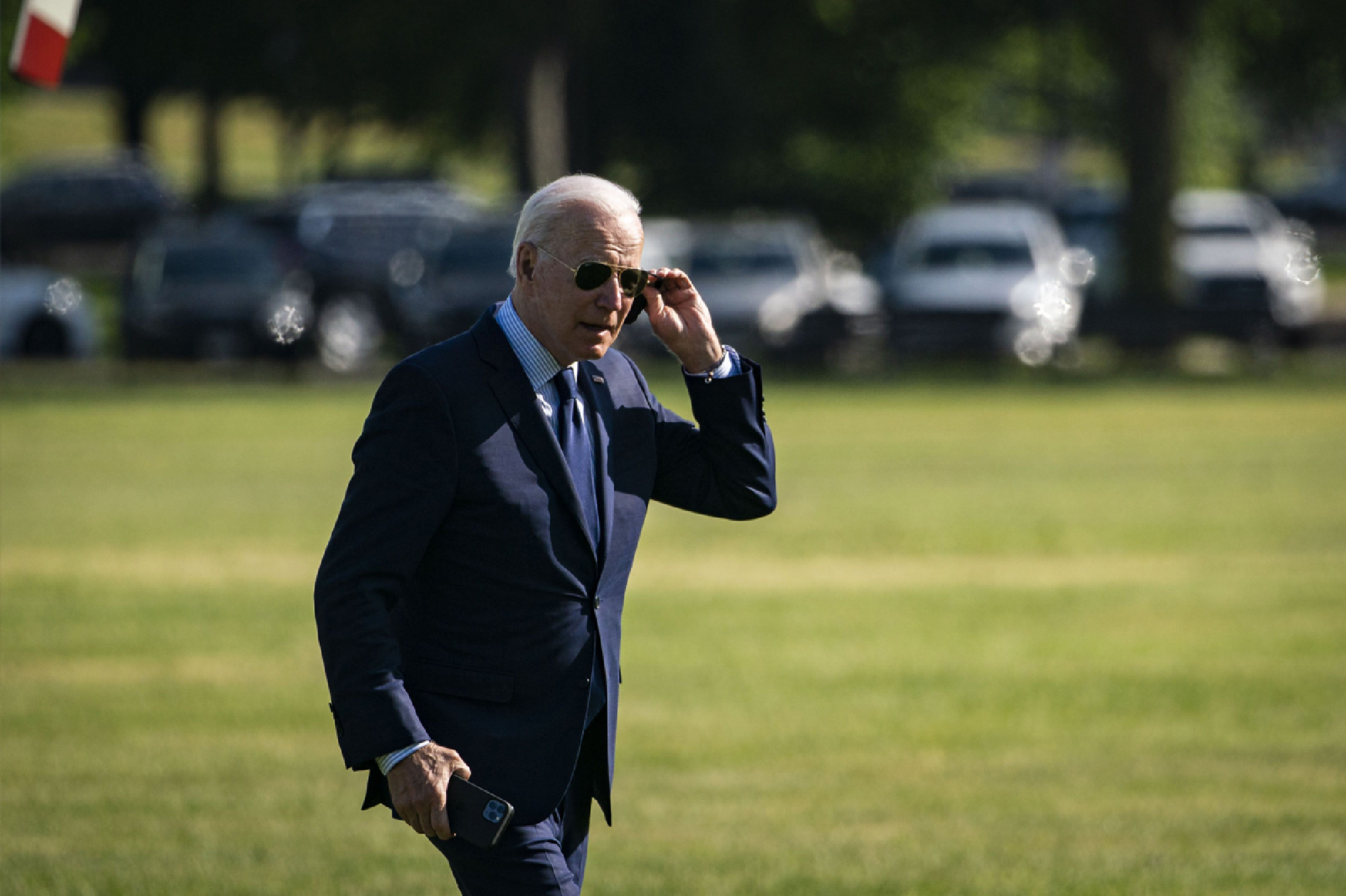
Far from dismissing the lab-leak theory, however, President Biden has told his spies to see if the previous administration’s officials, whose work some of his own skeptical aides have called tendentious and overreaching, may have been right to question the lab and conduct a thorough investigation. The White House recently was told that a large amount of information remained to be examined that could shed light on the question, according to a senior administration official who, like others, spoke on the condition of anonymity to discuss internal deliberations.

Biden stunned security and health experts on Wednesday when he announced that at least one “element” of the intelligence community “leans more toward” a lab accident as the source of the outbreak, as opposed to a natural transference of the virus from an animal to a human.

“Jaw-dropping,” one of the Trump-era officials involved in the hunt for covid-19’s origins said of Biden’s remarks and the president’s order that the intelligence agencies “redouble their efforts to collect and analyze information that could bring us closer to a definitive conclusion” about the pandemic’s origins. They are to report back in 90 days.

National security officials in the Trump administration had scoured classified intelligence data, scientific papers and even popular magazine articles trying to determine if the lab-leak hypothesis held water. They found no smoking gun, but they felt the information they had gathered demanded closer scrutiny, said several people who were involved in the effort.

The Wuhan lab’s location in the same city as the outbreak was for many the first point of suspicion. But more alarming was the Chinese government’s response to the outbreak.

Chinese officials seemed more interested in blocking investigations than aiding them, the former officials said. They had moved to silence doctors and journalists from reporting on the spread of the virus, which had appeared to first show up in hospital patients in Wuhan in December 2019.

Across the globe, security and health officials began speculating about the source of the virus shortly after it emerged, one former official said, adding that there was enormous frustration that the Chinese government was not more forthcoming with information and did not immediately allow international investigators into the country.

The evidence that the virus may have emanated from the Wuhan lab was circumstantial, the former officials stressed. Their default assumption, one of them added, which was shared by most scientists, was that the pandemic had begun in nature.

But as they read published reports about the kinds of research the lab was conducting, their concerns mounted. Some experiments appeared designed to make viruses more infectious and potentially deadly to humans. Such experiments are often conducted to develop more-effective vaccines and treatments.

The institute was on the radar of some health and national security officials, two former senior officials said, because there were questions about its safety standards and some of its research. These officials expressed frustration that there was not better funding in the intelligence community to gather more information on the lab’s activities.

The U.S. officials felt that experts should consider the possibility that the lab was engaged in risky research that might have sparked an outbreak.

Trump agreed. In April 2020, he first publicly raised the idea that the virus could have leaked from a lab. At the same time, Trump intensified his anti-China rhetoric, referring to the coronavirus as the “China virus.” A rise in anti-Asian hate crimes followed.

Trump offered no evidence to back the lab theory. His trade adviser, Peter Navarro, a longtime China hawk, accused the Chinese government of engineering the virus, offering no credible evidence to support such an audacious claim.

For some of the officials who were privately suspicious of the Wuhan lab, Trump’s and Navarro’s comments turned the lab leak scenario into a fringe conspiracy theory. It became nearly impossible to generate interest among health experts in a hypothesis that Trump had turned into a political weapon, they said.

But in the fall of 2020, momentum picked up again. The U.S. intelligence community had obtained information that three workers at the Wuhan lab had fallen ill in November 2019 with symptoms similar to covid, which had sent them to the hospital. Their symptoms were also similar to seasonal illnesses, including the flu, but they’d gotten sick the month before the initial cases of the disease were confirmed in Wuhan.

The officials had also come upon information that the Chinese military had been conducting experiments at the lab for years. That also renewed focus on the lab leak.

“The information about the sick workers was really striking,” said David Feith, who was the deputy assistant secretary of state for East Asian and Pacific affairs at the time. “Simply knowing that there were secret military ties to the lab didn’t necessarily tell you where covid came from. But if you had a cluster of illnesses and they were indeed covid, that could be your Patient Zero,” said Feith, now an adjunct senior fellow at the Center for New American Security.

The new information “began a much larger effort to examine data” about the origins, said David Asher, who was a senior adviser in the State Department’s Bureau of Arms Control, Verification and Compliance at the time and had been working on investigations into China’s compliance with international treaties and its nuclear weapons program. When that work concluded, Asher, now a senior fellow at the Hudson Institute, became the leader of Pompeo’s task force looking into the origins of covid-19, which the secretary also believed may have emanated from the lab.

In the waning days of the Trump administration, the officials mounted an effort to declassify information, including some about the sick lab workers. On Jan. 15, the State Department released a “fact sheet” that was vetted by multiple agencies, including in the intelligence community, which stated that the virus could have spread naturally or come from a lab.

It described three categories of activity that pointed to the latter scenario, including the report of sick workers; the lab’s history of research on coronaviruses in bats; and findings that the Chinese military had secretly engaged “in classified research, including laboratory animal experiments, on behalf of the Chinese military since at least 2017.”

The fact sheet, short though it is, stands as the most comprehensive public document to date on what the U.S. government knows about a possible lab leak.

One of the former officials stressed that the evidence has not substantially changed, but that there are many unanswered questions.

“There are a lot of coincidences and circumstantial stuff and the questions is: ‘When are too many coincidences too much?’ ” another former official said. “One side of the ledger is growing, and the other isn’t.”

While more scientists have said the lab leak theory is worthy of further investigation, many have cautioned against embracing it too enthusiastically.

“The only reason this story has any legs is the media has chosen to dress up old speculation as new information and claim that it’s evidence. It’s not. It’s speculative and all origin hypotheses remain possible,” said Angela Rasmussen, a virologist at the Vaccine and Infectious Disease Organization at the University of Saskatchewan.

Indeed, it took years to unravel the source of the SARS epidemic.

“A 90-day focus on coming to a definitive answer sounds good in ‘D.C. talk’ but is unlikely to come to a definitive answer,” said Chris Meekins, a former Health and Human Services official who is now an analyst at Raymond James, a financial services firm. Unless “we have definitive intelligence information that the U.S. has refused to release thus far to protect sources and methods, I’m not sure what will change over the next 90 days to change their minds.”

Published : May 29, 2021

By : The Washington Post · Shane Harris, Yasmeen Abutaleb

Biden budget expects hot – but not overheating – economy heading into 2022 midterm elections #SootinClaimon.Com

#SootinClaimon.Com : ขอบคุณแหล่งข้อมูล : หนังสือพิมพ์ The Nation.

https://www.nationthailand.com/international/40001436

Biden budget expects hot – but not overheating – economy heading into 2022 midterm elections


WASHINGTON – The budget officially released Friday by the White House hinges on an optimistic projection that the economy will grow at a rapid pace for the next two years, with inflation under control and unemployment falling to near pre-pandemic levels.

Biden budget expects hot - but not overheating - economy heading into 2022 midterm elections

In its first budget, the Biden administration said the economy will grow at just north of 5% this year as the nation rebounds from the coronavirus pandemic. The White House sees robust growth continuing through the following year as well, with the economy expanding by 4.3% in 2022. The economy has not grown at a rate faster than 4% rate in more than 20 years. White House officials told reporters on Friday that these projections predate the rollout of the Biden administration’s full economic spending proposals and may therefore prove to be conservative estimates.

The budget also projects that the unemployment rate will fall from 6.1% as of April 2021 to 4.1% in 2022. The jobless rate was 3.5% in February 2020 before the pandemic pushed it up to 14.8% in April 2020.

All of these forecasts would set the table for a vibrant economy just ahead of the 2022 midterm elections, possibly bolstering Democrats’ shot at maintaining control of Congress despite tough odds. But numerous economists believe that predicting the economy’s performance coming out of the pandemic is very difficult, as there is little precedent for what the country has endured since early last year.

One part of the newly released budget that will likely face the most scrutiny is the White House’s estimate that this hot economy will not lead to a dramatic and sustained spike in inflation, despite a sharp uptick over the past two months. The administration says the consumer price index – the main measure of inflation – would increase by a little more than 2% every year over the next decade. Republicans have said that the Biden administration’s economic agenda would flood the economy with too much cash and lead to a surge of inflation that hurts the economy.

Recent reports appear to be somewhat skewed because the economy is reopening quickly after many parts of it were sluggish during the pandemic. Prices jumped 3.6% in April compared to one year ago, although policymakers including central bankers have said that will likely be transitory rather than permanent change. The University of Michigan Surveys of Consumers said Friday that consumers are bracing for an uptick in inflation to persist throughout the year but largely expect a healthy economic recovery.

The projections may give congressional Democrats a glimmer of hope in what is otherwise expected to be a difficult battle to maintain control of the House and Senate in the 2022 midterm elections. The Senate is evenly divided between the parties and Democrats only have a narrow margin in the House, meaning even a minor electoral setback could cost them control of Congress. They are swimming against the historical tide: The president’s party has lost seats in the House in every midterm election since 1938 with only two exceptions – 1998 and 2002, according to David Hopkins, a political scientist at Boston College.

Upbeat economic projections are common in White House budget proposals, but economists believe forecasting the next few years is very difficult. The pandemic delivered an enormous shock to the U.S. and global economies, and it is still unclear which sectors will return to pre-pandemic levels and which sectors might never return to normal.

“We are seeing waves of the virus continue globally, and in that world forecasting becomes highly uncertain,” said Constance Hunter, chief economist at KPMG. Hunter added that the uncertain state of congressional negotiations over the administration’s priorities further cloud the projections. “There are still many negotiations between now and the point we have legislation, and those negotiations will contract this plan not expand it.”

Biden’s approval rating has hovered around the mid-50s, but many political scientists think it will have to be above 60% for Democrats to retain control of Congress. It is unclear if even relatively robust economic growth can pull him over that threshold given the country’s deep partisan divides.

“There will be a lot of twists and turns between now and the election, but to the extent you’re running on impressive economic growth this has to be encouraging for them,” said Jim Manley, a former aide to Sen. Harry Reid, D-Nev. “If you look at history, the House is destined to change. But this has to make Democratic strategists optimistic. These are pretty good numbers.”

The economic projections are included as part of the White House’s release of a $6 trillion budget on Friday for the fiscal year that begins in October. That budget includes no major new spending proposals but reflects what the administration has already said it wants to advance, including a $2.3 trillion jobs and infrastructure plan, a $1.8 trillion education and families plan, and a $1.5 trillion discretionary spending plan for agencies like the Department of Defense.

The proposal kicks off negotiations between the White House and Congress over the federal budget, which must be agreed to avert a shutdown of the U.S. government.

Republicans and even some Democrats dispute the administration’s projections of a rosy economic rebound. These critics have pointed to rising inflation, as well as weaker-than-expected hiring and the continued growth of the federal debt. The administration’s economic projections are based in part on assuming some of their infrastructure and other domestic spending priorities as written are signed into law, which is far from clear given Biden’s negotiations with congressional Republicans over those priorities and Democrats’ narrow congressional majorities.

“We just got the most dramatic monthly inflation report in decades,” Senate Minority Leader Mitch McConnell, R-Ky., told CNBC on Friday.

Other parts of the administration’s economic projections could prove overly optimistic. The coronavirus continues to wreak havoc on global supply chains and dry up demand for U.S. exports. A new outbreak in Malaysia led to the announcement of a new lockdown this week, for instance, and coronavirus variants could pose further problems.

Conservatives also warn that the administration’s tax plans could slow growth. The administration has proposed increasing the corporate tax rate from 21% to 28%, while also imposing dramatically higher taxes on multinational corporations operating abroad. The White House has denied those plans will slow the growth rate, though Biden has said he’s willing to negotiate with Republicans on other alternatives.

Much of the next year in Washington could be defined by debates about government spending, but the economy’s performance could prove a major factor in the 2022 elections. And the White House is not alone in believing Biden could oversee a rapid economic rebound. The economic growth projections were squarely in line with the “blue chip” forecasters on Wall Street. The Wall Street forecaster Moody’s has said the economy will grow even faster than the White House suggested, projecting 7.4% growth in 2021. Moody’s and the White House have both forecast 4.3% growth for 2022, falling to a little above 2% in the year after that.

Published : May 29, 2021

By : The Washington Post · Jeff Stein

DHS budget reflects a shift in U.S. immigration policy, border enforcement #SootinClaimon.Com

#SootinClaimon.Com : ขอบคุณแหล่งข้อมูล : หนังสือพิมพ์ The Nation.

https://www.nationthailand.com/international/40001435

DHS budget reflects a shift in U.S. immigration policy, border enforcement


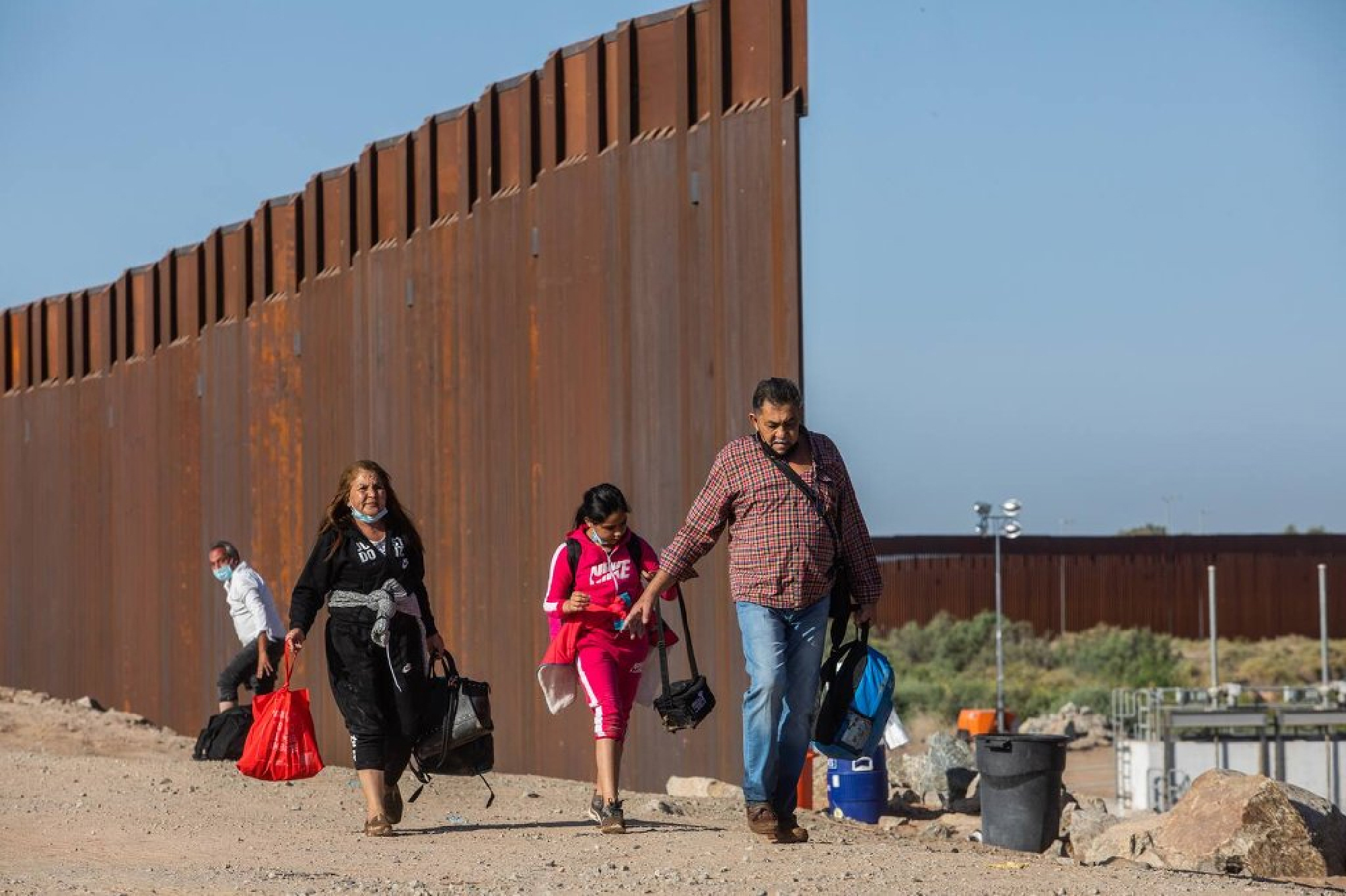
WASHINGTON – President Joe Bidens immigration policy changes took shape Friday in a budget request that would eliminate border-wall funding, boost spending on care for unaccompanied migrant children to $3.3 billion and overhaul the way asylum seekers are handled at the Mexico border by dramatically increasing staffing to process their claims.

DHS budget reflects a shift in U.S. immigration policy, border enforcement

The budget would also increase internal oversight of U.S. Customs and Border Protection, set up a $30 million fund to assist migrant families separated during the Trump administration and more than double the resources available for a major increase in refugee admissions.

Lawmakers from both parties have expressed concern that Biden’s $52 billion request for the Department of Homeland Security leaves overall funding flat, despite a migration influx this spring that has sent border crossings to their highest levels in 20 years.

The administration also faced criticism from immigrant advocates Friday who expressed disappointment that Biden’s budget continues to fund tens of thousands of U.S. Immigration and Customs Enforcement detention beds, while maintaining a controversial program that deputizes state and local police to detain immigrants for deportation.

In a statement, Homeland Security Secretary Alejandro Mayorkas said the president’s budget “will invest in our broad mission set, including preventing terrorism; keeping our borders secure; repairing our broken immigration system; improving cybersecurity; safeguarding critical infrastructure; and strengthening national preparedness and resilience.”

“The Budget will provide DHS with the resources we need to keep our country safe, strong, and prosperous,” Mayorkas said.

Under Biden, immigration arrests and deportations have dropped to their lowest levels on record. But advocates for immigrants, who have praised Biden’s other moves on immigration, said they were concerned about the budget for ICE.

“President Biden’s proposed DHS budget today includes positive measures to increase accountability and oversight but fails to make a sharp enough break from the Trump administration’s wasteful and harmful spending on the detention and deportation machine,” said Naureen Shah, lawyer at the American Civil Liberties Union.

On the campaign trail, Biden said he would create a “fair and humane immigration system,” and he has revoked his predecessor’s controversial measures, such as the travel ban from countries with Muslim majorities, and limited immigration arrests to recent border crossers and people who pose a threat to national security and public safety.

But Mayorkas has said he is considering “significant changes” to the enforcement guidelines for ICE agents, and the proposed budget provides for robust enforcement: The budget projects that ICE would deport 167,420 immigrants in fiscal 2022, the same estimate as the prior year’s proposal, and would fund 32,500 detention beds, down from 34,000 the prior year.

A Biden administration official, speaking on the condition of anonymity to detail ongoing deliberations, said the president’s budget would reduce the total number of ICE beds and shift some of their use from detention to processing individuals for release into the community on “alternatives to detention,” such as case-management programs, so they can await a hearing in immigration court.

Mayorkas said at a budget hearing this week that he was “concerned about the overuse of detention” and was looking to expand alternatives.

The Biden administration also would add 100 new immigration judges, provide funding to reduce the backlog of 1.2 million cases in the immigration courts, and increase access to legal aid for children and families.

Immigration and Customs Enforcement’s proposed budget also would increase programs that deputize state and local law enforcement to assist ICE in enforcing immigration laws.

Biden had promised to “end the Trump administration’s historic use of 287(g) agreements,” named after the section of federal immigration law that authorizes them. Biden said on his campaign website that the programs “undermine trust and cooperation between local law enforcement and the communities they are charged to protect.” He promised to terminate all agreements the Trump administration signed and “aggressively limit” the use of these types of programs.

But ICE’s budget proposal said it expected the 287(g) program to “continue to increase in future years.”

“It’s a betrayal of the promises made on the campaign trail,” said Heidi Altman, director of policy for the National Immigrant Justice Center, an advocacy organization. “It’s a real lack of political courage.”

DHS signaled later Friday that part of the 287(g) language in the proposed budget is inaccurate and would change.

“This language does not reflect Administration policy and we are working to correct it,” DHS spokeswoman Marsha Espinosa said in a statement. “ICE still maintains authority over 287g, and we continue to exercise strict oversight and evaluate each of these agreements.”

The biggest change in Biden’s DHS budget is the elimination of $1.5 billion in border-wall funding. Biden has pledged not to add “another foot” to the former president’s signature project, and his administration’s decision to suspend construction activity has left a significant portion of last year’s appropriation unused.

Biden’s CBP budget would invest $660 million in new facilities for CBP’s Office of Field Operation, part of a plan that the administration says will modernize U.S. ports of entry and improve processing for legal trade and travel. Another new program would spend $2.1 million “to fund on-site clinicians to support employee resiliency and suicide prevention” at CBP.

Biden’s proposed budget would fortify U.S. Citizenship and Immigration Services, the agency that processes immigrants’ applications for citizenship, green cards and other legal benefits. His budget request would add more than 1,300 positions and $345 million to reduce backlogs, and process up to 125,000 refugee admissions next year.

The 2022 request also boosts DHS’s cybersecurity defense funding to $2.1 billion, a 5% increase, and provides $131 million to counter domestic terrorism and violent extremism, which the administration has identified as the most urgent lethal threat to the American public.

Published : May 29, 2021

By : The Washington Post · Nick Miroff, Maria Sacchetti

Putin shows his support for Lukashenko as West moves to isolate Belarus #SootinClaimon.Com

#SootinClaimon.Com : ขอบคุณแหล่งข้อมูล : หนังสือพิมพ์ The Nation.

https://www.nationthailand.com/international/40001434

Putin shows his support for Lukashenko as West moves to isolate Belarus


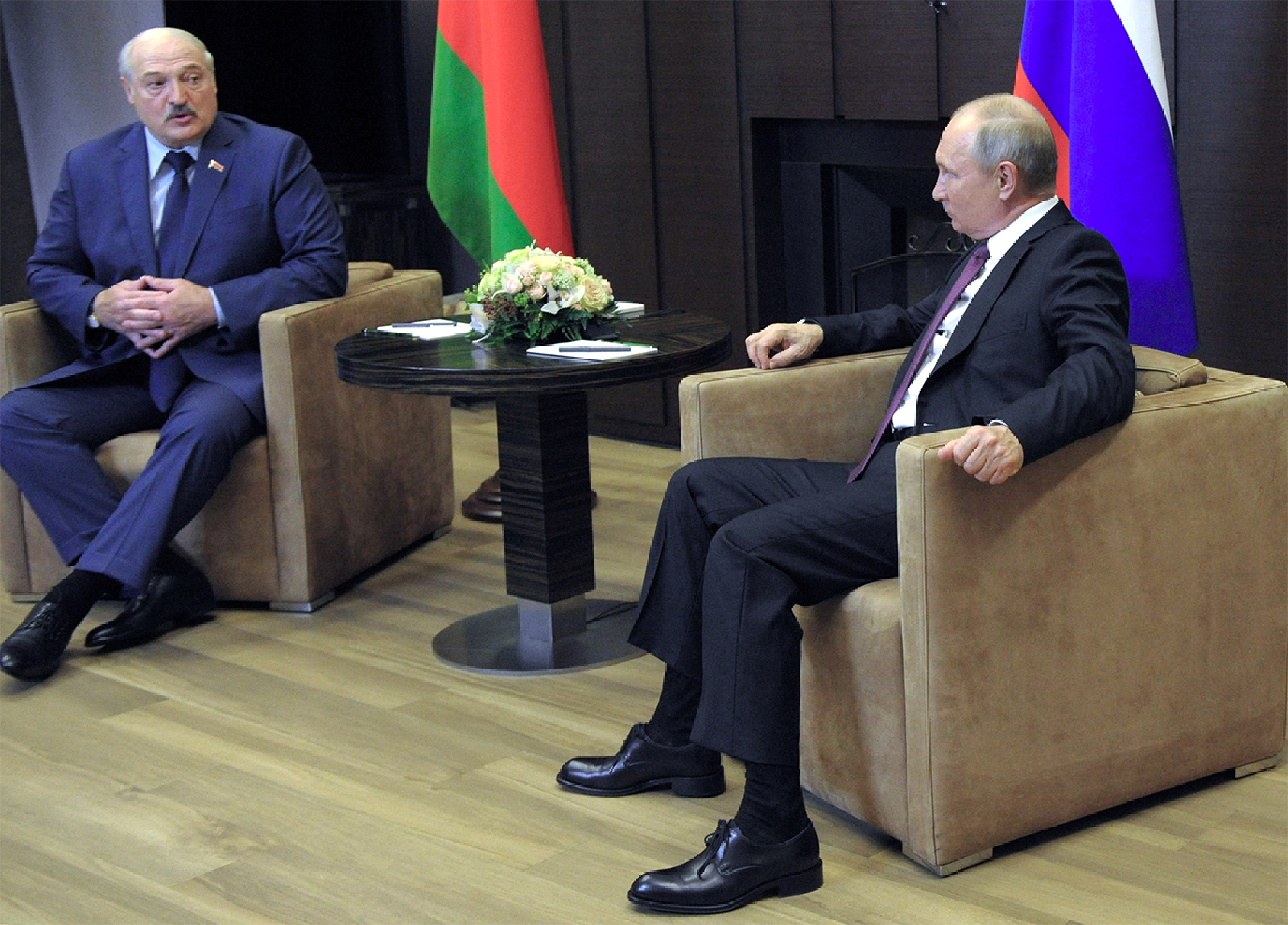
MOSCOW – Russian President Vladimir Putin offered a sweeping display of support Friday for his embattled ally in Belarus, as the West looked to further isolate Alexander Lukashenkos regime over its interception of a jetliner to arrest an opposition journalist.

Putin shows his support for Lukashenko as West moves to isolate Belarus

Ameeting in the Black Sea resort city of Sochi served as a reminder of Russia’s role as a political and economic lifeline for Lukashenko, who has held power since 1994 but faced a wave of protests last year after an election that opposition groups and Western officials decried as rigged.

His pariah status deepened after Belarus claimed it had received a bomb threat for a Ryanair plane and scrambled a fighter jet to divert the flight – bound from Athens to Vilnius, Lithuania – to the airport in Minsk. Prominent dissident Roman Protasevich, who had been living in exile, was arrested upon landing and now faces a 15-year prison sentence in Belarus.

In Sochi, Putin made no immediate comments on possible steps to strengthen Russia’s commitments to Belarus. But the cozy body language and banter – even joking about swimming in the Black Sea – conveyed a message that Russia was fully behind Lukashenko.

“Thank you for coming to this meeting. We agreed on this even before the next round of . . . ” Putin said as he turned to Lukashenko, who jumped in to finish the sentence: “A surge of emotions.”

“Yes, a surge of emotions,” Putin agreed.

“We have things to talk about even without these events,” added Putin, who also made note of the forced landing in Austria of a plane carrying Bolivia’s President Evo Morales in 2013 – part of the hunt for fugitive U.S. secret-spiller Edward Snowden.

“There was nothing, just silence,” Putin said of the response.

Lukashenko, making a dig at his Western critics, said he had brought “documents” to brief Putin.

“I will show you so that you understand what is happening, so that you understand what kind of people these are,” Lukashenko said.

Belarus said there was an in-flight bomb threat against the Ryanair flight, but an email cited by Belarusian authorities containing the alleged threat was sent after the plane was diverted, Swiss email provider ProtonMail said Thursday, further challenging the Belarusian regime’s version of events.

Russia’s backing for Belarus also became clear when two European airlines, Air France and Austrian Airlines, said they had to cancel flights to Moscow on Thursday because Russian aviation authorities did not approve new flight paths that avoided Belarus’s airspace. EU leaders on Monday had barred the bloc’s airlines from flying over Belarus.

Dmitri Trenin, director of the Carnegie Moscow Center, wrote on Twitter that the Kremlin’s tolerance of Lukashenko “hurts Russian interests.”

“The longer it lasts, the more bad surprises it breeds,” he said.

Moscow and Minsk have drawn closer to each other as both countries’ relations with the West have grown increasingly adversarial. Putin is a known opponent of regime change and prefers the stability of a long-serving ruler in a country that has so far served as an allied buffer between Russia and the West. Belarus geographically separates Russia from the NATO states of Poland and Lithuania.

“The message to Putin is that there will be no more anti-Western Belarusian leader, which means that we must hold on to this,” Artyom Shraibman, a Minsk-based analyst, wrote in a commentary. “Any change of power in Minsk in such a situation is a drift towards the Belarusian rapprochement with Europe.”

Yet Lukashenko has occasionally irritated the Kremlin by resisting plans to implement a more than two-decade-old unification plan for the two countries and by cozying up to Europe when he saw it benefiting his rule.

When the two countries were unable to agree on a new price for the oil Russia sells to Belarus in December 2019, Moscow cut the supply. A few months later, Belarus ordered its first shipment of U.S. oil in an attempt to show Russia that it would be willing to turn to its rivals, if necessary.

But Lukashenko no longer has the leverage to play the East against the West. Much of the international community considers his regime illegitimate after last August’s election – in which he claimed a resounding victory – was widely denounced as rigged.

As mass anti-government protests broke out in the aftermath, Lukashenko turned to Putin for help. Putin backed him then, too, promising to dispatch a military contingent to aid Belarusian authorities, if necessary.

All 27 EU leaders agreed Monday to toughen sanctions on Lukashenko’s government. On Friday, the White House announced that Washington will reimpose full sanctions against nine Belrusian state-owned enterprises. Biden administration officials are also coordinating with allies in the European Union and elsewhere to develop “a list of targeted sanctions against key members” of Lukashenko’s regime, Press secretary Jen Psaki said.

E.U. foreign ministers suggested during informal talks Thursday in Lisbon that coming sanctions could target Belarus’s exports of oil products and potash, a primary cash-earner for the Lukashenko government. State-owned giant Belaruskali says it produces about 20 percent of the world’s supply of the potassium-rich salt used in fertilizers.

If Lukashenko does not make concessions, “one must assume that this will be just the beginning of a large and long spiral of sanctions,” German Foreign Minister Heiko Maas told reporters.

The Kremlin has said that could also harm the Russian economy.

“Clearly, considering the direct and indirect assistance we have been providing to our Belarusian partners on a permanent basis, of course, the certain unfavorable atmosphere around Belarus is complicating things,” Kremlin spokesman Dmitry Peskov said Thursday.

Published : May 29, 2021

By : The Washington Post · Mary Ilyushina, Isabelle Khurshudyan

New Covid-19 cases and death toll continue to surge in Asean #SootinClaimon.Com

#SootinClaimon.Com : ขอบคุณแหล่งข้อมูล : หนังสือพิมพ์ The Nation.

https://www.nationthailand.com/international/40001425

New Covid-19 cases and death toll continue to surge in Asean


Southeast Asia on Friday reported its highest number of new Covid-19 cases and deaths in over two weeks.

New Covid-19 cases and death toll continue to surge in Asean

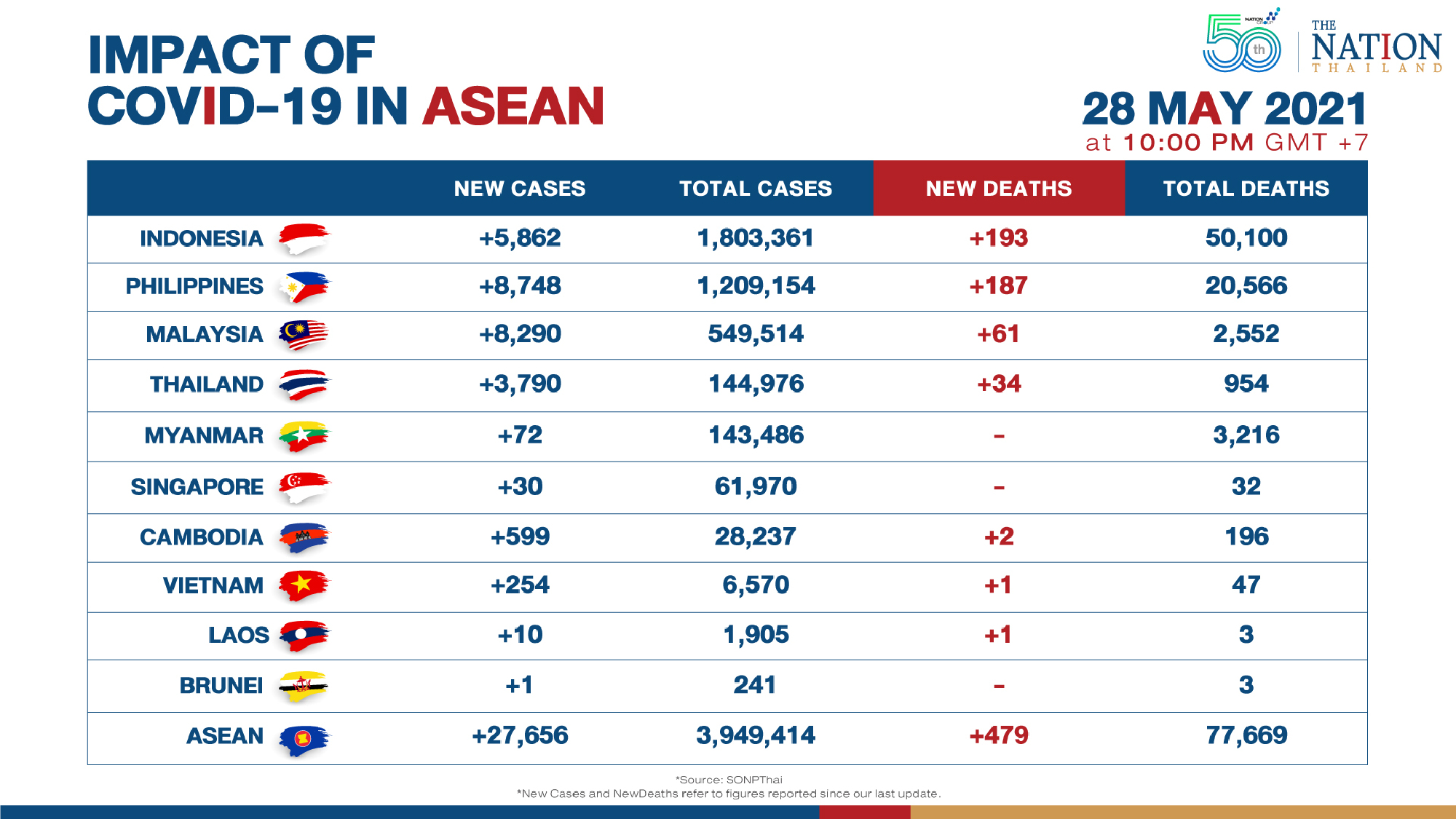
There were 27,656 new cases, higher than Thursday’s 24,952, while 479 people died, higher than the previous day’s 457.

The number of Covid-19 cases in Asean crossed 3.94 million, while total deaths rose to 77,669.

Malaysia reported a new high of infections for the fourth consecutive day with 8,290 new cases and 61 deaths on Friday, taking cumulative cases in the country to 549,514 and the death toll to 2,552.

The Malaysian government decided to announce a total lockdown countrywide from June 1-14 after new cases per day crossed 8,000. Over 72,000 patients are still hospitalised.

Cambodia reported 599 new cases and two nore deaths on Friday, taking cumulative cases in the country to 28,237 and the death toll to 196. So far, 20,900 people have been cured and discharged. Cambodia’s Ministry of Tourism on Friday announced the country’s readiness to welcome foreign tourists who have been vaccinated against Covid-19 to travel within the country.

Published : May 29, 2021

By : THE NATION

UK studying Covid-19 strain first found in Thailand as over 100 patients test positive #SootinClaimon.Com

#SootinClaimon.Com : ขอบคุณแหล่งข้อมูล : หนังสือพิมพ์ The Nation.

https://www.nationthailand.com/international/40001393

UK studying Covid-19 strain first found in Thailand as over 100 patients test positive


Britain is on alert for a new Covid-19 strain first detected in Thailand.

UK studying Covid-19 strain first found in Thailand as over 100 patients test positive

Reports said that more than 100 cases of the new strain, VUI-21MAY-02 (C.36.3), were detected in the UK.

The variant was first detected in Thailand in people who had travelled from Egypt.

Public Health England said the variant was under investigation since May 24 “on the basis of the mutation profile and increased importation from a widening international area”.

British authorities said they had managed to contain its spread through the test and trace process.

Published : May 28, 2021

By : THE NATION

Asean hits 10-day high in new Covid-19 cases and deaths #SootinClaimon.Com

#SootinClaimon.Com : ขอบคุณแหล่งข้อมูล : หนังสือพิมพ์ The Nation.

https://www.nationthailand.com/international/40001392

Asean hits 10-day high in new Covid-19 cases and deaths


Asean reported the highest number of Covid-19 cases and fatalities in 10 days on Thursday.

Asean hits 10-day high in new Covid-19 cases and deaths

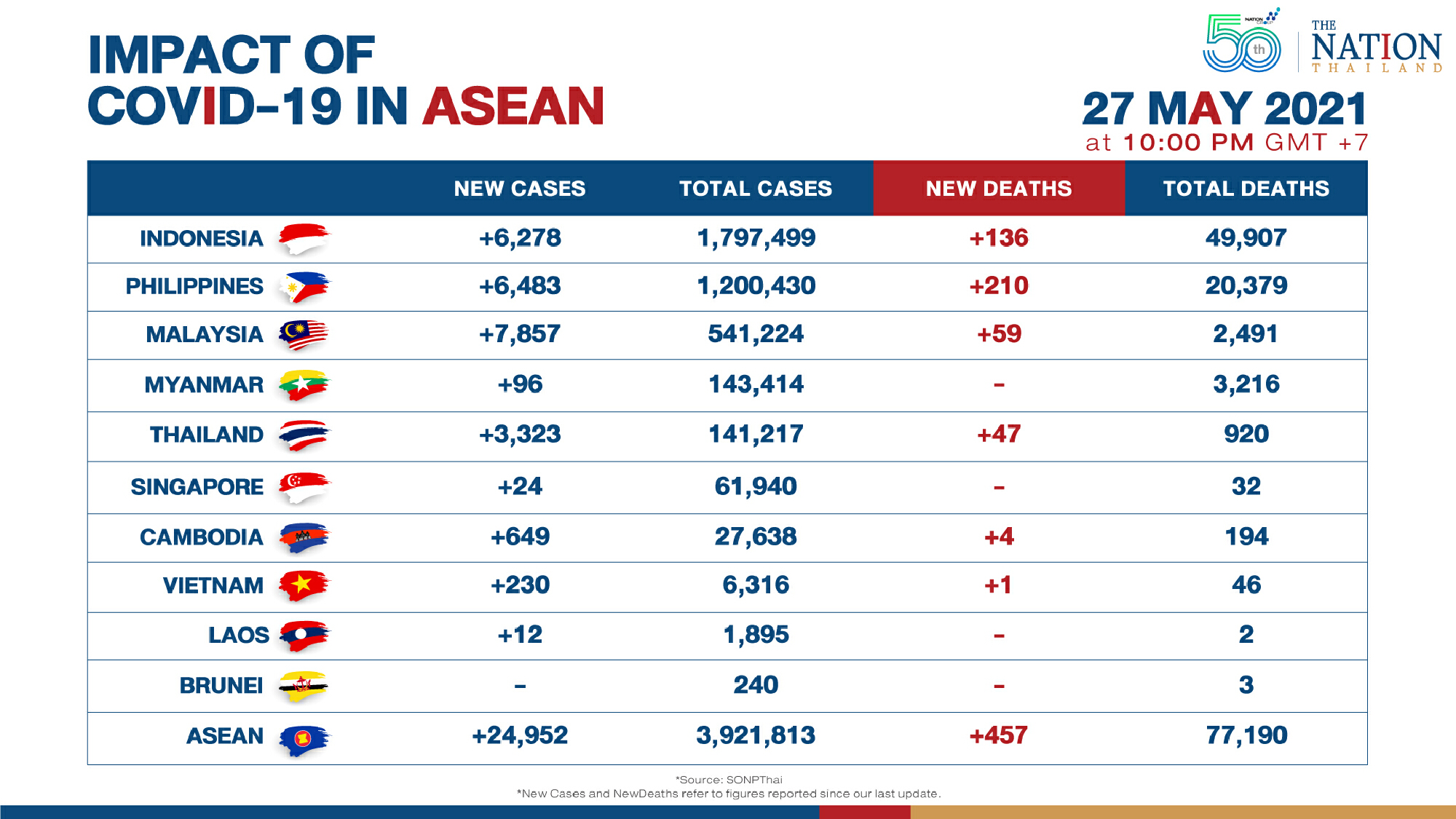
Southeast Asia saw 24,952 new cases on Thursday, higher than Wednesday’s 21,229, while 457 people died, up from Wednesday’s 406.

The number of Covid-19 cases in the region crossed 3.92 million while 77,190 people have died.

Malaysia reported a new high of 7,857 infections and 59 deaths on Thursday, bringing cumulative cases in the country to 541,224 and total deaths to 2,491. Nearly 40 per cent of new cases, or 2,675 patients, are from Selangor while 561 are from Kuala Lumpur.

Malaysia’s Ministry of Public Health said that most of the new cases were those aged 20-40 years residing in several states in the northern part of the country.

The Indonesian government, meanwhile, has confirmed that the AstraZeneca vaccine is safe and effective against Covid-19 after it was suspended since May 16 following the death of a 22- year-old man after getting a jab.

The government statement clarified that there was no connection between the vaccine and the severe reaction in the deceased recipient.

Indonesia had received 450,000 doses of AstraZeneca vaccine in April as part of the 3.85 million doses under the Covax programme of the World Health Organization.

Published : May 28, 2021

By : THE NATION

Olympic Games could create an Olympic strain, warns head of Japan Doctors Union #SootinClaimon.Com

#SootinClaimon.Com : ขอบคุณแหล่งข้อมูล : หนังสือพิมพ์ The Nation.

https://www.nationthailand.com/international/40001390

Olympic Games could create an Olympic strain, warns head of Japan Doctors Union


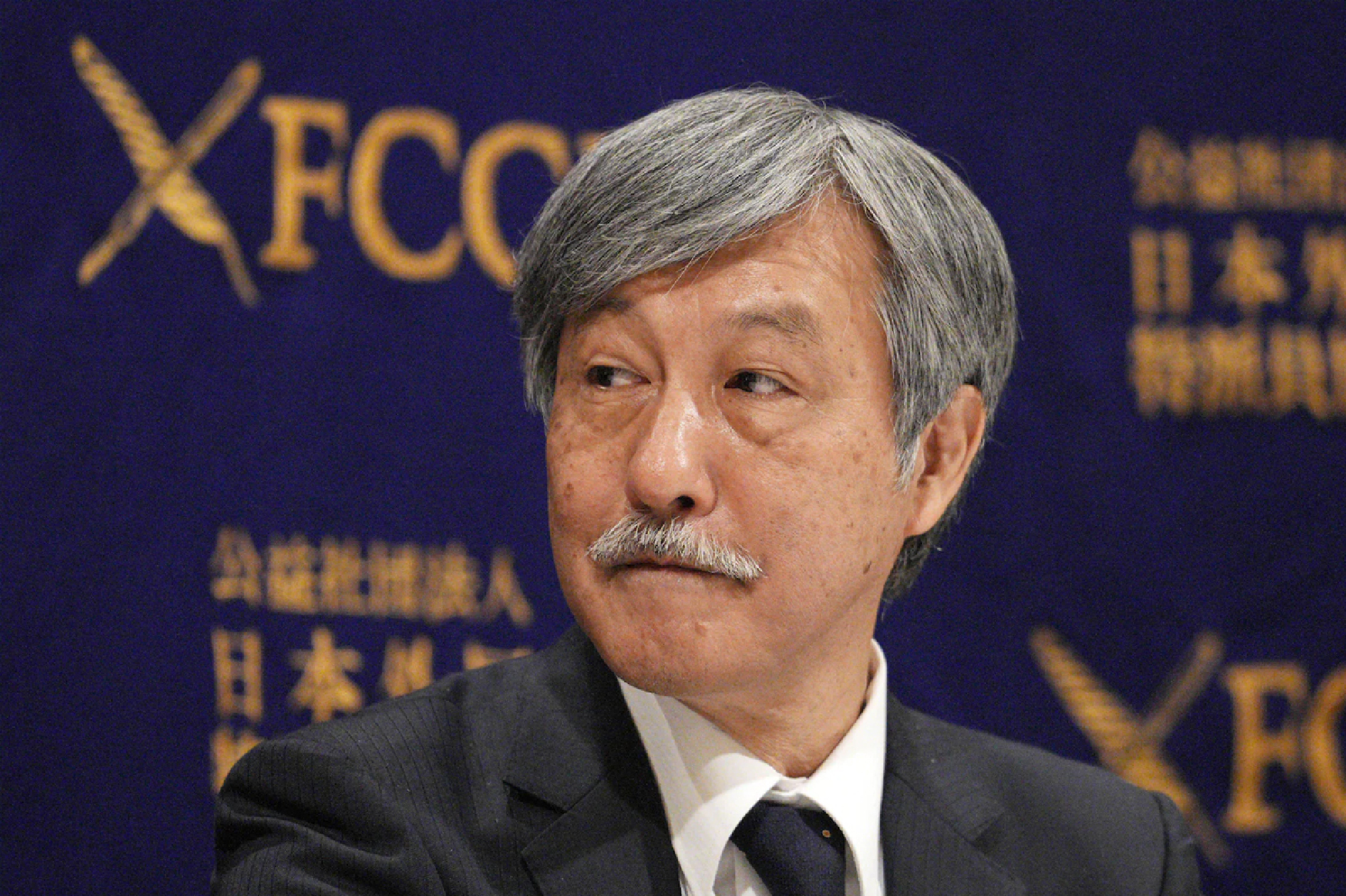
The chairman of the Japan Doctors Union, a lead critic of the holding of the Olympic Games amid the pandemic, warned Thursday that an “Olympic strain” of the coronavirus could emerge if the sports event goes forward.

Olympic Games could create an Olympic strain, warns head of Japan Doctors Union

Naoto Ueyama has repeatedly sounded the alarm about the Japanese government and International Olympic Committee’s decision to hold the Tokyo Olympics in July despite rising cases in the country and an increasingly burdened health-care system.

“It is dangerous to hold the Olympics here in Tokyo this July,” he warned in a news conference, saying that with people coming into Japan from over 200 nations around the world, “all of the different mutant strains of the virus that exist in different places will be concentrated and gathered here in Tokyo.”

Ueyama said that “a Tokyo Olympic strain of the virus” could develop as a result.

Japan has one of the slowest coronavirus vaccine rollouts among developed countries, with only 2.3 percent of a population of 125 million fully vaccinated.

With overwhelmed hospitals and an inevitable extension of the state of emergency expected just eight weeks before the Games, the medical community has been vocal in their opposition.

The Tokyo Medical Practitioners Association, representing 6,000 primary care doctors, posted an open letter addressed to Prime Minister Yoshihide Suga earlier this month, stating, “We strongly request that the authorities convince the IOC that holding the Olympics is difficult and obtain its decision to cancel the Games.”

With Tokyo’s intense heat and humidity expected for the Olympic months putting even more strain on the medical system, the association warned of a system collapse. As doctors and nurses are already exhausted, the letter added, “there is absolutely no extra manpower or facility for treatment.”

Japan’s insistence that the Olympics take place despite the potential health risks has increasingly become a source of controversy. Polling has shown that most people in Japan do not feel that the event should take place this summer, and one of Japan’s most widely read newspapers, Asahi Shimbun, called for the event to be canceled in a Wednesday editorial.

“Distrust and backlash against the reckless national government, Tokyo government and stakeholders in the Olympics are nothing but escalating,” the editorial said.

The prestigious New England Journal of Medicine also weighed in this week. “We believe the IOC’s determination to proceed with the Olympic Games is not informed by the best scientific evidence,” a commentary authored by multiple public health experts stated.

Last month, the British Medical Journal urged Olympic organizers to reconsider, noting that vaccines are still not widely available in many lower-income nations and “huge uncertainty remains about the trajectory of the pandemic.”

Both the Japanese government and International Olympic Committee have maintained that they are following all protocols recommended by the World Health Organization, such as requiring rigorous testing and social distancing. Spectators will not be allowed to travel from overseas to attend the event, and the government has not yet announced if Japanese citizens will be permitted to be in the stands.

Published : May 28, 2021

By : The Washington Post · Julia Mio Inuma, Antonia Noori Farzan