ศาสตร์เกษตรดินปุ๋ย : ขอบคุณแหล่งข้อมูล : หนังสือพิมพ์ The Nation
http://www.nationmultimedia.com/news/travel/30298409


By Urisara Kowitdamrong
The Nation
South Korea
4,896 Viewed
ศาสตร์เกษตรดินปุ๋ย : ขอบคุณแหล่งข้อมูล : หนังสือพิมพ์ The Nation
http://www.nationmultimedia.com/news/travel/30298409


If Hawaii ever chose to move from Oceania to Asia, it would almost certainly choose Jeju Island for its home. Both islands share volcanic roots, boast lots of lava rock and are terrific locations for windsurfing and various other water sports.
Unlike Hawaii though, Jeju, which sits 64 kilometres off the southern coast of South Korea, does not have long sandy beaches, nor does it have garland-clad girls dancing the hula.
Jeju Island is, though, a world-class destination in its own right.
Jeju is the world’s first recipient of Unesco’s triple crowns – a biosphere reserve, a global geopark, and a world natural heritage. In addition, since 2011, it has been recognised as one of the world’s new 7 wonders of nature.
Breathtaking nature aside, Jeju also boasts its distinct culture, rooted in shamanism and matrifocal ways of life.
Haenyeo or female divers are celebrated as one of Jeju’s most valued treasures. History tells us that the island’s Haenyeo were so independent and strong-willed that they even rose up against Japan between 1901 and 1933. Many decades have passed since but the Haenyeo still exist on Jeju Island today. They free dive to catch fish and are considered the family breadwinners.
Many Haenyeo are so skilled that they can dive into the water without any gear and stay under for a relatively long while.
At the Hanwha Aqua Planet, visitors can watch a Haenyeo diving performance four times a day. The women jump into the main tank of the aquarium without any oxygen tank to prove that the real Haenyeo can work under the sea at a depth of 5m for around 30 seconds. They can even stand for two minutes or longer under water at a depth of 20m when necessary. Age does not seem to pose an obstacle here, as the older and very likely more experienced performer can stay in the tank even longer than the young women. Together, they demonstrate perfectly the strength and tenacity of the women on Jeju Island.
Hanwha Aqua Planet is home to a great variety of marine species. Many of them are adorable, especially the swimming penguins and colourful fish, which are guaranteed to delight visitors. Others are startling, like the sandfish skink, snake-spotted eels, and various kinds of rock-like or plant-like fish. Sharks and manta rays are also among the highlights.
Even a stuffed oarfish at the aquarium promises to amaze visitors, especially Thais who are familiar with Naga myths. Indeed, this 462-cm display item bears striking resemblance to the imaginary Naga.
As interesting as Hanwha Aqua Planet is, its fame can’t compare with Mt Hallasan, a dormant volcano that’s also South Korea’s tallest mountain. Surrounded by the Hallasan National Park, it soars to 1,950 metres and boasts a beautiful lake at the top.
Seongsan Ilchulbong Peak is another outstanding island landmark. Declared part of a world heritage site, this wonderful crater materialised from hydrovolcanic eruptions about 5,000 years ago. From a distance, the huge crater at the top of Seongsan Ilchulbong looks like a gigantic crown. The crater is about 600m in diameter and 90m high. Up close, the peak offers a relaxing and ambience. Visitors can use the steps to climb hundreds of metres up while enjoying the view. It’s not too exhausting a trip when taken at a slow pace, which explains why both kids and the elderly are often seen on the steps.
While the southeast and north sides of Seongsan Ilchulbong are cliffs, the northwest side is a verdant grassy hill that is connected to the Seongsan Village. The ridge provides an ideal spot for walks and for horse riding as well.
A visit to Seongsan Ilchulbong is rewarding, no matter the time of day but the peak is at its most magnificent at sunrise earning Seongsan Ilchubong the reputation for the best place to admire the first light of the day.
Jeju has much to offer visitors, particularly when it comes to nature. Fans of South Korean soaps will also find it interesting because the island is a popular filming location. Some visitors indeed tour the island for the sole purpose of treading the same paths as their favourite characters.
Seopjikoji, for example, was the main filming location for “All In” and “Full House”. Fans of the series can walk along the path to the lighthouse and look out over the long seashore.
Down the trail, closer to the seashore, are several shops selling grilled seafood. The grilled squid is fresh and particularly tasty.
Locals speak their own dialect, which is different from the language used on the mainland. But there’s no need to worry about communicating, body language works just fine.
IF YOU GO
(The writer visited Jeju as a guest of the Korea Tourism Organisation.)
ศาสตร์เกษตรดินปุ๋ย : ขอบคุณแหล่งข้อมูล : หนังสือพิมพ์ The Nation
http://www.nationmultimedia.com/news/travel/30298224

Six hundred participants, 300 domestic and 300 foreign professionals from all areas of the world can stake their claim atop Taiwan

The race begins at sea level from Hualien

A participant in the annual Taiwan King of Mountain Challenge participates in the 105-kilometer race featuring 87 kilometers of sheer uphill climbing.
The 105-kilometer race features 87 kilometers of sheer uphill climbing. On Oct. 28, only the toughest cyclists will be able to master the mountain. With an event capacity of 600 participants, 300 domestic and 300 foreign professionals from all areas of the world can stake their claim atop Taiwan¡¦s famous Hehuan Mountain said the organizers, the Tourism Bureau and the Taiwan Cyclist Federation.
The race begins at sea level from Hualien¡¦s Qixingtan and passes through the spectacular Taroko Gorge before climbing to Taiwan¡¦s highest passable road apex atop Route 14A to reach Wuling at an altitude of 3,275 meters. Another challenge of this race is the change in temperature from 20 to 30 degrees Celsius at the start of the race to 5 to 10 degrees Celsius at the finish line. Stunning views also await cyclists along this exceptional route, which is considered one of the greatest climbs anywhere in the world by many athletes, according to the organizers.
The Serious Amateur Test
From the amateur, yet passionate cyclist, the Formosa 900 invites you to circle Taiwan on a 900-kilometer-long, nine-day and eight-night journey. You have two options — signing up individually for the race that takes place between Oct. 22 and Oct. 30 or signing up through your company for the contest scheduled from Nov. 5 to Nov. 13.
Designed to allow cyclists to set their own pace and enjoy the scenery, the Formosa 900 — which integrates the hotel and food industries, local dining areas, and combined railway and bicycle routes — will award successful participants with official certificates upon completion. Participants may travel alone or sign up to join a group, but all will experience the full range of Taiwan¡¦s culture as they pass the headquarters of Giant Bicycles, Xiluo Bridge, the Tropic of Cancer, Mudan Dam, Mr. Brown Avenue in Taitung and more, according to the organizers.
The Casual Ride
Meanwhile, the two-day Sun Moon Lake Bikeday is an event for those who want to boost their fitness, protect the planet and enjoy healthy family time. Slated for Nov. 12 to Nov. 13, the event is intended for bikers of all ability levels, meaning that children on tricycles or with training wheels are more than welcome to join in. Participants young and old can follow routes that suit them, creating a welcoming and accommodating environment for all, the organizers stated.
Sun Moon Lake is already famous both at home and abroad for its breathtaking landscapes and wonderful bicycle paths. Organizers will guide participants through the ¡§Family Route,¡¨ which is less than 10 kilometers long; the 30-kilometer ¡§Lake Cycling Route¡¨ or the 80-kilometer ¡§Self-challenging Route.¡¨
Also on Nov. 12, the ¡§Children Sliding Car Contest¡¨ will be held alongside bicycle exhibitions, performances and related activities. The young and the young at heart will be able to experience the ¡§Hundred Knights Oh Bear Cosplay¡¨ carnival on Nov. 13, during which 50 groups of parents and children will wear costumes during their cycling adventures, the organizers said.
ศาสตร์เกษตรดินปุ๋ย : ขอบคุณแหล่งข้อมูล : หนังสือพิมพ์ The Nation
http://www.nationmultimedia.com/news/travel/30297941

King Bhumibol, right, spent time with his men during a trip to a Karen village in Phetchaburi.

Queen Sirikit, left, in a Karen costume tests the water in Kaeng Krachan Reservoir, Phetchburi, during the royal visit to the Karen village in 1961.

King Bhumibol and Queen Sirikit made the most of the bamboo construction on their visit to the Karen village in Phetchaburi.
Born in Cambridge, Massachusetts, in the US and raised in Lausanne, Switzerland, His Majesty the King Bhumibol Adulyadej was very much a child of the world. With French as fluent as his native tongue and excellent English, the King could have enjoyed travelling around the world with his family, attending luxurious receptions and other occasions befitting the presence of a monarch.
Instead, he chose to stay close to home for most of his reign,
Crowned in 1946, he married Queen Sirikit on April 28, 1950 and the couple spent their honeymoon at Klai Kangwon Palace, the royal summer palace in Hua Hin.
For most of us, travel has many faces, varying from a short ride to the market to a grand tour to satisfy our wanderlust. For His Majesty the King, travel was always about his personal quest to improve the lives of his people. And despite only occasionally going overseas, the King covered the best part of 5,000 kilometres a year, much of it through uncharted villages across the kingdom.
Vietnam was the first country the King honoured with a State Visit in 1959. He also briefly visited Indonesia and Myanmar before taking a Grand Tour of America and Europe for six months accompanied by the Queen and his two elder children.
His Majesty was a little worried about leaving Thailand for the West.
“Tomorrow I will leave Bangkok for America and 13 European countries,” the King was quoted as saying on June 13, 1960. “This is a state visit following their invitations. Every country – big or small – has to maintain a friendship with each other.
“I will leave the country and people for six months, and I am concerned about not being here. I would suggest all of you to perform your duty well in order to maintain peace and order in the country.”
The Royal Couple together with Prince Vajiralongkorn and Princess Ubolratana Rajakanya visited Disneyland on June 22, 1960. Last Friday Disneyland published photos of the visit [disneyandmore.blogspot.com] as a tribute to His Majesty. The images, both in black and white and colour, include one of the Royal Family in a boat of Story Book Land with Captain Hook’s ship in the background.
After a month in the US, the King and his family crossed the Atlantic Ocean to Europe. He went to England and spent a short time there before travelling to 12 other countries.
On return to Thailand, the King rarely travelled overseas. The last country he visited was Laos in 1994.
For more than half a century the King moved extensively around Thailand, once telling a foreign correspondent that there was too much to do at home to go overseas. With maps in his hands and a camera around his neck, the King went to every corner of Thailand. The trips, however, were not for his personal pleasure but to improve the quality of life of his people. He initiated Royal Projects in the country’s far north, introducing cash crops as alternatives to the opium poppy so that people could stand on their feet.
“In my position, I am called the King. I am the King. But my duty if you’ve noticed is not the duty of the King. It is sometimes quite different or difficult to define,” the King told the BBC’s David Lomax in 1980 while describing his work.
He rode on horseback as he made his way to remote hilltribe villages. Dressed in military uniform, he visited Thailand’s most precarious outposts. And as with any travellers, he returned with plenty of travel tales.
During one visit to a remote hilltribe village in Northern Thailand, the headman invited the King to his hamlet and served him a glass of moonshine made of his finest corn. The glass was dirty and his servant suggested the King pass the home-made drink to him so he could take care of it. “It’s alright. Nothing could survive the ferocity of moonshine – let alone disease,” the King replied.
Another classic travel tale which has been repeatedly told is centred on a private trip from Klai Kangwon Palace to Phetchaburi province, sometime in 1955. The king was scheduled to visit Kang Krachan Reservoir, but decided to see it on his own the day before the official visit. On the way to the reservoir, he found the road blocked and the locals busy building the royal arch. A poor man approached and, unaware to whom he was talking, told the King to find another way around. No man could go through the royal arch – but the king. The following day, on his official visit, the King lowered his window and spoke to the man who had stopped him a day earlier:
“Today I am the King. I can now go through the arch, can’t I?” One can only imagine how the man felt!
“The King and Queen of Thailand have always been in close contact with the people and they usually regard the King as the father of the nation. That’s why we don’t have much private time because we’re considered the father and mother of the nation,” Her Majesty Queen Sirikit explained to the BBC’s journalist.
The Royal Couple made another trip to Kaeng Krachan Reservoir in 1961. It was a trip to remember and our thanks must go to Wut Boonlert for sharing these rare photos on Facebook.
King Bhumibol and Queen Sirikit travelled together to a Karen village beyond the reservoir. In a scene worthy of Shakespeare’s “Romeo and Juliet”, the Queen looking young and beautiful in a blue-and-red Karen costume can be seen leaning over the railing of a bamboo pavilion on the reservoir bank as King Bhumibol, accompanied by his bandmates, happily plays trumpet to serenade her. Their obvious happiness could well have stemmed from the fact that the water from this same reservoir was used to prepare the blessing water for their royal wedding.
“I remember my grandmother telling me she was preparing food for that Royal visit,” says Thanisorn Luckchai, who still lives in Phetchaburi. “Everyone dressed in their finest Karen clothes. While they were cooking, the Queen came into the kitchen and invited everyone to plunge in the reservoir.”
Almost 5,000 kilometres a year is a great distance for one man to travel and leave behind him hundreds of stories. In the case of King Bhumibol, those stories are everywhere and will last until the end of time.
ศาสตร์เกษตรดินปุ๋ย : ขอบคุณแหล่งข้อมูล : หนังสือพิมพ์ The Nation
http://www.nationmultimedia.com/news/travel/30297480
x
The Nation
Isfahan
A MELODIC adhan rings through the air of Isfahan in Central Iran as we stroll into Naqsh-e Jahan Square. The sun is high and the Islamic call for worship drifts north across the old square that stretches from the sixteenth-century Shah Mosque to the old bazaar at its northern edge. The call then spreads sideways to Ali Qapu Palace and Masjed-e Sheikh Lotfollah on the eastern and western sides.
“As followers of Shia Islam, we pray three times a day,” says Farnood, our guide in Isfahan. “Unlike the Sunni – who pray five times a day – we answer the call to prayer in the morning, at noon and in the evening. This means people have time for their daily tasks.”
We gaze at Shah Mosque, which is also known as Imam Mosque, impressed by both the size and richness of its massive blue dome and the colours of its mosaic designs. Turning away from it, we come face to face with the Ali Qapu Palace (the Residence of shah or the king) on our left. The six-storey palace, with slender columns and a gigantic elevated terrace, stands proudly opposite Masjed-e Sheikh Lotfollah across the maydan. At the square’s northern end, the dome and arch of the old bazaar beckons travellers to browse for Persian carpets, copper pots and trays, herbs and spices and miniature paintings.
Known as Persia in the pre-Islamic period, Iran is on the bucket list of most travellers.
Unfortunately, the violence in the Middle East and United Nation sanctions on Iran’s suspicious nuclear programme have kept the former Persian Empire off the tourist map. That ban has now been partly lifted and visitors are slowly making their way to Iran. Thai Airways International has responded to this curiosity and now operates four flights weekly between Bangkok and Tehran.
Iran has a great deal to share with visitors and Isfahan, quite aside from its magnificent culture and architecture, is reputed for its chicken kebabs.
Just 350 kilometres south of Tehran, Isfahan (sometimes spelt Esfahan) is an historic and beautiful city teeming with Persian architecture and gardens. The city was twice the capital of the Persian Kingdom and the seat of the Safavid dynasty for 138 years, from 1598 to 1736. The Safavid made Isfahan the world’s most beautiful city, leading French poet Renier, who came during its heyday in the 16th century to write “Isfahan is half the world” in honour of its unmatched beauty.
Five centuries later, Isfahan is still beautiful. At every turn, the square dazzles with Persian architecture and lush gardens. The age-old mosques, the Persian carpets, the women in chadors and the frescoes on the palace walls spell out the romance of medieval Persia.
Farnood leads us into the dome of Shah Mosque where blue, yellow and pink mosaics featuring geometric designs, floral motifs and calligraphy underline the skill of the 16th-century artists and artisans who created them. The pride of the Persian design is probably the acoustic properties and reflections at the central point under the dome.
“The Imam could speak with a subdued voice and still be heard clearly by everyone inside the building,” says Farnood, as he steps into the central point and chants “Allahu akbar allahu akbar” – Allah is greatest, God is greatest.
His resounding chant, reflected outwards from the dome, sees many visitors turn towards the sound.
We follow a group of French tourists to Masjed-e Sheikh Lotfollah. Shah Abbas I established this Mosque on the eastern side of Naqsh-e Jahan Square. The Masjed-e Sheikh Lotfollah has plenty to say about the quality of Persian architecture.
Under the dome, surrounded by a mishmash of tourists babbling away in Chinese, French, English and German, I sit on the floor and lean against the tiled wall trying to make sense of the complexity of the mosaics on the ceiling. Unlike the Shah Mosque, which was built by the king for the common man, the Masjed-e Sheikh Lotfollah was especially constructed for the royal family and is connected to the palace by an underground tunnel.
When evening falls, Naqsh-e Jahan Square is even more atmospheric.
Iranians of all ages sit on the mats and munch snacks as they watch visitors take rides in the horse-drawn carriages. Many of them greet us, thanking us for visiting their country.
A five-minute walk along Sepah Street takes us to Chehel Sotoun – the palace of 40 columns. Set in the middle of a park at the far end of a long pool, it was built by Shah Abbas II and boasts 20 slender ribbed wooden pillars that rise to a superb wooden ceiling with crossbeams and exquisite inlay work. The 20 columns are reflected in the pool, hence the “lucky forty”. The palace houses a beautiful collection of frescoes depicting both historical battles and warm welcomes.
Isfahan is split in half by the Zayandeh River and its banks are connected by six historic bridges, each a destination in its own right. The riverbed is dry most of the year, but the banks are flanked by leafy parks. In the cool morning air, the bridges come to life as residents walk or cycle back and forth. Others just sit in the gardens and watch the time going by.
At night the Si-o-Seh and Khaju bridges take on a life of their own, their illuminated walkways drawing Iranians to socialise with music, hookahs and herbal tea. For visitors from far afield, this is a visual feast.
IF YOU GO
– Thai Airways International operates direct flights between Bangkok and Tehran. Isfahan is about an hour by plane from Tehran. Visitors with Thai passports can ask for a visa upon arrival at Tehran Imam Khomeini International Airport.
– Watch a video of Isfahan at http://www.NationMultimedia.com/travel.
ศาสตร์เกษตรดินปุ๋ย : ขอบคุณแหล่งข้อมูล : หนังสือพิมพ์ The Nation
http://www.nationmultimedia.com/news/travel/30297483
x
The Straits Times/Asia News Networks
Singapore Airlines made headlines worldwide when it announced recently that it would not renew the lease on its first Airbus A380 aircraft which turns 10 next year.
I’ve reported on aviation long enough to know that when SIA moves, the world watches. In |this case, though, I do feel the whole thing was blown out of |proportion.
To the layman, it would appear almost as if SIA’s decision to return the first plane spelt doom for the double-decker superjumbo. To put the matter in perspective, the airline has 19 A380s, the first five on leases that expire between October next year and mid-2018. SIA has not said so but it is not expected to renew the remaining four leases either; no big surprise for an airline that prides itself on operating a young fleet. Keeping older planes also means hefty maintenance bills when they have to go in for major checks, usually after 10 to 12 years in the air.
Even as SIA is likely to retire the first few A380s when their leases expire, it does have another five on order. They start arriving in the second half of next year. Centre for Aviation analyst Brendan Sobie noted that it was always the airline’s intention for the new planes to replace the earlier ones, and not to grow the fleet. “This has always been and remains a sensible strategy and I’m amazed why this has led to such a hubbub,” he said.
The fact is, SIA does not need a big fleet of A380s, which can each carry about 470 passengers. With cut-throat competition in the long-haul premium market, especially from Middle Eastern carriers, it is no secret that SIA has been losing market share and yields in this sector. For the group, the focus in the last few years has been on growth in the low-cost and Asian markets. That explains the aggressive expansion at regional arm SilkAir and budget unit Scoot-Tigerair.
SIA has also put significant resources into Vistara, a New Delhi-based airline which it owns jointly with India’s Tata conglomerate. That is a sound strategy, given the fast-growing Indian air travel market.
Given its current growth strategy, SIA has good reasons not to grow its A380 fleet. That does |not in itself mean the plane is inferior. It does, however, add to Airbus’ grief over an aircraft programme which has not delivered as expected.
A decade after the world’s biggest passenger jet made its debut with pomp and pageantry in SIA’s colours, the stark reality is that the A380 has not proven as popular as its maker had hoped. Conceding waning interest, Airbus said in July that it would slash deliveries to just 12 A380s in 2018, or one plane a month. Last year, it achieved, for the first time, a break-even rate of 27 deliveries.
In 10 years, Airbus, which had once forecast a 1,200-strong market for giant planes over two decades, has secured just 319 A380 orders, of which 194 have been delivered. Emirates alone has ordered more than 140. Other than the Dubai-based carrier, only Australia’s Qantas and SIA have purchased at least 20 of the planes.
By comparison, the smaller and more efficient A350, which started flying commercially only in January last year, has 810 orders from 43 carriers, including SIA. The Singapore carrier, which received its first A350 earlier this year, ordered 67 of the planes, including seven of an ultra-long-range model that will be delivered in 2018 for use on non-stop services between Singapore and the United States.
With the A380, one could argue that Airbus got it wrong from the start. With passenger traffic doubling every 15 years, |the European firm was and remains convinced that the |A380 is the only efficient solution to meet demand on the world’s most heavily travelled routes, especially at capacity-constrained airports.
This is in stark contrast to the view held by its American rival, Boeing, which believes that the future lies less in growing traffic between major hubs and more in operating non-stop point-to-point flights to popular destinations. The whole idea is to bypass congested airport hubs.
According to Boeing, industry data shows that the bulk of growth in air travel in recent years has been on the back of an increase in the number of new non-stop markets and airlines operating more frequent flights. Looking at the number of A350 orders and strong demand for the Boeing 787 Dreamliner, it does seem Boeing was right.
Endau Analytics founder Shukor Yusof goes as far as to say that the A380 should not even have been built. He is convinced that “it is no longer a question of if, but when, Airbus will shut the programme”.
However, despite the dismal outlook for the A380 Airbus, which spent more than US$15 billion to design and build the aircraft – an investment it is unlikely to ever recover– refuses to give up.
The plan is to continue to improve the efficiency of its industrial system so that it can break even at 20 aircraft next year, and to further lower that figure by cutting costs.
“The A380 is here to stay!” Airbus’ president and chief executive Fabrice Bregier declared a couple of months back.
The question is, for how long?
ศาสตร์เกษตรดินปุ๋ย : ขอบคุณแหล่งข้อมูล : หนังสือพิมพ์ The Nation
http://www.nationmultimedia.com/news/travel/30297237

Egrets are seen on a tree near the Huaihe River in Xuyi county of Huai’an, East China’s Jiangsu province, Oct 8, 2016. [Photo/Xinhua]

Cattle egrets rest on a tree the Huaihe River in Xuyi county of Huai’an, East China’s Jiangsu province, Oct 8, 2016. [Photo/Xinhua]

An egret rests on a tree near the Huaihe River in Xuyi county of Huai’an, East China’s Jiangsu province, Oct 8, 2016. [Photo/Xinhua]

Egrets are seen on a tree near the Huaihe River in Xuyi county of Huai’an, East China’s Jiangsu province, Oct 8, 2016. [Photo/Xinhua]

Egrets are seen on a tree near the Huaihe River in Xuyi county of Huai’an, East China’s Jiangsu province, Oct 8, 2016. [Photo/Xinhua]
Asia News Network
Xinhua reporters on Saturday witnessed a lof egrets and cattle egrets descending trees near the river.
ศาสตร์เกษตรดินปุ๋ย : ขอบคุณแหล่งข้อมูล : หนังสือพิมพ์ The Nation
http://www.nationmultimedia.com/news/travel/30296900

Smoother flying ahead
Where in a plane do passengers feel turbulence the least?
“Ladies and gentlemen, please fasten your seatbelts.” Just hearing this announcement over an aeroplane’s PA system is enough to make some passengers feel a bit queasy.
Turbulence in the air is certainly not pleasant, especially for those with a fear of flying or a delicate stomach – but not everywhere on a plane shakes as strongly when turbulence hits.
So where is the best seat to feel as little turbulence as possible?
“In essence, you feel the least movement in the middle of the plane,” explains Professor Andreas Strohmayer of the Institute of Aircraft Design at the University of Stuttgart. The aircraft waggles the least at the point where the wings are attached to the fuselage.
In addition, for passengers seated near the middle of the plane the plane does not seem to swerve as much when the joystick is moved.
On the other hand, the most unsettled part of the aircraft tends to be the rear.
When the pilot operates the vertical stabilisers or rudder, an occupant at the very back may feel pulled out of line, especially since the aircraft’s outer shell is actually somewhat elastic. In turbulence, they may feel more whipped about.
A seat at the back is likewise less than ideal during takeoff.
“When the aircraft lifts its nose as it leaves the tarmac, those at the back will feel as if they are dropping in an elevator,” says Strohmayer. Takeoff is much smoother amidships, above the undercarriage.
One question remains: when sitting midway through a large aircraft, the ideal, is it better to be near the aisles or at the window?
“When sitting at the window seat, you will feel more lifted or dropped when the aircraft banks into a turn,” explains Strohmayer.
However, for people with a fear of flying, it is often a good idea to have the window to look out. Seeing the horizon can help soothe any nausea, since your eyes will have a point of reference in the distance, so on balance, a window seat is best for the anxious. – DPA
Emirates earlybird fee
Emirates is starting to charge customers in its economy class for earlybird seat reservations.
For special and saver tickets issued on or after October 3, passengers will be able to pay extra to pick their seat early, with the cost depending on how far they’re flying. For example, for flights between Dubai and Germany it will cost 25 euros (Bt600).
But this isn’t a compulsory cost – passengers can still pick their seats when they check in online during the 48 hours before departure.
The only risk is that the seat they want isn’t available anymore, because someone else has paid to snap it up. Other airlines already charge a fee for early seat reservations. – DPA
ศาสตร์เกษตรดินปุ๋ย : ขอบคุณแหล่งข้อมูล : หนังสือพิมพ์ The Nation
http://www.nationmultimedia.com/news/travel/30296889


The Nation
Located deep in the jungle of Kathu to the west of Phuket Town, Hanuman World is a great option for adrenaline junkies for whom sea, sand and sun simply aren’t enough. Here they can zipline in the rainforest, abseil down a century-old tree, walk on the treetops, climb up and down the tall trees, or go trekking in the rainforest.
Our small group arrives at Hanuman World Phuket just before noon and it is almost like stepping into another world. The shady jungle surrounding the reception hall reminds us that there is another face to Thailand’s best beach destination and the huge well preserved trees and the lush greenery make it clear that this is not the Phuket we ever see on postcards.
Connecting to the reception hall is the restaurant, Wanon, a poetic Thai word for monkey.
“I came to this restaurant once. The food is amazing especially the Hanuman Prasan Gai, which gets its two distinct flavours from Phuket chilli paste and shrimp in coconut milk,” says my friend, causing my stomach to grumble.
The park officer greets us with a welcome drink and asks what we would like to do first – have lunch or take to the air. The food is tempting but the thought of the Roller Zipline, which traverses the whole park at high speed in one long, twisting line, wins the day.
Open since March, the 80,000 square-metre eco-adventure park gets its name from Hanuman, the divine white monkey warrior who helps Prince Rama, the rightful king of Ayutthaya, fight against Totsakan, the evil king of Lanka, who abducted Sita, Rama’s beautiful wife, in the Thai epic, the Ramakien, which is based on the Indian Ramayana.
In the Ramakien, Hanuman is a mischievous, loyal and brave daredevil and all these aspects of his character are reflected in and around the park.
“Flipflops are not allowed in the park because you may have to walk a long way, climb some ladders and trees or even fly in the air. Everybody from the age of four to 80 with no critical health condition can join the activities in the park, although for safety reasons, there is a maximum weight limit of 120 kilograms,” says the friendly officer as he hands out sheets of paper giving the dos and the don’ts in the park.
We start our adventure on the Sky Walk, the treetop walkway that takes us more than 40 metres above the ground. The view is so breathtaking that it forces us to slow down and take in our surroundings.
“Everything in our park revolves around Hanuman and his clan. The Sky Walk allows us to move around the treetops as Hanuman does. You are seeing the world through his eyes,” says our guide.
“This area is Asurapat’s home. If you’ve read the Ramakien, you’ll know that Asurapat is half monkey and half giant since he is Hanuman’s son with the giantess Benjakai.”
The walk leads to a large platform that’s home to a refreshments bar serving local fruits and juice. The highlight though is a trampoline-like sun bed where we can sit back, relax and enjoy our bird’s-eye-view of the rainforest.
Sipping chilled fruit juice above ground is probably not what Hanuman would do but for humble mortals like us, it is exactly what we need to quench our thirst on this hot and humid afternoon. We take a short break before walking down the spiral staircase and heading back to the reception hall.
“The thrill is about to begin as you will become one of Hanuman’s warriors flying through the air,” says one of the staff.
We walk to the equipment corner where the staff put our bags in lockers and help us put on safety harnesses and helmets. When we are ready, the buggy take us up the hill to the Roller Zipline platform where two professional guides are waiting for us.
I take one look at the endless rail I will be riding along and wish I had opted for lunch instead.
“You will fly nonstop for 800 metres. It won’t take long because you will be travelling at 40 kilometres per hour. At that speed, you will get to the final point in a few minutes. If you feel scared, my advice is to scream as loud as you can. It will make you feel better,” says our guide with a grin.
Scream? That sounds exactly what I want to do right now.
My heart pounds like a drum as my turn gets closer. Fight or flight? My brain cannot seem to get these words straight.
“Miss, it’s your turn now,” says our guide turning to me.
Like the world is crumbling around me, I drag my shaky legs to the takeoff point. As the guide clips my harness to the zipline trolley, I take a very deep breath.
“Hold on to this grip and enjoy the view.”
That’s the last thing I hear as I fly along the rail. It seems like there is no straight line at all. It’s all twists and curves. At every turn gravity takes over, making me swing even harder. I hold my breath, duck my head and pull my knees closer to my chest every time I bounce near the trees.
Do I scream? You bet!
IF YOU GO
– Hanuman World is less than 30 minutes drive from Phuket town. The park is open daily from 8 to 4. Transfer is available for a fee. Visit Facebook.com/Hanumanworld or email: Play@hanumanworldphuket.com.
– Bangkok Airways flies daily between Bangkok and Phuket. Visit http://www.BangkokAir.com.
ศาสตร์เกษตรดินปุ๋ย : ขอบคุณแหล่งข้อมูล : หนังสือพิมพ์ The Nation
http://www.nationmultimedia.com/news/travel/30296754


Hokkaido, Japan, topped the list for its “year-round charms” and China’s “Shanghai” was second to Hokkaido as “the centre of the universe”.
Take a look at the destinations and plan your next adventure.
On the list are:
1. Hokkaido, Japan. The island at Japan’s northern extremity is famous for volcano skiing and hot springs, but most of all, its year-round beauty.
2. Shanghai, China. Shanghai is a conjunction of fashion, culture and beautiful architecture. Lonely Planet said: “Looking for the centre of the universe right now? It’s surely Shanghai.”
3. Jeonju, South Korea. Jeonju, capital of North Jeolla Province, is the birthplace of Korea’s most famous dish, bibimbap. Lonely Planet said that Jeonju is “one of Korea’s best-preserved traditional villages with hundreds of wooden villas with gracefully upturned roofs housing an intriguing assortment of museums, teahouses and artisans’ workshops.”
4. Con Dao Islands, Vietnam. Isolated from the mainland, the Con Dao Islands can be hard to get to. But once you are there, you will find the Con Dao Islands to be a hidden gem in Vietnam.
5. Hong Kong, China. Hong Kong is a paradise for food and shopping. Lonely Planet also recognized Hong Kong for its focus on its natural heritage, specifically, the UNESCO-designated Geopark.
6. Ipoh, Malaysia. Ipoh is the capital city of the Malaysian state of Perak, and a gateway to the Cameron Highlands. Lonely Planet said: “Malaysia’s lesser-known food capital has new flair thanks to a crop of boutique cafes that have sprung up in its historic quarter.”
7. Pemuteran, Indonesia. Pemuteran is a laid-back beach destination for lovers of natural beauty. Lonely Planet said: “A double bay of beaches near Menjangan… don’t wait until everybody arrives though.”
8. Trang Islands, Thailand. Trang Islands offer some of Thailand’s best tropical weather, white beaches, great coral reefs and amazing marine life, which you could spend months exploring.
9. Meghalaya, India. Meghalaya, which means ‘the abode of clouds’, is a beautiful state in the northeast of India. Lonely Planet said: “Opportunities for hiking, climbing, caving and rafting abound.”
10. Taitung, Taiwan, China. Taitung is a city that lies on the southeast coast of Taiwan and home to seven aboriginal ethnicities. Lonely Planet said: “Taitung is Taiwan’s secret wild card.”
ศาสตร์เกษตรดินปุ๋ย : ขอบคุณแหล่งข้อมูล : หนังสือพิมพ์ The Nation
http://www.nationmultimedia.com/news/travel/30296753

Asia News Network
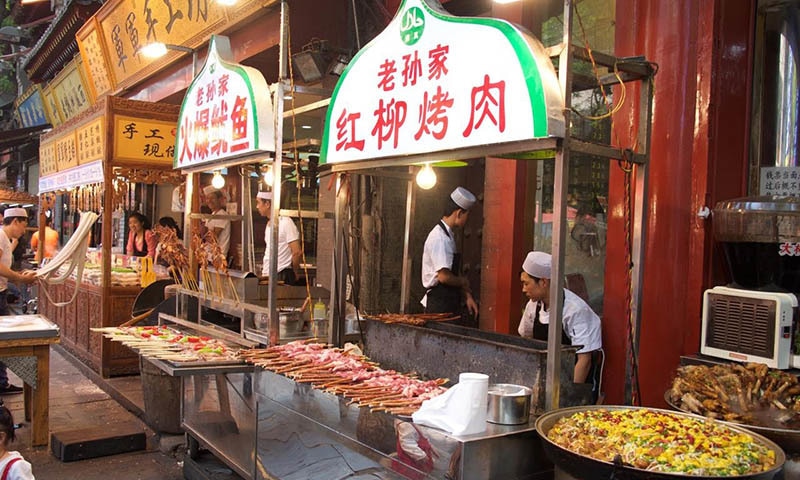
The market is a city block of narrow, cobbled streets lined by shade-giving trees and quaint buildings that betray their Tang and Ming heritages. Shops for the tourists are aplenty, but the crowds mill around the eateries that offer varieties of freshly prepared local cuisine.
The prominence of sales girls in hijab and signs proclaiming the food halal leave no doubt that Muslim tradition is alive and well in this improbable outpost of Islam in central China. The food, however, is not for the faint-hearted: seahorses and scorpions on skewers are also on offer. Mercifully for us, the food in this bazaar is free of pork, which inevitably finds its way into almost every Chinese dish. Ordering a meal in sign language is a frustrating exercise but a local person, having noticed our predicament, helped us order a local delicacy, which we washed down with a yoghurt drink.

Fortunately, his Mandarin-accented English was quite intelligible; he was sporting a skull cap favoured by Muslims and seemed knowledgeable. We were curious about the origin of Muslims in China and asked him to join us for the meal, which then turned into a history session.
There are 20,000 Muslims in Xi’an, he tells us, and they own almost all the shops around the mosque. Ethnically they are Hui, from the northwest region. There are, in fact, over 10 million Hui people in China and most are Mandarin-speaking Muslims. The largest population of Muslims in China is in the northwest Xinjiang province. Ethnically, the Muslims there are mostly Uyghur. Recently, they have been under government scrutiny due to a surge of religious extremism in the region and violence by some unruly young Muslims. Our friend tells us that, contrary to recent rumours, the government’s attitude towards Muslims in China is fair.

Xi’an served as the imperial city for 10 ancient dynasties; trade with Arab Muslims through the Silk Route originated here. It is, therefore, not surprising that very early in its history, during the Tang Dynasty in the seventh century, Muslim traders from Arab lands came over to China.
Among the first arrivals was Saad ibn Abi Waqqas, a close associate of Hazrat Usman. He brought a message from the caliph to Emperor Gaozong. The emperor received the Muslims well and honoured them by constructing China’s first mosque, the Huaisheng Mosque in Canton.
Later, many Muslims settled in Xi’an and eventually over the centuries prospered across China. They became particularly influential during the Ming Dynasty (1368-1644); Emperor Zhu Yuanzhang, the dynasty’s founder, had in his army six Muslim generals, including Lan Yu, who in 1388 led a strong army across the Great Wall to defeat the Mongols. In fact, Zheng He, the legendary admiral of the naval fleet of Ming Emperor Yongle (14th century) was a Hui born to a Muslim family.

It was during the Ming period that mosques mushroomed over China, and they all adopted the traditional architecture bequeathed by Tang and Ming period influences.
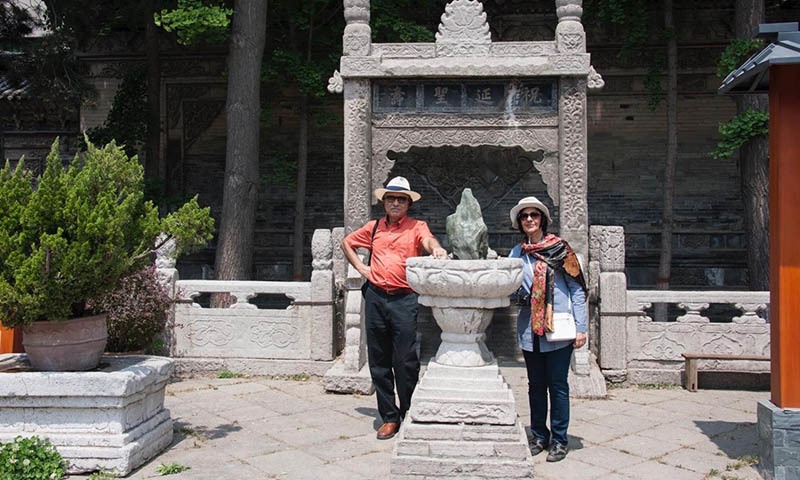
Our friend accompanied us to the ancient mosque, just around the corner from the restaurant. While there are many mosques across China, the Great Mosque of Xi’an dates all the way to the Tang Dynasty (circa 740) — about 100 years after the life of Prophet Muhammad (peace be upon him). Over the centuries, additions and modifications were carried out, mostly during the Ming Dynasty and the Manchu (Qing) period. The mosque is enclosed in a brick wall aged by time and nature. It has a typical layout common to Chinese temples — one courtyard leading into the next, with pavilions and towers richly engraved with calligraphy and decorated with floral patterns. Each courtyard has rooms designated for various religious rituals and traditions. Surprisingly, contrary to Islamic injunctions against icons of living objects, sculpted dragons and birds adorn the scaffolds along its roof. Prominent in the open spaces are stone arches and towers etched with verses from the Quran.

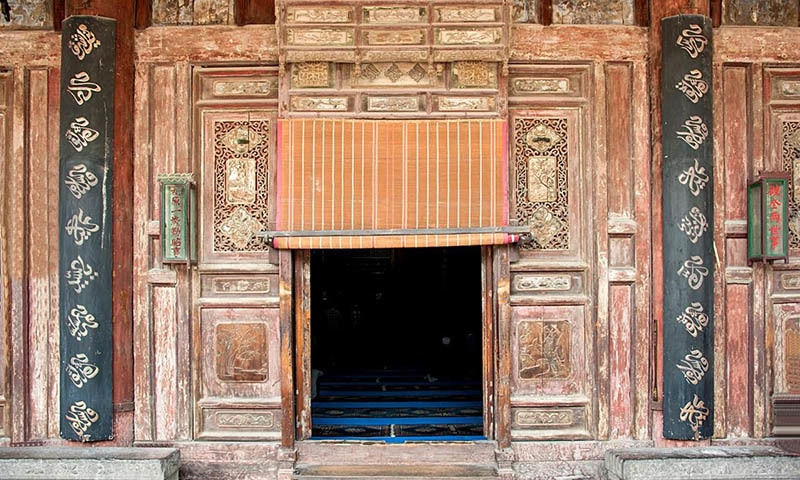
The last corridor leads to the prayer hall. Its entrance is framed with tablets engraved with floral motifs and calligraphy of verses from the Quran. The prayer hall is a large hypostyle leading to the mihrab, which is embellished with exquisitely carved arabesques and Chinese calligraphy in Arabic letters. While the hall is large enough to accommodate 1,000 people, our friend tells us that a typical congregation usually has around 100 worshippers.
The mosque is indeed an embodiment of the culture of ancient China. Muslims from around the world, familiar with the traditional minarets and domes of a typical mosque, are intrigued by the evolution of design from a classical Arabic to a quintessentially oriental façade. Indeed, devotion comes in many hues.


The writer is the author of Jerusalem — A Journey Back in Time.