THE NATION
CHUSRI NGAMPRASERT August 3, 2016 1:00 am
Black Mountain Championship Golf Course, Thailand’s Hua Hin
From a golfing holiday at a top course to getting up close and cosy with SpongeBob SquarePants, there’s plenty on offer in Asia this month
Experience the life of a professional golfer on tour with three official Asian Tour Stay and Playpackages by Hilton. You’ll enjoy accommodation at a Hilton property for two nights and a round of golf at a championship golf course in Singapore, Indonesia or Thailand. Each package includes 18 holes of golf at Singapore’s top-ranked Laguna National Golf and Country Club, the prestigiousRoyale Jakarta Golf Club, or the Black Mountain Championship Golf Course in Hua Hin, Thailand. To complement the game, the package includes a two-night stay with Hilton Singapore, DoubleTree by Hilton Jakarta Diponegoro or Hilton Hua Hin Resort & Spa respectively. The offer is available from now until June 16 next year for stays prior to June 30, 2017. Booking must be made at least 14 days prior to arrival. Call (+65) 67 372 233. Visit www.Hilton.com.
Make this Mother’s Day truly memorable at The St Regis Bangkok. On August 12 from noon to 3, treat mother to a brunch featuring the hotel’s Signature Raw Bar, premium-quality grilled imported meats and seafood and decadent dessert creations, complemented by a continuous flow of juices and smoothies. Rates are Bt3,000 per person including wines, sparkling wines, Siam Mary, Martinis, beers, bespoke smoothies, juices and Bt4,700 per person with all beverage options and unlimited Moet & Chandon champagne. If your mum prefers tea to brunch then invite her to enjoy Mother’s Day Afternoon Tea at the Drawing Room from 2 to 5pm. A set for two people, priced at Bt1,200, includes sweet delights and coffee or tea. All mothers having afternoon tea will receive a signature souvenir along with a St Regis Teddy Bear and fresh jasmine. Call (02) 207 7777 or email fb.bangkok@stregis.com.
Royal Orchid Sheraton Hotel & Towers is celebrating its 33rd anniversary with an exclusive room promotion. Starting from Bt3,333 a night, you’ll enjoy a deluxe room with unobstructed panoramic river views plus daily buffet breakfast for two people. Booking period is from now until August 7 for stays through October 31. Call (02) 665 3165 and quote rate code “DAILY0A” or email res172royalorchid@sheraton.com. Visit http://www.RoyalOrchidSheraton.com.
Plan an enticing break for families and friends at Soneva Kiri on Koh Kood, with a special rate of Bt191,600 for up to six persons. The Private Thai Resident package is valid from now until September 30, with accommodation in a Private Bayview Pool Reserve Villa, and a half-board meal plan that provides breakfast and dinner (including one BBQ at the villa) together with non-alcoholic beverages at the resort’s restaurants. The resort can be accessed by private aircraft from Bangkok, with the round-trip fixed schedule flight available at a supplement of Bt15,000 for an adult and Bt7,500 for a child. Lunch can be added to the package at Bt2,600 per adult and Bt1,300 for a child. Email: reservations@soneva.com or visit www.Soneva.com.
Nickelodeon’s SpongeBob SquarePants and his friends are visiting Hong Kong Ocean Park from Bikini Bottom to engage with guests and fans from all over the world in the city’s first-ever SpongeBob Water Party. The annual Ocean Park Summer Splash features lots of exhilarating water-themed attractions, scrumptious SpongeBob-themed dishes, SpongeBob SquarePants X Ocean Park limited-edition souvenirs, “Get Closer to the Animals” activities, face-painting and workshops. Find out more at www.OceanPark.com.hk/en.
Celebrate Mother’s Day by taking the family for an edutainment experience with the “10 Thai fish species”
Celebrate Mother’s Day by taking the family for an edutainment experience with the “10 Thai fish species” exhibition at Sea Life Bangkok Ocean World from Monday through August 14.
Creatures of the deep
Celebrate Mother’s Day by taking the family for an edutainment experience with the “10 Thai fish species” exhibition at Sea Life Bangkok Ocean World from Monday through August 14. The fish on show are from the rehabilitation project for Thai freshwater fish and other species, one of HM Queen Sirikit’s Royal Initiative Projects. Buy the tickets through Rabbit LINE Pay on http://www.SeaLifeBangkok.com from Sunday to August 13 and for each entry pass purchased, you’ll get another absolutely free. Sea Life Bangkok Ocean World is on floors B1 and B2 of Siam Paragon and is open daily from 10am to 9pm.
In celebration of Her Majesty
Bang Sai Royal Folk Arts and Crafts Centre together with public and private enterprises are organising a series of celebrations, on the theme “Ngan Silp Khong Mae” (Arts Creation by Her Majesty the Queen) in honour of Her Majesty Queen Sirikit’s 84th birthday. The festivities kick off with a concert by Kenny Rogers and Linda Davis. Other highlights include a musical fireworks extravaganza featuring seven shows of 8,499 fireworks at the waterfront of Chao Phraya River at Bang Sai Royal Folk Arts and Crafts Centre in Ayutthaya from August 12 to 14. Also expect exhibitions, fairs, performance, cultural shows, concerts and a candlelight ceremony. Find out more at http://www.NganSilpMae.com.
Swinging with the Akha
The Akha swing high in the air as they honour their ancestors and ask the gods for a good harvest. Akha communities in Chiang Rai, Thailand’s northernmost province, will be pulsating with energy and music during the Akha Swing Festival at various venues on different days in their villages from now to September 30. You don’t have to be a member of the tribe to enjoy it either because this annual festival always welcomes visitors to the village for tribal music, a feast and, of course, a chance to check out the swing. Call Tourism Authority of Thailand Chiang Rai Office at + 66 (0) 53 744 674-5 or TAT Call Centre 1672.
Cebu-Pacific orders new Airbus craft
Manila-based Cebu Pacific has placed a firm order with Airbus for two A330-300s. The aircraft will join the airline’s existing fleet of six A330s used on long-range flights to destinations in the Middle East and Australia, as well on selected domestic and regional routes. The newly ordered aircraft will enable the airline to add more long-haul routes, including the launch of its first flights to the US. Cebu Pacific currently operates 49 Airbus aircraft, including six A330s and a fleet of 43 A320 Family single aisle aircraft on its extensive domestic and regional network. In addition to the contract announced recently, the airline has 32 latest generation A321neo aircraft on order for future delivery.
Hukou Waterfall has regained its magnificent look, as its maximum flow reached its normal 30-meter drop again.
The waterfall drop stood at just two meters during the July-August rainy season, as heavy rainfall increased the level of the water in the plunge pool at the foot of the waterfall. Hukou Waterfall is located at the intersection of Shanxi and Shaanxi provinces, and is the largest waterfall on the Yellow River.
A special report by Dawn, a member of Asia News Network.
The first major terror attack in Karachi by extremist outfits took place in2002.
A bus carrying French engineers was targeted, killing many.
//
The same year (2002) suicide bombers belonging to an extremist outfit targeted the US Embassy in Karachi near Hotel Marriot.
Dozens of bystanders were killed. The Musharraf regime acknowledged that a new form of terror and violence has struck Pakistan.
A middle-class couple in Karachi, 2004.
The Musharraf regime greatly liberalised the economy and offered easy loans. The urban middle-classes benefited from this and their ranks grew rapidly.
But just as had happened during the Ayub regime, this time too, an economic boom had a flip side. Apart from giving more consumption powers to the urban middle-classes, it further widened economic disparities as well.
A vicious storm lashes Karachi in 2006.
The year’s monsoon in the city was extraordinarily harsh, causing severe urban flooding and deaths. The monsoon season in Karachi is normally very mild. But after every five years or so, Karachi receives heavy rains from ‘cloud bursts’.
Weather experts suggest that heavy monsoons in Karachi are not a norm because monsoon rains in the city are ‘mainly due to meteorological accidents’. By this they mean that heavy rains only occur in Karachi due to some unexpected weather conditions in the Arabian Sea or over the Gujarat province in neighbouring India.
The 2006 rains broke various previous records. They were compared to the record rains Karachi had received during the monsoon seasons of 1901,1967, 1976-77 and 1994.
2007 was particularly violent for Karachi. Terrorist attacks on civilians and security forces by clandestine extremist outfits increased twofold, and clashes between supporters of the Musharraf regime and opponents led to many deaths.
Karachi’s economy, which had enjoyed a brief boom in the early 2000s, had begun to buckle.
For the next many years, crime in the city would rise to unprecedented levels, forcing the military, the federal government (now led by Nawaz Sharif’s centre-right PML-N), and Sindh’s PPP-led provincial regime to initiate an extensive operation against terrorists and criminal gangs.
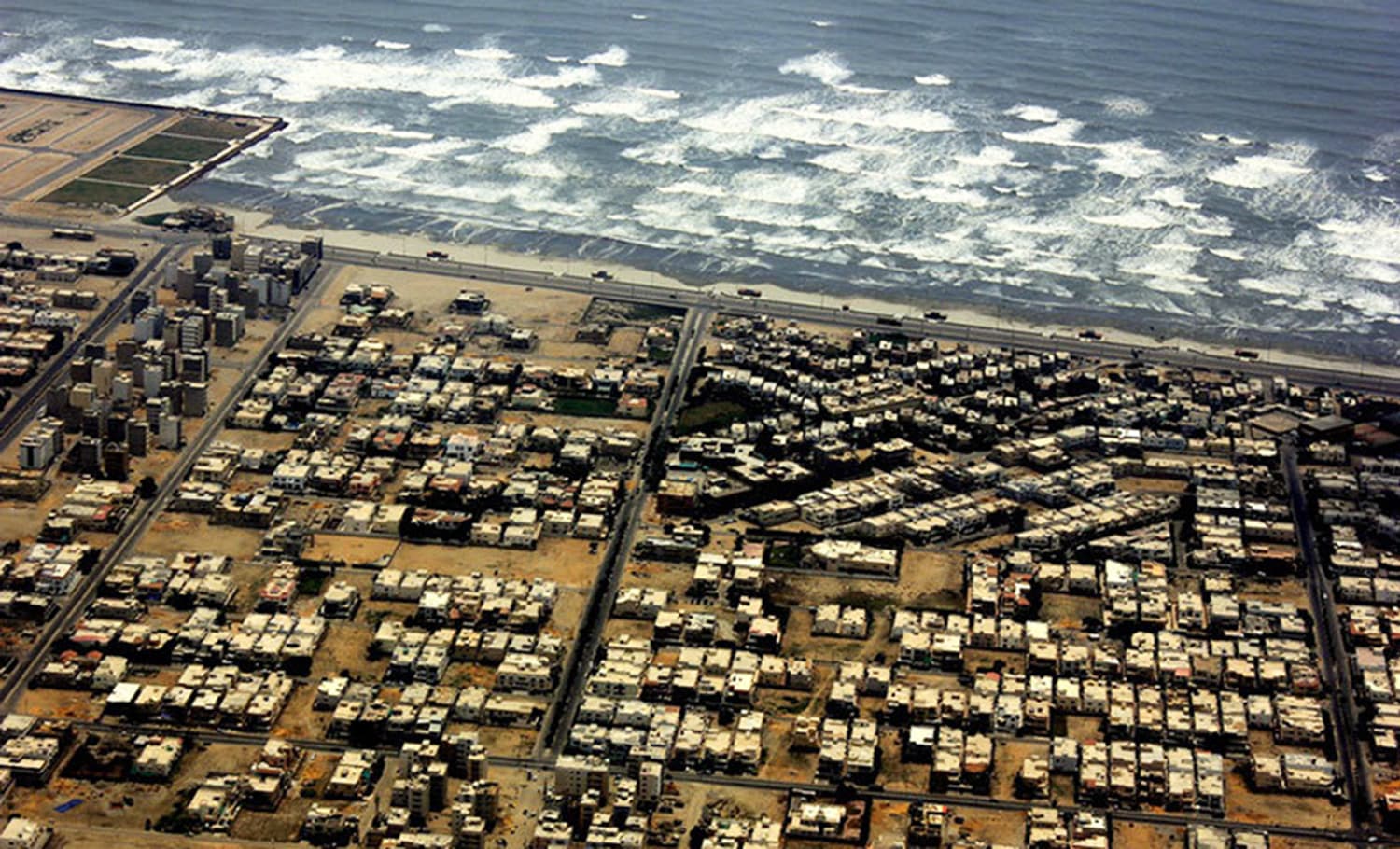
Karachi’s Seaview area near the Clifton Beach in 2015. Till the late 1970s, the area was a long stretch of sea, sand and shrubs.
Today, it is one of the most thriving residential, commercial and recreational areas of Karachi.
Body of a whale washed ashore the Clifton Beach. The hectic building boom along the Clifton Beach has severely polluted the sea waters here.
Karachi’s largest multiplex cinema, The Nueplex.
Multiplex cinemas mushroomed across the city from the mid-2000s onward. As conventional cinemas went out of fashion, multiplexes have been enjoying the return of middle-class audiences to watch films on the big screen.
Karachi’s Prince Cinema today. Built in 1977, it was the country’s largest cinema and the first one which had a 70mm screen, and Dolby sound system.
It was also the most expensive. However, decades later, it has been struggling to come to terms with the challenges posed by multiplexes. It survived the crisis of the 1980s when the VCR made sure to keep audiences seated in their homes, and it also survived when a rabid mob of extremists went on a rampage a few years ago and burned down a number of cinemas (Prince, Bambino, Nishat, Capri).
Nishat never reopened. Such cinemas now squarely cater to working-class audiences who can’t afford tickets at multiplexes.
Karachi (and Pakistan’s) tallest building under-construction.
Called the Icon Tower, it is situated in the New Clifton area of the city (near the famous shrine of Sufi saint, Abdullah Shah Ghazi).
It is going to be 60-stories-high and is expected to be completed by early 2017. So far, the tallest building in Pakistan is Karachi’s MCB Tower on II Chundrigarh Road. Built in the 2000s, it broke the record held by Habib Bank Plaza (also located on the same road). The Habib Bank Plaza (now HBL Plaza) was built in the early 1960s.
A special report by Dawn, a member of the Asia News Network
PIA airhostesses receiving lessons in English and French in Karachi in 1975.
PIA continued to grow into a world-class airline, and was making handsome profits since the mid-1960s. Karachi Airport, too, remained one of the busiest in the region, accommodating flights belonging to all the leading airlines of the world. But from the late 1980s onwards, PIA began to face a gradual decline. Its quality of service deteriorated and by the 2000s, it was on the verge of bankruptcy. It still is.
The airport in Karachi, too, lost out its ‘gateway to Asia’ status to Dubai. And due to rising incidents of terrorism in Pakistan, traffic at the airport was drastically reduced, despite the fact that the airport was shifted to a brand new building in 1992.
//
The incomplete building of what was supposed to be one of the largest 5-star hotels in Asia.
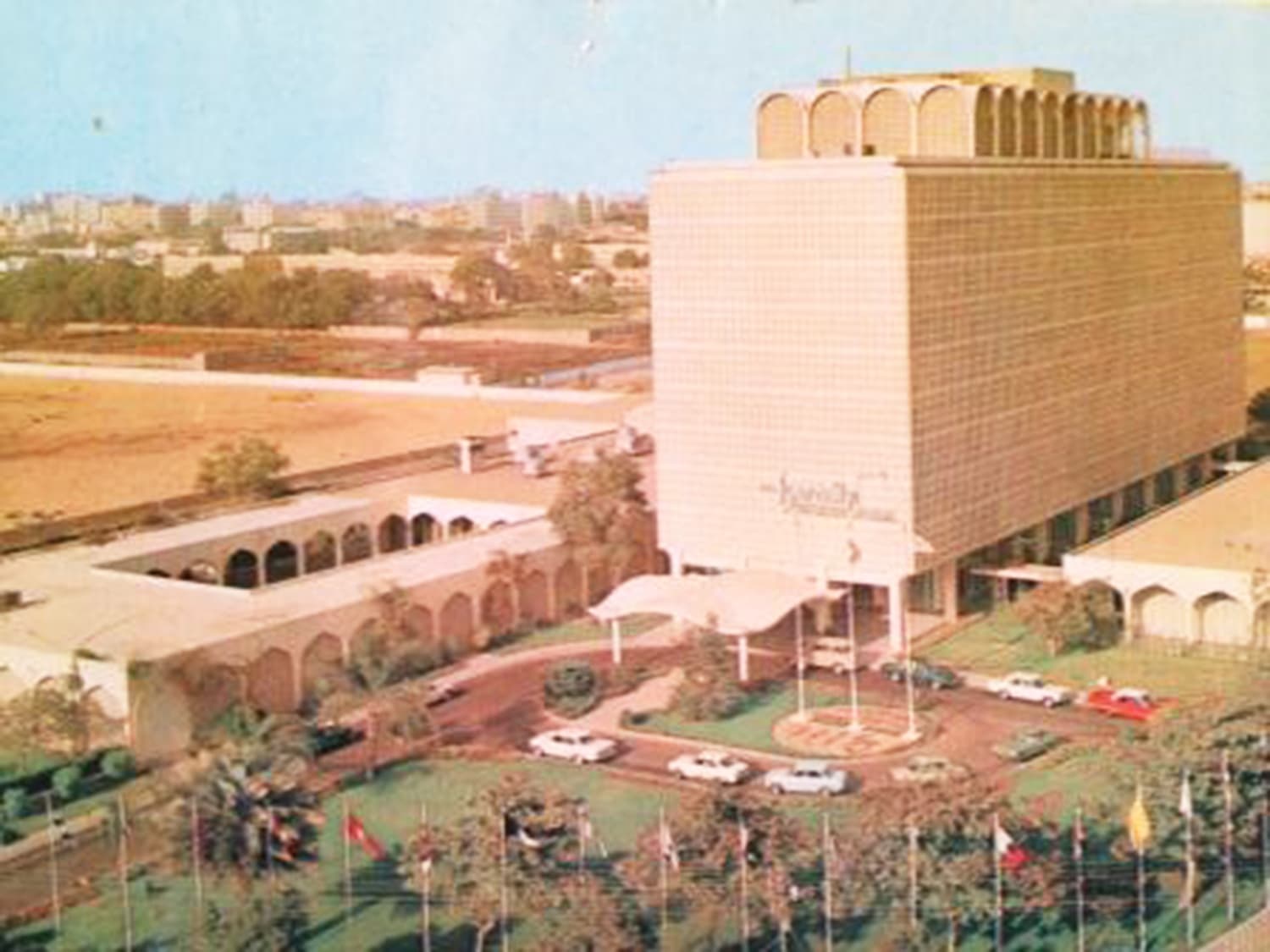
With rising violence in Beirut in the mid-1970s, the Bhutto regime planned to divert the wealthy European and Arab tourists from the crumbling casinos of Beirut to Karachi. For this purpose, the Bhutto government began building a large 5-star hotel in the heart of Karachi (Hayat Hotel), and an equally large casino situated on the shoes of the city’s Clifton Beach area.
By 1977 both the buildings were almost complete when Bhutto was overthrown in a reactionary military coup. Work on the hotel and the casino was halted. The empty casino building was finally torn down in the 2000s, whereas the incomplete structure of the hotel still stands, rather aimlessly.
The ‘recreational’ wealth Bhutto was trying to attract to Karachi eventually moved to Dubai.
The 5-star Taj Mahal Hotel on Karachi’s Shara-e-Faisal in 1981.
Its appearance symbolised a brief respite from economic turmoil which the city had fallen into in the late 1970s. The Ziaul Haq dictatorship was replenished with US and Saudi aid (at the start of the Afghan Civil War), and it also began to dismantle Bhutto’s rather ill-formed ‘socialist’ economic policies.
A new class of nouveau-riche began to emerge, which was comfortable with combining the accumulation of wealth and material exuberance with exhibitions of public piety encouraged by the Zia dictatorship.
Many members of this new class could be found holding business lunches and dinners at the Taj Mahal. The hotel still exists but in a more depleted state. It is now called the Regent Plaza and has become a 2-star resort.
Karachi’s Seaview Area begins to emerge in 1982.
Much of this area, located along the Clifton Beach, had just been about the sea, sand and shrubs. But in the early 1980s, town-houses and small bungalows began to come up, mostly catering to the growing middle-class sections of Karachi.
Today, it has become a widespread residential area with shopping malls, exotic restaurants and tall office buildings. However, the sea water here has become extremely polluted.
Prince Karim Agha Khan being given a tour of the Agha Khan Hospital in 1983.
Funded by the prince, the hospital has remained Karachi’s largest and most sophisticated surgical and treatment facility. It also has an excellent medical university attached to it.
Two photos of the same street in one of Karachi’s largest impoverished areas, Orangi. The pictures were taken by famous architect and sociologist Arif Hassan to demonstrate the success of the Orangi Pilot Project (OPP).
The first picture is from 1983 and second from 1984. OPP was an initiative of Akhtar Hameed Khan, a social scientist. He began a ‘bottom up community development program’ in Orangi which, at the time, was a large slum.
He registered the OPP as an NGO and then generated funds and plans for the upliftment of Orangi. He mobilised the area’s people and involved them in various self-help schemes aimed at building an effective sewerage and sanitation system, paved streets, low-income housing, schools and medical facilities.
He often got into tussles with the many land-grabbing, extortion and drug gangs operating here. The gangs utilised the area’s religious figures to intimidate him. But the OPP was a huge success.
Pakistan and India battle it out in the 1981 Champions Trophy at the Hockey Club of Pakistan (HCP).
The HCP is a state-of-the-art hockey stadium and headquarters of Pakistan’s hockey federation. Situated off Shara-e-Faisal Road in Karachi, it was inaugurated in 1979 and was the first hockey ground in the country to have an Astroturf field.
The HCP held various international tournaments between 1980 and 1992. Most of them were won by Pakistan which was a force in international field hockey between the 1960s and early 1990s. Pakistan’s fortunes, in this respect, began to plummet after 1994, so much so that by the 2000s, this once international hockey power and winner of three hockey World Cups was even struggling to qualify for the sport’s major events. The HCP stopped holding international events. The last major event here was actually a pop concert in 1995.
1985: School and college students chant slogans against the government and Karachi’s ‘transport mafia’ the day after a Mohajir student, Bushra Zaidi, was run over by a bus.
The accident sparked a series of deadly riots between the Mohajirs and the Pakhtuns of Karachi.
Hundreds of people lost their lives. These riots triggered a cycle of ethnic conflicts which became an uncomfortable norm in the city. The riots were initially the result of Karachi’s resources coming under great stress due to the unchecked influx of Afghan refugees.
Drug and land-grabbing mafias became interwoven with corrupt security personnel and some politicians and guns became easily available on the black market. This was also the start of ethnic ghettoisation in Karachi, in which ethnic communities began residing in areas mostly populated by their respective ethnic group.
Crew of the first ever Emirates Airline flight to Pakistan in 1985.
The flight arrived from Dubai to Karachi. Emirates, which would go on to become one of the leading airlines in the world, was initially set up by the UAE government with the help of engineers, pilots and administrators belonging to Pakistan’s national airline, PIA.
Ironically, from the late 1980s, as Emirates was beginning its gradual rise, PIA had already begun its eventual decline.
Members of Airport Security Guard posted near an American Pan Am plane on the runway of the Karachi Airport in 1986.
The plane, which was scheduled to take-off from Karachi to JFK Airport in New York (via Frankfurt), was stormed by four radical Palestinian militants belonging to the notorious Marxist Abu Nidal group. The militants had entered the plane dressed as security personnel.
They shot dead an airhostess before Pakistani army commandos entered the plane in the dead of the night. Twenty passengers lost their lives in the gun fight between the commandos and the militants. The dead included Indian, Mexican, American and Pakistani passengers. The militants were captured alive.
Master West Indian batsman, Viv Richards, hitting out against Pakistan at Karachi’s National Stadium during the 1987 Cricket World Cup.
The 1987 World Cup was the first major cricket tournament held in Pakistan (jointly held with India). Both Pakistan and India reached the semi-finals of the event but lost. Australia beat England in the final to win its first cricket World Cup trophy. It would go on to win it four more times!
The National Stadium had a history of crowd trouble. But when in 1987, the stadium was upgraded and a roof constructed over the general stands (to keep out the angry Karachi sun), incidents of pitch invasion and crowd violence decreased dramatically.
Karachi-based pop/rock band, Milestones. Formed in 1990, it went on to become part of a fresh wave of Pakistani pop music which swept the country in the 1990s.
Heroin addiction shot up dramatically in Pakistan in the 1980s.
The most severely hit city was Karachi. Heroin addiction was almost non-existent in Karachi till 1979. But by the end of the 1980s, Karachi had one of the largest number of addicts in Pakistan, numbering in millions.
Heroin first began proliferating in the metropolis when it was introduced by drug peddlers, who had accompanied Afghan refugees arriving in Karachi after the start of the Afghan Civil War in December 1979. Peddlers first handed out the drug free of cost calling it ‘meethi chars‘ (sweet hashish).
Users were not told it was physically addictive. But once the users were hooked, the peddlers began to charge them. Growth in drug addiction also led to more violent drug gangs and crime among addicts who soon ran out of money to satisfy their addiction.
The heroin menace cut across classes. In the late 1990s, when the price of heroin became even steeper, most addicts began to inject it. This led to the spread of diseases such as AIDs and fatal forms of hepatitis. Karachi still suffers from a major heroin problem.
Source: The detoxification of high dose heroin addicts in Pakistan: Micheal Goossop (1989)
A market in Karachi shut-down due to a strike in 1993.
When the state and government launched an operation against the alleged ‘militant wings’ of the city’s largest party, the MQM, strikes became common in Karachi.
Throughout the 1990s, strikes shut down businesses and Karachi’s economy and law and order situation deteriorated drastically. Hundreds of policemen and members of the MQM died in the conflict.
Indian actor Shashi Kapoor and British actor Christopher Lee shooting a scene in Karachi in 1997.
The scene was for the biopic of Pakistan’s founder Muhammad Ali Jinnah.
England cricketer McDermott Reeves enjoys a camel ride in Karachi.
Reed was part of the England cricket squad which toured Pakistan in 2000 for Test and ODI series.
A special feature of Dawn, a member of Asia News Network
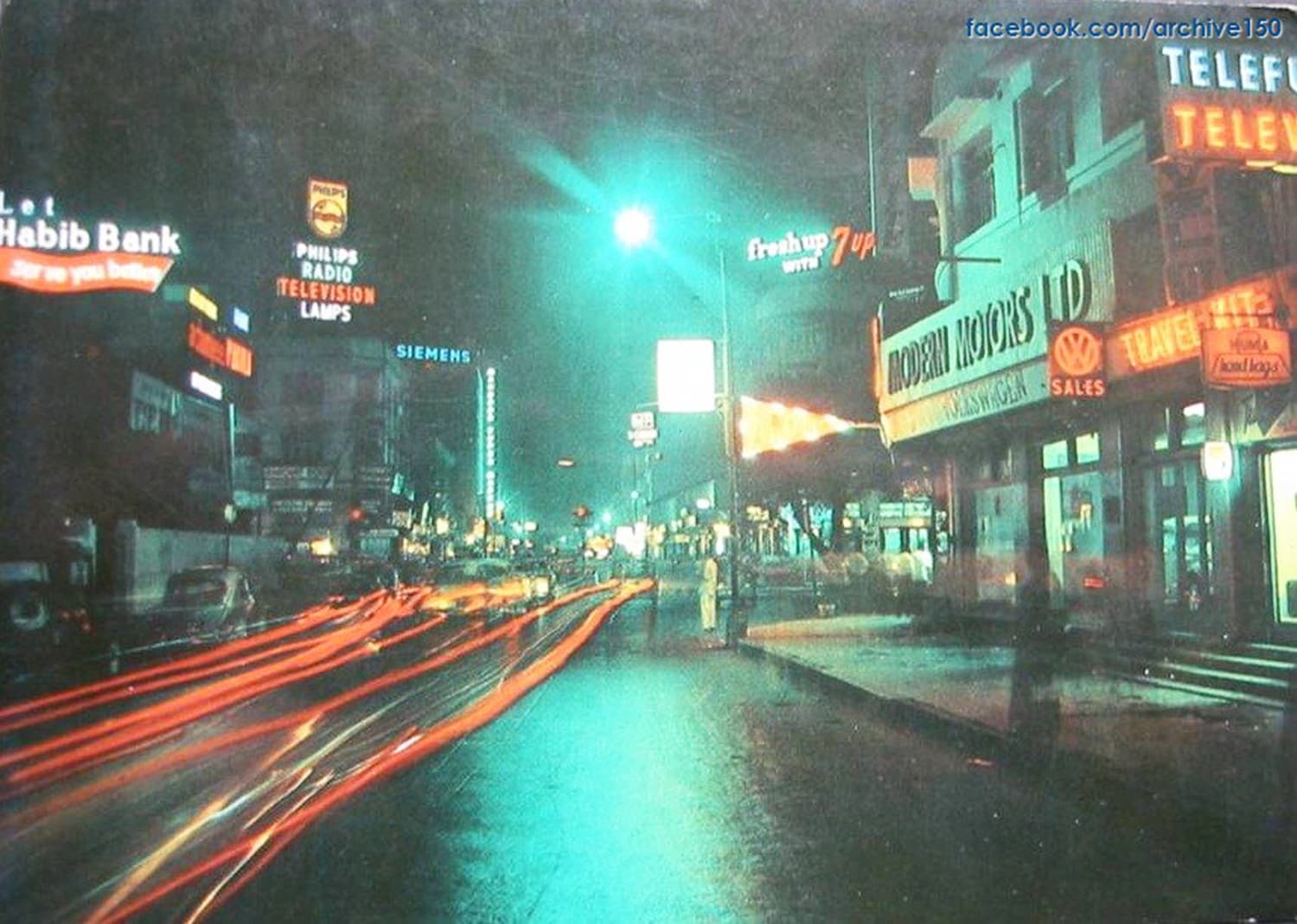
Karachi’s McLeod Road in 1962. After the economic boom and rapid industrialisation witnessed during the first half of the Ayub regime, McLeod Road became to be known as the ‘Wall Street of Pakistan’.
New buildings housing the Karachi Stock Exchange, banks, insurance companies, newspaper offices, other financial institutions and advertising agencies sprang up.
Between 1959 and 1965, streets of this area were regularly washed with water. Later, the area was renamed I.I. Chundrigar Road and has become extremely congested and polluted.
//
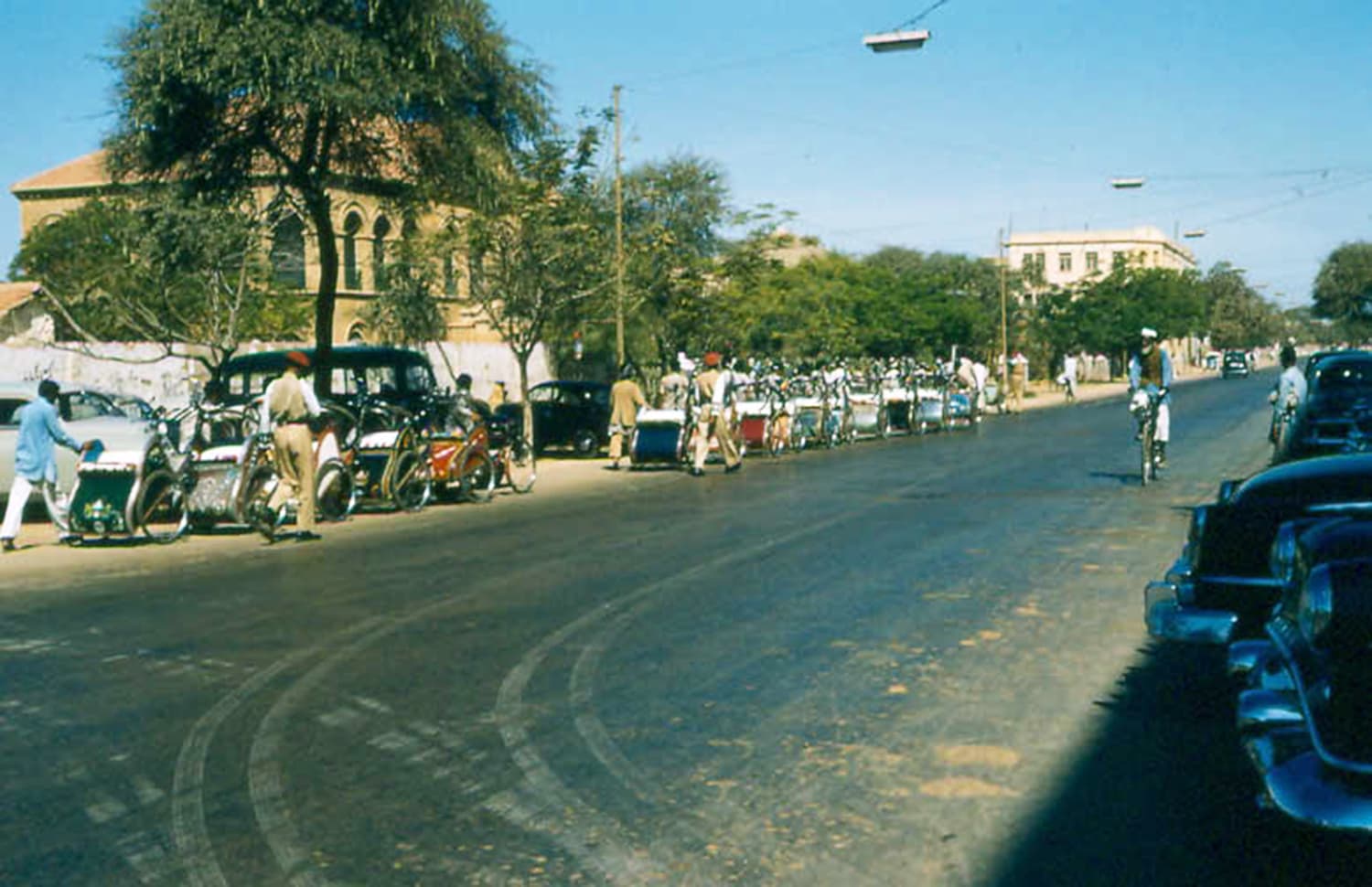
A Pakhtun rickshaw driver in Karachi’s Clifton area in 1963. The economic and building boom witnessed during the first phase of the Ayub regime saw the influx of labour arriving in Karachi from Pakistan’s NWFP province.
The hard-working Pakhtuns immediately populated the city’s labour force and also began to operate businesses involved in providing public transport. However, tensions began to mount between the city’s Mohajir majority and the new Pakhtun arrivals. The city eventually witnessed its first Mohajir-Pashtun riot in 1965.
Pro-Ayub graffiti on a wall in Karachi during the 1965 Presidential election.
Ayub Khan (Muslim League-Convention) defeated Fatima Jinnah (of Combined Opposition Parties — an alliance of anti-Ayub left and right outfits) and was re-elected as President. However, Karachi was the only city which voted against Ayub.
1967: An air-hostess of Pakistan International Airlines (PIA) pours Champagne for a business-class passenger at Karachi Airport.
In the 1960s, PIA rapidly emerged as one of the top airlines in the world and the Karachi Airport became ‘the gateway to Asia’.
The Intercontinental Hotel, 1966.
It was a popular high-end hotel in a city enjoying an economic boom and a rising number of foreign dignitaries, business personnel and tourists arriving for work and play to Karachi.
The hotel was re-named Pearl Continental in the 1990s. It is now mostly surrounded by tall barricades and security guards due to rise of terrorism and militancy in the city from 2004 onward.
A rare 1965 photograph of the last remnants of Karachi’s Jew community.
The community had grown in size in the early 1900s, but began to shrink from the 1950s onward. By the 1960s, only a handful of Jews remained in Karachi. They completely vanished after late 1960s (moving abroad).
Members of Karachi’s Jew community spoke fluent Hebrew, English, Urdu and even some Arabic.
Source: Pakistan’s Lost Jews: Rumana Hussain (Newsline, December 2013).
A widespread slum in Karachi in 1968.
The Ayub regime’s industrialisation project and pro-business policies had triggered an economic boom. But this boom had a flip side to it as well.
It also created serve economic disparities and gaps between classes and the expansion of slums like this one. The slums did not have any running water, sewerage system or electricity and were riddled with poverty, rising crime and alcoholism.
These tensions were expressed by an intense anti-Ayub movement in 1968-69, largely orchestrated by left-wing student outfits, labour unions and populist political parties. The movement forced Ayub to resign in early 1969.
The populist ZA Bhutto regime, which took power in December 1971, would go on to ‘regularise’ most of Karachi’s slums by providing them with some amenities, and ownership of land to those residing here. The Bhutto regime would also go on to build walls around such slums to stem their physical growth.
A 1970 Pakistani passport.
Though the Pakistani passport was always green (ever since the country’s creation in 1947), the full name of the country inscribed on it kept changing.
From 1947 till 1955, ‘Pakistan Passport’ was inscribed (in Urdu, Bengali and English) on the cover. This was changed to ‘Republic of Pakistan’ in 1956, and then to ‘Islamic Republic of Pakistan’ in 1958.
In 1960, the Ayub regime reverted it to ‘Republic of Pakistan. In 1969, the inscription was changed back to the simple ‘Pakistan Passport’. This was changed in 1973 to ‘Islamic Republic of Pakistan’ by the Bhutto regime (now written only in Urdu and English, because the Bengali-dominated East Pakistan had broken away in 1971).
This has remained, even though the Musharraf regime (1999-2008) did try to revert the inscription back to ‘Republic of Pakistan’, but his move was opposed by conservative opposition parties.
A 1973 photograph of a pop band playing at a nightclub in Karachi.
A majority of such bands, which played regularly at hotels and nightclubs of the city, consisted of members of Karachi’s vibrant Christian community. The community was largely Catholic and its ancestors had begun to arrive in Karachi in the early 1900s. Most had come from Goa where they had been converted to Christianity by Portuguese colonialists.
Karachi’s Christian community largely resided in the Saddar areas and was involved in education. The late 1960s and 1970s were the heydays of Christian pop bands, and most Christian youth made their living through this.
However, after nightclubs were closed down in April 1977 and a reactionary dictatorship came to power in July 1977, such bands struggled to find work. Many from these bands slipped into depression and alcoholism and died young, or migrated abroad. By the 1990s and 2000s, a majority of Karachi’s Christians had migrated.
—Picture courtesy: LMKonline.
McLeod Road in 1975.
Though it was still being called the ‘Wall Street of Pakistan’, the economy of the country which had boomed in the early and mid-1960s had already begun to falter.
Major industries and capital, which were concentrated in private hands, began to take flight and were stashed abroad after the Bhutto regime implemented its ‘socialist’ policies.
Most banks and insurance companies situated on this road were nationalised and fell into disarray. The economy also struggled to come to terms with the dramatic rise in global oil prices.
A 1975 poster of a Karachi-based pop band.
The 1970s were a surreal and flamboyant era in the city. Exaggerated and extroverted displays of one’s personality was common among the youth.
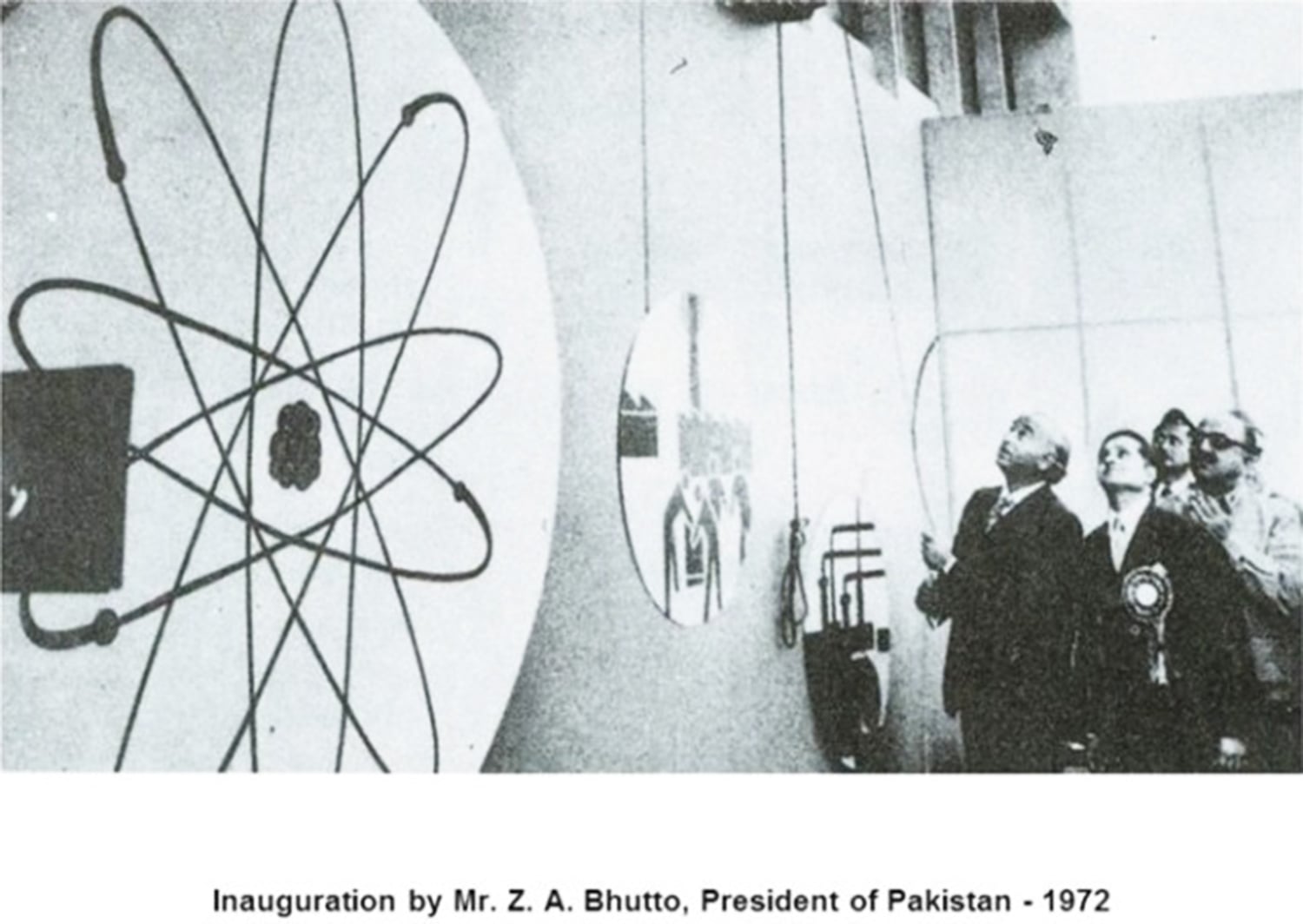
Bhutto inaugurates Pakistan’s first nuclear-power plant in Karachi in 1972. Bhutto accelerated Pakistan’s nuclear program in 1974 after India tested its first nuclear device. By the 1980s, Pakistan had developed its own nuclear device which it tested a decade later in 1998.
The plant which Bhutto inaugurated in Karachi is still operational.
Karachi’s famous Nishat Cinema in 1974.
It thrived in the 1970s and even survived the impact of the VCR invasion in the 1980s. However, in the 2000s, it was completely destroyed and set on fire by militant mobs incited by religious outfits. It has not been reconstructed.
Karachi’s busy Saddar area in 1974.
It had been an upscale shopping area during British Raj. From the mid-1960s, it began evolving as the epicentre of Karachi’s nightlife.
Its streets were lined with trendy restaurants, shops, bars and nightclubs, mostly catering to Karachi’s middle-classes. By the 1980s, it began to fall into disarray and suffer severe congestion. Today, it is a pale and an ill reflection of what it used to be.
Fishermen catch hammerhead sharks in Karachi’s coastal area in 1976.
Karachi always had a prominent fishing industry (fisheries), and it still does. However, ironically, it is perhaps the only major coastal city in the world where seafood is not all that popular.
Though small seafood eateries thrive near the port, and in the city’s historical coastal areas, such as Kemari, exclusive seafood restaurants are rare in Karachi.
This is mostly due to the fact that after the creation of Pakistan in 1947, the majority group of the city was made up of refugees arriving from various cities and towns of India. Many of these cities and towns were landlocked and never fully developed a taste for seafood.
Children enjoy a ride at a slum in Karachi in 1977.
The Bhutto regime ‘regularised’ many such slums by providing their residents land ownership and some amenities. Bhutto also got walls built around the slums to stem their growth, but the increasing rate of population in Karachi, inflation, and unemployment, could not stem swelling of poverty and economic desperation.
Criminal gangs dealing in drugs (mostly hashish), prostitution, pick-pocketing, gambling and black marketing grew two-fold in such slums, one of which was situated in the Lyari area. Paradoxically, Lyari had become a bastion of Bhutto’s Pakistan Peoples Party (PPP) from 1970 onward.
NADEEM F. PARACHA
Asia News Network July 30, 2016 12:23 pm
A special report by Dawn, a member of the Asia News Network.
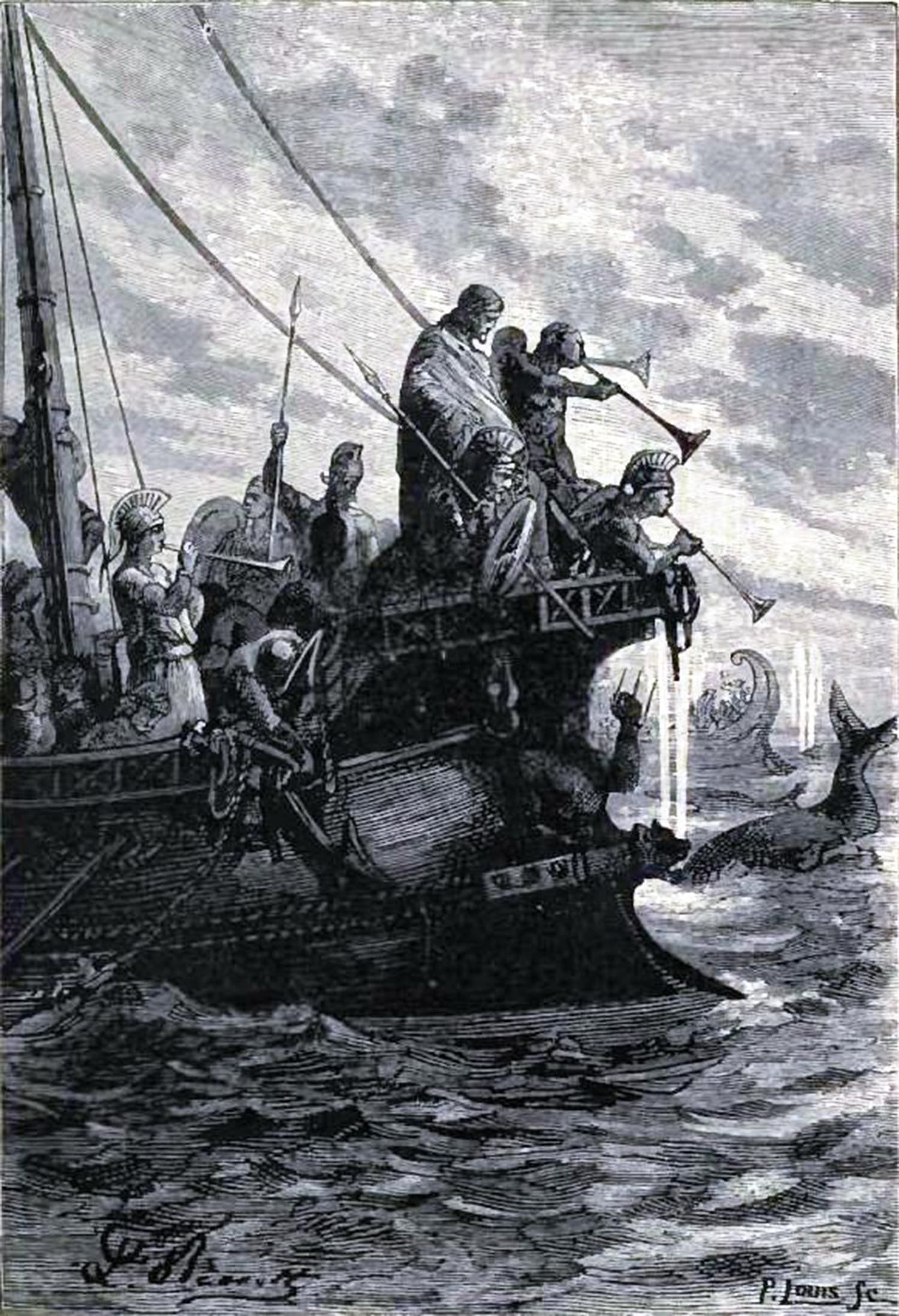
A 19th-century sketch of Greek commander, Nearchus, leading his fleet across River Indus in the present-day Sindh province of Pakistan.
//
Nearchus was a commander in ancient Greek king, Alexander’s army which had invaded India. In 325 BC, Nearchus exited India with his section of the army by sailing over the Indus and exiting from Balochistan.
He entered Balochistan by first reaching the mouth of Indus which emptied the river’s waters in the Arabian Sea. Historians believe this was where the coastal Manora area is in Karachi today.
A great storm from raging and Nearchus found a fishing village here led by a matriarch. He named the place Morontobara (Greek for Woman’s Harbour).
Source: The Voyage of Nearchus from the Indus to the Euphrates: William Vincent(Nabu Press, 2011). Karachi in the Mirror of History: M Usman Damohi (Al-Abbas Publications, 2011).
An 1839 sketch of Karachi drawn by a British traveller on the eve of Britain’s conquest of the city.
At the time, Karachi was just an insignificant dot on world maps. It was a small fishing town ruled by the Sindhi-Baloch dynasty (the Talpurs). It had a fort made of dry mud and an underdeveloped harbour. The town had no paved roads and no sanitation or garbage-collecting system.
It had a population of about 20,000 people who were mostly involved in the fish trade. Crime was high, and disease was rampant. The bulk of the population was made up of Sindhi, Balochi and Gujarati-speaking Hindus and Muslims.
Source: Gazetteer of the Province of Sind. B Volume 1 Karachi District 1919.
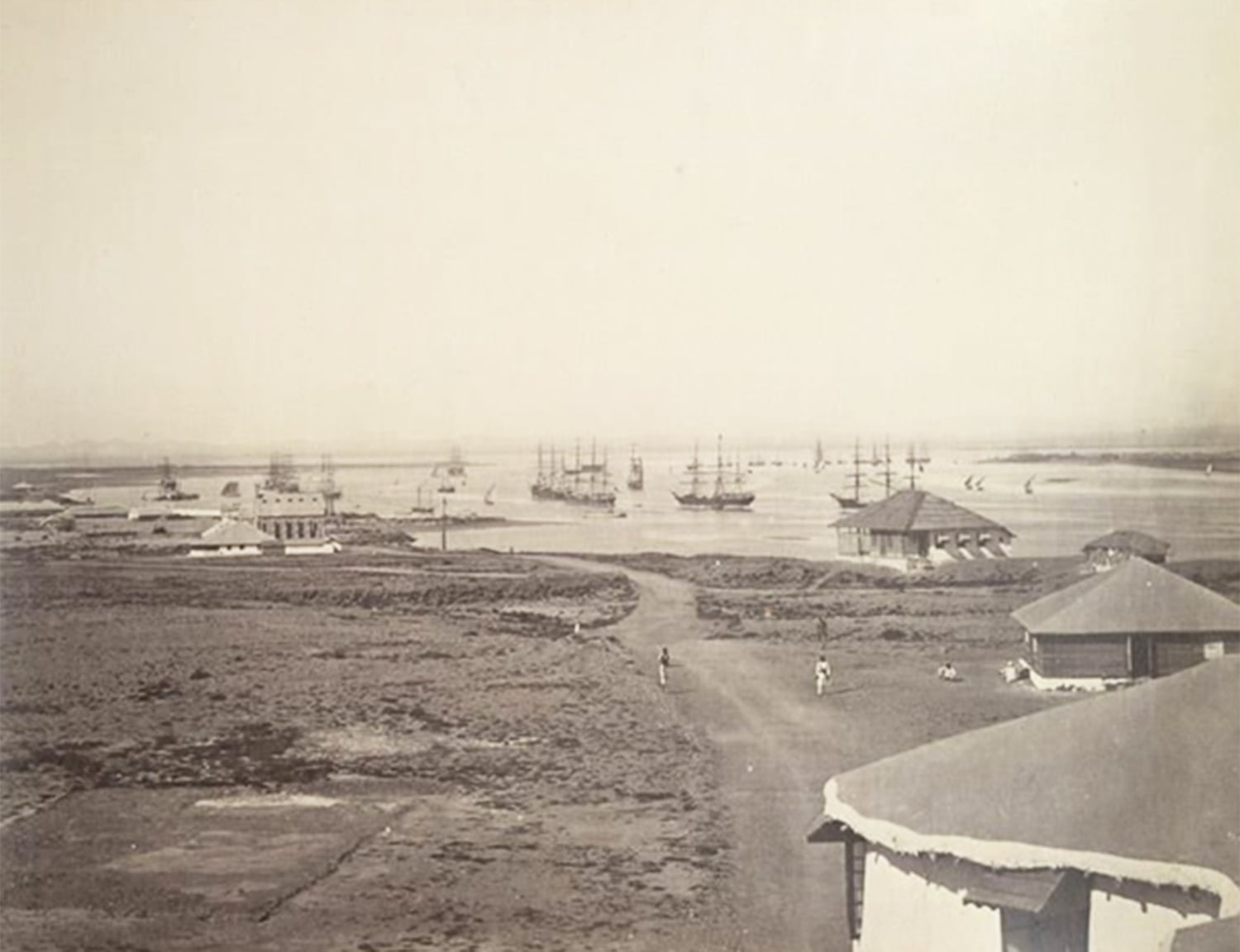
An 1860 photograph of British ships entering Karachi waters (Arabian Sea). By now the city had been made Sindh’s capital and absorbed into British India.
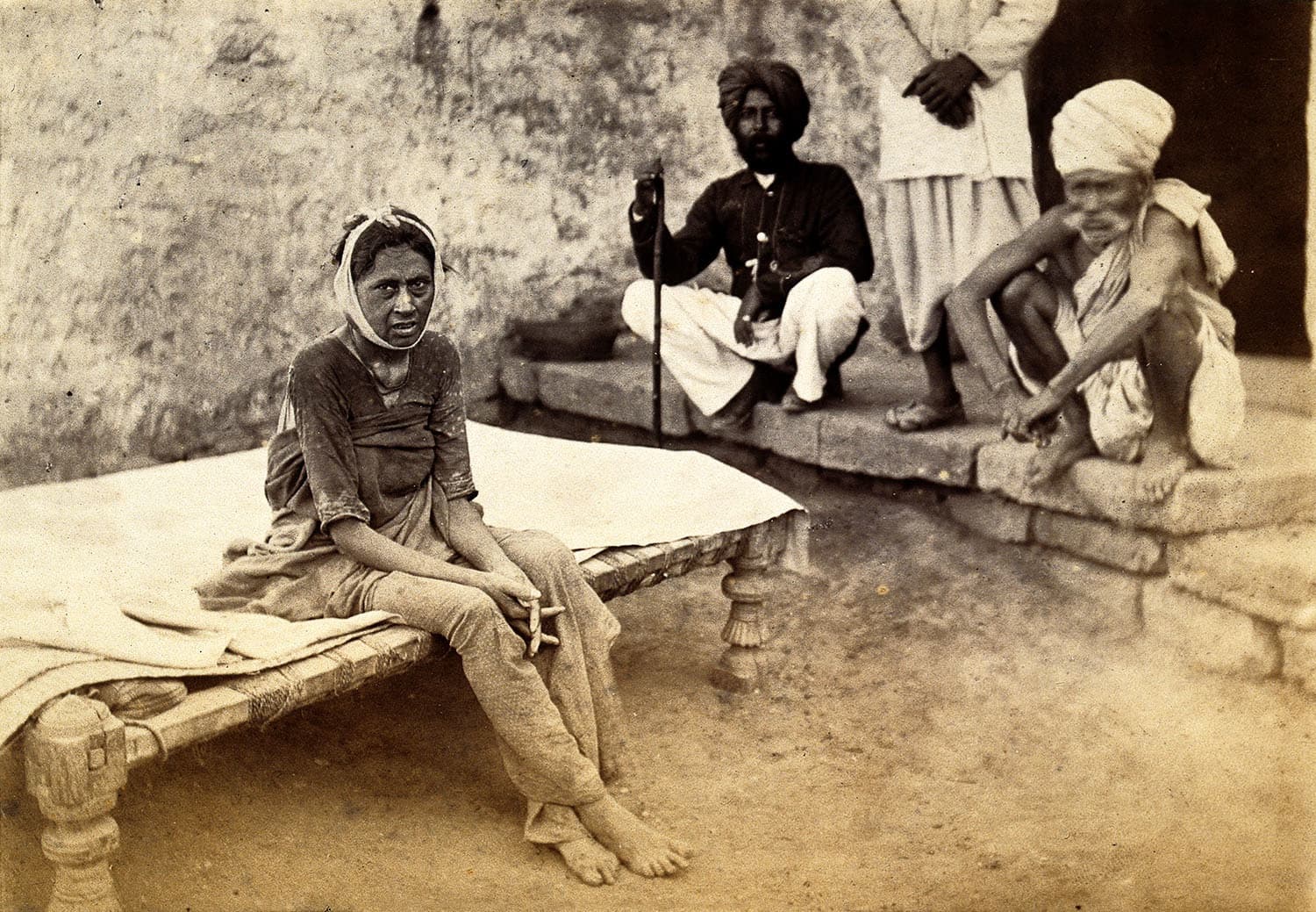
A woman suffering from the fatal bubonic plague awaits treatment in 1890, Karachi.
The city’s worsening sanitation conditions fed the infected rats which arrived on ships from elsewhere in India. Hundreds of people perished from the plague. The British began work on providing the city with an effective sanitation and sewerage system.
Source: Gazetteer of the Province of Sindh. B Volume 1 Karachi District 1919.
A 1919 photograph of Karachi’s Saddar area.
By the mid-1900s, Karachi had grown into an impressive trading post. The British developed Karachi’s harbour and it became one of the busiest in India. The British also built a robust infrastructure (roads, bridges, hospitals, parks, railways, etc.); and introduced modern policing and city governing systems.
The crime rate saw a sharp decline; and the city’s economy boomed. Fifty-one per cent of the city’s population was Hindu; 40 per cent was Muslim; and there were also large Christian and Zoroastrian communities.
There was a Jew community too, apart from thousands of British officers, doctors, engineers and administrators and their families residing here. It was during this period that Karachi became known as ‘the Paris of Asia’.
Source: Gazetteer of the Province of Sind. B Volume 1 Karachi District 1919.
Statue of the British Queen being unveiled at Karachi’s Frere Hall/Park during a ceremony.
The statue was shipped all the way from London. The ceremony was attended by British and local officials of the city government, British military personnel, Karachi’s wealthy Hindu, Muslim and Zoroastrian dignitaries and the general public.
A few years later, a statue of King Edward, too, was placed here. Both the statues remained in place when Karachi became a part of Pakistan in 1947. However, the statues were removed in 1956 when Pakistan’s first constitution declared the country a republic.
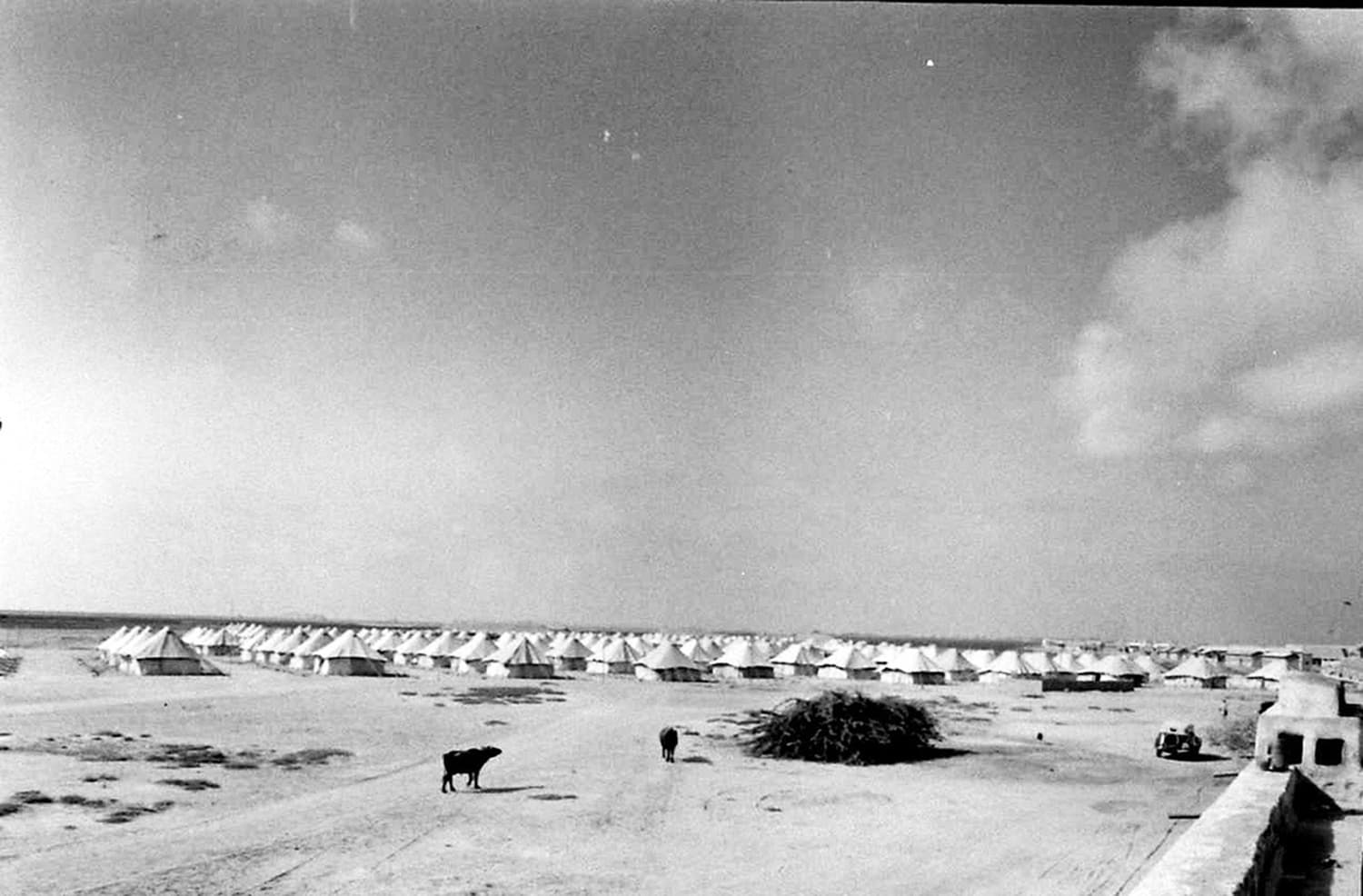
Karachi, 1948: An open area dotted by hundreds of temporary camps, housing government officials who ran matters of the country and the city from inside these dusty tents.
Karachi became the capital of Pakistan in August 1947. It witnessed a huge influx of Muslim refugees arriving from various Indian cities and towns. Karachi did not have the resources to accommodate such an influx. Many of its buildings were packed to capacity. Many civil servants, police personnel and ministers of the new country shifted to these tents from where (for almost a year and a half) they navigated the fate of Pakistan and its capital city.
Source: Pakistan’s Capital (A feature in LIFE Magazine’s June, 1948 issue).
A 1951 photograph of a busy commercial area of Karachi.
The city began to recover from the early demographic tremors caused by the dramatic influx of refugees when Karachi became the capital of Pakistan.
Another reason for the recovery was the sudden boom that the city’s economy enjoyed when Pakistan became a leading exporter of jute, cotton and other agricultural goods to the US troops stationed in Korea during the Korean War. The bulk of the goods were exported through cargo ships leaving from the city’s harbour.
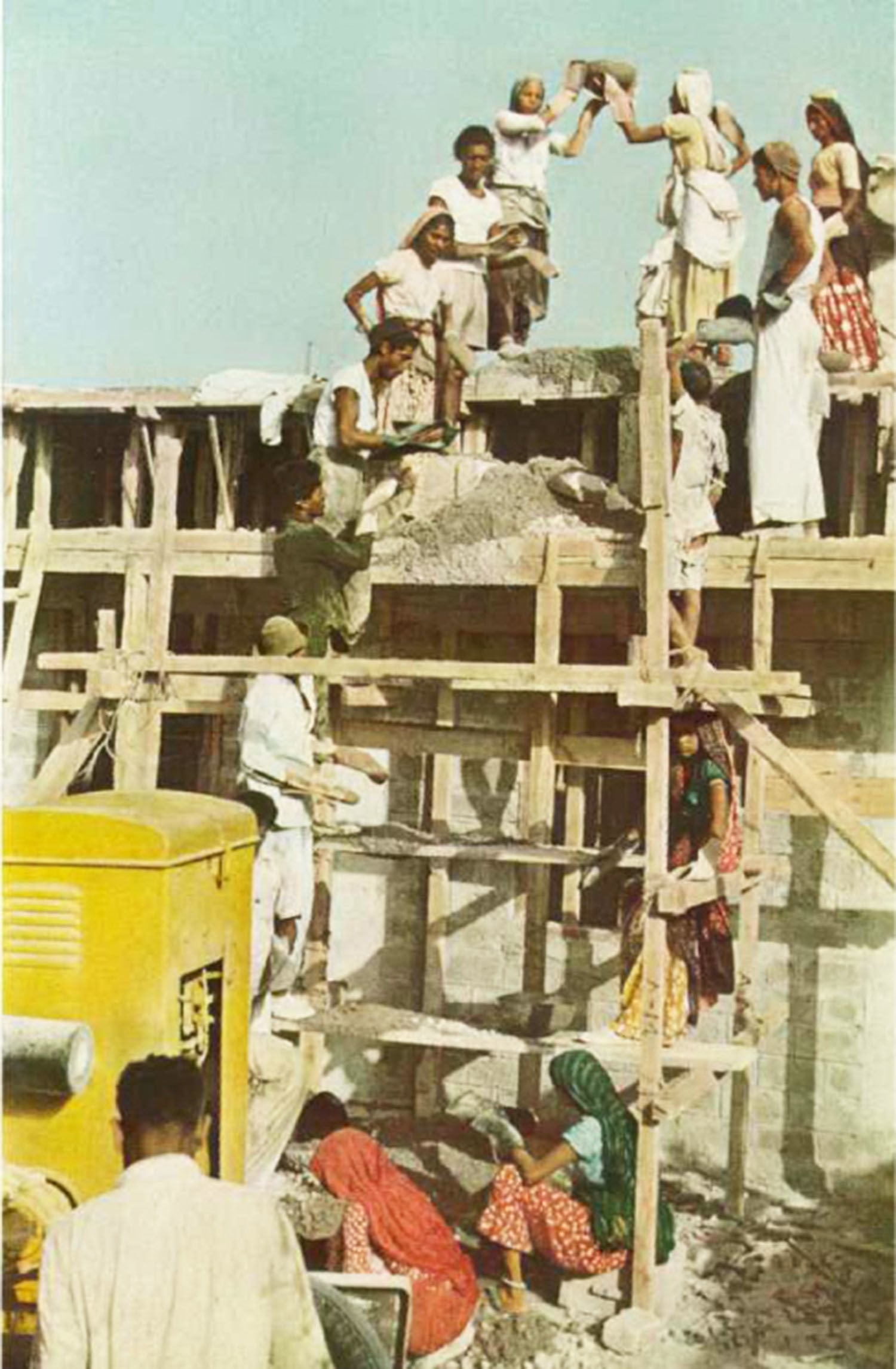
Men and women workers laying bricks during the construction of a building in 1952.
The brief economic boom that the city enjoyed (see previous picture and text), facilitated the government to erect some much needed buildings to house the growing number of government officials and refugees (Urdu-speaking Mohajirs).
In the early 1950s, a bulk of the city’s labour force was made up of the working-class sections of the refugees. By the late 1950s, much of the force comprised Pakhtun migrants arriving from the NWFP province (present-day Khyber Pakhtunkhwa).
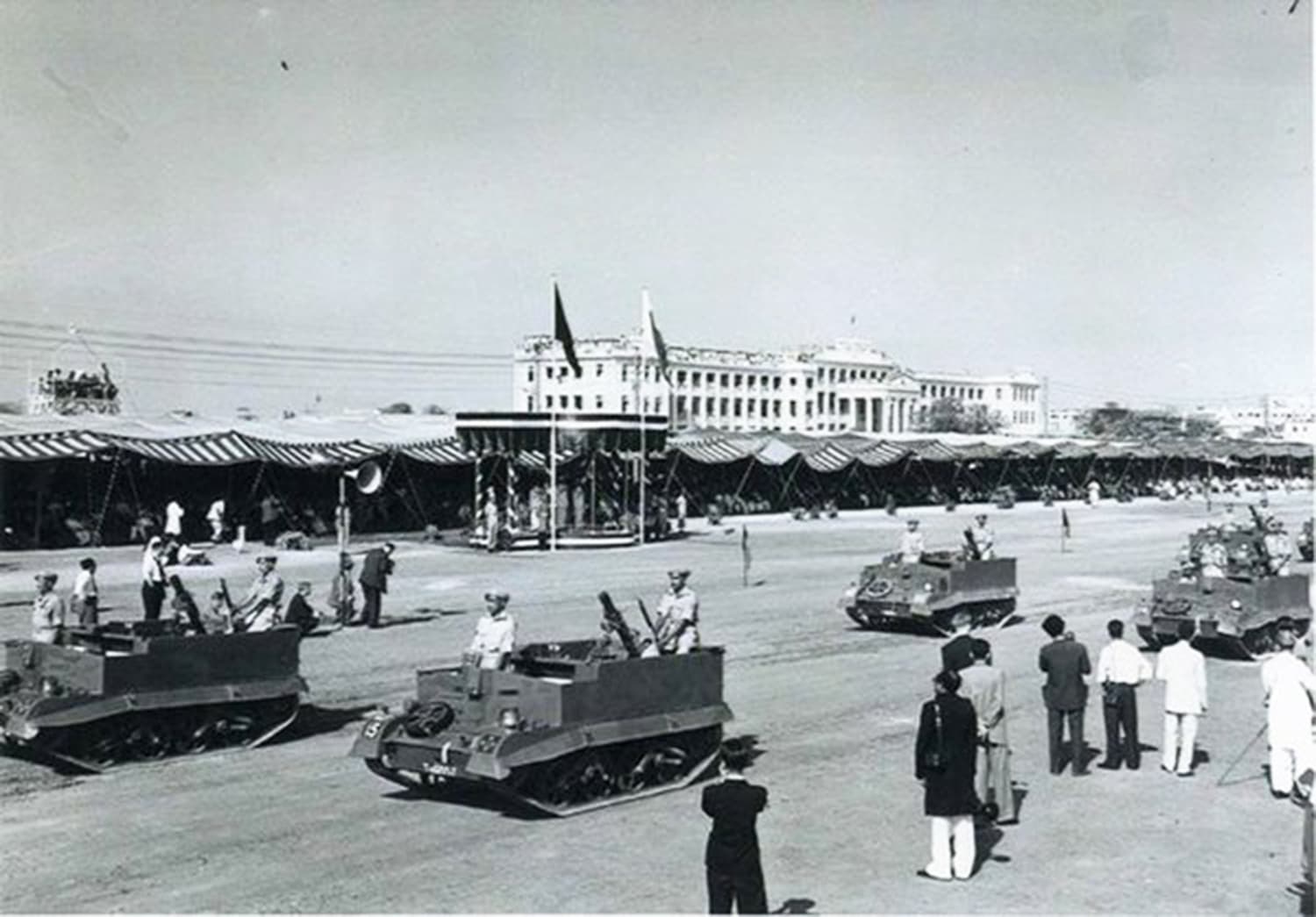
Pakistan’s first Republic Day parade. In 1956, Pakistan became a republic. The occasion was marked by a parade held on March 23, 1956 in Pakistan’s then-capital, Karachi.
Pakistan’s constituent assembly in Karachi passing the country’s first constitution in 1956.
The constitution declared the country a republic and promised Pakistan’s first election based on adult franchise. Assembly members were all indirectly elected, and consisted of legislators from the centre-right Muslim League, the centrist Republican Party and the left-leaning Awami League.
The assembly also consisted a few members from the left-wing Azad Pakistan Party. An alliance of centre-left outfits called the United Front had the second largest number of members in the assembly after Muslim League. The assembly did not have any member to form a religious party, even though the small Nizam-e-Islam Party (based in East Pakistan) was part of the United Front.
1957: Mohajir street actors re-enact scenes of violence during the partition of India and which forced many of them to migrate to Karachi.
Most such plays were staged on the streets of the refugee camps which were still existing till the late 1950s. Crime, exploitation and a sense of alienation were ripe in the camps. They were emphatically depicted by famous Urdu novelist Shaukat Siddique in his 1956 novel, Khuda Ki Basti (God’s Abode).
1958: American tourists enjoying a sunny day at one of the many beaches of Karachi. ‘Huts’ had begun to come up at these beaches to accommodate the increasing number of visitors to these beaches.
According to a 1957 newspaper article in America’s Washington Post, Karachi’s beaches were some of the ‘cleanest beaches in Asia’. Tiny working-class settlements (gohts) near these beaches began to expand.
The settlements were largely populated by Sindhi and Baloch fishermen and their families. They slowly began to venture into other areas of business as well, such as selling beer, soft-drinks and snacks to passing visitors, become caretakers of the huts, and invest in buying horses and camels to provide joy rides to bathers.
Military police personnel in Karachi checking licenses of car-owners in 1958.
Pakistan military chief, Field Marshal Ayub Khan, had come to power through a military coup. He ordered a crackdown against corruption and crime in Karachi which had grown ever since the city’s economy had begun to struggle from the mid-1950s onward.
Pakistan’s first leading female industrialist, Razia Ghulam Ali, giving instructions to an employee at her factory in Karachi. The Ayub regime had made Karachi the focus of its rapid industrialisation project.
Karachi’s Burns Road area in 1961. The area, first developed as a ‘posh’ locality by the British, had become a middle-class neighbourhood in the 1960s, largely populated by Mohajirs.
Restaurants and eateries offering spicy North Indian dishes had begun to come up here and by the 1970s, the area would become a famous ‘food street’ — but highly populated and congested. By the 1980s, though it remained famous for its eateries, it was mostly populated by lower-middle-class segments of Karachi.
China Daily
Asia News Network
Xinjiang July 30, 2016 10:13 am
These photos taken by Xinhua on July 22, 2016 show scenery of the Tomur Grand Canyon in Wensu county of Aksu prefecture, Northwest China’s Xinjiang Uygur autonomous region.
Tomur Grand Canyon, which has various landforms, has been listed as China’s National Geological Park.
The pillow case workshop, on the other hand, features the Nan royal handicraft “Hong Chao Khamfong” on which a statement is embroidered on a traditional pillow
In the old days, people cut pieces of paper to make a decorative flag for special religious events.
In true tradition
The Creative Tourism Office in the northern province of Nan invites visitors to experience local craftsmanship and the community spirit through two workshops – traditional flag making and pillowcase embroidery. The tradition of “tung ka king” shows off Lanna’s paper cutting. In the old days, people cut pieces of paper to make a decorative flag for special religious events. The pillow case workshop, on the other hand, features the Nan royal handicraft “Hong Chao Khamfong” on which a statement is embroidered on a traditional pillow. For the paper cutting, call the temple at (081) 882 3188. For the pillowcase embroidery, call (054) 710 537 or (087) 305 9660.
And the winners are …
Contemporary Thai restaurant, Jahn at Conrad Koh Samui has been named the Global Winner in three award categories; Overall Winner, Thai Cuisine and Ambience/Romantic Atmosphere, beating 166 restaurants from around the world at the 1st World Luxury Restaurant Awards 2016. Conrad Koh Samui‘s general manager, Stefano Ruzza, left, attended the red carpet gala dinner and award presentation ceremony, receiving the prestigious awards from Marna Laurens, centre, and Linda Cooper, right, executive managers of the World Luxury Spa and Restaurant Awards 2016 held in Pontresina, Switzerland.
Big bites for meat eaters
Inspired by New York’s famed Meatpacking District, Movenpick Siam Hotel Pattaya‘s new T55 New York Grill Room is set to become a signature restaurant for food lovers on the northern shores of the Gulf of Siam. With a chic, post-modern design, T55 New York Grill Room taps into the Big Apple’s hipster vibe. The menu delights even the most serious meat connoisseurs with an array of signature dishes including a succulent Tomahawk steak and the Meatpacking Burger which boasts 250 grams of beef topped with crispy bacon, avocado, beetroot and home-made truffle mayonnaise.
Flying high with Nok Air
Nok Air, one of Thailand’s low-cost carriers, recently took delivery of its seventh brand new Q400 NextGen from Bombardier. Made in Canada, this turboprop aircraft is designed to land and take off at destinations with short runways. The aircraft, which has 86 seats, is now in service on Nok Air’s domestic routes including Lampang and Loei. The airline fleet currently includes seven Q400 NextGens, 21 Boeing 737-800s, and two ATR 72-500s.
CHUSRI NGAMPRASERT
THE NATION
SINGAPORE July 27, 2016 1:00 am
Hilton Singapore King Deluxe Room
Whole Sea Bass Roasted on Olive Wood
Hilton Singapore Lobby
Opus Bar, Hilon Singapore
With excellent restaurants, four executive floors and two levels of boutiques, Hilton Singapore will delight both the business and leisure traveller
Located in Orchard Road, Singapore’s premier shopping district, Hilton Singapore is not only a hotel but a shopping destination in itself. The hotel boasts two floors of luxury boutiques, allowing hurried and harried executives to pick up gifts to take home without even leaving the building.
A three-minute walk from Orchard MRT station, just 20 minutes from Changi Airport and 10 minutes drive from the Central Business District, Hilton Singapore is a fine choice for both the business and leisure traveller.
As my private taxi comes to a complete stop, the concierge opens the door, takes my luggage and leads me into the lobby. Worried that I’m going to be late for a lunch meeting, I tell the receptionist I’ll probably have to check-in after lunch. She clicks her mouse and tells me that as an Executive Floor guest, I don’t have to worry about queuing up for check-in.
“My colleague will guide you to the restaurant so you’ll be on time for your appointment. She just needs your passport and your signature for check-in,” she explains.
//
As we make our time to the award-winning Italian restaurant il Cielo on the 24th floor of the hotel, the officer tells me that the Executive Floors are on levels 19 to 22 and that guests enjoy such benefits private check-in, complimentary in-room Wi-Fi, complimentary breakfast, snacks during the afternoon and an evening cocktail at the Executive Lounge on the 22nd floor.
I find my group at the restaurant, hand my passport to the officer and in less than five minutes, she’s back with passport and my keycard.
Having eaten a snack for breakfast on the plane, being served authentic Italian food made with natural, organic produce is like going to food heaven. The cosy atmosphere of the restaurant and a few glasses of wine relieve travel tension and there is plenty of laughter.
An early morning flight makes for a sleepy afternoon and when lunch is over I walk back to my room on the 19th floor to freshen up and laze around before my next meeting in the late afternoon.
Open since 1970, Hilton Singapore underwent a contemporary makeover in 2007. All guestrooms were refurbished with light-hued sycamore furnishings to add a more welcoming and relaxing ambience. My room is compact but cleverly decorated with modern furnishings to make it look light and cosy. For a single guest, the room is a perfect size with everything within easy reach but I suspect a couple might find it crowded.
The comfortable king bed takes almost all the space in the room while a single-seat sofa at the corner next to the floor-to-ceiling windows is a nice spot to sit back and enjoy the city view or one of the channels on the 40-inch HDTV. A working desk with the Herman Miller ergonomic chair is pleasant space to work on any project.
The Nespresso machine on the counter beckons but I decide to pass, not least because I’m still pleasantly full. My aching muscles are pleading for exercise so I call the front desk asking for information about the Fitness Centre. But after learning that the centre is open for 24 hours, my lazy alter ego mutters that there’ll be plenty of time to work out in the evening so I decide to freshen up before my afternoon nap. The marble bathroom is small but well designed with a walk-in rain shower equipped with Peter Thomas Roth bathroom amenities.
After my nap, I head to the Executive Lounge on the 22nd floor to enjoy a cup of tea before joining my friends for dinner at Opus Bar & Grill. The keycard elevator makes access easy for Executive Floor guests and I’m soon heading to Opus for a delicious dinner of grilled sustainable seafood and prime cuts; dry aged in-house for 14 to 36 days in customised Himalayan salt tile cabinets.
My vegetarian grill and side dish go very well with the wine and the waiters, who are very attentive, suggest a perfect wine for the food.
The dim lighting and cosy ambience in Opus morph overnight into a bright and airy atmosphere as partitions are removed and space made for the international buffet breakfast.
As I sip my last glass of wine, I hear my lazy self whisper “exercise can wait”.
AT A GLANCE
High point: Prime location with helpful and friendly staff.
Low point: None
Pay for it: Visit the hotel’s website for the best deals.