K2 via Concordia: Trekking through the valley of giants

ศาสตร์เกษตรดินปุ๋ย : ขอบคุณแหล่งข้อมูล : หนังสือพิมพ์ The Nation

http://www.nationmultimedia.com/travel/K2-via-Concordia-Trekking-through-the-valley-of-gi-30293398.html

In July 2016, I embarked on an incredibly memorable, yet challenging, 11-day trek to the base camp of K2 – the highest mountain in Pakistan – with three other Dutch hikers in tow.

Arranged by Snowland Treks and Tours, our trip started from Islamabad where we stayed for a day. The next morning, we took a short, but a very scenic, flight to Skardu. We acquired a great deal of interesting information about our destination from the plane’s captain, which naturally got us pumped for the journey ahead.

The PK451 flight that took us to Skardu. We passed through Nanga Parbat and Lake Saif-ul-Mulook among other landmark destinations.

The PK451 flight that took us to Skardu. We passed through Nanga Parbat and Lake Saif-ul-Mulook among other landmark destinations.


Following a brief stay in Skardu, we left for the town of Askole, which is only 115km away but the rocky roads, not to mention the landslides and floods that we encountered on our way stretched our journey an additional five hours.

The picturesque drive through hanging wooden bridges, however, made it worth it.
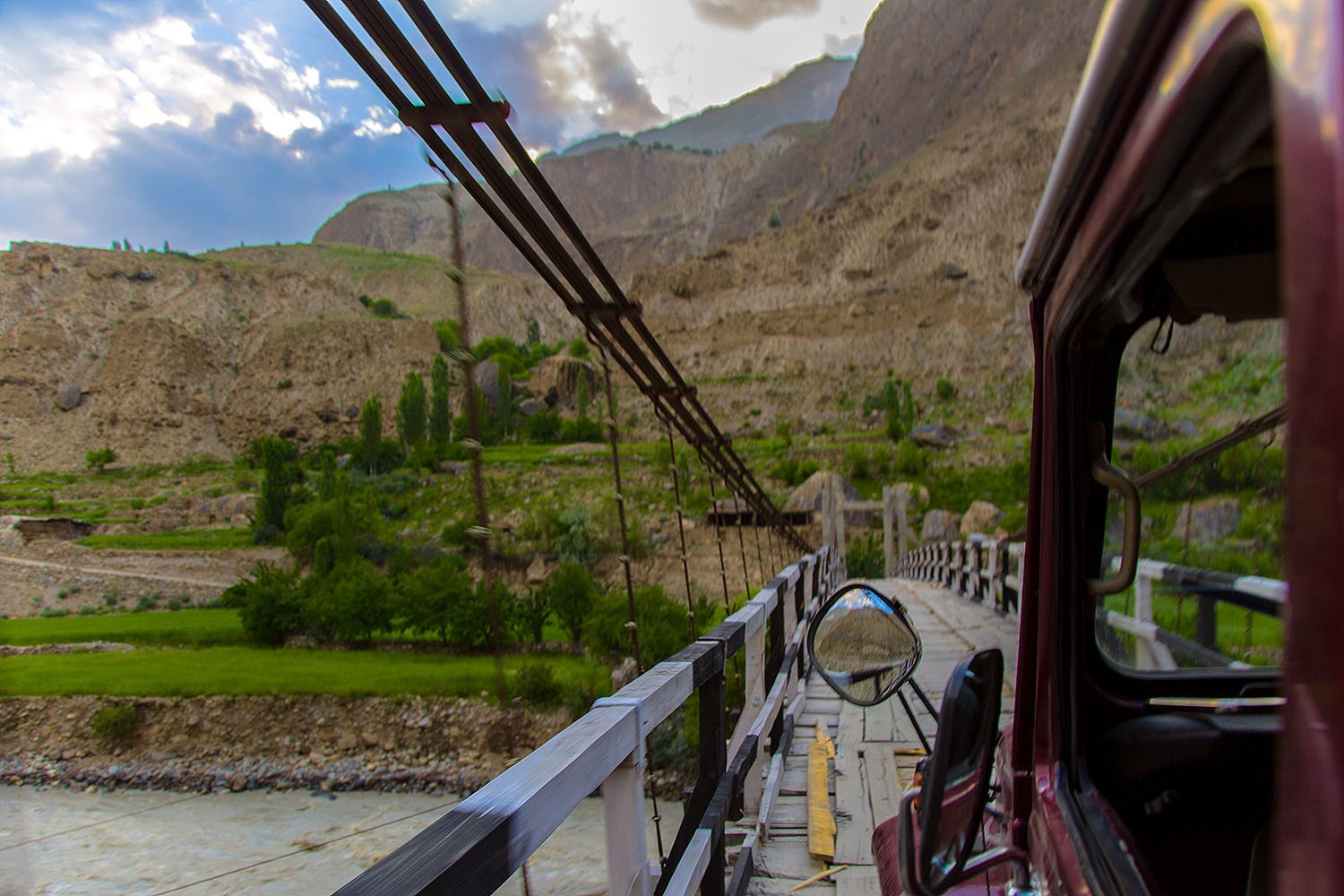
One of the several hanging wooden bridges we encountered on our way to Askole.

One of the several hanging wooden bridges we encountered on our way to Askole.


Arriving in Askole, we stopped for some garam parathas, and washed them down with wonderful milky tea before starting our first trek to the Jhula campsite.

We walked through a small lane in the town of Askole that widened as we exited the village. Then, we entered Shigar Valley, where I saw jagged mountain peaks and views that quite literally took my breath away.

The track was nice and wide as we left Askole.

The track was nice and wide as we left Askole.


Much of the track is well-established and follows the Braldu River.

Much of the track is well-established and follows the Braldu River.


Night descending upon our Jhula campsite.

Night descending upon our Jhula campsite.


Situated at a distance of 18kms from Askole, we reached Jhula just before sunset. We parked our camp next to the river, which afforded us an ethereal view of the Barkhudas mountain peak.

The next morning, we trekked from Jhula to Payu campsite, which is 22kms away, at 200 metres of elevation gain; the route that we took was close to the river bank with many uninhabited houses.

From a distance, the Payu campsite is the green patch on the mountain.

From a distance, the Payu campsite is the green patch on the mountain.


Porters make special bread for us at the Payu camp; they serve pretty good green tea there as well!

Porters make special bread for us at the Payu camp; they serve pretty good green tea there as well!


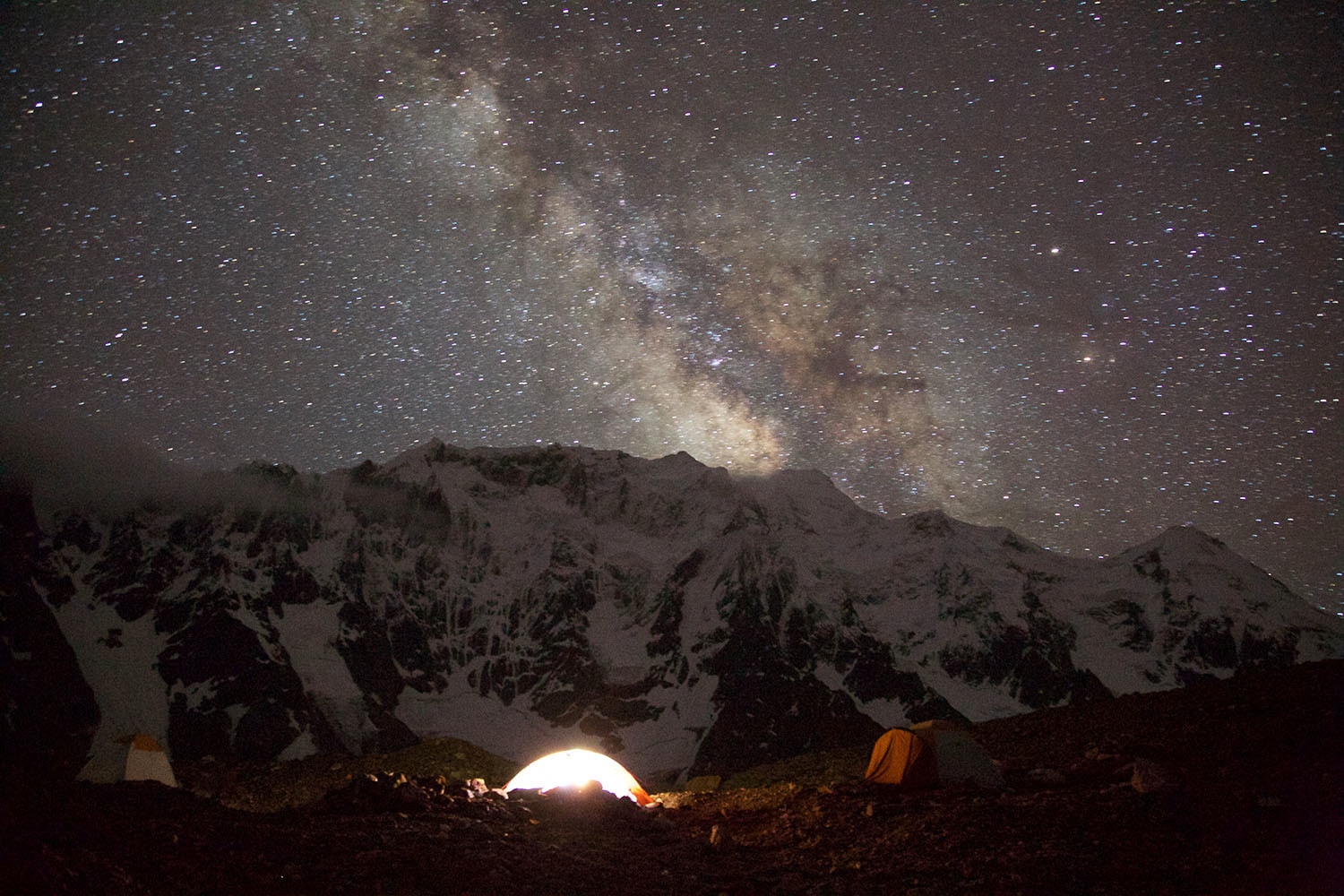
I woke up in the middle of the night and was awestruck when I looked at the sky. I immediately grabbed my camera to take this shot of the Milky Way from our Payu camp.

I woke up in the middle of the night and was awestruck when I looked at the sky. I immediately grabbed my camera to take this shot of the Milky Way from our Payu camp.


From Payu, we made our way to the Baltoro glacier, the focal point of our trek. The journey to our next campsite Khoburshe was 15km away, with 500 metres elevation gain.

The long distance and the formidable gain of elevation, coupled with our first, tentative steps on a glacier, was taxing but also proved rewarding as we got a glimpse of the spectacular Trango and Lobsang mountain spires as well as the starting point of the serene Baltoro River from here.

Trango Towers (L) and Lobsang Spire (R). Also visible is the famous Nameless Tower to the left of Trango.

Trango Towers (L) and Lobsang Spire (R). Also visible is the famous Nameless Tower to the left of Trango.


Our first view of Khoburshe Camp. We had to take a detour due to the formation of a lake near the camp.

Our first view of Khoburshe Camp. We had to take a detour due to the formation of a lake near the camp.


I woke up to a view of the Giant Trango from my tent.

I woke up to a view of the Giant Trango from my tent.


Near the Khoburshe campsite, a lake has sprung up due to a glacier melt, which required us to take a detour, adding about another two kilometres to the trek; we retired at the camp for the night.

The next morning, we trekked from Khoburshe to Urdukas, which is situated at a relatively short distance of 6km, with 200m of elevation gain.

The journey was, by far, the most wonderful part of the trek as we crossed two glaciers and glacial streams to reach Urdukas, surrounded by tall imposing mountains. It is a wonderful campsite that sits atop huge rocks.

Our first view of Urdukas.

Our first view of Urdukas.


Porters singing and clapping as we celebrated Eid. A Pakistan Army officer stationed at Urdukas joined in the celebrations.

Porters singing and clapping as we celebrated Eid. A Pakistan Army officer stationed at Urdukas joined in the celebrations.


As we set up our tents and settled into them, we heard the sound of music. Venturing outside, we saw porters from different teams who had gathered around a big boulder and were dancing and celebrating as it was Eid!

Close to Urdukas, there is a Pakistan Army checkpost and some military men also joined in the heartfelt celebrations.


Our next stop was the Goro II. It was another long trek of 15kms, with 270 metres of elevation gain. We were ecstatic when we saw our first views of the incredible Masherbrum (7821m) and Gasherbrum-4 (7925m) mountains.

The next day, we were back on the glacier, making our way through the crevasses and small lakes.

The next day, we were back on the glacier, making our way through the crevasses and small lakes.


The first rays of the sun on the beautiful Masherbrum mountain.

The first rays of the sun on the beautiful Masherbrum mountain.


Our first view of Gasherbrum-4 as we climb up the valley.
Our first view of Gasherbrum-4 as we climb up the valley.


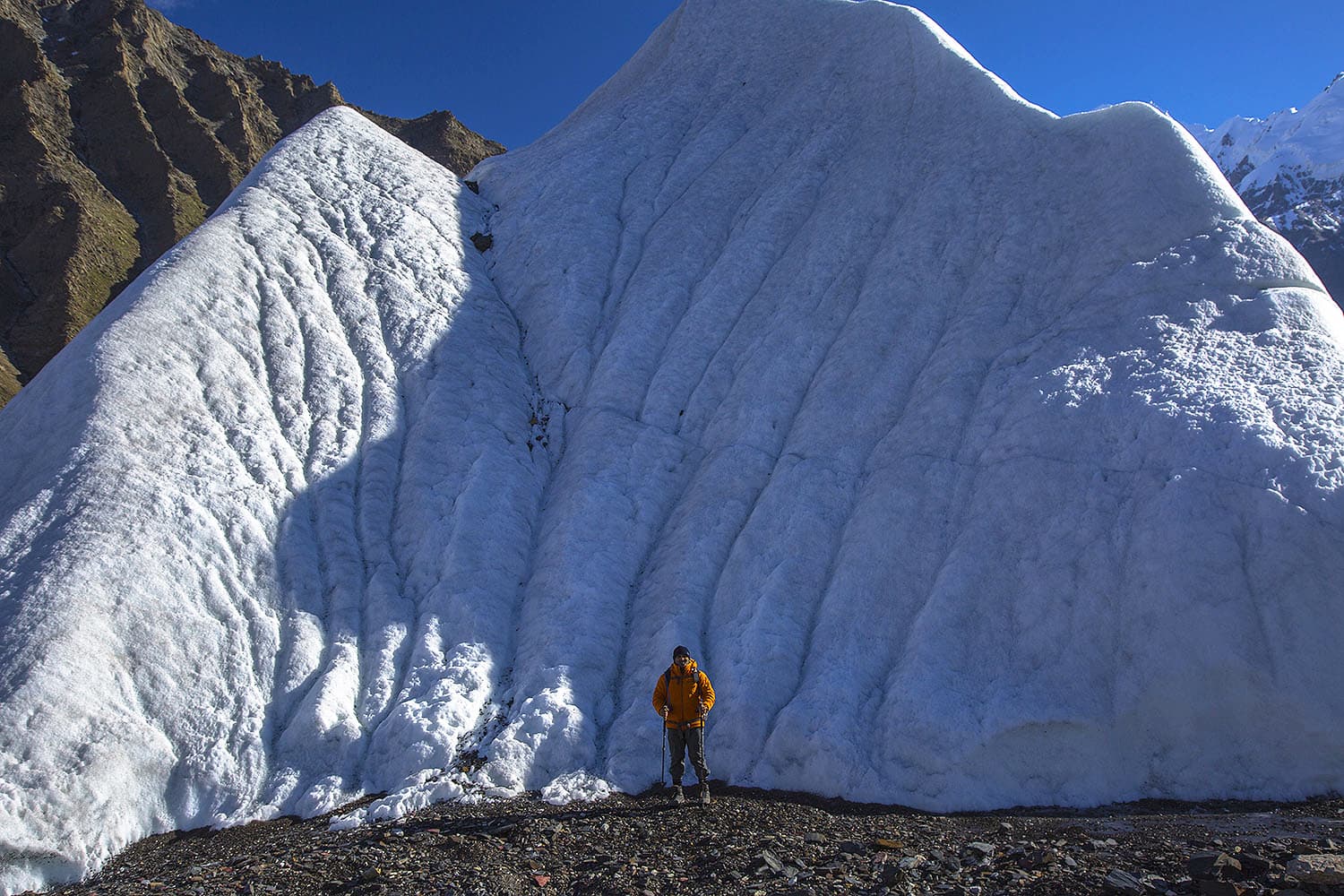
The route from Goro II and Concordia has several snow capsules.
The route from Goro II and Concordia has several snow capsules.


Goro II is notorious for being the coldest site. I took this photograph of the Milky Way extending from Biarchedi mountain with my tent lit up.

Goro II is notorious for being the coldest site. I took this photograph of the Milky Way extending from Biarchedi mountain with my tent lit up.


Traversing along the route, we saw large protruding chunks of snow, known as snow capsules. These capsules vary in size and are sparsely found along the trek.

Our campsite at Goro II was the coldest on the trek. When I woke up in the middle of the night, my tent was covered in frost.

The morning that greeted me was equally cold, if not more. But the day was special. Crossing Gora II, we finally saw the magnificent K2 mountain, and other stunning peaks such as Muztagh Tower (7273 metres) and Mitre Peak (6010m).

Our next camp on Concordia glacier was next to Mitre Peak. With that as our reference, we walked about 12kms to reach Concordia.

The crevasses just before Concordia. The white mountain in the back is Snow Dome which is about 5,029m high.

The crevasses just before Concordia. The white mountain in the back is Snow Dome which is about 5,029m high.


Our campsite in Concordia.

Our campsite in Concordia.


My first view of K2.

My first view of K2.


Near Concordia, we had to negotiate many complicated crevasses. We also heard loud songs of the glacier cracking up.

A whale of a time

ศาสตร์เกษตรดินปุ๋ย : ขอบคุณแหล่งข้อมูล : หนังสือพิมพ์ The Nation

http://www.nationmultimedia.com/travel/A-whale-of-a-time-30293125.html

NEW ZEALAND

A sperm whale shows of its signature fluke before diving into Kaikuora Canyon in South Island of New Zealand. The Nation/Chusri Ngamprasert


Hapuku Tree Houses and Lodge are perched 10 metres above the ground in the canopy of a native Manuka grove, making a bold statement for this stylish and eco-friendly retreat. The Nation/Phoowadon Duangmee

Nins Bin serves freshly cooked lobsters, which owner Ricky catches the old way – by spearfishing. The Nation/Phoowadon Duangmee


Marlborough vineyard in the South Island is famous for its best-selling Sauvignon Blanc. The Nation/Phoowadon Duangmee


The scenic Pacific coastline is a common sight in New Zealand’s South Island. The Nation/Phoowadon Duangmee


Kaikoura on the plate – Kaikoura in the Maori tongue, means “meal of crayfish”. The Nation/Phoowadon Duangmee


A scenic road along the western coastal line of South Island. The Nation/Phoowadon Duangmee

No trip to New Zealand is complete without a whale-watching experience

“Whale watching is a life-changing experience,” says the friendly man from Hertz Rental Car at Nelson Airport as he helps me set up “Becky”, our speaking GPS device. “The whales are spectacular when they are breaching, hopping, sailing and tailing,” he tells us and his enthusiasm is catching. We can’t wait to spot our first whale. Two days later, when we arrive in Kaikuora on the east coast of South Island, we discover that the life-changing experience starts with a plea for mercy. We miss the boat by just seconds and it seems that we are going to miss the whales too.

“Please, everyone we’ve met in the last two days insists that whale watching is a must. It’s a life changing experience,” I implore the staff of Whale Watch. “Back home in Thailand, we don’t have whales and the biggest animal we’ve ever seen is an elephant. We cannot leave New Zealand without seeing a whale fluking.”

The lady behind the counter regards us sympathetically and turns back to her computer before running her fingers through the reservations. She takes a while to check the bookings and makes a telephone call. We have only a half a day in Kaikuora, and it’s looking more and more like our whale-watching trip is a write-off. Then Lady Luck gives a broad smile.

“Two people haven’t confirmed their bookings,” she tells us. “I will put you two in the first boat tomorrow morning. Don’t miss the boat twice.”

//

We didn’t mean to be late but the scenery here in New Zealand, not to mention the fine food and wine, made us linger a little too long on the road. We have only one week in South Island and we are determined to do as much as possible, from paddling in the clear turquoise crystal waters to strolling around Mt Cook Valley. Whale watching, of course, is also part of our road trip around South Island.

Nestled on the island’s rugged east coast, Kaikoura is the unofficial whale watching capital of New Zealand. In the waters off this peninsula, a complex marine system provides an abundantly rich habitat for marine mammals and seabirds, making it an ideal place for getting close to nature. Legend has it that the Ngati Kuri people, as the Maori tribe who founded Kaikoura are known, rode with the mythical Paikea on the back of a white whale from Hawaii to New Zealand. Whale Watch is also run by the Maori and has been taking tourists out to sea for almost 30 years. Kaikoura, we are told, is the best place to watch whales fluking, as the action of lifting its tail is called.

Right now though, we still have a few hours in Kaikoura before the sky goes completely dark. We quickly check into Hapuku Tree Houses and Lodge – a stylish eco-friendly resort. Perched 10 metres above the ground in the canopy of a native Manuka grove, our Tree House is designed as a contemporary complement to the environment. The exterior is clad in native woods and copper shingles and large windows bring the tree canopy right into the bedroom.

We leave our lodge with a list of places we want to explore and again are grateful for deciding on a self-drive trip. Rather than being rushed on and off a tour bus, we’ve been able to discover New Zealand at our own pace. From Nelson on the northern tip of South Island, for example, we’ve come to Kaikoura via Havelock and Marlborough. The small seaport of Havelock is known as the mussel capital of the world, while Marlborough is famous for its Sauvignon Blanc.

Kaikoura itself, in the Maori tongue, means “meal of crayfish” and that prompts us to ask “Becky” to guide us to Nins Bin, a roadside eatery specialising in freshly cooked lobster. Owner Ricky, who’s been in business since 1977, catches his lobster the old way – by spearfishing. We order a decent-sized crayfish and savour the taste of Kaikoura.

The next morning, we’re the first to arrive at Whaleway Station and check in for Whale Watch Kaikoura tour. As the lady said, you cannot miss the boat twice.

Back in 1987, at a time when the Maori were finding it impossible to earn a decent living, Ngati Kuri leader like Bill Solomon looked at the Pacific and hoped the whale could bring prosperity to his people. The tales of breaching, hopping, sailing and fluking whales quickly spread and today business is thriving.

Our boat is packed with tourists from all corners of the world. We’re informed that beneath the Kaikoura sea is a canyon – a giant habitat for a giant creature.

“Roughly put together in a U-shape, Kaikoura Canyon is about 60 kilometres long and up to 1,200 metres deep,” says our guide.

The sea is very rough. From time to time the Maori “whale spotter” dips a stethoscope of sorts into the sea to listen to the whales, helping the crews locate the giant creatures. An hour passes and sensitive stomachs are reacting badly to the churning waves but there’s no sign of a whale never mind any fluking.

“Whale spotting is a matter of luck too,” says the guide. “On a trip we might spot five or six whales, while on another we see little more than a wandering albatross.”

“Just wait and be patient” I whisper to myself, determined to keep sea sickness at bay. It doesn’t look good though and it seems that the Asian elephant will remain the largest mammal I’ve ever seen.

Then, just as the captain is just about to sheer away, the miracle happens.

“Eleven o’clock!” somebody yells.

Like something out of “Moby Dick”, a massive sperm whale emerges from the water. The 15-ton behemoth sends up a v-shaped spout of water from its blowhole, flips, and flukes as it dives into the depths of Kaikoura Canyon.

A life-changing experience indeed.

IF YOU GO

+Thai Airways International flies between Bangkok and Auckland. A Thai driving license, with the name is English, can be used to hire a car.

+Driving in New Zealand is easy. Just stick to the speed limit, and follow the rules of the road.


Birds of a feather

ศาสตร์เกษตรดินปุ๋ย : ขอบคุณแหล่งข้อมูล : หนังสือพิมพ์ The Nation

http://www.nationmultimedia.com/travel/Birds-of-a-feather-30293127.html

AROUND THAILAND

“Tropical Bird” boasts cool t-shirts, stylish bag tags and carry-on bags and will be on sale on all Nok Air flights throughout September.

Thai low-cost carrier Nok Air has released a new collection of accessories to raise funds for the Hornbill Research Foundation.

Birds of a feather

Thai low-cost carrier Nok Air has released a new collection of accessories to raise funds for the Hornbill Research Foundation. “Tropical Bird” boasts cool t-shirts, stylish bag tags and carry-on bags and will be on sale on all Nok Air flights throughout September. Khao Yai National Park, Huai Kha Khaeng Wildlife Sanctuary and Budo-Su-ngai Padi National Park are home to 13 species of hornbill. Visit http://www.NokSmileShop.com.

Tales of two countries

Amari Phuket invites guests to experience a new buffet-themed night at Rim Talay restaurant. The buffet, which is priced at Bt790, offers an amazing combination of Thai favourites and popular curry dishes from the northern part of India. The Indian goodies include tandoori chicken, lamb rogan josh, chicken tikka masala, fish curry, lentils, papadums, naan bread and biryani rice, while the Thai specials cover masaman, green and penang curries and other Thai noodle and rice dishes. Complete a wonderful dinner at the dessert corner with Indian and Thai sweets plus seasonal fruits. Book a table at (076) 340 106 extension 8027, or email rimtalay@amari.com.

Kilos of kindness

To mark the United Nations International Day of Charity on September 5, Movenpick Hotels & Resorts introduces the latest initiative in its “Kilo of Kindness” drive. Guests and residents are invited to visit the 16 participating hotels to donate at least a kilo of learning supplies – such as notebooks, pens and pencils – for distribution to local schools. Supplies can be dropped off from Sunday through September 1. The participating properties are located in Jordan, Lebanon, Pakistan, Saudi Arabia, the United Arab Emirates, Thailand and the Philippines. Each person who makes a donation will get an ice cream as a small gesture of appreciation.

Italian by design

Marco Pacetta and Joss Linde of modern Italian restaurant Sensi Bangkok are staging a five-course dinner tomorrow night paired with Bellavista and Petra wines. The menu features assorted canapes and Alma Bellavista sparkling wine, insalata di mare served with Acquagiusta Bianco Maremma, beef carpaccio with sea urchin paired with Grand Cuvee Brut Rose and ravioli with ricotta nettles and a Petra Merlot Quercegobbe. The price is Bt2,900 per person. For reservations, call (02) 117 1618 or visit http://www.SensiBangkok.com.

Luxury at a stretch

ศาสตร์เกษตรดินปุ๋ย : ขอบคุณแหล่งข้อมูล : หนังสือพิมพ์ The Nation

http://www.nationmultimedia.com/travel/Luxury-at-a-stretch-30293128.html

GETAWAYS

Amatara Phuket offers yoga retreats from three to seven days in one of Thailand

Amatara Phuket offers yoga retreats from three to seven days in one of Thailand’s best beach holiday destinations.

Revive your inner self with a yoga programme or dine with the world’s leading chefs at an island resort

Explore your inner strength through yoga at the luxury Amatara Resort & Wellness in Phuket. The Amatara Yoga programmes run for three, five and seven nights, with each session offering a chance to deepen yoga practice, and customised to help you achieve happiness and ideal yoga outcomes during the stay. The package costs Bt45,000 for three nights, Bt74,000 for five nights and Bt103,000 for seven nights and covers daily physical Asana practice, meditation, philosophy, consulting, accommodation, round-trip airport transfer, full board with three healthy a la carte meals per day or set detox programme, blood pressure check-up, use of fitness facilities, steam and infrared sauna, access to daily fitness classes and daily Signature Royal Amatara massage. Call (+66 (0) 76) 200 800, (+66 (0) 76) 318 888, visit www.AmataraPhuket.com or emailphuket@amataraphuket.com”>sales.phuket@amataraphuket.com.

Onyx Hospitality Group will be offering special accommodation deals at more than 20 properties across five countries at the 40th Thai Tiew Thai Fair running from September 1 to 4 at the Queen Sirikit National Convention Centre. Get the most of each destination in Thailand with Amari, at prices starting from Bt2,200 a night in Pattaya and Bangkok, Bt2,800 in Hua Hin, Bt3,500 in Krabi and Koh Samui or enjoy a relaxing escape at a private island paradise with a two-night all-inclusive package at Amari Havodda Maldives, starting at Bt69,900. Get the best deals with Ozo Samui in Thailand starting at Bt2,700, while the prices for Ozo in Hong Kong and Sri Lanka start from Bt4,250 a night. A stay at Loei Palace and Angkhang Nature Resort starts at Bt900 and Bt1,700 respectively. Prices are valid for stays between September 1 and March 31.

Culinary aficionados are invited to an extraordinary two-night getaway that blends the beauty of nature with the luxury of world-class cuisine on October 28 and 29 at Soneva Kiri Koh Kood. Sit down to an intimate six-course dinner prepared by six Michelin starred European chefs with 10 stars between them, and explore the elaborate art of gastronomy paired with breath-taking views of the Gulf of Siam. Starting from Bt105,000, the rate is inclusive of a two-night stay at the luxurious resort, the six-course dinner, daily half board, spa treatments for two at the resort’s Six Senses Spa, and return private plane transfers from Bangkok to Koh Kood. The offer is available for bookings via travel agent or by calling ( +91) 124 4511000 or email: reservations@soneva.com. Quote booking code: SKMSCP16.

Designed to bring people and nature together, Botanica Khao Yai is a fine place to relax during the green season. The resort is now offering an early bird deal starting from Bt3,900 per night. The offer includes accommodation for two with daily American breakfast. An extra bed is available upon request at Bt1,800 per person per night and inclusive of breakfast. Book in August for a stay during September and October. Call (+66 (0) 2) 661 2999 extensions 400-404 or email:reservation@botanicakhaoyai.com.

Reward yourself with a healthy holiday at Royal Wing Suites & Spa in Pattaya. The resort is offering a Health and Relax package starting from Bt10,365 per night covering accommodation, breakfast buffet, free Wi-Fi, tropical fruit basket in room, a 60-minute massage treatment, an hour’s use of tennis or squash courts, a one-hour private work-out class and personal training session and 10-per-cent discount at Cliff Spa. The deal is good until October 31 and a stay of two nights minimum is required. Call (+66 (0) 38) 250 421 or email: relax@royalcliff.com.

Ancient Egypt and Han civilizations collide at Nanjing exhibit

ศาสตร์เกษตรดินปุ๋ย : ขอบคุณแหล่งข้อมูล : หนังสือพิมพ์ The Nation

http://www.nationmultimedia.com/travel/Ancient-Egypt-and-Han-civilizations-collide-at-Nan-30292865.html

The grand exhibition “Pharaohs and Kings: Treasures of Ancient Egypt and China’s Han Dynasty” was unveiled to the public on Wednesday, which presents the different features of ancient Egypt civilization and Han Dynasty (202 BC-AD 220) civilization through a comparison of the two ancient cultures.

Nearly 150 antiques from the Royal Ontario Museum in Canada and 150 pieces of unearthed Han Dynasty relics from domestic museums nationwide are put on display together. The exhibition is the first charged special exhibition since the implementation of free museum entry policy in China, and the ticket is set at 30 yuan ($4.5) for per person.

The highlight of the exhibition is the Cleopatra statue and a series of cultural products are also designed to cooperate with the exhibition. It will last until January 9.

A visitor takes a photo of a color-painted gold-gilded mummy mask at the Nanjing Museum in Nanjing, Jiangsu province, August 10, 2016. [Photo by Su Yang/Asianewsphoto]


Visitors view jade clothes sewn with gold wire at the Nanjing Museum in Nanjing, Jiangsu province, August 10, 2016. [Photo by Su Yang/Asianewsphoto]

People view a mummy mask from ancient Egypt at the Nanjing Museum in Nanjing, Jiangsu province, August 10, 2016.[Photo/Xinhua]


A visitor takes a photo of a copper cattle lamp from Western Han Dynasty at the Nanjing Museum in Nanjing, Jiangsu province, August 10, 2016. [Photo by Su Yang/Asianewsphoto]


Visitors view a humanoid sarcophagus avatar at the Nanjing Museum in Nanjing, Jiangsu province, August 10, 2016. [Photo by Liu Jianhua/Asianewsphoto]


The mummy-shaped cover plate (L) and jade coffin from Han Dynasty (R) are exhibited together at the Nanjing Museum in Nanjing, Jiangsu province, August 10, 2016. [Photo by Su Yang/Asianewsphoto]

Visitors enjoy the Cleopatra statue, highlight of the exhibition at the Nanjing Museum in Nanjing, Jiangsu province, August 10, 2016. [Photo by Liu Jianhua/Asianewsphoto]


People view bronze statues from ancient Egypt at the Nanjing Museum in Nanjing, Jiangsu province, August 10, 2016. [Photo/Xinhua]


A crocodile mummy from ancient Egypt is seen at the Nanjing Museum in Nanjing, Jiangsu province, August 10, 2016. [Photo/Xinhua]

Visitors view a bianqing (chime-stone), an ancient musical instrument at the Nanjing Museum in Nanjing, Jiangsu province, August 10, 2016. [Photo/IC]

Rhythms of Rio

ศาสตร์เกษตรดินปุ๋ย : ขอบคุณแหล่งข้อมูล : หนังสือพิมพ์ The Nation

http://www.nationmultimedia.com/travel/Rhythms-of-Rio-30292534.html

POSTCARDS

Folks in Rio commute via the historic Santa Teresa Tram, which connects the hillside neighbourhood of Santa Teresa with the city. The Nation/Phoowadon Duangmee


The Girl from Ipanema – Rio’s beaches have long seduced visitors. Ipanema Beach, with its long stretch of sun-drenched sand, is the preferred hangout for ageing leftists, hippies and artists. It’s also the best place to order a Caipirinha – Brazilian’s un


Copacabana, which extends some four kilometres, is Rio’s most iconic and hedonistic beach. By day, tourists line up for Caipirinhas at kiosks while beach hawkers weave among tanned bodies selling swimwear. As day gives way to night, the Cariocas throw wil


No trip to Rio is complete without taking the cog train to the top of Corcovado in central Rio de Janeiro. Standing 40 metres high atop the summit is the statue of Cristo Redentor (Christ the Redeemer) – one of the New Seven Wonders of the World. The Nati


Puppets hang over windows in the historic neighbourhood of Santa Teresa. The area, which is home to artists, hippies and writers, is worth the tram trip to enjoy a leisurely walk and great dining. The Nation/Phoowadon Duangmee


Brazilians gather for beach volleyball at Rio’s Copacabana Beach. The Nation/Phoowadon Duangmee

As Brazil goes nuts for the Olympics, we take a walk around the streets and check out the sights

Rio de Janeiro is famous for many things, among them the bossa nova jazz number “The Girl from Ipanema”, the statue of Cristo Redentor, Copacabana Beach and, of course, the Rio Carnival.

Now Brazil’s second largest city is adding the Rio 2016 Olympics to its portfolio of attractions.

The games, which kicked off in style last Friday with a ceremony at the city’s Maracana Stadium, and continue through August 21, followed by the Paralympics from September 7 to 18, have drawn hundreds of thousands of visitors to Rio.

With 37 beaches surrounded by mountains and streets that seethe with sensuality, Rio has more than its fair share of beauty to share. And even without the Olympics, it vibrates with sports.

//

The Cariocas – as Rio’s residents are called – bring sport from the stadiums to the beaches, mixing action with leisure and even business.

Along the four-kilometre strip of sand that makes up Copacabana Beach, Brazilian boys from favelas show off their skills at beach football. Young men and women, with surfboards attached to their bicycles, cruise along the promenade in search of good waves to ride.

Back in the 1800s, way before the arrival of the athletes last week, the Portuguese led by their Prince Regent sailed to Rio de Janeiro to escape Napoleon’s march on Lisbon. The Portuguese gave the city (and the country) its religion and language, while the locals shaped the city with music, dance and cuisine.

As soon as the prince, who later become known as Dom Joao VI, set foot in Rio, the Cariocas threw a wild party with dancing in the streets.

Rio experienced its Golden Age between the 1920s and the 1950s. The construction of luxurious hotels turned the city into a haven for Hollywood celebrities and hi-so A-listers who came here for the beach and samba.

Copacabana is still Rio’s most famous beach – a place where tourists chill out on the hot white sand and sip Caipirinha, Brazilian’s unofficial national cocktail.

Ipanema Beach is more fashionable and infinitely hipper than Copacabana and was immortalised in the worldwide hit “The Girl from Ipanema”. Inspired by Helo Pinheiro, a true beauty who lived in the fasionable seaside neighbourhood during the ’60s, the song was an international hit for Astrud Gilberto and Stan Getz back in 1964. It was featured in last Friday’s opening ceremony, with supermodel Gisele Bundchen portraying the girl from Ipanema.

Rio de Janeiro today is really two cities – one for the rich, the other for the poor. The rich and the middle classes live along the Atlantic coastline in Ipanema, Copacabana and Leme. The poor and powerless inhabit the shantytowns – favelas – covering the steep hillsides around the city.

Santa Teresa, which is perched on a hill overlooking the city, is Rio’s answer to Montmartre in Paris and connects with the city centre via an old tramline. It is a far cry from the glitz and glamour of Copacabana and Ipanema, yet captures the heart and imagination of many visitors, myself included.

A Bohemian hideout that’s home to musicians, novelist-wannabes, daydreamers and ne’er-do-well junkies, this neighbourhood also has a thriving broken hearts club.

“When lovers are dumped by their significant others, they come here,” the guide tells me.

Oh to be a romantic loser!


On your marks

ศาสตร์เกษตรดินปุ๋ย : ขอบคุณแหล่งข้อมูล : หนังสือพิมพ์ The Nation

http://www.nationmultimedia.com/travel/On-your-marks-30292562.html

AROUND THAILAND

Queen’s Cup Hua Hin Triathlon will be held this weekend at Black Mountain Water Park in Prachuap Khiri Khan province.

Queen’s Cup Hua Hin Triathlon will be held this weekend at Black Mountain Water Park in Prachuap Khiri Khan province.

The competition is divided into different endurance tests: a sprint triathlon made up of a 750-metre swim, 20km of cycling and 5km of running; a duathlon featuring a 2.5km run and 20km of cycling …

On your marks

As part of the celebrations marking Her Majesty Queen Sirikit’s 84th Birthday, the annual Queen’s Cup Hua Hin Triathlon will be held this weekend at Black Mountain Water Park in Prachuap Khiri Khan province. The competition is divided into different endurance tests: a sprint triathlon made up of a 750-metre swim, 20km of cycling and 5km of running; a duathlon featuring a 2.5km run and 20km of cycling; a 5km road race and an Olympic-distance triathlon which involves 1.5km of swimming, 40km of cycling and 10km running. Call Tourism Authority of Thailand Prachuap Khiri Khan Office at (032) 513 885 or email: tatprachuap@tat.or.th. Visit http://www.huahintriathlon.com.

Wonders of the wheels

Mark the last weekend in August on your calendar and take time out from the city to join the Bhumibol Dam International Mountain Bike Championships in Tak province on August 27 and 28. Organised by the Electricity Generating Authority of Thailand, the Tourism Authority of Thailand and the Sports Authority of Thailand, the competition has something for everyone, from a 12-kilometre bike ride to a 60-kilometre international race. Expect live music, cultural performances, a classic bicycle show and loads of fun. Find out more from the local tourism organisation at (055) 549 509.

Perfect percussion

Ang Thong province comes alive with the sound of beating drums from August 18 to 21 as Ang Thong International Drum festival comes to town. The event features a colourful parade, fanfares and a stage performance at the drum-making village of Ekaratch in Pa Mok district. Ang Thong is a two-hour drive north of Bangkok. Call The Traditional Drum-Making Village (Ban Bang Phae) at (035) 662 201, the Tourism Authority of Thailand Suphan Buri Office at (035) 535 789 or TAT’s Call Centre at 1672.

In the spirit of giving

The Dragon Descendent Museum and the City Pillar Shrine in Suphan Buri will be packed with locals and visitors for the upcoming Tingkrajad Festival, a century-old ceremony held to give offerings both to the deceased and to the less unfortunate. From August 20 to 24, the Chinese Association in Suphan Buri will give offerings to the poor. Visitors will be entertained by lantern processions, parades, Chinese opera, films and food, Call the Tourism Authority of Thailand Suphan Buri Office at (035) 535 380 or e-mail: tatsuphan@tat.or.th. Visit http://www.Suphan.biz/tingkrajad.htm.

Turbo at the turns

ศาสตร์เกษตรดินปุ๋ย : ขอบคุณแหล่งข้อมูล : หนังสือพิมพ์ The Nation

http://www.nationmultimedia.com/travel/Turbo-at-the-turns-30292563.html

GETAWAYS

Mandarin Oriental Singapore offers a great view of the Singapore circuit’s turns 16 and 17. dpa

Mandarin Oriental Singapore offers a great view of the Singapore circuit’s turns 16 and 17. dpa

Enjoy private viewing of the Singapore Grand Prix or shop till you drop in Bangkok

Lewis Hamilton, Nico Rosberg, Daniel Riccardo, Max Verstappen and Sebastian Vettel will be hoping to lead the field as the Singapore Grand Prix returns to the city state for a weekend of speed, song and celebration from September 16 to 18. Mandarin Oriental Singapore marks the occasion with a “Race Through the Night” package. Priced at SGD4,650 (Bt162,500) per night for double occupancy, the package covers access to the Oriental Club Lounge, dinner at Dolce Vita, a 60-minute Pitstop Dinner buffet at Melt Café, fresh oysters and champagne at Axis Bar and Lounge and a spa treatment. A minimum of three nights’ stay is required. Located in Marina Bay and right in front of turns 16 and 17 of the street circuit, the hotel is one the best places to see the race. For reservation, e-mail: mosin-reservations@mohg.com or call (+65) 6885 3030.

From Phuket to Maldives and at other Banyan Tree Hotel & Resort properties across Asia, holidaymakers can wake up with a sense of wholeness and balance by taking advantage of the resort’s new Detox and De-stress with a Sense of Rejuvenation promotion. The detox programme features a relaxing Swedish body massage to relieve weary muscles while the de-stress treatment is designed to soothe over-worked souls. For details of the pampering in detail, visitwww.BanyanTree.com/en/rejuvenation-offers.

LiT Bangkok Hotel celebrates Mother’s Day throughout August with an enchanting “My beloved Mom” spa package. Enjoy precious time with your mother for 70 minutes of blissful treatment with a choice of massages inspired by Thai performing arts. Spend the day being indulged together at a very special price of Bt3,000 net for two people. Mother also gets to enjoy extra pampering with a complimentary 30-minute Relaxing Facial or Foot Massage. This boutique hotel is a short walk from National Stadium BTS Station. Call (02) 612 3456 or visit www.LitBangkok.com.

Drive to Pran Buri, a pristine beach beyond Hua Hin, and enjoy a peaceful break at Villa Maroc Resort with the Secret of Spa Indulgence package at Bt7,900 for two sharing. The price includes a savoury breakfast, spa treatment for two and Moroccan-style afternoon tea. The deal is good from now through December 29. Call (032) 630 771 email rsvn@villamarocresort.com. Visitwww.VillaMarocResort.com.

Plaza Athenee Bangkok, A Royal Meridien Hotel is offering a special deal on its newly renovated rooms until August 20. Prices start from Bt4,500 per night for an Athenee room with international buffet breakfast for two people. Guests also enjoy complimentary Internet and late check out until 2pm. Located in a high-rise building with a glass facade, this upmarket hotel is just five minutes on foot from Phloenchit BTS Station and Central Embassy shopping mall making it ideal for an urban retreat. |Call (02) 650 8800 extension 6206 or e-mailatreservations.bangkok@lemeridien.com.

Should you turn your phone off during a flight?

ศาสตร์เกษตรดินปุ๋ย : ขอบคุณแหล่งข้อมูล : หนังสือพิมพ์ The Nation

http://www.nationmultimedia.com/travel/Should-you-turn-your-phone-off-during-a-flight-30292299.html

TRAVEL TIPS

Smartphones are constantly looking for signals and that interferes with the radio in the cockpit. Christian Charisius /dpa

Smartphones are constantly looking for signals and that interferes with the radio in the cockpit. Christian Charisius /dpa

So you shouldn’t feel too bad if you don’t turn yours off. However there is another reason for the phone ban.

“All electronic devices must be switched off during take-off and landing.” It’s a familiar announcement to all who fly regularly.

And for those who ignore the order, cabin crew on commercial planes are quick to appear with a stern follow-up request.

But why do they even bother?

“The myth that mobile phones have an effect on the electronics of the plane is not true,” says Professor Andreas Strohmayer from the University of Stuttgart’s aircraft construction department.

So you shouldn’t feel too bad if you don’t turn yours off. However there is another reason for the phone ban.

“Smartphones are constantly looking for signals and that interferes with the radio in the cockpit,” explains Strohmayer.

“That means the pilot has a constant crackling in his ear.” In the worst case the pilot may not be able to hear something important over the radio.

“Airlines vary in their estimations of how much interference there is.”

Many airlines just play it safe and ask that smartphones, and other electronic devices, be turned off for take-off and landing.

As far as technology goes, experts say that it’s sufficient to turn on airplane mode – which several airlines now allow.

“If airlines demand that you turn your device off completely, it’s probably just because it makes it easier for them to check,” says Strohmayer.

All the same, he says: “Generally you should listen to the instructions the airline gives you.”

Because at the end of the day, they’re in charge while you’re their guest.

Rolling down the River

ศาสตร์เกษตรดินปุ๋ย : ขอบคุณแหล่งข้อมูล : หนังสือพิมพ์ The Nation

http://www.nationmultimedia.com/travel/Rolling-down-the-River-30292016.html

MYANMAR

The Strand Cruise takes in the Ayeyarwaddy River in Upper Myanmar. Photo/Courtesy of the Strand Cruise

The Strand Cruise takes in the Ayeyarwaddy River in Upper Myanmar. Photo/Courtesy of the Strand Cruise

The valley of pagodas comes into the view as the Strand Cruise approaches the ancient kingdom of Bagan. The Nation/Phoowadon Duangmee

The valley of pagodas comes into the view as the Strand Cruise approaches the ancient kingdom of Bagan. The Nation/Phoowadon Duangmee

A fresco of reclining Buddha in Salami Temple, Bagan, Myanmar. The Nation/Phoowadon Duangmee

A fresco of reclining Buddha in Salami Temple, Bagan, Myanmar. The Nation/Phoowadon Duangmee

A fresco of a praying scene in Sulamani Temple of Bagan, Myanmar, shows the Siamese influence through the elegant postures, slim bodies and old-fashioned hairstyles. The Nation/Phoowadon Duangmee

A fresco of a praying scene in Sulamani Temple of Bagan, Myanmar, shows the Siamese influence through the elegant postures, slim bodies and old-fashioned hairstyles. The Nation/Phoowadon Duangmee

An old Myanmar woman smokes a cheroot at the entrance to Hsinbyume Pagoda. The Nation/Phoowadon Duangmee

An old Myanmar woman smokes a cheroot at the entrance to Hsinbyume Pagoda. The Nation/Phoowadon Duangmee

A map in the Strand Cruise shows the route along the Ayeyarwaddy River in Upper Myanmar. The Nation/Phoowadon Duangmee

A map in the Strand Cruise shows the route along the Ayeyarwaddy River in Upper Myanmar. The Nation/Phoowadon Duangmee

The Strand Cruise offers fine dining with a menu of traditional Myanmar food and French cuisine. The Nation/Phoowadon Duangmee

The Strand Cruise offers fine dining with a menu of traditional Myanmar food and French cuisine. The Nation/Phoowadon Duangmee

The ‘real’ Myanmar emerges on a slow boat to Mandalay, the Strand Cruise

The Romance of old Mandalay all but dissipated when the Chinese moved into the former capital to seek their fortunes in jade and other gemstones excavated from Myanmar’s mines. Once home to King Thibaw, Burma’s last monarch, and a home away from home for British writer George Orwell, Mandalay is today little more than a satellite of China. Yet there is still romance to be found – all you have to do is board a boat and take to the Ayeyarwaddy River.

As our Strand Cruise skates over the surface of the water, chaos gives way to calm and the effect is almost spiritual. Here, along the Ayeyarwaddy River, or the Irrawaddy as it is sometimes called, both the land and the people are authentic. Now and then, we see Myanmar women negotiating the muddy paths as they balance earthen pots on their heads. The air is thick with the fragrances of cheroots and betel, the view from the boat composed of remote villages, gilded pagodas, tier-roofed monasteries and old palaces.

“When we leave Mandalay tonight, we will follow the river downstream to Bagan,” begins Neville, who is acting as cruise manager, as he briefs us at the bar on the sun deck. “When night falls, we will moor in a remote district.”

The Strand Cruise gets its name from its sister – the iconic and legendary Strand Hotel in Yangon. This luxurious new ship began plying the waters early in 2016 taking passengers on stylish river cruises on the historic section of Ayeyarwaddy River. The Strand Cruise is geared towards adventurous culture buffs, the kind of people who want to walk through the villages to search for the Myanmar spirit and heritage but also appreciate a spa treatment and glasses of chardonnay when they get back.

//

The expedition takes four days travelling from Mandalay to Bagan and five on the return journey.

On our first day onboard, we stop at Mingun and Sagaing to admire the unfinished pagoda and big bell of Mingun and the whitewashed Hsinbyume Pagoda, whose melancholy tale is similar to that of the Taj Mahal. We return to the ship in time for a sunset cocktail and a delightful dinner of traditional Myanmar dishes, all of which are excellent.

Built locally, the Strand Cruise offers 27 cabin suites and 24 hour butler service. The luxurious ship also hosts a spacious pool deck, wellness centre and wine tasting corner as well as gourmet a la carte cuisine in a restaurant with panoramic views of the river. In short, it’s a floating and compact version of the legendary hotel.

My cabin, 201, is on the main deck. Luxurious as it is stylish, there is plenty of room to move. The wall is adorned with black-and-white photos of old Burma, including a beautiful portrait of a young Burmese woman. Every evening, as the passengers share travel tales over the dining table, the housekeeper slips into our cabins to turn down the beds and leave a Burmese puppet or another delightful souvenir.

We reach Ava on the second day. Nestled on the left bank of Ayeyarwaddy River, Ava or Inwa is the ancient imperial capital of Burmese kingdoms from the 14th to 19th centuries. Ravaged by war and natural disasters over the years, Ava today is scarcely larger than a rural backwater dotted with ruins, monastic buildings and stupas. We explore the remains of the abandoned kingdom by horse cart before taking a break at a roadside café for sweet tea and bean cake.

Back on board, the Strand Cruise resumes its journey towards Bagan.

With the bar, books and board game, the Upper Deck is understandably the most popular spot with passengers. You can bury yourself in a sofa with George Orwell’s “Burmese Days”, or take a glass of wine out to the sun deck for panoramic views of the historic river.

Also known as the “Elephant River”, the Ayeyarwaddy begins at the top of the snow-capped Himalayas then flows for roughly 1,550km passing through the centre of Myanmar before throwing itself into the Andaman Sea. Thousands of temples, stupas as well as royal capitals stand on its banks.

Water levels in July and August are high and it is sometimes impossible to tell the riverbank from the sky. Both – water and sky – look grey. As we sail downstream, we can see the widespread flooding that has left hamlets and pagodas under water. In the distance, people in small sampans bob up and down on the river.

On the second night, the Strand Cruise is moored at Pakokku – a remote township 30 kilometres northwest of Bagan. From my cabin, I can see Myanmar’s longest bridge spanning the river.

About 7.30am on the third day, the very first Myanmar Empire comes into view. From the sun deck, I can clearly see a large white pagoda sitting on the left bank. The tips of other pagodas gradually come into view, shooting up over the mist that lies thick over the forest. As the ship gets closer, the valley of Bagan reveals itself with many more pagodas in different shapes and colours, varying from white bell-shaped pagodas to betel-spit red with a gilded umbrella on top.

“From the plain-looking pagoda of the common man to the gilded pagoda of the kings, the valley of Bagan has more than 2,000 pagodas,” Tin Tin Aye, a member of the Bagan Heritage Trust explains before we disembark for our pagoda visit.

Tucked away in the country’s uplands and nestled along a bend of the Ayeyarwaddy River, Bagan was the capital of the Kingdom of Pagan – the first kingdom to unify on the Ayeyarwaddy Plain. The city enjoyed its glory for two-and-a-half centuries before falling to Kublai Khan’s raiders.

You need a week or more to see the 2,000 pagodas from different angles. Unfortunately, we have only one days in Bagan so we pick the most important. Shwezigon Pagoda of King Anawrahta, Gubyaukgyi temple with its fresco, and of course the famous Ananda Temple are on our list.

I fall in love with the fresco at Sulamani Temple. The corridors inside the temple, which is dimly lit by the daylight, leads us to the murals, which illustrate the lives of the Lord Buddha. Dominated by red complemented by yellow, green and a hue so dark that it could be black, the fresco is from the 12th century. Naung Naung, our guide in Bagan, takes us to the dark corridor before shining her torch on a painting of a Buddhist praying scene.

“We believe this is a scene of Siam,” says Naung Naung. “The hairstyle, the elegant postures and the slim bodies are not so common in Myanmar.”

Nuang Naung and Tin Tin Aye from the Bagan Heritage Trust believe that the Burmese were influenced by Siamese art, pointing out that following the fall of Ayutthaya, artists were most likely among the Siamese brought as hostages to Burma. Ayutthaya art, they say, could well have played a part in the restoration of Sulamani Temple in the 18th Century.

Back on the ship, we find the crew has arranged a cultural show complete with traditional Myanmar dance for our farewell night.

Not too formal an event, the traditional music and performance set against the backdrop of a pagoda valley transport us, at least spiritually, to the days of old Burma.

IF YOU GO

Bangkok Airways operates flight from/to Bangkok and Mandalay. All inclusive 3-night cruise (Mandalay – Bagan) starts at US$1,782 (double Occupancy) and $2,673 (single occupancy) per person. For more deals, visit www.thestrandcruise.com.