At botanical gardens, let serenity bloom #ศาสตร์เกษตรดินปุ๋ย

#ศาสตร์เกษตรดินปุ๋ย : ขอบคุณแหล่งข้อมูล : หนังสือพิมพ์ The Nation.

At botanical gardens, let serenity bloom

WorldJul 26. 2020A fountain within a walled garden at the Stevens-Coolidge Place in North Andover, Mass. MUST CREDIT: Photo for The Washington Post by Alexandra PecciA fountain within a walled garden at the Stevens-Coolidge Place in North Andover, Mass. MUST CREDIT: Photo for The Washington Post by Alexandra Pecci

By Special To The Washington Post · Alexandra Pecci · FEATURES, TRAVEL, HOMEGARDEN 

One minute I was smack in the middle of the real world, standing in a nondescript parking lot during a global pandemic, hot and sweaty under the mask I wore to fend off the deadly virus. 

The next minute I was walking under a white trellis covered in snaking vines, through a narrow evergreen hedge, and into a garden where roses bloomed pink, red and coral in neatly cut beds.

Lily pads cover the surface of a man-made pond at the Stevens-Coolidge Place. MUST CREDIT: Photo for The Washington Post by Alexandra Pecci

Lily pads cover the surface of a man-made pond at the Stevens-Coolidge Place. MUST CREDIT: Photo for The Washington Post by Alexandra Pecci

My daughter, Chloe, and I were alone in this little oasis at Fuller Gardens on the New Hampshire seacoast, so we slipped off our masks. Misty ocean air cooled my face as I breathed in the smell of flowers. A fountain tinkled, a rabbit hopped across the grass, and the world beyond the garden hedge seemed to melt away. I felt like Alice in Wonderland, disoriented but eager to explore this pretty and peaceful world.
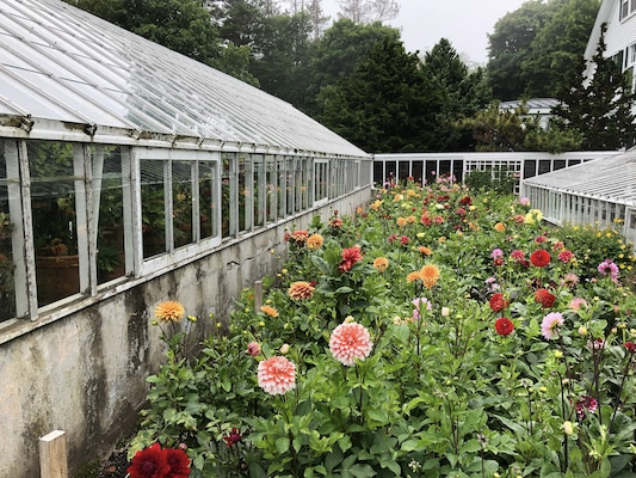
The dahlia display garden at Fuller Gardens was in full bloom during the author's visit. MUST CREDIT: Photo for The Washington Post by Alexandra Pecci

The dahlia display garden at Fuller Gardens was in full bloom during the author’s visit. MUST CREDIT: Photo for The Washington Post by Alexandra Pecci

Like so many Americans, I have been taking the same three walks around my neighborhood since March, thanks to the novel coronavirus. I canceled my 40th birthday vacation and got a refund on flights for work travel. I’m grateful for my backyard, but I’m frankly tired of staring at the same patch of grass every day.

I won’t be traveling this summer – or anytime soon – but my desire for novel experiences and new places hasn’t gone away. In fact, it’s gotten more intense knowing I can’t have it. So when an acquaintance told me about a local public garden that had recently reopened after shutting down because of the pandemic, my imagination went into overdrive looking at pictures of it online. It was beautiful. One spot reminded me of a place I’d visited in England the summer before. Another evoked a dewy fairyland. I looked at the garden’s address and saw that it was a short drive from my house, yet I had never visited.

Intrigued, I typed “botanical gardens near me” into Google and saw even more pictures that called to mind bucket-list places such as Japan and Versailles. These gardens were close to my house – many less than a 30-minute drive – but I hadn’t visited any of them. It was time to change that.

I’m not alone in my sudden desire to visit local botanical gardens. Data from around the country is showing an increase in visits to outdoor spaces this summer, and public parks, including botanical gardens, were the top spot that visitors to cultural institutions planned to return to in the wake of pandemic closures, according to Colleen Dilenschneider, data analyst and publisher of Know Your Own Bone, a market research website for cultural executives.

To find places near you, PublicGardens.org, the website of the American Public Gardens Association, includes a map of its member gardens that’s searchable by garden name or Zip code. Searching by location yields all the gardens within 150 miles.

“Botanical gardens are a known entity,” says Joan Thomas, director of external relations for the association. “They’re places of sanctuary, refuge, and calming places to be.”

Plus, “they’re cared-for spaces,” she adds, natural but organized, alive but orderly, combining the structure of a museum with the outdoor space of a park.

Eager for something new but still wanting to stay safely outdoors, Chloe and I hit the road. Our first stop was Bedrock Gardens in Lee, N.H., where two miles of paths link 20 acres of cultivated gardens with woodland and meadows. 

“It is designed as a journey,” Jill Nooney, who co-founded and owns Bedrock Gardens with her husband, told me later. “A journey has to have a destination, and it has to have adventures along the way.”

At Bedrock Gardens, themed garden “rooms” connect to one another along meandering paths like “beads on a necklace,” Nooney says. The landscape also is peppered with pieces of Nooney’s art, much of which she built with found objects. Some pieces recall the property’s former life as a dairy farm – a pitchfork and shovels become the crowning pieces of a sculpture, and metal tractor seats transform into swivel chairs.

Each garden room has a whimsical name that echoes its theme. The “Wiggle Waggle” is an undulating, narrow water channel dotted with lotus and lilies, and “ConeTown” is an ode to the dozens of conifers that grow there.

While it’s possible to simply wander around and enjoy the landscape without any context, be sure to grab the map that comes with the suggested $10 donation for admission. It will deepen the experience, teaching visitors about everything from horticulture to history. 

“There are aspects in this garden that are based on French formal gardens, Asian gardens, medieval fruit growing,” Nooney says. 

Chloe and I weren’t the only visitors that day, but at times it felt like we were nearly alone in the 37-acre landscape, which was perfect for social distancing. 

“There aren’t many things you can do safely with kids. Because it’s so large it can easily incorporate 300 people,” Nooney says. “People are starved for safe outdoor activity. People are starved for something that refreshes the soul.”

Seeking to refresh our souls a little more, Chloe and I got back into the car and headed 20 miles southeast to another, very different place: Fuller Gardens in North Hampton, N.H., which former Massachusetts governor Alvan Fuller built at his summer estate, Runnymede-by-the-Sea, in the 1920s and ’30s. 

Whereas Bedrock Gardens felt quirky and fanciful, Fuller Gardens is decidedly more manicured, reflecting its elegant country estate history. An English perennial garden, formal rose garden, classical European sculptures and fountains, conservatory, dahlia display garden, and neat paths and hedgerows give the place an Old World feel. 

A few days later, Chloe and I visited yet another garden near our home, the one at the Stevens-Coolidge Place in North Andover, Mass., which is also part of a former country estate. 

Behind the estate’s historic house, we explored around a French garden’s vegetables and fruit trees, an elegant sunken walled garden with intricate wrought-iron gates, and an exuberantly flowering perennial garden filled with bearded iris, phlox and plume poppy.

Visiting such gardens is not only good for the spirit; it’s also good for the gardener’s imagination. After all, gardening is another activity that’s gotten a boost during the pandemic.

“Ideas are free,” Nooney says, encouraging budding landscape designers to take inspiration from the art within Bedrock Gardens’ landscape, maybe by piling up some stones to make a cairn or inverting a pot to see how it looks.

“There are tremendous things to be learned from botanic gardens around the country and around the world, but by focusing on local gardens, you can really see what will grow best in your own community,” says Joann Vieira, director of horticulture for the Trustees of Reservations, which manages the Stevens-Coolidge Place and other properties throughout Massachusetts.

Local botanical gardens could also help you satiate your wanderlust when far-flung travel isn’t possible. At Fuller Gardens, you might feel transported by the Japanese Garden, where a traditional bamboo farming device called a shishi-odoshi – which uses water and noise to frighten away crop-eating animals – and a pond filled with bright orange koi add meditative, liquid sounds to the hushed space. 

Or you might feel dropped into a classic British novel. Wandering around the manicured rose beds at Fuller Gardens, I half expected to see Elizabeth Bennet strolling along the hedgerows with her nose stuck in a book, or Alice herself, chasing after the white rabbit.

That global feeling is evident at the Arnold Arboretum of Harvard University, a 281-acre Frederick Law Olmsted landscape that’s free and open to the public.

“We’re a tree museum. So when you come to the Arboretum you have the opportunity to see trees from all over the temperate world,” says Arboretum spokesperson Jon Hetman, pointing to collections from China, Japan, Korea and Europe. The Arboretum’s broad landscape and wide, paved walkways provide ample space for people to safely explore outside, he says, though the website suggests avoiding peak visitation hours. (The visitor center and indoor exhibits are closed.)

Hetman believes that visiting botanical gardens can remind us of the “restorative power of nature,” and after being in some of these beautiful, serene places, I have to agree with him.

“While people are really feeling adrift and uncertain, gardens and nature itself can really offer a way to decompress and provide some guidance and solace,” Vieira says.

– – –

IF YOU GO:

WHAT TO DO

– Arnold Arboretum of Harvard University

125 Arborway, Boston 

617-524-1718

arboretum.harvard.edu

The Arnold Arboretum of Harvard University is a 281-acre preserve laid out by Frederick Law Olmsted and contains nearly 17,000 plants. In addition to learning about the arboretum, website visitors can access its collection digitally through a partnership with Google Arts and Culture. The arboretum also launched this summer a free mobile app called Exhibitions, through which visitors can take self-guided tours and hear stories about the arboretum’s collections. Outdoor areas that allow social distancing open daily. Free admission.

– Fuller Gardens

10 Willow Ave., North Hampton, N.H.

603-964-5414

fullergardens.org

Fuller Gardens is a formal estate garden featuring more than 100 rose varieties, a Japanese garden, a dahlia display garden and European art. Find information about the garden’s history and landscape, as well as extensive information on planning a perennial garden and gardening tips on its website. Open daily 10 a.m. to 5:30 p.m. Admission $9 adults, $8 seniors and students, $4 children younger than 12. 

– United States Botanic Garden

100 Maryland Ave. SW Washington, D.C.

202-225-8333

usbg.gov

Although the United States Botanic Garden at the Capitol in Washington is temporarily closed to the public, it’s hosting a number of programs online, including cooking demos, trivia, garden yoga, lectures and concerts. There’s also a virtual tour, gardening and sustainability tips, kids’ activities and resources, photos, a collections archive, and much more. Free.

– Bedrock Gardens

19 High Rd., Lee, N.H.

603-659-2993

bedrockgardens.org

Bedrock Gardens has 20 acres of cultivated gardens, each with a different theme, located throughout woodland and meadows and among pieces of original art placed throughout the property. Open Tuesday through Friday and the first and third weekends of the month from 10 a.m. to 4 p.m. Admission $10 suggested donation for adults, free children 12 and under.

– Stevens-Coolidge Place

137 Andover St., North Andover, Mass.

978-689-9105

thetrustees.org/places-to-visit/northeast/stevens-coolidge-place.html

The gardens at Stevens-Coolidge Place are part of a former country estate and include a French vegetable garden, fruit trees, sunken walled garden, conservatory, meadows and perennial garden. Masks required. Open Tuesday through Sunday 10 a.m. to 4 p.m. Free admission. 

Amsterdam wants nothing to do with Europe’s tourism revival #ศาสตร์เกษตรดินปุ๋ย

#ศาสตร์เกษตรดินปุ๋ย : ขอบคุณแหล่งข้อมูล : หนังสือพิมพ์ The Nation.

Amsterdam wants nothing to do with Europe’s tourism revival

WorldJul 24. 2020Femke Halsema, mayor of Amsterdam, in her office on Nov. 30, 2018. MUST CREDIT: Bloomberg photo by Jasper Juinens.Femke Halsema, mayor of Amsterdam, in her office on Nov. 30, 2018. MUST CREDIT: Bloomberg photo by Jasper Juinens.
By Syndication Washington Post, Bloomberg · Ellen Proper · WORLD, EUROPE 

Europeans are free to travel again, but Amsterdam’s mayor is anxiously telling visitors to stay away.

The return of crowds meandering through the city’s narrow streets could spark a new wave of infections, putting local officials in the unusual position of actively trying to keep people from visiting.

“If you want to come, then think twice about it,” Femke Halsema said in an interview in the garden of her 17th century mayor’s office on Thursday. “The tourists who are coming to Amsterdam at the moment I want to say quite urgently: avoid the busy places, avoid the weekend.”

Amsterdam has been struggling with crowds since cheaper flights made the city’s historic center a popular weekend destination. Before coronavirus lockdowns, its renowned red-light district, marijuana shops and picturesque canals attracted over 1 million visitors a month — more than its permanent population.

The reputation as Europe’s party town strained resources and pushed locals out of the center. The pandemic adds a public-health element to Amsterdam’s tourism backlash.

“Corona and mass tourism just don’t go together — certainly not in a historic city center like in Amsterdam,” said Halsema. “There is a risk of contamination,” as a large increase in tourists means that it’s no longer possible to maintain social-distancing rules.

A recent influx of visitors prompted the Amsterdam government last Saturday to close several streets in the narrow alleys where scantily-clad prostitutes pose in brothel windows. It put up signs on the popular Dam square to warn people of the danger of spreading the disease, advising them to maintain a distance of at least 1.5 meters (5 feet).

In an effort to limit risky behavior, one-way walking lanes have been implemented and parts of the red-light district can be closed. Shops in the dense 500-year-old center will be banned from selling alcohol from Thursdays to Sundays starting this weekend and until at least Sept. 1.

While new infections remain low compared to the height of the pandemic, cases doubled last week, Dutch health agency RIVM said on Tuesday, warning that the disease is spreading again.

Halsema pointed the finger at young people from neighboring countries looking for a cheap thrill without adding much to the local economy. More broadly, the backsliding on rules designed to thwart infections is cause for concern.

“In general, you see all over Europe that people are increasingly not caring about social distancing,” Amsterdam’s first female mayor said. “That is really very worrying.”

Southwest announces it will no longer allow customers without masks to fly #ศาสตร์เกษตรดินปุ๋ย

#ศาสตร์เกษตรดินปุ๋ย : ขอบคุณแหล่งข้อมูล : หนังสือพิมพ์ The Nation.

Southwest announces it will no longer allow customers without masks to fly

WorldJul 23. 2020

By The Washington Post · Lori Aratani · NATIONAL, BUSINESS, WORLD, HEALTH, TRANSPORTATION, TRAVEL 

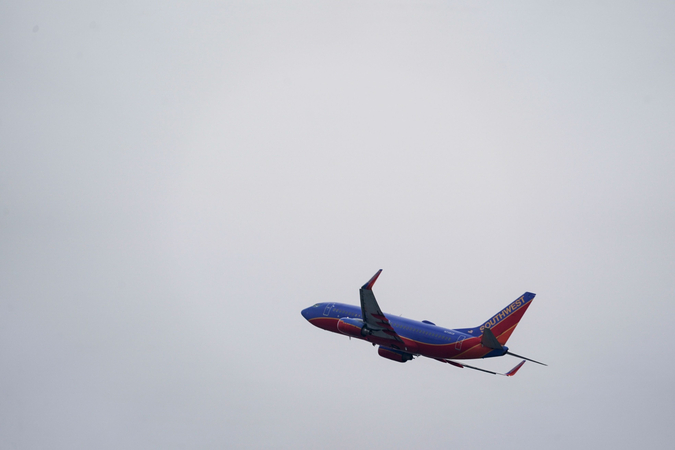
Southwest Airlines said that beginning July 27, all travelers must wear face coverings in order to fly. The only exception will be for children under the age of two.

“If a Customer is unable to wear a face covering or mask for any reason, Southwest regrets that we will be unable to transport the individual,” the airline said in a statement. “In those cases, we hope the Customer will allow us to welcome them onboard in the future, if public health guidance, or other safety-related circumstances, regarding face coverings changes.”

The policy is the strictest so far among U.S. airlines.

Two other carriers, United and Delta Air Lines, have made similar changes to face covering policies. However, unlike Southwest, United and Delta may still allow some travelers to fly without wearing a face covering. Passengers flying Delta would have to undergo a separate screening process that could take more than an hour, the airline said. On United, customers will be reminded of the policy and could be denied boarding if they refuse to comply. Those with special medical conditions should contact the airline prior to their flight.

As part of a revised policy announced Wednesday, United said face coverings also would be required in all areas of the more than 360 airports it serves.

There is no federal requirement that air travelers wear masks when they fly, so airlines have largely been left to craft their own policies. A growing number of states however, are now making masks mandatory. On Wednesday, governors in Ohio, Indiana and Minnesota made face coverings a requirement.

Southwest is taking other steps to reassure travelers in the midst of a pandemic. The airline said in early August, it will launch a pilot program at Dallas Love Field to screen passengers for elevated temperatures using thermal screening cameras. The pilot program would last from 30 to 90 days, airline officials said.

“Southwest always operates a multilayered approach to supporting the well-being of travelers and employees, which is especially important during the current covid-19 pandemic,” said Scott Halfmann, vice president of safety and security. “We are pleased to partner with Dallas Love Field on this pilot project as thermal screenings could be an important, additional layer of precaution that Southwest can offer customers starting at the very beginning of their travel journey.”

Even with the launch of that program, the airline said it was still hopeful that the Transportation Security Administration would take on the responsibility for conducting the screenings. Southwest is among several U.S. airlines that have called on the agency to do so, given that it already conducts security screenings. However, the agency has not committed to launching such a program, saying that it is not clear that it would be effective in identifying passengers who have covid-19.

Currently, Frontier Airlines is the only U.S. airline that does temperature screenings of all passengers before they board.

Sai Yok — home to the wonders of nature with a touch of history #ศาสตร์เกษตรดินปุ๋ย

#ศาสตร์เกษตรดินปุ๋ย : ขอบคุณแหล่งข้อมูล : หนังสือพิมพ์ The Nation.

Sai Yok — home to the wonders of nature with a touch of history

Jul 19. 2020

By Komchai Tawanchaui

The Sai Yok National Park located in Kanchanaburi has not been as high on tourists’ popular places in this province as in the past. People visit other areas of the province, such as Thong Pha Phum and Sungkraburi. But considering the attractions it offers, the national park is still worthy of a visit.

Lava Cave

Lava Cave

The 19th national park opened on October 27, 1980. Covering 312,500 rai, or around 500 square kilometres, it extends all the way to the Myanmar border.

Entry ticket is priced at Bt100. The first place worth visiting is “Lava Cave”. This site is famous for its beautiful patterns of stalactites and stalagmites. Visitors can drive from the park’s entrance to this cave.

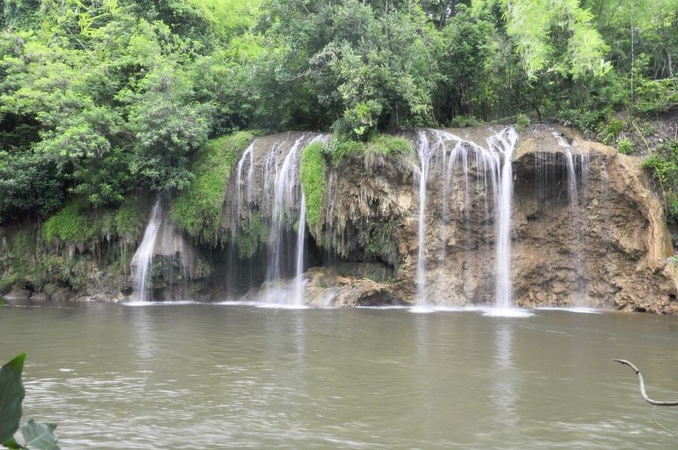
The park’s highlight is the “Sai Yok Waterfalls”, which is located near the main street and train station. The railway was constructed in the WWII period, when under Japanese occupation.

The rich pine garden offers a cool shade for visitors. The park also provides accommodation and hiking routes for tourists. Along the routes, there is evidence displayed of Japanese soldiers having lived around the park area in the past.

Sai Yok Waterfalls consist of big and small falls, situated far from each other. They share the same origin from the nearby mountain, flowing to Khwae Noi River. And since the source is not far from the waterfalls, they do not dry up in summer as many other waterfalls in the country.

Throughout the year, visitors come here to take part in water activities. Besides, the park is very convenient for camping, with electricity, local restaurants and telephone signals.

Before Sai Yok was declared as a national park, King Rama V had visited the waterfalls. His bust stands there as a testimony to his visit while a replica of his boat also is displayed in the park.

Dusit hotels offering 40% discount via govt tourism scheme #ศาสตร์เกษตรดินปุ๋ย

#ศาสตร์เกษตรดินปุ๋ย : ขอบคุณแหล่งข้อมูล : หนังสือพิมพ์ The Nation.

Dusit hotels offering 40% discount via govt tourism scheme

ThailandJul 20. 2020dusitD2 Ao NangdusitD2 Ao Nang

By The Nation

Dusit International has joined government efforts to boost domestic tourism with its nationwide subsidy programme, “Rao Tiew Duay Gan” (We Travel Together).

From July 18 to October 31, rooms at Dusit Hotels & Resorts in Bangkok, Chiang Mai, Hua Hin, Pattaya, Phuket, Khao Yai and Krabi are available with government subsidies of 40 per cent – up to Bt3,000 per night – for up to five nights per person.

Guests will also receive a Bt600 e-voucher per room per night to use for dining in the hotel or at participating standalone outlets.

Subsidies are available for eligible Thai nationals who have registered at เราเที่ยวด้วยกัhttp://xn--q3c.com/ (or via the Paotung mobile app) before booking direct via www.dusit.com/specialoffers/rao-teaw-duay-kan.

Upon booking, a payment link will be sent to the app so the recipient can receive the saving.

Guests booking via dusit.com can take advantage of current promotional offers, such as room rates starting from Bt999 net per room per night.

Several Dusit Hotels & Resorts in Thailand will also offer additional exclusive benefits for guests who book weekday stays (including Sundays) using Rao Tiew Duay Gan. This includes a guaranteed room upgrade, 40 per cent discount on spa treatments (where applicable), and 20 per cent discount on food and beverages.

Korat’s waterfalls flowing again thanks to heavy rain #ศาสตร์เกษตรดินปุ๋ย

#ศาสตร์เกษตรดินปุ๋ย : ขอบคุณแหล่งข้อมูล : หนังสือพิมพ์ The Nation.

Korat’s waterfalls flowing again thanks to heavy rain

ThailandJul 18. 2020

By The Nation

Nakhon Ratchasima’s famous Man Fah waterfall in Thap Lan National Park is beautiful and flowing again thanks to recent heavy rainfall.

Pongthep Malachasing, president of the provincial tourism club, said the waterfall had dried out during the drought season, “but recent heavy rain has filled up streams and made forests and agricultural areas lush again”.

Apart from Man Fah waterfall, Khun Joan and Khlong Din Dam waterfalls are also beautiful and ready to welcome visitors.

“I think a good rainy season will also bring tourists back to the Wang Nam Khiao district,” he said.

Wang Nam Khiao, often referred to the Switzerland of Thailand, is known for its fields of flowers and lush surroundings.

Krabi emerges shining from lockdown #ศาสตร์เกษตรดินปุ๋ย

#ศาสตร์เกษตรดินปุ๋ย : ขอบคุณแหล่งข้อมูล : หนังสือพิมพ์ The Nation.

Krabi emerges shining from lockdown

Thailand

Jul 17. 2020Photo Credit: Hat Noppharat Thara–Mu Ko Phi Phi National ParkPhoto Credit: Hat Noppharat Thara–Mu Ko Phi Phi National Park

By The Nation

Krabi’s marine national park today posted pictures of a stunning sunrise lighting up a cloud pillar at Koh Mai Pai (Bamboo Island) in the Andaman Sea.

Koh Pai is a small island located in Hat Noppharat Thara-Mu Ko Phi Phi National Park, at the northern end of the Koh Phi Phi archipelago.

Unlike its more touristic neighbour Koh Phi Phi, Koh Pai is a peaceful island with beautiful beaches, clear seawater, and teeming coral reefs ideal for diving.

Koh Pai is expecting to welcome back international tourists later this year. The best time to visit is between November and April.

America’s 3,000 bus companies make appeal for economic relief amid pandemic #ศาสตร์เกษตรดินปุ๋ย

#ศาสตร์เกษตรดินปุ๋ย : ขอบคุณแหล่งข้อมูล : หนังสือพิมพ์ The Nation.

America’s 3,000 bus companies make appeal for economic relief amid pandemic

World

Jul 12. 2020William Torres, president of DC Trails, on his lot Wednesday in Lorton, Va., where many of his 70 motor coaches have been parked. MUST CREDIT: Washington Post photo by Marvin JosephWilliam Torres, president of DC Trails, on his lot Wednesday in Lorton, Va., where many of his 70 motor coaches have been parked. MUST CREDIT: Washington Post photo by Marvin Joseph

By The Washington Post · Luz Lazo · NATIONAL, BUSINESS, FEATURES, TRANSPORTATION, TRAVEL

In two decades, William Torres built one of the largest private bus companies in the nation’s capital, ferrying millions of people to destinations within and outside the Washington region. 

Last year his buses carried 1.4 million people in the region and traveled 4.2 million miles. 

Then the coronavirus pandemic hit. The cancellations began to pour in. All the trips lined up for spring and summer – $5.4 million in business – were canceled within days in March. No new trips have been booked for the fall. Most of the company’s nearly 200 employees have been laid off, and many of its 70 motor coaches sit parked in a Lorton, Va., lot. 

“This knocked us back 10 years,” said Torres, a retired District of Columbia police officer who lives in Prince William County and runs DC Trails with his wife and two sons. “We are definitely, definitely in trouble.”

The pandemic has been a blow to the entire transportation industry, but the motor coach sector has been hit especially hard. 

Private bus trips came to a near-standstill as the pandemic forced schools to close, sporting events to cancel and people to stop traveling altogether amid the country’s shutdown. Four months into the crisis, nearly 90 percent of the nation’s private bus companies are still shut down, according to the American Bus Association, and there is little to no sign of recovery for the sector, which supports nearly 100,000 jobs.

Unlike the airlines and public transit, the private bus industry, also known for transporting commuters in major metropolitan areas such as Washington and New York, has received no economic relief from the government. Now some trade leaders and lawmakers say they hope that will soon change. 

Congress is considering a bailout for them. The Coronavirus Economic Relief for Transportation Services (CERTS) Act, introduced by Sens. Jack Reed, D-R.I., and Susan Collins, R-Maine, on July 2, would provide $10 billion in emergency relief funding in the form of grants to the industry. 

“The road to economic recovery for these businesses is already long and steep, and in order to get our economy working again, the federal government needs to extend assistance to this critical link in our transportation network,” said Reed, the top Democrat on the Appropriations Subcommittee on Transportation, Housing and Urban Development. 

Bus operators provide essential transportation for millions of Americans, Reed said in a statement, noting that even during the crisis, motor coaches continued to serve communities, helping evacuate passengers stuck on cruise ships affected by the novel coronavirus, and to ferry troops. 

Bus operators and trade groups have been knocking on doors of members of Congress for months. In May, a caravan of motor coaches from across the country drove to the Capitol in a collective plea for federal aid. 

“You missed us. You missed the bus. You know, you’ve missed us,” Torres, of DC Trails, said he tells his congressional representatives. “Our industry transports almost as many people as the airlines; however, we didn’t receive any stimulus help from our government.”

The roughly 3,000 bus companies across the nation – many of them small, family-owned businesses – carry 600 million passengers each year, compared with the airlines’ 700 million domestic passengers. 

Although the industry is known mostly as the carrier for intercity travel and sightseeing group tours, it also provides critical transportation in local communities, from bringing air and cruise travelers to and from ports to taking grade school kids on field trips, college athletes to sporting events and commuters to jobs. The military contracts them to move troops between bases, to training and to and from deployments. When natural disaster hits, they are called in to evacuate people. 

Even so, said Peter Pantuso, president and chief executive of the American Bus Association, the industry was left to survive on its own while Congress made $50 billion in grants and loans available to airlines, $25 billion to public transit agencies and $1 billion to Amtrak. 

“Buses were the only form of passenger transportation that were left out,” Pantuso said. “We were very disappointed, and we’ve been going up to Congress, literally every day we’re on the phone with members of Congress, their staffs, their committees, talking about the help that this industry needs.” 

The bus association and the United Motorcoach Association have been lobbying for $10 billion in grants and $5 billion in loans to the $15 billion industry.

A growing number of lawmakers in both chambers and parties are rallying for a motor coach bailout. In April, nearly 100 members of Congress sent a letter to House leadership urging support to rectify a “grave oversight” of leaving the bus industry out of America’s largest bailout – the $2 trillion coronavirus relief package approved in late March.

In May, 27 lawmakers led by Sens. Steve Daines, R-Mont., and Chris Van Hollen, D-Md., wrote a letter of support urging Senate leadership to include the motor coach industry in a future stimulus package. 

“These businesses provide crucial transportation services for both commuters and long-distance travelers, and also support Maryland and the national capital region’s tourism industry,” Van Hollen said in a statement. “The Congress must continue working to provide support to those hit hardest by the COVID-19 pandemic, and we’ll be looking for ways to include this relief in the next package.”

Operators are hopeful the bipartisan CERTS Act will pass but say they need the aid soon. 

“Some of us aren’t going to survive without help, and I could very well be one of those ones,” said Albert Spence, owner of A.S. Midway Trailways, a small, family-run company of 15 employees in Baltimore.

His seven buses have not made a trip since mid-March when the fleet returned home from the canceled Mid-Eastern Athletic Conference basketball tournament in Norfolk. The March Madness trips were canceled. Then the spring school field trips gone. So were group tours and conventions. 

“There’s no explaining how devastating this has been,” said Spence, 64. “And it’s just a bleak look for the fall right now.”

Bill Moberg, who operates a fleet of 80 buses in central Florida, said his company would usually make the year’s earnings in March, April, May and June, ferrying cruise ship guests to and from port and taking students to end-of-year excursions. 

“Within four or five days we went to zero revenue, and we have pretty much been there since,” Moberg said. Hope for business in the months ahead disappeared in late June, he said, when news came that the cruise lines would not return this summer as previously thought and that Florida was turning into a national coronavirus hot spot. 

“Things are getting rough now, so this may even extend a lot longer,” Moberg said. Close to 100 employees have been laid off. Buses are parked, and every two weeks Moberg himself starts them and drives them around the lot to keep them in condition. 

So much of the motor coach business depends on other parts of the economy opening and people regaining confidence in group travel. Will schools reopen in the fall and resume field trips? Will seniors feel safe going on group tours? Will conventions resume? Will workers return to the office? Will people travel? 

“There are so many unknowns,” Moberg said. The prospects for any return to normalcy this year are slim. Even the popular intercity trips are not returning quickly enough, nor are the commuter trips as more people work from home, trade leaders say. 

Spence, who chairs the Maryland Motorcoach Association, said in the Free State alone, of 35 member companies only a handful have active jobs – doing some of the commuter runs for the Maryland Transportation Administration. 

The MTA reduced commuter operations in mid-March, as the state enforced a shelter-at-home policy and ridership dropped by 95 percent. The state contracts with six companies to run commuter buses at a cost of $55.5 million. When bus service is reduced, private buses don’t make trips or money. 

Commuter service, however, may be the first source of revenue for the industry to return. Maryland, for example, is planning to resume normal operations July 27. Still, that’s only a small portion of the industry’s business.

Intercity operations are also slowing returning. Providers such as Megabus and Greyhound have recently announced they are resuming some trips. 

Sean Hughes, director of corporate affairs at Coach USA, one of the country’s largest bus companies and the parent company of Megabus, said it only recently resumed D.C.-to-New York trips and other routes across the country. The D.C.-to-New York line is doing three round trips a day, compared with 25 round trips pre-pandemic. As a safety precaution, buses are restricting capacity to 50 percent. 

Coach USA, which owns other private bus companies that provide airport transportation, tours and commuter services in 35 states, said 3,000 of the company’s 5,000 workers are furloughed, and those working took a 40 percent pay cut starting at the end of March.

“We have high hopes that the [CERTS] bill will be picked up and move forward, because the overall industry needs relief,” Hughes said. 

In Washington, Torres said his family has already poured its life savings into the business. In late May, the company called back some workers when it obtained a contract with Metro to transport commuters along a segment of the Orange Line that is closed because of a platform project. The contract, good until early September, has secured jobs for about 50 DC Trails drivers, he said. 

The company also resumed daily D.C.-to-New York trips, though it is only making eight trips instead of the usual 60, he said. Everything else – the contracts with Prince William County for senior trips, with Fairfax County Public Schools for field trips and with Georgetown and American universities for their athletes’ travel – are halted. 

“If they don’t go, we don’t get paid,” Torres said. 

Logjam of tourists at Glacier National Park #ศาสตร์เกษตรดินปุ๋ย

#ศาสตร์เกษตรดินปุ๋ย : ขอบคุณแหล่งข้อมูล : หนังสือพิมพ์ The Nation.

Logjam of tourists at Glacier National Park

World

Jul 12. 2020With only one entrance open to Glacier National Park, outdoors-eager visitors have faced long lines to get to the wilderness in this corner of northwestern Montana. MUST CREDIT: Glacier National Park webcam.With only one entrance open to Glacier National Park, outdoors-eager visitors have faced long lines to get to the wilderness in this corner of northwestern Montana. MUST CREDIT: Glacier National Park webcam.

By Special To The Washington Post · Kathleen McLaughlin · NATIONAL, HEALTH, SCIENCE-ENVIRONMENT
As Montana warily reopened last month to pandemic-weary tourists, an isolated community held firm with closures and stay-at-home orders. Few outsiders would have paid much attention but for one detail: The Blackfeet Nation borders Glacier National Park, and its decision blocked access to much of the vast wilderness there.

The result this month has meant throngs of visitors crowding into a tiny corner of Glacier – a crown jewel of the park system – with long lines of cars at what is now the only entry point. 

And the bottleneck won’t disappear anytime soon. Tribal leaders recently announced they would keep the eastern entrances and roads to Glacier, which lie on reservation land, closed at least through August.

“Our number one objective is to keep people alive,” said Robert DesRosier, who leads the tribe’s covid-19 incident response team. “We don’t want one person to die. Our elders are the keepers of the culture, and we can’t afford to lose them.”

The Blackfeet’s fears are well-founded. Covid-19, the disease caused by the novel coronavirus, has ravaged some Native American communities. In Montana, state data show that more than a third of the people to have died so far identified as Native American, though natives make up less than 7 percent of the population. In the Southwest, the Navajo Nation has been one of the country’s worst hot spots. 

The National Park Service and local tourist companies are backing the Blackfeet. Boat and bus operators are shut down for the summer, as are hotels and restaurants on Glacier’s east side, and Park Service officials are weighing Glacier’s first-ever ticketing and reservation plan to deal with the crush of traffic. The park, which extends north to Canada, encompasses a million acres of glacially carved peaks, turquoise-colored lakes, trails and wild country. Until a controversial land agreement in 1895, all of it was Blackfeet country.

Just one thruway – the evocatively named Going-to-the-Sun Road – traverses Glacier. Because snow and ice at Logan Pass, elevation 6,646 feet, routinely obstruct the road into July, most of the park’s 3 million annual tourists come during an abbreviated summer season. 

With the east side locked up, rangers have been dealing mostly with traffic management near the west entrance. Many locals have wondered why the area reopened at all given the risk of travel amid the pandemic. 

Most tourists have respected the tribe’s decision, according to DesRosier. Blackfeet wildland hotshot fire crews are patrolling roads on the reservation, keeping any outside traffic moving through and allowing nonresidents to stop only for gas – and only if they’re wearing masks and gloves. A few angry voices have complained on social media, with one man suggesting that the National Guard be mobilized against the sovereign nation, but there has been no serious pushback.

“We rousted out some campers who said, ‘We didn’t know this was Indian country,’ ” DesRosier said. “It’s all about education.”

Montana’s Native American nations have been a priority for Gov. Steve Bullock, a two-term Democrat now running for the U.S. Senate, as his administration manages the state’s response to the coronavirus. The governor visited all seven reservations in recent weeks and put them first in line for increased testing, promising the state will respect any additional closures and measures they take to protect members.

“Right from the time we declared a statewide emergency, we’ve been in regular contact with tribes to make sure they have what they need to keep tribal members safe and healthy,” Bullock said in an interview Monday. Many families live in multigenerational households and have higher rates of underlying health conditions, which increase their risk. “Our tribal communities are that much more important to protect.”

It’s a stark difference to the situation in South Dakota, where Republican Gov. Kristi Noem in May asked the White House and the Justice Department to intervene after leaders of the Oglala and Cheyenne River nations set up boundary checkpoints to stop non-reservation traffic. Last month, the Cheyenne River Sioux Tribe filed a federal lawsuit against President Donald Trump, the Interior Department and Bureau of Indian Affairs for interfering with the tribe’s efforts to prevent coronavirus infections. 

Bullock said he has no intention of countering the Blackfeet’s border closures, including at the national park. Montana, like many states, has seen a spike in coronavirus infections since it eased caps on restaurants, bars, gyms and movie theaters; more than half of roughly 1,600 cases have been confirmed just since June 10. On Friday, the state recorded another daily record of 127 new cases, and Bullock warned that some restrictions could be reimposed.

The governor considers local events like weddings and dances a larger concern for transmission than out-of-state travelers. Not everyone dealing with tourists agrees. 

Paul Doughtery, a teacher who works summers at a recreational equipment company inside Glacier, said the crowds worry him. While the park is encouraging everyone to follow certain protective measures – “Don’t arrive with a bear face! Please wear a mask!” – Doughtery thinks the state has sent a mixed message by lifting quarantine requirements on visitors. Montana residents are being treated like service staff for vacationers, he complains. 

“There’s just a carelessness” among visitors despite the pandemic, Dougherty said. “To be fair, they’re doing everything the state has said is safe. I can’t shame and blame them too much, it’s the state that has abdicated responsibility here.”

On the Blackfeet Reservation, home to around 10,000 people, staying closed was not an easy decision. Businesses owned by tribal members have suffered severe financial losses, and the cancellation of gatherings like North American Indian Days – an annual parade, rodeo and powwow celebrating native traditions – have taken an emotional toll.

Angelika Harden-Norman and her husband, Darrell, a Blackfeet artist, own a tepee lodge and gallery that sits just outside the small town of Browning on the road to Glacier. While 2020 has been incredibly difficult for them and all other local businesses, she says the pain is necessary.

“We get guests from all over the globe every year, exactly what we don’t want right now on the reservation,” she noted.

The tribe was able to hold the virus at bay for months; its mask order, issued in March and broadly supported by the community, remains in place.

But only days after leaders announced that the east side of the park would stay closed, nine Blackfeet tested positive. The reservation has suffered no deaths linked to covid-19.

“We went 105 days and kept the virus out of here,” DesRosier said. “Then some things happened around us, the state of Montana went to Phase II, and people let their guards down.”

Disney World set to reopen despite severe outbreak unfolding in Florida #ศาสตร์เกษตรดินปุ๋ย

#ศาสตร์เกษตรดินปุ๋ย : ขอบคุณแหล่งข้อมูล : หนังสือพิมพ์ The Nation.

Disney World set to reopen despite severe outbreak unfolding in Florida

World

Jul 10. 2020

By The Washington Post · Jennifer Hassan · BUSINESS, FEATURES, TRAVEL

Orlando theme parks Magic Kingdom and Animal Kingdom are set to reopen Saturday even though coronavirus cases in Florida are surging and experts are calling for the state to be shut down as the United States struggles to control the health crisis.

The Disney parks, which have been closed since March, will reopen under stringent new health and safety guidelines to prevent the spread of the virus, which so far has claimed at least 130,000 lives nationwide.

Guests age 2 and older must wear a face covering, and those who enter the park will be subject to temperature screenings. Those with a temperature above 100.4 degrees will be refused entry, as will their companions.

Visitor numbers will be reduced, and hand-sanitizing stations will be available for staff and guests to use. Visitors will not be allowed to hug their favorite Disney characters, and they will be asked not to pay in cash.

“The magic returns beginning July 11,” reads a statement on the official Walt Disney website, although many have expressed concerns that the attraction’s return could be far from magical.

Health-care workers in Florida say the situation is dire and that hospitals are “overfilled and understaffed.” Fedrick Ingram, president of the Florida Education Association, said the state is going backward in its handling of the crisis.

Josh D’Amaro, chairman of Disney Parks, Experiences and Product, said last month that the health and safety of staff and visitors were “top of mind” and that although the parks will be operating under new measures, the Disney experience would not change. “We recognize the trust that you have in the Disney brand, and we will continue to earn your trust every day,” he said.

Disney World’s other main parks, Epcot and Hollywood Studios, will reopen July 15, while Disneyland in California will remain closed until further notice.