Russia appoints top soldier Gerasimov to oversee Ukraine campaign
THURSDAY, JANUARY 12, 2023
Russian Defence Minister Sergei Shoigu appointed Chief of the General Staff Valery Gerasimov on Wednesday to oversee the military campaign in Ukraine, in the latest shake-up of Moscow’s military leadership.
Gerasimov, like Shoigu, has faced sharp criticism from Russia’s hawkish military bloggers for multiple setbacks on the battlefield and Moscow‘s failure to secure victory in a campaign the Kremlin had expected to take just a short time.
In a statement, the defence ministry said Shoigu had appointed Gerasimov as commander of the combined forces group for the “special military operation” in Ukraine. It is the most senior position among Russia’s battlefield generals.
Only last October, Russia had put Sergey Surovikin, nicknamed “General Armageddon” by the Russian media for his reputed ruthlessness, in overall charge of Ukraine operations following a series of counter-offensives by Ukrainian forces that turned the tide of the conflict.
Surovikin will now stay on as a deputy of Gerasimov, the defence ministry said.
The changes are designed to increase the effectiveness of military operations in Ukraine, it said, more than 10 months into a campaign in which tens of thousands of soldiers on both sides as well as Ukrainian civilians have been killed.
“The increase in the level of leadership of the special military operation is connected with the expansion in the scale of tasks … the need to organise closer contact between different branches of the armed forces and improve the quality … and effectiveness of the management of Russian forces,” the ministry statement said.
Russian pro-war commentators were not impressed.
“The sum does not change, just by changing the places of its parts,” wrote one prominent military blogger who posts on the Telegram messaging app under the name of Rybar.
He said Surovikin, a veteran of Russian campaigns in Chechnya and Syria, was being made the fall guy for a series of recent Russian military failures, including a Ukrainian attack on a Russian barracks in the town of Makiivka that killed at least 89 Russian soldiers, including conscripts, at New Year.
Military analyst Rob Lee, a senior fellow at the Foreign Policy Research Institute, said on Twitter that Gerasimov’s appointment reasserted the defence ministry’s position in the conduct of the war.
“I don’t think this is because Surovikin is viewed as a failure. (It is) certainly possible that this was driven by political reasons. As the unified commander in Ukraine, Surovikin was becoming very powerful and was likely bypassing Shoigu/Gerasimov when talking to Putin,” Lee said.
Political analyst Abbas Gallyamov noted on Telegram that the move followed the transfer of another top general, Alexander Lapin, to the role of land forces chief on Tuesday.
“All this moving of the same individuals from one chair to another, at the height of military hostilities, may say whatever you like but not that ‘everything is going according to plan’,” Gallyamov said.
Russian and Ukrainian forces were engaged in intense fighting on Wednesday over the town of Soledar in eastern Ukraine, a stepping stone in Moscow’s push to capture the entire Donbas region. The Russians appeared to have the upper hand.
Peruvian families mourn protest dead after worst violence in decades
THURSDAY, JANUARY 12, 2023
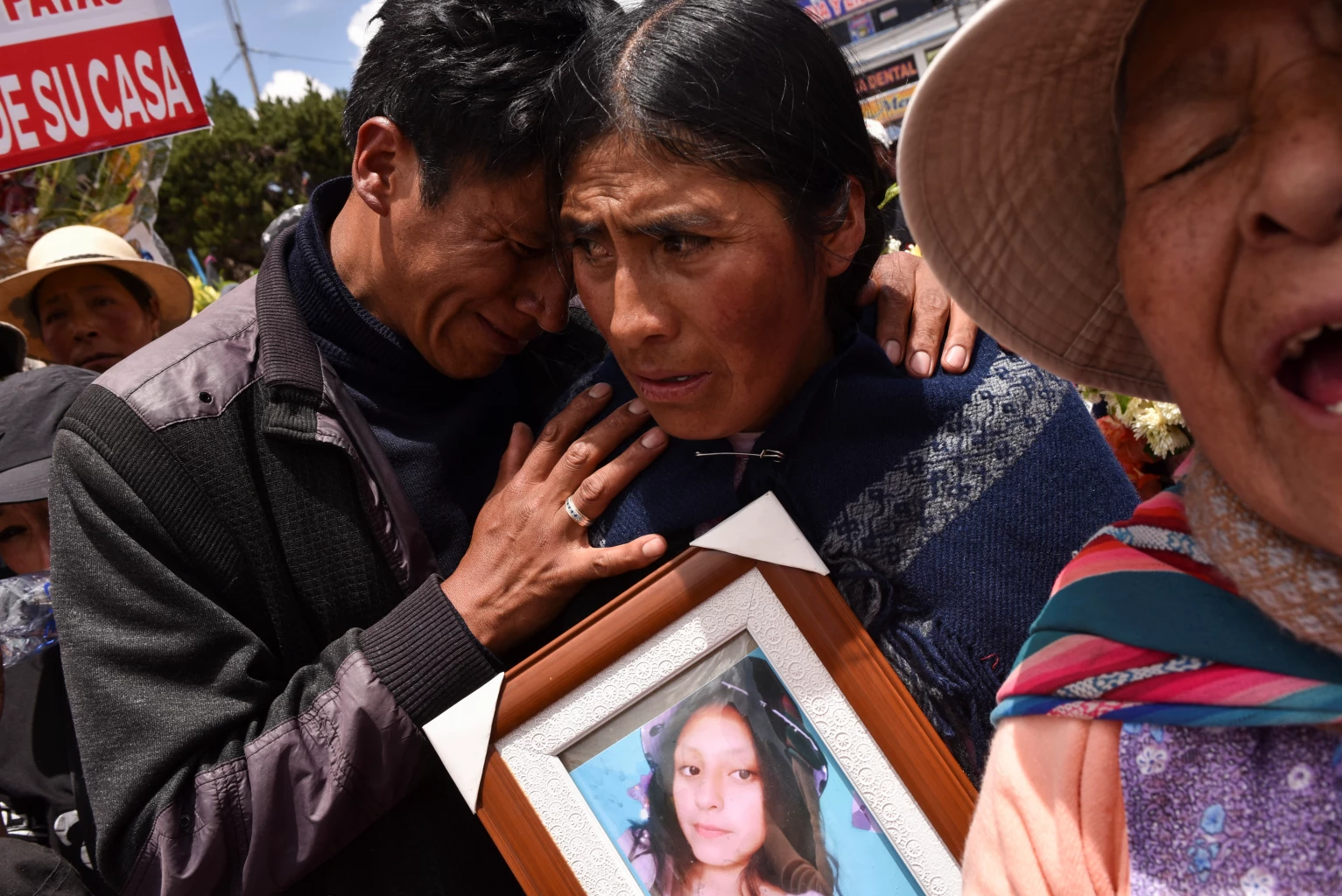
Peruvians in the southern region of Puno carried coffins through the streets on Wednesday after 17 civilians who in protests in the area earlier this week.
The outbreak of violence is the worst the Andean country has seen in over 20 years.
Peru has been roiled by protests since the abrupt ouster of leftist President Pedro Castillo in early December, with a total of 40 people killed, almost half of them in the city of Juliaca, Puno, on Monday (January 9), including one police officer.
Hundreds of people in the city paid tribute to the dead by carrying coffins through the streets before their burial along with photos of the faces of the victims, flowers, Peruvian flags, and banners blaming the new government for the violence.
Some protesters were heard shouting “Dina assassin,” in reference to recently-installed President Dina Boluarte.
Others carried symbolic black flags.
The region of Puno, which borders Bolivia, has been the epicentre of the most recent protests.
The violence has proved a severe test for Peru’s democracy and is the most severe since the late 1990s when the country was gripped by a conflict between the rebel group Shining Path and the state, which left 69,000 people dead or missing over two decades.
Protesters are calling for the resignation of Boluarte, quick general elections, a new Constitution and the release of Castillo, who was ousted and arrested for “rebellion” after trying to illegally shutter Congress.
On Wednesday, a mission from the Inter-American Commission on Human Rights (IACHR) met Boluarte, whose Cabinet survived a confidence vote in Congress on Tuesday (January 10), to assess the crisis.
IACHR representative Edgar Stuardo Ralon told reporters his team would listen to civil organisations and victims’ relatives before announcing their findings on Friday.
Boluarte, facing a preliminary investigation by state prosecutors over the deaths, said in a statement after the meeting that the government would give the commission all the support needed to find out what had happened.
Peruvian police and armed forces have been accused by human rights groups of using deadly firearms and launching tear gas canisters from helicopters.
The army says, for its part, that the demonstrators have used weapons and homemade explosives.
Castillo is serving 18 months of pre-trial detention on charges of rebellion, which he denies.
On Monday at least 38 people also had been injured and hospitalised in Juliaca, the ministry added in a statement published on Facebook.
In Juliaca, near the banks of Lake Titicaca in Peru’s southern Puno region, protesters took cover behind large metal plates and road signs and threw rocks at police using improvised slingshots as gunshots were seen in the background.
Other footage showed people with severe injuries in a crowded in Carlos Monge Medrano hospital.
An unidentified injured local in the hospital said he took his camera to film the clashes in the street when a police officer shot him in the foot and fell on the floor.
The protests resumed last week after a holiday lull.
The number of Korean women married for the first time in their 30s surpassed women married in their 20s as of 2021.
WEDNESDAY, JANUARY 11, 2023
The average marriage age for South Korean women was consistently in their 20s for decades, but statistics showed a shifting trend where women are now getting married in their 30s.
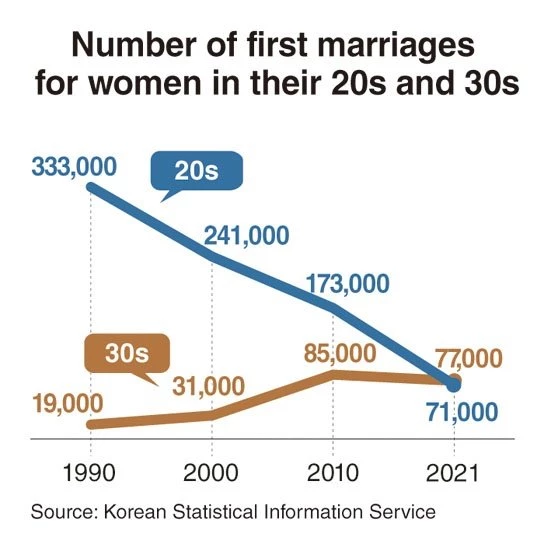
According to Statistics Korea, the number of women married for the first time in their 30s surpassed women married in their 20s as of 2021. This is the first time in 31 years, since 1990 when the agency started to compile related data.
In 2021, the total number of reported marriages was 193,000, and of this number, women married for the first time were 157,000.
Analyzing cases by age for first-time marriages, 76,900 cases involved women in their 30s, which accounted for 49.1 % or almost half of the total number of cases. Followed by 71,263 in their 20s; 6,564 in their 40s; 798 in their teens and 724 in their 50s.
Number of first marriages for women in their 20s and 30s (Korean Statistical Information Service)
In the 1990s, the number of first-time marriages for women in their 20s was 333,000 while first-time marriages in their 30s were only 19,000. The number of first-time marriages for women in their 20s decreased to 173,000 in 2010, and for women in their 30s, it was 85,000, almost two times less than for women in their 20s.
As for men, the first-time marriage age already changed in 2005, with 121,000 in their 30s and 119,000 in their 20s.
The average age of first-time marriage was 31.1 years for women and 33.4 years for men, as of 2021. Compared to the average age of first-time marriage in 1991, 30 years ago – 24.8 for women and 27.9 for men – women and men now wait 6.3 years and 5.5 years, respectively.
In addition, the number of marriages in 2021 fell below 200,000 for the first time since 1990, recorded as the lowest statistic ever. The number of marriages, which exceeded 400,000 in the 1990s, continued to decline to 300,000 in the 2000s and to 200,000 ten years later, before falling to 193,000 as of 2021.
South Korea’s military dodgers seek new ways by using local military brokers
WEDNESDAY, JANUARY 11, 2023
South Korean men seek new options to avoid their two-year mandatory military service, and the number of draft dodgers continues to grow.
According to data provided by Rep. Song Gab-seok of the Democratic Party received from the Military Manpower Administration, 578 people were turned over to prosecution for intentional draft dodging from 2012 until Nov. 30 last year.
Recently, volleyball player Jo Jae-sung was charged with contacting a local military broker to help him show false symptoms of epilepsy during a military reexamination. He was then deemed unfit to serve as a soldier due to this fake health issue, allowing him to serve as a social service agent as an alternative form of service.
The broker he had come in contact with was arrested last month for violating the Military Service Act.
Professional athletes in the fields of soccer, horse riding and bowling are also under investigation for attempting draft evasion with the broker. The names of the others have not been revealed.
On Monday, prosecutors sought an arrest warrant for another military broker, only identified by the surname Kim, for helping the draft dodgers fake disabilities that would disqualify them from their duties.
Under the current conscription system, those in grades one, two and three are eligible to enlist for active duty service. Those in grade four can serve for supplemental or second citizen service, and those in grade five are enlisted as second citizen service.
Those excused from military service due to health issues are categorized at grade six, and those in grade seven are unable to be graded due to disease or illness.
Local media outlets reported a man tried to raise his blood pressure through heavy smoking and requested for change of military service, where he received grade four.
In 2020, a man showed fake symptoms of wrist pain after being injured during arm wrestling and was later diagnosed by the military as having a congenital deformity. The court found him guilty of intentionally deceiving the doctor to receive a grade six.
A case in 2021 showed that a man purposely scratched his skin with his nails to cause hives and rashes. He received grade four but was later charged with breaching the Military Service Act.
All able-bodied South Korean men between the ages of 18 and 28 are required to serve in the country’s armed forces for about 18-21 months.
The World’s Most (and Least) Powerful Passports in 2023
WEDNESDAY, JANUARY 11, 2023
As we enter the new year, the latest results from the Henley Passport Index provide fascinating insights into a world characterized by extraordinary upheaval and offer a revealing look at what lies ahead.
For the fifth year running, Japan crowns the index, which is based on exclusive data from the International Air Transport Association (IATA) and ranks all the world’s 199 passports according to the number of destinations their holders can access without a prior visa.
Japanese citizens can now visit an astonishing 193 destinations out of 227 visa-free, while those of South Korea and Singapore, which are tied in 2nd place, enjoy a visa-free/visa-on-arrival score of 192.
Germany and Spain are joint 3rd, with visa-free access to 190 destinations worldwide. The UK and the US remain in 6th and 7th places, with scores of 187 and 186, respectively, and appear increasingly unlikely to regain the top spot they jointly held nearly a decade ago.
Afghanistan remains firmly at the bottom of the Henley Passport Index, with a score of just 27 – 166 fewer visa-free destinations than Japan – the widest global mobility gap in the index’s 18-year history.
Chairman of Henley & Partners, Christian H. Kaelin, says the firm’s latest research into the link between visa-free travel and global economic access unpacks what passport power means in concrete financial terms. “For global citizens, a better measure of economic mobility and fiscal opportunity afforded by their passports is to look at the percentage share of global GDP accessible to them visa-free. Our latest research into how much global economic access each passport provides is a useful tool for investors and gives new insight into the ever-widening inequality and wealth disparity that defines our world.”
Direct link between passport strength and economic power
On a macro level, the new study by Henley & Partners reveals that just 6% of passports worldwide give their holders visa-free access to more than 70% of the global economy. And only 17% of countries give their passport holders visa-free access to more than four-fifths of the world’s 227 destinations.
The Japanese passport gives visa-free access to 85% of the world and, collectively, these countries account for a whopping 98% of the global economy (Japan’s own GDP contribution is around 5%). In contrast, the Nigerian passport at the lower end of the index provides visa-free access to only 46 destinations (20% of the world), which account for just 1.5% of global GDP. The lowest-ranked Afghanistan passport provides visa-free access to just 12% of the world and less than 1% of global economic output.
Areef Suleman, Director of Economic Research and Statistics at the Islamic Development Bank Institute, says cross-country visa-free access to more stable economies helps investors mitigate country- or jurisdiction-specific risks. “In general, greater access to the world’s economic output is advantageous as it expands the basket of products available to any individual. While this is also attainable through international trade, the options with physical access are far greater, extending to the use of services that are non-exportable such as better-quality education and healthcare.”
In terms of percentage of global GDP, the US and China have the lion’s share, with 25% and 19%, respectively, but American passport holders can access a further 43% of the world’s economic output visa-free, bringing their total to 68%, whereas Chinese passport holders can access only an additional 7% visa-free, taking their total to just 26% of global GDP.
Looking at another set of comparisons, South Korea and Russia have similar national GDPs of around 1.9% of global economic output. However, South Korea has a visa-free score of 192, giving its passport holders access to 81% of the global GDP, while Russia has a score of just 118, providing its passport holders with access to only 19% of the world’s economy.
India fares even worse, despite having the world’s fifth-largest economy: its passport holders can access just 59 destinations worldwide and only 6.8% of global GDP, of which the country’s own GDP accounts for around half.
Prof. Trevor Williams, former chief economist at Lloyd’s Bank Commercial Banking, says the research proves the causal relationship between the ability to travel, foreign investment in a country, increased trade, and economic growth. “These links are mutually reinforcing and agglomerative. Skills and talent go where there is the ability to work, invest, and travel, attracting others wishing to do the same and creating a positive loop.”
The war in Ukraine: shockwaves continue
The Ukraine war is yet to have a significant impact on the Henley Passport Index scores of Russia and Ukraine, with both countries retaining roughly the same position ‘on paper’ since the invasion nearly a year ago. Russia is currently ranked 49th with a score of 118, while Ukraine sits 13 places above, ranking 36th with a score of 144. However, due to airspace closures and sanctions, Russian citizens are effectively barred from travelling throughout most of the developed world, with the marked exceptions of the UAE and Türkiye, which have become focal points.
Ukrainians, on the other hand, have been granted the right to live and work in the EU for up to three years under an emergency plan in response to what has become Europe’s biggest refugee crisis this century. Already one of the biggest climbers on the Henley Passport Index, moving up 24 places over the past decade, Ukraine would likely break into the Top Ten most powerful passports in the world if it were to join the EU. Negotiations for membership are due to begin in earnest in the next few months after the EU approved Ukraine’s application for EU candidate status in record time last June.
Leading financial journalist and author, Misha Glenny, says it’s hard to overestimate how the continuing conflict will dictate global politics and the economy throughout 2023. “It’s a brutal ground war in which one combatant possesses more nuclear warheads than any other country on the planet. The Russian and Ukrainian economies exert a huge influence over two vital sectors of the global economy – energy and agriculture. This has been reflected in steep price rises, turning a manageable inflationary struggle into a dangerous one.”
While Asian countries still dominate the very top of the index, the growing passport strength of Gulf states has been identified as a key trend in the coming year. The UAE has climbed an astonishing 49 places over the past 10 years. Ranking 64th in 2013, with a visa-free score of just 72, the UAE now sits in 15th place, with a score of 178 and access to nearly 70% of global GDP. Analysts anticipate that Kuwait and Qatar will sign a visa-free deal with the EU this year – a move that will dramatically enhance their Henley Passport Index scores.
Indonesia’s LGBT community fears threat posed by new law
WEDNESDAY, JANUARY 11, 2023
Assigned male at birth, Eva identifies as female and says the country’s new criminal code banning sex outside marriage fills her with dread every day. Last month, the world’s largest Muslim-majority country, banned people from having sex outside marriage or even living together.
In a small rented room nestled within narrow alleyways in a Jakarta slum, Eva, a 45-year-old transgender Indonesian busker, carefully applies makeup on her face.
“If you ask if we are afraid, yes we are, but what can we do?” she says sitting next to her partner, Ucok, in their cramped room.
Civil society groups have slammed the new laws saying the changes constitute a huge democratic setback and pose a particular risk to LGBT people, who could be disproportionately impacted by the so-called morality clauses.
Chika, 28, another transgender woman who is also a busker by trade, commutes to her preferred spot in a nearby town every day. Every time she leaves her house she worries about being caught living with her partner.
“When I heard (the news) that we could be punished, my heart dropped. I was shocked and kept thinking about it. Really? What kind of regulation is this?” she said.
When the legal changes take effect in three years, such unmarried couples, particularly in the LGBT community already under pressure from religious conservatives, will have to contend with the constant threat of being reported to the police. Even though only a spouse, parent or child may report suspected offences under the new law, experts and rights groups have warned of the risk of misuse by those looking to crush alliances they dislike.
Although homosexuality is considered taboo in Indonesia, it is not illegal, except in the ultra-conservative, autonomous province of Aceh. But a rising tide of conservative Islam has swelled persecution of the LGBT community.
Government officials have said they hope police raids and finger-pointing by moral crusaders would be prevented by the limitations on who is allowed to report a possible offence.
Indonesia’s National Commission on Human Rights (Komnas HAM) would oversee the course of the new criminal code and has made three recommendations to ensure the laws are non-discriminatory and adhere to human rights, an official told Reuters. Officials of the law ministry did not respond to fresh requests for comment.
But few in the LGBT community are convinced.
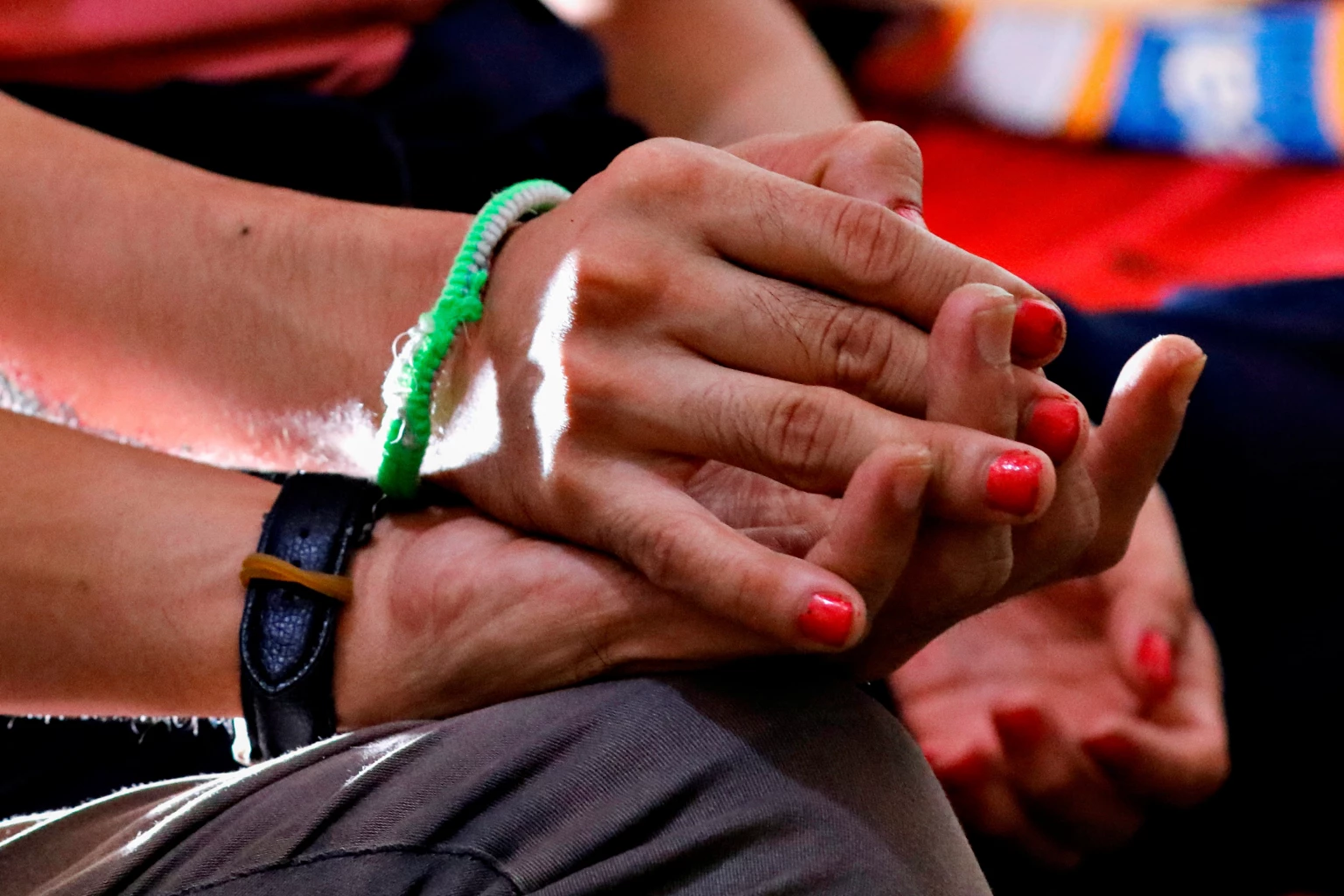
“We must be smart in the way we socialise. Not just with our extended family, even in our neighbourhood, we try not to behave intimately, we don’t hold hands like husband and wife. We act normal when we go outside, but we’re intimate in private places. We don’t do anything (intimate) in public,” says Eva as her partner holds her arm in the privacy of their home.
Classified documents from Biden’s vice presidency found at think tank
WEDNESDAY, JANUARY 11, 2023
President Joe Biden said on Tuesday he was surprised to learn that classified documents were found in a think-tank office he once used and said he and his team are cooperating fully with a review into what happened.
Biden told reporters at a joint news conference with the leaders of Mexico and Canada that he takes classified documents seriously. He said he did not know what was in the documents.
“We are cooperating fully with the review, which I hope will be finished soon,” Biden said.
Biden defended the handling of the documents.
“They found some documents in a box in a locked cabinet or at least a closet. And as soon as they did, they realized there were several classified documents in that box. And they did what they should have done. They immediately called the Archives,” he said.
“I was briefed about this discovery and surprised to learn that there were any government records that were taken there to that office, but I don’t know what’s in the documents,” he said.
He said his lawyers have suggested he not ask what was in the documents.
“I’ve turned over the boxes, they’ve turned over the boxes to the Archives, and we are cooperating fully with the review, which I hope will be finished soon. And there’ll be more detail at that time,” he said.
A Democrat, Biden has faced criticism from Republicans after his Justice Department launched an investigation last year into Republican former President Donald Trump’s handling of classified documents discovered at his Mar-a-Lago club in Palm Beach, Florida.
The cases differ in several ways.
Biden’s attorneys discovered fewer than a dozen classified records inside the office at the think tank and informed the US National Archives of their discovery, turned over the materials, and said they were cooperating with the Archives and the Justice Department.
By contrast, Trump kept thousands of government records, a few hundred of which were marked as classified, inside his Florida residence for more than a year after departing the White House, and did not return them immediately or willingly despite numerous requests by the National Archives.
Young Vietnamese lieutenant provides meals and education to 3,500 children
TUESDAY, JANUARY 10, 2023
To combat poverty and promote education in remote mountainous areas, Lieutenant Duong Hai Anh and various sponsors have come together to provide meals and schooling for more than 3,500 children.
One of their projects, “Nuôi em Mộc Châu” (Bringing up children in Mộc Châu), began in January 2021.
More than 3,500 students in 75 kindergartens in Moc Chau, Van Ho, and Bac Yen districts are receiving financial support for lunches through the project.
So far, the financial support is estimated at VNĐ9 billion (US$384,000).
Another project is “Hanh phuc cho em” (Happiness for children), which started in December 2021.
The project built 16 schools and four houses and gave scholarships to poor students in Moc Chau, Van Ho, Yen Chau, Muong La and Quynh Nhai districts, worth more than VNĐ3.4 billion ($145,200).
Anh and his 38 partners run the two projects. Most of them are police in Son La Province and students.
Anh achieved his dream in 2015 when he passed the entrance exam to the People’s Police Academy. Since then, he has enthusiastically joined the youth union’s campaigns.
But Anh does not forget his main task of studying. With excellent learning results, Anh has received many certificates of merit from the Ministry of Public Security.
After graduating from school in 2019, Anh was assigned to the traffic and public order police team in Moc Chau District Police, in charge of managing the Long Sap border gate, which is a drug hotspot.
“At that time, my station is right next to a kindergarten. Every day I see children going to school carrying only rice and water bottles to mix with rice. Therefore, every child has a very big belly but a small body, stunted and malnourished. I feel so sorry,” said Anh.
He came up with the idea to support the children with lunch. Initially, only 54 children in Long Sap received support. Then, the word spread and the number of beneficiaries increased.
To help the children, Anh and his comrades called for sponsors in social networks, including the youth union, women’s association, the police and the community.
Nguyen Thi Quyen, deputy principal of the Phong Lan Kindergarten in Moc Chau District, said that when the projects had not been implemented, the students were very miserable.
They had to quit school to help their parents in the fields.
“The projects have helped us a lot, encouraged parents to let their children go to school, reduce the rate of malnourished children and raise children’s awareness,” she said.
Ngọc Anh, deputy head of the Bringing up children in Moc Chau project, said that Hai Anh’s work was meaningful.
“I’m a lot older than Hai Anh. He’s a young man but has a great heart. He can do things my generation has not thought of and dare not do. Hai Anh is an example which we can learn from. I admire Hai Anh for his activities. He is also the inspirer to all members of the projects,” said Ngoc Anh.
Hai Anh said, “Happiness is sharing. For me, the happiness I give to others is forever”.
Besides volunteer work, Anh also does his profession very well.
He is compiling a handbook about fighting online crimes, the first kind of handbook in the country.
“When doing charity work, we insert knowledge about the law to the people, especially at the schools we built. We spread information about Children’s Law and drug-related crime prevention. The work is not only highly appreciated in Son La Province but also nationwide,” said Anh.
Being active in volunteering activities but did not forget to complete the police’s duty, particularly in 2021 successfully, Anh was awarded two certificates of merit from the Son La Province Police and one certificate of merit from the Ministry of Public Security.
He also received the National Volunteer Award in 2021.




 Number of first marriages for women in their 20s and 30s (Korean Statistical Information Service)






 SootinClaimon.Com