
Visiting a Rohingya refugee camp was the most heart-wrenching medical mission I’ve undertaken

ศาสตร์เกษตรดินปุ๋ย : ขอบคุณแหล่งข้อมูล : หนังสือพิมพ์ The Nation

http://www.nationmultimedia.com/detail/asean-plus/30331726

Visiting a Rohingya refugee camp was the most heart-wrenching medical mission I’ve undertaken

ASEAN+ November 16, 2017 09:48

By Minal Ahson
Dawn
Asia News Network

I have visited many poverty-stricken, underserved areas of the world on medical missions. However, my most recent trip to the Rohingya refugee camp in Ukhiya, Cox’s Bazar in Bangladesh, marked the first time that I have ever cried during fieldwork.

Stories of suffering usually affect me after the adrenaline has worn off and the fatigue has set in – most often on my long plane ride back home or during jet-lagged nights as I lie awake, remembering the patients I have left behind.

Children play by the water pump at the base of the refugee camp. -All photos by author unless stated otherwise

Children play by the water pump at the base of the refugee camp. -All photos by author unless stated otherwise


This time, however, things were different and the emotional toll my work at the Rohingya camp took on me was greater than ever before.

I had come to Bangladesh as part of the MedGlobal assessment team — a group of doctors, nurses and public health professionals tasked by the NGO with the huge responsibility of determining the needs of the population and initiating a primary health care clinic in the middle of the camp.

One of the pathways leading to the crowded tents of the camp.

One of the pathways leading to the crowded tents of the camp.


One day in the camp, after listening to an elderly lady’s breathing to diagnose pneumonia, I went to find water so that she could take her first dose of antibiotics. Upon my return, I found tears in the eyes of my Bengali/Urdu-speaking male interpreter.

After many childhood summers in Karachi, I knew well enough that for a man to show his vulnerability like this in a public place, especially around relative strangers, is not typical in this part of the world. So something must have been very disturbing.

The campsite overlooking the roofs of the tents.

The campsite overlooking the roofs of the tents.


When I asked him what happened, he just shook his head and told me that our patient was describing how she and her frail husband had witnessed their three adult sons being killed by the Myanmar army. They also saw one of their young grandchildren being thrown into a fire.

Despite the unimaginable horrors they had experienced, somehow, the couple managed to travel for days to reach Bangladesh with their granddaughter. The young girl had accompanied her grandmother to the clinic and could not have been older than eight or nine.

MedGlobal Needs Assessment Team along with local staff in the clinic.

MedGlobal Needs Assessment Team along with local staff in the clinic.


The child would get daily rations of food and water for her elderly grandparents. Seeing how this little one was bravely shouldering the responsibility for the care of her aging grandparents not only brought tears to my eyes, but also made me worry about her future. What would happen to her after they are gone?

Maybe she would become like the three children we met as we explored the makeshift refugee camps in the Kutupalong and Balukhali areas of Ukhiya. The site consisted of about 800,000 people and was comprised of tents made from flimsy tarps and bamboo poles pitched on dirt ground, which turned into slippery mud during the monsoon rains.

The MedGlobal/Hope Foundation Clinic

The MedGlobal/Hope Foundation Clinic


These children were brought across the border because their parents were killed in Myanmar. They are being raised by distant relatives.

Their story was told to us by a man who spoke both Rohingya and Bengali. He was standing outside of his small tent, in which he lived with his four children, wife and two other family members.

These children just crossed the Naf River to Bangladesh a few hours prior to this picture being taken. Myanmar can be seen in the background.

These children just crossed the Naf River to Bangladesh a few hours prior to this picture being taken. Myanmar can be seen in the background.


As he stood outside his makeshift home, he told us another story of the lady in the neighbouring tent, who walked nine days over mountains, at eight months pregnant, with her three other children, to reach safety. Her husband was back in Myanmar, and she was unsure of his fate.

Editorial: Rape in Myanmar

So many women had made this difficult journey by foot or boat while pregnant. These women brought their tiny babies to the clinic to be checked by a doctor; tiny likely due to premature births and lack of hydration/nutrition of the mother, which leads to decreased breast milk production.

Refugees carrying bags of food and supplies in the monsoon floods. Photocredit: Maren Wolf

Refugees carrying bags of food and supplies in the monsoon floods. Photocredit: Maren Wolf


One baby sticks out in my memory. She was extremely small and had a sickly appearance. I took her temperature and found out she was flush with fever.

Normally, a baby in her condition would be rushed to the emergency room for blood work, a lumbar puncture, and IV antibiotics. As I tried to keep calm and decide what to do, I asked the interpreter to ask the mother how old the baby was. He replied, “Twenty something days.”

I asked again, saying that I needed a more precise answer. The mother replied and again my interpreter shook his head in sadness: “She says that the baby was born on her journey here, which she had made on foot. She walked for so long that the days and nights blended together, so she does not know how old the baby is.”
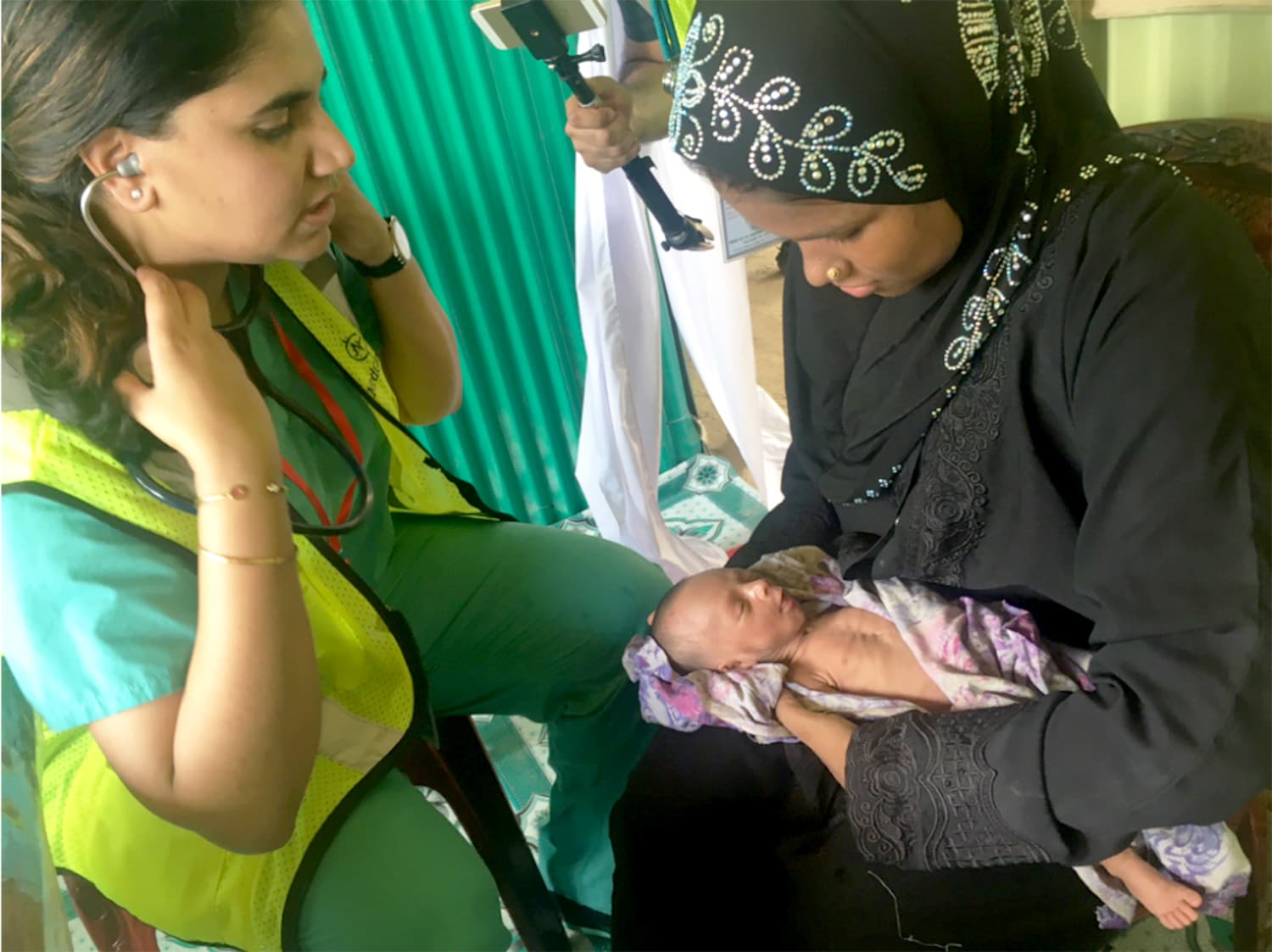
Dr. Minal Ahson examining a very small newborn.

Dr. Minal Ahson examining a very small newborn.


In the doctor’s room next door, my colleague was dealing with a similar situation – a malnourished, tiny baby with a fever.

After writing our assessments and findings on a referral form, we spoke to the local staff and arranged a tom tom (rickshaw) to take both babies to the nearest hospital. We returned to the queues of patients waiting for us, busy again with physical exams and dispersing medications.

A few hours later, I asked the clinic manager if the babies reached the hospital safely. He stated, “One of them did. The other one went home with the mother. She said she needed to ask her husband permission to take the baby to the hospital.”

A mother holds her sick child at the clinic. Photocredit: Farida Ahmad

A mother holds her sick child at the clinic. Photocredit: Farida Ahmad

My heart stopped. Did the mother not realise how sick the baby was? That the baby could die? Why did the staff let that happen?

I had a long discussion with the clinic manager about the seriousness of the situation. I asked him to inform us the next time this happens so that we can educate not only the mother, but also the father. This particular scenario really opened my eyes to navigating cultural boundaries and norms.

MedGlobal Needs Assessment Team exploring the camp. Photocredit: Farida Ahmad

MedGlobal Needs Assessment Team exploring the camp. Photocredit: Farida Ahmad


Many of these patients had never seen a doctor before due to their socioeconomic status in Myanmar. Most of them had acute complaints – respiratory infections, gastroenteritis, dehydration.

There were descriptions by many women of post-traumatic stress disorder, with symptoms of insomnia due to anxiety and flashbacks. But occasionally, I found a case that made me wonder if we were even equipped to provide appropriate treatment in such a resource-limited setting:

The eight-year-old with huge lymph nodes sticking out of his neck, pointing to systemic tuberculosis or cancer; the man with one-sided weakness likely due to a stroke; or the child with a neuromuscular disorder who stopped walking.

Children stand outside what is now their home.

Children stand outside what is now their home.


In a proper medical facility, these conditions would easily be worked up with biopsies and MRIs. However due to our lack of resources, all I could do was offer a smile, encouragement, and offer a prayer.

These are just a few of the many horrific stories I heard during my time at the refugee camp. Each of the hundreds of thousands who have fled Myanmar, now and over the years, have a tale equally heart-wrenching.

Since returning home, I have had multiple people tell me that the first time they had heard of the conflict was through me. This has reinforced my motivation to stand up and speak out for this neglected group of people.

Broad-economic sanctions against Myanmar would not be advisable at this time: US Secretary of State

ศาสตร์เกษตรดินปุ๋ย : ขอบคุณแหล่งข้อมูล : หนังสือพิมพ์ The Nation

http://www.nationmultimedia.com/detail/asean-plus/30331725

State Counsellor Daw Aung San Suu Kyi and US Secretary of State Rex Tillerson held a joint press release in Nay Pyi Taw on November 15.

Broad-economic sanctions against Myanmar would not be advisable at this time: US Secretary of State

ASEAN+ November 16, 2017 09:43

By Nay Rine & Kyaw Zin Win
Eleven Media

In a joint press release in Nay Pyi Taw on November 15, US Secretary of State Rex Tillerson said broad-economic sanctions would not help Myanmar in solving the Bengali issue at this time.

He held separate talks with Myanmar State Counsellor Daw Aung San Suu Kyi and Commander-in-Chief of Defence Services Senior General Min Aung Hlaing in Nay Pyi Taw on November 15.

Rex Tillerson arrived in Myanmar on November 15 to pay one-day visit.

US Secretary of State Rex Tillerson formally met Commander-in-Chief of Defence Services Senior General Min Aung Hlaing in Nay Pyi Taw. The meeting mainly focused the real situations of terror attacks in Rakhine State and the exodus of Bengalis, the re-acceptance of refugees in accord with the law, the fair distribution of humanitarian assistance, full cooperation between the government and the Tatmadaw and cooperation between the armed forces of the two countries in the eradication of narcotic drugs and counter-terrorism.

Afterwards, the US Secretary of State Rex Tillerson held a talk with Myanmar State Counsellor Daw Aung San Suu Kyi at the Ministry of Foreign Affairs in Nay Pyi Taw. Both sides cordially exchanged views on the success of democratic transition, US’s continued assistance for national reconciliation efforts and the situations in Rakhine state.

In a joint press release between Secretary of State Rex Tillerson and State Counsellor Daw Aung San Suu Kyi, Rex Tillerson said: “Broad-based economic sanction against the entire country is not something that I would think would be advisable at this time. I think we want to see Myanmar succeed.”

“I have called on Myanmar’s civilian government to lead a full and effective, independent investigation, and for the military to facilitate full access and cooperation. We remain dedicated to Myanmar’s successful transition, which we are confident will bring peace and prosperity to this rich and beautiful land. The crisis in Rakhine State is one of the greatest challenges Myanmar has faced since the elected government came into office last year. The United States will provide an additional $47 million in humanitarian assistance for refugees, bringing the United States response to the Rakhine State crisis in Myanmar and Bangladesh to more than $87 million since August of this year. The United States and friends from around the region are committed to helping the Government of Myanmar and its people work through this crisis with urgency, sensitivity, and openness,” he added.

State Counsellor Daw Aung San Suu Kyi said: “I haven’t been silent. Actually, we’ve been sending out a lot of statements from my office, and I’ve also made statements of my own. But I think what people mean is that what I say is not interesting enough. But what I say is not meant to be exciting, it’s meant to be accurate. And it’s aimed at creating more harmony and a better future for everybody, not for setting people against each other.”

“Doing politics does not intend to build authority. It aims to enable Myanmar people to enjoy the fruits of rule of law, peace and economic development. In politics, opposition is not a strange thing.  In the past, there were oppositions inside and outside the country. Now the people in the country have more understanding. The country still faces oppositions outside the country. It is natural that we shall face such circumstances when we are involved in politics. I bear in my mind that I shall face these matters while performing duties,” she added.

Rex Tillerson arrived in Myanmar on November 15 after attending the 31st ASEAN Summit and related meetings in the Philippines.

On November 14, State Counsellor Daw Aung San Suu Kyi held a talk with Rex Tillerson in Manila of the Philippines. The separate talk focused democratic transition, peace process, economy and investments between the two countries and the latest development in Rakhine State.

Trump defends Asia trip, vows ‘maximum pressure’ on N.Korea

ศาสตร์เกษตรดินปุ๋ย : ขอบคุณแหล่งข้อมูล : หนังสือพิมพ์ The Nation

http://www.nationmultimedia.com/detail/asean-plus/30331720

x

Trump defends Asia trip, vows ‘maximum pressure’ on N.Korea

ASEAN+ November 16, 2017 07:46

By Agence France-Presse
Washington

US President Donald Trump hit back at critics of his recent Asia trip and vowed a global campaign of “maximum pressure” on North Korea Wednesday, warning Pyongyang will not subject the world to “nuclear blackmail.”

Defending an almost two week trip to Asia that was long on pomp but — critics say — short on achievements, Trump said he had successfully galvanized opposition to North Korean proliferation.

“I made clear that we will not allow this twisted dictatorship to hold the world hostage to nuclear blackmail,” Trump said in a televised statement a day after returning from the marathon trip.

During a 25 minute address, Trump repeatedly reached for a bottle of water and appeared worn by the long journey that took in Hawaii, South Korea, Japan, China, Vietnam and the Philippines.

Always keen to garner praise and lift up examples of others showing him respect, Trump said the red carpet rolled out for him in Asia showed that “America is back.”

“Everywhere we went, our foreign hosts greeted the American delegation and myself included with incredible warmth and hospitality and most importantly respect,” he said.

Trump and his supporters are fighting a rearguard action against suggestions that the trip was a failure.

They are pointing to a series of Asian investments in the United States and the release of three US basketball players on Chinese shoplifting charges, after presidential intervention, as evidence it was a success.

Adding to that, Trump himself said that he had won a commitment from Chinese leader Xi Jinping to use Beijing’s economic leverage to denuclearize the Korean peninsula.

It was not clear if that went beyond Chinese implementation of existing UN Security Council resolutions against Pyongyang.

Trump also suggested that Xi — who will send a special envoy to Pyongyang later this week — had ditched a proposal to freeze US military maneuvers in exchange for a freeze in North Korean proliferation.

“President Xi recognizes that a nuclear North Korea is a grave threat to China,” Trump said. “And we agreed that we would not accept a so-called ‘freeze for freeze’ agreement like those that have consistently failed in the past.”

There was no immediate confirmation of what would be a significant shift in Chinese policy from Beijing’s embassy in Washington.

Welcome home

Democratic Senator Edward Markey summed up the sentiment of many in his camp in saying that Trump failed to “make meaningful progress” on “critical economic and security issues during his trip to East Asia.”

“Rather than building on the messages in Japan and South Korea on the importance of trilateral unity in the face of the North Korean threat, President Trump tweeted about how hard he has tried to be North Korea’s friend and called Kim Jong Un ‘short and fat,'” he said.

Aside the furor over Trump tweets, his visit also saw 11 Asia-Pacific allies announce they would press ahead with a free trade agreement known as the Trans-Pacific Partnership.

That was seen as a diplomatic slap in the face and evidence that the world was looking beyond America’s mercurial and nationalistic current leadership.

“The US is out of the game,” said Nate Olson of the Stimson Center. “While the US posture alternates between defensive and scorched-earth, other countries are actively fighting to reshape the trade landscape in their favor.”

“The progress toward a successor to the Trans-Pacific Partnership is just the latest example.”

World leaders plead for climate action at UN forum

ศาสตร์เกษตรดินปุ๋ย : ขอบคุณแหล่งข้อมูล : หนังสือพิมพ์ The Nation

http://www.nationmultimedia.com/detail/asean-plus/30331716

x

World leaders plead for climate action at UN forum

ASEAN+ November 16, 2017 07:14

By Agence France-Presse
Bonn

World leaders shared the spotlight with a 12-year-old Pacific islander on Wednesday to drive home a plea for urgent climate action despite the Trump administration’s rejection of a planet rescue plan.

UN chief Antonio Guterres, French President Emmanuel Macron and German Chancellor Angela Merkel led the diplomatic push in Bonn, but it was a small boy with a big smile who got the message across.

“My home, my school, my source of food, water, money was totally destroyed. My life was in chaos,” Timoci Naulusala, whose village in Fiji’s Tailevu province was hit by a devastating cyclone last year, told hundreds of delegates including some 25 heads of state and government.

“My once beautiful village is now a barren and empty wasteland… Climate change is here to stay unless you do something about it.”

The boy received rousing applause before shaking hands with some of the most powerful people in the world and posing for photographs at the 23rd annual round of UN climate talks.

The leaders descended on Bonn to re-energise negotiations hamstrung by America’s rejection of the 2015 Paris Agreement.

They were met in the morning by anti-fossil fuel protesters waving posters proclaiming: “Clean coal is a dirty lie” and “Stop corporate capture of the climate”.

The Paris pact, which Donald Trump announced in June the US would abandon, took more than two decades to negotiate and envisions a drawdown of Earth-warming greenhouse gas emissions from burning coal, oil and gas.

Labelling climate change “the defining threat of our time”, Guterres told delegates that continued investment in fossil fuels made no financial sense and was “counterproductive”.

“We must stop making bets on an unsustainable future that will place savings and societies at risk,” he said.

Macron, for his part, described climate change as “the most significant struggle of our time”, and urged European countries to open their wallets for the UN’s IPCC climate science panel, which is facing a critical budget shortfall.

– Central challenge –

Trump cut funding to the IPCC, to which the US traditionally contributed about $2 million (1.7 million euros) a year — representing almost half of its 2016 budget.

A collaboration of thousands of experts worldwide, the panel issues reports every few years and is widely considered as the authority on global warming science.

“I can guarantee that starting in 2018 the IPCC will not be short a single euro,” Macron said to loud applause.

Merkel agreed climate change was “a, if not the, central challenge of mankind,” adding the world must “stand together to implement” the Paris Agreement.

The pact commits countries to limiting average global warming to under two degrees Celsius (3.6 degrees Fahrenheit) over Industrial Revolution levels, and 1.5 C if possible, to avert calamitous climate change-induced storms, drought and sea-level rises.

To bolster the agreement, nations submitted voluntary commitments to curb emissions.

But the 1 C mark has already been passed.

A report Wednesday said America’s withdrawal would boost global temperatures, calculated on current country pledges, by nearly half a degree Celsius by 2100, for a total of 3.2 C.

To widespread disappointment, Merkel said the shift away from fossil fuel was not always “that easy”.

Coal still provides about 40 percent of Germany’s electricity needs, and the country is set to miss its own goal of cutting emissions by 40 percent by 2020 from 1990 levels.

“We have a long way to go yet,” the chancellor conceded, adding that job retention and economic viability must be considered when weighing energy projects.

“Mrs Merkel… needed to come to Bonn and show she had heard the suffering of the people of the Pacific and around the world and would do the responsible thing and end coal. She did not deliver this,” said Jennifer Morgan, a Greenpeace executive director.

Back home, the issue has dogged Merkel’s efforts to form a coalition government of her conservative allies, the anti-coal Greens and the pro-industry Free Democrats.

– Lone outsider –

Since Monday last week, bureaucrats in Bonn have haggled over a Paris Agreement “rule book”, which will specify how countries must calculate and report their emissions cuts.

Now it is the turn of energy and environment ministers to unlock issues above the pay grade of rank-and-file negotiators — with climate finance from rich to poor countries the main sticking point.

The task has been complicated by the presence of White House officials who hosted a sideline event Monday defending the continued use of fossil fuels.

The highest ranking American at the talks is an acting assistant secretary of state, Judith Garber, who is due to address the conference on Thursday.

This week, Syria became the 196th country to formally adopt the pact, leaving America as the only nation in the UN climate convention to reject it.

‘Mounting evidence’ of Myanmar genocide: watchdogs

ศาสตร์เกษตรดินปุ๋ย : ขอบคุณแหล่งข้อมูล : หนังสือพิมพ์ The Nation

http://www.nationmultimedia.com/detail/asean-plus/30331712

General view of the Thankhali refugee camp in the Bangladeshi district of Ukhia on November 15, 2017./AFP PHOTO / Munir UZ ZAMAN

‘Mounting evidence’ of Myanmar genocide: watchdogs

ASEAN+ November 16, 2017 06:31

By Agence France-Presse
Washington

Myanmar security forces slit the throats of Muslim Rohingya and burned victims alive, watchdogs said in a report on Wednesday that cited mounting evidence of genocide against the minority group.

The report by the United States Holocaust Memorial Museum and Southeast Asia-based Fortify Rights documents “widespread and systematic attacks” on Rohingya civilians between October 9 and December of last year, and from August 25 of this year.

The 30-page report, entitled “They tried to kill us all,” is based on more than 200 interviews with survivors and eyewitnesses, as well as international aid workers.

Some world leaders have already described as “ethnic cleansing” the scorched-earth military campaign against the Rohingya.

Evidence gathered by Fortify Rights and the Holocaust Museum demonstrates that “Myanmar state security forces and civilian perpetrators committed crimes against humanity and ethnic cleansing” during two waves of attacks in the majority Buddhist nation, the report says.

“There is mounting evidence to suggest these acts represent a genocide of the Rohingya population,” it says.

Almost 700,000 Rohingya, more than half of the population in northern Rakhine state, have been forcibly displaced since October last year when Myanmar’s army began “clearance operations” after a previously unknown group attacked and killed security officers.

Those operations were, in practice, “a mechanism to commit mass atrocities,” the report said.

“State security forces opened fire on Rohingya civilians from the land and sky. Soldiers and knife-wielding civilians hacked to death and slit the throats of Rohingya men, women, and children,” it said.

“Rohingya civilians were burned alive. Soldiers raped and gang-raped Rohingya women and girls and arbitrarily arrested men and boys en masse.”

The report said investigators from Fortify Rights and the Holocaust Museum’s Simon-Skjodt Center for the Prevention of Genocide traveled to Rakhine and the Bangladesh-Myanmar border area, where Rohingya have fled.

It quoted eyewitness testimony of mass killings in three villages in late August.

“When the killing was complete, soldiers moved bodies into piles and set them alight,” after soldiers reportedly murdered hundreds in one attack, the report said, adding to chilling and consistent accounts of widespread murder, rape and arson at the hands of security forces and Buddhist mobs.

Global outrage is building over the violence, while Myanmar’s army insists it has only targeted Rohingya rebels.

The watchdogs’ report came a day after Washington’s top diplomat, Secretary of State Rex Tillerson, said there were “credible reports of widespread atrocities committed by Myanmar’s security forces and vigilantes.”

Speaking during a visit to Myanmar, he urged authorities there to accept an independent investigation into those allegations.

The army and administration of de facto civilian leader Aung San Suu Kyi — a Nobel peace laureate — have dismissed reports of atrocities and refused to grant entry to UN investigators tasked with probing allegations of ethnic cleansing.

“Without urgent action, a risk of further outbreaks of mass atrocities exists in Rakhine state and possibly elsewhere in Myanmar,” Fortify Rights and the Holocaust Museum wrote.

At least seven die in Greece flash flood

ศาสตร์เกษตรดินปุ๋ย : ขอบคุณแหล่งข้อมูล : หนังสือพิมพ์ The Nation

http://www.nationmultimedia.com/detail/asean-plus/30331701

Cars float on the national road at Mandra, near Athens, Greece, 15 November 2017. // EPA-EFE PHOTO

At least seven die in Greece flash flood

ASEAN+ November 15, 2017 19:38

By Athens

At least seven people died on Wednesday and more were missing after a strong overnight downpour flooded three towns in Greece, officials said.

The flooding struck the towns of Mandra, Nea Peramos and Megara, a semi-rural area west of Athens where many warehouses are located.

“Everything is lost, the disaster is biblical,” Mandra mayor Ioanna Kriekouki told state TV ERT.

A general view of the flood on a national road at Mandra, near Athens, Greece, 15 November 2017. // EPA-EFE PHOTO

“We have people who are trapped… we need machinery to get them out of their homes,” said Kriekouki, who was also immobilised in her home.

Five people were found inside and outside their homes, the fire department said. Another two bodies were found in the coastal areas of Aspropyrgos and Elefsina, the coastguard said.

State TV ERT said at least three more people were missing.

Prime Minister Alexis Tsipras said the deaths had been caused by “disastrous flood” and expressed deep sorrow.

A driver tries to escape from his car stuck on a flooded road in Mandra, near Athens, Greece, 15 November 2017. // EPA-EFE PHOTO

TV images showed large vehicles such as tanker trucks, buses and lorries nearly completely submerged in the muddy torrent.

The fire service said it had received over 300 calls for help and dispatched over 120 firemen to the area.

Damaged vehicles piled up in Mandra, near Athens, Greece, 15 November 2017.  // EPA-EFE PHOTO

Rare 5.4-magnitude quake hits southern S. Korea

ศาสตร์เกษตรดินปุ๋ย : ขอบคุณแหล่งข้อมูล : หนังสือพิมพ์ The Nation

http://www.nationmultimedia.com/detail/asean-plus/30331687

Bricks that fell off a building after a 5.4-magnitude earthquake are seen on the ground in the southeastern port city of Pohang on November 15, 2017. // AFP PHOTO

Rare 5.4-magnitude quake hits southern S. Korea

ASEAN+ November 15, 2017 17:47

By Agence France-Presse
Seoul

2,085 Viewed

A rare 5.4-magnitude earthquake hit South Korea’s southeast Wednesday afternoon, the second most powerful quake on record in a country that seldom experiences significant tremors.

The quake, felt across much of the country including in the capital Seoul, struck at the shallow depth of nine kilometres (six miles) near the industrial city of Pohang at around 2:30 pm (0530 GMT), the Korea Meteorological Administration said.

Bricks that fell off a building after a 5.4-magnitude earthquake are seen on the ground in the southeastern port city of Pohang on November 15, 2017. // AFP PHOTO

Seven people were injured, Seoul’s public administration ministry said, but they warned that number could rise because the quake was shallow.

The Korean peninsula is rarely troubled by significant quakes.

But seismic activity is closely monitored because a spike in activity is often the first indication that North Korea has carried out a nuclear test.

The port city of Pohang is home to the headquarters of Posco, the world’s fourth largest steelmaker. No immediate damage was reported in the firm’s steel mills.

Photos and video footage sent to local TV stations showed crumbled street walls, furniture violently shaking inside people’s homes and people rushing out of buildings in panic.

Shattered storefronts and goods tumbling off store shelves were seen in images posted on social media, as well as cars smashed by fallen bricks and cracks in the ground.

Emergency centres nationwide were flooded with thousands of calls seeking information, while Kakao Talk — the South’s top mobile messenger application — reported service disruption due to heavy traffic.

South Korean students take shelter after a 5.4-magnitude earthquake struck in the southeastern city of Daegu on November 15, 2017.// AFP PHOTO

Wednesday’s quake was followed by multiple aftershocks including a 4.3-magnitude tremor that hit about two hours later.

It came a day ahead of the all-important college entrance exam during which the whole nation falls silent to help teenagers focus on the annual event, whose result could define their future in the competitive society.

As many fear more quakes that may take place on the crucial day, South Korean President Moon Jae-In ordered officials to stay prepared in a bid to ensure that Thursday’s test is held smoothly.

“The president ordered officials to… prepare all possible measures to help students keep their mind stable during the test,” his spokesman said after Moon held an emergency meeting with advisors.

Even Seoul’s financial markets and many businesses open late on the day to clear traffic for test-takers, with airport landing and takeoffs suspended for 30 minutes during the main language listening test.

Local nuclear reactors were operating without disruption, Yonhap news agency said, citing officials at Korea Hydro and Nuclear Power.

The most powerful quake recorded in the South was a 5.8-magnitude tremor that hit the southeastern city of Gyeongju in September last year.

China assures ASEAN, world leaders of safe navigation

ศาสตร์เกษตรดินปุ๋ย : ขอบคุณแหล่งข้อมูล : หนังสือพิมพ์ The Nation

http://www.nationmultimedia.com/detail/asean-plus/30331643

Premier Li Keqiang (8th L) and other leaders attending the 12th East Asia Summit pose for a group photo before the meeting in Manila, Philippines, Nov 14, 2017. [Photo/Xinhua]

China assures ASEAN, world leaders of safe navigation

ASEAN+ November 15, 2017 10:25

By Zhang Yue in Manila
China Daily
Asia News Network
Manila

Chinese Premier Li Keqiang said on Tuesday that China will firmly safeguard freedom of navigation and overflight in the South China Sea.

He said China, as the largest country in the South China Sea and a major user of its sea lanes, wants peace and stability for the region more than any other country.

Li made the remarks at the 12th East Asia Summit in Manila on Tuesday afternoon.

Leaders of the 10 Association of Southeast Asian Nations countries as well as those from the Republic of Korea, Russia, Japan, India, Australia, New Zealand and the United States attended the meeting, chaired by Philippine President Rodrigo Duterte. The meeting was part of the ASEAN summit held in Manila.

Since 2005, the annual meeting of leaders of 18 countries, including 10 ASEAN member states and eight dialogue partners, serves as a forum for dialogue on broad strategic issues of relevance to East Asia as well as other regional and global issues, focusing on areas such as international terrorism, energy, infectious diseases, sustainable development and poverty reduction.

The situation in the South China Sea has been cooling down, Li said.

Noting that China and ASEAN announced plans to begin the next step of consultation on the text of a code of conduct in the South China Sea on Monday, Li said this shows a willingness from both China and ASEAN countries to properly handle differences through consultation and maintain peace and stability for the South China Sea.

He said the regional countries have the confidence, wisdom and ability to properly handle the South China Sea issue and turn the area into a sea of stability, friendship and cooperation.

The premier pointed out that over the past 12 years, the summit has become an important platform for maintaining regional stability and dialogue on key issues, particularly at present when the global economy is still in a sluggish recovery and trade protectionism is on the rise.

He said the East Asia Summit should remain a strategic forum guided by national leaders and adhere to the principle of being driven by both economic development and political security.

During the meeting, Li called for efforts to build a regional economic community and promote collaboration between China’s Belt and Road Initiative and Master Plan on ASEAN Connectivity 2025, as well as to work toward an early implementation of the upgrade to the China-ASEAN Free Trade Area.

He also proposed cooperation to promote regional sustainable development, social development and the fight against nontraditional security threats and called on regional countries to further research improving the Asia-Pacific security framework.

The meeting concluded with an announcement of several packs of cooperation documents, including declarations of cooperation on poverty alleviation, preventing terrorism and curbing money laundering and terrorism financing.

Guo Yanjun, deputy director of the Institute of Asian Studies at China Foreign Affairs University, said the premier’s reiteration of China’s stance on the South China Sea issue sends a signal that China has the competence and wisdom to properly handle the issue.

Which Asian country has suffered most financial loss due to ​climate ​change?

ศาสตร์เกษตรดินปุ๋ย : ขอบคุณแหล่งข้อมูล : หนังสือพิมพ์ The Nation

http://www.nationmultimedia.com/detail/asean-plus/30331633

Which Asian country has suffered most financial loss due to ​climate ​change?

ASEAN+ November 15, 2017 08:33

By DataLEADS
Asia News Network
NEW DELHI

2,991 Viewed

The Global ​Climate Risk Index for 1996-2015 reveals that China has suffered the most financial loss​.

With losses amounting to US$​ ​32,847 million since 1996, China has borne the brunt of financial loss due to climate change, as per the ranking released by the Germanwatch, a Berlin-based development and environmental organisation, in its latest ​Global ​Climate ​R​isk ​Index (CRI).

India has suffered a loss of US$11,335 million to the impact of climate change, such as stark weather events, sea level rise or desertification.

Analysing the relevant data of past 20 years (1997-2016), the CRI report Philippines, Bangladesh, Pakistan and Vietnam in top-10 most vulnerable countries to climate change.​ The report found that the world has suffered financial losses to the tune of $3.16 trillion as a direct result of more than 11,000 extreme weather events during the period.

In Asia, besides China and India, Thailand, Pakistan and Japan have been at the receiving end of the negative economic consequences of climate change.

Thailand has suffered losses to the tune of US$7574 million between 1996 and 2015 owing to climate change effects, while Pakistan and Japan have both faced losses up to US$3823 million and US$2441 million each during the same period.

Vietnam, Indonesia, Philippines, Bangladesh, Myanmar and South Korea have all suffered major financial losses as well due to climate change.

Most of these Asian countries which have suffered losses due to climate change are developing nations, with some like Bangladesh and Philippines being particularly vulnerable to the effects of climate change.

The total loss of Bangladesh due to climate change effects was US$2283 million, while for Philippines it was US$2761 million.

Unlike these  nations, Bhutan, Singapore and Brunei have been among the least suffering economies when it comes to financial damage due to climate change, according to the Climate Risk Index data.

Smaller economies like Nepal, Sri Lanka, Laos and Cambodia have also suffered substantial financial losses owing to Climate change consequences.  Sri Lanka has lost US$234 million, Nepal has lost US$107 million, Laos and Cambodia have each lost US$75 and US$241 million respectively between 1996 and 2015.

According to a study conducted by the London School of Economics last year, Climate change could wipe off the world’s financial assets by $2.5trillion.

Asian countries in particular may prove to be the most acutely affected by soaring temperatures or extreme weather patterns attributed to climate change, a 2017 study by the Asian Development Bank has warned.

Australians back gay marriage in non-binding vote

ศาสตร์เกษตรดินปุ๋ย : ขอบคุณแหล่งข้อมูล : หนังสือพิมพ์ The Nation

http://www.nationmultimedia.com/detail/asean-plus/30331631

x

Australians back gay marriage in non-binding vote

ASEAN+ November 15, 2017 07:12

By Agence France-Presse
Sydney

Australians voted in favour of allowing same-sex couples to marry, official results showed Wednesday, sending the task of legalising marriage equality to a deeply divided parliament.

Almost 62 percent of the 12.7 million people who participated in the two-month postal survey voted in favour of allowing gay marriage, the Australian Bureau of Statistics announced at a press conference in Canberra. The “no” vote garnered 38.4 percent.

Nearly 80 percent of eligible voters took part in the poll, said the chief of the statistics bureau Davis Kalisch, adding: “Australians can have confidence these statistics reflect the view of the eligible population.”

Same-sex couples could be able to marry by Christmas, but first parliament must adopt legislation giving the non-binding vote result the force of law.

Thousands of marriage equality supporters erupted into celebrations at rallies in major cities across Australia when the result was announced.

“This means everything, this means everything,” repeated Chris, fighting back tears and hugging his partner Victor at a huge rally in Sydney.

– “Yes for love” –

Prime Minister Malcolm Turnbull, a moderate conservative who supported legalisation, called the “yes” vote an “overwhelming” endorsement of marriage equality.

“They (Australians) have spoken in their millions and they have voted overwhelmingly yes for marriage equality,” Turnbull told reporters in Canberra.

“They voted yes for fairness, yes for commitment, yes for love.”

He reaffirmed that his government would now push ahead with passing legislation to change the marriage laws by Christmas.

Turnbull defended the ballot’s legitimacy, and said he was confident of pushing the issue through parliament in a “conscience vote” where lawmakers are not obliged to vote along party lines.

But he must first battle hardline elements within his own ruling coalition who have demanded extensive “religious freedom” exemptions that would roll back discrimination laws.

This include allowing commercial service providers to reject same-sex weddings and let parents pull their children from school programmes they feel undermine heterosexual traditions.

Turnbull and the opposition Labor Party have backed a simpler draft bill that legalises gay marriage while allowing religious institutions to refuse to wed same-sex couples if they oppose the practice.

That bill is expected to be introduced in the Senate as early as Thursday.

A survey of federal politicians by the Australian Broadcasting Corporation published Tuesday found that 72 percent of the lower House of Representatives would support changes to marriage laws and in the Senate, 69 percent would approve the changes.

Wednesday’s result was a historic accomplishment for proponents of marriage equality after more than a decade of political wrangling and two months of voting, which highlighted deep divisions in Australian society over the issue.

“Yes” campaigners complained gay people and their families were subjected to hate speech, while “no” supporters argued they were being accused of being bigots for not favouring such unions.

Even before the ballot papers were sent out in September, the debate turned toxic with a poster emblazoned “stop the fags” put up in central Melbourne and flyers describing homosexuality as “a curse of death” distributed in suburban Sydney.

Amid public outcry over the hostile discourse, the government had to rush through legalisation to introduce safeguards during the campaign process, including tighter advertising restrictions.

Conservative opponents vowed before Wednesday’s result was announced to pursue their campaign for exemptions from the eventual legalisation of gay marriage, which they say will lead to attacks on their freedoms of speech and religion.

“If a ‘yes’ vote is returned, we will do what we can to guard against restrictions on freedom of speech and freedom of religion, to defend parents’ rights, and to protect Australian kids from being exposed to radical LGBTIQ sex and gender education in the classrooms,” Lyle Shelton, a spokesman for the Coalition for Marriage, said at the weekend.

“We promise our supporters that no matter the result, we will continue to work to defend Australian families,” he said.