Trump just crushed stimulus talks, endangering U.S. economy and 26 million on unemployment #ศาสตร์เกษตรดินปุ๋ย

#ศาสตร์เกษตรดินปุ๋ย : ขอบคุณแหล่งข้อมูล : หนังสือพิมพ์ The Nation.

Trump just crushed stimulus talks, endangering U.S. economy and 26 million on unemployment

Biz insightsOct 07. 2020President Donald Trump watches Marine One from the Truman Balcony on Monday, Oct. 5, 2020, as he returns to the White House after receiving treatments for covid-19. MUST CREDIT: Washington Post photo by Jabin Botsford
President Donald Trump watches Marine One from the Truman Balcony on Monday, Oct. 5, 2020, as he returns to the White House after receiving treatments for covid-19. MUST CREDIT: Washington Post photo by Jabin Botsford 

By The Washington Post · Heather Long · BUSINESS, US-GLOBAL-MARKETS
ECON-ANALYSIS

WASHINGTON – President Donald Trump’s surprise move Tuesday to shut down all negotiations on another big relief package until after the Nov. 3 election threatens to stall the U.S. economic recovery – or even trigger a backslide.

Many economists and business leaders were quick to dub the move disheartening and irresponsible. The stock market immediately sold off after the news, with the Dow Jones industrial average ending the day 376 points down. Companies from airlines to energy firms to restaurants have warned in recent days that they will have to undertake massive layoffs without more government aid. At least 75,000 layoffs were announced by major corporations at the end of last week alone, and Boeing has sharply pulled back its forecasts for airplane sales for years.

In short, the U.S. economy is about half recovered, meaning there is still a long way to go. For weeks, economists and business leaders have warned that the next phase of the recovery will likely be harder and it would be a huge mistake for politicians to think their job is done.

Even some right-leaning economists were calling for stimulus.

“If there isn’t more stimulus, the recovery is in danger of collapsing. It’s that simple,” said Peter Morici, an economist and emeritus business professor at the University of Maryland who has supported Trump’s reelection. “Waiting until after the election is waiting too long.”

There’s growing concern among economists about a downward spiral. As businesses cut more jobs, people have less money to spend, which means they buy less at stores, restaurants and other companies, putting those businesses and workers at risk.

Trump has tried to portray this recovery as a rapid bounceback – a “super V” shape when considered on a line chart – but there’s growing fear it could turn into more of a “W” shape with a second dip if layoffs and business closures escalate in the coming weeks.

“Corporations were holding off on laying off employees in the hopes of further stimulus,” said Peter Atwater, an adjunct lecturer in economics at the College of William & Mary. “With this afternoon’s news, I expect that we will see businesses capitulate and begin to announce large scale layoffs.”

This new wave of layoffs will add more to the ranks of the 26 million Americans who were receiving unemployment compensation. Many unemployed people say they no longer have enough money to pay for rent, cars, utilities or even food. The average unemployment-benefit payment fell from $900 a week to just over $300 at the end of July, a sharp reduction that makes it hard for many families to survive. As these people stop paying renting and car payments, it hurts landlords, firms and banks waiting for the money.

Hours before Trump’s tweet, Federal Reserve Chair Jerome Powell urged Congress to act quickly and go big on more aid, saying the risk was far greater of backsliding for inaction than doing too much.

“Too little support would lead to a weak recovery, creating unnecessary hardship for households and businesses,” Powell said at an event hosted by the National Association for Business Economics.

These fears are growing as the United States tries to contain the novel coronavirus, which causes the deadly illness covid-19. More than two dozen states have reported increases in cases in recent days. As case counts rise, people typically stay home and curtail spending. Rose and Sparrow Salon, a top rated hair salon in the District of Columbia, has seen a pickup in cancellations as people worry about venturing out, said owner Amie Adkins.

Trump tweeted that “the Stock Market is at record levels, JOBS and unemployment also coming back in record numbers,” but the reality is that about half the jobs lost in the spring, during the initial spike of the public health crisis, have returned.

Economists have warned for weeks that jobs that have returned are the low-hanging fruit and getting the rest of the jobs back will be more difficult, much like running the second half of a marathon.

Trump’s own treasury secretary, Steven Mnuchin, told Congress during a recent hearing that another round of stimulus was needed for small businesses and the unemployed.

“We should act quickly because they need the support now,” Mnuchin said told the Senate Banking Committee on Sept. 24. “They don’t need the support next year.”

Mnuchin and House Speaker Nancy Pelosi, D-Calif., were close to a deal for over $1.6 trillion in aid. The major disagreements were over how much help to give cash-strapped states, cities and the unemployed, but many felt a deal was within reach.

The momentum in negotiations came after the September jobs report. Permanent job losses are rising as people have been out of work for half a year. While the nation did add jobs in September, the gains were the slowest since the recovery and nearly a quarter of restaurant and hospitality jobs remain wiped out. State government and the education sector lost jobs in September, a red flag of what lies ahead for many states, cities and municipalities are running low on funding.

Fred Warf runs a small barbershop and salon called Hair FX in Chicago with his wife. Like many small business owners, he was really hoping for another round of government grants or loans like the Paycheck Protection Program that went to more than 5 million businesses.

Warf did receive a loan over the summer, but that money is long gone. He has been able to reopen, but like many “high contact” businesses, it’s nothing like before. Some clients still have not returned. His costs are up for all the protective gear and cleaning that he has to do in between clients. And a lot of people are still on edge. The business staff is down to him and his wife, but he’s still struggling to pay his landlord.

“My business has to change to make profitability, but what else can we cut?” said Warf, who is 62. “This was supposed to be my golden years to make money and it certainly is not.”

Warf says he’s staying in business largely because of his blue-collar clients. They still have to go to work in factories and warehouses, and they are willing to come in for regular haircuts. Yet, many of his white-collar Chicago office workers are “leery” to come in. As winter approaches, he’s worried about whether he can make it without more aid or more customers coming back.

The National Restaurant Association warned that 40% of restaurants are in danger of closing in the next six months without more aid. The American Hotel & Lodging Association warned thousands of hotels can’t pay toward their mortgages right now, putting them in danger of closing. Overall, 21% of small business warn that they will have to shut permanently if something doesn’t change in the next six months, according to a National Federation of Independent Business survey in August.

Economists, including those at the Fed, have built more government stimulus into their projections about the economic recovery. Without it, they warn the economy is likely to sputter again or even backslide.

“My forecast is, it may take until the end of 2021 to recover all of the economic output losses and three years to recover all the job losses,” said Lynn Reaser, chief economist at the Fermanian Business & Economic Institute at Point Loma Nazarene University. But she predicted a sharp “drop in economic activity” without more government stimulus.

Trump risks the nation backsliding economically, putting more jobs and business in danger of going away. He wanted a V-shaped recovery, but a W is looking more likely.

China announced new climate goals. But it can’t quit coal just yet. #ศาสตร์เกษตรดินปุ๋ย

#ศาสตร์เกษตรดินปุ๋ย : ขอบคุณแหล่งข้อมูล : หนังสือพิมพ์ The Nation.

China announced new climate goals. But it can’t quit coal just yet.

Biz insightsSep 30. 2020

China's President Xi Jinping

China’s President Xi Jinping

By Special To The Washington Post · Joanna Lewis · WORLD, ASIA-PACIFIC 
CHINA-ANALYSIS

China’s President Xi Jinping announced new climate targets during his Sept. 22 address to the U.N. General Assembly, including the nation’s plan to achieve carbon neutrality before 2060.

China’s international climate leadership seems to be in direct conflict with Beijing’s continued promotion of fossil fuel projects at home and abroad, however – so why did Xi make this announcement? Here’s what you need to know about its political and scientific implications.

– The timing of China’s announcement is strategic

It’s a big year for the 2015 Paris agreement – by year-end 2020, countries are supposed to submit their second round of “Nationally Determined Contributions” (NDCs), as well as their long-term strategies. Current NDCs target the 2025-2030 time frame, while long-term strategies target mid-century goals. Both are self-designed pledges tailored to each country’s circumstances.

Xi’s announcement suggests that, administratively, China expects to fulfill both 2020 requirements on time, a goal few other countries will probably meet. China is also on track to achieve its original Paris goals ahead of schedule. This lends some new credibility to China’s claim to climate leadership.

China is finalizing its 14th Five-Year Plan, which analysts anticipate will include new climate and energy targets for 2021-2025 that build upon those in previous Five-Year Plans. Since the Paris agreement has minimal enforcement mechanisms, it essentially relies on domestic policy to back up the goals pledged internationally. The 2020 Paris agreement deadline coincides with China’s domestic planning horizon, effectively giving the international community a look under the hood to understand how China plans to meet its international goals.

– External politics may factor into China’s plans

Making this announcement before the U.S. election could be a sign that China anticipates scaled-up U.S. pressure and demands on climate action if Democratic nominee Joe Biden wins in November. A new U.S. NDC would come sometime in 2021 at the earliest, so an early announcement from China would preclude the possibility of another round of coordinated U.S.-China climate targets, giving Beijing more autonomy this time.

The announcement may also appease the European Union. The EU has been increasing bilateral engagement with China in an attempt to fill the void left by the United States, which has dramatically reduced cooperation with China on energy and climate over the past four years. During a mid-September leader’s summit, the EU urged China to “to strengthen its climate commitments in terms of peaking carbon dioxide emissions and setting the goal of climate neutrality domestically,” and agreed to launch a new high-level dialogue in advance of the COP 26 major international climate summit, which has been postponed until November 2021.

China faces an uphill battle to reduce its carbon emissions

Beijing relies on high-level climate and energy goals to compel local governments to act. National targets become provincial targets, which become municipal-level targets, and so on – and meeting these targets affects the evaluation of local officials.

Sometimes this can create perverse incentives, such as the time people were left without heat in the winter so provinces would not violate national coal heating restrictions. But on the whole, targets are important levers in what is still primarily a top-down political system. Without stringent climate targets, local governments under pressure to stimulate the economy after the covid-19 slowdown will face few constraints on energy demand or infrastructure approvals.

Despite calls for a green recovery, China’s post-outbreak stimulus focuses primarily on promoting high-carbon energy and infrastructure projects. China has an estimated 249.6 gigawatts of coal power capacity under construction or in the planning stages – more than the entire coal capacity of the United States (246.2 GW) or India (229 GW).

This includes 40.8 GW of new coal capacity proposed in the first-half of 2020 alone, of which 17 GW is already permitted for construction. Despite rampant overcapacity and low utilization rates in existing plants, as well as record low prices for the renewable energy technologies that China leads the world in deploying, pressure to boost GDP figures combined with antiquated pricing mechanisms means that officials are pushing through approvals for projects that make little economic sense.

China has also played a prominent role in supporting coal-fired plants elsewhere. Increasingly, China has become the lender of last resort as countries such as Japan and South Korea join other countries and multilateral banks in restricting overseas coal investments. Studies have found that the majority of China’s overseas energy investment is going to finance coal plants, and these plants tend to use less efficient technology than the plants they are building at home.

Increasingly, however, China is under pressure to undertake more dramatic changes in its domestic and overseas coal activities – the EU, for example, urged that Beijing place a moratorium on building new plants at home and abroad, and Biden has vowed to make similar demands if elected.

What does this mean for the global climate?

The Climate Action Tracker estimates that China’s pledge of climate neutrality by 2060 could reduce global temperature by about 0.2 to 0.3°C by the end of the century – that would be the single biggest reduction ever estimated by this European modeling tool, which translates country pledges into climate impacts. As the world’s largest carbon emitter and energy consumer, China transitioning away from a carbon-based energy system would have a huge global impact.

Of course, there are all sorts of methodological issues with making estimates of the impact of climate goals on global temperature – especially China’s goals, which as my research has shown, tend to operate with their own set of metrics and assumptions. And there are many ways to interpret what carbon neutrality might actually mean for China.

Ultimately, having a long-term goal for carbon neutrality is only meaningful today if it influences action now. For China, phasing out fossil fuel use in key sectors – and keeping the economy growing – will require far more ambitious measures. Meanwhile, making this pledge buys China some increased leverage in the climate negotiations, and perhaps even some global goodwill at a time of mounting concern over China’s actions at home and abroad.

– – –

Lewis is provost’s distinguished associate professor of energy and environment and director of the Science, Technology and International Affairs Program at Georgetown University. She is the author of “Green Innovation in China: China’s Wind Power Industry and the Global Transition to a Low-Carbon Economy” (Columbia University Press, 2015). 

As Trump moves closer to Pelosi in economic aid talks, House speaker must decide next move #ศาสตร์เกษตรดินปุ๋ย

#ศาสตร์เกษตรดินปุ๋ย : ขอบคุณแหล่งข้อมูล : หนังสือพิมพ์ The Nation.

As Trump moves closer to Pelosi in economic aid talks, House speaker must decide next move

Biz insightsSep 18. 2020House Speaker Nancy PelosiHouse Speaker Nancy Pelosi

By The Washington Post · Rachael Bade, Erica Werner · NATIONAL, HEALTH, CONGRESS, HEALTH-NEWS 
STIMULUS-ANALYSIS

WASHINGTON – House Democrats were starting to squirm earlier this week, fretting that House Speaker Nancy Pelosi’s risky gamble in economic relief talks would backfire and they would go into the November elections without any new stimulus package.

But President Donald Trump scrambled that calculus Wednesday when he cast aside the Republican negotiation position and told his party to embrace a much larger spending bill, including stimulus checks, to give Americans more money. In short, he moved closer to Pelosi’s position after a month-long showdown.

Now the California Democrat faces a crucial decision: Does she try to negotiate an agreement with a White House that suddenly seems ready to deal, or continue to hold her ground and make Trump, facing his own election woes, swallow the sweeping $2.2 trillion bill she has long demanded. 

Early signs suggest Pelosi’s still not ready to budge. 

“Great, call me when he’s at $2.2 trillion,” Pelosi told Treasury Secretary Steven Mnuchin during a private call Wednesday, referring to Trump. 

Holding her ground with Trump may be the easy part. It also means facing down an insurrection from the very members she’s long tried hardest to protect, the swing-seat Democrats whose victories in GOP-leaning districts returned Democrats to the House majority last year.

These centrist Democrats, fearful of constituent blowback, are pushing Pelosi to return to the negotiating table and strike a deal with Trump on an expansive relief package – even if she can’t get the $2.2 trillion she wants. Congress has already approved roughly $3 trillion in emergency spending in response to the coronavirus pandemic, and Pelosi has called for much more. The latest Republican offer, the one Trump dismissed, was closer to $300 billion.

There’s a palpable fear among Democrats that voters will blame them on Election Day should they appear to be putting their own reelections ahead of what’s good for Americans.

“We should have that same level of urgency that we had when we were dealing with this in March and April,” said Rep. Andy Kim, who flipped a GOP district in New Jersey last election. “And I don’t really get that sense that that type of just timeliness and that urgency is underlying what everybody here is feeling right now.” 

The infighting has created an odd situation whereby Pelosi’s centrist members have applauded the position of a president they voted to impeach just months ago. Some of these moderates offered kudos for Trump on Wednesday after he praised a $1.5 billion bipartisan coronavirus deal put forward by the Problem Solvers Caucus, a group of 50 pragmatic-minded Republicans and Democrats in the House — and tweeted that his own party should consider “much higher numbers,” signaling his openness to a deal. 

“The tweet that Trump just sent out saying that he was open to more resources for the American people is a good thing because they need more resources,” said Blue Dog Coalition leader Stephanie Murphy, D-Fla. “We can argue about what the specifics of a plan should look like, but the important thing is that we get back to the negotiating table and hammer out a deal that can be passed into law.” 

Pelosi, meanwhile, had dismissed the Problem Solvers pitch, having her top policy chairmen put out a statement saying the proposal “falls short” and “leaves too many needs unmet.” 

The diss by senior House Democrats infuriated many frontlines eager to work with the GOP. Rep. Max Rose, D-N.Y., a vulnerable New York Democrat from a district Trump carried in 2016, called their statement “laughable,” “idiotic” and “representative of why everyone hates this place.” 

“That does not speak to what they should be doing as party leaders,” Rose said. “Sit down. Work something out. We have a bipartisan road map right here. Then you put the ball in [Senate Majority Leader] Mitch McConnell’s’ court.”

Republicans have sought to exploit the Democrats’ divisions.

“I think knowing her well, she cares more about politics than she does about the people,” House Minority Leader Kevin McCarthy, R-Calif,) said Thursday. “And that’s unfortunate. That’s why she should not be fit for that job.”

But underscoring the complex calculations at play for everyone involved, McCarthy is simultaneously quelling a rebellion of his own, one that could undercut his criticism of Pelosi. 

A group of conservative House Republicans have begun discussing trying to use an obscure House procedure to try to force a vote to boot Pelosi from the speakership, known as “a motion to vacate the chair,” first reported by Politico. The action, they believe, would require moderate Democrats to decide whether they want Pelosi as speaker, putting them on the spot at a moment of internal tension.

McCarthy has made clear his concerns that it would only backfire by giving vulnerable Democrats a chance to separate themselves from Pelosi just ahead of an election where she’s unpopular in some of the GOP-leaning districts they represent.

“I’m in favor of defeating Nancy Pelosi,” McCarthy said in an interview Wednesday night with conservative host Laura Ingraham. “The real challenge would be we’re four weeks away from election. These Democrats could vote against Nancy Pelosi, use it in their campaigns to say they’re not with her even though they vote with her 95 percent of the time.” 

At the same time such a move by conservative Republicans would almost certainly make Pelosi stronger, unifying Democrats behind her and pushing their own internal skirmish to the back burner. Despite her current predicament with moderates, Pelosi, many Democrats believe, is stronger than ever as speaker. Notably, many moderates upset with Pelosi have refused to call her out by name – and make it a point criticize both GOP and Democratic leaders for the coronavirus talk standoff. 

Pelosi has served as speaker during two different stints, first from 2007 until 2011 and then retaking the gavel in 2019. She is expected to continue in her role next year if Democrats retain control the House.

Privately, some House Democrats eager to return home in early October with something concrete in hand have echoed GOP speculation that Pelosi and Schumer don’t want to negotiate because a deal could help McConnell, R-Ky., keep the Senate, giving cover to his vulnerable GOP members in tough reelections. 

Pelosi, for her part, flatly denies that politics has anything to do with her negotiating tactics. The GOP’s proposals thus far, she has argued for months, would do little to stem the hardship faced by Americans struggling amid the pandemic. 

Last week, the Senate GOP tried to advance a relief package that was a mere fraction of what House Democrats have demanded, ringing in at just around $300 billion in new spending. Senate Democrats blocked the bill, which excluded any new stimulus checks and did not include money for rental or nutrition assistance that Pelosi has demanded.

Still, the game of chicken between Pelosi and moderate Democrats is striking. While liberal in her own beliefs, the speaker has routinely put the needs of her so-called Majority Makers over the desires of the left. For two years she has eschewed demands for a Medicare for All vote that centrist worried would repel swing voters in their GOP-leaning districts. She has kept the left’s beloved Green New Deal at arm’s length too, as moderates fret about blowback. 

For the first nine months of 2019, Pelosi also stood firm against liberals’ calls to impeach the president, even after a majority of her caucus demanded his ouster – all in the name of her frontliners. And even after the Ukraine scandal forced her hand, she took the advice of her moderate members over some of her own investigative chairmen, including calls to keep articles narrow and focused on Trump’s bid to pressure the nation to investigate his political rival. 

Yet on coronavirus, the gap between the frontlines and Pelosi has only widened in recent days, as her moderate members call to reopen talk and pass legislation closer-aligned to what Republicans would accept. 

The matter will come to a head in a matter of days. Congress is set to leave town the first week of October and not return until after the election. Pelosi, in a nod to the pressure from moderates, has vowed that the House won’t adjourn until they pass something addressing he virus. But the promise was vague and perhaps a bit misleading: The House can technically stay in session even if members return home to their districts, on standby to come back to Washington to vote if needed – and Pelosi hasn’t committed to making members physically stay in town. 

Some moderates hope Pelosi will come around and make a deal — particular now that the Problem Solvers Caucus has laid out a bipartisan blueprint. 

“It seems like all sides are willing to go back to the table to get something done,” said Rep. Josh Gottheimer, D-N.J., the leader of the Problem Solvers Caucus who helped negotiate their recent proposal. “It’s unconscionable to go home before the election without helping families and small businesses, and I think there’s a deep recognition that now, at this point, that it’s simply impossible to go home without getting something done.” 

Some senior Democrats agree House Democrats’ current position is untenable. Pelosi’s No. 2, House Majority Leader Steny Hoyer, D-Md., has already made clear that he is sympathetic to the frontliners’ concerns. Those close to him believe he would be fine with having a vote on another package before they leave town, even if it’s smaller than the plan Pelosi wants. 

But the speaker has been known for her iron grip on her caucus — and despite the standoff with her frontliners, that has not diminished. 

In a news conference on Thursday, Pelosi once again touted House Democrats’ $3.4 trillion coronavirus relief package that passed the House in May, chiding the president for not doing enough to save the hundreds of thousands of American lives that have been lost amid the pandemic. 

“It didn’t have to be that way,” she said solemnly – a sign blaring the name of the House’s coronavirus relief package — “Heroes Act” — in bright blue and white lettering before the podium. 

When asked about moderates wanting her to put a new, perhaps smaller proposal on the floor, Pelosi bristled, arguing that “they didn’t say it to me.” 

“I’m very proud of the dynamism in our caucus,” she said of the lively debate. 

Some Democrats are happy with Pelosi’s positioning. Trump’s insistence that he is willing to increase the price of the package, they argue, is proof that her tactics are having results. 

“It sounds like it’s working pretty well,” said Rep. Mary Gay Scanlon, D-Pa., praising the speaker for her tough line. 

But telling that to some Democrats facing difficult reelections is another matter entirely. 

“We’re back home and every place I go people are like, ‘what’s the status of the new covid deal? Like where is it?'” said Rep. Elissa Slotkin, D-Mich., who faces a tough reelection in a Trump-carried district. “And that’s business owners wanting another [small business aid] law and that’s our food banks. That’s our teachers. I mean, it’s everybody.” 

Microsoft’s Xbox game plan has big problems #ศาสตร์เกษตรดินปุ๋ย

#ศาสตร์เกษตรดินปุ๋ย : ขอบคุณแหล่งข้อมูล : หนังสือพิมพ์ The Nation.

Microsoft’s Xbox game plan has big problems

Biz insightsSep 13. 2020An Xbox One controller sits on display below gaming passes at a Microsoft store in London on July 9, 2019. CREDIT: Bloomberg photo by Chris J. Ratcliffe.An Xbox One controller sits on display below gaming passes at a Microsoft store in London on July 9, 2019. CREDIT: Bloomberg photo by Chris J. Ratcliffe. 
By  Bloomberg Opinion · Tae Kim · OPINION, BUSINESS, TECHNOLOGY 

The latest round of the gaming console wars has officially begun. Following a protracted standoff between Microsoft and Sony over which company would share their plans first, Microsoft blinked first, revealing its Xbox launch details this week. Of note, the software giant is releasing two tiers of devices at different price points. It’s an unprecedented move, but will it pay off? I am not sure.

Responding to industry speculation, Microsoft confirmed on social media the existence of the long-rumored next-generation Xbox Series S console, along with its low $299 price and Nov. 10 release date. At the same time, the company also will roll out a higher-end Xbox Series X for $499. As of yet, Sony hasn’t revealed pricing or release date details for its next-generation PlayStation 5.

The stakes couldn’t be bigger for the two console rivals. The video-game industry has already thrived amid the pandemic as an attractive option for in-home entertainment. As consumer habits get more ingrained, analysts believe the sector may offer one of the brightest growth prospects over the next few years. And it is a enormous opportunity. Research firm Newzoo projects the overall gaming market will grow to nearly $200 billion by 2023 from an estimated $160 billion this year. Even entertainment executives that have long downplayed gaming are increasingly intrigued. In an interview with Variety, Netflix Inc. CEO Reed Hastings said video games were one of the key categories his company is looking at entering in the future.

So, what is Microsoft trying to do with its new strategy? With the two-pronged device offering, the company is hoping it can gain share by attracting hard-core gamers – who crave the best performance – with the Xbox Series X, while also accommodating the casual, price-sensitive customers with the cheaper Xbox Series S. Microsoft also plans to emphasize its Game Pass service, which gives its subscribers affordable access to a library of more than 100 games for a $10 monthly fee. 

Microsoft’s plan may seem to make sense on paper, but it has several big flaws. First, the naming convention is a confusing mess. One can imagine the poor store sales clerk, who has to explain the differences between the Xbox Series X, Xbox Series S and the prior generation’s Xbox One S to the average consumer. In contrast, Sony’s proposition of PlayStation 5 as being much more powerful than the PlayStation 4 is a more concise message. Second, and more importantly, success in the video-game industry has always been about which company can offer the best, exclusive gaming experiences.

Unfortunately for Microsoft, its new hardware strategy doesn’t fix this deficiency, where it lags far behind its Japanese competitor. Simply, the Sony PlayStation’s lineup of exclusive franchises is unparalleled. This year, the game maker has already generated record-breaking sales numbers for its original games such as Last of Us Part II and Ghost of Tsushima, presaging further strong results for those franchises. And Sony has already announced upcoming PlayStation 5 titles in key series such as Horizon, Gran Turismo and Spiderman. Microsoft’s lineup doesn’t have the same cachet. To add insult to injury, the company’s anchor title for its next-generation console launch, Halo Infinite, was recently delayed to next year on the back of development complications.

The existence of a cheaper Xbox console may be a critical problem in itself. Earlier this year, a Sony executive said his company believes “in generations.” What he meant was that by launching games specifically designed for the high-performance PlayStation 5, Sony could attract gamers with releases that take full advantage of the advanced technical capabilities and features of the new console. Therein lies the negative consequence of releasing the under-powered Xbox Series S console, which has one-third the graphics performance of the Series X. The inexpensive console’s anemic horsepower will force developers to dumb down their games to work on the lowest-common denominator device. That means Sony’s games will likely have better visuals and more immersive gaming worlds versus the Xbox counterparts.

Even if Microsoft was able to roughly match its rival’s attributes point-by-point, it wouldn’t be enough. Sony has the advantage of the large user base it has acquired during the current generation, which engenders an enormous switching cost for its users. According to Jefferies, the console maker has sold about 110 million PlayStation 4 consoles since 2013, compared to Microsoft’s roughly 50 million units. In its latest financial report, Sony said it had 45 million subscribers for its PlayStation Plus service, which enables online multiplayer functionality for its users. Since tens of millions of PlayStation owners have built up in-game social connections playing games on the Sony platform, they will likely upgrade to a PlayStation 5 to maintain their gaming relationships and access to their PlayStation 4 games, all things being equal. 

Bottom line, Microsoft’s two-tiered strategy that attempts to make next-generation console gaming more affordable misses the mark. The company seems to have forgotten the most important video-game industry lesson: It’s all about the games.

– – – 

This column does not necessarily reflect the opinion of the editorial board or Bloomberg LP and its owners. Kim is a Bloomberg Opinion columnist covering technology. 

How tech options started juicing the stock market #ศาสตร์เกษตรดินปุ๋ย

#ศาสตร์เกษตรดินปุ๋ย : ขอบคุณแหล่งข้อมูล : หนังสือพิมพ์ The Nation.

How tech options started juicing the stock market

Biz insightsSep 10. 2020

By Syndication Washington Post, Bloomberg · Yakob Peterseil · BUSINESS 
The precipitous rise of U.S. technology stocks in 2020 left even seasoned veterans on Wall Street struggling for explanations.

Sure, many of the companies were among the select few that had prospered during the pandemic, as online shopping and working from home proliferated. But the stock gains were so stratospheric — Apple Inc. shares doubled in five months — that some market watchers began to speculate that a traditional hedging trade might be fanning the flames. Options trading — so the theory goes — had evolved from a way for investors to protect against losses to a key driver of market frenzy.

1. Why are options under the spotlight?

The options market in the U.S. has exploded this year. Trading volumes of single-stock options exceeded those of regular shares for the first time during July, according to Goldman Sachs Group Inc. strategists. Options became hugely popular with retail investors seeking to ride the technology share rally. That’s had some peculiar effects on markets, such as reversing the usual relationship between options and stock prices, which typically move in opposite directions but have been rising together. An unusually volatile Nasdaq 100 Index — it fell 4.9% or more in three straight trading sessions in early September — also hinted at the outsize influence of options.

2. How do options work?

An option is a financial contract that gives the holder the right to buy (a call option) or sell (a put option) an underlying security at a predetermined price. A contract typically references 100 shares, meaning that for a relatively small sum an investor gets exposure to a lot of stock. For example, to buy an option on Apple stock rising over the next week might cost a few hundred dollars compared to more than $10,000 to purchase 100 shares. Given how Apple shares rose for 19 of the 23 weeks from the final week of March, it’s easy to see why options became a favored trade.

3. How exactly are options moving markets?

One theory is that the explosion in demand for options fed into gains in the stocks. That’s because the people offering the contracts (options dealers) typically offset losses or gains on their positions by trading in the underlying stock. When the price of the share moves, they’re forced to adjust their hedges. For example, if a dealer sold call options to clients, they’d usually buy the underlying stock when it rises and sell when it falls. Taken together, these hedging trades can influence equity prices but by exactly how much is a matter of speculation. Some analysts say hedging by options dealers had more impact this year because of the fierce demand for short-term options in single stocks. When there’s not much time before expiration and a contract is likely to be profitable, dealers have to be more active in adjusting their positions, which can fuel volatility. Some analysts disagree and contend that the influence of such hedging trades has been overstated.

4. Who has been buying options?

Retail investors using trading apps such as Robinhood piled into bullish bets on tech shares, lured by the appeal of supersized gains from leveraged trading of popular stocks. Larger investors eventually joined the fray, too. The Financial Times reported that SoftBank Group Inc. poured billions into bets on Amazon.com Inc. and Microsoft Inc. using a trade known as a call spread, earning itself the moniker the “Nasdaq whale.” The trade involved simultaneously buying and selling a call option — a technique that caps possible winnings but also lowers costs. According to the FT, the Japanese investment group spent $4 billion on options focused on tech stocks. That compares with the $40 billion in call premiums paid by retail investors in a single month, according to data compiled by Sundial Capital. Whether the enthusiasm for options continues after the big tech shares tumbled in early September remains to be seen.

# Tech rallies most since April in stock rebound (Bloomberg · Katherine Greifeld, Claire Ballentine)

U.S. stocks rebounded from a three-day rout, as dip buyers poured into beaten-down tech shares to send the Nasdaq 100 to its best day since April. The dollar fell vs. major peers.

The S&P 500 Index rose the most since June, though finished well off its session highs. The Nasdaq gains followed an 11% rout took it down to the average price over the past 50 days. Tesla also bounced off that closely watched level after suffering its biggest sell-off. Computer chip and hardware makers rose, led by Advanced Micro Devices Inc. and Apple Inc. Shares climbed broadly in Europe.

“Dip buyers have been handsomely reward for the last 12 years,” said Randy Frederick, vice president of trading and derivatives at Charles Schwab & Co. “There’s substantial amounts of capital on the sidelines still available to come into the market.”

Treasurys retreated and Bloomberg’s dollar index turned lower. The pound headed for its longest declining streak since March on worries that talks could collapse over changes to the Brexit withdrawal deal.

Volatility remains a feature on U.S. equity markets, where a three-day rout plunged the Nasdsaq 100 into correction before the Wednesday bounce. Investors will be on guard for any signs the selling may resume. Thursday brings the European Central Bank’s latest policy decision and weekly jobless claims data in the U.S..

“The market was sprinting so fast and it just seemed very reasonable for it to pause and catch its breath and decide what it wants to do next — and that’s where we are today,” said Lawrence Creatura, a portfolio manager at PRSPCTV Capital LLC.

Elsewhere, crude oil climbed just above $40 a barrel in London. Yields on New Zealand’s three-year bonds dropped into negative territory for the first time.

These are the main moves in markets:

Stocks

– The S&P 500 increased 2% as of 4 p.m. EDT.

– The Nasdaq 100 jumped 3%.

– The Stoxx Europe 600 Index climbed 1.6%.

– Germany’s DAX Index rose 2.1%.

– The MSCI Asia Pacific Index declined 0.8%.

Currencies

– The Bloomberg Dollar Spot Index fell 0.4%.

– The euro was gained 0.3% to $1.1809.

– The Japanese yen weakened 0.1% to 106.18 per dollar.

– The British pound rose 0.2% to $1.3008.

Bonds

– The yield on 10-year Treasurys climbed two basis points to 0.695%.

– The two-year rate was little changed at 0.14%

– Germany’s 10-year yield gained three basis points to -0.46%.

– Britain’s 10-year yield gained five basis points to 0.237%.

Commodities

– West Texas Intermediate crude climbed 3.5% to $38.06 a barrel.

– Gold futures rose 0.7% to $1,958 an ounce.

How AI in medical imaging is leading the way to better patient care #ศาสตร์เกษตรดินปุ๋ย

#ศาสตร์เกษตรดินปุ๋ย : ขอบคุณแหล่งข้อมูล : หนังสือพิมพ์ The Nation.

How AI in medical imaging is leading the way to better patient care

Biz insightsSep 09. 2020

By Weera Areeratanasak

Special to The Nation

Artificial intelligence (AI) is now transforming key areas of healthcare, helping to save lives and reducing costs across the medical ecosystem.

One of AI’s most promising applications is medical imaging. This should come as no surprise, since radiologists have always pioneered digital technology in medicine.

As a result, the use of AI in medical imaging over the last 10 years has grown faster than in other specialties, according to the US National Institute of Health.

AI is now used frequently in magnetic resonance imaging and computed tomography. Other uses include interventional radiology, triage, aided reporting, follow-up planning, and infrastructure planning and prediction.

Pressure from ageing populations

Medical imaging is under pressure. Patient populations are ageing, which means the volume, complexity, and resolution of images are increasing, but the size of the radiology workforce is flat or shrinking.

In the developing world, the lack of radiology expertise is widespread.

Therefore, radiology departments need to carry out more examinations with fewer personnel. AI is a precious medical tool, enabling departments to make better use of limited resources.

By providing pre-screening or pre-analysis, AI operates as a co-pilot, helping radiologists be more efficient by pinpointing critical results – or exceptions – and enabling radiology teams to focus attention on patients who need urgent care first.

Earlier disease detection

Machine learning is being applied in all areas of medical imaging – from image acquisition to analysis to reporting.

For example, a medical start-up company is developing a suite of medical imaging applications that can enable contrast reduction, up to 4x faster scans, or both. This improves patient comfort and safety while increasing the productivity of a radiology department.

Deep learning models are being developed for a wide range of conditions, promising to increase the speed and accuracy of analysis and enable earlier disease detection.

High-profile areas under study include detection of lung nodules, brain cancer, multiple sclerosis (MS), breast cancer, and prostate cancer.

Some AI-powered diagnostic techniques are even moving beyond the clinic.

The University of Michigan Kellogg Eye Center is combining a smartphone-mounted device for retinal imaging with an AI software platform called EyeArt. This solution can determine in real time whether a diabetes patient should see an ophthalmologist for follow-up care.

Regardless of the AI application, usually the first step is collecting a data set with examples of both diseased/damaged and healthy tissue for the target condition. The data set must be prepared and, in most cases, clearly annotated. Today, annotation is still usually a time-consuming manual process.

Much of the significant AI work to date has been accelerated through the use of publicly available, annotated data sets. For example, for lung nodule studies, the Lung Image Database Consortium image collection (LIDC-IDRI) provides a set of computed tomography (CT) scans with annotated lesions. This data set was used for the Lung Nodule Analysis 2016 (LUNA16) challenge contest which concluded in early 2018 with significant results.

The big benefits

Accenture estimates that AI applications in US healthcare alone could save up to $150 billion (Bt4.7 trillion) annually by 2026. In cash-strapped community hospitals, those kinds of savings can help keep the doors open. In addition, AI has the potential to replace many of the menial tasks currently performed by radiologists, as well as integrating data mining into the electronic medical records process.

The positive, immediate impacts of AI in medical imaging can be numerous:

• Faster reporting with AI prepopulated reports that radiologists can edit for accuracy.

• Easier cohorting of studies for image or patient similarity.

• Better identification of studies with no significant findings. Many people assume AI is only good at finding abnormalities but what is proving more useful is the faster classification of normal or negative studies. This leaves the radiologist more time to review the abnormal ones.

• Better processing of electronic medical records, presenting the radiologists with timely, relevant clinical information about their patients.

• Built-in mechanisms for quality control and communication between radiologists and technologists.

AI is already impacting radiology, and more quickly than other medical fields. Any uneasiness among radiologists to embrace AI is analogous to how airline pilots were reluctant to embrace early autopilot technology. Obviously, AI is not going to replace radiologists. Instead, AI is going to help radiologists and the healthcare system in general.

Radiologists should be aware of the basic principles of how AI observations are obtained and how they should be interpreted. Datasets used to train AI models do have limitations and can potentially include bias. In this new paradigm, radiologists will need to know how to interact with AI solutions, how to flag studies that provided incorrect results or failed AI processing, and how to interact with the data scientists and IT supporting these solutions.

To this end, NetApp and NVIDIA are partnering to deliver the right AI solutions for the healthcare industry. Both companies are laser-focused on eliminating AI bottlenecks and advancing the realm of the possible at a rapid pace. NetApp’s attention to the data pipeline amplifies NVIDIA’s efforts to accelerate compute.

By combining technologies from both companies, NetApp’s ONTAP AI accelerates all facets of AI training and inference, to deliver better outcomes more quickly. The solution brings together NVIDIA DGX supercomputers, NetApp cloud-connected all-flash storage, and Cisco Nexus switches. This proven architecture simplifies, integrates, and accelerates both machine learning and deep learning algorithms, and allows you to start small and grow as needed without disruption.

The ONTAP AI Toolkit offers an array of tools and functions to simplify setup and operation, delivering immediate productivity.

Weera Areeratanasak is regional director of NetApp in Malaysia, Indonesia and Thailand.

Stocks are cheap if Fed controls the yield curve #ศาสตร์เกษตรดินปุ๋ย

#ศาสตร์เกษตรดินปุ๋ย : ขอบคุณแหล่งข้อมูล : หนังสือพิมพ์ The Nation.

Stocks are cheap if Fed controls the yield curve

Biz insightsSep 08. 2020

By Syndication Washington Post, Bloomberg Opinion · Brian Chappatta · BUSINESS 
Stock market cheerleaders are finally putting the never-ending rally in share prices into terms that bond investors can understand.

More and more, investors and analysts are justifying the records in the S&P 500 Index and the technology-focused Nasdaq 100 in the context of interest rates, which is ordinarily the domain of bond traders. Strategists at Bank of America Corp. attributed about 16% of the outperformance in technology stocks in recent years to falling bond yields; that’s a record high and more than twice the level observed before the 2008 financial crisis. The earnings yields on the S&P 500 and Nasdaq 100, which measure profit relative to share price, might be at the lowest levels since the early 2000s, but they’re still 296 basis points and 184 basis points more than the benchmark 10-year Treasury yield, respectively.

Even trailing 12-month dividend yields look compelling: 1.69% on the S&P 500 and 0.71% on the Nasdaq 100, compared with 0.65% for the 10-year Treasury note. And those rates aren’t skewed by a few companies: About 78% of individual stocks in the S&P 500 have a dividend yield that exceeds the 10-year U.S. yield, an all-time high and compared with an average of 25% in the past two decades, according to Russ Certo at Brean Capital.

All of this is to say: In many ways, it’s still possible to claim that stocks are cheap. But only if you believe the Federal Reserve will keep tight control over the yield curve.

On Aug. 6, the 10-year Treasury yield fell to as low as 0.5%. Three weeks later, the yield touched 0.79% – still low by any historical measure, but suddenly higher than the dividend yield on the Nasdaq 100 by the most since before the coronavirus pandemic took hold in America. The only other time this relationship reversed was in early June, when 10-year Treasury yields were heading toward 1%. After that, stocks swiftly sold off and yields fell back in line.

That precedent was enough to make JPMorgan Chase & Co. strategists nervous. “With the long end of the curve already threatening a confluence of threshold signals for yields to break higher, continued price weakness has the potential to trigger another flow of momentum based selling pressure,” said Peng Cheng, a JPMorgan global quantitative and derivatives strategist. Bloomberg News’s Ven Ram wrote this week that “Treasury Yields Will Become a Headache for Stocks Around 1%.”

This time around, however, U.S. yields tumbled back into their range while the stock-market rally pushed forward unperturbed. What happened?

The Fed tipped its hand.

For evidence, look no further than the move in 10-year Treasurys on Sept. 1, from a yield of 0.73% at 10:30 a.m. in New York to 0.67% by 3 p.m. There was no bad economic news; in fact, Institute for Supply Management data showed U.S. manufacturing expanded in August at the fastest pace since late 2018. It was hardly a risk-off day, either, with the S&P 500 advancing by 0.75% and a Bloomberg Barclays index of high-yield bonds gaining for the eighth consecutive session.

Instead, it all boiled down to the central bank. First, the Fed bought $1.73 billion of 20- to 30-year Treasury bonds in its daily purchase operation, immediately driving down longer-term yields. Then, Fed Governor Lael Brainard discussed the central bank’s new policy statement, following speeches from Chair Jerome Powell and Vice Chair Richard Clarida.

“In coming months, it will be important for monetary policy to pivot from stabilization to accommodation,” Brainard said. “While the Committee did not anticipate the unprecedented challenge of the Covid-19 pandemic when the review was launched, the new statement puts us in a stronger position to support a full and timely recovery.”

Most obviously, this is a nod toward a form of explicit forward guidance that ties future interest-rate increases to actual inflation that exceeds the central bank’s 2% target. But it could also be seen as foreshadowing a more tactical round of quantitative easing, perhaps in the same mold as Operation Twist in 2011. The Fed’s official line on the program at the time, after all, was that it should “put downward pressure on longer-term interest rates and help make broader financial conditions more accommodative.” 

One of the last remaining points of intrigue among Fed watchers is how officials would react to rising long-term Treasury yields. In general, I tend to think central bankers would tolerate a modestly steeper yield curve if it was happening for the “right reasons,” like a pickup in inflation or signs of a more robust economic recovery. It would certainly be a lifeline for the banking industry. But, as my Bloomberg Opinion colleague Tim Duy has said, Powell and his colleagues have also been begging Congress for additional fiscal stimulus to support the economy, and rock-bottom borrowing costs make that an easier sell on Capitol Hill. Then again, if low Treasury yields are pushing the stock market to record highs, which in turn dials back lawmakers’ urgency to pass a new round of relief, which harms the economic recovery, then that brings everything back to square one. And around and around it goes.

An alternative way to measure the appeal of equities relative to bonds is looking at how the two markets treat the same company, which incorporates credit risk into the equation. Consider one poster child for an overpriced tech titan: Apple Inc. Even though its share price has more than doubled in the past six months, it doesn’t look wildly overvalued in a fixed-income context. The iPhone maker issued five-year securities last month that pay a 0.55% interest rate. That’s far below its current earnings yield of 2.45%, and somehow even less than its dividend yield of 0.6%.

Now, it’s not quite such a simple calculation. While Apple will pay its bondholders their initial investment upon maturity, its shares offer no such promise. In theory, the company could stumble and leave investors saddled with a steep loss. A bond’s yield is a guaranteed nominal return if the security is held to maturity (defaults notwithstanding). A stock’s earnings yield is just the inverse of the price-to-earnings ratio. Dividends can also rise or fall in a hurry – globally, payouts dropped in the second quarter by the most since 2009.

Regardless, the stock market appears to be all-in on the Fed keeping the long end of the U.S. yield curve in check. This week’s moves “can be chalked up to the market’s faith that the Fed will not hesitate to offer additional accommodation in aggressive fashion,” BMO Capital Markets strategists Ian Lyngen, Jon Hill and Ben Jeffery wrote. “There is limited scope for risk assets to fall in the very near term.”

In other words, it all comes down to yields. And from that vantage point, even after this unprecedented run, stocks still offer better value than bonds. For better or worse, that doesn’t seem likely to change until the Fed says so.

– – – 

Chappatta is a Bloomberg Opinion columnist covering debt markets. He previously covered bonds for Bloomberg News. He is also a CFA charterholder.

Comparing the Trump vs. Obama economies #ศาสตร์เกษตรดินปุ๋ย

#ศาสตร์เกษตรดินปุ๋ย : ขอบคุณแหล่งข้อมูล : หนังสือพิมพ์ The Nation.

Comparing the Trump vs. Obama economies

Biz insightsSep 07. 2020Job gains
Photo by: The Washington Post — The Washington Post

Job gains Photo by: The Washington Post — The Washington Post 

By The Washington Post · Heather Long · BUSINESS, PERSONAL-FINANCE, US-GLOBAL-MARKETS 
As the United States suffers the worst economic downturn in nearly a century, a key question remains: How quickly can the nation recover, and who has the better track record to get us there?

The dire job losses from the spring are close to half recovered, but 13.6 million workers remain unemployed. Stocks are back near record highs, but food bank lines are long and evictions in parts of the country are growing.

GDP Photo by: The Washington Post — The Washington Post File Size: 0.09 Mb

GDP Photo by: The Washington Post — The Washington Post File Size: 0.09 Mb

The 2020 presidential election will be, at least partly, about the economy. President Donald rump argues the economy was soaring pre-pandemic and he can bring it back again, while former vice president Joe Biden, the Democratic nominee, argues the nation wouldn’t be in such bad shape if Trump hadn’t fumbled the handling of the pandemic. Biden says he can get people working again and points to the Obama administration’s track record after the Great Recession. Trump portrays the Obama era as sluggish.

Middle-class income Photo by: The Washington Post — The Washington Post

Middle-class income Photo by: The Washington Post — The Washington Post

Perhaps the best case Trump can make for improvement since he took office is higher wages and a boost in confidence. The average worker’s pay finally grew more than 3% a year under Trump, and there was a drop in the number of Americans on food stamps. Consumer and business confidence also jumped after Trump’s election and remained high after the GOP tax cuts took effect in 2018. As recently as February, many Americans rated this as the best economy since the late 1990s. Now those gains are wiped out.

Wages Photo by: The Washington Post — The Washington Post

Wages Photo by: The Washington Post — The Washington Post

The pandemic recession triggered more than 22 million job losses, modern-day bread lines and millions of pay cuts. Even before the pandemic hit, the picture was mixed. Manufacturing, business investment and growth were slowing noticeably heading into 2020.

While there’s ongoing debate about how much influence presidents really have over the economy, the charts below illustrate the trends under then-President Barack Obama and Trump.

Photo by: The Washington Post — The Washington Post File Size: 0.08 Mb

Photo by: The Washington Post — The Washington Post File Size: 0.08 Mb

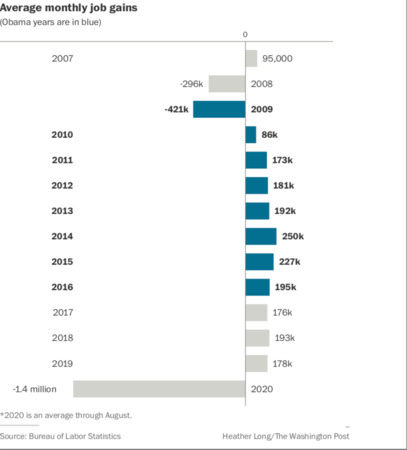
1. Job gains (and losses)

The United States experienced some of its best years of job gains in 2014 and 2015 in Obama’s second term when the economy added over 225,000 jobs a month. Employment continued to be strong under Trump – until the pandemic hit.

Average monthly job gains under Trump peaked at 193,000 in 2018. Economists call this very robust, especially given the recovery was nearly a decade old by then. But the devastation from the pandemic wiped out a decade worth of jobs gains in the spring. By August, 48% of the jobs had returned.

Black jobs Photo by: The Washington Post — The Washington Post File Size: 0.08 Mb

Black jobs Photo by: The Washington Post — The Washington Post File Size: 0.08 Mb

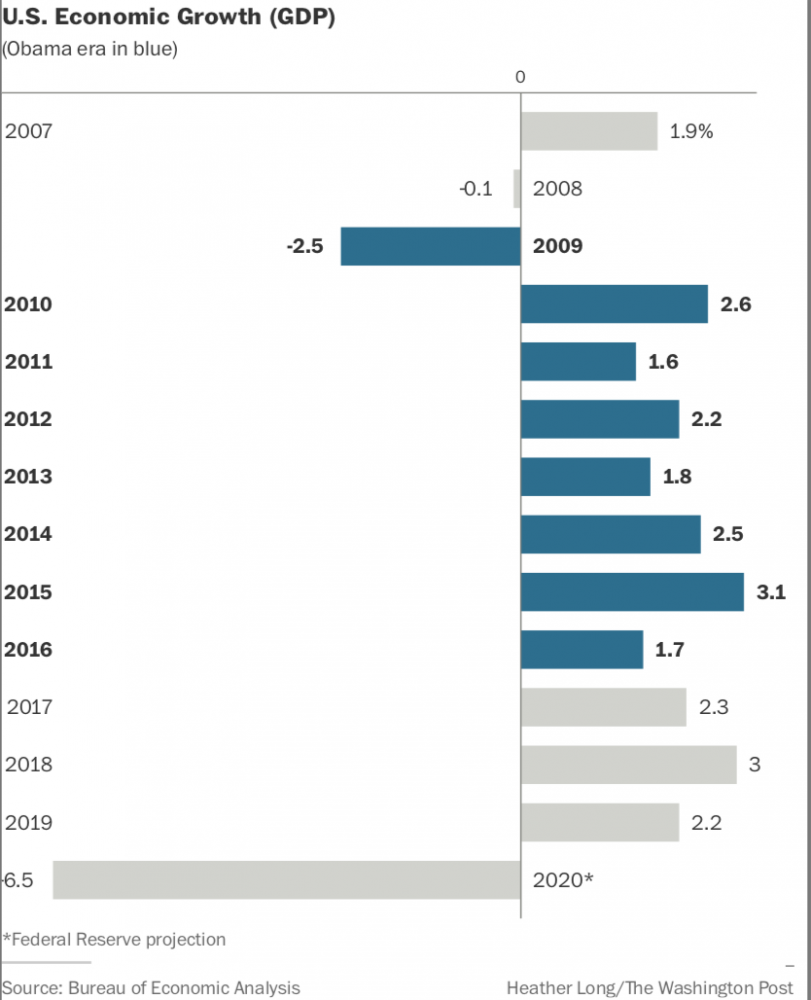
2. Economic growth 

Trump says he had the “greatest economy in history” during the GOP convention, a claim fact checkers quickly marked as false. A look at economic growth shows why.

The economy grew just shy of 1% in Obama’s first term when the Great Recession took its toll. Growth improved to 2.3% in Obama’s second term. Under Trump, the economy is on track to average slightly above zero in his first term because of the sharp losses from the pandemic.

Excluding 2020, growth in Trump’s initial three years in office was 2.5% – barely above Obama and well below the growth under the Clinton, Reagan and Johnson administrations.

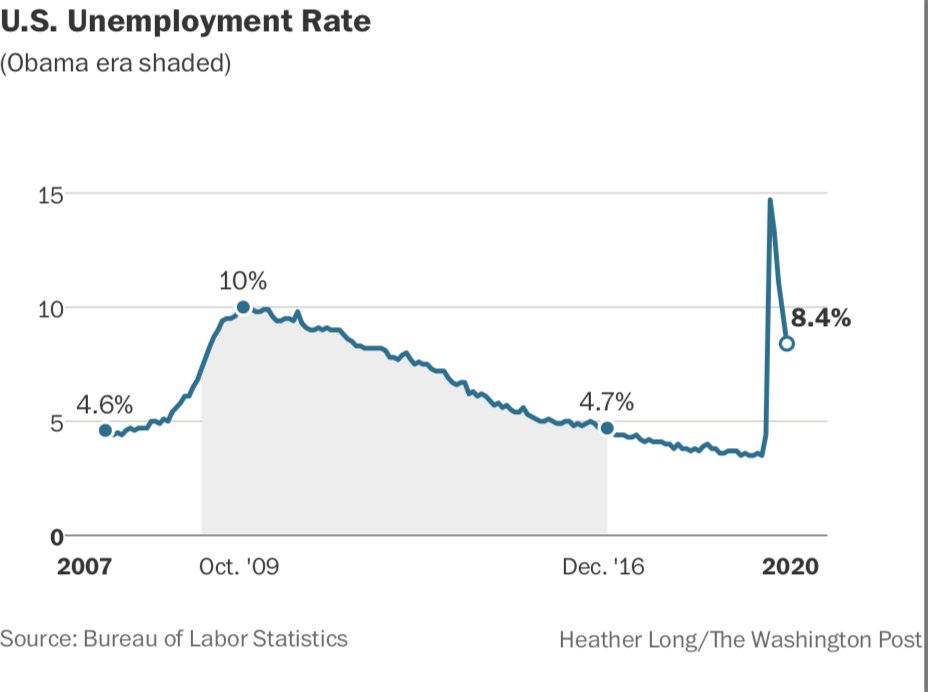
3. U.S. unemployment 

The U.S. unemployment rate hit a half-century low of 3.5% in late 2019 and stayed around that level through February 2020. Trump frequently touted the job news, though he often left out that the unemployment rate was a fairly low when he took office (4.7%) and has been steadily declining since 2011.

As the pandemic escalated, Trump and other officials opted to close down much of the economy to keep people home to slow the spread of the deadly coronavirus. This caused the official unemployment rate to soar to nearly 15% in April. The Labor Department had trouble doing its usual worker surveys during the pandemic and says the unemployment rate likely reached as high as 19.7% – a level not seen since the Great Depression. But as the economy reopened, many jobs came back. By August, the unemployment rate had fallen to 8.4%, a level that’s still high but not unprecedented.

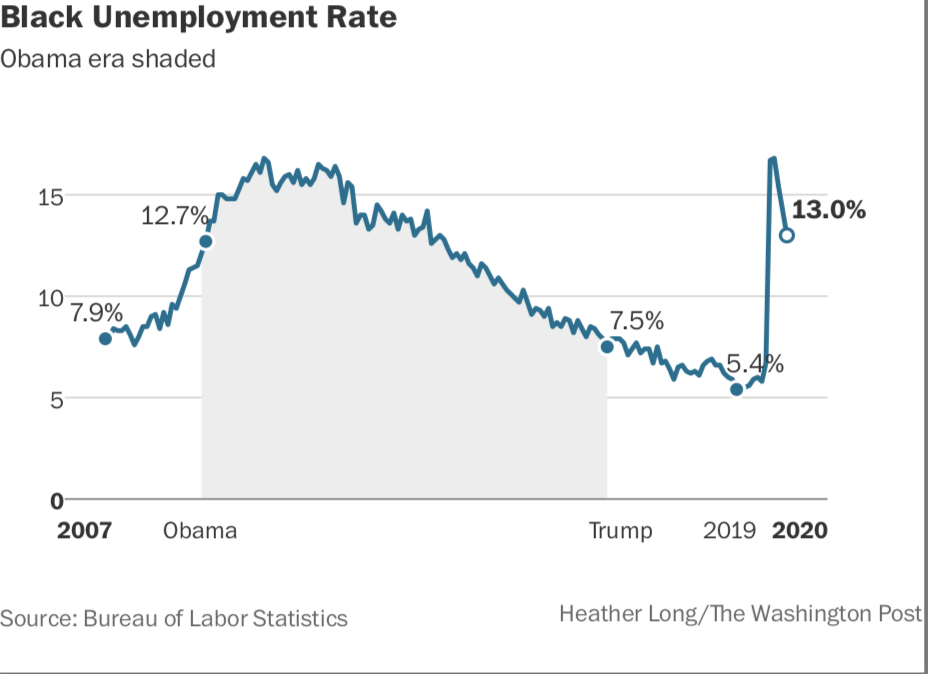
4. Black unemployment rate

Trump has started making the claim that his administration has done more for African Americans than “any president since Abraham Lincoln,” which The Washington Post Fact Checker gave Four Pinocchios. A key part of Trump’s argument is the Black unemployment rate, which hit the lowest level ever recorded – 5.4% – in August 2019. (The Labor Department began tracking the Black rate in 1972).

When Trump took office, Black unemployment was 7.5%. Many of the job gains under Trump did go to Black and Hispanic workers, especially women. As the labor market tightened, many employers gave a chance to workers they were not looking at before, such as those without college degrees. The pandemic, however, has hit Black and Hispanic workers the hardest, erasing many of the gains it took years to see after the Great Recession. In August, the Black unemployment rate was 13%.

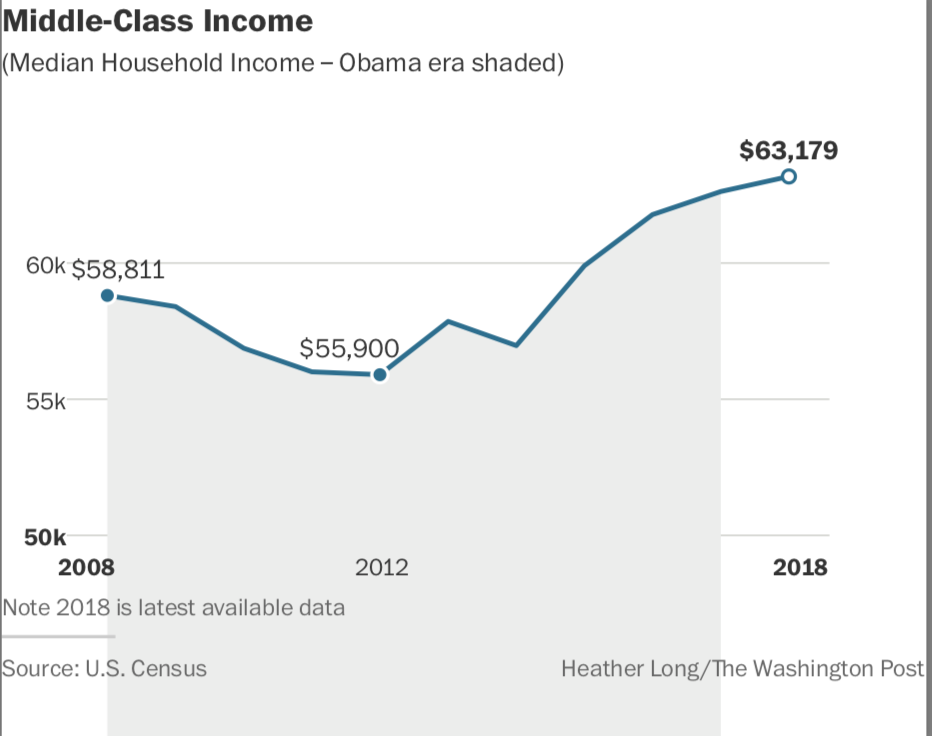
5. Middle-class income

Middle-class households were hit hard during the Great Recession. For years, their incomes remained lower than in the late 1990s, once the cost of living was taken into account. While incomes rose the most during the final two years of Obama’s term, median household income did not officially equal its 1999 level until 2018, according to the U.S. Census.

Economists generally credit Obama with getting the recovery solidly underway and Trump with keeping it going until the pandemic recession. The steady job and pay gains in recent years have been the biggest drivers of rising middle-class incomes.

6. U.S. stock market

One of Trump’s favorite indicators is the U.S. stock market. Even with the deep blow of the pandemic that caused a 30% drop in stocks in March, the market has come roaring back this summer. The Standard & Poor’s 500-stock index recently surpassed its pre-pandemic record level thanks largely to surging tech stocks such as Apple, Facebook, Amazon, Netflix, Microsoft and Google’s parent, Alphabet. The index has fallen some in the past week.

Many economists are quick to point out the stock market is not the economy. Analysts also note that stocks gained more in Obama’s first term than Trump’s. But that comes with a caveat: Stocks began Obama’s presidency in a deep slump from the financial crisis and then began an epic rebound a few weeks into his presidency. The market was already high when Trump took office and has climbed higher since then. Though Obama had better market gains, both presidents have been good for Wall Street.

7. Food stamps

While the stock market was quick to soar under Obama, many people were quick to point out that the United States still had record numbers of Americans on food stamps, a sign of the lingering pain of the Great Recession. By 2013, roughly 1 in every 6 Americans was on government food aid. That declined only slightly by the end of Obama’s tenure.

The Trump administration made it a goal to get the number of Americans on food stamps down, including by tightening rules about who is eligible for food aid. As a result of more stringent eligibility rules and more job gains in recent years, the number of Americans on food stamps dropped to 35.7 million in 2019 – the lowest level since 2009. The pandemic has ushered in deep hardship again, causing many Americans to seek food stamps and visit food banks for the first time. Photos of long lines of cars waiting outside food banks during the pandemic have been dubbed modern-day bread lines.

8. Manufacturing output

The end of Obama’s second term saw a mini manufacturing recession that deeply hurt blue-collar workers even as the service economy continued to chug along. Trump vowed to revive factories. Early on in his presidency, manufacturing jobs and output jumped. In 2018, manufacturing jobs were growing at the fastest clip since the early 1980s. But it didn’t last.

Manufacturing output and jobs stalled in 2019, an early warning sign of economic trouble. The pandemic was a major blow. Real-time indicators show some rebound in manufacturing, especially as auto sales and home sales have bounced backed. But manufacturing employment remains more than 700,000 jobs below pre-pandemic levels.

9. U.S. home prices

Home prices have been on a steadily upward climb even since bottoming out in 2011. A lot of this growth has been driven by the Federal Reserve. The Fed has kept interest rates low, which has led to historic lows in mortgage rates that have made home-buying more affordable for many families (as long as they have savings for a down payment).

Even the pandemic didn’t put much of a dent in home purchases. In fact, some city dwellers have been rushing to the suburbs in search of bigger homes with more space. That trend, combined with a surge in millennials buying homes and mortgage rates below 3%, have fueled a housing boom. The median home price in the United States hit $304,100 in July, according to the National Association of Realtors. It’s the highest price on record, surpassing the prior 2006 high in inflation-adjusted terms.

10. U.S. government debt

Both Obama and Trump have been criticized for growing the national debt. Spending increased under Obama as the federal government tried to revive the economy after the Great Recession, as well as fund the ongoing wars in Iraq and Afghanistan and continuing most of the Bush tax cuts.

Trump’s 2017 tax cut added about $1.5 trillion more to the debt, contrary to claims by the president’s administration that it would not. Then the pandemic hit and the federal government responded with more than $3 trillion in aid. The result is the national debt is at the highest levels since World War II. The closely watched debt-to-GDP ratio, a sign of how big U.S. debt held by the public is relative to the economy, is on track to surpass 100% in the coming months.

Many economists say the bulge in spending after the Great Recession and pandemic recession were necessary and unavoidable, but they fault Obama and Trump for not doing more to right the federal budget during the good economic years.

11. Consumer confidence

Consumer spending drives about 70% of the U.S. economy. Many economists and business leaders closely watch signs of consumer confidence to see if Americans are likely to keep buying. The two main gauges of consumer confidence are monthly surveys by the Conference Board and the University of Michigan. Both showed an increase in confidence after Trump’s election, largely because Republicans and Independent voters rated the economy more highly.

As the unemployment rate continued to decrease, confidence hit levels not seen since the late 1990s in early 2020. Though much of the economy under Trump looked similar to under Obama, many Americans appeared to feel better about their job and business prospects. Then the pandemic hit, causing confidence to tank. Nearly 1 in 3 Americans now worries about losing their job, according to Gallup.

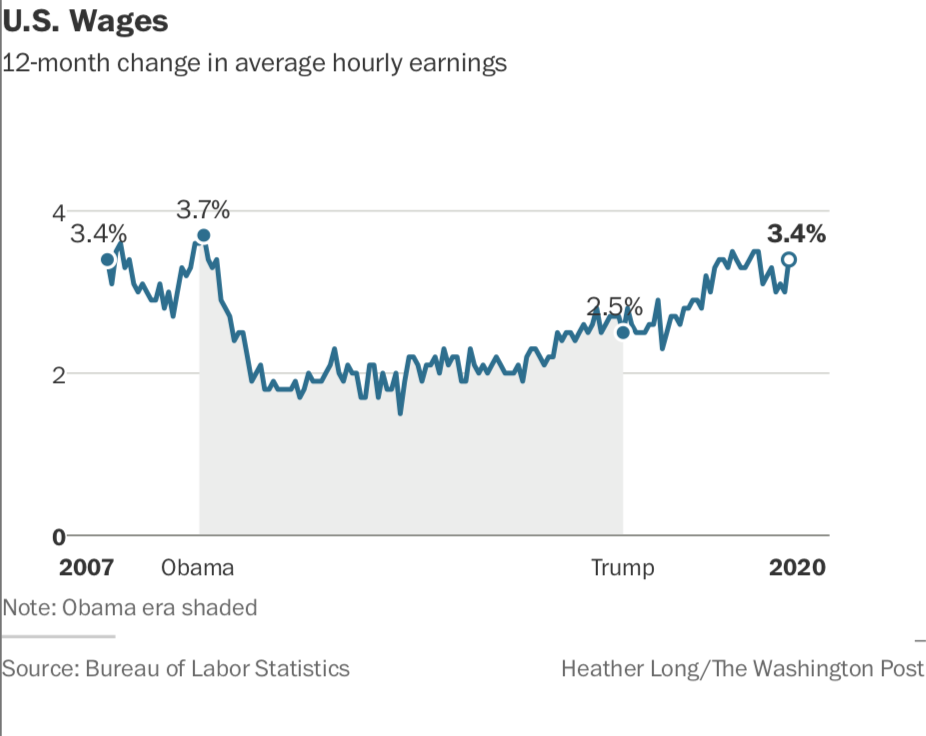
12. Wages

While the economy did a big U-turn under Obama, his administration admitted that its “unfinished business” was seeing wages grow faster again. When the economy is performing well, it’s usually hard for employers to find enough workers, and they start lifting pay by more than 3% a year. That did not happen in the Obama era. It took until the summer of 2018 to finally see average hourly earnings rising above 3%.

13. Gas prices

Gas prices were well above $3 a gallon for much of Obama’s tenure. Many Americans see these prices as they drive to work, and it influences their overall feeling about the economy. As prices rise, they tend to feel gloomier as gas costs eat into their weekly pay. But oil prices plunged in 2014 as the world’s major oil-producing countries, such as Saudi Arabia, refused to cut back production, leading to a glut of oil on the world market.

When Trump took office, gas prices were just $2.37 a gallon, on average. They have remained low throughout Trump’s first term, helping keep costs manageable for many Americans. Though Trump likes to tout that America is now “energy independent” because it exports oil again, the reality is the nation still depends on imports of crude oil from abroad. The rise and fall of gas prices are largely driven by the world market and power players like Saudi Arabia that have continued to pump cheap oil.

14. Americans with health insurance

Obama made it one of his top goals to get more Americans covered by health insurance. The number of Americans lacking health insurance went from more than 48 million people in 2010 down to 28 million after the passage of the Affordable Care Act.

The uninsured rate has remained low under Trump, though it ticked up slightly after Trump did away with the penalty for American adults who don’t buy health insurance. Trump also made it a goal to repeal the Affordable Care Act, but that has not happened in his first term.

15. Business investment

An ongoing problem for the U.S. economy in recent years has been sluggish business investment. The economy tends to perform better when firms spend more on new research, products and equipment, since that tends to lead to more innovation.

Business investment was slow at the end of Obama’s second term. Trump and many Republicans said their 2017 tax cut would spur a business investment boom. Though 2018 did see improved business investment, the bump was short-lived. Business investment was anemic again in 2019, even before the pandemic’s economic blow.

16. Trade deficit

Most economists paid little attention to the trade deficit before Trump ran for office. The United States has purchased more goods from abroad than it has sold for years, largely because American consumers like to shop. Economists didn’t worry about this because foreign nations would turn around and invest in America, so the dollars typically came back, one way or another.

But Trump insisted deficits were a sign of weakness. He promised his trade deals would get the deficit back down. What happened instead is the overall trade deficit in 2018 was the largest in a decade.

The trade deficit is on track to come down in 2020 but not for particularly encouraging reasons. Trade deficits tend to shrink during recessions, as Americans save more and shop less.

Food and beverage manufacturers ‘must change with the times’ #ศาสตร์เกษตรดินปุ๋ย

#ศาสตร์เกษตรดินปุ๋ย : ขอบคุณแหล่งข้อมูล : หนังสือพิมพ์ The Nation.

Food and beverage manufacturers ‘must change with the times’

Biz insightsAug 27. 2020Fabio Tiviti, vice president Asean for InforFabio Tiviti, vice president Asean for Infor 

By The Nation

In a move to meet consumers’ shift in habits, food and beverage manufacturers must speed up product introductions and develop new offerings that reflect changing views on what is fresh, healthy and mindful – and technology can help, said Fabio Tiviti, vice president Asean for Infor, a global leader in business cloud software.

It’s not just taste, freshness and convenience that drive food purchases today. Conscientious consumers also focus on health, wellness and social issues as they shop for meals.

They take nutrition labels, traceability of suppliers, humane treatment of animals and environmental sustainability into consideration when shopping for food. While these expectations put added pressure on food and beverage manufacturers, companies that already have technological systems in place should seize the opportunity. Meeting the demands of today’s socially aware consumers can be a valuable differentiator.

Growing demands

It starts with the farm. Consumers today want to learn more about the origin of their food and its journey from farm to fork. The International Food Information Council (IFIC) Foundation said in a 2019 paper on food trends: “Americans have a growing appetite for more information about their food, and technology is enabling eaters like never before … it’s also driving transparency across the food supply chain.”

Meanwhile, it is not just millennials looking for health-related options. People of all ages are turning to vitamins, minerals, and other ingredients that are potentially beneficial for bone, joint, immune system, digestive, and brain health. Research shows that 20 per cent of US consumers aged 65-plus currently use a supplement for joint health.

As consumers seek food and drink products that reduce inflammation, more products are featuring ginger, turmeric, green tea extract, and medicinal mushrooms. Food and beverage manufacturers can also benefit from research done by the beauty industry, which has found that certain berries and spices can have anti-ageing benefits.

The IFIC Foundation says: “There is a movement towards circularity as new approaches to sustainability span the entire life of a product, from ingredient sourcing to package design, disposal, or reuse. The 360-degree approach reflects the principles of a circular economy, where resources are kept in use for as long as possible, extracting the maximum value while in use and then recovering materials at the end of use.”

Rethinking plastic

Plastics have come under fire globally, pushing demand for new packaging innovations. Bio-based packaging materials will likely be key components to the next generation of responsible packaging. Additionally, initiatives such as “Loop” are attempting to bring back the idea of returnable and re-usable packaging.

Meanwhile, in 2018, awareness around “ugly produce” grew. Fruit and vegetables, that fall outside of the specifications retailers typically insist upon, got a second chance. Tesco became the exclusive retailer for a range of fruit juices, Waste NOT, which are made from produce designated as “ugly”.

Also, companies have started playing a part in replenishing soil to ensure healthy food. For example, US baby food brand Gerber’s is hoping its organic agriculture, featured in its “Clean Field Farming” line, will pay-off and increase biodiversity as well as enhance ecosystems. Additionally, Annie’s Homegrown is another brand helping to raise awareness in this area.

Many people are also responding to dietary guidance that recommends eating less added sugar, with 77 per cent saying they are taking steps to limit or avoid sugars in their diet, and 59 per cent viewing sugars as negative, according to the 2015–2020 Dietary Guidelines for Americans report. New plant-based and dairy sweeteners are gaining attention and providing new opportunities for updating classic product offerings.

Plant-based eating continues to gain adoption, with sales of “vegetarian alternatives” growing by 20 per cent since 2017. Only 5 per cent of Americans identify as vegetarians and 3 per cent as vegans, according to a Gallup poll, but others are adding vegetables and reducing protein consumption for general health benefits.

How technology can help

In order to remain relevant, food and beverage manufacturers must continually stay tuned into trends and update product offerings. Fortunately, technology can help in several ways:

Product innovation: Introducing new products quickly is a necessity. New product lines can represent healthier choices and include minerals and nutrients associated with wellness.

Reducing sugars, artificial colours and preservatives will also appeal to many modern consumers. Advanced enterprise resource planning (ERP) solutions, purpose-built for the food and beverage industry, will help manage recipes, raw ingredients, and formulations – ensuring quality is maintained. Product lifecycle management solutions (PLM) also help speed launches, managing the various steps and enabling improved project management, collaboration and product testing.

Clean labels: Transparency and visibility into how food is produced is increasingly important. Labels are the key tactic for conveying messages.

“With today’s instant access to information, if a consumer can’t understand or find out where and how a product is made and what’s in it, they’ll be more inclined to leave it behind,” says RSM, which serves as a consultant to the industry. Food and beverage manufacturers can turn to technology to help comply with current mandates for clean label formatting and content. PLM solutions help streamline the process, making it easier to stay within compliance.

Supply planning: As new ingredients come to market and the demand for them starts to expand, the challenge may quickly become a supply shortage. Companies must work closely with their suppliers and leverage supply chain planning tools so retailers can meet the demand.

Supply chain traceability: This is one of the top five food trends in 2019, according to IFIC Foundation, and will cause demand for technology solutions that provide clear product information. They note that as technologies become cheaper and therefore more accessible, more food manufacturers will be able to utilise them to manage supply chain activities. Modern supply chain management solutions are essential for full visibility and tracking suppliers.

Predictive analytics: Modern business intelligence solutions, with built-in artificial intelligence, will help companies project trends and anticipate market demands. This insight into the future helps procure raw ingredients and plan use of resources, like machinery, packaging, and personnel.

The world of food and beverage manufacturing is ever-changing – with taste becoming just one of many factors influencing a consumer’s decisions. Today, health, wellness and social issues like environmental sustainability are just as important. Manufacturers can see this as a challenge or as an opportunity to align with customers. With modern technology in place, companies can seize the chance to speed introductions and offer new product line-ups which will appeal to consumers. This can be the ticket to future growth.

As stocks’ prices touch record high, economy trails behind #ศาสตร์เกษตรดินปุ๋ย

#ศาสตร์เกษตรดินปุ๋ย : ขอบคุณแหล่งข้อมูล : หนังสือพิมพ์ The Nation.

As stocks’ prices touch record high, economy trails behind

Biz insightsAug 19. 2020David J. LynchDavid J. Lynch

By The Washington Post · David J. Lynch · BUSINESS, US-GLOBAL-MARKETS 
VBI Vaccines has lost money in each of the four years it has been listed on the Nasdaq stock exchange and last month told investors not to expect that to change anytime soon. Yet since its mid-March low amid the pandemic-related shutdown, the company’s share price has rocketed by more than 400%.

The jump comes even as VBI’s candidate for a vaccine for the coronavirus remains in the earliest stage of development, trailing well behind alternatives from bigger and better-known rivals that already are being tested on humans.

At first glance, VBI – which was almost dropped from the Nasdaq last year after its share price languished below $1 – looks like a perfect example of how the stock market has become detached from the reality of a bruised and battered U.S. economy. Stock prices briefly touched a fresh all-time high on Tuesday, despite a double-digit unemployment rate and the collapse in recent months of perhaps 100,000 small businesses.

The Standard & Poor’s 500-stock index – the best-known broad market gauge – has risen more than 50% since March and is on the verge of completing the fastest rebound from a bear market in history. President Trump has repeatedly celebrated the market’s performance, saying it represented an endorsement of his agenda and warning that a Democratic victory in November would cause stocks to “go down like a rock.”

Prominent lawmakers, including Sen. Bernie Sanders, I-Vt., and Rep. Alexandria Ocasio-Cortez, D-N.Y., cite the apparent disconnect between financial markets and the real economy as evidence of a malfunctioning capitalist system.

A closer look at both VBI and the broader stock market, however, suggests that Wall Street is neither a proxy for the real economy nor a financial casino entirely divorced from the lives of everyday Americans.

“The idea that the stock market is the economy and the economy is the stock market – the correlation between the two is tenuous at best,” said Barry Ritholtz, whose N.Y.-based firm manages $1.5 billion in assets.

There is more to the tiny biotech company than red ink and long shot projects. And though soaring markets may seem at odds with the ailing economy, their inner workings show that investors are distinguishing between industries that have been crushed by the pandemic and those that are poised to prosper.

As Americans in recent months traded traveling for digital connections, for example, the value of United Airlines fell by roughly one-half while shares of Nvidia, a maker of computer chips for gaming devices and data centers, almost doubled.

“There’s always a difference between the market and the economy,” said Howard Silverblatt, senior index analyst for S&P Dow Jones Indices in New York. “We’re up because we’re looking past 2020 and looking at 2021.”

In VBI’s case, both the company and independent analysts say recent achievements support its share price rise. The Cambridge, Mass.-based company earlier this month received $56 million in funding from the Canadian government, which is backing its research into a vaccine for covid-19 and two other coronaviruses known as SARS and MERS. The cash infusion came a few months after VBI raised $57 million in an April stock offering.

While a coronavirus product remains far off, the company is moving closer to approval from American and European regulators to sell its hepatitis B vaccine, which already is on the market in Israel. VBI’s vaccine to treat glioblastoma, the virulent form of brain cancer that killed Sens. John McCain and Ted Kennedy, demonstrated in clinical studies the ability to shrink tumors by more than 50%.

“Since March 2020 there have been a number of achievements which have substantially changed the fundamentals of the company,” Jeff Baxter, VBI’s chief executive, said via email.

VBI’s stock price now hovers near $4, up from less than $1 in March.

VBI’s claim to fame is a proprietary vaccine platform known as an “enveloped virus-like particle” designed to mimic a virus to trigger the body’s immune response. The innovative design has attracted institutional shareholders including Perceptive Advisors, a prominent health-care hedge fund.

VBI also boasts an experienced management team, including Baxter, a veteran pharmaceutical executive who previously worked at GlaxoSmithKline. The company’s chief scientific officer, David Anderson, is a former professor at Harvard Medical School.

“People may have looked at them for the first time because of the covid news flow and, once they looked under the hood thought ‘hey, this is interesting,’ ” said Leland Gershell, senior analyst covering biopharmaceuticals at Oppenheimer & Co. in New York. “It’s now a stock on people’s radar.”

Whatever VBI’s fortunes, Wall Street is the wrong place to look for a real-time report card on the $19 trillion U.S. economy.

The stock market only captures the fortunes of publicly traded companies, those that are owned by individual and institutional shareholders. Most of the businesses that Americans patronize on a daily basis – local restaurants, dry cleaners, hardware stores – are not part of the major market indexes: the Dow Jones industrial average, the S&P 500 and the tech-heavy Nasdaq.

All of the companies in the S&P 500 combined, for example, employ less than one-fifth of the nation’s 140 million workers. Small businesses, which have been devastated by the pandemic, account for almost one-half of private sector employment, according to the Small Business Administration.

The S&P 500’s ascent – it is within a few points of closing at a record high – also doesn’t mean that the whole stock market is rising. Since the index gives greater weight to companies with the largest market value, just 10 companies account for 27% of its value, according to Silverblatt.

In practice, the index is being driven higher by a relative handful of prominent technology companies, including Apple, Alphabet, Microsoft, Amazon and Facebook.

“The index isn’t the real world,” said Ritholtz.

Despite talk of a market and economy that are at odds, investors are not indiscriminately lifting all stocks. Industries that have been badly damaged by the pandemic – such as airlines and hotels – are doing poorly while those that have retooled for socially distanced operations are thriving.

Through Aug. 17, the information technology and consumer discretionary sectors were both up more than 20% this year, outperforming the broader market. Providers of videoconferencing software, cloud computing platforms, communications services as well as online retailers are prospering from the shift of tens of millions of Americans to remote work.

Energy companies, down more than one-third, and financial institutions were lagging.

Even within sectors, investors are flocking to companies that have adapted and shunning those that haven’t. Target’s stock is up almost 10% this year, reflecting its ability to stay open throughout the pandemic, while shares of Kohl’s, which closed all of its 1,159 stores for several weeks beginning March 20, have lost roughly half their value.

The market also is benefiting from massive monetary stimulus by the Federal Reserve, which has added $2.8 trillion to its balance sheet during the pandemic. The money supply has increased by 22% over the past year, the fastest rate in history and twice the pace of the inflationary 1970s, according to Richard Bernstein, an investment manager in New York.

“I don’t think people understand this money supply growth is so far off the charts, we don’t have anything to compare it to,” he said.

That’s precisely what worries some analysts. The International Monetary Fund warned in June that the gap between asset prices and fundamentals was “near historic highs,” leaving the market exposed to a calamitous sell-off that could lengthen the recession.

Stock prices relative to company sales also are now higher than just before the tech bubble popped in 2000, according to Peter Boockvar, chief investment adviser for the Bleakley Advisory Group.

“This is a highly expensive market . . . egged on by the Fed. It will last until it doesn’t,” he said.

To many Americans, Wall Street’s rapid recovery – even as 28 million Americans remain jobless – is a sign of something profoundly amiss in the economic system. The gains from rising stock prices go disproportionately to the well-off: 84% of American households with an annual income of $100,000 or greater own stocks vs. just 22% of those making $40,000 or less, according to a recent Gallup survey.

Sanders, the avowed socialist and two-time Democratic presidential candidate, earlier this month criticized Fed actions that backstopped financial markets, saying they aided billionaires at the expense of the working class.

“We are currently witnessing what is likely the greatest transfer of wealth from the middle class and the poor to the very rich in the modern history of this country,” he said on the Senate floor.

Likewise, Senate Minority Leader Chuck Schumer, D-N.Y., attacked the president’s proposal for a cut in the capital gains tax, saying it would only benefit “wealthy investors.” Only one-quarter of all stocks are held in taxable accounts, according to Steve Rosenthal of the nonpartisan Tax Policy Center.

The president, who often cites rising stock prices as validation of his performance – and dismisses them them when they fall – has latched onto Wall Street’s recent gains.

“The stock market’s rebound signals a ‘V’-shaped recovery, stronger than our competitors anywhere in the world,” Trump said at the White House on Wednesday. “We had to turn off the economy, and now we’re turning it back on, and that’s beyond a ‘V’ shape. This is going to be very strong; it’s called a “strong ‘V.’ “

But real-time data on spending and employment instead show that the economic recovery has plateaued in recent weeks as Congress and the administration failed to reach a deal on new emergency funding.

The expiration of the extra $600 in weekly unemployment benefits will provide a new test for the economy and the stock market, which also faces the danger of a renewed surge of coronavirus infections this fall as well as the presidential election.

At VBI, meanwhile, executives are looking ahead to what they hope will be major accomplishments. Though they were late to the coronavirus vaccine race, the recipe they are developing is being designed to cope with future mutations of the virus, a potential competitive advantage.

Baxter, the CEO, also anticipates filing before year end the necessary paperwork with regulators in the United States, Europe and Canada for authorization to sell VBI’s hepatitis B vaccine. There is a “very, very high probability of approval” in 2021 with sales the following year, he told an investment conference in June.