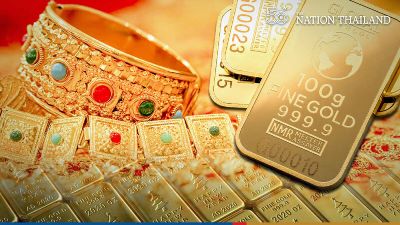
The price of gold dropped by THB50 in morning trade on Wednesday.
A9.23am report from the Gold Traders Association showed the buying price of gold bar at THB28,300 per baht weight and selling price at THB28,400, while the buying and selling price of gold ornaments is THB27,788.28 and THB28,900, respectively.
At close on Tuesday, the buying price of gold bar was THB28,350 per baht weight and selling price THB28,450, while gold ornaments were THB27,833.76 and THB28,950, respectively.
The spot gold price on Wednesday morning was hovering around US$1,790 (THB59,928) per ounce after Comex gold at close on Tuesday rose by $5.2 to $1,784.7 per ounce due to support in buying gold before the New Year festival. Meanwhile, the market is keeping an eye on the US inflation figures in November on Friday, including meetings of the US Federal Reserve and the European Central Bank next week.
Krungsri Securities forecast the Stock Exchange of Thailand (SET) Index on Wednesday (December 8) would rise to between 1,615-1,620 points.
It said the index gained positive sentiment from the good news that Omicron patients developed mild symptoms despite high transmissible. It added that rising oil price above US$71 per barrel would help boost the index.
However, fund flow volatility due to uncertainty over US Federal Reserve’s signal it would taper its quantitative easing programme during the meeting next week would pressure the index.
It also recommended buying of the following companies’ shares as an investment strategy:
▪︎ RCL, LEO, III, WICE, SONIC and JWD, which benefit from rising freight rate.
▪︎ BBL, TTB, KTB and KBANK, which benefit from news of interest rate hike.
▪︎ HMPRO, CPN, CRC, AMATA, WHA, BTS, BEM and VGI, which are domestic play shares.
Intel Corp. plans to list shares of its Mobileye self-driving car business by the middle of next year, letting the chipmaker capitalize on its investment in a burgeoning industry.
Intel will remain the majority owner after the transaction, which involves an initial public offering of newly issued Mobileye stock, the company said in a statement Monday. Mobileye’s executive team, led by Amnon Shashua, also will stay on board.
News of the IPO sent shares of Intel up as much as 7.9% on Tuesday, their biggest intraday gain since January. The stock had previously increased just 2.3% this year, trailing the performance of Intel’s chip peers and broader indexes.
The move could generate billions for Intel at a time when it’s tying to revitalize its main business. Mobileye’s valuation and the total amount to be raised in the IPO will be determined nearer the event, Intel Chief Executive Officer Pat Gelsinger said Tuesday on a conference call. The majority of the proceeds will be retained by Intel, but Mobileye will be given a balance sheet that allows it to fuel its expansion plans, he said.
Analysts at Morgan Stanley said the news was a “significant positive,” noting that Intel can generate some value from the business, as it will remain the majority owner, and the move will free up additional capital.
Gelsinger has been shaking up Intel since taking the helm in February, looking to revive the fortunes of the world’s largest chipmaker. Intel, long the dominant maker of computer processors, has ceded market share to rivals such as Advanced Micro Devices Inc. and lost its technological edge in key markets.
Against that backdrop, Mobileye has been a particular bright spot. The business, acquired by Intel in 2017 for about $15 billion, has consistently grown faster than its parent — and it serves a still-nascent industry. Intel has projected that the market for automotive silicon will reach $115 billion by the end of the decade.
Gelsinger stressed that Intel doesn’t need the IPO money to fund its push into new businesses. But Mobileye was undervalued by investors because it’s part of a much larger company, he said. A greater degree of independence will also help the profile of the business in the automotive industry and with attracting customers, he added.
The auto industry’s shift to electric vehicles and more autonomous cars is creating a huge appetite for electronics. Mobileye makes chips and software that work with sensors to let vehicles handle more driving functions, with the ultimate goal of replacing humans in the role altogether.
The company recently shipped its 100 millionth EyeQ chip system and unveiled a six-passenger vehicle that will be used for driverless ride-hailing services in Tel Aviv and Munich next year. It has won contracts with more than 30 top automakers globally, Intel said Monday.
Mobileye has about 80% of the global market for advanced driver-assistance vision systems, according to researcher Guidehouse Insights.
The unit, based in Israel, has tested its technology in robo-taxi fleets in Tokyo, Paris, Shanghai and Detroit. It posted revenue of $326 million last quarter, up 39% from a year earlier. Operating income climbed to $105 million, double the year-earlier total. Overall, Intel posted a 5% revenue increase in its third quarter.
Mobileye expects revenue to rise 40% for all of 2021. The transaction won’t affect Intel’s 2021 financial targets, the company said.
Intel has made other recent moves to push deeper into transportation technology. In 2020, it acquired Israeli startup Moovit for about $900 million. The purchase gave it access to data from public-transport mapping, which could be integrated into a ride-hailing service.
That division, along with Intel staff working on lidar and radar development, will be part of Mobileye, the company said Monday.
Intel’s broader comeback effort has been slower going. The stock slid after the company’s last earnings report in October, when management warned that the turnaround would hurt profitability over the next few years. Investors are waiting to see if Gelsinger can improve Intel’s products quickly enough to keep more customers from switching to competitors or, in some cases, designing the chips themselves.
The share of global wealth held by billionaires surged to a record during the Covid-19 crisis, according to a group founded by French economist Thomas Piketty.
About 2,750 billionaires control 3.5% of the world’s wealth, the Paris-based Global Inequality Lab said in a report Tuesday. That’s up from 1% in 1995, with the fastest gains coming since the pandemic hit, the group said. The poorest half of the planet’s population owns about 2% of its riches.
The study’s findings add to a debate about worsening inequality during a public health crisis that’s hurt developing economies — which are short of vaccines as well as financial resources to cushion the blow — even more than advanced ones. Within the rich world too, financial and real-estate markets have soared since the depths of the slump last year, widening domestic gaps.
Those pandemic trends come after decades of policy that was often geared toward people at the top, on the expectation that it would “trickle down” and everyone else would ultimately benefit too, according to Lucas Chancel, one of the report’s authors.
“There is really this polarization on top of a world that was already very unequal before the pandemic,” Chancel, co-director of the World Inequality Lab, said in an interview. He said billionaires accumulated 3.6 trillion euros ($4.1 trillion) of wealth during a crisis in which the World Bank estimates that some 100 million people have fallen into extreme poverty.
Across most parts of the world, the richest 10% of people control roughly 60% to 80% of wealth. But the report highlights some clear regional distinctions.
Overall, poorer countries have been catching up with richer ones — but within those developing nations, inequality has soared. Same-country disparities now account for more than two-thirds of global inequality, up from roughly half in 2000, according to the Lab.
Latin America and the Middle East are the world’s most unequal regions, with more than 75% of wealth in the hands of the top 10%, the report says. Russia and sub-Saharan Africa aren’t far behind.
Other emerging economies like India still suffer from a “missing middle class,” Chancel said. “Colonial inequalities have been replaced by market inequality.”
Wealth gaps are reflected in bigger carbon footprints, too. In North America, for example, the top 10% emits an average 73 metric tons per capita each year, compared with less than 10 tons for the poorest half.
Measured by both income and wealth, Europe is the most equitable region, according to the report. The 19% of total income earned by the poorest half of Europeans is higher than the equivalent share for that group anywhere else. Pandemic policies like income support for workers thrown out of their jobs likely helped prevent that gap from widening further.
“The Covid crisis has exacerbated inequalities between the very wealthy and the rest of the population,” said Chancel. “Yet in rich countries, government intervention prevented a massive rise in poverty.”
The World Inequality Report 2022 is based on work by more than 100 researchers around the globe, led by economists at the Paris School of Economics and the University of California at Berkeley. The first version of the study came out in 2018.
The baht opened at 33.66 to the US dollar on Wednesday, strengthening from Tuesday’s closing rate of 33.70.
The Thai currency is likely to move between 33.50 and 33.70 to the greenback during the day, Krungthai Bank market strategist Poon Panichpibool predicted.
Poon said that the market is in a risk-on state which causes foreign investors to invest in Thai assets. The baht will strengthen slightly if investors are investing in Thai assets.
The baht will not strengthen much until foreign investors are buying a large number of short term bonds.
Meanwhile, the resistance level of baht would be from 33.50 to 33.60 to the dollar, from importers buying the dollar.
Poon said that the currency market will be highly volatile in this period. Business operators should be cautious and use hedging tools to manage the risk.
The Stock Exchange of Thailand (SET) Index closed at 1,609.28 on Tuesday, up 21.09 points or 1.33 per cent. Transactions totalled 74.92 billion baht with an index high of 1,611.58 and a low of 1,595.14.
The index rose after falling by 3.65 points or 0.23 per cent on Friday, thanks to the good news of Omicron Covid-19 variant and rising oil price.
The SET Index on Monday was closed for Substitution for HM King Bhumibol Adulyadej The Great’s Birthday.
The 10 stocks with the highest trade value today were KBANK, SCB, CPALL, PTT, AOT, MINT, BBL, EA, ADVANC and KTB.
Other Asian indices were up with one exception:
Japan’s Nikkei Index closed at 28,455.60, up 528.23 points or 1.89 per cent.
China’s Shanghai SE Composite closed at 3,595.09, up 5.78 points or 0.16 per cent, while the Shenzhen SE Component closed at 14,697.17, down 55.79 points or 0.38 per cent.
Hong Kong’s Hang Seng Index closed at 23,983.66, up 634.28 points or 2.72 per cent.
South Korea’s KOSPI Index closed at 2,991.72, up 18.47 points or 0.62 per cent.
Taiwan’s TAIEX Index closed at 17,796.92, up 108.71 points or 0.61 per cent.
The baht opened at 33.85 to the US dollar on Tuesday, strengthening from the previous closing of 33.89.
The Thai currency is likely to move between 33.75 and 33.95 during the day and between 33.60 and 34 during the week, Krungthai Bank market strategist Poon Panichpibool predicted.
Poon said that the baht might continue to weaken due to the Omicron variant of Covid-19 which caused investors to sell Thai assets.
The key resistance level for the baht would be at 34 to the dollar, which is the level at which exporters might sell the US currency and the Bank of Thailand might slow down the volatility.
If the baht weakens past the key resistance level, the baht might weaken to 34.15 and 34.40 to the dollar.
Poon said that the dollar might move sideways after the US Federal Reserve is speeding up to decrease quantitive easing which might increase the level of inflation. Meanwhile, the demand for safe-haven assets during the Omicron variant crisis especially the US 10-Year Bond that went down recently.
The price of gold in Thailand on Tuesday morning was unchanged from Mondays close.
AGold Traders Association report at 9.27am said the buying price of a gold bar was THB28,500 per baht weight and selling price THB28,600, while the buying and selling price of gold ornaments is THB27,985.36 and THB29,100, respectively.
Krungsri Securities forecast the Stock Exchange of Thailand (SET) Index on Tuesday (December 7) would rise to between 1,595-1,600 points.
It said the index gained positive sentiment from the good news that Omicron patients in Africa have developed mild symptoms. It added that rising oil price would also help boost the index.
However, Krungsri Securities predicted that uncertainty over US Federal Reserve would end its quantitative easing programme and raise interest rate in response to higher inflation would pressure the index.
It also recommended buying of the following companies’ shares as an investment strategy: ▪︎ RCL, LEO, III, WICE, SONIC and JWD, which benefit from rising freight rate. ▪︎ HANA, KCE, TU, ASIAN, EPG and XO, which benefit from the weakening baht. ▪︎ BBL, TTB, KTB and KBANK, which benefit from news of interest rate hike.
Gold edged lower as investors weighed mixed labor data from the U.S., the Federal Reserves hawkish tilt and the threat of the omicron variant to global growth.
Data Friday showed U.S. job growth registered its smallest increase this year while the unemployment rate fell by more than forecast to 4.2%, offering a mixed picture that may nevertheless push the Fed to quicken the wind-down of pandemic stimulus. It came after Chair Jerome Powell signaled faster tapering of asset purchases amid elevated inflation.
Meanwhile, Goldman Sachs economists cut their forecasts for the U.S. economy this year and next after deciding that the spread of the omicron strain of the coronavirus would exert a “modest downside” drag on growth. Moderna President Stephen Hoge said there’s a “real risk” that existing Covid-19 vaccines will be less effective against omicron, while U.S. medical adviser Anthony Fauci said the variant’s severity may be limited.
Bullion climbed Friday, paring a third straight weekly loss, the longest stretch since September, amid the prospects of less accommodative monetary policy and omicron risks. U.S. consumer prices due this Friday are projected to show the largest annual advance in decades, keeping pressure on the Fed to deliver swifter tightening.
“Gold is still struggling to break above the $1,800 level and we are yet to see any significant safe-haven flows from the recent omicron development,” said John Feeney, business development manager at Sydney-based bullion dealer Guardian Gold Australia. “Gold investors will be paying very close attention to the U.S. inflation numbers out this Friday, so we might see a reaction if we get another beat to the upside.”
Spot gold was 0.2% lower at $1,780.43 an ounce by 10:19 a.m. in London after rising 0.8% Friday. The Bloomberg Dollar Spot Index was steady. Silver, platinum and palladium fell.