The Stock Exchange of Thailand (SET) Index closed at 1,194.95 on Friday, down 6.69 points or 0.56 per cent. The volume of total transactions was Bt52.72 billion with an index high of 1,204.99 and a low of 1,187.49.
In the morning session, a Krungsri Securities analyst said he expected the day’s index to fluctuate between 1,195 and 1,210 due to uncertainty over a global economic slowdown after Germany and France imposed lockdown measures to contain the spread of Covid-19, which is pressuring the index.
“This negative sentiment has caused the oil price to drop as well,” he said, adding that the index would rebound from mass buy-ups in shares whose third-quarter performance is expected to improve.
The top 10 stocks with the highest trade value today were SCGP, AOT, STA, PTT, CPALL, KBANK, SCC, SCB, BBL and STGT.
As of 4.30pm, the price of oil rose by US$0.21 or 0.58 per cent to $36.38 per barrel, while gold rose by $5.10 or 0.27 per cent, to $1,873.10 per ounce.
Other Asian indices were also on the slide:
Japan’s Nikkei Index closed at 22,977.13, down 354.81 points or 1.52 per cent.
China’s Shanghai SE Composite Index closed at 3,224.53, down 48.19 points or 1.47 per cent, while Shenzhen SE Component Index closed at 13,236.60, down 283.06 points or 2.09 per cent.
Hong Kong’s Hang Seng Index closed at 24,107.42, down 479.18 points or 1.95 per cent.
South Korea’s KOSPI Index closed at 2,267.15, down 59.52 points or 2.56 per cent.
Taiwan’s TAIEX Index closed at 12,546.34, down 116.57 points or 0.92 per cent.
The much-touted Eastern Economic Corridor (EEC) has, so far, won extensive investment in several infrastructure projects, especially in the cast-iron equipment business.
Lertpong Sriwongthong, managing director of DR Industrial, said the EEC has had a positive impact on his company’s operations as its main products are used in power equipment and electrical systems in buildings and large projects.
DR Industrial manufactures steel conduits and fasteners as well as electrical box accessories under the brand Steel City.
He said in large projects, materials meeting high safety standards are used, and usually one brand is used for most of the production. Lertpong said this adds to the strength of his company, which has been in business for more than 30 years and has been producing more than 3,000 products.
Thanks to this strength, the Covid-19 outbreak has had a minimal impact on the company, despite a decline in real-estate and large-scale construction projects. By yearend, the company expects to achieve Bt200 million in sales revenue, which is lower than the Bt270 million earned last year.
However, he said, once the Covid-19 situation is resolved in 2021, the company expects to generate Bt450 million in revenue.
DR Industrial is also planning to spend more than Bt500 million to build a galvanising factory by 2024. He said the company is having to rely on other factories to galvanise products, which is causing problems with standard control and production timelines. However, with the new factory, the company will have full control of its production, will reduce costs by 10 to 20 per cent and will also be able to expand its production capacity. The additional cast-iron furnace will also help the company boost its production from 150 tonnes per month to 500 tonnes.
He said the first step will be make existing machines more efficient, so the production capacity can rise to 300 tonnes in order to meet rising demands thanks to new infrastructure projects in Bangkok and other provinces, including the EEC, as well as demands from neighbouring countries.
The Office of Trade Competition Commission (OTCC) has deferred for 15 days a decision on the proposed merger of a subsidiary of Charoen Pokphand (CP) Group with Tesco Thailand, amid worries of giving the company monopolistic control over the retail market.
CP had acquired Tesco Thailand and Tesco Malaysia in a $10.6-billion deal early this year.
A decision on the merger request of a Charoen Pokphand subsidiary was due on Thursday when the 90-day period after the request ended. However, the law permits the commission to delay its decision by 15 days after the end of 90 days.
CP Group, one of Thailand’s largest business conglomerates, had filed a document with the OTCC, seeking permission to merge its retail business with Ek-Chai Distribution System Co Ltd, the operator of Tesco Lotus.
The OTCC was strengthened when it became independent under new laws in 2017, with the power to block the creation of monopolies.
OTCC chairman Sakon Waranyuwattana said that the committee held a meeting and resolved to delay the decision for another 15 days as allowed by law. The meeting took time to consider all relevant information including the market structure, shareholders, business plan and the period of action relevant to the entity seeking merger of businesses, the impact on consumers and the competition. He said the meeting was unable to come to a conclusion and resolved to seek more time.
Under Thailand’s antitrust rules, an individual entity having a market share of over 50 per cent in the previous year, or 75 per cent in aggregate when combined with two other competitors is deemed a monopoly.
CP Group subsidiary CP All currently has a 64 per cent stake in over 11,500 7-Eleven stores, and also runs the Siam Makro stores.
Tesco Lotus has close to 2,000 stores in Thailand.
“The meeting considered reports from the subcommittee, which has quite a lot of details. It would take time to carefully consider those before voting. Therefore, we have set a meeting for consideration of the issue on November 2,” said Sakon.
The outcome would certainly be revealed in mid-November as required by law. He said the outcome could leave some people satisfied and some dissatisfied. He accepted that because of the importance of the case, society was very interested. Therefore, the committee must be careful and consider all factors in accordance with the rules prescribed by the law. Moreover, related businesses are listed on the Stock Exchange of Thailand, so any decision would have an effect on the share prices as well.
The meeting on November 2 may see a voting by members summarising the resolutions of the merger request.
One committee shall have one vote. In the event of a tie, the chairman of the meeting shall have a casting vote. The results of the consideration can be decided in three ways:
▪︎The merger is allowed as requested.
▪︎A conditional merger is allowed.
▪︎The merger is not allowed.
The law requires the commission to consider the needs of the business, benefits for business promotion, low damage to the economy and not affect the interests of consumers as a whole, he said.
Experts are suggesting picking up stocks of companies that will not be affected by the second Covid-19 outbreak on Friday.
The Stock Exchange of Thailand (SET) Index on Thursday hit its lowest point at 1,195.99 before closing at 1,201.64, down 6.30 points or 0.52 per cent, with total transactions at Bt50.83 billion due to uncertainty over escalation in Covid-19 cases, especially in the US and Europe. The number of patients has increased to 500,000 people on average daily.
Margin account sales were Bt27.05 million, institutional investors made net sales of Bt189.71 million, foreign investor sales accounted for Bt1.17 billion and domestic investors Bt1.38 billion.
Therdsak Thaveeteeratham, executive vice president of research at Asia Plus Securities, said uncertainty over an economic slowdown after many countries imposed lockdown measures to contain the spread of Covid-19 had caused global stock indices, including the SET, to fall.
“Therefore, we advise investors to buy food and agriculture shares such as STA, TU and DCC, as well as stocks that generated returns over 5 per cent in the beginning of the Covid-19 outbreak, such as HMPRO, TISCO, MTC and AP,” he said.
Sorrabhol Virameteekul, senior vice-president at Kasikorn Securities, expected the day’s index to fluctuate between 1,190 and 1,210 as the number of Covid-19 cases is increasing. He advised investors to follow the Covid-19 situation in the Asian region and the US presidential election.
He recommended investors to buy STA, as the Covid-19 outbreak had helped boost the demand for rubber gloves, and TISCO, as it has strong fundamentals.
Nuttachart Mekmasin, research analyst at Trinity Securities, said uncertainty over the Covid-19 outbreak had caused the SET to fall only 0.5 per cent compared to other indices, adding that this is the best time for investment.
He recommended buying canned seafood and pet food stocks such as ASIAN, seasonings stocks such as XO, polyethylene terephthalate film stocks such as PTL, and rubber gloves stocks such as STGT.
The price of gold dropped by Bt100 per baht weight in morning trade on Friday, the Gold Traders Association reported.
As of 9.28am, the buying price of a gold bar was Bt27,600 per baht weight and selling price Bt27,700, while gold ornaments were priced at Bt27,106.08 and Bt28,200, respectively.
At close on Thursday, the buying price of a gold bar was Bt27,700 per baht weight and selling price Bt27,800 while gold ornaments were priced at Bt27,197.04 and Bt28,300, respectively.
Spot gold price moved to US$1,873 (Bt58,401) per ounce on Friday morning after the price dropped by US$11.2 to $1,868 per ounce at close on Thursday due to the strengthening dollar and mass sell-offs of safe-haven assets in response to strong US economic data, especially the historic rise in third-quarter gross domestic product.
Hong Kong gold price dropped by HK$120 to $17,250 (Bt69,381) per tael on Friday morning, the Chinese Gold and Silver Exchange Society reported.
The Stock Exchange of Thailand (SET) Index rose by 1.16 points, or 0.10 per cent, to 1,202.80 in the morning session on Friday.
An analyst at Krungsri Securities expected the day’s index to fluctuate between 1,195 and 1,210 amid uncertainty over an economic slowdown after Germany and France imposed lockdown measures to contain the spread of Covid-19, which is pressuring the index.
“This negative sentiment has caused the oil price to drop as well,” he said, adding that the index would rebound from mass buy-ups in shares whose third-quarter performance is expected to improve.
He recommended that investors buy TU, STGT, STA, CBG, IVL, COM7, SYNEX, ASIAN, HANA, SVI and TVO, whose third-quarter performance is expected to improve.
The SET Index closed at 1,201 on Thursday, down 6.30 points or 0.52 per cent, while total transactions amounted to Bt50 billion due to uncertainty over an economic slowdown after Germany and France imposed lockdown measures and Thailand’s political unrest.
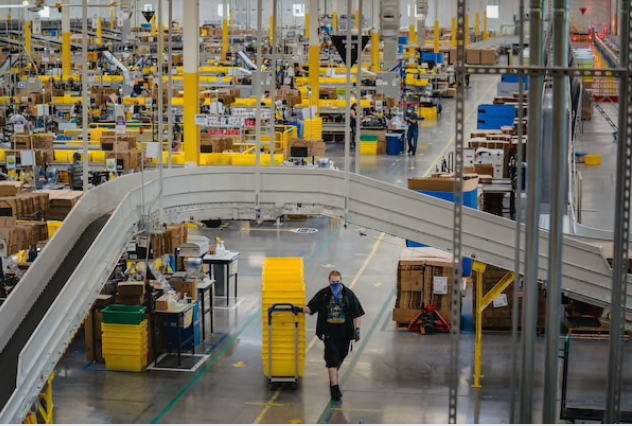
By The Washington Post · Jay Greene · NATIONAL, BUSINESS, TECHNOLOGY SEATTLE – Pandemic-fueled online shopping, coupled with the expected crush of holiday sales, has led Amazon to add 400,000 jobs this year, pushing its total employment over 1 million for the first time.
Those new jobs – primarily in its warehouses and delivery operations – come as the company continues to deal with a crush of orders from shoppers reluctant to buy goods in stores over concerns about the novel coronavirus. Amazon added 250,000 jobs in the three months through the end of September alone, Amazon finance chief Brian Olsavsky said in a call with journalists after the company reported its financial results Thursday. It added another 100,000 workers in October, and now has nearly 1.13 million employees worldwide, compared with 750,000 workers a year ago.
“We are adding people at a rapid clip,” Olsavsky said.
That’s still about half the 2.2 million workers that rival Walmart employs. Home Depot employs about 400,000 workers. At the same time, layoffs continue to mount at other major employers in the United States. ExxonMobil announced plans Thursday to slash 1,900 jobs from its U.S. workforce. Previously, Disney said it would lay off 28,000 workers and American Airlines cut 19,000 jobs.
Amazon’s latest wave of hiring comes after it already announced plans to hire 100,000 workers in March, the company’s first move to add staff to handle the initial surge of pandemic-driven shopping.
The company has also grown its fulfillment capacity – the collection of warehouses, delivery stations and drivers it uses to get packages to customers – by 50% this year, Olsavsky said. What’s more, the company this year has doled out $30 billion in capital spending – the amount it spends for property, equipment and other fixed assets – “a large part” of which has been directed at operations, Olsavsky said. And still, Amazon faces challenges to getting packages to customers on time.
“We’re not totally insulated because we still have third-party delivery partners and certainly our own (shipping) capacity has its limitations,” Olsavsky said. “We do think it will be tight on capacity industry-wide, and we’re no exception to that.”
(Amazon chief executive Jeff Bezos owns The Washington Post.)
And while the pandemic has fueled a surge in online shopping, the virus has also hit Amazon warehouse workers. The company announced earlier this month that nearly 20,000 of its U.S. employees had tested positive, or had been presumed positive, for the coronavirus since the pandemic started. The company faced fierce criticism from employees and some lawmakers that it wasn’t doing enough to protect workers.
In April, the company said it would spend $4 billion on pandemic-related costs, including testing warehouse workers and providing them with personal protective gear. It said it expects coronavirus-related costs, including productivity losses in warehouses where workers no longer can work closely together, to hit $4 billion.
In the quarter, Amazon beat analyst expectations, earning $6.3 billion, or $12.37 a share. Sales jumped 37% to $96.1 billion. Analysts expected Amazon to earn $7.36 a share on sales of $92.6 billion, as measured by S&P Global Market Intelligence.
Nation Broadcasting Corporation (NBC) has gained shareholders’ approval for a new issue of 321.26 million ordinary shares to increase its registered capital by Bt170.27 million to fund its business expansion.
The approval was given during the annual shareholders’ meeting on Thursday.
The newly issued shares will be offered to existing shareholders at a price of Bt0.53 and a ratio of two per every five existing shares held.
The offering period is December 1-4, 8-9, and 14-15.
Proceeds from the issue will be used to support investment in expansion of the media business, including the planned acquisition of Greennet 1282 (GNET). NBC will buy 189,997 GNET shares worth Bt164.40 million at Bt865.30 per share from News Network Corporation (NEWS) and be responsible for paying GNET’s outstanding debt of Bt85.59 million.
Currently, GNET earns revenue from three businesses – online media, call centre, and software services.
NBC chairman Shine Bunnag said the acquisition of GNET will help enhance the company’s media business and reduce its dependence on advertising revenue.
“We believe that this is the best decision as GNET’s call centre business will help boost the Happy home-shopping service, while the New Media programme will help with digital media development and its content can be applied to news content,” he said.
He added that NBC also approved the acquisition of Kom Chad Luek Media (KMM) from Nation Multimedia Group (NMG) in a deal worth Bt70 million.
The baht opened at 31.23 to the US dollar on Friday, unchanged from Thursday’s close.
The Thai currency on Friday is likely to move between 31.20 and 31.40, said Jitipol Puksamatanan, senior director of the chief investment office at SCB Securities.
He said the S&P 500 and Nasdaq indices rose by 1.2 per cent and 1.6 per cent, respectively, after strong US economic data and announcement of third-quarter profit by large companies.
“The US third-quarter gross domestic product [GDP] rose by 33.1 per cent quarter on quarter, private consumption rose by 40.7 per cent, and initial jobless claims dropped to 751,000 positions, better than most analysts expected,” he said.
He said the Bank of Japan recently decided to maintain its short-term interest rate at minus 0.1 per cent and expected the country’s economy next year to recover by 2.6 per cent.
“Meanwhile, the European Central Bank signalled that it would initiate additional monetary policies to stimulate the economy amid the Covid-19 outbreak,” he said.
He said the US 10-year bond yield rose by 8 basis points to 0.84 per cent and the dollar strengthened by 0.5 per cent due to the positive factors, causing the price of oil and gold to drop by 3.5 per cent and 0.5 per cent respectively, as well as the Australian dollar and Japanese yen to weaken.
“Therefore, we expect the baht in the short term to move in a narrow range until the US presidential election next week,” he added.
AIS x Techsauce Esports Summit 2020, the first e-sports and gaming conference in Thailand, has revealed that the Thai gaming market can compete overseas provided it receives continuous support from all parties.
Alistair David Johnston, AIS’s new managing director, told the summit on Wednesday that the e-sports industry in Thailand is likely to generate more than Bt27 billion this year, and will also help drive the country’s digital economy forward.
He added that as a digital service provider, AIS will work on four key strategies – connect, compete, co-educate and community – to upgrade the Thai gaming and e-sports industry.
“AIS is ready to lead the market in e-sports in Southeast Asia, which is constantly growing and is attractive to businesses,” Johnston said.
Beyond just a game
Oranuch Lertsuwankij, co-founder and CEO of Techsauce, said e-sports brand revenue is currently valued at US$1 billion, with an annual growth rate of 10 per cent. She is calling on companies and stores to not overlook this opportunity, but to join the industry as consumers are now paying more attention to interactive media.
She said interactive media can be used not just for IT products, but also for FMCG (fast-moving consumer goods) as well.
“We want to be a bridge connecting both sides to drive the e-sports industry,” she said.
5G to drive industry
Chatchai Khunpitiluck, vice president of the Digital Economy Promotion Agency (DEPA), said the digital content market, including game and animation industry, is expected to continue growing especially since people are having to stay at home due to the outbreak. This has resulted in a 20-per-cent increase in online media consumption and also resulted in rising popularity of e-sports.
Research conducted by the department shows that the e-sports industry is likely to grow by an average of 9 per cent from Bt22 billion in 2019 if it gets constant support from the government. The market was valued at Bt24 billion this year and is expected to expand further until yearend.
“We found that up to 70 per cent of young people play games on a wireless device. Therefore, the government’s role is to ensure the infrastructure is ready for a 5G network,” Chatchai said.
Change of social mindset
Santi Lohtong, president of the E-Sports Association of Thailand, said Thailand’s e-sports industry is growing slowly compared to neighbouring countries, and one of the biggest obstacles is the negative mindset Thai society has toward e-gaming. He said the association has tried to change the image of e-gaming and is also promoting nutrition and exercise in line with sports science principles.
Santi said the E-sports Association of Thailand wants to create professional athletes who can compete at the global level.





 Alistair David Johnston

