The Department of Business Development approved foreign investment worth a total Bt1.074 billion in September. The investment came from 22 foreign entities who would employ a total of 138 Thai workers, said director-general Tossapon Tangsubut.
Most of the foreign investors are from Japan, Singapore and the Netherlands.
The department’s foreign investment committee has granted permits to 201 foreign investors in the first nine months of this year (January-September), with total investment of Bt8.083 billion.
By Syndication Washington Post, Bloomberg · Patrick Clark · BUSINESS Hotel companies are going to new lengths to get guests through the doors in a bid to salvage a historically bad year for the industry.
More than 2,000 hotels in the Marriott International Inc. system will begin allowing guests to check in at 6 a.m. and stay as late as 6 p.m. the next day, a promotion aimed at remote workers looking for a change of scenery from their homes.
Other Marriott hotels are trying out similar initiatives, including one that offers discounted rates to guests who want a room for the day but not the night. Another program pitches resorts as places where parents can work while hotel staff supervise activities for their kids.
“People are tired of being at home,” said Peggy Fang Roe, global officer for customer experience at Marriott, the world’s largest hotel company. “They want the ability to be in different space, and they also want to stay safe. Working out of a guest room is the best of both worlds.”
At the tail end of the most dismal year in the history of the modern hotel industry, there’s little downside to trying. Across the country, revenue per available room, a measure of occupancy and pricing, was down 47% in September from the year before, according to lodging-data provider STR. Results were even worse in the largest U.S. markets, giving owners and operators reason to get creative.
Hilton Worldwide Holdings Inc. and Hyatt Hotels Corp. also have tried marketing rooms as makeshift offices. As far back as March, when the covid-19 pandemic ground U.S. travel to a halt, hotels have looked for new sources of business, offering cheap lodgings to medical personnel and first responders, or turning rooms into temporary college dorms.
Marriott says surveys have shown that office workers see hotel rooms as a way to ease the stresses and distractions of working from home, and that some of its corporate clients are studying the possibility of offering rooms to employees.
Quantifying demand for these kinds of efforts is difficult, but lodging industry consultant Bjorn Hanson said his research shows that hotels in big markets are finding some takers, at least for day rates. Beyond room rentals themselves, the initiatives may help hotel companies deepen customer relationships with corporate accounts, he said.
“It lets them say, ‘Look how good we’ve been as a partner during a difficult time,’ ” Hanson said.
Ant IPO by the numbers: It’s bigger than Finland’s GDP
CorporateOct 28. 2020Jack Ma. MUST CREDIT: Bloomberg photo by Kiyoshi Ota Photo by: Kiyoshi Ota — Bloomberg Location: Tokyo Japan
By Syndication Washington Post, Bloomberg · David Scanlan · BUSINESS
There’s no shortage of superlatives for Ant Group Co.’s initial public offering. Here’s a look at some of the key metrics, and why billionaire Jack Ma seems to be such a fan of the number eight.
IPO: $34.5 Billion
Ant’s $34.5 billion IPO blows past the previous record, set last year by Saudi Aramco at $29 billion. Ant’s money raise will likely jump another $5.2 billion once bankers sell additional shares to meet demand in what’s known as the greenshoe option. This chart of the 10 biggest IPOs also reflects the growing economic clout of Asia. The top five are all from Asia or the Middle East, and eight of the 10 are from the region, including Ma’s online giant Alibaba Group Holding Ltd. and Japan’s SoftBank Group Corp.
Valuation: $315 Billion
Ant’s IPO puts the company’s valuation at dizzying heights. At about $315 billion, Ant is worth more than the gross domestic products of Egypt, Chile or Finland. For corporate comparisons, it’s bigger than JPMorgan Chase & Co., the biggest U.S. bank. Ant is larger than payment rival PayPal Holdings Inc., media giant Walt Disney Co. and dwarfs Bank of America Corp. It’s three times bigger than tech giant IBM Corp. and four times larger than Goldman Sachs Group Inc.
Wealthy Eight
Ma appears to be a big fan of the number eight, which is often associated with wealth in China. Eight is pronounced “ba” and rhymes with the word for “prosperity” or “getting rich” in Mandarin. As a result, couples often try to get married in August, the 8th month, while eight is a popular number for street addresses and apartment floors. The 2008 Beijing Summer Olympics opening ceremonies began at 8 p.m. on Aug. 8.
Ant is knee-deep in eight. The stock ticker in Shanghai will be 688688; in Hong Kong it’s 6688. Six is also considered a lucky number in China. The shares were priced in Shanghai at 68.8 yuan and at HK$80 in Hong Kong. Ma’s Alibaba Group, which owns about a third of Ant, trades under the ticker 9988 in Hong Kong.
The eight focus seems to be working for Ma. Alibaba has soared since its Hong Kong listing last year, up 69%, trouncing the Hang Seng Index, which is down 8% over that period.
76 Billion Shares
Ant’s IPO was expected to attract investors from all over the world and that’s borne out in the demand for shares. Institutional investors put in orders for 76 billion shares, more than 284 times the initial offering, according to the Shanghai filing. Brokers were willing to lend individual investors credit worth 20 times their investment so they could load up on the shares. Ant is planning to stop taking investor orders for the Hong Kong leg a day earlier than scheduled as the share sale has already been heavily subscribed, according to people familiar with the matter.
$71.6 Billion Fortune
Ma, the former English teacher who co-founded Alibaba with $60,000, is poised to become the world’s 11th-richest person after the Ant IPO.
Ma’s 8.8% stake is worth $27.4 billion based on the stock pricing in Hong Kong and Shanghai. That will lift the 56-year-old’s fortune to $71.6 billion on the Bloomberg Billionaires Index, exceeding that of Oracle Corp.’s Larry Ellison, L’Oreal SA heiress Francoise Bettencourt Meyers and individual members of the Waltons, whose family own Walmart Inc.
$396 Million Fees
The banks working on the IPO are looking at a nice windfall.
Ant is set to raise as much as $19.8 billion in Hong Kong if it fully exercises an overallotment option. The fintech giant disclosed in a filing that it will pay an underwriting commission of as much as 1% of the total deal size, or $198 million. That’s below the average 1.45% paid by companies raising over $1 billion in the city, according to data compiled by Bloomberg. Add in the 1% fee paid by investors via brokers, and the amount jumps to about $396 million.
By Syndication Washington Post, Bloomberg · David McLaughlin · BUSINESS Visa Inc.’s $5.3 billion acquisition of Plaid Inc. has raised competition concerns at the U.S. Justice Department, which is nearing a decision about whether to sue to block the deal, according to two people familiar with the matter.
Lawyers at the Justice Department’s antitrust division who are investigating the takeover are worried the deal could allow Visa to acquire a potential competitor, said the people. The division’s leadership hasn’t made a final decision about whether to sue.
The Justice Department, Visa and Plaid declined to comment.
Visa operates a network that facilitates payments between consumers and merchants around the world. Plaid connects a bevy of financial technology apps with the data sitting inside consumers’ bank accounts.
Visa said in January it was seeking to purchase Plaid in a deal that was valued at $5.3 billion and the two companies hoped to close the transaction within three to six months. By July, the company acknowledged it needed more time to satisfy regulators’ concerns.
“We certainly are expecting to close by the end of the calendar year and are doing everything we can to comply with any request from the regulators that are looking at it,” Chief Executive Officer Al Kelly told analysts on a conference call in July.
The Wall Street Journal reported earlier on the Justice Department’s concerns.
EconOct 28. 2020A United Parcel Service driver unloads packages from a delivery truck in Chicago on July 22, 2019. MUST CREDIT: Bloomberg photo by Christopher Dilts
By Syndication Washington Post, Bloomberg · Alex Longley, Jeffrey Bair, Javier Blas · BUSINESS Look across the street from your home-office window: chances are you will see a delivery van.
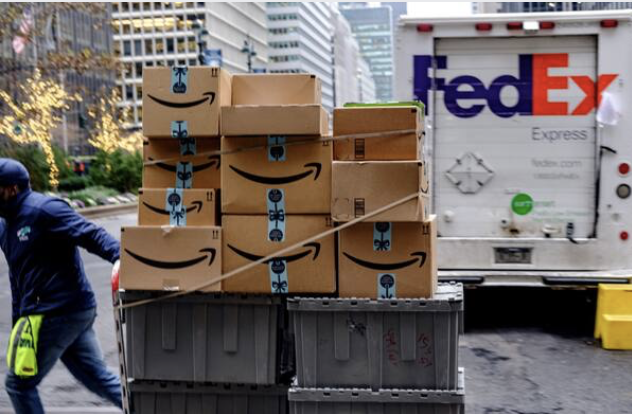
A worker pushes Amazon.com packages in front of a FedEx delivery truck in New York on Nov. 26, 2018. MUST CREDIT: Bloomberg photo by Christopher Lee
Trucks from Amazon.com Inc. and other e-commerce companies have become ubiquitous during the pandemic. In much of the industrialized world, an ever-growing number of vans, trucks, trains and ships are hauling everything from desks to smartphones as consumers turn to online shopping and companies restock their supply chains after months of disruption.
For the oil market, it is a potential fillip: In a world ravaged by coronavirus, freight is again growing, in some areas rapidly. And that means diesel.
“Truck traffic is up substantially,” said Gary Ross, a veteran oil market watcher and chief executive officer of Black Gold Investors LLC. “People have money and they’re not spending it on going out to the theater, they’re buying goods.”
Official statistics reflect what many can see from their window. In the U.S., for example, large trucks have driven 5% more miles over the last four weeks than they did a year before, according to data from the U.S. Federal Highway Administration.
Freight companies also confirm the revival. James Foote, chief executive of CSX Corp., one of the largest railway companies in the U.S., says volumes ended the third quarter above pre-covid levels. U.S. trucking companies, facing a shortage of drivers and high demand, are rejecting about 25% of requests for their business, compared with just 6% on average in 2019, according to Zach Strickland, head of market intelligence for FreightWaves.
“We’ve had a surge of business, and no one really saw it coming,” he said.
The trend matters for the oil market because trucking accounts for about 16% of global oil consumption and almost half of all diesel demand, according to 2019 data from the International Energy Agency.
The surge is expected to intensify in the shopping frenzy before Christmas. Delivery company DHL, owned by Germany’s Deutsche Post AG, expects its peak shipment quantities to be 50% higher than the same time last year.
There’s also a boost in freight from companies restoring inventories in supply chains that were disrupted by the pandemic — from car parts to children’s toys.
“As we talk to our customers, most specifically our overseas customers, they’re still seeing an opportunity for restocking,” said Keith Reardon, senior vice president of product and supply chain growth at Canadian National Railway Co.
The diesel market has struggled since the coronavirus pandemic began as the collapse in air travel forced refiners to push unwanted jet fuel into the production of diesel. That, in turn, swelled diesel inventories, sending prices down. As a result, profits from producing the fuel remain close to $3 a barrel, the lowest for this time of year in at least a decade.
While the freight rebound is helping oil prices, crude is still languishing at about $40 a barrel. Demand in the broader market is being crimped by the resurgence of the virus, and the outlook is fragile.
There’s also a risk the restocking surge could result in a vacuum of activity down the line, Drewry Shipping Consultants Ltd. wrote in a report. That would mean at least some of the additional demand tapers off by the start of next year.
But for now, thousands of miles of sprawling highways are full of trucks delivering goods. In the U.K., weekly figures show the use of heavy goods outpaces the recovery in any other vehicle type. It’s a similar picture on German roads, where large-truck miles have been at pre-pandemic levels since May.
Lithuania-based Girteka Logistics, one of Europe’s biggest truck owners, has added 500 trucks to the 7,000 it already had, as it rides the wave of housebound consumerism, according to Kristian Kaas Mortensen, director of strategic partnerships.
“People have to feel good, they have a need to spend.”
By The Washington Post · Jeff Stein · NATIONAL, BUSINESS, POLITICS, WHITEHOUSE, US-GLOBAL-MARKETS A sudden drop in the stock market threatens to muddle President Donald Trump’s campaign message about America’s economic recovery just days before the Nov. 3 election.
Trump has touted a partial economic rebound and rising stock market as central to his 2020 reelection bid, frequently pointing to Americans’ 401(K) accounts and investment portfolios. The president has insisted that both the market and the economy would nosedive should he lose to Joe Biden, at one point claiming the Democratic presidential nominee would cause a “super depression.”
But a sharp market drop this week — which follows a sharp rise in coronavirus cases and continued gridlock over a stimulus deal in Washington — may complicate the president’s boasts of overseeing a rapid economic recovery. Trump will likely see a boost from a positive report on America’s economic growth on Thursday, but investors fear a prolonged downturn in the stock market given that the virus is raging with increasing ferocity across much of the country.
The Dow Jones Industrial Average fell by more than 600 points on Monday, an approximately 2.3 percent drop, one of the largest single-day declines on the year. After a smaller dip on Tuesday, the Dow Jones Industrial Average opened down more than 700 points on Wednesday.
The Dow Jones is down nearly 2400 points since Sept. 2, a roughly 8% decline.
“This election is a choice between a Trump super recovery and a Biden – in my opinion, this is going to happen; I hate to say it – depression,” Trump told a crowd in Ohio earlier this week. “You’re going to have a depression. And your 401(k)s. Does anybody have a 401(k)? Throw them away. They’re not going to be worth – It’s a choice between a boom and a lockdown.”
The stock market dip comes amid wider signs of potential economic headwinds at the end of the president’s first-term.
Multiple federal relief measures approved by Congress expired months ago, depriving millions of small businesses and jobless Americans of emergency financial lifelines. Treasury Secretary Steven Mnuchin and House Speaker Nancy Pelosi, D-Calif., are formally continuing talks, but another stimulus package is not expected to be passed before the election.
The spread of the pandemic threatens to wreak further havoc on the recovery. The nation faces a coronavirus outbreak more widespread than those in the summer or spring, with hospitalizations increasing in 38 states and deaths beginning to tick up. The rise in covid cases raises the prospect of another wave of lockdowns that can cripple the economy. El Paso, Texas, and Newark, N.J., have both introduced curfews to curb their spike in covid cases.
The federal jobless rate has come down substantially to 7.8%. White House officials frequently point out that several key sectors — including housing; automobiles; and manufacturing — show signs of rapid growth that could power the U.S. economic recovery. Analysts expect Thursday could show a quarterly jump of more than a 25% increase in America’s Gross Domestic Product after the economy sharply contracted in the spring.
Joseph LaVorgna, chief economist of the White House National Economic Council, said after Monday’s dip that the stock market decline was unremarkable and that the underlying American economy remains fundamentally strong. Weekly unemployment claims have begun coming down and retail sales are now above their prior peak, LaVorgna said.
“I don’t think this is anything fundamentally amiss with the economy,” LaVorgna said in an interview. “The economy looks pretty darn healthy — and that’s what’s going to eventually steady stocks. I’m not worried. I think the markets are very much sending a message of growth and rebound.”
Still, even some of the president’s allies acknowledge the challenge posed by the market decline, arguing Trump must continue to blame Pelosi for holding up the stimulus.
“It’s a big, big decline,” said Stephen Moore, an outside economic adviser to the White House. “Trump has to keep saying: ‘Pelosi blocked the plan because she wanted the blue state bailout.'”
Wall Street has had mixed assessments of which presidential candidate would be best for growth. JP Morgan analysts said in a report on Monday that an “orderly” Trump victory represents “the most favorable outcome” for the market. The stock market is still up roughly 40% since Trump was elected in 2016. Historically, the market typically increases by about 7% every year, meaning Trump’s term in office is better than the median president, but not spectacularly so.
Moody’s Analytics estimated stronger GDP growth under Biden’s economic plans than Trump’s. Other financial analysts have pointed out that Trump’s term in office has been punctuated by erratic swings in the market, dropping dramatically during the 2018 government showdown and again when trade tensions flared in the summer of 2019. About half of all Americans own no stock at all, including retirement accounts such as 401(k) plans.
“We got a big gain but, boy, were we subjected to extreme volatility to get it, and not everyone got to enjoy the ride up,” said Chris Rupkey, chief financial economist at MUFG Union Bank.
Ed Yardeni, president and chief investment strategist of Yardeni Research, said on Monday that the early sell-off may well represent “garden variety volatility” rather than a new crisis. Manufacturing indexes last week, Yardeni pointed out, still suggest a “v-shape” recovery and wider strength in the broader U.S. economy. It’s still possible that stocks make a healthy recovery in time for Election Day.
“It’s not a correction yet. This is just more of the same,” Yardeni said. “The market could be up big tomorrow. Or it could be back to worrying about covid.”
Bangkok-Nong Khai high-speed rail contract inked with China
EconOct 28. 2020PM Prayut Chan-o-cha, centre, presides over the signing ceremony.
By The Nation
Prime Minister Prayut Chan-o-cha has hailed the development of the Thai-Sino high-speed rail project as key to strengthening the country’s competitiveness.
The premier on Wednesday presided over the signing of “Contract 2.3” between the State Railway of Thailand (SRT), China Railway International and China Railway Design Corp at Government House.
The Bt50.63-billion contract is for Phase 1 of the Bangkok-Nakhon Ratchasima high-speed railway, which will run from Bangkok to Nong Khai. The contract covers construction of the track and electrical, signalling and communication systems, procurement of trains, maintenance and technology transfer.
Transport Minister Saksayam Chidchob said that Phase 1 comprises a 253-kilometre stretch of track with six stations – Bang Sue, Don Muang, Ayutthaya, Saraburi, Pak Chong and Nakhon Ratchasima.
The Thai side is entirely responsible for investment on this phase and the civil works, while the Chinese side will oversee the design and installation of track, electrical systems, train operation system, train procurement and personal training.
The Thai side is currently drafting the design of Phase 2 – a 354.5km track from Nong Khai to Nakhon Ratchasima.
Saksayam said the ministry will ask the Cabinet to approve the launch of an institute to conduct research and development of track system technology, aiming to increase the number of experts in the field.
This would help boost use of local materials, add about Bt21 billion in value to the Thai rail industry, and create jobs worth about Bt6 billion annually, he said.
The Stock Exchange of Thailand (SET) Index closed at 1,207.94 on Wednesday, down 1.01 points or 0.08 per cent. Total transactions amounted to Bt55 billion with an index high of 1,217.88 and a low of 1,205.88.
In the morning session, an analyst at Krungsri Securities expected the day’s index to hover around 1,200 points in the absence of new positive economic factors.
“Existing factors include the Covid-19 situation and doubts over fresh economic stimulus in the US,” he said.
However, the analyst expected investors to focus on business turnovers in the third quarter of this year.
The 10 stocks with the highest trade value today were SCGP, STA, PTT, AOT, BBL, KBANK, STGT, NER, CPALL and MINT.
As of 4.30pm, the price of oil dropped by US$1.45 or 3.66 per cent to $38.12 per barrel, while gold fell by $8.20 or 0.43 per cent, to $1,903.70 per ounce.
Other Asian indices were mixed:
Japan’s Nikkei Index closed at 23,418.51, down 67.29 points or 0.29 per cent.
China’s Shang Hai SE Composite Index closed at 3,269.24, up 14.92 points or 0.46 per cent, while the Shenzhen SE Component Index closed at 13,388.10, up 118.45 points or 0.89 per cent.
Hong Kong’s Hang Seng Index closed at 24,708.80, down 78.39 points or 0.32 per cent.
South Korea’s KOSPI Index closed at 2,345.26, up 14.42 points or 0.62 per cent.
Taiwan’s TAIEX Index closed at 12,793.75, down 81.26 points or 0.63 per cent.
The Cabinet on Wednesday approved in principle guidelines for foreigners to disembark cruise liners under the Special Tourist Visa programme, deputy government spokesperson Traisuree Taisaranakul said.
The guidelines cover captains, crew and passengers from countries where the Covid-19 outbreak is low or medium based on the Public Health Ministry’s list.
The visitors will also have to agree to go into quarantine for at least 14 days, as well as have health coverage of US$100,000 for Covid-19 as well as local health and accident insurance. Proof of advance payment for the anchoring of the liner will also have to be provided.
Eligible tourists will be allowed to stay in Thailand for 90 days, after which they will be allowed to extend their stay twice, by 90 days each time.
By Syndication Washington Post, Bloomberg · Vildana Hajric · BUSINESS
Tech shares rose after Advanced Micro Devices announced a $35 billion takeover of another chipmaker, helping to blunt concern about the impact of growing coronavirus infections. Oil climbed.
The tech strength wasn’t enough to buoy the S&P 500 Index, which declined for a second straight day. Almost four stocks fell for every one that rose, with banks bearing the brunt of selling. Xilinx Inc. surged after agreeing to be bought by AMD. Megacap tech names including Amazon.com Inc. and Apple Inc. also gained as investors sought out companies that fare well during lockdowns.
The Stoxx Europe 600 Index fell to its lowest since May amid concern about the faster spread of the coronavirus on the continent. BP Plc warned of many challenges ahead as the pace of recovery in oil demand remained uncertain.
Stocks have been knocked around in recent weeks by speculation about whether lawmakers will pass a fiscal stimulus package, but with almost no possibility of that happening before Americans vote Nov. 3, investors were looking for fresh insight into corporate America’s health. A U.S. consumer confidence report came in worse than forecast Tuesday as data showed Covid-19 hospitalizations have risen at least 10% in the past week in 32 states and the nation’s capital.
“Covid case counts and hospitalizations continue to rise — these will continue to be closely watched as investors gauge the likelihood of more stringent mitigation measures,” said Yousef Abbasi, global market strategist at StoneX.
Elsewhere, the dollar slipped and Treasury yields dipped. Crude oil climbed as U.S. Gulf producers shut production ahead of Tropical Storm Zeta. Bitcoin rose past $13,500, approaching levels not seen since just after the burst of the cryptocurrency market bubble almost three years ago.
Here are the main moves in markets:
Stocks
– The S&P 500 Index fell 0.3% as of 4 p.m. EDT.
– The Stoxx Europe 600 Index decreased 1%.
– The MSCI Asia Pacific Index rose 0.2%.
Currencies
– The Bloomberg Dollar Spot Index dipped 0.1%.
– The British pound rose 0.2% to $1.3055.
– The Japanese yen strengthened 0.3% to 104.49 per dollar.
Bonds
– The yield on 10-year Treasuries dipped three basis points to 0.77%.
– Germany’s 10-year yield decreased four basis points to -0.62%.
– Britain’s 10-year yield fell four basis points to 0.23%.
Commodities
– West Texas Intermediate crude added 2.2% to $39.42 a barrel.


 Jack Ma. MUST CREDIT: Bloomberg photo by Kiyoshi Ota Photo by: Kiyoshi Ota — Bloomberg Location: Tokyo Japan
 A United Parcel Service driver unloads packages from a delivery truck in Chicago on July 22, 2019. MUST CREDIT: Bloomberg photo by Christopher Dilts
 PM Prayut Chan-o-cha, centre, presides over the signing ceremony.


