
Cabinet releases billions more in SME loans to support grassroots economy #ศาสตร์เกษตรดินปุ๋ย

#ศาสตร์เกษตรดินปุ๋ย : ขอบคุณแหล่งข้อมูล : หนังสือพิมพ์ The Nation.

Cabinet releases billions more in SME loans to support grassroots economy

EconAug 19. 2020 Deputy government spokeswoman Rachada DhnadirekDeputy government spokeswoman Rachada Dhnadirek

By The Nation

The Cabinet on Tuesday approved five more financial-relief measures to support small and medium-sized enterprises (SMEs) and individuals suffering fallout from Covid-19 and other crises, said deputy government spokeswoman Rachada Dhnadirek.

First, the Thai Credit Guarantee Corporation (TCG) will guarantee loans taken by SMEs under the central bank’s soft loans scheme. The guarantee scheme will cost Bt57 billion and cover loan terms of up to eight years. The guarantee will kick in the third year of borrowing. The guarantee fee is 1.75 per cent annually, with up to 30 per cent subsidised by the TCG. The TCG has asked for Bt9.12 billion in compensation from the Budget Bureau.

Second, the Government Savings Bank will expand coverage of the existing Covid-19 lending scheme to provide loans of up to Bt50,000 to individuals with regular income. The Bt10 billion scheme will also cover small business, the self-employed and families affected by the virus outbreak, economic fallout or natural disasters. The loans have a six-month grace period for principal and interest rate payment. Another Bt5 billion will be earmarked for loans of up to Bt500,000 for small businesses and individuals in tourism-related industries such as restaurants, spas, traditional massage, car rental, guest houses, and hostels. The GSB will charge 3.99 per cent interest rate for a five-year loan term with one-year grace period on interest rate payment.

Third, the Finance Ministry wants the GSB to expand coverage of the Bt80-billion lending scheme for SMEs  approved earlier by the Cabinet. The GSB will offer Bt10 billion in loans to support SMEs in tourism, related services, and other sectors, offered via non-bank financial companies. Another Bt3 billion will be lent directly by the GSB to SMEs. Each borrower will get up to Bt20 million in credit.

Fourth, the Small and Medium Enterprise Development Bank of Thailand will expand its existing loan scheme worth of Bt10 billion for tourism and related services to cover other types of businesses affected by the virus crisis. These loans are open to both individual or corporate entities and capped at Bt30 million. Currently the bank has approved loans worth only Bt417 million, leaving Bt9.6 billion still available.

Fifth, the Cabinet approved extending the loan guarantee scheme under the TCG package to support micro entrepreneurs with total funding of Bt15 billion. Each will get no more than Bt200,000. The deadline for application was also extended from July 23 to December 30. Loans totalling Bt2.5 billion are still available.

ThaiBev founder Charoen takes Bt100bn hit from virus crisis #ศาสตร์เกษตรดินปุ๋ย

#ศาสตร์เกษตรดินปุ๋ย : ขอบคุณแหล่งข้อมูล : หนังสือพิมพ์ The Nation.

ThaiBev founder Charoen takes Bt100bn hit from virus crisis

EconAug 19. 2020

By The Nation

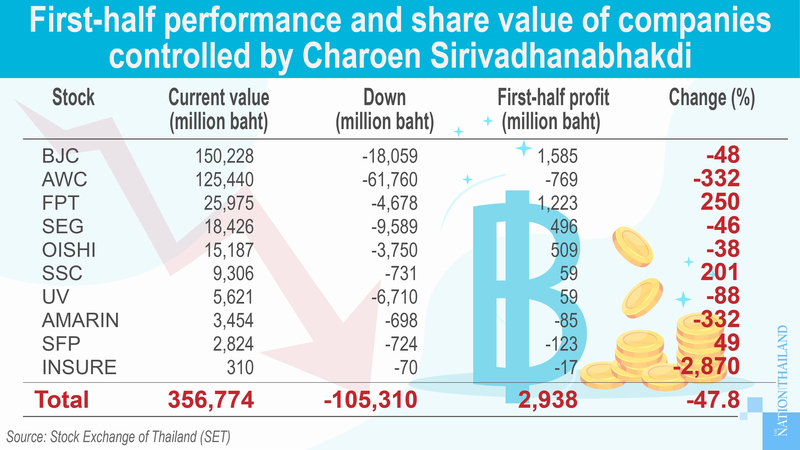
The market capitalisation of listed companies controlled by property magnate and ThaiBev founder Charoen Sirivadhanabhakdi has slumped over Bt100 billion this year, while their first-half profit plummeted by 47 per cent to Bt2.9 billion, experts said.

Charoen is currently major shareholder in 10 listed companies, either personally or via affiliates, after his 11th firm, Goldenland (GOLD), filed for delisting from the Stock Exchange of Thailand (SET) and stopped trading on August 10.

The combined market capitalisation of his 10 companies stands at around Bt356 billion, most of which comes from two companies – Berli Jucker (BJC) at Bt150 billion and Asset World Corporation (AWC) at Bt125 billion.

However, AWC shares have fallen 30 per cent from Bt6 to Bt3.92, helping to wipe Bt105 billion or 22.8 per cent off the combined market cap of both companies this year.

Charoen controls businesses in a variety of sectors, including real estate with AWC and Univentures (UC), industrial estates with Frasers Property (FPT), food with Oishi Group (OISHI) and Siamfood (SFP), insurance with Indara Insurance (INSURE) and Thai Group Holdings (SEG), and media with Amarin Printing and Publishing (AMARIN).

Combined profit of his 10 companies in the first six months this year was Bt2.9 billion, down 47.8 per cent year on year from Bt5.6 billion. Four companies recorded net losses, namely AWC (Bt768 million), SFP (Bt122 million), AMARIN (Bt85 million) and INSURE (Bt17 million).

An analyst at investment bank UOB Kay Hian said the bank has cut its 2020-2022 profit forecast for AWC profit after lower-than-expected results, adding that tourism is likely to recover slowly. AWC has invested heavily in hotels.

“AWC is not very attractive during this time although the company will grow in the long term because its share value is high,” the analyst predicted.

An analyst at Bualuang Securities said AWC would gain benefit from the tourism recovery in the long term because it is the largest mid-range and luxury hotel business operator in Thailand.

“Based on the Discounted Cash Flows [DCF] method, we advise buying AWC shares with a Bt5 target price at the end of 2021, according to our new profit forecast, down from Bt5.80 per share,” the analyst said.

Meanwhile BJC’s net profit dropped by 47.7 per cent from Bt3.03 billion to Bt1.58 billion due to a decline in revenue. An analyst at Trinity Securities explained that BJC’s packaging business revenue fell by 11.1 per cent after Covid-19 prevention measures such the alcohol ban took a toll.

“Pharmaceutical and technical business revenue fell by 5.9 per cent as consumers prioritised their health, causing less sickness and demand for certain drugs to drop,” the analyst said.

“Retail business revenue fell by 11.4 per cent, while same-store sales dropped 17 per cent due to unnecessary product space restriction, limited opening times, and rent discount exemptions.”

“Consumables was the only business that saw increased revenue, of 4.7 per cent, from logistics and overseas businesses in Vietnam, cleaning products, alcohols, and hand sanitisers demand and the decline in domestic consumption.”

The analyst said the securities company has cut BJC’s profit forecast this year by 39 per cent to Bt4.78 billion, down 34.3 per cent year on year, expecting its profit in the second half to improve.

FPT’s net profit rose around 250 per cent year on year from Bt763 million extra profit after it acquired GOLD shares at the beginning of this year, as well as profit from the sale of company’s assets to FTREIT.

An analyst at DBS Vickers expected FPT’s profit in the fourth quarter this year and the first half of 2021 to increase from the sale of company’s assets to FTREIT, while the demand for factories and warehouses for rent is still high.

“However, the company’s short-term income will be affected by the rental discount to relieve the Covid-19 burden on tenants,” the analyst said.

Based on the DCF method, the analyst advised buying FPT shares at a new base price of Bt13.80.

“We increased the company’s profit forecast this year by 18 per cent, but reduced its profit forecast next year by 19 per cent in response to more caution on GOLD’s sales and transfers of residential and hotel businesses and assets,” he said.

“We expect the company’s profit from asset sales next year to drop to Bt1.2 billion from Bt2 billion this year.”

Farmers of casava, rubber, corn get Bt14bn price guarantee schemes #ศาสตร์เกษตรดินปุ๋ย

#ศาสตร์เกษตรดินปุ๋ย : ขอบคุณแหล่งข้อมูล : หนังสือพิมพ์ The Nation.

Farmers of casava, rubber, corn get Bt14bn price guarantee schemes

EconAug 18. 2020

By The Nation

The Cabinet today approved price guarantee schemes for casava, rubber and corn-feed farmers with a total budget of Bt14.106 billion.

Of the total, Bt2.4 billion will be added to the Bt24-billion price guarantee scheme for rubber farmers approved last October. The government’s Bank for Agriculture and Agricultural Cooperatives will finance the scheme in advance.

Another Bt1.913 billion of the total budget will fund a price guarantee for maize planters this year and next year.

The remaining Bt9.78 billion will pay for price guarantees for casava planters, covering a total 530,000 households nationwide.

SET rallies despite lack of positive sentiment #ศาสตร์เกษตรดินปุ๋ย

#ศาสตร์เกษตรดินปุ๋ย : ขอบคุณแหล่งข้อมูล : หนังสือพิมพ์ The Nation.

SET rallies despite lack of positive sentiment

EconAug 18. 2020

By The Nation

The Stock Exchange of Thailand (SET) Index closed at 1,330.11 today (August 18), up 9.20 points or 0.70 per cent. Total transactions tallied at Bt50.855 billion with an index high of 1,330.40 and a low of 1,321.07.

During the morning session, a stock analyst at Krungsri Securities said he expected the index to fluctuate between 1,315 and 1,330 owing to the lack of positive sentiment to boost investment after listed companies had announced their second-quarter performance.

“Besides, we expect investors to delay trading to follow the US Federal Reserve’s meeting on Thursday to monitor interest-rate signals in the future, resulting in volatility in the index,” he said.

The top 10 stocks with the highest trade value today were CPALL, STGT, KBANK, CRC, AOT, PTT, ADVANC, MINT, GULF and NER.

As of 4.30pm, the price of crude oil dropped by US$0.10 or 0.23 per cent to $42.79 per barrel, while gold rose by $18.30 or 0.92 per cent, to $2,017 per ounce.

Other Asian indices were mixed:

Japan’s Nikkei Index closed at 23,051.08, down 45.67 points or 0.20 per cent.

China’s Shanghai SE Composite Index closed at 3,451.09, up 12.29 points or 0.36 per cent, while Shenzhen SE Component Index closed at 13,768.17, up 25.94 points or 0.19 per cent.

Hong Kong’s Hang Seng Index closed at 25,367.38, up 20.04 points or 0.079 per cent.

South Korea’s KOSPI Index closed at 2,348.24, down 59.25 points or 2.46 per cent.

Taiwan’s TAIEX Index closed at 12,872.14, down 83.97 points or 0.65 per cent.

Cambodia offers great opportunities for Thai bubble tea, coffee business #ศาสตร์เกษตรดินปุ๋ย

#ศาสตร์เกษตรดินปุ๋ย : ขอบคุณแหล่งข้อมูล : หนังสือพิมพ์ The Nation.

Cambodia offers great opportunities for Thai bubble tea, coffee business

EconAug 18. 2020

By THE NATION

The Department of International Trade Promotion (DITP) is advising Thai businesses to invest in coffee and milk tea products in Cambodia, as it already has more than 800 coffeeshops nationwide and is showing good potential for more.

“Coffee and bubble tea are a big hit in Cambodia with more than 300 shops in Phnom Penh and 500 in other provinces,” DITP director general Somdet Susomboon said on Tuesday (August 18). “Thai brands like Amazon, Black Canyon, True Coffee, Inthanin, Arabitia, Doi Chang, Doi Lor and Chao Doi have become very popular, with Thai coffeeshops holding more than 45 per cent market share in Cambodia. Amazon is the biggest player after having opened 140 branches nationwide.”

Somdet said foreign companies are also eyeing the Cambodian market, with Starbucks opening its 20th branch in the country.

“Local brands like Brown Coffee are also strong players, making Cambodia a promising market with the potential of high competition in the future,” he added.

Jirawut Suwanart, director of DITP Cambodian Office, said entrepreneurs wanting to set up coffeeshops or bubble milk-tea businesses in Cambodia can contact the office for details on documentation and regulations.

“Thai businesses can enter the market in three ways – opening and managing the shop with 100-per cent-ownership, which is suitable for well-established brands; co-investing with a local investor, which is suitable for expanding into rural areas as the insight of locals will help secure the market; and the third is to sell franchise licence to locals. The last option is the cheapest with low financial risks, though brand owners must ensure that franchisees maintain the product’s quality or they risk injuring the brand image.”

Energy Ministry plans a future with electric vehicles #ศาสตร์เกษตรดินปุ๋ย

#ศาสตร์เกษตรดินปุ๋ย : ขอบคุณแหล่งข้อมูล : หนังสือพิมพ์ The Nation.

Energy Ministry plans a future with electric vehicles

EconAug 18. 2020

By The Nation

The Energy Ministry plans to have up to 1.2 million electric vehicles plying the roads by 2030 and is laying the foundation for infrastructure and battery development.

Wattanapong Kurovat, chief of the Energy Policy and Planning Office, said the ministry was sticking by its goal of 1.2 million EV cars by 2030 as other facilities such as charging stations, electric system and EV car technology were being developed including plans on reducing energy consumption.

He said the office was also studying the option of EV users selling extra energy from their batteries to the national power grid, which will help strengthen the country’s electricity security.

Somphot Ahunai, president of the energy firm, Energy Absolute, said promoting the use of electric vehicles should be done systematically, starting with creating a demand by reducing the price barrier and installing some 2,000 charging stations 50 kilometres apart nationwide.

He said the government can pilot EVs in public transport, taxis and government cars first. When demand rises, it will result in automakers, battery manufacturers and makers of EV parts basing themselves in Thailand and ultimately turning it into an EV hub in Asean.

Goldman sees small-business bounce with most now operating again #ศาสตร์เกษตรดินปุ๋ย

#ศาสตร์เกษตรดินปุ๋ย : ขอบคุณแหล่งข้อมูล : หนังสือพิมพ์ The Nation.

Goldman sees small-business bounce with most now operating again

CorporateAug 18. 2020Goldman Sachs headquarters in New York on April 11, 2020. MUST CREDIT: Bloomberg photo by Mark Kauzlarich.
Goldman Sachs headquarters in New York on April 11, 2020. MUST CREDIT: Bloomberg photo by Mark Kauzlarich.

By Syndication Washington Post, Bloomberg · Michael Sasso · BUSINESS, US-GLOBAL-MARKETS 

About 2.7 million job losses in the U.S. can be attributed to shuttered small businesses since the start of the pandemic, or about 18% of the total, according to a Goldman Sachs study that found that those firms have been surprisingly resilient so far.

The report shows that the majority of employees let go in early temporary closures are now back at work. The job losses from small-business closings as of July are down from a peak of 10.7 million as of April, suggesting reopenings helped propel the better-than-expected employment reports of recent months. One caveat: active small businesses probably cut jobs as well, so the overall effects of the pandemic on employment are probably much higher, according to the Aug. 16 report.

Among optimistic economic signs is an all-time high in business formations filed with the IRS, including so-called high-propensity applications that are likely to lead to new wage-paying businesses, according to the report. Most small businesses that responded to a July U.S. Chamber of Commerce survey reported being able to sustain operations for at least another six months without permanently closing.

One major unknown is what will happen once support from the $669 billion federal Paycheck Protection Program and other aid to small businesses wears off. With little chance that a new stimulus deal may be reached in Congress before September, the next few months may proved challenging for small firms.

“Thus far, the U.S. appears to have avoided the surge in Covid-19-related permanent business shutdowns that many feared at the pandemic’s onset, likely because the PPP and other policy support helped businesses survive the sharp pullback,” the Goldman Sachs economists wrote in their study.

One troubling spot for the economy is a fairly high rate of bankruptcy filings among large companies, although most appear to have had unsustainable capital structures even before the health crisis, according to the report. Overall, bankruptcy filings by large companies could hold back U.S. employment growth by 94,000 jobs a month if they stay at their elevated levels, according to the study.

Standard Chartered Bank lowers GDP forecast to 8% contraction #ศาสตร์เกษตรดินปุ๋ย

#ศาสตร์เกษตรดินปุ๋ย : ขอบคุณแหล่งข้อมูล : หนังสือพิมพ์ The Nation.

Standard Chartered Bank lowers GDP forecast to 8% contraction

EconAug 18. 2020Tim Leelahaphan, economist, Standard Chartered Bank (Thai)Tim Leelahaphan, economist, Standard Chartered Bank (Thai)

By The Nation

Thailand’s gross domestic product will contract by 8 per cent compared to 2019, more than the 5 per cent contraction forecast earlier, reflecting the worsening outlook due to political concerns and a lack of concrete stimulus measures, Standard Chartered Bank said on Tuesday.

“While we believe the second quarter saw the worst of the Covid-19 impact on Thailand’s economy, we now expect a slower recovery ahead. Domestic activity – currently the main economic driver – remains weak, while external sources of growth are unreliable,” said Tim Leelahaphan, economist, Standard Chartered Bank (Thai).

The bank pushed back its call for the next policy rate cut to the fourth quarter from the third quarter given limited monetary policy space. The bank has raised its 2021 growth forecast to 2 per cent from 1.8 per cent to reflect this year’s lower base.

“Looking ahead, we do not see a clear post-Covid development strategy for Thailand. The current crisis has exposed the economy’s heavy dependence on external drivers, particularly tourist arrivals from China. This issue will need to be structurally resolved over the medium term to ensure sustainable growth,” Tim said.

Better returns in foreign markets lure Thai investors #ศาสตร์เกษตรดินปุ๋ย

#ศาสตร์เกษตรดินปุ๋ย : ขอบคุณแหล่งข้อมูล : หนังสือพิมพ์ The Nation.

Better returns in foreign markets lure Thai investors

EconAug 18. 2020Pichet Sithi-Amnuai, Bualuang Securities presidentPichet Sithi-Amnuai, Bualuang Securities president

By The Nation

Due to low interest rates worldwide and a drop in the Thai stock market’s return on investment, more and more individual investors are opening accounts with Bualuang Securities (BLS) to invest in foreign shares.

Pichet Sithi-Amnuai, BLS president, said Thai investors were interested in foreign stock markets because the global interest rate remained low, and had even contracted in some countries.

“Meanwhile, the Thai stock market’s return on investment contracted 19 per cent compared to foreign stock markets, which generated good returns, especially Nasdaq and S&P 500, which rose 40 per cent and 18 per cent respectively,” he said.

Pichet added that BLS has designed special tools to make investing in foreign markets easy, especially the “Global Signals” tool, which indicates bear and bull shares.

Rhatsarun Tanapaisankit, chief of BLS’ Global Investing department, said foreign investments in the second half of this year is an interesting option, because apart from cutting down on geographic risks, it offers people an opportunity to invest in new industries that are not available in the Thai stock market, such as shares of firms coming up with innovations.

“Many foreign markets have risen sharply, so investors should buy shares when they are cheap,” he said.

He advised that investors spend 70 per cent of their funds in the US stock market and focus on three groups, namely technology stocks such as Microsoft (MSFT) and Apple (AAPL), growth stocks such as healthcare companies, and value stocks whose price dropped due to the Covid-19 crisis and will rise once the crisis is resolved.

“We also advise investors to spend 20 per cent in the Hong Kong stock market because many of its shares grow alongside the Chinese economy,” he said. “In addition, investors should spend the remaining 10 per cent on the Vietnam stock market and focus on investment via depositary receipt ‘E1VFVN3001’ which is an exchange traded fund of the VN30 Index.

“If investors are interested in individual stocks, we recommend Vinamilk [VNM], which is growing in line with domestic consumption in Vietnam,” he added.

Gold price hits single-day highest in four months #ศาสตร์เกษตรดินปุ๋ย

#ศาสตร์เกษตรดินปุ๋ย : ขอบคุณแหล่งข้อมูล : หนังสือพิมพ์ The Nation.

Gold price hits single-day highest in four months

EconAug 18. 2020

By The Nation

The price of gold rose by Bt600 per baht weight in morning trade on Tuesday (August 18), the Gold Traders Association reported.

As of 9.28am, the buying price of a gold bar was Bt29,250 per baht weight and selling price Bt29,350, while gold ornaments cost Bt28,728.20 and Bt29,850, respectively.

At close on Monday, the buying price of a gold bar was Bt28,650 per baht weight and selling price Bt28,750 while gold ornaments cost Bt28,136.96 and Bt29,250, respectively.

The Chinese Gold and Silver Exchange Society said that Hong Kong gold price rose by HK$270, opened at $18,340 (Bt73,784.48) per tael this morning.

Meanwhile, the Comex (Commodity Exchange) gold price to be delivered in December rose by US$48.9, or 2.51 per cent, to $1,998.7 (Bt62,320.07) per ounce at Monday’s close.

Gold price hit the single-day highest in four months from the decline in dollar and US bond yields. Besides, investors were buying gold as a safe-haven asset after the number of Covid-19 cases started to rise again.