SET-listed Bangkok Chain Hospital (BCH) projects annual revenue growth of between 10 and 15 per cent next year, said director of finance and investor relations Pumipat Chatnoraset.
The operator will open two new facilities next year – Kasemrad Hospital in Prachinburi and Kasemrad Hospital in Vientiane, Laos.
Pumipat said competition in the hospital sector would be intensify in the premium customer segment as hospitals focused on attracting foreign patients.
Energy Absolute Plc (EA) expects Thailand’s electric vehicle (EV) industry to grow quickly once its battery plant starts production in the first quarter of next year.
Amorn Sapthaweekul, EA deputy CEO, said the company is focusing on investments in new businesses to boost new S-curve industries next year.
He said construction of the battery factory was 90 per cent complete, with production expected to start in January next year.
“The factory will enable the company’s subsidiaries to produce various types of electric vehicle, such as cars, buses and ferries,” he said.
Next year, the company will focus on investing in EV and power plant businesses, both domestic and overseas.
EA has allocated Bt17.2 billion for investment next year – 5.19 billion for the battery business, Bt5.13 billion for industrial estate development, and Bt3.35 billion for an EV plant in Chachoengsao.
The rest will be spent on other businesses, such as electric boats and renewable energy.
“Thailand’s automotive market is transforming from traditional to modern, so it still has a chance to expand,” said Omsin Siri, EA’s vice president of corporate communication.
She added that the company will participate in bidding to provide about 3,000 electric buses by the first quarter next year.
EA also plans to apply its bio-based phase change material business to the textile industry, with gains expected to be realised by the fourth quarter this year, she said.
“In addition, a joint venture with Nex Point Pcl will enable the company to develop more electric vehicles, which should result in gains next year,” she said.
She expects the company’s fourth-quarter performance to rise quarter on quarter, on profits from wind and solar power plants.
“The company’s revenue and net profit in the first nine months this year was Bt12.73 billion and Bt3.72 billion, respectively. Revenue from the biodiesel business was Bt4.63 billion, up 72 per cent, while revenue from the electrical business was Bt7.79 billion, down 2 per cent,” she added.
Satit Viddayakorn, managing director and major shareholder of Principal Capital, said on Wednesday that he has bought 90.5 million shares of Bumrungrad Hospital (BH) from Bangkok Dusit Medical Services (BDMS).
This follows BDMS’ agreement with a purchaser it chose not to name on November 19 to dispose all its 180.72 million ordinary shares in BH worth about Bt18.61 billion.
According to BDMS’ filing with the Stock Exchange of Thailand on Tuesday, the shares will be sold at Bt103 apiece. The first lot of 90.5 million shares will be sold in a big lot, while the sale of the remainder is expected to be completed by December 31.
Satit said the purchase was his personal investment as he has confidence in the performance of Bumrungrad Hospital.
Bangkok Insurance Pcl (BKI) aims to invest Bt1.5 billion in commercial bank and energy shares next year as these would benefit from the economic recovery, its chairman said.
Chai Sophonpanich expects companies listed on the Stock Exchange of Thailand to pay low dividends next year as they had used retained earnings to pay dividends this year.
He said bank shares is an interesting choice for investment next year because these would benefit from the economic recovery as banks have already set up high reserves for doubtful debts.
“However, we have to monitor whether banks will be able to pay dividends or not because the company hasn’t received interim dividends from Bangkok Bank and Bangkok Life Assurance totalling Bt70 million,” Chai said.
He said BKI has an investment portfolio worth Bt41 billion, with return on investment of 4.4 per cent, higher than last year’s 3.6 per cent.
“We expect to gain profit of over Bt1 billion this year from investments as our profit in the past nine months was Bt900 million,” he added.
Meanwhile, BKI chief executive officer and director Apisit Anantanatarat expected the company’s aircraft insurance premiums to drop by 15-20 per cent next year after the firm gave out some premiums to airlines which were affected by the Covid-19 pandemic.
“The company provides insurance services for three airlines – Thai Airways International, AirAsia and Bangkok Airways,” he said.
He added that BKI would focus on providing insurance services for large projects next year because many large government projects were postponed this year.
Amata Corporation Plc, operator of several industrial estates, has estimated that the company would sell only 10-15 new factories this year, while sales before the Covid-19 crisis were 30-50 factories per year, with the highest recorded sales being 102 factories.
“We had set the land sales target this year at 950 rai and are unlikely to achieve it by the year-end,” said Amata’s chief marketing officer Viboon Kromadit.
“We would like the government to implement the measure proposed by the Public Health Ministry to reduce the mandatory quarantine period from 14 to 10 days as soon as possible to help foreigners who are interested in investing in Thailand,” he said.
“The outbreak is deadly, but the impact on the economy due to a lack of foreign investment could be deadly too if the government continued to enforce strict quarantine measures,” he said. “Our neighbours are relaxing measures in order to ensure their economic survival.”
Viboon said the company has set a sales target of 30-40 factories next year.
“Whether we can achieve this depends on factors such as the political situation, quarantine measures and the availability of a Covid-19 vaccine,” he said.
“Easing up domestic lockdown will help boost economic activity. Factory owners have reported increasing production capacity to 60-80 per cent lately, compared to earlier this year when capacity had been limited at 20-30 per cent due to intensive lockdown measures and a prohibition on travel,” Viboon said.
“We are positive that foreign investors are still eying Thailand as their destination and have not moved elsewhere, but they are just slowing down their investments while judging the political climate and virus situation in Thailand. That’s why the government needs to reduce the quarantine period as well as promote the travel bubble campaign to attract foreign investors,” he added.
By The NationEnergy firm Banpu Plc expects to set aside at least US$1 billion (Bt30.4 billion) for its five-year investment plan (2021-2025), said chief executive officer Somrudee Chaimongkol.
The budget would be spent on business expansion through joint investment, takeovers, and boosting existing production capacity, she added.
She said the company expects continued growth of Ebitda ( Earnings before Interest, Tax, Depreciation and Amortisation) from the fourth quarter this year into next year, thanks to improving gas and coal prices in the fourth quarter. The advent of winter has triggered higher energy demand, especially in China and India.
Banpu’s completed acquisition of a gas-producing operation in the Barnett Shale in Texas in the third quarter will enable realisation of its new production capacity in the fourth quarter this year.
The Mass Rapid Transit Authority of Thailand (MRTA) is expected to call for bids to construct the Purple Line southern extension in February next year, said governor Pakapong Sirikantaramas.
Construction of the extension from Tao Poon to Rat Burana is expected to start in September 2021 and take six years to complete at a cost of Bt124.959 billion.
The project will be financed by a public-private partnership.
Of the total cost, Bt80 billion will be for civil works, Bt16 billion for land expropriation and Bt23 billion for the train system.
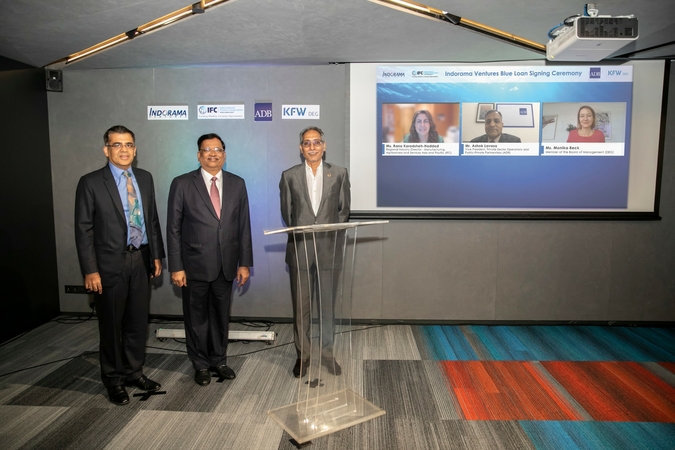
The Asian Development Bank (ADB) and Indorama Ventures (IVL) Plc have signed a $100-million (Bt3.04 billion) financing package to reduce the environmental impact of plastic by boosting the capacity of IVL’s plastic recycling plants in Thailand, India, Indonesia, and the Philippines.
The plants will recycle polyethylene terephthalate (PET) plastics widely used in bottles. The finance package comprises $50 million from ADB and $50 million from the ADB-administered Leading Asia’s Private Infrastructure Fund (LEAP). A $150 million loan will be provided by the International Finance Corporation, and $50 million from Germany’s DEG.
“The recycling of plastics like PET is a must for healthier oceans, and this initiative will help to achieve that objective by partnering with IVL, which is the global leader of PET production and recycling,” said vice-president for Private Sector Operations and Public–Private Partnerships Ashok Lavasa. “There is a rising global demand for recycled plastic packaging. ADB’s support will help IVL to meet this demand by collecting and treating plastic waste that would otherwise have been released into the oceans.”
Said chief Sustainability Officer at Indorama Ventures Yashovardhan Lohia: “By using post-consumer PET bottles as a feedstock for new bottles, we give value to waste. This drives improvements in waste collection systems, meaning less waste and cleaner oceans.”
It is estimated that Asia accounts for more than 80 per cent of all plastics released into the ocean. Globally around half of PET is recycled. In a circular economy, products and materials are redesigned, recovered, and recycled to divert plastic waste from landfills and oceans. The plants to be built under the project are expected to be fully operational by 2022, and will ensure that nearly 5 billion additional bottles are diverted from waste annually.
IVL is a Thailand-listed, global business committed to develop technologies and processes that use post-consumer PET and polyester waste materials as feedstock for the future. As the largest producer of 100 per cent recyclable PET in the world, IVL supports all aspects of the circular economy to reduce the amount of waste entering the environment. IVL is listed on the Dow Jones Sustainability Index and operates 125 manufacturing facilities in 33 countries across five continents.
Electricity Generating Plc (Egco) applied for a licence to procure and trade liquified natural gas (LNG) with the Energy Regulatory Commission last week, said the company’s president Thepparat Theppitak.
Egco plans to import 250,000 tonnes of LNG per year to feed its Banpong power plant in Ratchaburi and Klongluang plant in Pathum Thani.
The shipment will also be used to fuel its Egco Cogen power plant in Rayong.
He added that the company was closely monitoring LNG markets to identify the right time to import the gas.
Five companies already hold LNG import and trade licences: PTT, the Electricity Generating Authority of Thailand, Gulf Energy Development, B Grimm LNG, and Hin Kong Power Holding (HKH), in which Gulf Energy Development holds a 49-per-cent stake.
Bangkok Dusit Medical Services Plc (BDMS) on November 19 decided to dispose all its ordinary shares in Bumrungrad Hospital (BH) worth around Bt18.613 billion.
According to BDMS’s filingwith the Stock Exchange of Thailand, it will sell more than 180.72 million shares at Bt103 apiece, representing 22.71 per cent of Bumrungrad Hospital’s total issued shares.
On Tuesday, the purchaser confirmed the availability of funds for the share purchase and BDMS is expected make the initial sales of 90.5 million shares on Thursday.
The sale of the remaining shares is expected to be completed by December 31.
BDMS has noted, however, that the sale is still uncertain and subject to the availability of the purchaser’s funding.


 CEO Somrudee Chaimongkol