The Stock Exchange of Thailand (SET) Index dropped by 1.68 points, or 0.13 per cent, to 1,303.89 in the morning session today (September 2) after foreign investors resorted to mass sell-offs of Thai shares.
An analyst at Krungsri Securities expected the index to rebound between 1,310 and 1,315 points before falling in response to a rise in the US manufacturing Purchasing Managers’ Index (PMI) in August.
“The US PMI in August rose to 53.1, the highest in a year,” the analyst said.
“The market did gain positive sentiment after the US moved to consider new Covid-19 relief measures.”
However, he warned investors to beware of market volatility because foreign investors’ funds continued to flow out.
He recommended that investors buy stocks whose third-quarter performance would improve, such as CPF, GFPT, TU, Asian, KCE, Hana, Delta, HMPro, Global, DoHome, Com7, JMT, CHG, BCH, PTG, PlanB, CBG and Tasco.
The SET Index closed at 1,305.57 yesterday, down 5.09 points, or 0.39 per cent. Total transactions amounted to Bt48.63 billion, with an index high of 1,316.68 points and a low of 1,301.014.
The index fell into negative territory following news that Finance Minister Predee Daochai had tendered his resignation less than a month after taking the post, citing health problems.
The price of gold dropped by Bt100 per baht weight in morning trade today (September 2), the Gold Traders Association reported.
As of 9.28am, the buying price of a gold bar was Bt28,950 per baht weight and selling price Bt29,050, while gold ornaments cost Bt28,425 and Bt29,550, respectively.
At close yesterday, the buying price of a gold bar was Bt29,050 per baht weight and selling price Bt29,150, while gold ornaments cost Bt28,531.12 and Bt29,650, respectively.
The Comex (Commodity Exchange) gold price to be delivered in December rose by 30 cents, or 0.02 per cent, closing at US$1,978.90 (Bt61,849) per ounce yesterday, the highest in two weeks since August 18 this year.
The gold price rose slightly due to a strengthening dollar. However, analysts expected the price to rise further from the US Federal Reserve’s policy to maintain a low interest rate.
Significant aid package is needed to help economy recover from coronavirus, Mnuchin says
EconSep 02. 2020Treasury Secretary Steven Mnuchin/ File photo
By The Washington Post · Erica Werner, Jonathan O’Connell · NATIONAL, BUSINESS, POLITICS, CONGRESS WASHINGTON – Treasury Secretary Steven Mnuchin said Tuesday that a new stimulus package is still needed to help the economy recover from the ravages of the coronavirus, and he committed to calling Speaker Nancy Pelosi, D-Calif., right away to try to restart talks.
Mnuchin’s comments came in testimony before the select subcommittee on the coronavirus crisis, which convened on Capitol Hill in the final week of Congress’s summer recess. Mnuchin and the panel’s chairman, Rep. James Clyburn, D-S.C., appeared in person along with a handful of lawmakers, while others spoke through a video link.
“While we continue to see signs of a strong economic recovery, we are sensitive to the fact that there is more work to be done, and certain areas of the economy require additional relief,” Mnuchin testified in his opening statement. “I believe a bipartisan agreement still should be reached and would provide substantial funds” for areas including schools, testing, vaccines, small businesses, enhanced unemployment benefits and the U.S. Postal Service. President Donald Trump, meanwhile, said on Tuesday that the struggling airline industry would also need more assistance.
Clyburn chided Mnuchin for not making a deal with Democrats months after the House passed a sweeping $3.4 trillion bill in May called the Heroes Act.
“Additional economic stimulus is urgently needed . . . as the pandemic drags on, states, cities and businesses are warning that more layoffs may be coming,” Clyburn said. “Secretary Mnuchin, I hope you will return to the negotiating table prepared to find common cause.”
Mnuchin was involved in talks last month with Pelosi, Senate Minority Leader Charles Schumer, D-N.Y., and White House Chief of Staff Mark Meadows aimed at producing a new economic relief package. But those talks collapsed amid partisan rancor, and Trump moved forward on his own with executive actions aimed at providing some relief in areas including unemployment assistance.
Those executive actions have had limited impact, but Meadows reiterated in a television interview Tuesday that more such unilateral moves were under consideration.
Efforts at restarting the talks have sputtered. Pelosi and Meadows spoke last week, with Pelosi saying Democrats would agree to a $2.2 trillion package. But that figure is still too high for Republicans.
“I do not support $2.2 trillion,” Mnuchin said Tuesday. “But what is more important is what is the breakdown of getting money to American workers, American families, kids . . . there are tremendous areas of agreement and that’s what we should be doing right away.”
“I don’t think the right outcome is zero. No one thinks the right outcome is zero,” Mnuchin said.
Rep. Maxine Waters, D-Calif., asked Mnuchin if he would commit to calling Pelosi on Tuesday to restart talks.
“Can I tell her you suggested I call her right after the hearing?” Mnuchin asked.
“Yes, yes, yes,” Waters said.
“Done, I will call her right after the hearing,” Mnuchin said.
The treasury secretary did reach out to the House speaker following the hearing, according to a person familiar with the call who requested anonymity to discuss private communications. However, it was unclear if they actually connected, and there was no public sign of movement in the negotiations.
The administration has pushed Democrats to agree to a slimmed-down package addressing areas of common ground, but Democrats have refused to abandon their goal of a comprehensive package.
Senate Republicans have been working to agree on what they’re calling a “skinny” or “targeted” package with a price tag under $1 trillion that they may try to move forward on the Senate floor as soon as next week. Democrats would probably block this, but Republicans have been trying to put the focus on what they view as Democrats’ unreasonable refusal to compromise in the talks. Senate GOP incumbents in tight races are also eager to be able to vote on some additional recovery measures.
Some 27 million Americans are receiving some form of unemployment aid. On Thursday, the Labor Department said another 1 million Americans filed jobless claims the prior week.
The stock market has made strong gains, and the economy has recovered slightly less than half of the jobs that were initially lost during the pandemic in March and April. Trump has been talking bullishly about the economy’s revival, focusing on things like the stock market, as he and some other White House advisers insist that the economy is poised for a strong “V-shaped” recovery.
Democrats and some liberal economists, however, have expressed concerns about a “K-shaped” recovery, in which the economically advantaged bounce back, while people who are on the lower levels of the income scale fare poorly.
Rep. Andy Kim, D-N.J., asked Mnuchin if he agreed the economy was poised for a strong “V-shaped” recovery.
“I think we are set for a very strong recovery but let me just say, there are many businesses, many industries that have been destroyed by this, and that’s why I urge Congress, the House and the Senate, to move forward and let us provide help especially for those hardest-hit businesses,” Mnuchin said.
“Let’s not get lost on different letters of the alphabet, let’s move forward in a bipartisan basis on areas we can agree on,” he said.
Some House Democrats in tough reelection races have also grown uneasy about the inaction on additional coronavirus aid, as the stimulus checks, enhanced unemployment aid and other programs Congress agreed to in a $3 trillion spate of spending in March and April expire. Even as Pelosi has held out for a comprehensive package, some in her caucus have sounded open to the incremental approach pushed by Mnuchin.
At Tuesday’s hearing, Kim, a freshman Democrat up for reelection in a contested race, told Mnuchin that moving forward on areas of agreement was “a great sentiment” – although he went on to highlight some Democratic priorities such as health insurance assistance that Republicans have not embraced.
Ahead of the hearing, Democrats on the subcommittee released a report showing the potential for significant waste in the small-business Paycheck Protection Program Congress created in March. The program distributed $530 billion to small businesses in an effort to keep their workers on payroll. The report found that more than $1 billion went to companies that may have improperly received multiple loans, nearly $100 million went to companies that have been barred from doing business with the government, and nearly $200 million went to companies that staffers found had been previously flagged by the federal government for performance or integrity issues.
The amount of potential waste identified in the report still constitutes a small fraction of the entire program, and Treasury and Small Business Administration officials have committed to auditing loans of more than $2 million. But the staffers behind the report said the loans to be audited constitute less than 1 percent of the total and wrote that “the Administration appears to lack the appropriate oversight mechanisms to identify and root out these problems.”
Mnuchin disputed this allegation in his testimony Tuesday, and Republicans on the subcommittee issued a competing report that praised the administration for demonstrating “how the government can work with the private sector to quickly and efficiently get aid to those in need” by dispensing an unprecedented volume of loans in a short period of time to prevent catastrophic job losses at small businesses.
There continues to be disagreement over how effective the program has been in reducing unemployment. Trump and other administration officials still claim that the program helped small businesses retain or support 50 million jobs – something Trump again boasted during his acceptance speech at the Republican National Convention – despite agreement among many experts that the number was likely far smaller due to the government’s faulty data collection methods.
A Post analysis of data on 4.9 million PPP loans released shows that many companies are reported to have “retained” far more workers than they employ. In other cases, the SBA’s jobs claim for entire industries surpasses the total number of workers in those sectors.
By Syndication Washington Post, Bloomberg · Vildana Hajric · BUSINESS U.S. stocks notched fresh records with tech shares in the lead as investors snapped up work-from-home winners.
Zoom Video Communications led a rally in companies well positioned for stay-at-home orders, while Apple pulled the S&P 500 Index to a fresh high after August’s blowout gain. The dollar erased losses as data showed U.S. manufacturing expanded last month at the fastest pace since 2018. Treasury yields dipped.
Stocks have churned ever higher as investors anticipate a flood of cash coming into the market, with last week’s announcement from the Federal Reserve that the central bank will maintain an easy-money policy adding fuel to the trade. Meanwhile, Chinese factory data Tuesday signaled rising global demand for exports after the initial shock of the pandemic, a good sign for the world economy.
“The big theme right now is the unrelenting, record-breaking rally in tech stocks,” said Candice Bangsund, portfolio manager of global asset allocation at Fiera Capital Corp. “The landscape for stocks is great but there’s still, from a macro perspective, a lot of unknowns as to the progression of the virus and, of course, the implications for global growth.”
Oil climbed toward $43 a barrel as the pickup in economic activity in the U.S. and China signaled a pronounced recovery in crude consumption.
The Stoxx Europe 600 slumped, with travel and leisure shares among the worst performers.
In Asia, equity indexes were mixed. South Korean shares rose, while Australia’s stock benchmark dropped to the lowest since early August.
Here are the main market moves:
Stocks
–The S&P 500 Index rose 0.8% as of 4 p.m. EDT.
–The Stoxx Europe 600 Index fell 0.3%.
–The MSCI Asia Pacific Index increased 0.5%.
–The MSCI Emerging Market Index increased 1.5%.
Currencies
–The Bloomberg Dollar Spot Index rose less than 0.1%.
–The euro fell 0.2% to $1.1908.
–The Japanese yen was little changed at 105.95 per dollar.
Bonds
–The yield on 10-year Treasurys fell three basis points to 0.67%.
–Germany’s 10-year yield fell two basis points to -0.42%.
–Britain’s 10-year yield fell two basis points to 0.29%.
Commodities
–West Texas Intermediate crude rose 0.6% to $42.88 a barrel.
Germany cushions pandemic blow by weaning itself off exports
EconSep 02. 2020The bear and bull statue stands outside the Frankfurt Stock Exchange in Frankfurt, Germany, on Aug. 31, 2020. MUST CREDIT: Bloomberg photo by Alex Kraus. Photo by: Alex Kraus — Bloomberg Location: Frankfurt, Germany
By Syndication The Washington Post, Bloomberg · Birgit Jennen, Raymond Colitt
Germany expects the blow from the coronavirus crisis to be less severe than feared, as the country reduces its traditional reliance on exports.
Chancellor Angela Merkel’s administration forecast that national output will shrink by 5.8% this year. While that still marks one of the worst recessions since the end of World War II, it’s a smaller contraction than an April prediction of 6.3%, as efforts to shore up domestic demand bear fruit.
The relatively moderate decline is “an important sign that we have managed to stabilize domestic demand and decouple to a great extent from global economic developments,” Economy Minister Peter Altmaier said Tuesday at a press conference in Berlin. “We are looking at an unexpectedly fast V-shaped recovery,” and the worst is over, he said.
The government forecast a 12.1% drop in exports this year, compared with a decline of 8.1% for imports and 3.6% for domestic consumption. Germany’s trade surplus was one of the sources of tensions with President Donald Trump, and U.S. trade conflicts with China have hit Germany, even before the pandemic decimated economies across the world.
Germany’s domestic shift may continue. While the country can avoid another nationwide shutdown despite a recent upsurge in infections, its trading partners may need to rein in activity, Altmaier said.
“The global economic environment could remain difficult for a longer time,” he said. “The global recession will be significantly stronger” than during the financial crisis in 2008 and 2009.
Still, Germany’s recovery will be less robust, with 2021 growth of 4.4%. That’s lower than the previous projection of a 5.2% expansion, and pre-crisis levels won’t likely be reached until 2022, Altmaier said.
Activity in Europe’s biggest economy has staged a strong rebound after collapsing in the second quarter, and German companies have turned slightly more optimistic that the economy will continue on its long road to recovery.
Reports on Tuesday showed that German unemployment declined in August and a gauge of factory activity rose to a 22-month high. Still, the manufacturing report from IHS Markit wasn’t all positive. The machinery and equipment sectors — which are more exposed to global demand — remain weak, and businesses continued to cut jobs.
To soften the blow from the pandemic, Merkel’s government suspended constitutional debt limits as part of a massive stimulus program, including cutting value-added taxes and providing money to families. The efforts were mainly focused on getting Germans to spend.
Altmaier said Germany will emerge stronger from the crisis, and his optimistic assessment marks a stark contrast to Merkel’s stern warning last week. The chancellor said the coronavirus crisis will get worse before it gets better, defending her government’s move to abandon its balanced-budget policy.
“I am firmly convinced that it is a good decision to take on a high degree of debt because anything else would mean we would be in the grip of the pandemic for a lot longer,” Merkel said in her annual summer press conference on Friday.
Don Mueang Airport is expected to see 13.6 million passengers this year, falling short of the targeted 15 million, said the airport’s general manager Sumpun Kutranon.
The airport catered to more than 41 million passengers per year before the Covid-19 pandemic.
Passenger numbers at the airport gradually recovered as the lockdown was eased, said Sumpun. The airport currently serves 220 flights and 45, 000 passengers daily.
That compares with 700 flights and 120,000 passengers before the outbreak.
The airport is ready to serve foreign passengers when the government implements the travel bubble policy, he added.
The Cabinet on Tuesday (September 1) approved the Transport Ministry’s proposal for the State Railways of Thailand (SRT) to take a Bt11.5 billion loan for operations in the 2021 fiscal year as well a short-term loan of Bt800 million.
The loans aim to boost SRT’s liquidity, especially since the agency expects to suffer a shortage of cash in the next fiscal year.
The loans will be sought and guaranteed by the Finance Ministry, while SRT will be responsible for the repayment of the principle and interest.
‘Phuket model’, job creation on agenda for Prayut’s economic team today
EconSep 02. 2020Deputy Prime Minister and Energy Minister Supattanapong Punmeechaow
By The Nation
More economic stimulus measures are expected today as ministers and experts in the Covid-19 economic management team discuss a job creation scheme for new graduates and packages to bring in foreign tourists.
Chaired by PM Prayut Chan-o-cha, the meeting will discuss proposals to boost the economy in the rest of the year, Deputy Prime Minister and Energy Minister Supattanapong Punmeechaow said on Tuesday.
Most of new measures would be short-term, he said.
The team will also address the employment situation and discuss a plan to hand financial support for companies that hire new graduates, he said. Previous tourism measures would be reassessed, he added, promising details would be revealed after the meeting.
Government spokesman Anucha Burapachaisri said ministries have submitted their proposals to the team, while PM Prayut wants to strike a balance between economic activities and virus control. The government is worried that workers in neighbouring countries experiencing a surge in new cases may illegally enter Thailand, he added.
Tourism and Sports Minister Pipat Ratchakijprakan said his ministry and the National Economic and Social Development Council will offer a joint proposal on how to bring in more foreign tourists. The Cabinet recently approved a proposal to bring in 200 long-stay tourists from Australia and New Zealand next month to pilot the so-called Phuket model on the southern island. The tourists will be checked for Covid-19 before they depart and again when they arrive in Thailand. If they test negative again after a mandatory 14-day quarantine in their hotel rooms, they will be able to travel in Phuket province. After 21 days in Phuket province, they will be permitted to travel further afield on 90-day visas that can be extended by 180 days.
Authorities will watch how local communities react to the tourists before deciding whether to allow more in, said the minister.
Subsequent groups may be not be required to stay in their rooms but instead be able to walk around hotel areas for four to seven days before travelling outside.
Pipat insisted reopening for foreign tourists was essential for the economy, adding that he failed to understand why medics oppose the move but supported bringing in migrant labourers. He said foreign labourers from neighbouring countries such as Myanmar, where cases have surged, were a bigger worry since they could not be checked if they entered Thailand illegally.
The Stock Exchange of Thailand (SET) should begin to gradually recover this month after securities companies cut their forecasts of listed companies’ profit for this year and next year, according to Asia Plus Securities’ executive vice president Therdsak Thaveeteeratham.
He explained that listed companies’ second-quarter performance was Bt117 billion, down 46 per cent year on year, the lowest in 13 years.
“Therefore, the securities company has cut listed companies’ profit forecast this year from Bt64 to Bt56.65 per share, the lowest in 11 years,” he said.
“We hope this is the last time we cut the forecast because profits are expected to recover by 28 per cent next year on the base profit of Bt76.7 per share, resulting in a rise in the SET Index.”
He expected foreign investors’ cash to flow into the SET despite pressure from domestic politics and imported Covid-19 cases.
“Currently, mass sell-offs of Thai stocks by foreign investors are lower than in previous months, while they only hold 26.13 per cent of Thai shares,” he said.
He forecast the index would move between support and resistance lines of 1,300 points and 1,335 points, respectively.
“We do not expect the index to fall below 1,270 points, because of the SET’s uptick rule, while the domestic political situation will pull down the index by only 4 per cent,” he said.
“But if the index does rise over the current resistance line at 1,335 points, the next resistance is 1,385 points.”
He forecast the SET Index will rise from deposits, which at Bt15.52 trillion are currently higher than the index’s market capitalisation of over Bt14 trillion.
“According to historical statistics, when deposits are higher than capitalisation, cash flows into the market to boost index recovery.”
“In the long term, the index will move to 1,450 points due to the high earning yield gap of 5 per cent, based on the index at 1,320 points. If the interest rate is below 0.5 per cent, the index will move to 1,500 points,” he predicted.
Comparing the Covid-19 crisis to the 2008 global financial crisis, he said the difference between the two is there is still cash in the system this time.
“If investors realise where the low point is, they will invest more and the index will rise sharply,” he added.
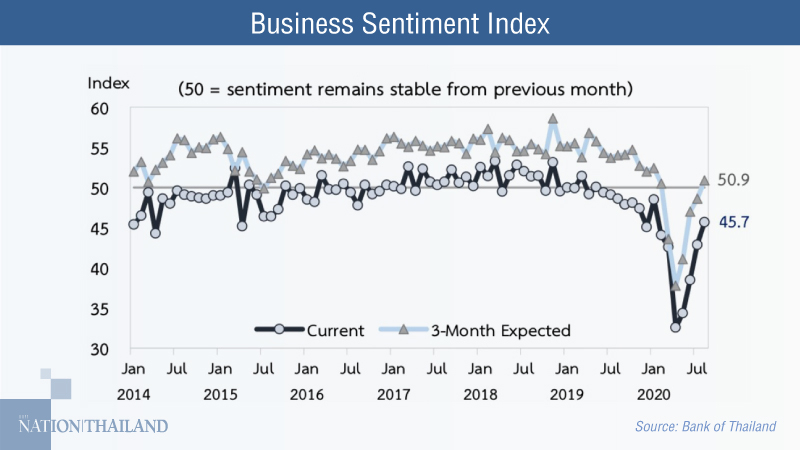
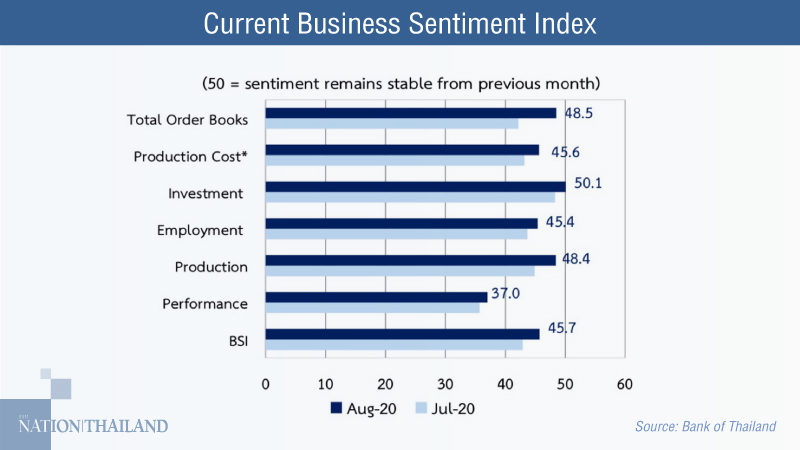
The Business Sentiment Index (BSI) rose for a fourth consecutive month in August thanks to improved sentiment in the manufacturing sector.
The BSI rose almost 3 points, from 42.9 in July to 45.7 in August.
However, although the index signalled ongoing recovery, it was still below the threshold, according to the Bank of Thailand (BOT).
Meanwhile the 3-month expected BSI rose again to 50.9, above the 50-threshold for the first time since the Covid-19 crisis began, implying that future business confidence has improved.
The BSI rise in August was mainly due to stronger confidence from manufacturing, especially in the machinery and automotive sectors following recent launches of new car models. The index for the non-manufacturing sector remained relatively stable.
While the hotel and restaurant sector benefited somewhat from the government’s tourism stimulus package, August’s index for the logistics sector fell after a sharp improvement last month.
The 3-month expected BSI rose from 48.6 to above the 50-threshold, reflecting confidence that business conditions are improving. The 3-month index was driven up by growth in both the manufacturing and non-manufacturing sectors and from almost all components, especially production and total order books.
Specifically, indices for the food & beverage and automotive sectors were above the threshold for three consecutive months. Moreover, indices for the electric appliance and electronic sectors significantly rose this month. These implied that
confidence of respondents in the manufacturing sector is recovering relatively well, the BOT said. For the non-manufacturing sector, the index increased in all businesses except for construction, whose index dropped for the second consecutive month because of lower construction volume given fewer property projects launched.


 Treasury Secretary Steven Mnuchin/ File photo

 The bear and bull statue stands outside the Frankfurt Stock Exchange in Frankfurt, Germany, on Aug. 31, 2020. MUST CREDIT: Bloomberg photo by Alex Kraus. Photo by: Alex Kraus — Bloomberg Location: Frankfurt, Germany

 Deputy Prime Minister and Energy Minister Supattanapong Punmeechaow