The Stock Exchange of Thailand (SET) Index closed at 1,330.11 today (August 18), up 9.20 points or 0.70 per cent. Total transactions tallied at Bt50.855 billion with an index high of 1,330.40 and a low of 1,321.07.
During the morning session, a stock analyst at Krungsri Securities said he expected the index to fluctuate between 1,315 and 1,330 owing to the lack of positive sentiment to boost investment after listed companies had announced their second-quarter performance.
“Besides, we expect investors to delay trading to follow the US Federal Reserve’s meeting on Thursday to monitor interest-rate signals in the future, resulting in volatility in the index,” he said.
The top 10 stocks with the highest trade value today were CPALL, STGT, KBANK, CRC, AOT, PTT, ADVANC, MINT, GULF and NER.
As of 4.30pm, the price of crude oil dropped by US$0.10 or 0.23 per cent to $42.79 per barrel, while gold rose by $18.30 or 0.92 per cent, to $2,017 per ounce.
Other Asian indices were mixed:
Japan’s Nikkei Index closed at 23,051.08, down 45.67 points or 0.20 per cent.
China’s Shanghai SE Composite Index closed at 3,451.09, up 12.29 points or 0.36 per cent, while Shenzhen SE Component Index closed at 13,768.17, up 25.94 points or 0.19 per cent.
Hong Kong’s Hang Seng Index closed at 25,367.38, up 20.04 points or 0.079 per cent.
South Korea’s KOSPI Index closed at 2,348.24, down 59.25 points or 2.46 per cent.
Taiwan’s TAIEX Index closed at 12,872.14, down 83.97 points or 0.65 per cent.
The Department of International Trade Promotion (DITP) is advising Thai businesses to invest in coffee and milk tea products in Cambodia, as it already has more than 800 coffeeshops nationwide and is showing good potential for more.
“Coffee and bubble tea are a big hit in Cambodia with more than 300 shops in Phnom Penh and 500 in other provinces,” DITP director general Somdet Susomboon said on Tuesday (August 18). “Thai brands like Amazon, Black Canyon, True Coffee, Inthanin, Arabitia, Doi Chang, Doi Lor and Chao Doi have become very popular, with Thai coffeeshops holding more than 45 per cent market share in Cambodia. Amazon is the biggest player after having opened 140 branches nationwide.”
Somdet said foreign companies are also eyeing the Cambodian market, with Starbucks opening its 20th branch in the country.
“Local brands like Brown Coffee are also strong players, making Cambodia a promising market with the potential of high competition in the future,” he added.
Jirawut Suwanart, director of DITP Cambodian Office, said entrepreneurs wanting to set up coffeeshops or bubble milk-tea businesses in Cambodia can contact the office for details on documentation and regulations.
“Thai businesses can enter the market in three ways – opening and managing the shop with 100-per cent-ownership, which is suitable for well-established brands; co-investing with a local investor, which is suitable for expanding into rural areas as the insight of locals will help secure the market; and the third is to sell franchise licence to locals. The last option is the cheapest with low financial risks, though brand owners must ensure that franchisees maintain the product’s quality or they risk injuring the brand image.”
The Energy Ministry plans to have up to 1.2 million electric vehicles plying the roads by 2030 and is laying the foundation for infrastructure and battery development.
Wattanapong Kurovat, chief of the Energy Policy and Planning Office, said the ministry was sticking by its goal of 1.2 million EV cars by 2030 as other facilities such as charging stations, electric system and EV car technology were being developed including plans on reducing energy consumption.
He said the office was also studying the option of EV users selling extra energy from their batteries to the national power grid, which will help strengthen the country’s electricity security.
Somphot Ahunai, president of the energy firm, Energy Absolute, said promoting the use of electric vehicles should be done systematically, starting with creating a demand by reducing the price barrier and installing some 2,000 charging stations 50 kilometres apart nationwide.
He said the government can pilot EVs in public transport, taxis and government cars first. When demand rises, it will result in automakers, battery manufacturers and makers of EV parts basing themselves in Thailand and ultimately turning it into an EV hub in Asean.
Goldman sees small-business bounce with most now operating again
CorporateAug 18. 2020Goldman Sachs headquarters in New York on April 11, 2020. MUST CREDIT: Bloomberg photo by Mark Kauzlarich.
By Syndication Washington Post, Bloomberg · Michael Sasso · BUSINESS, US-GLOBAL-MARKETS
About 2.7 million job losses in the U.S. can be attributed to shuttered small businesses since the start of the pandemic, or about 18% of the total, according to a Goldman Sachs study that found that those firms have been surprisingly resilient so far.
The report shows that the majority of employees let go in early temporary closures are now back at work. The job losses from small-business closings as of July are down from a peak of 10.7 million as of April, suggesting reopenings helped propel the better-than-expected employment reports of recent months. One caveat: active small businesses probably cut jobs as well, so the overall effects of the pandemic on employment are probably much higher, according to the Aug. 16 report.
Among optimistic economic signs is an all-time high in business formations filed with the IRS, including so-called high-propensity applications that are likely to lead to new wage-paying businesses, according to the report. Most small businesses that responded to a July U.S. Chamber of Commerce survey reported being able to sustain operations for at least another six months without permanently closing.
One major unknown is what will happen once support from the $669 billion federal Paycheck Protection Program and other aid to small businesses wears off. With little chance that a new stimulus deal may be reached in Congress before September, the next few months may proved challenging for small firms.
“Thus far, the U.S. appears to have avoided the surge in Covid-19-related permanent business shutdowns that many feared at the pandemic’s onset, likely because the PPP and other policy support helped businesses survive the sharp pullback,” the Goldman Sachs economists wrote in their study.
One troubling spot for the economy is a fairly high rate of bankruptcy filings among large companies, although most appear to have had unsustainable capital structures even before the health crisis, according to the report. Overall, bankruptcy filings by large companies could hold back U.S. employment growth by 94,000 jobs a month if they stay at their elevated levels, according to the study.
Standard Chartered Bank lowers GDP forecast to 8% contraction
EconAug 18. 2020Tim Leelahaphan, economist, Standard Chartered Bank (Thai)
By The Nation
Thailand’s gross domestic product will contract by 8 per cent compared to 2019, more than the 5 per cent contraction forecast earlier, reflecting the worsening outlook due to political concerns and a lack of concrete stimulus measures, Standard Chartered Bank said on Tuesday.
“While we believe the second quarter saw the worst of the Covid-19 impact on Thailand’s economy, we now expect a slower recovery ahead. Domestic activity – currently the main economic driver – remains weak, while external sources of growth are unreliable,” said Tim Leelahaphan, economist, Standard Chartered Bank (Thai).
The bank pushed back its call for the next policy rate cut to the fourth quarter from the third quarter given limited monetary policy space. The bank has raised its 2021 growth forecast to 2 per cent from 1.8 per cent to reflect this year’s lower base.
“Looking ahead, we do not see a clear post-Covid development strategy for Thailand. The current crisis has exposed the economy’s heavy dependence on external drivers, particularly tourist arrivals from China. This issue will need to be structurally resolved over the medium term to ensure sustainable growth,” Tim said.
Better returns in foreign markets lure Thai investors
EconAug 18. 2020Pichet Sithi-Amnuai, Bualuang Securities president
By The Nation
Due to low interest rates worldwide and a drop in the Thai stock market’s return on investment, more and more individual investors are opening accounts with Bualuang Securities (BLS) to invest in foreign shares.
Pichet Sithi-Amnuai, BLS president, said Thai investors were interested in foreign stock markets because the global interest rate remained low, and had even contracted in some countries.
“Meanwhile, the Thai stock market’s return on investment contracted 19 per cent compared to foreign stock markets, which generated good returns, especially Nasdaq and S&P 500, which rose 40 per cent and 18 per cent respectively,” he said.
Pichet added that BLS has designed special tools to make investing in foreign markets easy, especially the “Global Signals” tool, which indicates bear and bull shares.
Rhatsarun Tanapaisankit, chief of BLS’ Global Investing department, said foreign investments in the second half of this year is an interesting option, because apart from cutting down on geographic risks, it offers people an opportunity to invest in new industries that are not available in the Thai stock market, such as shares of firms coming up with innovations.
“Many foreign markets have risen sharply, so investors should buy shares when they are cheap,” he said.
He advised that investors spend 70 per cent of their funds in the US stock market and focus on three groups, namely technology stocks such as Microsoft (MSFT) and Apple (AAPL), growth stocks such as healthcare companies, and value stocks whose price dropped due to the Covid-19 crisis and will rise once the crisis is resolved.
“We also advise investors to spend 20 per cent in the Hong Kong stock market because many of its shares grow alongside the Chinese economy,” he said. “In addition, investors should spend the remaining 10 per cent on the Vietnam stock market and focus on investment via depositary receipt ‘E1VFVN3001’ which is an exchange traded fund of the VN30 Index.
“If investors are interested in individual stocks, we recommend Vinamilk [VNM], which is growing in line with domestic consumption in Vietnam,” he added.
The price of gold rose by Bt600 per baht weight in morning trade on Tuesday (August 18), the Gold Traders Association reported.
As of 9.28am, the buying price of a gold bar was Bt29,250 per baht weight and selling price Bt29,350, while gold ornaments cost Bt28,728.20 and Bt29,850, respectively.
At close on Monday, the buying price of a gold bar was Bt28,650 per baht weight and selling price Bt28,750 while gold ornaments cost Bt28,136.96 and Bt29,250, respectively.
The Chinese Gold and Silver Exchange Society said that Hong Kong gold price rose by HK$270, opened at $18,340 (Bt73,784.48) per tael this morning.
Meanwhile, the Comex (Commodity Exchange) gold price to be delivered in December rose by US$48.9, or 2.51 per cent, to $1,998.7 (Bt62,320.07) per ounce at Monday’s close.
Gold price hit the single-day highest in four months from the decline in dollar and US bond yields. Besides, investors were buying gold as a safe-haven asset after the number of Covid-19 cases started to rise again.
The Stock Exchange of Thailand (SET) Index rose by 4.17 points, or 0.32 per cent, to 1,325.08 in morning session on Tuesday (August 18).
A stock analyst at Krungsri Securities expected the index to fluctuate between 1,315 and 1,330 due to lack of positive sentiment to boost investment after listed companies had announced their second-quarter performance.
“Besides, we expect investors to delay trading to follow the US Federal Reserve’s meeting on Thursday to monitor interest-rate signals in the future, resulting in volatility in the index,” he said.
The SET Index closed at 1,320.91 on Monday, down 6.14 points or 0.46 per cent. Total transactions amounted to Bt47.812 billion with an index high of 1,331.80 and a low of 1,315.89.
He recommended that investors buy:
▪︎Stocks that benefit from rising crude oil price, such as PTTEP, PTTGC, TOP and IVL.
▪︎Stocks that benefit from lockdown easing and progress in Covid-19 vaccine development, such as CRC, CPN HMPRO, GLOBAL, COM7, DOHOME, AOT, MINT, CENTEL and ERW
Oil rises with stronger equities on signals of economic recovery
EconAug 18. 2020An employee walks down stairs on the Armada gas condensate platform operated by BG Group in the North Sea off the coast of Aberdeen, Scotland, on Dec. 10, 2015. MUST CREDIT: Bloomberg photo by Simon Dawson.
By Syndication Washington Post, Bloomberg · Andres Guerra Luz · BUSINESS, US-GLOBAL-MARKETS Oil climbed alongside U.S. equities as optimism that an economic recovery may be on the horizon lifted hopes that improving fuel demand may follow.
Equities in the U.S., Europe and Asia strengthened on Monday, with the S&P 500 approaching an all-time high, bolstered by fresh stimulus out of China’s central bank. A gauge of builder sentiment in the U.S. jumped to its highest since 1998, signaling a bright spot in an economy reeling from the coronavirus pandemic. Helping buoy sentiment, there are signs that some parts of the U.S. hardest hit by the outbreak may be improving, with Arizona reporting the smallest increase in new infections in two months and no deaths.
Equities are rising, lifting all asset classes and reflecting the outlook that “we’re getting closer to some kind of economic recovery,” said Phil Streible, chief market strategist at Blue Line Futures in Chicago. “We’ve seen a big recovery in the equity markets, we’re seeing the reflation trade take off, why not oil participate in that.”
Meanwhile, a panel of technical experts is reviewing the deal between the Organization of Petroleum Exporting Countries and its allies on Monday, followed by a ministerial meeting on Wednesday. The group is starting to return some crude supply to the market this month following deep reductions.
U.S. benchmark crude futures are up over 5% so far this month as inventories shrink and the virus crimps U.S. shale operations. In fact, oil driller Chaparral Energy Inc. filed for bankruptcy protection, adding to a string of energy companies that have done so amid the pandemic.
“While prices have sharply recovered, we still see substantial challenges ahead for the shale patch,” such as limited financing and increasing cost of capital for shale plays, TD Securities commodity strategists including Bart Melek said in a note. “This should bode well for prices as demand growth continues to normalize into 2021.”
Oil’s rally remains capped by the surge in coronavirus cases around the world that have depressed demand. The sale of diesel in India — the country’s most-used fuel and a proxy for its economic health — slumped 20% in the first half of August from the same period in July, according to people familiar with preliminary data from the country’s three biggest fuel retails.
With the pandemic crippling consumption for gasoline and diesel during the normally active summer driving season, refiners on the U.S. Gulf Coast are cutting run rates or considering whether to restart certain process units after maintenance in response. Calcasieu Refining has idled its entire Lake Charles refinery in southwest Louisiana and may keep it shut for the rest of the year unless product demand improves. Exxon Mobil Corp. has also idled a key process unit at its Baton Rouge, Louisiana, refinery due to weak demand.
OPEC+ is planning to return about 1.5 million barrels a day to the market this month after trimming roughly 10% of global supply following a crash in demand due to the pandemic. Iraq has also made its strongest commitment yet to implement deep output cuts, including deeper cuts in the coming months to compensate for missing previous targets.
OPEC+ sees overall implementation of its pledged production cuts in July of 95%, before the meeting of the group’s Joint Technical Committee to formally assess compliance, said delegates.
“Unlike at the July JMMC when the market was waiting for guidance on an extension of the deepest of supply cuts to August, at this meeting there is no supply policy determination to make,” said Harry Tchilinguirian, head of commodity markets strategy at BNP Paribas. “We expect the committee to reinforce the same message of compliance and group discipline as it did at the July meeting.”
Trump finalizes drilling plan for iconic Arctic National Wildlife Refuge
EconAug 18. 2020The coastal plain of the Arctic National Wildlife Refuge, with the Brooks Range as a backdrop. CREDIT: U.S. Fish & Wildlife Service photo
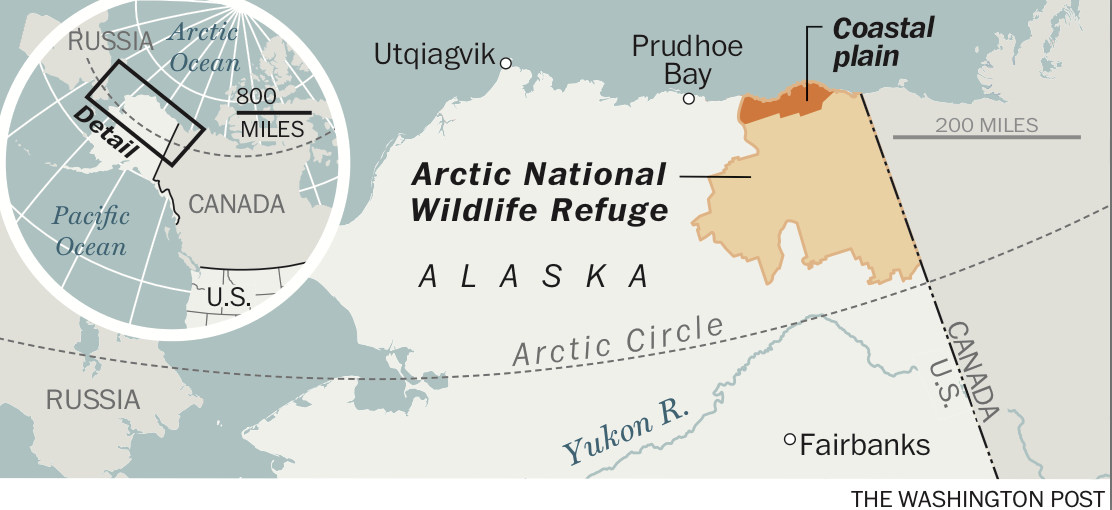
By The Washington Post · Juliet Eilperin · NATIONAL, BUSINESS, SCIENCE-ENVIRONMENT WASHINGTON – The Trump administration will open up the Arctic National Wildlife Refuge to drilling, a move that will auction off oil and gas rights in the heart of one of the nation’s most iconic wild places. Achieving a goal Republicans have sought for 40 years, it marks a capstone for an administration that has ignored calls to reduce fossil fuel consumption in the face of climate change.
The move will allow leasing on the 1.6 million-acre coastal plain, part of a nearly pristine wilderness that is home to migrating caribou and waterfowl as well as polar bears and foxes that live there year-round. It marks a major step toward reviving fossil fuel development in an area that has been untouched for three decades.
Arctic National Wildlife Refuge, ANWR, Alaska Photo by: The Washington Post — The Washington Post
In a conference call with reporters, Interior Secretary David Bernhardt said that his department was following through on the 2017 budget bill that instructed the federal government to conduct oil and gas leasing on the refuge.
“President [Donald] Trump’s leadership brought more than three decades of inaction to an end,” he said, adding that the plan was “carefully tailored” to minimize its impact on the surrounding environment. “This is no ordinary oil and gas program on public lands.”
The push to grant rights to drill on the refuge represents one of the most significant energy policy decisions Trump will make before his first term ends in January. He has doggedly worked to expand fossil fuel production in the United States, even as the climate impacts of burning those fuels – scorching temperatures, increased flooding and more-intense storms – have battered the country. In recent months, the administration has expanded oil and gas drilling, weakened gas mileage standards and rolled back energy efficiency standards for appliances.
According to an analysis by the Center for American Progress, a liberal think tank, the lease sales would result in the release of more than 4.3 billion metric tons of carbon dioxide over the projected life of the field. That total, which includes the impact of oil and gas once it is burned, is equal to roughly three-quarters of U.S. annual emissions.
Environmentalists and some Alaska Natives – including the Gwich’in, who live outside the refuge but rely on the Porcupine Caribou Herd, which migrates through it – have pledged to fight the drilling plan in court. Under the 2017 law, the federal government must conduct two lease sales of 400,000 acres each by December 2024.
The first auction would be held by Dec. 22, 2021, according to the plan, though Bernhardt said it was possible that it could take place by the end of this year. “I am confident that we can move forward quite promptly after this decision is rendered,” he said.
Bernhardt estimated that drilling could begin in roughly eight years and that the operations could last for about half a century.
Stretching into the Arctic Ocean’s frigid waters and 200 miles south on land, the refuge encompasses rolling tundra, jagged mountains and boreal forest. It provides habitat for more than 270 different species, including 900 denning polar bears, 250 musk oxen and 300,000 snow geese. While Congress authorized drilling on the coastal plain in 1980, opponents have managed to block energy development there for decades.
The move opens up all of the coastal plain’s polar bear denning habitat to energy exploration. In 2010, according to the U.S. Fish and Wildlife Service, there were 900 Southern Beaufort Sea polar bears left in the world. The overall number of bears, some of whom den on land, has declined 50% since 1980.
In issuing a “record of decision,” officials at the Interior Department’s Bureau of Land Management concluded that establishing a network of well pads and pipelines would not pose an undue threat to the wildlife that depend on the refuge for survival. The plan calls for the construction of as many as four airstrips and major well pads, 175 miles of roads, vertical supports for pipelines, a seawater-treatment plant and a barge landing and storage site.
Adam Kolton, executive director of the Alaska Wilderness League, said in a statement that the administration ignored science and the law in making this decision.
“Our climate is in crisis, oil prices have cratered, and major banks are pulling out of Arctic financing right and left. And yet the Trump administration continues its race to liquidate our nation’s last great wilderness, putting at risk the indigenous peoples and iconic wildlife that depend on it,” Kolton said. “We will continue to fight this at every turn, in the courts, in Congress and in the corporate boardrooms.”
Bernhardt said that while Democrats might want to scuttle the lease sale after taking office, they must contend with the fact that Congress has legally mandated auctions there. “They can’t just simply unduly delay. So that is a reality that Congress created.”
But if Democrats win control of the White House and both the House and Senate, experts said, they could pass new legislation overriding the 2017 law.
David Hayes, who served as Interior deputy secretary under both Bill Clinton and Barack Obama, said he believes the administration’s decision is legally vulnerable because it restricted its environmental analysis to the leasing stage and said it would only affect 2,000 acres on the surface. The 2017 law, he noted, instructs Interior to conduct an oil and gas program that covers “the leasing, development, production and transportation of oil and gas in and from the Coastal Plain area within the Arctic refuge.”
“You can’t just take the first step of the program,” Hayes said. “I think that statutory language is a real tripwire for these guys.”
Bernhardt, who noted that he had significant experience litigating cases related to Interior’s oil and gas leasing programs, said the department had crafted the decision within the confines of the law. “I would not be going forward if I was not very comfortable with the lines that we drew in this case.”
Alaska Republicans hailed the decision as an economic boost for their state. Gov. Mike Dunleavy said in a statement that the vision of Trump and Bernhardt “will lead to the responsible development of Alaska’s abundant resources, create new jobs, support economic growth and prosperity.”
Sen. Lisa Murkowski agreed. “This is a capstone moment in our decades-long push to allow for the responsible development of a small part of Alaska’s 1002 area.”
Frank Macchiarola, senior vice president of policy, economics and regulatory affairs at the American Petroleum Institute, said in a statement that the oil and gas industry has proven it can drill on Alaska’s North Slope safely.
“The industry has a well-established record of safe and environmentally responsible development of Alaska’s energy resources and has been recognized for its success in being respectful of Alaska’s wildlife and surrounding communities,” he said.
It is unclear which companies will bid on leases in the refuge and risk a potential backlash from conservation groups and the public. In an April poll, Yale and George Mason universities found that 33% of registered voters supported drilling for oil there, while 67% opposed it. And the low price of oil has made projects on Alaska’s North Slope, where operations are more costly, less attractive recently.
Some major banks, including JPMorgan Chase and Goldman Sachs, have already announced they will not finance projects in the refuge, and other financial institutions are under pressure to follow suit.
The government estimates there could be 7.8 billion barrels of recoverable oil on the coastal plain, though seismic surveys have not been conducted since the 1980s. Initially the administration projected that leasing would generate $1.8 billion in revenue over a decade, but it has subsequently cut that estimate in half.
One of the unanswered questions is how much oil lies beneath the refuge’s surface. There has not been seismic testing to identify potential deposits since the 1980s, and the results of any new testing will not be released before companies are asked to make bids on leases there.
But Bernhardt said he did not think that would deter bidders. “I think a lot of people will bid for leases without seismic data.”



 Goldman Sachs headquarters in New York on April 11, 2020. MUST CREDIT: Bloomberg photo by Mark Kauzlarich.
 Tim Leelahaphan, economist, Standard Chartered Bank (Thai)
 Pichet Sithi-Amnuai, Bualuang Securities president


 An employee walks down stairs on the Armada gas condensate platform operated by BG Group in the North Sea off the coast of Aberdeen, Scotland, on Dec. 10, 2015. MUST CREDIT: Bloomberg photo by Simon Dawson.
 The coastal plain of the Arctic National Wildlife Refuge, with the Brooks Range as a backdrop. CREDIT: U.S. Fish & Wildlife Service photo