Verso, Bangkok’s biggest international school, nears completion #ศาสตร์เกษตรดินปุ๋ย

#ศาสตร์เกษตรดินปุ๋ย : ขอบคุณแหล่งข้อมูล : หนังสือพิมพ์ The Nation

https://www.nationthailand.com/business/30383860?utm_source=category&utm_medium=internal_referral

Verso, Bangkok’s biggest international school, nears completion

Mar 11. 2020
By THE NATION

Construction of Verso International School at a 168-rai site near Thana City in Bang Na district is 90 per cent complete, on schedule for the facility to open in August.

Applications are now being accepted for Early Years 2-Grade 8. Grades 9-12 will be open next year.

Piyaporn Phanachet, chief executive at U City, an affiliate of infrastructure developer BTS Group Holdings, which has partnered with Fortune Hand Ventures of Hong Kong to build Verso, said it will be “a new educational innovation hub”.

U City is ready to offer strong and continuing support for Verso as it enrols 100-200 students for the first academic year using online and offline channels, including workshops for interested families and open houses.

Verso is offering a limited number of student grants to founding families, equivalent to 20 per cent of the tuition fee for a four-year consecutive period. It’s available to families who apply by March 31.

“The Thana City area is known for its convenient access to amenities and transportation links,” Piyaporn said. “Verso will further drive the growth in the area and in turn ensure a better quality of life for residents, students and families, fostering an integrated live-work-play community.”

Verso will be the largest international school in the Bangkok metropolitan area, boasting a capacity for 1,800 students.

It’s four kilometres from Suvarnabhumi Airport and will be near Light Rail Transit on the future Brown Line.

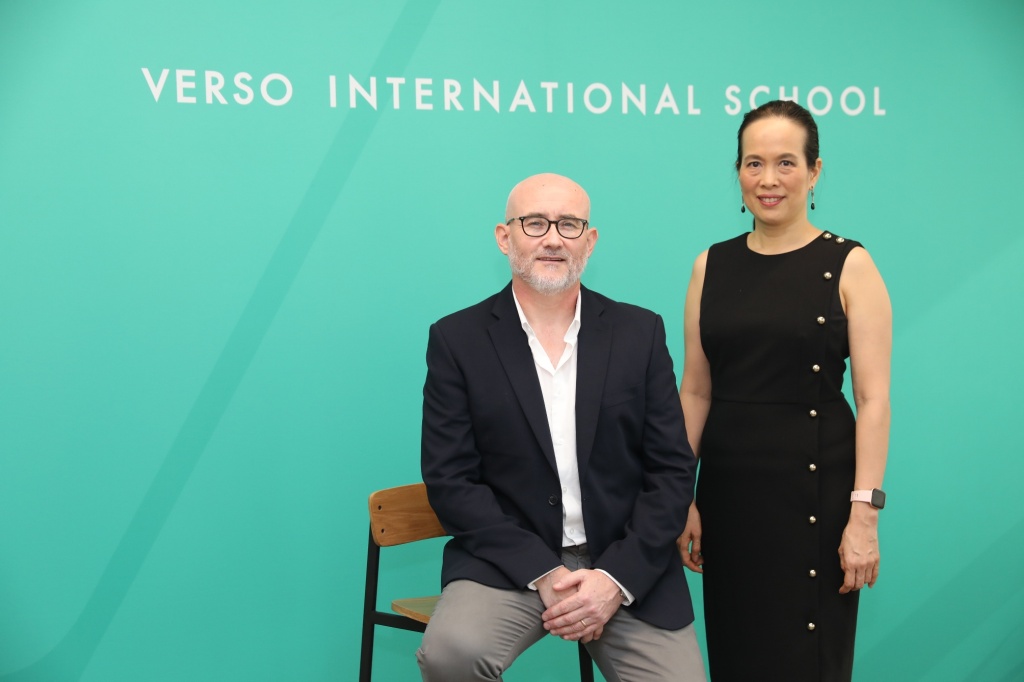
Cameron Fox, left and Piyaporn Phanachet

Cameron Fox, left and Piyaporn Phanachet

“Now that our buildings and programmes are close to completion,” said founding head of school Cameron Fox, “our learning designers [teachers] are getting really excited about meeting our founding students and helping them take the first steps on an incredible journey together.”

The school will use an American curriculum model aligned with New York State education standards. Learning will be interdisciplinary, project-based and highly personalised for every student.

“We’ve all experienced the limitations of a one-size-fits-all approach to learning,” Fox said. “At Verso we want to look at the school experience differently. Research shows us that young people learn best when they are actively engaged, creating and solving problems they care about. That’s our starting point.

“Two years before the school opened, we recruited 12 highly qualified foreign educators to form a Learning Design Team. This team shares a common desire to make school a place where every student discovers who they are and develops the confidence and skills needed to lead their own journey.”

Verso partnered with San Francisco-based design company Ideo to consider inspiring examples of school innovation from around the world to Bangkok, testing the ideas with students, teachers and families living in Bangkok, the United States, Singapore and Hong Kong.

“At Verso, we think and behave like designers,” said Fox. “Working with Ideo, we found out what families in Bangkok wanted most from an international school. That’s how we identified Verso’s three founding beliefs. We learned that students need to develop a strong sense of personal and cultural identity, they need to know how to actively engage with the world around them, and they will flourish if they have the confidence to lead their own journey.”

Verso will be fully accredited by the Western Association of Schools and Colleges, which ensures quality and validates the school’s certificates, diplomas and transcripts acceptable for university admissions worldwide.

Foresight Energy is latest U.S. coal miner in bankruptcy #ศาสตร์เกษตรดินปุ๋ย

#ศาสตร์เกษตรดินปุ๋ย : ขอบคุณแหล่งข้อมูล : หนังสือพิมพ์ The Nation

https://www.nationthailand.com/business/30383825?utm_source=category&utm_medium=internal_referral

Foresight Energy is latest U.S. coal miner in bankruptcy

Mar 11. 2020
By Syndication Washington Post, Bloomberg · Steven Church, Will Wade, Jeremy Hill · BUSINESS

Foresight Energy filed for bankruptcy with plans to hand ownership to its creditors, becoming the latest coal company to fail as power generators switch to cleaner and cheaper fuels.

The filing in U.S. Bankruptcy Court for the Eastern District of Missouri is another sign that efforts to stem coal’s decline aren’t working. A wave of U.S. miners have filed for Chapter 11 in recent years, including Murray Energy, which owns a controlling stake in Foresight. Its owner, Robert Murray, is an outspoken supporter of President Donald Trump, who has pledged to save the industry.

Foresight listed between $1 billion to $10 billion in assets and liabilities in the same range in Chapter 11 documents filed with the court. The restructuring plan, which allows the company to stay in business, would cut debt by about $1 billion by swapping $1.33 billion of debt for equity. The plan would leave Foresight with just $225 million in new secured debt, Chief Executive Officer Robert Moore said in a court declaration.

Moore, who is also the CEO of Murray Energy and is Robert Murray’s nephew, would remain the chairman of Foresight, according to a company statement.

Foresight, founded by the late billionaire Christopher Cline, signaled it was in trouble when it suspended its quarterly dividend in May, and again on Oct. 1 when it missed a $24.4 million interest payment. It hasn’t posted an annual profit since 2014, and matters were made worse by 2019’s unusually heavy rains, which made rivers so high and swift that coal vessels had trouble delivering to power stations.

While Foresight has been struggling for years, its bankruptcy filing comes as investors have become skeptical about the credit quality of U.S. energy companies after a crash in oil prices. More than 400 energy-related companies went bust between 2015 and the end of 2019, according to law firm Haynes & Boone.

Holders of 69% of Foresight’s first-lien loans and 82% of its second-lien notes have agreed to support Foresight’s bankruptcy plan, Moore said. In addition, existing lenders agreed to provide $100 million in new money to finance Foresight’s operations in bankruptcy, subject to court approval. Without access to that new money, Foresight would likely run out of cash needed to run the business within a week, Alan Boyko of FTI Consulting said in a court declaration.

Despite the White House efforts to save coal, the industry continues to decline as utilities forsake the fuel for cheap natural gas, wind and solar. Fifteen years ago, coal accounted for more than half of all U.S. power generation. Today it’s less than 25%.

St. Louis-based Foresight’s bankruptcy also follows Chapter 11 filings last year by Cloud Peak Energy, Cambrian Coal, Blackhawk Mining and Blackjewel.

Cline, a mining tycoon born into a coal-mining family, died in a helicopter crash in July. He founded Foresight in 2006 and has been credited with reviving the industry in the Illinois basin. The company has been recognized for efficient production, but that wasn’t enough to compensate for slumping demand and prices. Cline stepped down as chairman in 2017 but remained one of the company’s top shareholders, according to data compiled by Bloomberg.

Murray Energy acquired a stake in Foresight 2015 and gained a majority voting position in its general partner two years later. Robert Murray himself ranks among Foresight’s biggest shareholders. He also serves on the general partner’s board of directors, which controls decision-making at Foresight, along with Moore, three independent directors and an affiliate of The Cline Group LLC, according to court papers.

The case is Foresight Energy LP, 20-41308, U.S. Bankruptcy Court for the Eastern District of Missouri (St. Louis).

Walmart, Apple, Olive Garden are among major employers updating sick leave policies as coronavirus cases spread #ศาสตร์เกษตรดินปุ๋ย

#ศาสตร์เกษตรดินปุ๋ย : ขอบคุณแหล่งข้อมูล : หนังสือพิมพ์ The Nation

https://www.nationthailand.com/business/30383824?utm_source=category&utm_medium=internal_referral

Walmart, Apple, Olive Garden are among major employers updating sick leave policies as coronavirus cases spread

Mar 11. 2020
By The Washington Post · Abha Bhattarai · BUSINESS, CAREER-WORKPLACE

The coronavirus outbreak that is quickly spreading throughout the country is forcing major American companies to rethink how they approach paid sick leave. More than 30 million U.S. workers – many of them low-wage service employees at restaurants, stores and airports – lack access to sick pay, raising fears that the epidemic could escalate if symptomatic workers do not feel that they can afford to take time off.

Vice President Mike Pence on Monday hinted that the Trump administration may soon introduce an economic package that would provide paid sick leave to workers affected by the virus, though he did not specify what such a plan would look like or how it would be enforced.

In the meantime, companies such as Walmart, Uber and Apple are among those announcing new policies that they say are designed to keep employees and customers safe from the coronavirus. Here is a look at major employers that have so far adapted their leave policies.

– – –

Walmart

Retail giant Walmart said Tuesday that it will not penalize workers who call in sick after an employee at a Kentucky store tested positive for the coronavirus. Employees who are diagnosed with covid-19 or placed in quarantine will receive up to two weeks of pay and will not be asked to dip into their paid leave during that time, the company said.

“If they’re not able to return to work after that time, additional pay replacement may be provided for up to 26 weeks for both full-time and part-time hourly associates,” Walmart said in a memo to its 1.5 million U.S. workers Tuesday. The retailer, based in Bentonville, Arkansas, is the country’s largest employer.

The store in Cynthiana, Kentucky, where the worker tested positive, has been sanitized and remains open. The employee is receiving medical care and her condition is “improving,” Walmart said.

– – –

Darden Restaurants

The parent company of Olive Garden and Eddie V’s said Monday that it would begin offering up to 40 hours of paid sick leave annually to all hourly employees, making it one of the only major restaurant chains to do so. Executives said they had been considering the benefit for a while, but sped up the timeline because of the growing threat of the coronavirus.

Workers at Darden’s eight restaurant chains – which include LongHorn Steakhouse, Bahama Breeze and the Capital Grille – will accrue one hour of sick leave for every 30 hours they work. Current employees, the company said, will receive paid sick time for the hours they’ve worked over the past six months. The Orlando-based company has 180,000 employees.

“As we continue to make investments in our employees, we strengthen our greatest competitive edge – because when our team members win, our guests win,” Gene Lee, Darden’s chief executive, said in announcing the new policy.

– – –

Uber and Lyft

Ride-hailing companies Uber and Lyft were among the first to announce coronavirus-related sick pay for affected drivers, who are technically independent contractors and have not previously qualified for paid leave or benefits. Uber this weekend said it will provide 14 days of sick pay for any drivers or delivery workers who are sick with the coronavirus or are required to be isolated, though it did not offer details on how it could calculate that pay.

“We are supporting drivers and delivery people who are diagnosed with COVID-19 or placed in quarantine by a public health authority,” Andrew Macdonald, a senior vice president at Uber, said in a statement announcing the policy Saturday. “We believe this is the right thing to do.”

Lyft, meanwhile, says it will “provide funds to drivers” who become ill with the virus or are put under quarantine, but did not elaborate. “This helps support drivers financially when they can’t drive, while also protecting our riders’ health,” the company said on its website.

– – –

Apple

Apple this week said it will begin providing unlimited paid leave to hourly employees, including those at its retail stores, who become sick with cold or flu symptoms similar to covid-19. The company is also urging corporate employees to work from home, and said it has “increased cleaning protocols” at its stores.

A worker at Apple’s European headquarters in Dublin tested positive for the coronavirus Tuesday. That employee has been quarantined, and some others have been asked to stay home, the company said.

– – –

Instacart

App-based grocery delivery service Instacart said it would offer up to 14 days of paid leave for any employee or contractor diagnosed with covid-19 or under mandatory quarantine by public health authorities. The company has more than 200,000 shoppers around the country, the vast majority of them independent contractors, who do not qualify for other types of paid sick leave.

The company said it will also begin offering sick pay to its in-store shoppers – a small segment of its workforce that picks groceries but does not deliver them. Those workers, the company said, can earn one hour of sick pay for every 30 hours they work.

“To the best of our knowledge, no one in our community has contracted COVID-19, but we believe this is the right thing to do for our employees and shoppers,” Instacart said in a blog post announcing the new policy.

An Instacart shopper in Portland, Oregon, told The Washington Post this week that she routinely works while sick – with the flu, pulled muscles, even after spells of vomiting – because she cannot afford to take a day off. She works up to 50 hours a week, but does not qualify for paid sick leave because she an independent contractor.

Airbnb tweaks its refund policy amid virus spread #ศาสตร์เกษตรดินปุ๋ย

#ศาสตร์เกษตรดินปุ๋ย : ขอบคุณแหล่งข้อมูล : หนังสือพิมพ์ The Nation

https://www.nationthailand.com/business/30383822?utm_source=category&utm_medium=internal_referral

Airbnb tweaks its refund policy amid virus spread

Mar 11. 2020
By Syndication Washington Post, Bloomberg · Olivia Carville, Eric Newcomer · BUSINESS

Airbnb is making adjustments to its refund policy in an attempt to balance the needs of hosts and guests on its home-sharing site amid the global coronavirus outbreak that has severely reduced travel demand.

Because Airbnb operates as an online platform — connecting people who want to rent out all or part of their home with travelers seeking accommodations — it’s choosing to take a lighter touch with hosts.

The San Francisco-based startup said it will reward hosts who are more flexible or generous on offering refunds. The company will offer promotions for those listings to drive new bookings and will waive the standard 3% host fee on new reservations for those listings through June 1.

“When a crisis like coronavirus hits, we know both hosts and guests are affected,” Airbnb said in a statement Tuesday. “Hosts lose earnings that they rely on to make ends meet. Guests are losing hard earned vacation savings.”

Airbnb’s policy is that all reservations are able to be canceled within 48 hours of booking for a full refund. Beyond that, it’s up to hosts to determine the refund policy, which are stated on the listings and range from flexible to strict.

Since the Covid-19 virus became more widespread Airbnb has been granting full refunds to people traveling to China, South Korea and Italy.

Airbnb also announced some changes Tuesday meant to encourage people to keep booking trips on its platform. The company will return the service fee guests pay to Airbnb as a coupon for future reservations if people cancel their trips on bookings made from now through June 1. That doesn’t guarantee that hosts offer a refund and it doesn’t help people who already booked their trips.

“While it is clear that the coronavirus will have an impact on the entire travel and tourism industry, we believe travel will recover in the long run,” Airbnb said.

JPMorgan, Citigroup feast on equity derivatives in virus panic #ศาสตร์เกษตรดินปุ๋ย

#ศาสตร์เกษตรดินปุ๋ย : ขอบคุณแหล่งข้อมูล : หนังสือพิมพ์ The Nation

https://www.nationthailand.com/business/30383819?utm_source=category&utm_medium=internal_referral

JPMorgan, Citigroup feast on equity derivatives in virus panic

Mar 11. 2020
By Syndication Washington Post, Bloomberg · Donal Griffin · BUSINESS 

The historic panic in global stock markets has spawned a fortune for some of the world’s biggest investment banks.

JPMorgan Chase & Co. and Citigroup have added about $500 million in revenue from equity derivatives trading year-to-date compared with the same period in 2019, people familiar with the matter said. Trading surged as investors rushed to bet on stock moves and protect their holdings.

The spreading coronavirus has killed thousands, roiled the global economy and forced Italy to announce a nationwide lockdown. But for Wall Street’s trading desks, which rely on volatility to generate profit, the turmoil is an opportunity after investment banks long bemoaned the calmness of markets in recent years.

Patrick Burton, a spokesman for JPMorgan in London, declined to comment, as did Edwina Frawley-Gangahar, a spokeswoman for Citigroup.

JPMorgan has generated about $300 million of additional revenue so far this year, including about $50 million in one trading day in late February, according to the people, who requested anonymity as the details are private. Citigroup has made between $150 million and $200 million, the people said.

Recent swings in U.S. stock prices rank among some of the biggest in market history as investors struggle with the fallout from the coronavirus and an oil price war. That’s triggering a surge in demand for equity derivatives, which allow investors to make complex bets on shares and volatility in stock markets and protect against losses.

Trading in options linked to the S&P 500 Index, among the most popular equity derivatives, surged to a record high of more than 3.5 million contracts in February. The CBOE Volatility Index jumped to the highest since 2008 on Monday.

The stock market chaos means equity derivative revenue may snap back from last year’s drop. Wall Street banks generated about $12 billion from equity derivatives in 2019, a 17% decline from the previous year, according to research firm Coalition Development Ltd.

“It’s been a good start to the year,” said Amrit Shahani at Coalition in London. “Our expectation is it will be better than 2019.”

The S&P 500 gained as much as 3.7% in early New York trading — after a plunge on Monday — as President Donald Trump said he would announce “substantial” economic measures on Tuesday in response to the virus. The rebound faltered as signs mounted that the stimulus is not imminent.

While traders desire volatility, sudden swings can lead to losses for banks as well. BNP Paribas SA, the biggest French bank, lost about $80 million on equity-derivative trades over a few days in December 2018 after markets were whipsawed by trade tensions between the U.S. and China.

JPMorgan, based in New York, is the world’s biggest player in equity derivatives, Coalition data show.

Qantas culls flights while European carriers quit Italy #ศาสตร์เกษตรดินปุ๋ย

#ศาสตร์เกษตรดินปุ๋ย : ขอบคุณแหล่งข้อมูล : หนังสือพิมพ์ The Nation

https://www.nationthailand.com/business/30383807?utm_source=category&utm_medium=internal_referral

Qantas culls flights while European carriers quit Italy

Mar 11. 2020
A Boeing 737-838 aircraft operated by Qantas approaches to land at Sydney Airport in Sydney, Australia, on Feb. 21, 2019. MUST CREDIT: Bloomberg photo by Brendon Thorne.

A Boeing 737-838 aircraft operated by Qantas approaches to land at Sydney Airport in Sydney, Australia, on Feb. 21, 2019. MUST CREDIT: Bloomberg photo by Brendon Thorne.
By Syndication The Washington Post, Bloomberg · Angus Whitley, Christopher Jasper

Airlines from Australia to Scandinavia stepped up capacity cuts as the coronavirus numbed demand and Italy locked down internal travel.

Qantas cut almost a quarter of international services for six months, grounded most of its giant A380 jets and slashed management pay. Air France-KLM said its main Paris-based arm will cancel 3,600 flights this month, while Finnair Oyj will eliminate 2,400 short-haul services in April.

Discount specialist Norwegian Air Shuttle meanwhile said it will cut 3,000 flights through mid-June, including some trans-Atlantic trips, and temporarily lay off a “significant” proportion of employees, among them flying crew members, ground staff and office personnel.

Italy’s imposition of a ban on travel between provinces led Ryanair Holdings to ground all services to, from and within the country starting later this week until April 8. IAG’s British Airways scrapped all flights to Italy on Tuesday and suspended operations to four airports in the north through April 4.

Qantas’s biggest reductions are in Asia, where the Australian airline’s capacity is now down 31% from a year earlier, it said Tuesday. The carrier also cut services to the U.S. and the U.K., or put smaller planes onto existing routes. Eight of Qantas’s 12 Airbus SE A380s will be grounded until mid-September.

The overhaul, one of the most dramatic responses to the outbreak by any airline, is accompanied by wide-ranging cost cuts. Qantas’s group executive managers and board members will take a 30% pay cut for the rest of the fiscal year through June. Chief Executive Officer Alan Joyce won’t be paid at all.

“In the past fortnight we’ve seen a sharp drop in bookings on our international network,” Joyce said in the statement. “We expect lower demand to continue for the next several months.”

Air France-KLM will cut long-haul capacity by about 13% this month out of both Paris and Amsterdam, while the French arm will slash capacity by a quarter in Europe and 17% on domestic routes.

The reductions at Finnair amount to 20% of its European traffic and follow the earlier cancellation of 1,400 flights. The virus has been especially disruptive for the carrier after it built Helsinki into a hub for travel to east Asia, utilizing the shortest flight times from anywhere in Europe.

At Norwegian, which has already been shrinking its network after struggling with a debt pile, the flight cuts amount to 15% of total capacity, according to a statement.

The discount operator and rivals including Wizz Air Holdings Plc were among airlines canceling flights to Italy amid the escalating crisis there. Budapest-based Wizz also said it will also suspend services from London Luton to Tel Aviv until March 23, citing Israel’s announcement of a 14-day quarantine period for all arrivals.

Qantas shares tumbled in early trading before rebounding as successive governments announced stimulus measures to cushion the economic impact of the virus, closing 7.2% higher. Air France-KLM was priced up 5.1% in Paris as of 12:26 p.m., and Finnair was up 5.3%.

The viral outbreak will cost global airlines as much as $113 billion in lost passenger revenue this year, the International Air Transport Association said last week. Only a couple of weeks earlier, IATA had expected a $30 billion hit.

Speaking to reporters on a call, Joyce said Qantas could make yet more cuts to services. “We can go a lot deeper,” he said.

He said Qantas has also asked Airbus for more time to confirm an order for as many as 12 A350-1000 jets for ultra-long-haul services from Sydney to London and New York.

The Sydney-based company is asking all employees to take paid or unpaid leave as fewer planes take to the air. Qantas also scrapped a stock buyback to save A$150 million in cash. Analysts at Jefferies International described the measures as “significant but appropriate.”

“We know we can ride this out,” Joyce said on the call. “Not all airlines in the world will.”

– – –

Bloomberg’s Phil Serafino, Andrew Noël and Charlotte Ryan contributed to this report.

CPN responds to tenant’s complaint to The Nation: We have issued several measures to deal with Covid-19 situation #ศาสตร์เกษตรดินปุ๋ย

#ศาสตร์เกษตรดินปุ๋ย : ขอบคุณแหล่งข้อมูล : หนังสือพิมพ์ The Nation

https://www.nationthailand.com/business/30383795?utm_source=category&utm_medium=internal_referral

CPN responds to tenant’s complaint to The Nation: We have issued several measures to deal with Covid-19 situation

Mar 11. 2020
Fewer customers shop at department stores in Bangkok due to coronavirus fears. NationPhoto

Fewer customers shop at department stores in Bangkok due to coronavirus fears. NationPhoto
By The Nation

A tenant has complained to The Nation that department store tenants are facing financial burdens stemming from low sales as much fewer customers and tourists visit their shops amid fears over Covid-19. She said she asked for a temporary reduction in the cost of rent but received a cold response from the landlord.

She said her landlords range from CPN and Emporium to KP Development. Her office has raised concerns about the low number of customers and asked for a rebate/discount on the rent for a couple of months.

According to her, “they said it is not their problem if tenants don’t have enough money to pay rent”. They added: “We have many potential tenants who can take over if you cannot pay as our contract does not state that we need to give you a discount if there is an economical problem or the government does not support you. Why should we cut our profits just to help you?”

“How can the landlord only think of profits and not care for local businesses with fellow Thai employees?” the tenant asked. “I have 66 employees, all above 40 years old. I give the landlords three to six months of rental deposit. On top of that, since 2019, they have changed our lease to yearly and said it’s normal so they can increase rents every year if the economy is bad. We spend a lot on renovating our business premises. Why is this normal practice here? At first they let you sign a contract of two to three years, after they know you have renovated the place nicely, they change the lease contract to yearly, with a 15-20 per cent rent increase,” she complained.

“For example, Central Lad Phrao with not a lot of residences around charges the exact same rent as an Emporium Tower office. Close to Bt400,000 for a space less than 188sqm,” she claimed.

“Will the government come up with some help for retailers and offices? There are many businesses closing down as of today and many people are losing their jobs. My purpose to come here [to The Nation] is to ensure jobs are not lost,” she added.

The Nation passed on her complaint to the one of the landlords, Central Pattana (CPN).

CPN replied that it has issued numerous measures to deal with the Covid-19 situation for people renting shops at its department stores.

“We have discussed the issue with related persons for designing a plan to tackle the virus situation, and are also updating renters about the situation periodically,” a company statement said.

CPN has also organised several campaigns to stimulate public spending at its department stores, according to the statement.

In addition, the company is regularly cleaning and sterilising its department stores nationwide to boost customer confidence. “We have ordered relevant staff to sterilise numerous points every hour,” it pointed out.

CPN also screens its employees for Covid-19 infections, and is informing people on safety at its department stores, the statement said.

The tenants can contact 02-021-9999 or the department stores’ offices for further information regarding rent issues and other support, it added.

Meanwhile, real estate economist Samma Kitsin suggested that the two sides, landlords and tenants, should together find a way out during the current crisis.

“I do not think the landlords would benefit if small shop owners shut their shops or booths at the department stores. We have seen 20-30 per cent of shop owners having to close in some community malls, resulting in landlords themselves having business difficulties,” he said.

Companies have campaigned against sick pay for years #ศาสตร์เกษตรดินปุ๋ย

#ศาสตร์เกษตรดินปุ๋ย : ขอบคุณแหล่งข้อมูล : หนังสือพิมพ์ The Nation

https://www.nationthailand.com/business/30383800?utm_source=category&utm_medium=internal_referral

Companies have campaigned against sick pay for years

Mar 10. 2020
Marty Flynn, 29, who has worked for six restaurants in 10 years, poses for a portrait at his home in Orlando, Florida, on Monday, March 9, 2020. As the threat of the Coronavirus spreads, Flynn, like many workers, is concerned about the implications of having no paid sick leave. MUST CREDIT: Photo for The Washington Post by Charlotte Kesl

Marty Flynn, 29, who has worked for six restaurants in 10 years, poses for a portrait at his home in Orlando, Florida, on Monday, March 9, 2020. As the threat of the Coronavirus spreads, Flynn, like many workers, is concerned about the implications of having no paid sick leave. MUST CREDIT: Photo for The Washington Post by Charlotte Kesl
By The Washington Post · Abha Bhattarai, Peter Whoriskey · NATIONAL, BUSINESS, CAREER-WORKPLACE

Marty Flynn knows Orlando’s restaurants. The son of a bartender is 29 and has already worked at six. Chili’s. Bahama Breeze. Crave. Johnnie’s Hideaway. The Meatball Stoppe.

Now he’s a sushi chef.

“Every restaurant I’ve worked at, it’s been the same: No sick leave,” Flynn said, just like it was with his mom, the bartender. “I remember being home alone as a kid because I was sick and she couldn’t take time off. You just have to work through it unless you’re dying.”

As the coronavirus spreads across the United States, major U.S. companies and business groups have put out hand sanitizer and discussed precautions they are taking to keep sick workers away from customers. The Centers for Disease Control and Prevention has advised employers to “ensure that your sick leave policies are flexible and consistent with public health guidance.”

Although most Americans say businesses should offer sick pay, at least a dozen states, including Florida and much of the Southeast, have passed legislation since 2011 to block efforts to require medical leave. Even in liberal-leaning states that have passed sick pay requirements, some companies sidestep the requirement by counting their workers not as employees, but as contractors.

In Orlando, for example, voters overwhelmingly approved a measure that would have guaranteed that Flynn and thousands of other service workers in the tourist magnet would get sick pay. But in 2013, according to Florida news reports, business lobbyists for Walt Disney World, Darden Restaurants and the Florida Chamber of Commerce pushed state officials to overrule the Orlando mandate.

Stopping Orlando’s sick pay requirement, then-Gov. Rick Scott, a Republican, said at the time, was “essential to ensuring a business-friendly environment.”

Organizers of the measure said they were stunned.

“I never thought they would put up such a big fight over something so small,” said Stephanie Porta, one of the leaders of the ballot initiative. “They were so dug in on ‘You can’t tell businesses what to do.’ But if workers had more protections right now, the coronavirus outbreak would look much different.”

Even with confirmed U.S. cases of the novel coronavirus rising to more than 500 on Monday, much of the opposition to the Orlando sick pay mandate remains committed to blocking such measures.

Scott is now a U.S. senator, and in a statement Monday, his office said “businesses should have the ability to make the best decisions for their employees.”

A representative of the Florida Chamber of Commerce, Edie Ousley, said the organization is “confident employers will do the right thing . . . without government getting in the middle of something that should be left to the private sector.”

Representatives of Walt Disney World did not respond to a request for comment.

But at Darden Restaurants, the company that owns Olive Garden and LongHorn Steakhouse, managers announced Monday that they would be offering employees as much as 40 hours of paid sick leave annually. The benefit had been under consideration, officials said, but Darden moved quickly because of the coronavirus threat.

“As we continue to make investments in our employees, we strengthen our greatest competitive edge – because when our team members win, our guests win,” Darden president and chief executive Gene Lee said in announcing the new benefit.

– – –

White House advisers on Monday presented President Donald Trump with measures aimed at halting the economic disruptions caused by the coronavirus. Among the remedies they discussed was paid sick leave.

Across the country, efforts to contain the coronavirus are complicated by the legions of low-wage workers who lack sick pay and often feel compelled to show up even when they’re showing symptoms. Experts have a name for the phenomenon: “contagious presenteeism.”

For years, these workers say, they’ve just muddled through.

In Detroit, Katie Muncy knew when she got bronchitis last year that there was no way she could afford to call in sick to her job loading catered meals onto airplanes. Instead, she took Robitussin and showed up to her job for 2 1/2 months with the respiratory infection.

“I went in every day,” said Muncy, 39, who has two teenage children. “I was constantly wiping everything down, washing my hands, sanitizing things because I didn’t want anyone else to get sick.”

She eventually caught the flu and took a couple of days off without pay. But it was tough: Bills went unpaid, her family did without milk and fresh produce for a month, and she began relying on the local food bank for meat.

“Honestly I try not to go to work ill, but I really don’t feel like I have a choice,” she said. “If I want to put meals on the table, I have to suck it up and go.”

In Allentown, Pennsylvania, nursing-home worker Christine Talley, 63, came down with a week-long cold in December but decided she had to work anyway, calling out bingo for the home’s 65 residents and wheeling them to art class. She’d used up her vacation and doesn’t get dedicated sick time, so Talley tried to ignore the sneezing, coughing and runny nose. She washed her hands obsessively and wore a mask.

“Getting sick just throws a monkey wrench in your plans,” said Talley, who worked as nurse for 25 years.

And in Miami, Frank, who asked to be identified by his middle name because he fears retribution at work, spends each shift helping hundreds of international travelers make their way through customs checks. Last month he tried to work while he had the flu and pneumonia – and ultimately ended up in the hospital for a week. He was behind on rent for his studio apartment that month.

“When I don’t make enough money, I struggle to pay my bills,” he said.

Now as the coronavirus spreads, he is increasingly worried about his health. He doesn’t usually have time to wash his hands more than twice a day and has begun wearing a mask during to work, even though managers have asked him not to, saying it scares travelers.

“They don’t train us. They don’t tell us what we should be doing to protect ourselves or passengers,” he said. “I worry about it all the time. We still have big flights: 400 people coming from France, 300 people from Spain, planes from Italy and the U.K. We just have to hope that none of us gets the coronavirus so we don’t get other people sick.”

– – –

For years, the difficulties of working without sick pay have received a smattering of attention, but with the coronavirus outbreak, the question of sick pay has risen to national prominence.

Today, about 24% of U.S. workers lack access to sick pay, according to the Bureau of Labor Statistics, or more than 30 million people. Many of them are low-wage workers whose jobs involve working closely with the public – restaurant and retail workers, health-care aides – and this could conceivably make them virus “super spreaders.”

“If employers are providing hand sanitizer and cleaning their offices but they still have workers come in because they can’t take a day away from work when they’re sick, that’s simply not sufficient,” said Sarah Fleisch Fink, vice president of policy at the National Partnership for Women and Families, an advocacy that has campaigned for sick pay requirements.

The same geographic polarization apparent in presidential elections arises as well in debates over sick pay: Some states, most in the Northeast and West Coast, are requiring sick pay. Many other states, most in the South, are heading in the opposite direction: They are passing legislation explicitly forbidding any such mandates.

Since 2011, 13 states and the District of Columbia have required employers to offer sick pay, according to the National Conference of State Legislatures: Arizona, California, Connecticut, Maryland, Massachusetts, Maine, Michigan, Nevada, New Jersey, Oregon, Rhode Island, Vermont and Washington.

Over the same period, more than dozen other states have passed legislation forbidding any such mandates, even if the people of a city or county want the requirement. Those states include: Arkansas, Florida, Iowa, Kentucky, Louisiana, Mississippi, Missouri, North Carolina, Ohio, Oklahoma, South Carolina, Tennessee and Wisconsin.

In Wisconsin, for example, Milwaukee voters approved a measure requiring that workers receive sick pay, but state leaders led by then-Gov. Scott Walker, a Republican, passed legislation overruling the local measure.

“This law gives employers the flexibility they need to put people back to work, and that makes Wisconsin a more attractive place to do business,” Walker said at the time. A spokesman for Walker declined to comment Monday. (Walker was succeeded by Democrat Tony Evers last year.)

For Milwaukee workers such as Tracy Jones, 52, who at the time was a factory machine operator and didn’t have sick pay, the reversal was “inhumane.”

One day, she recalled, she stayed on the line despite what turned out to be a blood clot in her leg.

“I didn’t want to lose the day’s pay, and I didn’t want to lose my spot,” she said.

When the mandate was undone by state officials she said, “I was so livid. The people had spoken.”

– – –

Even when states mandate sick pay, however, many workers can remain without it. Companies that hire people as “contractors” rather than as “employees” say they are not obliged to offer sick pay.

Take, for example, Jordan Anderson, 44, an Instacart shopper in Portland, Oregon, where the state requires employers to offer sick pay. Although Anderson works 40 to 50 hours a week picking up groceries and other items for Instacart customers, she isn’t entitled to paid sick leave.

In fact, Anderson can’t remember the last time she took a day off: not when she had the flu, or a pulled muscle in her back, or the several times a month she has debilitating migraines. More than once, she has vomited in the parking lot in the middle of a shift, then walked back into the supermarket to resume picking out groceries and delivering them to customers’ homes.

“If I don’t work, I don’t get paid,” said Anderson. “So far it’s been like, good luck out there and try not to get sick while you’re at it.”

Anderson figures she has to make at least $60 a day to cover monthly expenses and pay rent on her one-bedroom apartment, which she moved into last summer after a year of sleeping on friends’ couches and in her car.

“I shouldn’t be puking next to my car and going inside, washing my hands and doing somebody’s grocery shopping,” she said. “But I am because I don’t have a choice.”

Now with the rise of coronavirus cases, customers sometimes ask her to wear rubber gloves while she shops, or to leave groceries in the garage. She says Instacart sent workers a note a couple of weeks ago urging them to wash their hands and stay home if they’re sick. The company is also recommending that shoppers who have recently traveled abroad to countries such as China and Italy, or live with someone who has, stop working for 14 days.

A spokeswoman for the San Francisco-based company said it is working with local and national authorities to monitor the coronavirus outbreak.

“I don’t think anybody working this job full time – and there are a lot of us – would definitely stay home because of a cough,” Anderson said.

– – –

Last week, Sen. Patty Murray, D-Wash., and Rep. Rosa DeLauro, D-Conn., introduced legislation to provide paid sick days immediately to workers. The legislation would require employers to allow workers to accrue seven days of paid sick leave and to provide an additional 14 days available immediately in the event of any public health emergency.

And on Sunday, House Speaker Nancy Pelosi, D-Calif., and Senate Minority Leader Chuck Schumer, D-N.Y., said any coronavirus economic stimulus plan from the administration should include, among other things, sick leave.

“We are demanding that the administration prioritize the health and safety of American workers and their families over corporate interests,” the Democrats said.

As federal lawmakers consider sick-pay measures, the argument in favor is buttressed by research from economist Nicolas Ziebarth at Cornell University and his colleagues.

Using two independent data sets on flu outbreaks – one from Google and the other from the CDC – the researchers showed that in both cases, places that imposed sick pay mandates reduced flu cases by about 10% or more.

The researchers found that workers who obtained sick-pay coverage through the mandates took two or fewer days of sick pay annually, and that the economic costs of the regulation are fairly small: the equivalent of about 21 cents per hour worked.

Based on the research, Ziebarth said, mandated sick pay “would definitely slow down the spread of the disease, which is crucial in these times.”

For now, amid the mounting toll of coronavirus, some business groups say they are willing at least to talk.

“We’re talking with our members and elected officials about how to help employees and restaurants address this unprecedented crisis,” Sean Kennedy, executive vice president, public affairs, at the National Restaurant Association said in a statement.

The American Health Care Association said its nursing homes “face low reimbursement rates and slim operating margins, sometimes making it challenging to offer paid sick leave as well as overtime to other employees, or hire an agency who have to cover for those sick employees.”

The National Retail Federation, an industry lobbying group, told its members last week that “sick leave policies need to be flexible” and that “it may be necessary to develop an emergency sick leave policy.”

But for Flynn, the Orlando sushi chef, the idea that companies will agree to such mandates seems unlikely. The restaurants he’s known, after all, have long paid lip service to public health while also demanding employees show up for work even if they’re not feeling well.

“They have these signs up in every restaurant I’ve ever worked – ‘Send Sick Employees Home Now,’ ” Flynn said. “But it’s so hypocritical. I’ve never worked at a restaurant that didn’t encourage you to come in no matter what. They’d rather you come in sick than be short a person. It’s exactly opposite of what health officials are asking.”


SET dips as Covid-19 cases edge up #ศาสตร์เกษตรดินปุ๋ย

#ศาสตร์เกษตรดินปุ๋ย : ขอบคุณแหล่งข้อมูล : หนังสือพิมพ์ The Nation

https://www.nationthailand.com/business/30383872?utm_source=category&utm_medium=internal_referral

SET dips as Covid-19 cases edge up

Mar 11. 2020
By The Nation
The Stock Exchange of Thailand (SET) Index closed at 1,249.89 today (March 11), down 21.36 points (1.68 per cent) from Tuesday’s close with an index high of 1,281.63 and a low of 1,238 on a total transactions of Bt72.236 billion.

The SET Index fell after the number of confirmed Covid-19 infections in Thailand rose to 59 with the announcement of six more cases.

A stock analyst at Krungsri Securities expected the SET Index to move between 1,250 and 1,285.

“Although the global markets have recovered due to investors’ expectation of the US launching economic stimulus measures, details of these measures are still unclear,” the stock analyst said.

“Therefore, we believe that this factor would benefit the market in the short term, while there is a risk that the market would fluctuate again if the US does not issue these measures.”

The top ten stocks with the highest trade value today were PTT, PTTEP, BAM, GULF, ADVANC, CPALL, AOT, PTTGC, BGRIM, and GPSC.

Elsewhere in Asia, Japan’s Nikkei Index closed at 19,416.06, down 451.06 points, or 2.27 per cent.

China’s Shanghai SE Composite Index closed at 2,968.52, down 28.24 points, or 0.94 per cent, while Shenzhen SE Component Index closed at 11,200.05, down 203.42 points, or 1.78 per cent.

Hong Kong’s Hang Seng Index closed at 25,231.61, down 160.90 points, or 0.63 per cent.

South Korea’s KOSPI Index closed at 1,908.27, down 54.66 points, or 2.78 per cent.

Taiwan’s TAIEX Index closed at 10,893.75, down 109.79 points, or 1.00 per cent.

Gold price unchanged at the close #ศาสตร์เกษตรดินปุ๋ย

#ศาสตร์เกษตรดินปุ๋ย : ขอบคุณแหล่งข้อมูล : หนังสือพิมพ์ The Nation

https://www.nationthailand.com/business/30383871?utm_source=category&utm_medium=internal_referral

Gold price unchanged at the close

Mar 11. 2020
By The Nation

The price of gold was unchanged, from the end of the morning session, at the close today (March 11), the Gold Traders Association reported.

At 3.54pm, buying price of a gold bar was Bt24,600 per baht weight and selling price Bt24,700, while buying price of gold ornaments was Bt24,149.88 per baht weight, selling price Bt25,200.

Gold contracts in COMEX futures to be delivered in April dropped by 1.35 per cent to US$1,653.1 per ounce at Tuesday’s close due to investors selling their safe haven assets and turning to risk assets amid hopes of economic stimulus measures, the strengthening dollar, and rising oil prices.

Investors responded to US President Donald Trump’s move to issue economic stimulus measures, including reducing payroll tax and other urgent measures to relieve impact from the Covid-19 outbreak.

Investors expect the US Federal Reserve to cut interest rate by up to 1 per cent at its the meeting on March 17-18 next week, despite the Fed having made an emergency interest rate cut by half a percentage point last week.