China’s Belt and Road plan is getting lashed by coronavirus #ศาสตร์เกษตรดินปุ๋ย

#ศาสตร์เกษตรดินปุ๋ย : ขอบคุณแหล่งข้อมูล : หนังสือพิมพ์ The Nation

https://www.nationthailand.com/business/30383639?utm_source=category&utm_medium=internal_referral

China’s Belt and Road plan is getting lashed by coronavirus

Mar 08. 2020
The Ban Ladhan Railway bridge, a section of the China-Laos Railway built by the China Railway Group Ltd., stands under construction on the Mekong River in Ban Ladhan, Luang Prabang province, Laos, on Oct. 18, 2018. MUST CREDIT: Bloomberg photo by Taylor Weidman.

The Ban Ladhan Railway bridge, a section of the China-Laos Railway built by the China Railway Group Ltd., stands under construction on the Mekong River in Ban Ladhan, Luang Prabang province, Laos, on Oct. 18, 2018. MUST CREDIT: Bloomberg photo by Taylor Weidman.
By Syndication Washington Post, Bloomberg · Iain Marlow, Karlis Salna, Anusha Ondaatjie, Dandan Li · WORLD

Xi Jinping’s Belt and Road Initiative has long been seen as a way to project China’s influence around the world. Now, the coronavirus is showing how the trade and infrastructure program can help export the country’s troubles.

The deadly outbreak is prompting delays and disruptions to China’s construction and investment plans overseas, risking years of planning and hundreds of billions of dollars in economic diplomacy. Quarantine measures are preventing Chinese workers from making it to foreign building sites, domestic firms supplying overseas projects face acute labor shortages and fears are mounting that workers will inadvertently spread the virus to new locales.

Projects that have been affected since the virus emerged in December include a $5.5 billion high-speed rail line in Indonesia. There’s also a separate railway initiative in neighboring Malaysia, construction projects in Sri Lanka and corporate expansion plans in Pakistan.

The disruption has exposed another pitfall of the region’s growing dependence on China’s backing for major infrastructure projects. Even as the pace of new coronavirus cases slows in China, host countries remain wary of avoiding future outbreaks, with deadly infection surges in places like Iran, Italy and South Korea serving as a warning about how quickly a small cluster can spin out of control.

“While there are risks of delays and cancellation of projects, there are also risks in early resumption,” said Bonnie Glaser, who has advised the U.S. government and directs the China Power Project at the Center for Strategic and International Studies in Washington.

Xi “seems determined to demonstrate that life is returning to normal and he wants to get the economy churning again,” Glaser said. “Resuming BRI projects is probably among his goals, not only for economic reasons, but also because BRI activities are a lever to enhance Chinese political influence.”

Even before the outbreak, Xi had been seeking to rebrand and scale back his Belt and Road ambitions amid an economic slowdown at home and backlash from some partner nations concerned about the costs. The U.S. has led a global campaign against the program, arguing that China’s reliance on loans locked poorer countries in “debt traps” while advancing its own strategic aims.

The virus has thrown up another hurdle, as countries bar or quarantine Chinese visitors. One official involved in BRI planning in Beijing said last week that a failure to stop the virus spreading outside of China would inevitably take a toll on projects.

Still, another Chinese official in Beijing said that the impact to key projects remained limited and that significant disruptions were likely to remain an issue only in the short term. That optimistic assessment was echoed Thursday by Vice Chinese Foreign Minister Ma Zhaoxu at a briefing on international support for coronavirus actions.

“The impact of the outbreak on the construction of BRI is only temporary,” Ma told reporters in Beijing. “We are willing to work with all parties to continue to promote the high-quality construction of BRI. We have full confidence in this.”

The same day, however, Indonesian Coordinating Minister for Maritime Affairs and Investment Luhut Pandjaitan acknowledged that the multibillion dollar Jakarta-Bandung high-speed railway — a flagship BRI project — was likely to face delays. More than 300 workers remain stuck in China.

In neighboring Malaysia, a dozen of the roughly 200 Chinese workers building the $10.4 billion East Coast Rail Link hail from Wuhan, the city at the center of the outbreak. They’re not allowed back to the Southeast Asian nation, while other workers can return after a 14-day quarantine process.

In Pakistan, which hosts numerous BRI projects spanning power and construction, two companies — Engro Polymer & Chemicals and Pakistan Oxygen — have said their projects face slowdowns because their Chinese contractors alerted them to delays stemming from hampered mainland facilities.

There has been widespread disruption to efforts in Sri Lanka, where Chinese investment is building the massive Port City Colombo, an expansion of the capital city via land reclamation.

The Ceylon Chamber of Commerce recently reported that about half of 100 firms surveyed said that business was affected by the coronavirus outbreak. Government road and apartment construction projects involving Chinese contractors have slowed down, said Nissanka Wijeratne, secretary general of the Chamber of Construction Industry of Sri Lanka.

Chinese workers returning to Port City Colombo have self-quarantined and there have so far been no major delays at the country’s biggest construction site, said Thulci Aluvihare, head of strategy and business development for the project, which is being built by state-owned China Communications Construction Co.

The virus may prompt a shift in focus by Chinese firms in the future, according to Arv Sreedhar, Singapore-based executive director at investment firm Atlantic Partners Asia. “China is under incredible stress from the current situation and has other priorities for its money, such as coming to an acceptable agreement with the U.S. on the trade war, and fighting both the health and financial aspects of the coronavirus,” he said.

That puts political pressures on BRI partners, as well. Developing nations such as Cambodia, Laos, Myanmar and Pakistan might be afraid to aggressively tackle the virus for fear of alienating China, research firm Fitch Solutions said in a note on Thursday.

“That these countries, which are heavily dependent on China’s patronage, have so far reported zero or just a few confirmed cases, and we believe that this could be attributed to both low access to health care, which is likely to inhibit infection detection, and a desire to avoid antagonizing China by ‘overreacting’ to the outbreak,” Fitch Solutions said.

China’s overseas investments were already beginning to tail off and consolidate before the virus brought the country’s industry to a standstill.

The American Enterprise Institute and the Heritage Foundation, which have tracked 3,600 major Chinese overseas transactions since 2005, found that outbound investment last year totaled just $68.4 billion. That’s a 41% plunge from 2018 and the lowest in a decade. The figure is far less than the Chinese Ministry of Commerce’s official tally of $124.3 billion in total overseas investment last year.

Going forward, China could concentrate its BRI programs in fewer countries, working to avoid criticism by making its outbound investment less aggressive and one-sided, said Derek Scissors, a resident scholar at the American Enterprise Institute.

Xi could “retrench and advertise more loudly that the BRI is a group effort,” he added. “It’s going to be harder for host governments over the next year to tout their supposedly close relationship with China as contributing to development.”

Chirativats pick up half a million CRC shares #ศาสตร์เกษตรดินปุ๋ย

#ศาสตร์เกษตรดินปุ๋ย : ขอบคุณแหล่งข้อมูล : หนังสือพิมพ์ The Nation

https://www.nationthailand.com/business/30383584?utm_source=category&utm_medium=internal_referral

Chirativats pick up half a million CRC shares

Mar 07. 2020
Tos Chirathivat

Tos Chirathivat
By THE NATION

Central Retail Corp (CRC) chairman of the executive committee Tos Chirathivat and director Suthilaksh Chirathivat bought a total of 500,000 CRC shares worth Bt18.45 million on March 5, according to the Securities and Exchange Commission (SEC)’s report on changes in securities and derivatives holdings.

Of the total, 200,000 were snapped up by Tos at an average price of Bt36.75. Suthilaksh bought 300,000 shares at an average price of Bt37.

After the transaction, Tos owns 38,461,600 shares in CRC.

On March 3, Tos and CRC director Prin Chirathivat purchased a total of 300,000 CRC shares worth Bt10.65 million. Tos bought 200,000 shares at an average price of Bt35.38. Prin bought 100,000 shares at an average price of Bt35.75.

Samsung releases Galaxy S20 worldwide #ศาสตร์เกษตรดินปุ๋ย

#ศาสตร์เกษตรดินปุ๋ย : ขอบคุณแหล่งข้อมูล : หนังสือพิมพ์ The Nation

https://www.nationthailand.com/business/30383579?utm_source=category&utm_medium=internal_referral

Samsung releases Galaxy S20 worldwide

Mar 07. 2020
(Yonhap)

(Yonhap)
By Shim Woo-hyun
The Korea Herald

Samsung Electronics on Friday launched its flagship smartphone Galaxy S20 models in 20 nations, including the US, Canada, Singapore, Vietnam, Puerto Rico and others — with plans to release them in 130 nations by end-March.

The new smartphone model comes in three types: 6.2-inch Galaxy S20, 6.7-inch S20 Plus and the 6.9-inch S20 Ultra. All the three variants support 5G network and camera system that utilizes artificial intelligence technology and the company’s high-end image sensor.

However, the 6.2-inch Galaxy S20 does not have mmWave module, which is specifically designed to support 5G cellular network at higher frequencies from 30 GHz to 300 GHz. The 6.2-inch model has the lowest-end camera array among the three.

The S20 Plus and the S20 Ultra have one extra camera each and come with mmWave modules for 5G networks.

All the models that have been launched in Korea do not come with mmWave modules as the nation has not built network infrastructure that uses the millimeter wave spectrum.

In Korea, customers can get free Bixby-enabled smart speaker Galaxy Home Mini or portable printer Nemonic Mini, when purchasing S20 models on Samsung’s official website or other online shopping platforms, the company said.

By Shim Woo-hyun (ws@heraldcorp.com)

Hedge-fund legend Jakurski holds sway in market he helped launch #ศาสตร์เกษตรดินปุ๋ย

#ศาสตร์เกษตรดินปุ๋ย : ขอบคุณแหล่งข้อมูล : หนังสือพิมพ์ The Nation

https://www.nationthailand.com/business/30383593?utm_source=category&utm_medium=internal_referral

Hedge-fund legend Jakurski holds sway in market he helped launch

Mar 07. 2020
Andre Jakurski, founding partner of JGP Asset Management, in Rio de Janeiro on Sept. 17, 2019. MUST CREDIT: Bloomberg photo by Dado Galdieri.

Andre Jakurski, founding partner of JGP Asset Management, in Rio de Janeiro on Sept. 17, 2019. MUST CREDIT: Bloomberg photo by Dado Galdieri.
By Syndication Washington Post, Bloomberg · Vinicius Andrade, Cristiane Lucchesi, Felipe Marques · BUSINESS, WORLD, US-GLOBAL-MARKETS, THE-AMERICAS

André Roberto Jakurski may just be the most important Brazilian hedge fund guru most people have never heard of-and that’s just how he likes it.

At 71, Harvard-educated Jakurski is seen as a godfather to Brazil’s now booming hedge fund industry. Several top managers credit “the Jakurski way” with helping them lure new cash as peers abroad increasingly lose out to passive investing or quant strategies. Over a career spanning more than 45 years, he’s traded for George Soros, mentored billionaire banker Andre Esteves, and partnered with future Economy Minister Paulo Guedes to found a bank now called Banco BTG Pactual. In 1998, Jakurski and Guedes started JGP Asset Management, one of Brazil’s first hedge funds, at a time when fellow money managers thought, Why bother?

“When I started trading stocks, I was a one-eyed man in a country of the blind,” says Jakurski, who became famous in the 1990s for a risky telecommunications shares trade that multiplied sixteenfold Pactual’s proprietary capital in a year. “Back then it was almost impossible to move around in the market. There were times when it took me three months to buy and then three more months to sell. I spent most days on the phone-yelling.”

In a rare interview, Jakurski sits in the conference room of JGP’s headquarters in Rio de Janeiro’s Humaitá neighborhood, under the auspices of the Christ the Redeemer statue. Soft-spoken and measured, he’s nursing a bad cold, for which he’s taking antibiotics, and waves off a photographer who starts snapping pictures while he’s talking. The cameraman is, however, welcome to sit and take part in the conversation that wanders from the personal to the professional and-at times-the philosophical.

It used to be that sky-high borrowing costs in Brazil meant investors had to do very little to earn a healthy return, while hedge fund pioneers such as Jakurski had to do a hell of a lot to top them trading stocks. Brazil’s benchmark Selic interest rate, which averaged about 14% in the past two decades and at one point hit 45%, now sits at a record low 4.25%.

It’s no coincidence, then, that with every notch downward, more asset managers have opened shop and more money has flowed their way. Brazilian funds managed 5.4 trillion reais ($1.23 trillion) at the end of last year, an almost fivefold increase from a decade earlier, according to capital markets association Anbima. Only 28 billion reais of that sat in exchange-traded funds.

“Brazil was always a nation where you had zero-risk government bonds and guaranteed returns-no one wanted to mess with that,” Jakurski says. “What we’re seeing now is a revolution in how money is allocated.”

Among top funds benefiting from this new environment are Constellation Investments, Verde Asset Management, and BlueLine Asset Management-each with a resident Jakurski mentee.

And while Jakurski is often overshadowed by his more famous protégés and former partners, the JGP Equity Master FIA fund returned 34.65% last year, 3.5 percentage points more than the benchmark Ibovespa stock index. With 20 billion reais in assets under management, JGP is still one of the biggest independent hedge funds in Brazil.

So what, exactly, is the Jakurski way?

Luciano Brandao, head of equity at BlueLine, breaks it down like this: consistency, leverage, and capital preservation. At BlueLine, the 220 million-real hedge fund firm founded by former JPMorgan Chase executives, Brandao says, about 30% of the firm’s equity portfolio is managed with that in mind-as opposed to his usual “double alpha strategy,” which targets gains through short and long positions. BlueLine’s Blue Alpha Master FIM fund has returned 10.32% since its inception on May 31, 2019, compared with 3.82% for its benchmark through Feb. 12.

Pedro Sales, portfolio manager at Verde, expands on the method: “Jakurski has a macro outlook, which is great for the medium to long term, but in the day-to-day, he often just goes on market feeling,” says Sales, whose Verde Am Long Bias Master FIA fund posted a 37.66% gain in 2019. “It’s not uncommon for him to make short-term bets that completely contradict his long-term view.”

Over the course of the interview, as he talks, Jakurski shares some of those views and his own story, touching on everything from why he chose Harvard over Stanford (“We didn’t have much money at the time, and we figured the plane ticket to Harvard was cheaper”) to what it was like starting out (“Twenty years on a trading desk, and it was always infernal screaming-now it’s as quiet as a tomb”) to why he’d never move to São Paulo, Latin America’s financial hub (“I want to stay in Rio, doing my job, having fun”).

Jakurski has a special affinity for Rio de Janeiro, the city where he was born after his parents immigrated to Brazil following World War II. They met before the war, were from the Polish resistance movement and got imprisoned in two Nazi camps in Poland, he says.

He earned his bachelor’s degree in mechanical engineering from Pontificia Universidade Católica, a university in Rio, and pursued an MBA at Harvard Business School. His father persuaded him to get the business degree, as he needed Jakurski to manage his public lighting firm, which installed lights for streets and soccer stadiums. When the young Jakurski returned to Brazil after finishing at Harvard, he was “in love” with finance and decided not to go to work at his father’s company. He was soon recruited for a career as a banker.

Jakurski started out at Unibanco, which merged with Banco Itau in 2008 and is now Latin America’s biggest bank by market value. After stints in leasing and investment and commercial banking, he was offered a big promotion: to become the bank’s head of treasury and proprietary trading. But it came with a caveat: He’d have to move to São Paulo. “I said no, and that was the end of my career at Unibanco,” he recalls.

In 1983 the banker Luiz Cesar Fernandes asked Jakurski and Guedes to co-found Banco Pactual, which became powerhouse BTG Pactual. Guedes and Jakurski had the same combustible chemistry as other famous business duos-a Jobs and Wozniak or a Gates and Allen-with Guedes the temperamental visionary and Jakurski the get-it-done trader.

In 1991, after a 70% stock market collapse, Jakurski made his most legendary trade: He leveraged up heavily and pooled all Pactual’s proprietary capital into two telecommunications stocks. They both shot up in price, with one of them, Telebras, soaring from $2 to $32 in a year, he says, handing Pactual and clients that sixteenfold return.

Such extreme wagers, where a portfolio is concentrated in one or two investments, should be made only in “moments when all the variables are in your favor,” he says. “Opportunities like that are very rare. When they do come along, you’ve got to go for the jugular.”

In an age when central banks are pumping liquidity into the markets and one tweet from President Trump can send markets into a tailspin, such surefire windows are getting harder and harder to find, Jakurski says.

Thanks to his telecommunications trade, Pactual became a relevant player in Brazilian markets. The bank could take leading proprietary positions on carry trades that exploited the difference between international and domestic interest rates by borrowing in dollars and investing in reais, with earnings as big as 60% a year. Jakurski and Guedes’ reputation grew while about 90% of Pactual’s profit came from trading. The duo decided to take advantage of their fame and leave to create their own hedge fund. It was at JGP that their relationship deteriorated, leading to Guedes’s departure. Guedes declined to comment for this article. Jakurski declined to discuss Guedes’s leaving JGP.

A generation of famous would-be investors and bankers got their start at Pactual under Jakurski, including Esteves, who began as a computer technician in 1989, and Florian Bartunek, a former intern who’s now the chief investment officer at Constellation.

Esteves, BTG’s biggest shareholder, spoke of Jakurski’s ongoing influence in a panel at the bank’s investor event in July: “Jakurski has been my partner for many years, my boss, and the father of the risk management DNA at the bank, [which] is a reason to be proud.”

Bartunek says he still relies in part on the risk management methodology Jakurski taught him. “With Jakurski, it was never just a question of teaching the craft but also shaping personalities,” he says. “He was always tough but fair. You couldn’t make a mistake. He’d find the error.” With a weariness that’s gripped much of the active management world amid the rise in passive investing, Bartunek adds: “He’s a dying breed.”

Even as the industry booms in Brazil, hedge fund managers are all too aware of what’s happening abroad. The U.S. recorded more fund closures than launches for a fifth year in 2019, a blow to a $3 trillion market that once minted millionaires at a heady pace. Investors yanked out almost $98 billion last year, more than twice the amount in 2018, as high fees and mediocre returns sent them searching for yield elsewhere, according to EVestment data.

The rush toward ETFs is just one of the seismic shifts that have rocked the investment world since Jakurski started. The “obsession” for passive investment, he warns, brings with it systemic risks. “The ETFs all offer immediate liquidity, but their assets that replicate indexes don’t necessarily have that kind of liquidity,” he says.

He marvels at other changes, too, that he says turned the market into a “casino.” Quantitative easing is a topic that earns an outsize amount of scorn from Jakurski. “Only the wealthy who hold financial assets have benefited,” he says. “Poor people are angry. They’re saying, ‘This system doesn’t interest me.’ ”

Jakurski himself has stopped trading stocks outside Brazil and instead plans to return to his credit roots. He’s keen to further develop JGP’s data business for collecting information on pricing and trade volume of Brazilian corporate debt in the secondary market. The firm has already used the data to create an index.

Seven minutes into the two-hour interview, Jakurski’s phone rings. “Hang on, hang on,” he says.

On the other end of the line, Jakurski’s son is calling from Harvard. Paulo Roberto, named after Guedes, plans to follow in his father’s footsteps in other ways, as well; he’s in line to take over managing the family’s investments. Jakurski listens for a moment. “I told you not to short the S&P on the eve of a Fed meeting. You saw the message but didn’t act, right?” he says, his even tone never changing. Another pause. “Well, you better scrap it.”

The legendary fund manager, it seems, still has his mentees-even if not all of them consistently follow the Jakurski way.

Coming to a couch near you: A brave new world of telework in the coronavirus era #ศาสตร์เกษตรดินปุ๋ย

#ศาสตร์เกษตรดินปุ๋ย : ขอบคุณแหล่งข้อมูล : หนังสือพิมพ์ The Nation

https://www.nationthailand.com/business/30383626?utm_source=category&utm_medium=internal_referral

Coming to a couch near you: A brave new world of telework in the coronavirus era

Mar 08. 2020
By The Washington Post · Shibani Mahtani · BUSINESS, WORLD, ASIA-PACIFIC 

HONG KONG – For a taste of what’s in store for Americans, look to Hong Kong, where businesses have been enforcing work-from-home arrangements for six weeks due to coronavirus fears.

The social experiment of teleworking en masse has unearthed pitfalls, comical moments and potential opportunities. With the virus hitting the United States and Europe, millions more will likely need to crowd into homes with children and spouses while finding a way to stay productive.

Businesses in Hong Kong say the biggest challenge is getting staff to stay focused and on task. Terence Lin, who runs an online jewelry and used-car sales business, repeatedly has caught employees slacking off on social media and playing games during work hours.

“I can see that they keep logging into Facebook, posting photos on their stories, showing up on online games,” he said of his employees, who are scattered across Hong Kong and several Chinese cities. A favorite is Wangzhe Rongyao, or Honor of Kings, a multiplayer fantasy battle game based on historical Chinese heroes. “They are always online there, and they think I can’t see them!” Lin said.

Employers, including government departments, closed offices here in January when the coronavirus spread rapidly in China. Though some workers have trickled back to their desks, many corporate offices will remain shut for at least several more weeks.

U.S. companies are preparing for similar: Twitter is encouraging its 5,000 employees to work from home – already mandatory for staff in East Asia. Seattle-based Microsoft and Amazon have urged employees to avoid the office, and banks are preparing contingency plans if the outbreak worsens. (Amazon CEO Jeff Bezos owns The Washington Post.) Facebook asked Bay Area employees, including those at the Menlo Park headquarters, to stay at home Friday.

In Hong Kong, some businesses are enforcing morning video chats to deter workers from lounging around in their pajamas. Food-delivery companies, online video platforms and virtual private network providers are enjoying a boom in business, bucking wider economic worries.

Some firms have seen the allure of this brave new world – allowing them to cut down on pricey office rents, attract global talent and provide flexibility – and are considering shifting to teleworking full-time.

“All signs point to this being something we will just have to deal with in the long term, so we will just have to be prepared,” said Eric Burns, chief executive of Panopto, a Seattle-based company that provides video streaming and management software to universities as they switch to e-learning.

Interest from China and Hong Kong in its software has surged 1,000 percent compared with a year ago, Burns said, and he is getting inquiries from officials in Seattle and elsewhere in the United States. “It is the same set of problems worldwide,” he said.

Business is soaring for Deliveroo, a London-based food-delivery platform. Brian Lo, the firm’s Hong Kong general manager, said there has been a “massive explosion” in lunch orders, which almost doubled in February from the previous month, while dinner orders also rose as some people avoid eating in crowded restaurants. Overall, he said, orders in Hong Kong were 65 percent higher last month compared with January.

Companies in Hong Kong expect work-from-home arrangements to continue until schools reopen in late April.

Ben Cheng, co-founder of Hong Kong-based software company OurSky, said the firm marked a teleworking milestone this week: celebrating the first remote birthday party for a member of the team. About 30 employees logged into video conferencing app Zoom and sang him a birthday song, he said.

Next, they are considering a remote hot-pot gathering in lieu of monthly team dinners.

“We need to figure out how we do this if this becomes a longer-term arrangement,” Cheng said. “How do you keep a team feeling close to each other, especially when, like us, you are a smaller company? There’s still that need to do some team bonding.”

To keep employees motivated, Lin, of the online platform Jewellery-Box, says he uses apps such as WeChat and DingTalk, a business productivity platform owned by Alibaba, to communicate with staff.

“I can see what time they wake up, what time they check in,” he said. During morning meetings, Lin said employees must switch on their video function. “I require them to clean themselves up, or at least not wear pajamas, and look proper for the work day.”

Deliveroo holds a team call every Monday via Google Meets, and similarly encourages people to use the camera function.

“Obviously some people are more disheveled than others, but it kind of forces you to be more present,” Lo said.

OurSky and Jewellery-Box are looking to continue remote working beyond the outbreak, hoping to adapt their culture, instill discipline and recruit talent from anywhere.

Cassie Law, 27, a public relations executive in Hong Kong, said she still finds herself in her pajamas late into the morning, glued to her laptop. She feels more pressure to respond constantly to emails compared with when she’s in the office, so she tends to shower later in the day.

“When I miss emails from my boss or clients, I worry that they may think I’m not working,” she said.

But there are distractions. Hardest to ignore are her parents, with whom she lives – common in Hong Kong, where rents are among the world’s highest.

“They talk to me all the time,” Law said. “I think they don’t really realize I’m actually working.”

A tortuous journey from London exposes a hard economic truth #ศาสตร์เกษตรดินปุ๋ย

#ศาสตร์เกษตรดินปุ๋ย : ขอบคุณแหล่งข้อมูล : หนังสือพิมพ์ The Nation

https://www.nationthailand.com/business/30383614?utm_source=category&utm_medium=internal_referral

A tortuous journey from London exposes a hard economic truth

Mar 08. 2020
Vans sit parked at the Dunsters warehouse in Bury, England, on Feb. 20, 2020. MUST CREDIT: Bloomberg photo by Lucy Meakin.

Vans sit parked at the Dunsters warehouse in Bury, England, on Feb. 20, 2020. MUST CREDIT: Bloomberg photo by Lucy Meakin.
By Syndication Washington Post, Bloomberg · Lucy Meakin, David Goodman · BUSINESS, WORLD, EUROPE

Tom Mathew travels most weeks from his home in London to the industrial park on the edge of the northern English town of Bury from where the family business distributes food and drinks to schools and hospitals.

It takes just over two hours by train to go the first 160 miles (259 kilometers) to the nearby city of Manchester. Usually, there’s even wifi so he can get some work done. The trip will be quicker once a controversial new high-speed rail link is completed, albeit in two decades.

Factories operate on the banks of a river in Manchester, England, on Feb. 5, 2020. MUST CREDIT: Bloomberg photo by Paul Thomas.

Factories operate on the banks of a river in Manchester, England, on Feb. 5, 2020. MUST CREDIT: Bloomberg photo by Paul Thomas.

Then Mathew, 33, begins a completely different journey, one that exposes the underlying malaise in the economy: the weakest productivity performance since the Industrial Revolution. It’s something the government must contend with just as the U.K. enters a critical juncture after leaving the European Union and tackles the coronavirus outbreak.

In an all-too-familiar account of Britain outside the big cities, Mathew’s next dozen or so miles require either a taxi or a combination of tram and bus that can add another hour again. The poor infrastructure hampers the company’s ability to attract staff because too many simply can’t get to work on time. One employee commutes from a town 30 miles away and it can take more than two hours by car or train. Road congestion regularly delays deliveries.

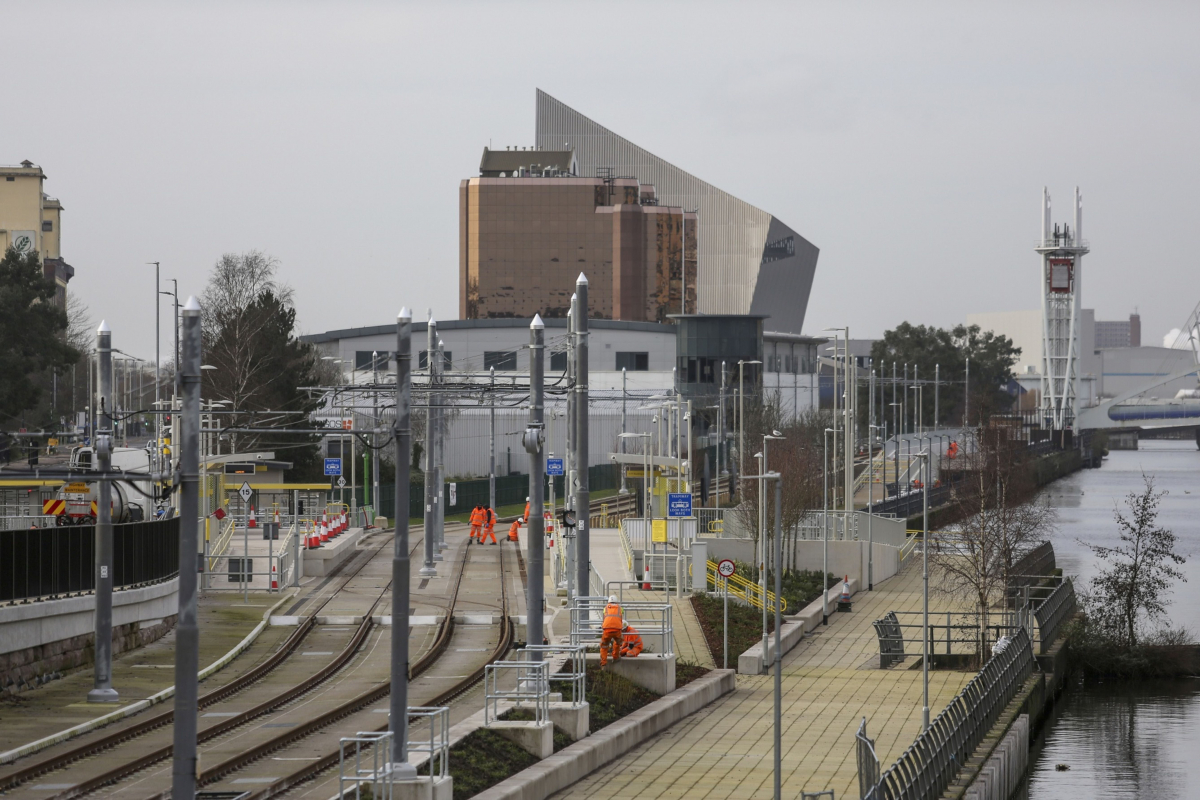
Workmen work on the site of the new Wharfeside tram stop in Trafford Park in Manchester, England, on Feb. 5, 2020. MUST CREDIT: Bloomberg photo by Paul Thomas.

Workmen work on the site of the new Wharfeside tram stop in Trafford Park in Manchester, England, on Feb. 5, 2020. MUST CREDIT: Bloomberg photo by Paul Thomas.

“They seem to be obsessed with huge projects, headline grabbers, when actually the question is could they be doing more around how much businesses our size make up of the economy,” says Mathew. “If you can improve the productivity of those companies, you’re going to improve the productivity of the whole country.”

The fact that the British spend more time than just about any developed nation for the same economic benefit presents the biggest challenge to a government aiming to make the country a powerhouse outside the EU-with or without a trade deal with the bloc.

Poor productivity is the slow puncture that has curtailed economic growth potential to just over a third of the government’s 2.8% target and left companies at bottom of the league table for efficiency of output. The government’s task is also made tougher by the huge disparity between London and anywhere more than an hour north.

A report by the Office for National Statistics on Feb. 29 showed an hour of work in London produced 44% more gross value to the economy than the northwest or a whopping 76% more than the part of the Manchester metropolitan area that includes Bury. Productivity there is lower than it was in 1994.

“Leveling up” the country has become the mantra of Prime Minister Boris Johnson after so many voters in northern regions abandoned their traditional politics and defected to his Conservative Party in December’s election as he promised to “Get Brexit Done.”

Next week’s budget is expected to deliver billions of pounds of infrastructure spending based on a review of the government’s “Green Book,” the guidelines for projects. Chancellor of the Exchequer Rishi Sunak will also address the potential impact of the latest global headwind, coronavirus.

“We are on the verge of a Japan-like decade of stagnation if we can’t transform productivity,” says Tony Danker, chief executive of Be the Business, a group that aims to boost U.K. competitiveness. “This is the secret sauce missing in the economy that will fuel growth.”

Bury, population 80,000, is one of the red-brick northern towns that encapsulates Britain’s Victorian heyday and the challenges the country now faces. Geographically, it’s in a prime spot in the shadow of Manchester, the city that defined the Industrial Revolution. The railways arrived in Bury in the 19th century, as did a hallmark of English life at the time, a local soccer club.

While the town is one of the lucky ones-it maintains its connection to central Manchester via the city’s tram network-it suffered from cuts after World War II as local industry went into decline. The only trains moving through Bury now are the historic steam and diesel engines that operate on the rescued heritage line. Bury Football Club was expelled from the soccer league last year because of financial trouble.

“This is the country that brought railways to the rest of the world,” shrugs volunteer John Hulme as he stands in the entrance to an old disused station, which now houses displays of bygone engines and signage from long-abandoned train stops.

The government’s spending plans include 100 billion pounds ($128 billion) on the HS2 high-speed rail network from London, even though it probably won’t reach Manchester until 2040. By comparison, new local bus and cycle networks to ease congestion on roads are slated to get just 5 billion pounds. A proposed east to west northern train line that could more than double average train speeds has yet to be approved.

But it’s those kind of smaller, more locally targeted initiatives that Mathew and his sister and business partner, Hannah Barlow, say would make a bigger difference to productivity-or, as they see it, efficiency and profitability.

Their business, Dunsters Farm Foodservice, was built up over 60 years from their grandfather’s milk deliveries. It needs to get vans out from the 20,000 square-foot warehouse to schools before parents drop off their kids, something again Barlow blames on a lack of alternatives. Shifts run from 4 a.m. to 11 p.m., in part to take traffic into account.

“With the northern archaic system, everyone just jumps in a car and that does have an impact on our deliveries, our stock,” says Mathew.

To get more done for the cost, they have focused on technology, streamlining the process by which orders are picked from the warehouse and replacing paper lists with management software. That reduced the time employees spend walking around the vast floor space by as much as 40% and has given them a 99% plus accuracy rate, meaning dramatically fewer extra deliveries to rectify problems.

“We weren’t thinking about being productive,” says Barlow. “We were thinking this is wasting time, it’s wasting money.”

Research by the Industrial Strategy Council, which oversees the government’s efforts to boost productivity and wage growth, found that locally tailored policies would be more effective than top-down, big-ticket projects.

There’s also the issue of Brexit. Tougher immigration rules are designed to staunch the supply of cheaper labor from Eastern Europe, and one of the goals is to force companies to invest in technology and machinery that can reduce the need for manual workers.

But in the meantime the economy faces significant hurdles. Uncertainty over whether Brexit would happen-Britain finally left the EU on Jan. 31 after 3 ½ years of wrangling-has given way to the prospect of turmoil over trade talks. The Bank of England said in January that the limit the economy can grow without generating inflation is now just 1%.

Now there’s the impact of coronavirus, which the Organisation for Economic Cooperation and Development said could shrink the global economy this quarter.

“It’s easier for firms to improve productivity when demand for their product is rising, but the slowdown in the economy means that for many firms demand has been flat or even falling,” says John Young, one of the Bank of England’s network of representatives based in the northwest.

There’s also not the same money being spent everywhere. A report by the Resolution Foundation think-tank published a week before the government’s budget highlighted the stark differences in regional public investment. London’s spending per head of 1,456 pounds in 2018-19 was 53% more than in the northwest and more than double that of the East Midlands.

At the Dunsters warehouse on the outskirts of Bury, Mathew and Barlow urged the government to focus less on the new high-speed train link and do more for what’s known as “soft infrastructure” like better broadband.

“There’s probably a lot more productivity stuff that could be done without HS2, but it gets all the fanfare,” she says. “Give people the support on the ground.”

This New York CEO put his company in a simulated coronavirus lockdown #ศาสตร์เกษตรดินปุ๋ย

#ศาสตร์เกษตรดินปุ๋ย : ขอบคุณแหล่งข้อมูล : หนังสือพิมพ์ The Nation

https://www.nationthailand.com/business/30383549?utm_source=category&utm_medium=internal_referral

This New York CEO put his company in a simulated coronavirus lockdown

Mar 07. 2020
Marc Cenedella of The Ladders, a recruiting company in New York City, works from home during the onset of the coronavirus season in March 2020. (MUST CREDIT: Steven Zeitchik/The Washington Post)

Marc Cenedella of The Ladders, a recruiting company in New York City, works from home during the onset of the coronavirus season in March 2020. (MUST CREDIT: Steven Zeitchik/The Washington Post)
By The Washington Post · Steven Zeitchik · NATIONAL, BUSINESS

NEW YORK – Marc Cenedella is close with his 60 employees, but he’s never managed them from his kitchen table.

The executive runs Ladders, a job-search site he founded after the first digital boom, in 2003. On a typical day, he’s guiding his staffers – about two-thirds engineers – at the company’s headquarters 50 stories above New York’s financial district.

On Thursday, the 49-year-old found himself helming a more forward-minded experiment. He told employees to schedule as much face-to-face work and meetings as possible – and then do it all from their homes. Cenedella would run Ladders from the apartment he shares with his wife and three kids in Nolita, the boutique-dotted downtown neighborhood.

As the novel coronavirus has started to spread in the United States, some chief executives have begun considering how remote work would be conducted in the case of a lockdown, following the trend in Asia. Cenedella, though, decided to attempt this one-day trial 10 days earlier, before any New York cases had been reported, and put it into place even as its mayor, Bill de Blasio, urges residents to commute to work as usual. Cenedella hoped to learn both the adjustments a lockdown would require and the toll it could take.

“We’re normally a very in-person company,” Cenedella said Thursday morning. He wore a casual button-down shirt, jeans and white socks as he sat in front of two monitors he’d set up on the large wooden table in his dining area, opposite children’s drawings and other signs of its normal inhabitants. “But I wanted everyone to start to feel more comfortable in case there’s a long lockdown – to feel reassured there’s a plan in place and know how to execute it.”

He paused. “Of course, the question isn’t Day 1 but Day 20. It will be harder to keep people from feeling lonely.”

Managers can be reluctant to trot out emergency protocols too soon out of fear of rattling employees. But Cenedella thought a lack of preparation would lead to more anxiety. He called the process a “rehearsal,” not a “drill.”

First order of business: a welcome call.

“Good morning and welcome to our coronavirus rehearsal,” he said to the staffers brought together on Google Hangouts from basements and bedrooms across the New York metropolitan area. “We want to do everything possible to make this a full, productive workday for everyone.”

He continued offering encouragement and guidance. “It’s really important we stick with regular meetings and not push them off or blow them off. We want to experience this in case we’re in a work-from-home scenario. We want to feel the full burden.”

After another moment of speaking he realized he wasn’t getting much feedback. “Am I muted? ” Someone responded on the accompanying chat that he was. “The whole time?” Also affirmative.

“I guess the first lesson of lockdown rehearsal is to turn off the mute,” he said self-deprecatingly and started the spiel again.

The meeting ended and the names vanished from the screen. Cenedella went into a virtual meeting with sales executives.

After a moment of getting the glitches out from among the trio (“Can you share your camera?” “We want to see you.” “I don’t see you.” “I see me.” “I see you.” “Oh, there you are.”), they dived in and started discussing employer clients.

A few minutes in, a nonhuman sound could be heard.

“Sorry, I think my dog wants to join the conversation,” one of the sales executives said.

Ladders bills itself as a site for higher-paying jobs, in contrast to competitors like Indeed, LinkedIn and ZipRecruiter. To attract subscribers (the site charges both employers and job-seekers), it is constantly adding content and features. Normally employees work in one-week “sprints” – getting a new set of innovations going Wednesday and passing them to other teams the following Tuesday. A lockdown of a few days would be one thing; an entire cycle without in-person meetings to pitch, plan and polish is another.

“We’ve never had a problem doing one snow day – people do ‘personal’ work that doesn’t require a lot of interaction,” Cenedella said. “But once it interrupts a full sprint or several sprints, I don’t know how that will go.”

When he’s done personal work, Cenedella said, it was from a desk set up in his bedroom. But he wasn’t getting on video calls then. “You don’t want employees to see the CEOs’ bed,” he said.

One of the executive’s tasks is staying on top of tickets – essentially high-end versions of what the rest of us send to the IT department when we can’t log in. He spent some time dealing with that. Ladders also has a content team, which works on a parallel product offering Web posts about the job market.

Cenedella held a call with some of the editors who run that department.

“With social, every 12 months something’s new so we have to stay on top of it, “Cenedella said. “It was Facebook, now it’s Instagram – ”

“TikTok,” a millennial editor said.

“But what’s the upper age limit of TikTok?” Cenedella asked.

“Honestly it’s kind of all over the place. Parents do it to see what their kids are up to. I’ve seen people in their 80s doing it. I personally didn’t download it because I think it would take over my life,” the editor responded.

Cenedella’s three children are all under the age of 8. The youngest, 3, came scampering into the room as he was responding to an email about a client.

“Do you want to help Daddy type?” he asked his daughter.

She said yes, then plunged into a description of a character she liked, pointing out they should be on the screen before running off. It was like a hardware check from a tech staffer but with more “My Little Pony” talk.

An all-staff Slack channel was active; Cenedella had encouraged employees to weigh in on how their day was going. He clicked over to it.

One had written. “I feel like I’ve been grounded and sent to my room.” Cenedella clicked off. “They’re one of the more extroverted people we have here,” he explained.

A ticket came through on an engineering issue. He studied it for a moment. “There are too many opinions to solve it in Slack,” he concluded. “Normally I’d just say let’s huddle for five minutes and we’ll solve it. We can’t do that now.”

He decided to punt it to Friday when everyone would be back in the office. That luxury wouldn’t be available in a real lockdown, but he felt he had no choice; he couldn’t just message everyone to get on a conference call.

“Popping by an engineer’s desk – when they have their head down and headphones on – is easy. But Slacking them to stop what they’re doing will make it seem like a much bigger deal that it is.”

Couldn’t he just preface that it wasn’t a big deal? “Whenever a CEO says that you know it’s a big deal,” he noted.

It was nearly 6 p.m., time for an end-of-day wrap call on the rehearsal.

“Hopefully this has been a helpful experiment for everyone in case things begin to really go poorly,” he said as everyone gathered virtually. He asked what they missed being out of the office. A few said they missed the more efficient hardware; another said the lack of distractions.

“None of you missed me?” Cenedella asked, prompting a raft of employees to say they did.

After the call, Cenedella said he thought the experiment mostly ran smoothly. But a number of incidents – especially the engineering ticket – convinced him there would be hurdles. “What I realize now is that to make this work we need to pull in as much work that’s independent and push out as much that’s collaborative, which I don’t know if we can do for several weeks.”

Asked if it felt strange for his offices to sit empty on a workday, he said, “But it’s not really empty. Everyone’s here.” He gestured to a screen. “Are they here? Where is here?”

“I may have been away from people for too long,” he said.

Judge says Amazon ‘likely to succeed’ on key argument in Pentagon cloud lawsuit #ศาสตร์เกษตรดินปุ๋ย

#ศาสตร์เกษตรดินปุ๋ย : ขอบคุณแหล่งข้อมูล : หนังสือพิมพ์ The Nation

https://www.nationthailand.com/business/30383544?utm_source=category&utm_medium=internal_referral

Judge says Amazon ‘likely to succeed’ on key argument in Pentagon cloud lawsuit

Mar 07. 2020
By The Washington Post · Aaron Gregg · NATIONAL, BUSINESS, TECHNOLOGY, POLITICS, COURTSLAW, NATIONAL-SECURITY

WASHINGTON – A federal judge has concluded that a bid protest lawsuit brought by Amazon over President Donald Trump’s intervention in an important Pentagon cloud computing contract “is likely to succeed on the merits” of one of its central arguments, according to a court document made public Friday.

The document provides the first indication of how Court of Federal Claims judge Patricia Campbell-Smith views the evidence presented on both sides.

In a blow to Microsoft and the Defense Department, Campbell-Smith ordered the Pentagon to halt work on JEDI last month. In an opinion explaining her reasoning, Campbell-Smith sided with Amazon’s contention that the Pentagon had made a mistake in how it evaluated prices for competing proposals from Amazon and Microsoft. She also concluded that the mistake is likely to materially harm Amazon, an important qualifier for government contract bid protests. And she rejected arguments raised earlier by Microsoft and the Defense Department that Amazon should have raised its concerns sooner.

A Defense Department spokesman expressed disappointment in the ruling but declined to comment on its specifics.

“The Department is disappointed in the Court’s ruling,” Pentagon spokesman Lt. Col. Robert Carver said in an email. “We remain focused on getting this critical capability into the hands of our warfighters as quickly and efficiently as possible.”

Microsoft spokesman Frank Shaw downplayed the ruling, saying it focused on a single technical factor.

“The decision disagreed with a lone technical finding by the Department of Defense about data storage under the evaluation of one sub-element of one price scenario,” Shaw said in a statement. “While important, there were six pricing scenarios, each with multiple sub-elements, and eight technical factors, each with numerous subfactors evaluated during the procurement. The decision does not find error in the Department of Defense’s evaluation in any other area of the complex and thorough process that resulted in the award of the contract to Microsoft.”

Shaw further defended the Defense Department’s handling of JEDI, adding: “We have confidence in our technology, our bid, and the professional staff at the Department of Defense.”

The Joint Enterprise Defense Infrastructure contract, better-known as ‘JEDI’, calls for a powerful cloud computing system through which military agencies can access data centers operated by a commercial tech company. Top defense officials have labeled it a crucial national security priority that will improve deployed troops’ access to technology and intelligence, and lay the groundwork for the military’s adoption of artificial intelligence. It has been delayed repeatedly since it was first announced in early 2018.

In its bid protest, Amazon accused Trump of improperly interfering in the bid protest to spike the company’s bid. It cited repeated public statements Trump has made against the company and its founder, Jeff Bezos, going back to the early days of his campaign. And it has asked to depose Trump along with Defense Secretary Mark Esper, chief information officer Dana Deasy and others.

(Bezos owns The Washington Post.)

Campbell-Smith has not yet ruled on Amazon’s contention that Trump interfered personally in the bidding process.

Representatives from Amazon did not immediately respond to requests for comment on Friday’s ruling.

Airlines, travel and cruise industries hurt by coronavirus could get a tax relief from the White House #ศาสตร์เกษตรดินปุ๋ย

#ศาสตร์เกษตรดินปุ๋ย : ขอบคุณแหล่งข้อมูล : หนังสือพิมพ์ The Nation

https://www.nationthailand.com/business/30383542?utm_source=category&utm_medium=internal_referral

Airlines, travel and cruise industries hurt by coronavirus could get a tax relief from the White House

Mar 07. 2020
File photo/ Syndication Washington Post

File photo/ Syndication Washington Post
By The Washington Post · Jeff Stein, Rachel Siegel, Heather Long, Erica Werner · NATIONAL, BUSINESS

WASHINGTON – The travel and tourism industries are facing their worst crisis since the 2001 terrorist attacks, prompting White House officials to consider deferring taxes for the cruise, travel and airline industries to stem the economic fallout of the coronavirus, according to two people briefed on the discussions.

The discussions are a sign that the White House is grappling with how to respond to an outbreak they have publicly downplayed. The talks remain fluid and are preliminary.

These tax deferrals for the travel industry are being considered as airlines cut back on routes and warn about dropping ticket sales. Hotel chains are struggling with vacancies in Asia and are bracing for similar waves in the United States. Businesses travel is falling, and trade shows, music festivals and conventions are being canceled from San Francisco to Chicago to Miami. Families and college students are reconsidering spring break excursions and distant summer plans.

Other countries have already enacted tax relief for their hardest hit industries. On Sunday, Italy announced a tax credit for any company that has seen revenue decline by more than a quarter. This is on top of Italy’s announcement last month that companies and individuals living in areas affected by the “epidemiological emergency” would be granted an extension on spring tax filings.

It’s not clear how U.S. relief would be administered or whether President Donald Trump’s own hotels could be beneficiaries. Administration officials also disagree on the extent to which some of these measures could be done without Congress.

On Friday, White House economic adviser Larry Kudlow confirmed the administration is considering “timely and targeted” federal interventions to help workers, businesses and industries most vulnerable economically to the outbreak.

“Perhaps on a large scale, some of the sectors might need some temporary assistance,” Kudlow said on Fox Business, adding, “We don’t want to act prematurely.”

Kudlow’s comments were the administration’s most definitive public admission yet that U.S. companies have been hurt by the coronavirus.

Speaking on CNBC, he specifically pointed to airlines, saying they are “in trouble in some of their numbers.” But he stressed that the White House was not concerned about widespread economic damage, a stark difference to most independent economists and investors who see growing risk of a recession.

Yet many travel experts and industry executives are comparing the current industry upheaval to that of the Sept. 11, 2001, attacks because fear and uncertainty are driving consumer behavior and keeping people at home.

“It has a 9/11-like feel,” Southwest Airlines CEO Gary Kelly said Thursday on CNBC. He also said that “9/11 wasn’t an economically driven issue for travel. It was more fear, quite frankly, and I think that that’s really what’s manifested this time.”

This week, the International Air Transport Association warned the outbreak could cost airlines as much as $113 billion in lost revenue. The U.S. Travel Association forecasts that international travel to the U.S. will decline 6 percent over the next three months – the largest decline since the 2008 financial crisis.

The sector’s grim outlook comes as coronavirus cases surpass 100,000 worldwide and deaths number in the thousands. The United States announced its 14th fatality, and Maryland joined states with confirmed new cases. Meanwhile, health officials have warned against travel restrictions on China, Iran, Italy and South Korea, while the U.S. Centers for Disease Control and Prevention has advised advanced precautions regarding travel to Japan.


While there are no restrictions on domestic travel – and basic habits like hand washing remain among the best defenses against the flu-like virus – the outbreak has sent global markets into near-hysteria. The Dow Jones Transportation Average careened into a bear market this week, meaning these stocks have fallen more than 20 percent from their recent highs.

United Airlines and American Airlines stocks are both down about 40 percent to date this year, while Delta Air Lines has shed more than 20 percent.

In addition to helping sectors like hospitality and airlines, the White House also is considering helping people unable to work because they are forced to stay home, as well as small businesses who may need some “cash flow” help amid the outbreak, Kudlow said.

Kudlow didn’t specify what types of assistance the government could offer. Trump signed legislation on Friday to address the outbreak, which includes $7 billion in loans for the Small Business Administration.

Travel and tourism accounted for 5.9 million jobs in 2018, including jobs in lodging, dining and transportation. The sector accounted for 2.9 percent of the economy in 2018, federal data show.

Cruise prices are beginning to fall, after two high profile quarantines, said Mike Driscoll, editor in chief of the trade publication Cruise Week. On the Diamond Princess 700 people were infected and seven died and now the Grand Princess, is being held off the coast of California as passengers await test results.

Because cruises are generally booked months in advance, it’s hard to predict how many people will cancel summer plans, said Mike Driscoll, editor in chief of Cruise Week. Fewer Americans take cruises to Asia compared to Europe or elsewhere, so the industry’s long-term impact depends heavily on where the outbreak takes hold. “The potential is so worrisome for the cruise business,” Driscoll said. “It depends on what happens in the Caribbean. It depends on what happens in Mexico.”

Debra Adams, 57, is counting down to April 19, the start of her 27-day cruise across the Atlantic and through Europe. She regularly checks for bulletins from Princess Cruises that may threaten her trip, but says she and her 81-year-old father are determined to go. Adams said she sees no reason to sit and home and worry when she has this “opportunity to live.”

“Right before we get off the ship, my dad and I spend a day in Paris,” she said. “It’s going to be amazing. I’m going to go until they tell me I can’t.”

Glenn Wilcox has been fielding questions by anxious callers looking to rearrange European vacations or finagle flights to avoid certain airports. His company, Wilcox Travel, books trips for leisure travelers and humanitarian aid groups. Wilcox estimates that future bookings are down 20 to 30 percent compared to last year.

“We’ve had constant questions,” Wilcox said. “It’s a hard thing. What I’m telling folks is that we can only go off of what travel restrictions there are.”

As people cancel flights, they ditch hotel reservations too. Marriott said in an earnings call that revenue from bookings in China plunged in February. Hilton estimates that coronavirus will affect its bottom line by as much as $50 million if the outbreak lasts several months. And Hyatt said its hotels in Singapore, Bali and Japan saw bookings fall as Chinese travelers stayed home.


At San Francisco’s Moscone Center, the city’s largest convention and exhibition complex, at least seven groups – including Facebook and IBM – have canceled or rescheduled for total economic losses of roughly $138 million, according to Laurie Armstrong Gossy of San Francisco Travel Association.

Airport hotels in particular are seeing a loss in bookings, said Jan Freitag, senior vice president of lodging insights at the data firm STR. Especially those with a lot of international traffic. And there’s some indication that people are canceling weekend bookings, suggesting leisure travel could be pulling back more than corporate travel.

But Freitag said that if people want to travel, they’ll do it. He pointed to high occupancy rates at New Orleans hotels during Mardi Gras, a hot spot for travelers coming in very close contact.

“One week does not a trend make,” Freitag said.

In suburban Maryland, it seemed like business as usual at the MGM Grand casino. In the food court, the only sign of coronavirus fears was an oversized jug of hand sanitizer next to the register of a Vietnamese eatery. On the casino floor, one slot player out of dozens wore a face mask. At blackjack and baccarat tables, players sat as close to each other as ever, fiddling with chips that had been handled by countless others that day.

Yet, some were staying away. Maryland poker pro Andrew Brokos, an author and host of the podcast “Thinking Poker,” said he was focusing on his coaching business and finishing his latest book.

“I actually have not been going to casinos,” he said. “By the time we’re hearing about confirmed cases in the area, it’s too late.”

A spokeswoman from MGM Grand declined to comment on the outbreak’s impact on business but said the casino had placed additional hand sanitizer dispensing stations in high-traffic areas, among other cleaning protocols.

The White House conversations over tax relief for hospitality leaves a big question about whether the president might directly benefit. Trump’s company, which he still owns but which is run by his sons, owns and operates hotels in the District of Columbia, Chicago and Las Vegas, plus the Mar-a-Lago Club in Florida and a vineyard in northern Virginia.

The company also owns 11 golf courses in the U.S. and three golf resorts in Europe. Like Hilton, Marriott and other big-name hotel firms – which mostly manage but do not own hotels – the Trump Organization also operates properties under the Trump brand for other owners in Hawaii, New York and Vancouver.

Since Trump’s election, his politics have taken a toll on the business, with the “Trump” name being removed from hotels in New York, Rio de Janeiro, Toronto and Panama, as well as from a number of residential buildings in New York. The Trump Organization is now looking to sell its D.C. hotel business.

The company did not respond to questions about how the outbreak has affected its business and any actions it has taken in response.

BGrimm Power looks to 15% rise in revenue, M&A talks underway #ศาสตร์เกษตรดินปุ๋ย

#ศาสตร์เกษตรดินปุ๋ย : ขอบคุณแหล่งข้อมูล : หนังสือพิมพ์ The Nation

https://www.nationthailand.com/business/30383533?utm_source=category&utm_medium=internal_referral

BGrimm Power looks to 15% rise in revenue, M&A talks underway

Mar 07. 2020
President Preeyanart Soontornwata

President Preeyanart Soontornwata
By THE NATION

BGrimm Power Plc, a major private power producer in Thailand, targets revenue growth of 10 per cent to 15 per cent this year, from Bt44.660 billion last year, said president Preeyanart Soontornwata on Friday (March 6).

Two new power plants will begin commercial operation this year, with the 16-megawatt Bo Thong wind farm in Mukdahan province set to start in September.

She said the company was in talks on merger and acquisition (M&A) deals of several power plants. Targeted facilities are small power plants (SPP) with combined capacity of 400MW and a natural gas plant in Malaysia with a capacity of 250MW.

The company has also studied plans to invest in a wind power plant in South Korea, a liquefied natural gas (LNG) power plant in Vietnam, and a solar farm in the Philippines.

Nopadej Karnasuta, Chief Financial Officer, said BGrimm Power may issue debentures worth not more than Bt8 billion in the middle of this year, depending on interest rate trend.