Dollar’s strength yet another snag for U.S.-China farm deal #ศาสตร์เกษตรดินปุ๋ย

#ศาสตร์เกษตรดินปุ๋ย : ขอบคุณแหล่งข้อมูล : หนังสือพิมพ์ The Nation

https://www.nationthailand.com/business/30383456?utm_source=category&utm_medium=internal_referral

Dollar’s strength yet another snag for U.S.-China farm deal

Mar 06. 2020
By Bloomberg · Isis Almeida · BUSINESS, WORLD, US-GLOBAL-MARKETS, ASIA-PACIFIC 

Crop traders obsessing over the deadly coronavirus in China may be overlooking another key challenge to the Trump administration’s phase one trade deal: the U.S. dollar.

The virus’s spread is upending supply chains and cutting food demand in China, delaying billions of dollars in American sales of everything from pork to soybeans. Making up for the losses later in the year may be difficult if the dollar continues to strengthen against currencies in Brazil and Argentina, two of the U.S.’s top agricultural rivals.

China has pledged to buy $36.5 billion in U.S. farm goods this year under the trade deal, $12.5 billion more than in 2017. But some tariffs remain in place, and China has said its purchases need to make economic sense with both Washington and Beijing acknowledging that the timing of the sales depends on market conditions.

“We are already dealing with retaliatory tariffs and now coronavirus presents challenges for China to fill its obligations,” said Dan Kowalski, vice president of research at CoBank, a $145 billion lender to the agriculture industry. “If the dollar remains strong, that has tangible impacts on market conditions. And that could or could not play a part in China filling its purchases.”

Traders were already skeptical China would reach the phase one targets before the virus hit. Even the U.S. Department of Agriculture’s own export projections cast doubt on the deal. Now, with the Brazilian real and the Argentine peso hitting record lows against the dollar, the trade-deal targets are even more in doubt.

“We always have to be mindful that the Chinese are price buyers,” said Stephen Nicholson, a senior analyst for grains and oilseeds at Rabobank. “I don’t think that’s going to change under phase one. They are going to do what they do. I think they will continue to buy what they need and they will buy at the best price. It’s an ingrained behavior.”

For now, U.S. authorities are dismissing the currency threat. Agriculture Secretary Sonny Perdue said at a USDA forum last month that he expects China to live up to its pledges, and Ted McKinney, the undersecretary of agriculture for trade, added that their $36.5 billion commitment stands despite the dollar strength.

Gregg Doud, U.S. chief agricultural negotiator at U.S. Trade Representative, also dismissed the idea. But he delivered a scary prospect for American farmers already dealing with high debt, several years of low prices and piles of corn and soybeans from last year’s harvest still stashed in their bins.

“At least in my mind, as an old commodity analyst, I don’t think that’s an issue here,” Doud said at the USDA event. “It just means that as that gap gets further, the U.S. price has to come down to be competitive with what’s going on in South America.”

Brazil is already harvesting a record soybean crop and with a weaker real boosting farmer profits, the incentive will be there to expand plantings in the years to come. On Wednesday, Brazil’s economy posted a third consecutive year of sub-par growth.

“Maybe China doesn’t reach $36.5 billion,” said Dan Basse, president of consulting firm AgResource. “But I think if you were to ask the market today, and say it’s going to do the same as in 2017 — $24 billion, $28 billion — we’d probably be OK there.”

There’s no reason to sound the alarm bells at this point, said CoBank’s Kowalski. The lender believes China will make a “good faith” effort to meet the targets and said the nation will have a bigger opportunity to buy American farm goods in the second half of the year.

Concerns about the slowdown of the Chinese economy may also end up helping the nation meet its pledges. That’s because the agreement allows for nations to impose tariffs equivalent to the size of the damage without retaliation in the case of non-compliance.

“They signed an agreement, they know it’s enforceable,” Steve Censky, the USDA’s deputy secretary, said in an interview last month in Arlington, Virginia. “Given their economy and everything else, they don’t want to be back in the soup, battling the U.S. on tariffs.”


$54 billion and counting: U.S., Europe and Asia respond to virus #ศาสตร์เกษตรดินปุ๋ย

#ศาสตร์เกษตรดินปุ๋ย : ขอบคุณแหล่งข้อมูล : หนังสือพิมพ์ The Nation

https://www.nationthailand.com/business/30383455?utm_source=category&utm_medium=internal_referral

$54 billion and counting: U.S., Europe and Asia respond to virus

Mar 06. 2020
File photo/ Syndication Washington Post, Bloomberg

File photo/ Syndication Washington Post, Bloomberg
By Syndication Washington Post, Bloomberg · Michelle Jamrisko, Catherine Bosley · BUSINESS, US-GLOBAL-MARKETS

Governments around the world have opened up the fiscal spigots to fight the spread of the coronavirus outbreak.

More than $54 billion in budget support has already been pledged or is under consideration to counter the virus’s impact, with governments adopting a mix of cash handouts, tax breaks and transfers.

While numerous Asian countries have allotted funds, Europe’s spending is almost entirely confined to Italy, where the outbreak has taken a particularly big toll. The U.S. has earmarked $7.8 billion.

Here’s a look at what’s been announced so far:

China

– Top leaders signaled a “more proactive” fiscal policy, alongside steps already taken by authorities to cushion the economy and support financial markets.

– Among the upcoming measures: more targeted, phased tax cuts; increase in local government special bond quota; more fiscal transfers from central government to local virus-hit regions

Japan

– Prime Minister Shinzo Abe has pledged to take additional economic measures if needed.

– Economic adviser to PM said the government should consider 5 trillion yen ($47 billion) in extra spending toward virus relief.

South Korea

– 11.7 trillion won ($9.9 billion) was allocated in a special budget to aid medical response, businesses, households.

– Tax breaks, rent subsidies announced Feb. 28.

Australia

– Treasurer Josh Frydenberg said the government is preparing to spend billions of Australian dollars to help businesses cope with the virus fallout.

Indonesia

– A stimulus package of 10.3 trillion rupiah ($727 million) includes fiscal incentives, grants to local governments and a boost to social security funds.

– A second, “bigger” tranche is being planned to help middle-income earners.

Thailand

– More than 100 billion baht ($3.2 billion) in special stimulus measures being considered, including soft loans, tax measures to boost stock market and cash handouts.

– The spending would add to just-passed budget that’s expected to spur 640 billion baht in investment.

Singapore

– S$6.4 billion ($4.6 billion) allocated in annual budget toward virus response, support for businesses and consumers.

– Of that, S$800 million is dedicated spending to combat virus, the bulk of which will go to the Health Ministry.

Hong Kong

– HK$120 billion ($15 billion) relief package announced in annual budget.

– Includes HK$10,000 payment to each permanent resident 18 years or older.

Malaysia

– 20 billion ringgit ($4.8 billion) allocated in a special stimulus package

– Spending will focus on aiding businesses, especially tourism. Package also includes lower minimum pension contribution, tax payment extension, infrastructure upgrades.

Italy

– Italy has earmarked 7.5 billion euros.

– Finance Minister Roberto Gualtieri said the stimulus package will be presented next week, with funds to suspend loan payments from virus-hit companies, resources for health and emergency services.

France

– Government wants to lighten social and tax burden for businesses such as restaurants, hotels and bus companies; also loan guarantees for SMEs.

Germany

– Angela Merkel’s ruling coalition has been at odds over the need for stimulus. The head of her parliamentary caucus pushed back against calls to make as much as 50 billion euros available.

– Top officials are due to discuss measures in Berlin on Sunday.

U.S.

– The House passed a $7.8 billion emergency spending bill to fund the response to the outbreak.

Oil hovers below $47 while OPEC waits for Russia on supply deal #ศาสตร์เกษตรดินปุ๋ย

#ศาสตร์เกษตรดินปุ๋ย : ขอบคุณแหล่งข้อมูล : หนังสือพิมพ์ The Nation

https://www.nationthailand.com/business/30383454?utm_source=category&utm_medium=internal_referral

Oil hovers below $47 while OPEC waits for Russia on supply deal

Mar 06. 2020
By Syndication Washington Post, Bloomberg · Catherine Ngai · BUSINESS, US-GLOBAL-MARKETS 

Oil gyrated around $47 a barrel in New York as OPEC ministers laid the groundwork for a large production cut, even as a potential deal remains uncertain given Russia’s opposition.

Crude, which has plunged about 24% so far this year, swung between gains and losses as details of the proposal emerged. Ministers meeting in Vienna first said they were seeking to back a 1.5 million-barrel-a-day reduction, but cautioned that the plan is contingent on Russia’s support, which is so far not evident. Prices initially rallied, but then erased gains after the announcement.

“Prices are drifting lower now, which means there’s no confidence going into the meeting,” said Bob Yawger, director of the futures division at Mizuho Securities USA. “OPEC will need to pull the rabbit out of the hat here by the end of the day tomorrow if they want to support the market.”

The need for the oil cartel to curb supply will be more pressing this year as global markets falter over fears of the coronavirus, or Covid-19, spreading, which is also denting oil demand. Oil producers are struggling against a weakening demand outlook, the likes of which hasn’t been seen in years.

When OPEC released its supply and demand model in early February, it pegged global oil-consumption growth this year at 990,000 barrels a day. Now the group sees growth at just 480,000 barrels a day. Large Wall Street banks and consultancies are even anticipating global oil demand contracting in 2020 for only the fourth time in nearly four decades.

“We have modeled out three likely outcomes of the OPEC+ meeting, and not a single one of them comes close to bridging the supply-demand balance,” Bjørnar Tonhaugen, head of oil markets at Rystad Energy, said in a note. “Even though OPEC+ is already tremendously over-complying on cuts agreed upon in Dec-19, it’s not enough to counter the demand destruction of Covid-19.”

West Texas Intermediate futures for April delivery rose 3 cents to $46.81 a barrel on the New York Mercantile Exchange as of 11:05 a.m. local time. Brent futures for May dropped 5 cents to $51.10 a barrel on the ICE Futures Europe exchange. The premium for Brent over WTI in May traded at $4.07 a barrel.

The Organization of Petroleum Exporting Countries agreed it should cut daily crude output by 1 million barrels in the second quarter, with further curbs of 500,000 barrels coming from non-OPEC allies, according to a statement. But Russian Energy Minister Alexander Novak left Vienna on Wednesday without backing such a proposal, and won’t return to negotiations until Friday.

After the talks on Thursday, Iranian Oil Minister Bijan Namdar Zanganeh conceded there’s no plan B if Russia doesn’t agree.

U.S. stocks fall, bonds surge on coronavirus fears #ศาสตร์เกษตรดินปุ๋ย

#ศาสตร์เกษตรดินปุ๋ย : ขอบคุณแหล่งข้อมูล : หนังสือพิมพ์ The Nation

https://www.nationthailand.com/business/30383453?utm_source=category&utm_medium=internal_referral

U.S. stocks fall, bonds surge on coronavirus fears

Mar 06. 2020
By Syndication Washington Post, Bloomberg · Randall Jensen, Vildana Hajric · BUSINESS, US-GLOBAL-MARKETS

U.S. stocks dropped as volatility sparked by the spread of the coronavirus woes continued to grip financial markets. Treasury yields sank to record lows as haven assets remain in demand.

The S&P 500 fell more than 1.9%, as wild swings pile up. The measure has notched three 4% moves since its February record and two other 3% drops in the most volatile stretch since the week after S&P Global Ratings cut the U.S. debt rating in 2011. Banks led losses.

Sentiment took a hit after more cases of the virus popped up across the U.S., including in New York, and California declared a state of emergency. European shares slid as companies warned the epidemic would hurt results.

The 10-year yield sank to a record 0.93%, while the dollar dropped against the yen and the euro. Gold advanced, and oil edged lower as OPEC debated output cuts to battle the impact of the virus.

“If you think about what market volatility means, it’s lots of people moving at the same time. When you have a 4.5% up day and a 2% down day — what does that mean?” Kathryn Kaminski, chief research strategist at AlphaSimplex Group LLC, said on Bloomberg Television. “It means we don’t know what’s going on.”

Risk assets have whipsawed this week, with traders still on edge amid a rise in virus cases around the world and governments extending quarantines and travel restrictions. An industry association warned the outbreak could cost airlines as much as $113 billion in lost revenue. The S&P 500 has rebounded since the Federal Reserve pledged action on Friday, but it remains about 7.5% below last month’s all-time high.

In Asia, the main equities benchmark headed for a fourth straight gain. Surging Chinese stocks have now erased the last of their declines triggered by the outbreak.

These are the main moves in markets:

Stocks:

— The S&P 500 Index dropped 2% as of 11:35 a.m. New York time.

— The Stoxx Europe 600 Index fell 1.4%.

— The MSCI Asia Pacific Index gained 1.3%.

Currencies:

— The Bloomberg Dollar Spot Index declined 0.2%.

— The euro climbed 0.4% to $1.1179.

— The British pound gained 0.4% to $1.2927.

— The Japanese yen strengthened 0.7% to 106.78 per dollar.

Bonds:

— The yield on 10-year Treasuries sank 12 basis points to 0.93%.

— The yield on two-year Treasuries decreased 12 basis points to 0.57%.

— Germany’s 10-year yield fell three basis points at -0.67%.

Commodities:

— West Texas Intermediate crude fell 0.3% at $46.63 a barrel.

— Gold strengthened 1% to $1,659.80 an ounce.

U.S. services gauge hits one-year high before virus #ศาสตร์เกษตรดินปุ๋ย

#ศาสตร์เกษตรดินปุ๋ย : ขอบคุณแหล่งข้อมูล : หนังสือพิมพ์ The Nation

https://www.nationthailand.com/business/30383436?utm_source=category&utm_medium=internal_referral

U.S. services gauge hits one-year high before virus

Mar 05. 2020
By Syndication Washington Post, Bloomberg · Vince Golle · BUSINESS, US-GLOBAL-MARKETS 

America’s service industries in February enjoyed the fastest growth in a year as orders surged, showing momentum in the biggest part of the economy just as coronavirus concerns started to become more widespread.

The Institute for Supply Management’s non-manufacturing index unexpectedly rose 1.8 points to 57.3, according to data Wednesday. The median forecast in a Bloomberg survey called for a decline to 54.8. The third straight increase capped the longest stretch of gains since 2014. Figures above 50 show expansion.

A gauge of orders increased to the highest level since June 2018 and a measure of employment reached a seven-month high. While the improvement within service industries is at odds with a setback at factories during the same month, the risk for the economy is that the virus causes consumers to shy away from travel, entertainment and dining out.

“Most respondents are concerned about the coronavirus and its supply chain impact,” Anthony Nieves, chair of the group’s non-manufacturing business survey committee, said in a statement. “They also continue to have difficulty with labor resources. They do remain positive about business conditions and the overall economy.”

A separate gauge of service industries from IHS Markit dropped 4 points to 49.4, marking the first time since October 2013 that the measure has shown declining activity.

At the same time, business activity at health care providers is likely to increase amid industry efforts to battle the virus and ramp up production of medical supplies. Construction and real estate firms, meanwhile, are staying busy as home sales heat up.

The ISM report showed 16 non-manufacturing industries reported growth in February, led by accommodation and food services, mining, finance and real estate. Entertainment and recreation and agriculture indicated declining activity.

Nearly 40% reported that orders were higher in February, the most since June 2018. Only 8% reported a decline, the smallest share since April 2018.

“Even in spite of this pandemic threat, they’re still remaining optimistic about business conditions and the overall economy,” Nieves said on a call with reporters. “The only thing that derails this growth in this sector would be something geopolitical or catastrophic. Well, we are on the fringe of something that could develop or evolve into being catastrophic if it spreads beyond what we have right now.”

The ISM’s gauge of services employment increased to 55.6 from 53.1, indicating more firms are adding to their payrolls. Private hiring at service providers in the first two months of the year was the strongest since early 2018, according to data Wednesday from the ADP Research Institute. Official data are due Friday from the Labor Department.

The ISM’s index of business activity among non-manufacturers, which parallels the group’s measure of factory production, eased in February to a still-healthy 57.8 from 60.9. Order backlogs also increased, posting the strongest advance since May 2018.

The nation’s manufacturers, according to the ISM’s February data, experienced the brunt of the initial fallout from the virus. The group’s gauge showed near-stagnant activity as production slumped on the heels of virus-disrupted supply chains in Asia.

While the manufacturing supplier deliveries gauge jumped by the most since June 2018, indicating longer lead times, the same measure for services ticked only slightly higher. Instead, the jump in orders, which was the largest in more than two years, played a bigger role in boosting the ISM non-manufacturing index in February.

Stalled growth set back Thailand’s progress in poverty reduction: WB #ศาสตร์เกษตรดินปุ๋ย

#ศาสตร์เกษตรดินปุ๋ย : ขอบคุณแหล่งข้อมูล : หนังสือพิมพ์ The Nation

https://www.nationthailand.com/business/30383428?utm_source=category&utm_medium=internal_referral

Stalled growth set back Thailand’s progress in poverty reduction: WB

Mar 05. 2020
By THE NATION

Thailand’s poverty on the rise amid slowing economic growth, according to a new World Bank report today (March 5).

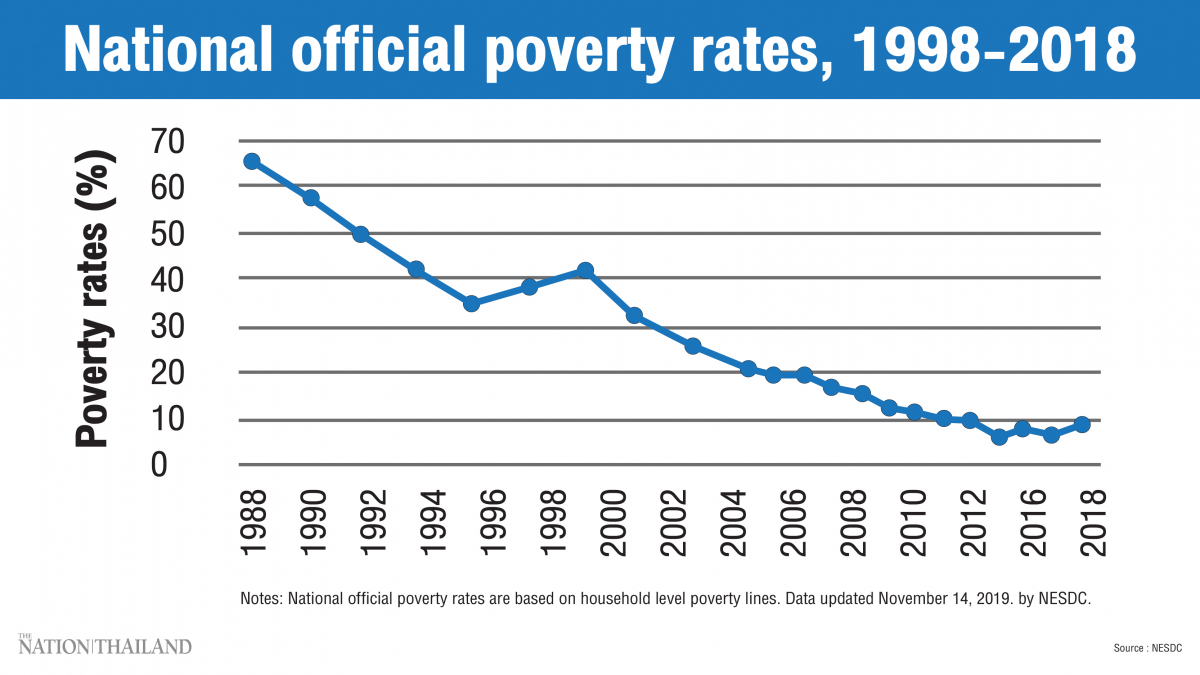
Thailand had successfully reduced poverty over the past three decades from over 65 per cent in 1988 to under 10 per cent in 2018.

However, the growth of household incomes and consumption have stalled nationwide in recent years. This resulted in a reversal in the progress of poverty reduction in Thailand with the number of people living in poverty rising, according to the World Bank report which analyses recent poverty and inequality trends based on official statistics.

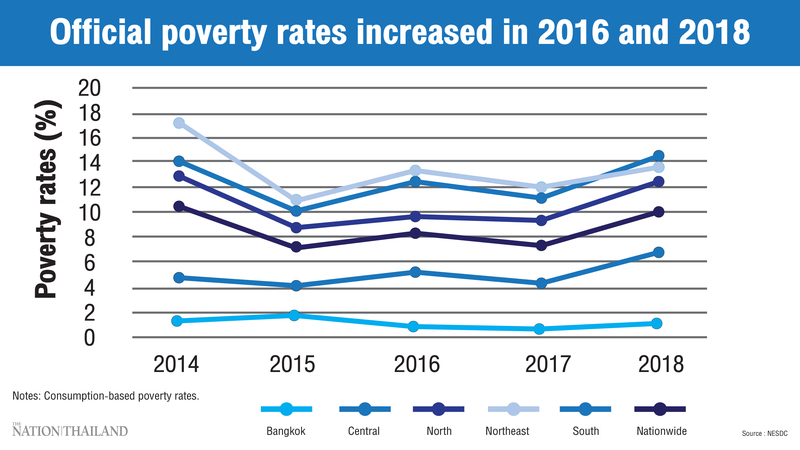
Between 2015 and 2018, the poverty rate in Thailand increased from 7.2 per cent to 9.8 per cent, and the absolute number of people living in poverty rose from 4.85 million to more than 6.7 million.

The increase in poverty in 2018 was widespread – occurring in all regions and in 61 out of 77 provinces. In the Central and Northeast, the number of poor increased by over half a million in each region during the same period. The conflict-affected South became the region with the highest poverty rate for the first time in 2017.

The report finds that the recent increase in poverty coincides with emerging and shifting economic and environmental challenges in the economy.

Over the past few years, Thailand’s growth rate has been lower than other large economies in the developing East Asia and Pacific region. Thailand had one of the lowest GDP growth rates in the region, at 2.7 per cent during the fourth quarter of 2019. Droughts have affected the livelihoods of farmers who are already typically the poorest.

“Recent poverty trends demonstrate that despite Thailand’s level of economic development, households are still vulnerable to shocks and weak economic conditions,” said Birgit Hansl, World Bank Thailand /Country Manager.

“To meet Thailand’s aspiration of achieving high-income status, Thai households will need better protection from income shocks such as ill-health, job-loss and natural disasters. It will be equally important to support the creation of more productive and higher-paying jobs.”

Since official poverty data were first published in 1988, Thailand’s poverty rate has increased in five instances, the most recent in 2018 and 2016 with the previous three instances occurring in 1998, 2000, and 2008 around the time of financial crises. Thailand is the only nation in Asean to experience several increases in poverty since 2000.

While Thailand performs better than its Asean peers on many international indicators of well-being, such as education enrolment among primary school-aged children, access to water, sanitation, and electricity, and has a low international extreme poverty rate based on $1.90/day at 0.03 percent, inequality remains an issue.

The population at the bottom 40 per cent of the income distribution is not sharing as well in prosperity, and in the recent period of 2015-2017, consumption and income growth in this bottom 40 per cent were negative. The reversal in trend among this bottom 40 per cent during this period is related to declines in all forms of labour incomes, including a stagnation in wage growth and declines in farm and business incomes.

“A more nuanced picture of inequity and a better understanding of vulnerability will be needed to guide Thailand’s next steps towards building a more prosperous society for all.” said Judy Yang, World Bank economist and author of the report. “Eliminating persistent pockets of poverty will require growth strategies that take into account short-run risk mitigation and long-run investment needs.”

The report calls for active interventions and investments to help transform Thailand. In the short-term, Thailand will need to reinforce its safety nets. Populations that are vulnerable would need to be better identified and swift action is needed in creating better jobs for households in a rapidly changing economy.

In the longer term, investing equitably in the next generation will be key. The next generation will be smaller due to demographic changes and lower fertility rates. Every child will need to be given a fair shot and be provided the health and education opportunities to reach their full potential. This will help households break out of the generational poverty trap, support an aging population, and boost Thailand’s growth prospects.

MINT takes Thai franchise rights for Bonchon chicken outlets #ศาสตร์เกษตรดินปุ๋ย

#ศาสตร์เกษตรดินปุ๋ย : ขอบคุณแหล่งข้อมูล : หนังสือพิมพ์ The Nation

https://www.nationthailand.com/business/30383423?utm_source=category&utm_medium=internal_referral

MINT takes Thai franchise rights for Bonchon chicken outlets

Mar 05. 2020
By THE NATION

Minor International Plc (MINT) announced on Thursday (March 4) that it had acquired an effective 70-per-cent stake in Spoonful Pte Ltd of Singapore and Spoonful (Thailand) Co Ltd in the total amount of Bt2.48 billion.

Spoonful SG is the master franchise rights holder of Bonchon in Thailand and its Thai affiliate is in charge of the chain’s future expansion here.

MINT has effectively become the operator of Bonchon in Thailand and master franchise licensee with long-term territorial rights and the ability to expand and sub-franchise.

The acquisition amplifies MINT’s belief in the growth potential of the fried-chicken market.

Bonchon will in turn take advantage of MINT’s strengths to execute current and future strategic plans to ensure strong and sustainable returns.

MINT aims to have more than Bonchon 150 restaurants throughout Thailand by the end of 2024.

Given its outlet and delivery platform, there is significant opportunity for store expansion in terms of geography, channel and type of outlet.

Bonchon will be able to utilise MINT’s delivery app and delivery fleet, as well as its centralised sourcing for efficient pricing and assured quality and availability.

Bonchon’s same-store sales remained resilient in the first two months of 2020 despite the Covid-19 situation, supported by its strong delivery sales.

Bonchon’s superior operating metrics to the market, including gross margin and EBITDA margin will allow it to withstand the negative impacts that could potentially arise in this challenging operating environment.

“This latest investment in the master franchise rights of the Bonchon brand in Thailand emphasises our strategy to enhance our portfolio offerings and further strengthen the restaurant business in Thailand,” said Minor Food chief executive Paul Kenny.

“With almost 10 years of presence in the country, Bonchon brings a highly loyal customer base of Thai millennials and Generation Z, which we will further build on.”

United Airlines cuts domestic flights by 10% as coronavirus saps demand #ศาสตร์เกษตรดินปุ๋ย

#ศาสตร์เกษตรดินปุ๋ย : ขอบคุณแหล่งข้อมูล : หนังสือพิมพ์ The Nation

https://www.nationthailand.com/business/30383397?utm_source=category&utm_medium=internal_referral

United Airlines cuts domestic flights by 10% as coronavirus saps demand

Mar 05. 2020
By The Washington Post · Michael Laris · NATIONAL, BUSINESS, TRANSPORTATION

United Airlines will cut domestic flights by 10% and international flights by 20% next month, and executives are planning “similar reductions” in May, the airline said Wednesday, underscoring the drop in demand for air travel given the worldwide spread of coronavirus.

Many major U.S. firms have paused non-essential travel, scientific conferences have been canceled, and some would-be passengers have balked at flying during a time of high uncertainty.

“We sincerely hope that these latest measures are enough, but the dynamic nature of this outbreak requires us to be nimble and flexible moving forward in how we respond,” United chief executive Oscar Munoz and President Scott Kirby said in a statement.

The airline is seeking volunteers at the company to take unpaid leaves of absence, and is instituting a hiring freeze “except for roles that are critical to our operation,” the executives said, noting that management and administrative salary increases are also being delayed.

United said “given the high level of uncertainly regarding travel,” no change fees will be charged for any domestic or international tickets purchased between March 3 and March 31.

United pointed to sharp cutbacks in flights by other airlines, saying that Cathay Pacific “had canceled more than three-quarters of its weekly flights in March,” and British Airways is making deep cuts later this month given the “large decline” in ticket purchases.

“Airlines are experiencing double-digit declines in demand, and on many routes traffic has collapsed,” Alexandre de Juniac, director general of the International Air Transport Association, said in a statement. The group noted that China’s Ministry of Transport “reported an 80% annual fall in volumes in late January and early February.”

Globally, travel demand still rose 2.4% in January, compared with the same period the year before, the group said. Those figures only partially reflected the impact of travel restrictions, some of which did not begin until late January, the group said. Still, it marked the lowest increase in demand for travel since April 2010, during “the volcanic ash cloud crisis in Europe that led to massive airspace closures and flight cancellations.”

Travel in December, by contrast, was up 4.6% from the same month the previous year. The signs of slowdown reflect the “tip of the iceberg in terms of the traffic impacts,” de Juniac said.

The U.S. Travel Association reiterated that the outbreak is “expected to disrupt inbound travel, particularly from fast- growing Asian markets, over the coming months.”

United is cutting back flights to Asia and suspending its trips to Hong Kong, Beijing, Shanghai and Chengdu, in Sichuan province.

United said its “aggressive” actions are designed to minimize impacts as much as possible, for example by cutting the weekly frequencies of certain flights, targeting routes that have alternatives “via other United hubs,” and delaying the start of seasonal travel. The airline said it would not completely cut off flights to any of its domestic destinations.

United said the specific schedule changes would be made public Saturday.

Airbus weighs A330 output cut after largest buyer seeks deferral #ศาสตร์เกษตรดินปุ๋ย

#ศาสตร์เกษตรดินปุ๋ย : ขอบคุณแหล่งข้อมูล : หนังสือพิมพ์ The Nation

https://www.nationthailand.com/business/30383396?utm_source=category&utm_medium=internal_referral

Airbus weighs A330 output cut after largest buyer seeks deferral

Mar 05. 2020
By Syndication Washington Post, Bloomberg · Siddharth Philip, Charlotte Ryan · BUSINESS 

Airbus is considering a cut in production of its A330neo jet after the biggest customer for the wide-body said a coronavirus-driven slump in travel had forced it to defer deliveries, according to people familiar with the matter.

The European planemaker is reviewing its production plans and may make a decision as soon as this month, the people said, asking not to be identified because the deliberations are private. In a filing last month, AirAsia X, the long haul unit of Malaysian low-cost carrier Air Asia Group, which represents about one-fourth of outstanding orders for the model, said it would postpone deliveries of its new A330neos.

The prospect of a reduction, coming on the heels of a recent cutback in A330 annual output to 40 jets, illustrates just how quickly the damage from the travel slowdown is rippling through the aerospace industry. The epicenter is in China, where flights have fallen by as much as 80% and forced a government takeover of HNA Group.

An Airbus spokesman declined to comment on its plans. Chief Executive Officer Guillaume Faury told French senators Wednesday that Airbus expects an “even tougher” year on long-haul routes.

AirAsia X, one of the largest foreign airlines operating in China, said in late February that the market represents 30% of its capacity, and it expects “major headwinds” from the outbreak during the first half of this year. The company said it may switch to single-aisle planes on thinner routes to better line up with demand.

AirAsiaX will also seek to return some older planes to lessors early, it said in a Feb. 27 filing. “Routes within a six-hour radius from our Kuala Lumpur hub will then be replaced with A321 aircraft when the market recovers.”

The market for wide-bodies was already soft when the coronavirus first started to upend travel earlier this year. In February, Airbus scaled back output plans for A330 aircraft by about 25% this year from 53 in 2019. It also said it would hold production of the larger A350 at 9 or 10 per month. U.S. rival Boeing Co. said in late January that it planned to reduce production of its 787 Dreamliner to 10 a month in early 2021 from a planned rate of 12 this year.

A thin backlog for the A330neo makes a potential pullback especially tricky for a model that hasn’t sold particularly well. AirAsia X had 76 on order out of a total of 292 for Airbus, based on the planemaker’s January order and delivery data. Iran Air has orders for 28 of the aircraft, frozen since U.S. President Donald Trump reimposed sanctions in 2018, along with 16 A350 orders.

While wide-bodies generate more profit per aircraft, airlines are switching to smaller and more-fuel efficient single-aisle aircraft that can go long distances. Toulouse, France-based Airbus has seen demand for its A320 family of narrow-body aircraft soar, especially for larger and longer-range variants.

For Chicago-based Boeing, the 787 Dreamliner has provided a stable source of cash flow over the past year, while its 737 Max has been grounded. It produced 14 a month during 2019.

Carriers across the world have pared flights and grounded jets following the spread of the coronavirus beyond China, and are bracing to see how demand holds up during the coming Easter holiday season. Deutsche Lufthansa AG, Ryanair Holdings Plc and British Airways-parent IAG SA, have cut capacity as companies reduce business travel and flyers chose to stay home.

“It’s too early to say if there will be a ripple effect onto the industrial side of this industry,” Airbus commercial chief Christian Scherer said Tuesday at an event in Brussels. “History tells us that the resilience is there. With SARS, for example, within eight months we were experiencing traffic that was higher than when it started.”

IRPC forms JV with Japanese giant to strengthen specialty portfolio #ศาสตร์เกษตรดินปุ๋ย

#ศาสตร์เกษตรดินปุ๋ย : ขอบคุณแหล่งข้อมูล : หนังสือพิมพ์ The Nation

https://www.nationthailand.com/business/30383374?utm_source=category&utm_medium=internal_referral

IRPC forms JV with Japanese giant to strengthen specialty portfolio

Mar 04. 2020
Noppadol Pinsupa, president of IRPC Pcl

Noppadol Pinsupa, president of IRPC Pcl
By The Nation

IRPC has acquired 50 per cent of Mytex Thailand’s shares, allying with Japanese firm JPP to gain more market share in Southeast Asia.

Noppadol Pinsupa, president of IRPC Pcl, said: “The company signed the joint venture [JV] contract with Japan Polypropylene Corporation [JPP], a leading petrochemical company which owns an in-line compound technology, to acquire 50 per cent of Mytex Polymers (Thailand) Co Ltd’s shares. Mytex Thailand engages in the production and sales of Polypropylene [PP] and PP compound for automotive parts in Thailand and Southeast Asia.

“The partnership with JPP will increase our specialty or in-line PP compound market share. IRPC’s PP compound production unit started the operation in late 2017 with a capacity of 140,000 tonnes per annum. The unit utilises a technology owned by JPP, an expert in PP compound formulas and production, which results in operation and energy efficiency.”

“This collaboration will strengthen IRPC’s core business, allow the company to enter the automotive market quicker and increase the competitive capability. This is a significant step for IRPC to boost up the specialty portfolio in accordance with the company’s strategy through PP compound development in response to the needs of automotive industry, both combustible and electric vehicles. The development will cover safety, product lifetime, and operational efficiency in order to respond to not only the automotive industry but also other industries.”

He said JPP and IRPC are applying for the approval from government authorities in relevant countries to comply with the competition laws. “Upon securing the necessary approvals, we will begin the joint operation in the second half of 2020. I’m confident that this collaboration will increase the competitiveness sustainably,” he added.