Sena Development targets ten new projects with solar rooftops #ศาสตร์เกษตรดินปุ๋ย

#ศาสตร์เกษตรดินปุ๋ย : ขอบคุณแหล่งข้อมูล : หนังสือพิมพ์ The Nation

https://www.nationthailand.com/property/30383161?utm_source=category&utm_medium=internal_referral

Sena Development targets ten new projects with solar rooftops

Mar 02. 2020
Kessara Thanyalakpark

Kessara Thanyalakpark
By THE NATION

Sena Development plans to install solar rooftops for ten new projects launching this year, company director Kessara Thanyalakpark said.

The projects consist of six condominiums and four horizontal projects worth Bt7.5 billion.

“Our solar rooftops will increase the use of green energy in our projects,” she said.

Seven Sena housing projects have previously participated in a programme called “Solar Move”, brought about by the Alternative Energy Institute of Thailand Foundation.

Under the programme, the property developer opened its 1,000 houses to people to learn about solar rooftops, besides inspiring them to realise the advantage of green energy.

“The programme aims to promote and educate people living in Bangkok and nearby provinces about solar energy,” she explained. “They are from 200 housing projects, or approximately 10,000 households.”

Sena has improved its solar-cell system to “Solar Scale-Up”, which allows people to increase or decrease the number of their solar cells in accordance with the number of electrical appliances in their houses.

THAI losses Bt12 billion in 2019 #ศาสตร์เกษตรดินปุ๋ย

#ศาสตร์เกษตรดินปุ๋ย : ขอบคุณแหล่งข้อมูล : หนังสือพิมพ์ The Nation

https://www.nationthailand.com/business/30383163?utm_source=category&utm_medium=internal_referral

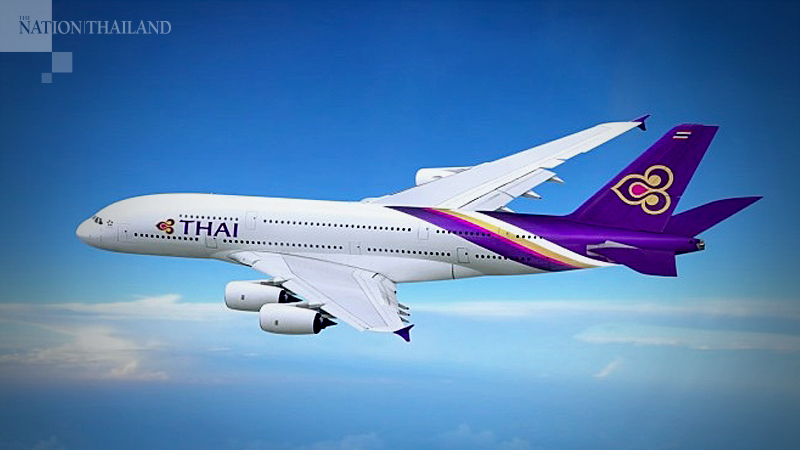
THAI losses Bt12 billion in 2019

Mar 02. 2020
By THE NATION

Thai Airways International (THAI) and its affiliates witnessed a net loss of Bt12.017 billion in 2019, Bt448 million – or 3.9 per cent – higher than the previous year, the airline announced today (March 2). This translates to Bt5.52 loss per share, Bt0.19 higher than the previous year, or 3.6 per cent.

Vice president of finance and accounting Nattaphong Smit-Ampaisal said that in 2019 the company was affected by several negative factors, including a slowdown in global economic expansion, the US-China trade war, natural disasters, the strengthening of the baht – which was the highest in six years – as well as a price war with other airlines.

“Furthermore, the company and its affiliates had to set aside Bt2.689 billion as a reserve fund for employees who wished to retire early,” he said, referring to the State Enterprise Labour Committee’s announcement that requires state enterprises to pay early retirement packages equal to 400 days of wages to employees who had been working more than 20 years, from the previous requirement of 300 days. The regulation came into effect at the start of the third quarter of 2019.

According to Nattaphong, in 2019 THAI and its affiliates earned Bt184.046 billion in revenue, Bt15.454 billion lower than the previous year, or 7.7 per cent.

“The revenue from passenger and cargo transport decreased by 8.6 per cent, or Bt15.767 billion, while the total expenditure stood at Bt196.470 billion, Bt12.088 billion, or 5.8 per cent, lower than last year.”

Nattaphong attributed the drop in expenditure to decreasing fuel cost by 9 per cent, or Bt5.421 billion.

THAI and its affiliates have 103 planes in operation, with an aircraft utilisation rate of 11.9 hours per day, lower than the previous year’s 12 hours per day. The reported cabin occupancy factor in 2019 was 79.19 per cent, higher than the previous year at 77.6 per cent, with 24.51 million passengers, an increase of 0.8 per cent from the previous year.

As of December 31, 2019, THAI and its affiliates possessed total assets of Bt256.665 billion, Bt12.056 billion lower than in 2018, or 4.5 per cent. Total debt in 2019 stood at Bt244.899 billion, Bt3.366 billion lower than the previous year, or 1.4 per cent. Shareholders’ equity was Bt11.766 billion – Bt8.69 billion, or 42.5 per cent, lower than the previous year.

Related story: Temporary salary cut for THAI boss, top execs

TikTok marketers chase billions of views in uncharted terrain #ศาสตร์เกษตรดินปุ๋ย

#ศาสตร์เกษตรดินปุ๋ย : ขอบคุณแหล่งข้อมูล : หนังสือพิมพ์ The Nation

https://www.nationthailand.com/business/30383133?utm_source=category&utm_medium=internal_referral

TikTok marketers chase billions of views in uncharted terrain

Mar 01. 2020
By Bloomberg · Sarah Frier, Kurt Wagner · BUSINESS, TECHNOLOGY, US-GLOBAL-MARKETS

In an October post on TikTok, digital magician and video star Zach King walks up to the counter at Chipotle to receive a burrito bowl with chips. After he pays, he jumps and his clothes change in an instant into astronaut gear. Soon, everything in the store is floating in apparent zero gravity.

Another star, Brittany Broski — known as “kombucha girl” — posted on the video-sharing app around the same time, biting into a Chipotle burrito and then suddenly sporting a mad-scientist wig. The famous pomeranian, @jiffpom, turns into a vampire after touching Chipotle. All of these TikTok videos were tagged #boorito, for a U.S. advertising campaign promoting $4 burritos on Halloween. It’s the most viral campaign Chipotle has ever done, based on one measure: the hashtag has 3.9 billion views on TikTok.

That’s a surprising metric given that TikTok has been downloaded only about 145 million times in the U.S, according to Sensor Tower. The viral social media app, where people post funny videos set to music, won’t disclose what counts as a “view,” so it doesn’t necessarily mean 3.9 billion people saw a #boorito post, or that they were in the market to purchase a burrito. Still, numbers that high are gratifying for marketing executives justifying their experiments on a relatively new social platform, without much other data to go on and few ways to target their messages to a tailored audience.

“The numbers are massive,” said Tressie Lieberman, a vice president of digital marketing at Chipotle Mexican Grill Inc. It’s not the restaurant chain’s only campaign that has crossed the 1 billion threshold on TikTok. “I don’t know that any brand has ever gotten that on YouTube,” she added. The company said Boorito sales were 15% higher than a year earlier.

TikTok, owned by Chinese internet giant ByteDance Inc., built its U.S. presence off the 2017 purchase of a similar app, Musical.ly, which was popular with young teens. After an advertising blitz on Facebook and Snapchat, TikTok soared in the charts to become a sensation among a younger audience for its feel-good content. Now, marketers are starting to experiment. They mention it alongside Snapchat as a way to reach the elusive teen demographic, to build their preference for brands just as they’re achieving independent spending power. According to influencer analysis firm Captiv8, 69% of TikTok users are age 14 to 26.

Still, venturing into TikTok ads can be complicated, and the return-on-investment unproven. One can’t simply run the same ad created for Facebook or YouTube. The format is skits, set to music, that work on a phone held vertically and repeat over and over. Brands can run a campaign to promote a hashtag, like #boorito, which can cost around $150,000; they can pay to take over the homescreen of the app, which can cost $50,000 a day for a guaranteed 5 million views; or can even run a campaign with the ability to buy a product within the app, according to case studies reviewed by Captiv8. TikTok said prices fluctuate based on an advertiser’s goals. Any effort requires careful coordination with both the TikTok sales team and outside “creators” — stars such as King and Broski, the TikTok equivalent of Instagram influencers, who are paid separately.

If a brand is spending enough, they can get an introduction to the creators through the company. Other times advertisers have to find connections on their own or through an agency. Since the success of #boorito, Chipotle pays TikTok stars special attention, sometimes catering food to a Los Angeles mansion known as the Hype House, which is full of skit-makers collaborating on projects.

Any time a new social media platform starts reaching a mass audience, the people who were there first reap the biggest rewards. Charli D’Amelio, whom the New York Times recently called the “reigning queen” of TikTok, started her career there in the summer of 2019 and now has 30.6 million followers. Other previously unknown teens have also seen a dramatic rise.

The same is becoming true for advertisers. Brands can pay to promote a hashtag challenge for more people to see it, in the hopes that TikTok’s users will create videos using the hashtag on their own, thereby increasing its reach. The National Football League saw more than 1 billion views for its #WeReady hashtag ahead of the Super Bowl in early February. Makeup company MAC saw 2.6 billion views for the tag #YouOwnIt.

That enormous reach is possible, in part, because the TikTok sensation in the U.S. is so new that it doesn’t have many advertisers — which means less competition for eyeballs and fewer constraints by the platform to limit or throttle an ad’s visibility.

“This type of virality just does not happen on Instagram or Facebook or YouTube,” said Krishna Subramanian, cofounder of Captiv8. “Getting to those billions of views is something that’s happening frequently. It’s something we haven’t seen on any other platform for quite some time.” The amount the creators make is similar to what Instagram influencers make on that app’s disappearing stories product. The biggest stars — such as Loren Gray, with 39.6 million followers — can garner $175,000 for a single sponsored TikTok video, Subramanian said.

TikTok is new enough that most advertisers are still learning what works on the service. Some have had early success. ELF Cosmetics created an original song for people to use in the background of their own videos, and there are 1.7 million videos on TikTok that use the song. It was so popular that it was even trending on Spotify. The associated hashtag, #eyeslipsface, has 4.5 billion views.

Anish Dalal, chief executive of digital-marketing company Sapphire Apps Media, has developed his own playbook for TikTok. In some cases, he’ll scour the app for new, popular music that users are uploading and use that same audio clip in his own ads. One current option is the ability to target an ad to TikTok users looking for a specific hashtag. Dalal creates a new hashtag for a brand’s campaign, and pays influencers to create dozens of videos using the hashtag. Once that hashtag is big enough to lure in regular users, he starts running ads targeting the hashtag.

The clients we work with “were excited to try something new,” Dalal said. “What we tell brands is, this is essentially Instagram in the early days.”

The first-mover advantage will be short-lived. TikTok is already testing a self-service advertising tool, which will make it possible for any brand to buy ads. Snapchat parent Snap Inc. went through a similar transition in 2017, moving from selling expensive ads with a personal touch to a model where anyone could buy them online. The prices for its ads dropped, but eventually the company started building more advertiser relationships and a more stable business.

To be successful with that strategy, though, TikTok will have to build more targeting options and controls for advertisers, according to Meghan Myszkowski, head of North American social media advertising at the ad agency Essence. Showing an ad to everyone can translate to a larger viewership, but isn’t necessarily efficient. Brands may waste money showing ads to an irrelevant audience, or run the risk of their ad appearing directly before or after a video that it wouldn’t want to be associated with. TikTok lets its advertisers target using basic information like a user’s location and gender; it’s less granular than what is offered by TikTok’s larger rivals, Instagram and YouTube, where ads can be targeted to specific interests and purchasing behavior.

But in order to improve TikTok’s targeting, the app will have to gather more detailed information about its users’ behavior — something that may prove tricky, as the U.S. government scrutinizes the app’s Chinese ownership. American lawmakers have warned the app could be a security threat; TikTok has repeatedly said it’s not influenced by the Chinese government and rejects the idea that U.S. user data is vulnerable. The Committee on Foreign Investment in the U.S., better known as CFIUS, is reviewing ByteDance’s purchase of the business that became TikTok, Bloomberg News has reported.

Essence ran some TikTok ads in the first half of 2019, but Myszkowski said the agency has pulled back until TikTok builds more advertiser controls.

“With risk can come great return,” Myszkowski added. “If you’re willing to take the risk.”

Spike in coronavirus cases disrupts Samsung, LG, Hyundai plants #ศาสตร์เกษตรดินปุ๋ย

#ศาสตร์เกษตรดินปุ๋ย : ขอบคุณแหล่งข้อมูล : หนังสือพิมพ์ The Nation

https://www.nationthailand.com/business/30383113?utm_source=category&utm_medium=internal_referral

Spike in coronavirus cases disrupts Samsung, LG, Hyundai plants

Mar 01. 2020
Samsung Electronics’ plant in Gumi (Samsung Electronics)

Samsung Electronics’ plant in Gumi (Samsung Electronics)
By The Korea Herald/ANN

The novel coronavirus is disrupting the plants of Korea’s major conglomerates, as new confirmed cases reported one after another involve their employees.

On Sunday, Samsung Electronics confirmed its third case of COVID-19 infection, of a worker at its smartphone plant in Gumi, North Gyeongsang Province.

The Gumi site produces next-generation smartphones such as the Galaxy Z Flip and Galaxy Fold. The assembly line where the employee worked is temporarily closed and expected to be fully functional early next week.

On Feb. 22, a facility in Gumi was shut down for about three days as an employee of the smartphone division was confirmed with COVID-19. Six days later, one more employee of the firm’s network business division at the Gumi plant was also confirmed.

LG Display shut down its module plant Saturday for three days after an employee of a bank on the campus of the Gumi plant was confirmed to be infected. The plant assembles small and medium-sized liquid crystal display and organic light-emitting diode panels and components.

The Gumi industrial complex, home to leading Korean companies, including Samsung and LG, is nearby Daegu, in an area that has more than 70 percent of the confirmed COVID-19 cases in Korea.

Hyundai Motor’s Ulsan plant also found a confirmed case of COVID-19 infection Friday. The automaker halted operations of the facility and identified the workplace, route and points of contact of the confirmed patient. The plant produces large sport utility vehicles such as the Palisade and Genesis GV80.

Korean carmakers have already been slowing down their factory lines and suspending production lines for a few days due to the disruption of parts supplies from China last month.

Last week, Lotte Foods, SK Telecom and LS Group closed their respective headquarters in Seoul after employees there were found to have been infected.

Alongside businesses here, Korean companies are having difficulties in doing business on the global market, as foreign countries have been restricting Koreans from traveling to their countries. As of Sunday, the number of countries that limit Korean entry increased to 71 countries, including Vietnam, where more than 3,000 Korean firms have a business presence.

Global companies are also restricting their employees from traveling to Korea in response to the spread of the new COVID-19 infection. Google has restricted its employees from traveling to Korea and Japan. Uber has limited its employees from traveling to Korea, Iran, Italy and China. Amazon went further, blocking its employees from moving even within the US.

By Shin Ji-hye (shinjh@heraldcorp.com)

Business sentiment plunges to lowest level in a decade #ศาสตร์เกษตรดินปุ๋ย

#ศาสตร์เกษตรดินปุ๋ย : ขอบคุณแหล่งข้อมูล : หนังสือพิมพ์ The Nation

https://www.nationthailand.com/business/30383172?utm_source=category&utm_medium=internal_referral

Business sentiment plunges to lowest level in a decade

Mar 02. 2020
By The Nation

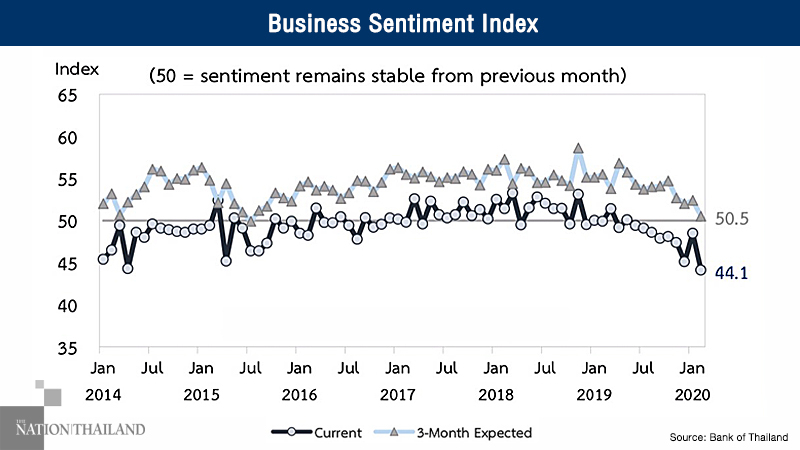
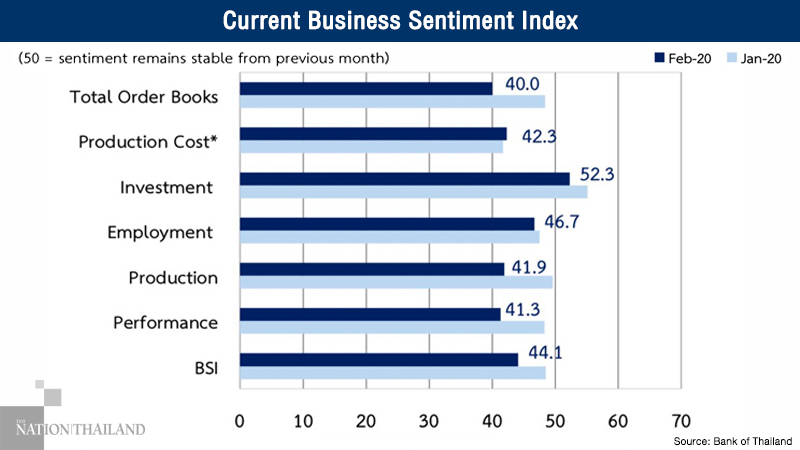
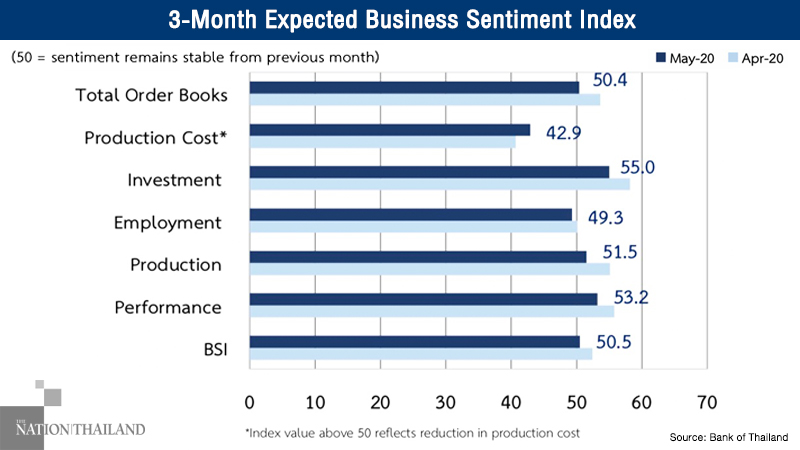
The Business Sentiment Index (BSI) significantly declined in February from 48.5 in the previous month to 44.1, the lowest level since the severe floods in 2011, the Bank of Thailand reported today (March 2).

The deteriorating confidence was common among respondents in both manufacturing and non- manufacturing sectors, as well as in almost all sub-indices, especially order books, production and performance, while the three-month expected BSI decreased from the previous month to 50.5 due mainly to concern over the Covid-19 coronavirus.

The central bank said most respondents in the manufacturing sector were much less confident in their order books, production and performance, especially those in electronics and electrical appliance sectors. Their production sub-index dipped due to an insufficient inventory level of raw materials, which were primarily sourced from China. As a result, their performance sub-index also plunged.

The continuous deterioration of order books and performance sentiment resulted in an increasing number of respondents seeing worsening liquidity conditions, reflected in the liquidity sentiment index which decreased from last month and remained below the 50 threshold for five consecutive months. Nevertheless, most respondents, either from small, medium or large businesses, still received sufficient credit from financial institutions.

Meanwhile, weaker confidence in the non-manufacturing sector was mainly driven by tourism-related sectors. Both transportation and hotel and restaurant sectors showed a pessimistic view of both foreign and domestic bookings because of the Covid-19 situation. Consequently, the service volume sub-index also dropped sharply.

The transportation sector was highly concerned about the depressed state of expected bookings and the electrical appliance sectors expected foreign orders to drop. In addition, the expected automotive sector production sub-index plunged as raw material shortage was likely to get more severe if the virus situation did not improve, the central bank added.

Domestic factors such as weak purchasing power and intense competition were still among the top business constraints, which made it more difficult to adjust prices. As a result, the expected inflation in the next 12 months would be stable at 1.6 per cent.

Last week, central bank senior director Don Nakornthab warned that economic growth might experience its slowest pace this year, or could grow below 1 per cent from 2.4 per cent last year. He cited the impacts from Covid-19, the annual budget delay and severe drought. He was also concerned about labour markets as large numbers of people working in tourism-related industries were hardest hit by the decline in the number of tourists, who were concerned about the coronarvirus spreading globally.

The government has pledged to launch additional stimulus packages to shore up the economy, but the stock index has also plummeted, moving closer to its lowest level in five years.

Food business, franchising growing in Thailand #ศาสตร์เกษตรดินปุ๋ย

#ศาสตร์เกษตรดินปุ๋ย : ขอบคุณแหล่งข้อมูล : หนังสือพิมพ์ The Nation

https://www.nationthailand.com/business/30383171?utm_source=category&utm_medium=internal_referral

Food business, franchising growing in Thailand

Mar 02. 2020
By The Nation

With the Covid-19 outbreak dealing a heavy blow to the food shop and restaurant segment, SMEs and Thai entrepreneurs must create new business models to expand their client base, said Boonprasert Pupan, president of Franchise and Licence Association at the SME D Bank seminar titled ‘Deep analysis of Food business in 2020’.

In addition to improving efficiency of the food delivery service, better storefront management will help boost turnover, he said

“According to last year’s data, the delivery business was worth a total of Bt35 billion. It is growing rapidly and the popularity of food- ordering applications has led to market expansion of operators.

Boonprasert Pupan

Boonprasert Pupan

” It creates opportunities and challenges that require entrepreneurs to adjust their business plans. It also encourages the consolidation of operators within the business chain while franchise purchasing is another option favoured by SMEs, ” Boonprasert said.

He attributed the rapid rise of the franchise business to its new approach and drive for fast success by the operators. The economic value of franchise businesses in Thailand reached Bt300 billion last year with an average growth rate of 10 per cent per year. About 15,000 – 20,000 are interested in entering the franchise business. Growth in market and players will continue for both Thai and foreign franchises as competition intensifies.

The franchise business in Thailand is also popular in the world market, such as massaman curry, tom yum goong, spa and, especially Thai boxing. Foreign investors from over 130 countries have applied for licences but ” these are just business, not branding, so imitations would increase. “If Thai boxing can be a franchise business, it will be able to expand internationally save the cost of opening a new branch,” he said.

Among foreign interest in Thai franchising, food accounts for 60-70 per cent, education 20 per cent. Others are Thai spa and massages, car care business, Muay Thai, and waste recycling etc.

The franchise business in Thailand comprises 10 main categories: food, beverage, snack, education, Thai spa and massage, car care, retail, real estate, service, and logistics.

Bubble milk tea has attracted much interest recently.

Krabi aims to woo more tourists from Europe as visitor arrivals dwindle #ศาสตร์เกษตรดินปุ๋ย

#ศาสตร์เกษตรดินปุ๋ย : ขอบคุณแหล่งข้อมูล : หนังสือพิมพ์ The Nation

https://www.nationthailand.com/business/30383162?utm_source=category&utm_medium=internal_referral

Krabi aims to woo more tourists from Europe as visitor arrivals dwindle

Mar 02. 2020
By THE NATION
The Tourism Council of Krabi and related parties are discussing a plan to woo tourists from six European markets after a sharp decline in visitors to the island amid the Covid-19 outbreak.

Council president Ekawit Pinyotamanotai said that among the six targeted countries are Albania, Montenegro, Romania, and Serbia.

According to him, tour agencies in those countries have said that most tourists there are not much worried about the virus, but actually concerned about the shortage of flights to Thailand from March.

He added that the hotel sector in Krabi has been hit by the impact from the outbreak.

Krabi has enforced stringent measures to tackle the spread of the virus, screening travellers at key locations including piers.

Baht climbs out of nine-month low against US dollar #ศาสตร์เกษตรดินปุ๋ย

#ศาสตร์เกษตรดินปุ๋ย : ขอบคุณแหล่งข้อมูล : หนังสือพิมพ์ The Nation

https://www.nationthailand.com/business/30383152?utm_source=category&utm_medium=internal_referral

Baht climbs out of nine-month low against US dollar

Mar 02. 2020
By The Nation

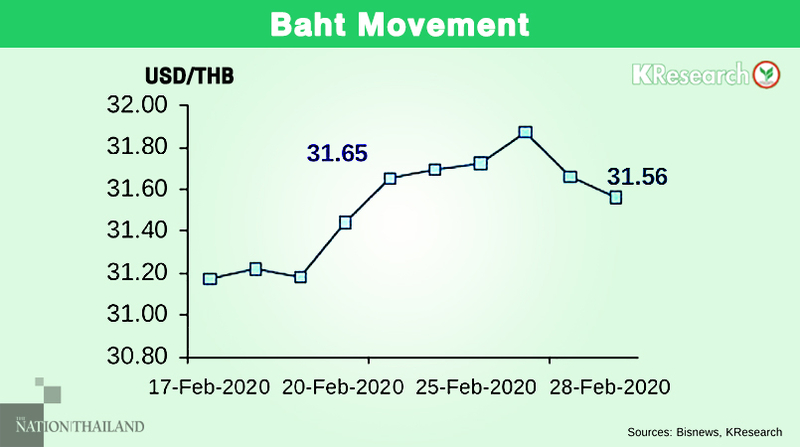
The baht rebounded from a nine-month low, hovering at around Bt31.33 per to the US dollar in Monday (March 2) morning trade

Last week ,Kasikorn Research Centre said the baht had rebounded later in the week, having recouped losses during early to mid-week, after the Thai currency weakened in line with other regional currencies amid growing concerns about the Covid-19 outbreak outside China.

The baht also fell on net foreign selling orders for Thai stocks and bonds. The baht’s rebound was partly due to position adjustments after it hit a nine-month low of Bt31.93/dollar during the week. On Friday (February 28), the baht closed at Bt31.56/USD, versus Bt31.65/USD on February 21.

During the week of March 2-6, KBank expects the baht to move within a range of Bt31.40-31.90/USD.

Key factors to be monitored closely are the Covid-19 situation, the US economic data to be released during the week including February non-farm payrolls and ADP Employment Report, January Factory Orders and Construction Spending, plus the US Fed’s Beige Book. In addition, other factors that warrant close monitoring include Thailand’s February consumer price index, the meetings of the Malaysian and Australian monetary policy committees, plus February manufacturing and services purchase managers index of the US, China, Japan and the euro zone, added Kasikorn Research Centre.

Gig workers face the spread of the new coronavirus with no safety net #ศาสตร์เกษตรดินปุ๋ย

#ศาสตร์เกษตรดินปุ๋ย : ขอบคุณแหล่งข้อมูล : หนังสือพิมพ์ The Nation

https://www.nationthailand.com/business/30383116?utm_source=category&utm_medium=internal_referral

Gig workers face the spread of the new coronavirus with no safety net

Mar 01. 2020
File Photo/Syndication Washington Post

File Photo/Syndication Washington Post
By The Washington Post · Nitasha Tiku · NATIONAL, BUSINESS, HEALTH 

SAN FRANCISCO – Some workers here who provide on-demand rides and delivery services, but are independent contractors without many protections, are bracing for the spread of the novel coronavirus.

Drivers have been scrubbing down their cars “inch by inch” between rides at local airport parking lots, according Edan Alva, who drives full-time for Lyft in the Bay Area.

Alva said the company has not communicated with drivers yet about the novel coronavirus, despite the risk of infection. “No support, no advice, no guidance regarding what we do if we suspect any indicators of the problem,” said Alva, who added that he has been spraying his car with Lysol twice a day.

Lyft spokeswoman Alexandra LaManna said there is no indication of a unique risk to Lyft drivers and that the company is monitoring the situation.

Meanwhile, Uber sent an in-app message to U.S. drivers Friday with guidance on how to protect themselves and others, guidance that included standard advice from health officials, such as staying home if they feel sick and washing their hands frequently. Uber also urged drivers to clean and disinfect frequently touched surfaces in their vehicles.

As coronavirus spreads globally, prompting some companies to instruct employees to stop traveling or to work remotely, one of the most vulnerable groups is likely to be tens of thousands of gig workers like Alva.

“With the gig economy specifically, it’s full of low-income, independent contractors who don’t have very good health insurance,” said Alex Rosenblat, the author of “Uberland: How Algorithms Are Rewriting the Rules of Work” and research lead for the nonprofit organization Data & Society. “They’re not going to have better protections than anyone else, but they may have higher risk.”

App-using companies such as Uber, Lyft, the grocery delivery service Instacart and the food delivery service DoorDash have classified the workers who deliver meals or transport passengers as independent contractors. This classification has saved the companies the cost of providing health insurance and other benefits to the people who make their service possible. Independent contractors also do not have the right to unionize.

But as cases of the new coronavirus appear, gig workers find themselves with few health protections but with a potentially higher risk of coming into contact with infected people.

In China, food delivery drivers became heroes to residents in lockdown during the outbreak, the New York Times reported. Authorities in Wuhan eventually instituted “contactless delivery” to reduce health risks.

Coronavirus fears have prompted some U.S. drivers to reject rides at airports with Asian passengers, according to Bloomberg News. At the same time, drivers are also worried about missing income if they stop driving or cancel rides.

The disease could potentially spread more quickly if sick people go to work because they can’t afford to stay home. And it’s not just gig workers. Only 46 percent of service workers received sick-leave benefits in 2017, according to the U.S. Bureau of Labor Statistics, compared with 93 percent of workers in management, business and finance.

The health risks posed by the new coronavirus could possibly prompt policy changes as companies think about liability issues if a driver or passenger is infected, Rosenblat said. For instance, drivers have no tool to report potentially infected passengers, she said, and it is unclear whether the algorithms that match drivers and passengers are factoring in health risks.

Although Lyft cites a lack of unique risk to its drivers, “in accordance with the Centers for Disease Control’s guidance to prepare for further spread of the virus, we have established an internal task force to ensure we are prepared to take action if needed,” Lyft’s LaManna said.

Uber said it always works to help ensure the safety of everyone using its platform. “We have formed a dedicated global team of Uber operations, security and safety executives, guided by the advice of a consulting public health expert, to respond as needed in each market where we operate around the world,” said Andrew Hasbun, Uber’s head of safety communications, in a statement. “We remain in close contact with local public health organizations and will continue to follow their recommendations.”

Instacart spokeswoman Natalia Montalvo said in a statement that the company is working with local and national authorities to monitor the situation. “We’re adhering to recommendations from public health officials to ensure we’re operating safely with minimal disruption to our service, while also taking the appropriate precautionary measures to keep teams, shoppers and customers safe,” Montalvo said.

DoorDash did not immediately respond to a request for comment.

The independent-contractor classification is being challenged in California. This week, a judge in San Diego issued the first court decision under California’s new AB5 law, ruling that Instacart is likely to have misclassified grocery shoppers as contractors when they should be employees.

On Saturday, Silicon Valley Rising, a labor advocacy campaign led by the community organizing group Working Partnerships USA, urged tech companies to include contractors and gig workers in their response plans. The campaign also asked companies to provide protective equipment, healthcare coverage, sick leave, and to ensure that workers who take sick leave are not stigmatized when they return.

“Cafeteria workers, janitors, security officers, shuttle drivers, and people working in the gig economy frequently interact with large numbers of people in the course of their jobs,” Silicon Valley Rising wrote in a statement posted on Twitter. “It is critical that companies partner with workers and unions to mitigate risks and protect public health.”

Menlo Park resident Vanessa Bain, a gig worker for the grocery-delivery app Instacart, says concerns around coronavirus are part of a larger conversation about why misclassifying employees as contractors can be harmful. Not having health insurance for workers who encounter hundreds of people in the course of their regular work could be a public health risk, she says.

“We deliver to people’s homes when they’re sick all the time,” says Bain, who has also operated a grassroots campaign to win Instacart workers more rights. She is covered by MediCal, a low-cost state health insurance, but protections are limited. So Bain no longer takes orders that contain supplies like Kleenex and Sudafed.

“I can’t afford to get sick,” she says.

Lyft drivers Alva and Carlos Ramos are also labor organizers through Gig Workers Rising, a group that partners with the Teamsters union but does not take funding from the union. Both drivers say the spread of coronavirus is a real-world example of why drivers need protections such as sick days, health insurance, disability, death benefits and minimum wage.

“Right now, it’s kind of a balancing act between putting ourselves at risk and being able to keep the lights on,” Ramos said.

Alva said that when he had the flu in January, he did not go to the doctor because every visit costs him $100 until he hits his high deductible, and that amount of money is hard to come by since he lost his 10-year job as a contractor for PayPal working on global security operations, which involved analyzing risks to the company such as extreme weather patterns, political instability and fraud.

To make ends meet, Alva had to work while he was sick. He suspects that other drivers are in the same position. “If we catch it, other people are likely to catch it from us because we are not likely to go to the doctor,” he said.

Kasikornbank sells stake in Ajinomoto for Bt5.9 billion #ศาสตร์เกษตรดินปุ๋ย

#ศาสตร์เกษตรดินปุ๋ย : ขอบคุณแหล่งข้อมูล : หนังสือพิมพ์ The Nation

https://www.nationthailand.com/business/30383093?utm_source=category&utm_medium=internal_referral

Kasikornbank sells stake in Ajinomoto for Bt5.9 billion

Feb 29. 2020
By THE NATION

Kasikornbank has sold its entire stake in Ajinomoto Co (Thailand), or AJT, to the latter’s parent company, Ajinomoto Co Inc (Ajico), according to its filing to the Stock Exchange of Thailand on Friday (February 28).

The total transaction value is Bt5.972 billion.

The bank entered into the transaction with Ajico on Friday. The shares represent 5 per cent of AJT’s total outstanding shares.

The shares are expected to be transferred within March.